
Enron North America ENA Proposed Base Gas Transaction
Enron North America ENA Proposed Base Gas Transaction Structures June 2001 CONFIDENTIAL 1
Contents • Deliverables • Market Status • ENA Proposal • Gas in Storage Analysis • Monetization • Commercial Constraints – Gas Sale – Monetization • Structure Review CONFIDENTIAL 2

Deliverables 1. After analyzing the example provided in the presentation, render an opinion on whether the structure therein is feasible from a regulatory stand point. 2. Which elements/parts of the structure are critical for the structure as a whole to work? 3. From a regulatory perspective, how can our structure be improved while keeping within the accounting and financial constraints detailed in the presentation? CONFIDENTIAL 3
Market Status – Required pipeline infrastructure will be enormous over next 20 years • EIA forecasts 20 Bcf/day will be added by 20201 • CERA forecasts 16 -22 Bcf/day will be added by 20152 • VP Cheney stated 38, 000 miles of natural gas pipeline must be added in US 3 – Based on our estimates, the costs of these projects will run up to $30 billion – Traditional capital markets financing may be constrained by volume of investment needs CONFIDENTIAL 1. EIA, Natural Gas Monthly, October 2000. 2. CERA, Toward New Frontiers: The Future of Gas Supply in North America, Table 5. 3. V. P. Cheney, D. , National Energy Plan, May 2001. Overview p. ix 4
ENA Proposal Enhance value of existing assets and provide financing for facility expansion through base gas backed off-balance sheet financing. • ENA has identified over 1. 3 trillion cubic feet of base gas in storage facilities at book values below $1. 00/MMBtu • Current gas prices are hovering in a range of $3. 50 - $4. 00/MMBtu • The value of this price differential can be reinvested in other investments or infrastructure • The ENA financing product is structured to achieve off-balance sheet status for the client ENA is seeking regulatory advice to overcome the regulatory hurdles associated with this transaction structure for assets within FERC jurisdiction. CONFIDENTIAL 5
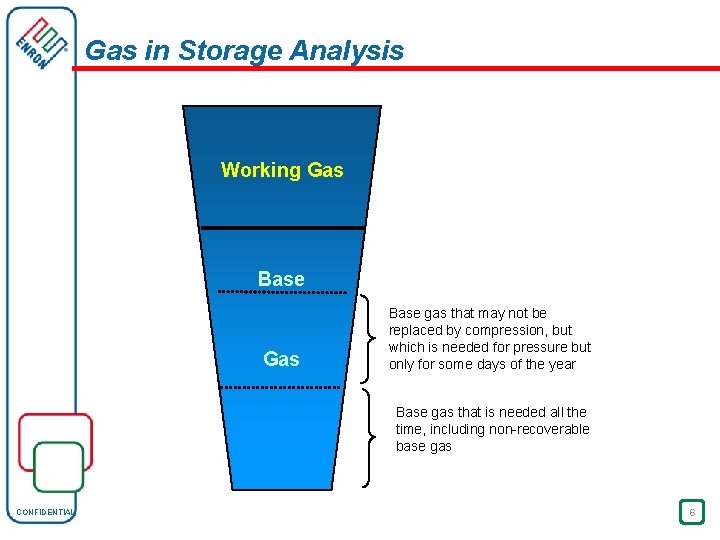
Gas in Storage Analysis Working Gas Base gas that may not be replaced by compression, but which is needed for pressure but only for some days of the year Base gas that is needed all the time, including non-recoverable base gas CONFIDENTIAL 6
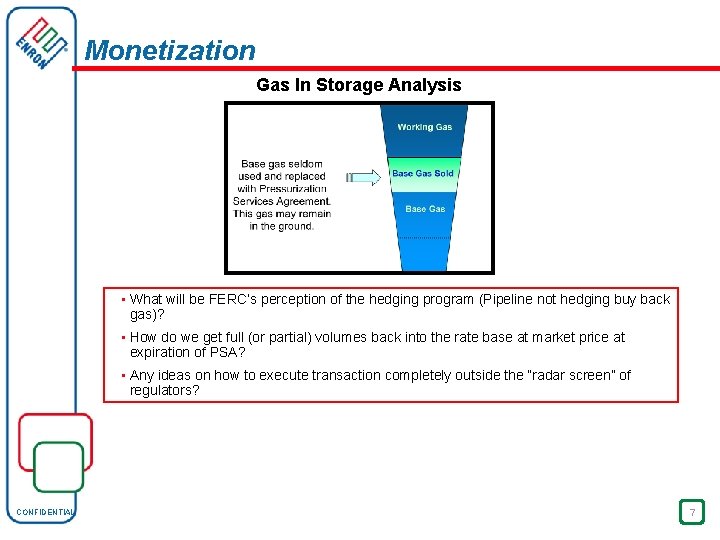
Monetization Gas In Storage Analysis • What will be FERC’s perception of the hedging program (Pipeline not hedging buy back gas)? • How do we get full (or partial) volumes back into the rate base at market price at expiration of PSA? • Any ideas on how to execute transaction completely outside the “radar screen” of regulators? CONFIDENTIAL 7
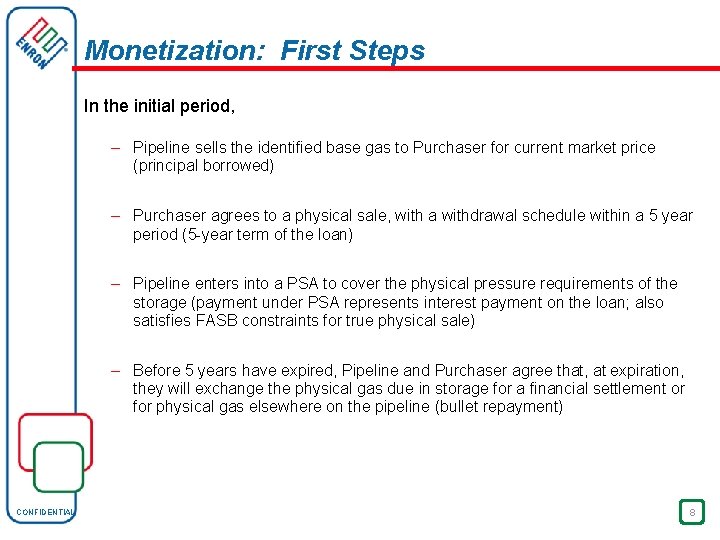
Monetization: First Steps In the initial period, – Pipeline sells the identified base gas to Purchaser for current market price (principal borrowed) – Purchaser agrees to a physical sale, with a withdrawal schedule within a 5 year period (5 -year term of the loan) – Pipeline enters into a PSA to cover the physical pressure requirements of the storage (payment under PSA represents interest payment on the loan; also satisfies FASB constraints for true physical sale) – Before 5 years have expired, Pipeline and Purchaser agree that, at expiration, they will exchange the physical gas due in storage for a financial settlement or for physical gas elsewhere on the pipeline (bullet repayment) CONFIDENTIAL 8
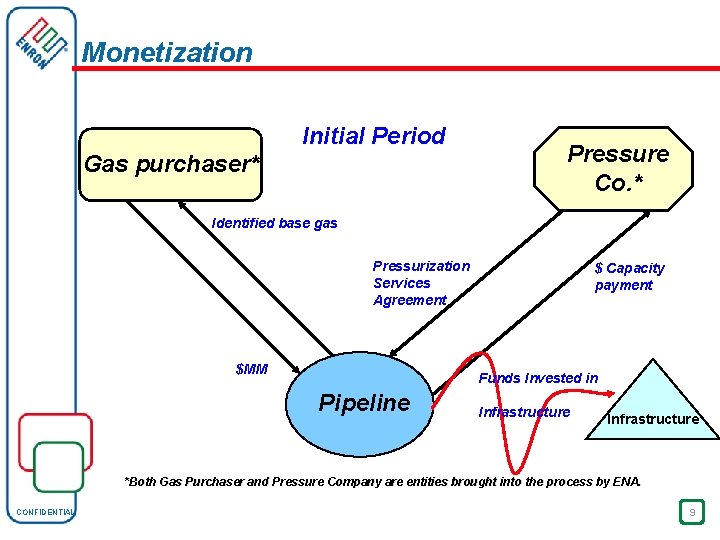
Monetization Initial Period Gas purchaser* Pressure Co. * Identified base gas Pressurization Services Agreement $MM $ Capacity payment Funds Invested in Pipeline Infrastructure *Both Gas Purchaser and Pressure Company are entities brought into the process by ENA. CONFIDENTIAL 9
Pressurization Services Agreement* The Pressurization Services Agreement (PSA) replaces the functionality of the base gas by providing pressure in place of the monetized gas: • Under the PSA, gas bought from the pipeline is kept in the storage facility by the Purchaser – Pressure fee paid by Pipeline represents interest on the loan – Gas must be withdrawn the gas at the end of the PSA; however, an exchange agreement may be established in some period after the initial sale has been concluded. This agreement would allow the gas to remain in the storage facility and be replaced by a cash or physical settlement • The PSA and the ensuing exchange agreement enable the Pipeline to keep the structure financial * Because each transaction is unique, there is no guarantee that meeting these conditions will ensure successful accounting treatment; these points are only a guideline CONFIDENTIAL 10
Monetization: Final Steps At the end of the loan period, Pipeline faces several alternatives: • Refinance through a bank loan - gas is returned to the balance sheet at a higher cost relative to the book value of the sold gas • Renew the PSA (reflecting current market conditions: interest rate, gas curve) • Repayment through Pipeline equity funds Key Value Drivers – repay financing at reduced principal through: • Risk management tools to repurchase gas at lower price • Physical enhancements that reduce amount of gas needed • Base gas placed on rate base at higher price CONFIDENTIAL 11
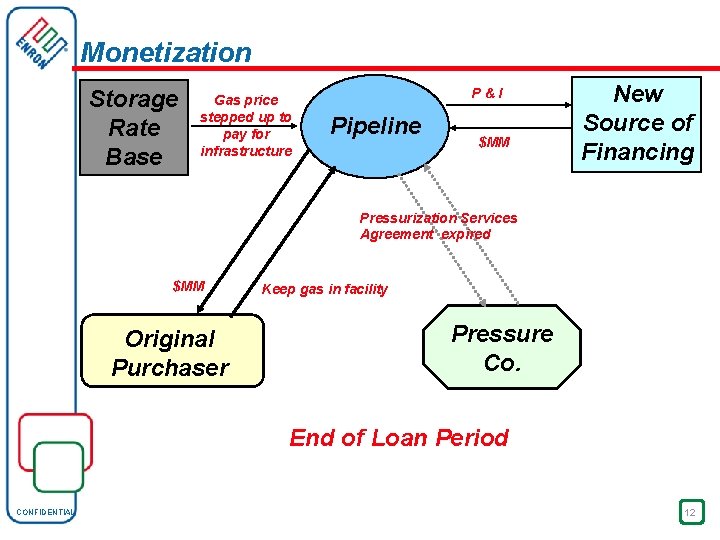
Monetization Storage Rate Base Gas price stepped up to pay for infrastructure P&I Pipeline $MM New Source of Financing Pressurization Services Agreement expired $MM Original Purchaser Keep gas in facility Pressure Co. End of Loan Period CONFIDENTIAL 12
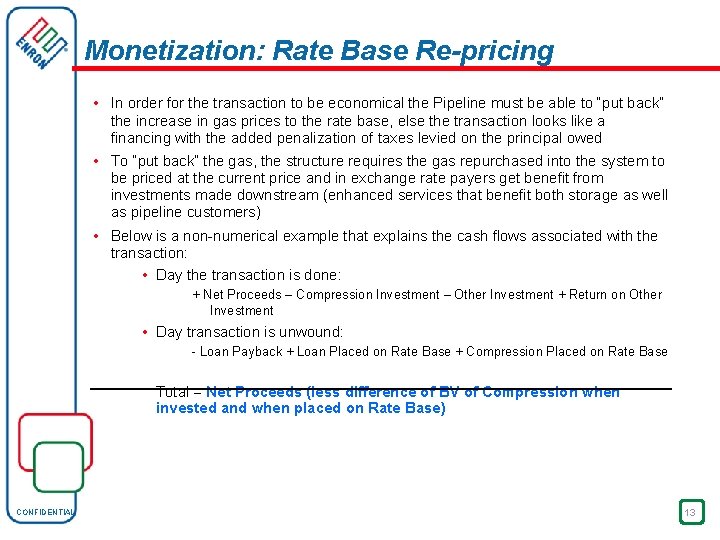
Monetization: Rate Base Re-pricing • In order for the transaction to be economical the Pipeline must be able to “put back” the increase in gas prices to the rate base, else the transaction looks like a financing with the added penalization of taxes levied on the principal owed • To “put back” the gas, the structure requires the gas repurchased into the system to be priced at the current price and in exchange rate payers get benefit from investments made downstream (enhanced services that benefit both storage as well as pipeline customers) • Below is a non-numerical example that explains the cash flows associated with the transaction: • Day the transaction is done: + Net Proceeds – Compression Investment – Other Investment + Return on Other Investment • Day transaction is unwound: - Loan Payback + Loan Placed on Rate Base + Compression Placed on Rate Base Total = Net Proceeds (less difference of BV of Compression when invested and when placed on Rate Base) CONFIDENTIAL 13
Constraints The structure must reflect the following limitations: • Commercial constraints – The ENA monetization must achieve off balance sheet treatment and be differentiated from FASB sale/leaseback structure • Regulatory constraints – Clients have shown keen interest in this monetization concept. Their primary concern relates to the regulatory risks associated with this structure – Key Issues: • Making sure that the Pipeline can keep the cash flows and earnings from the sale • Identify under what circumstances the base gas can be reintroduced into rate base CONFIDENTIAL 14
- Slides: 14