
Enriching primary student teachers conceptions about science teaching
Enriching primary student teachers’ conceptions about science teaching: Towards dialogic inquiry-based learning Ilkka Ratinen, Sami Lehesvuori, Otto Kulhomäki, Jousia Lappi and Jouni Viiri
Outline S-TEAM in University of Jyväskylä Dialogic inquiry based science teaching Research questions Methods Results Discussion Literature
S-TEAM in Jyväskylä Developing science education course 140 students, 28 of them focused on dialogic inquiry based teaching of global warming Six students and their science thinking was more thoroughly examined Focus on S-TEAM project is to plan, implement and evaluate science education course In order to improve our primary student teachers’ abilities to use inquiry teaching we redesigned our science education course
Study project The core of the course is a study project which the students prepare in groups. The project includes: the content analysis, finding out pupils’ ideas about the topic, finding, selecting or creating the most appropriate presentations and teaching strategies and making a plan for a teaching-learning sequence of several lessons.
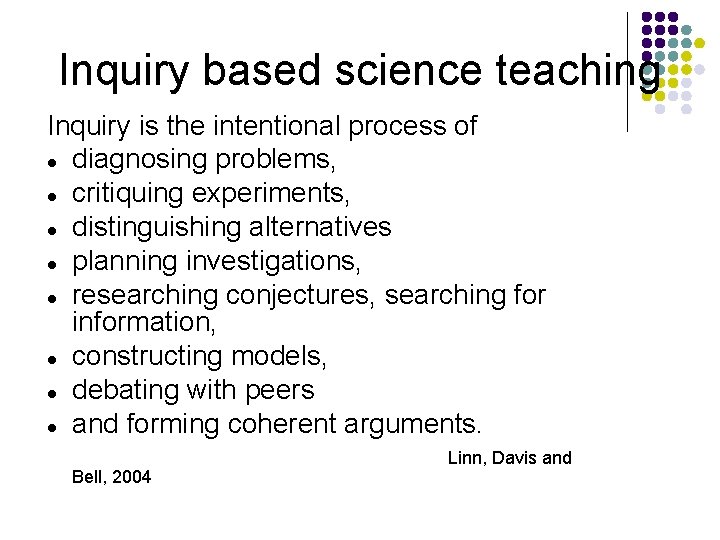
Inquiry based science teaching Inquiry is the intentional process of diagnosing problems, critiquing experiments, distinguishing alternatives planning investigations, researching conjectures, searching for information, constructing models, debating with peers and forming coherent arguments. Bell, 2004 Linn, Davis and
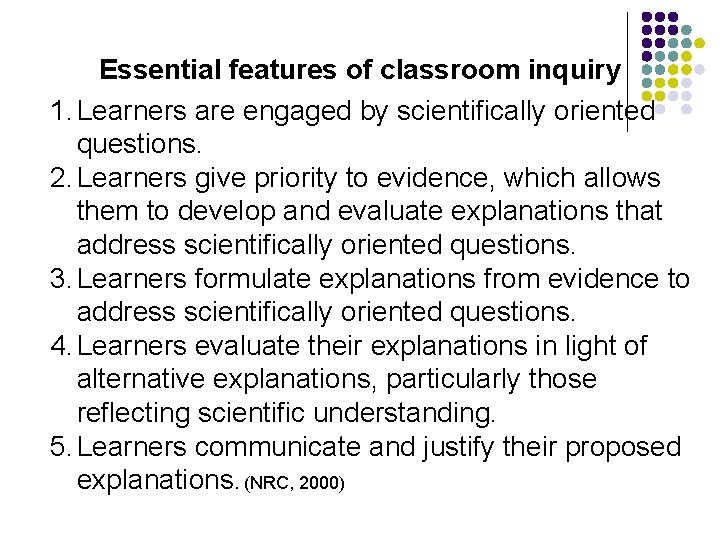
Essential features of classroom inquiry 1. Learners are engaged by scientifically oriented questions. 2. Learners give priority to evidence, which allows them to develop and evaluate explanations that address scientifically oriented questions. 3. Learners formulate explanations from evidence to address scientifically oriented questions. 4. Learners evaluate their explanations in light of alternative explanations, particularly those reflecting scientific understanding. 5. Learners communicate and justify their proposed explanations. (NRC, 2000)
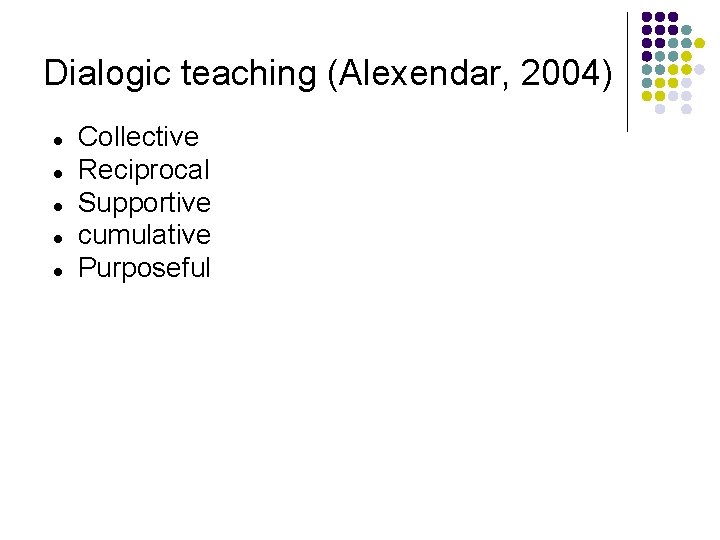
Dialogic teaching (Alexendar, 2004) Collective Reciprocal Supportive cumulative Purposeful
Communicative approaches (Mortimer & Scott, 2003)
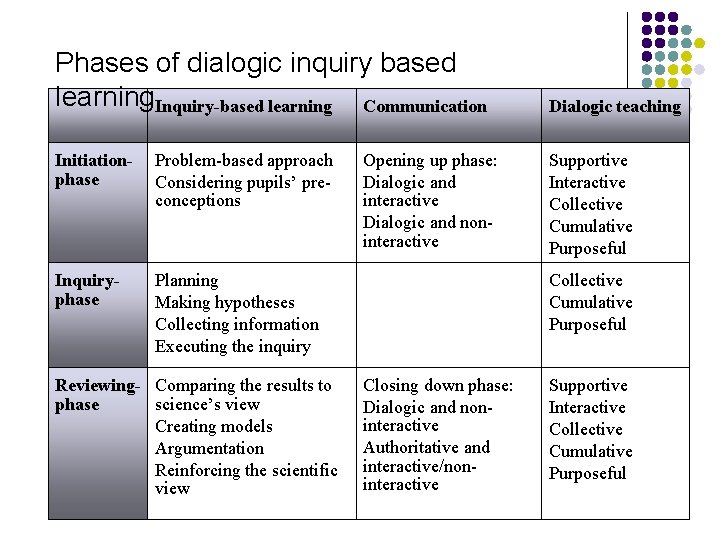
Phases of dialogic inquiry based learning. Inquiry-based learning Communication Initiationphase Problem-based approach Considering pupils’ preconceptions Inquiryphase Planning Making hypotheses Collecting information Executing the inquiry Reviewing- Comparing the results to phase science’s view Creating models Argumentation Reinforcing the scientific view Opening up phase: Dialogic and interactive Dialogic and noninteractive Dialogic teaching Supportive Interactive Collective Cumulative Purposeful Closing down phase: Dialogic and noninteractive Authoritative and interactive/noninteractive Supportive Interactive Collective Cumulative Purposeful
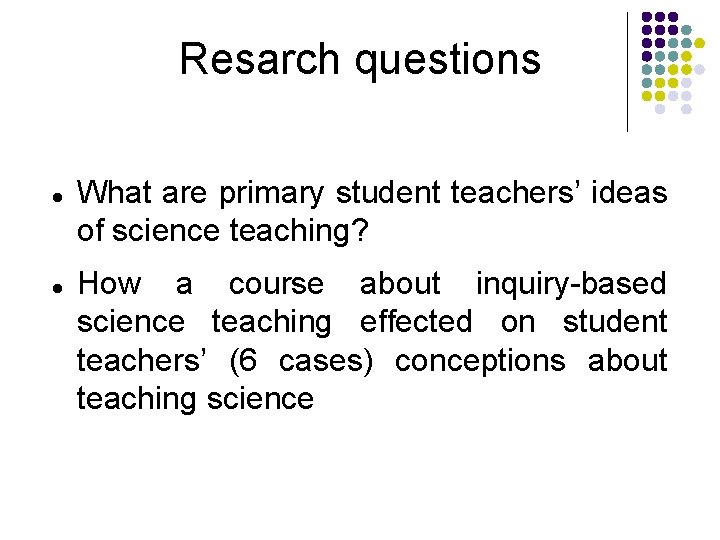
Resarch questions What are primary student teachers’ ideas of science teaching? How a course about inquiry-based science teaching effected on student teachers’ (6 cases) conceptions about teaching science
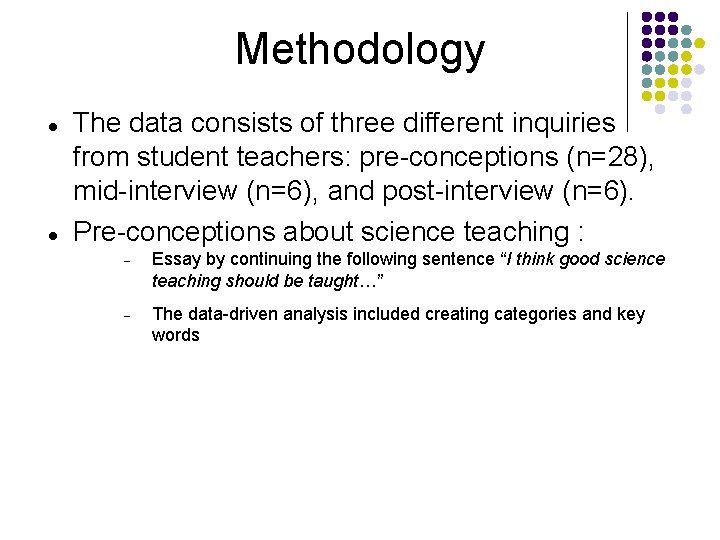
Methodology The data consists of three different inquiries from student teachers: pre-conceptions (n=28), mid-interview (n=6), and post-interview (n=6). Pre-conceptions about science teaching : Essay by continuing the following sentence “I think good science teaching should be taught…” The data-driven analysis included creating categories and key words
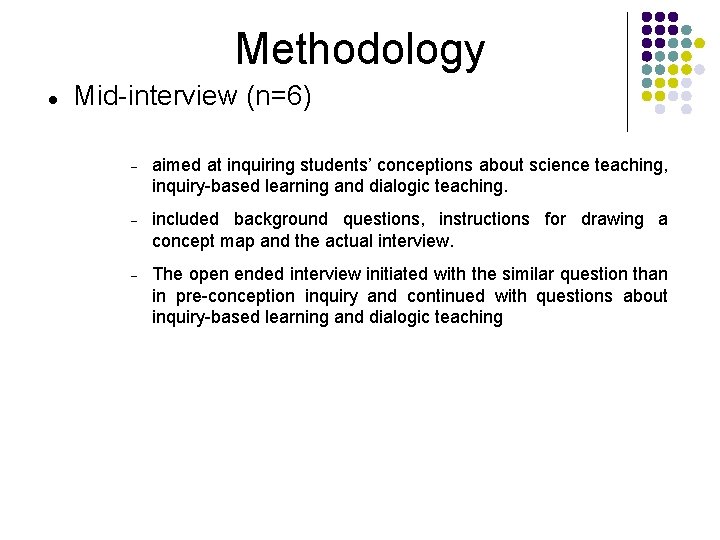
Methodology Mid-interview (n=6) aimed at inquiring students’ conceptions about science teaching, inquiry-based learning and dialogic teaching. included background questions, instructions for drawing a concept map and the actual interview. The open ended interview initiated with the similar question than in pre-conception inquiry and continued with questions about inquiry-based learning and dialogic teaching
Methodology Post-interview (n=6). semi-constructed individual interviews inquired students’ conceptions about dialogic inquiry-based learning and their willingness to use it in service
Methodology Categories we made included concepts of communicative approach and concepts related to inquiry-based learning (e. g. pre-conceptions of pupils, problem-based approach, making hypotheses). After categorisation the data was interpreted based on the exemplary model of dialogic inquiry-based learning and used in creation of learning profiles for six cases.
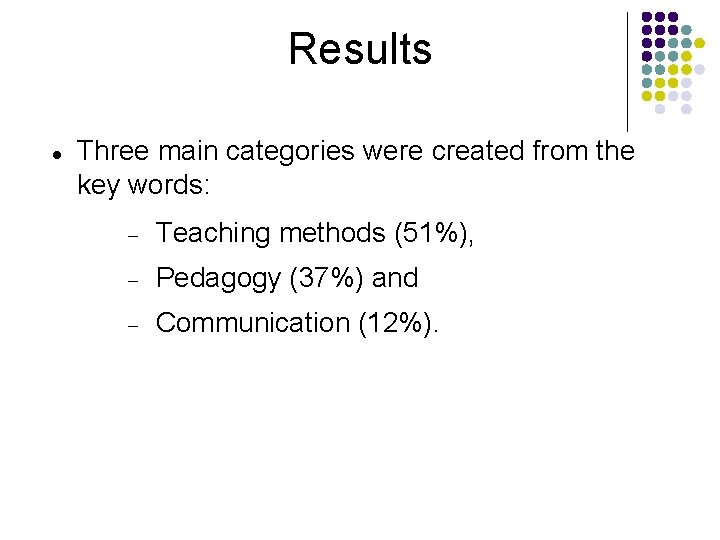
Results Three main categories were created from the key words: Teaching methods (51%), Pedagogy (37%) and Communication (12%).
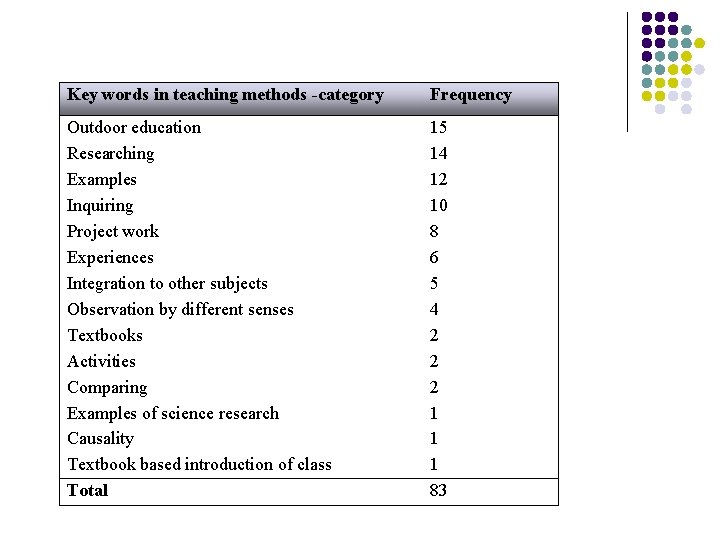
Key words in teaching methods -category Frequency Outdoor education Researching Examples Inquiring Project work Experiences Integration to other subjects Observation by different senses Textbooks Activities Comparing Examples of science research Causality Textbook based introduction of class Total 15 14 12 10 8 6 5 4 2 2 2 1 1 1 83
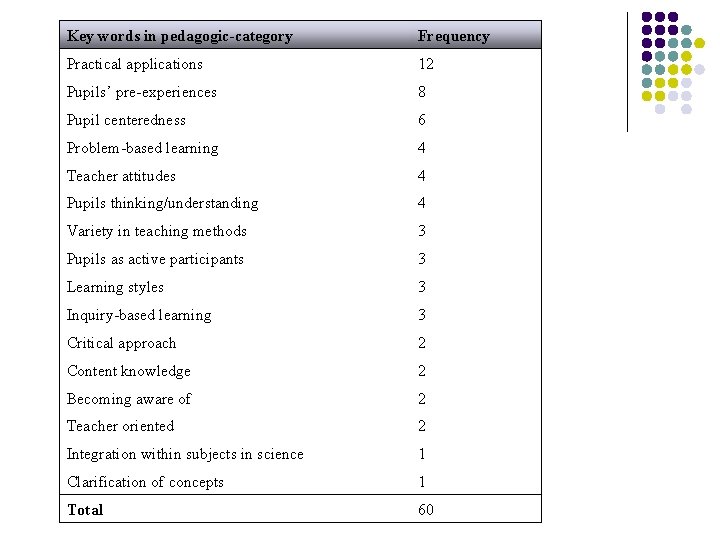
Key words in pedagogic-category Frequency Practical applications 12 Pupils’ pre-experiences 8 Pupil centeredness 6 Problem-based learning 4 Teacher attitudes 4 Pupils thinking/understanding 4 Variety in teaching methods 3 Pupils as active participants 3 Learning styles 3 Inquiry-based learning 3 Critical approach 2 Content knowledge 2 Becoming aware of 2 Teacher oriented 2 Integration within subjects in science 1 Clarification of concepts 1 Total 60
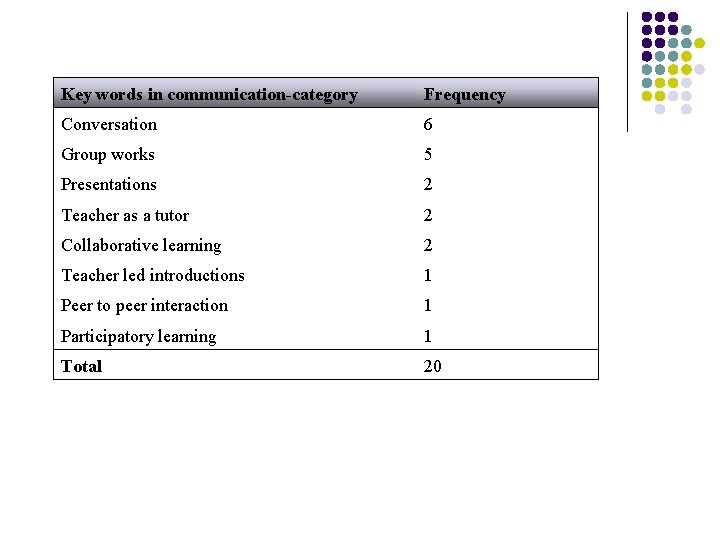
Key words in communication-category Frequency Conversation 6 Group works 5 Presentations 2 Teacher as a tutor 2 Collaborative learning 2 Teacher led introductions 1 Peer to peer interaction 1 Participatory learning 1 Total 20
The creation of the learning profiles The levels were created based on the data in order to describe the changes in conceptions as detailed as possible. We analysed dialogical and inquiry aspects as separate, since there were differences in students’ understanding of these concepts.
Learning profiles UNIVERSITY OF JYVÄSKYLÄ
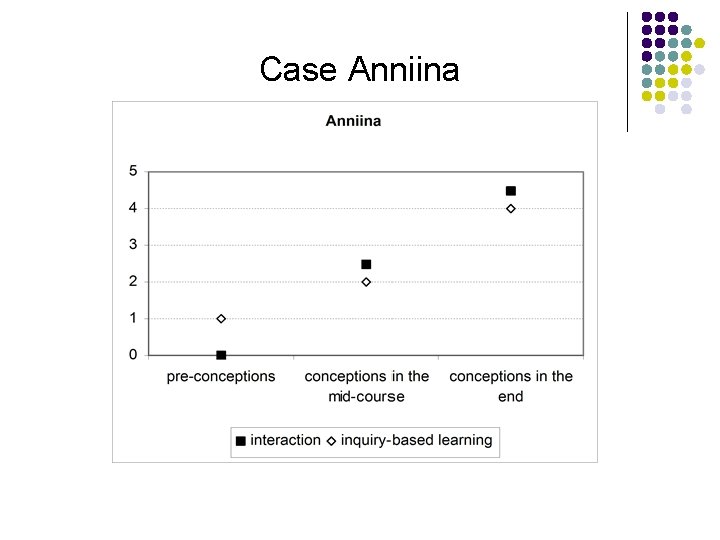
Case Anniina
Discussion Pre-conceptions: The most frequent category, teaching methods, considered that teaching should include especially outdoor education and methods related to experimentation. Most frequently emerged topic in pedagogy and instructional decision making was practicality. Inquiry-based learning is not sufficiently present in primary student teachers’ understanding. Also, classroom communication was not explicitly considered.
Discussion Learning profiles: Six student teachers revealed that except of two cases there was a progress in conceptions concerning inquiry-based learning and dialogic teaching. In the end four of the student teachers reached the standards for inquiry-based learning. And some student could be considered to have established a basis for implementing this kind of teaching in practice.
Literature Alexander, R. (2004). Towards Dialogic Teaching: Rethinking Classroom Talk. Cambridge: Dialogos. Linn, M. C. , Davis, E. A. , & Bell, P. (2004). Internet environments for science education. Mahwah, NJ: Erlbaum. Minner, D. , Levy, A. , J. & Century, J. 2009. Inquiry-Based Science Instruction—What Is It and Does It Matter? Results from a Research Synthesis Years 1984 to 2002. Journal of research in science teaching 47 (2).
- Slides: 24