
ENPAC Corporation Spill Prevention Secondary Containment Storm Water




- Slides: 40
ENPAC Corporation Spill Prevention, Secondary Containment, Storm Water, and Industrial Handling Products
Objective n EPA and DOT Federal Regulations for the storage and transportation of hazardous chemicals. – Salvage Drum vs. Overpack – Product Overview n EPA Federal Regulations for the storage of hazardous chemicals – Secondary Containment vs. Housekeeping – Product Overview n Portable Spill Containment n Absorbents and Spillkits n Stormwater Regulations
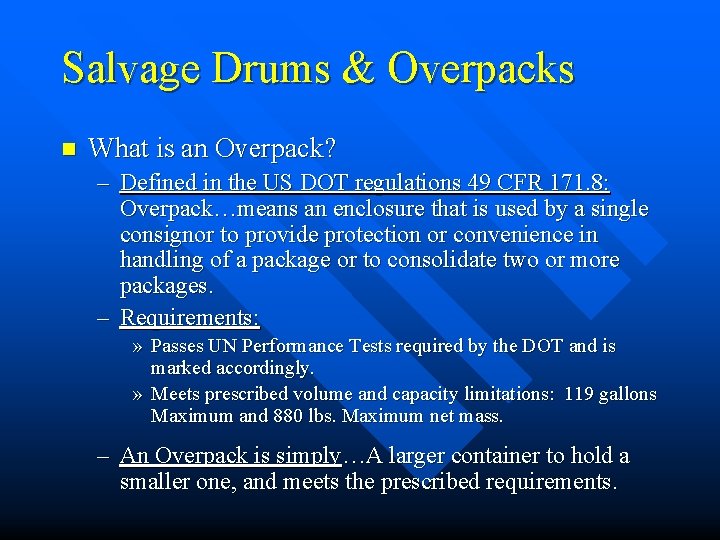
Salvage Drums & Overpacks n What is an Overpack? – Defined in the US DOT regulations 49 CFR 171. 8: Overpack…means an enclosure that is used by a single consignor to provide protection or convenience in handling of a package or to consolidate two or more packages. – Requirements: » Passes UN Performance Tests required by the DOT and is marked accordingly. » Meets prescribed volume and capacity limitations: 119 gallons Maximum and 880 lbs. Maximum net mass. – An Overpack is simply…A larger container to hold a smaller one, and meets the prescribed requirements.
Salvage Drums & Overpacks n What is a Salvage Drum? – Defined in the US DOT regulations 49 CFR 173. 3: Packages of hazardous materials that are damaged, defective, or found leaking and hazardous materials that have spilled or leaked may be placed in a metal or plastic removable head salvage drum that is compatible with the lading and shipped for repackaging or disposal… – Requirements: » » Passes requirements of an Overpack. Passes a required 3 psi pressure test One-trip container Labeled as a Salvage Drum – Therefore a Salvage Drum is an Overpack, but an
Salvage Drums & Overpacks n What happens when a spill occurs? – Since a user cannot tell in advance what is going to spill or leak, and whether the material is a hazardous material in US EPA Regulations, the wise choice is to use a Salvage Drum. n Why? – The shipper is responsible for assuring that the material is shipped in conformance with Federal regulations, and if shipped incorrectly, is a risk and major liability. – With the higher rating and product qualification, the wise choice is a Salvage Drum. n All of ENPAC’s Overpack Drums are qualified as Salvage Drums, so the guesswork has been
Salvage Drums & Overpacks n What features should I insist on? – – – – New and unused Salvage Drum Labeling Chemical compatibility (Plastic or Steel) Fast on/off closure (All ENPAC drums are screw-top lids) Ease-of-use: requires no special tools to open/close Package qualification certificate (call for cert. ) Reputable source (ENPAC is your choice. )
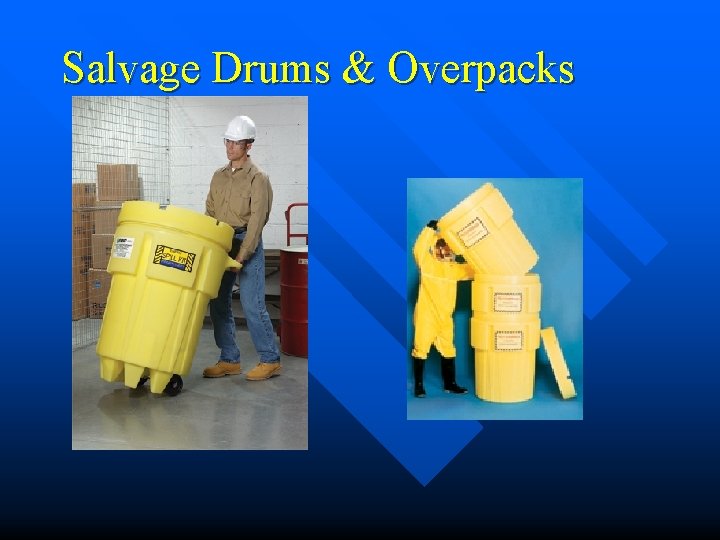
Salvage Drums & Overpacks ENPAC has the widest range and highest rated Overpack Salvage Drum line in the world. n Sizes 20 – 600 gallons. n Polyethylene Patented Construction n Screw-top lids n All drums nest for shipment n
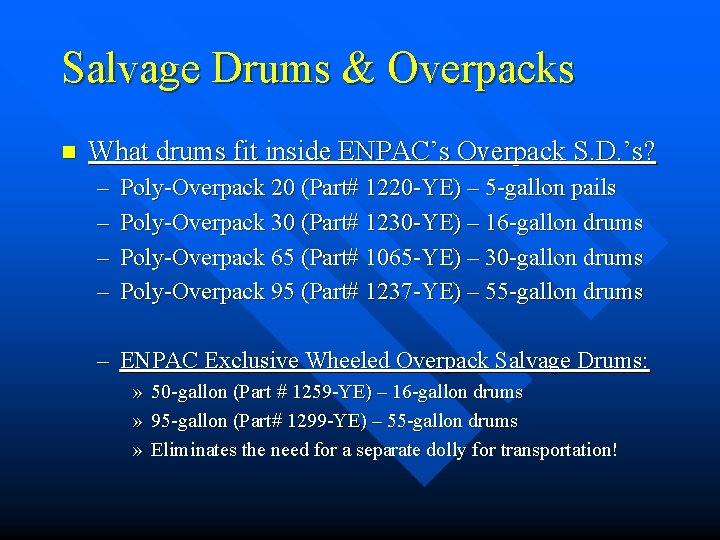
Salvage Drums & Overpacks n What drums fit inside ENPAC’s Overpack S. D. ’s? – – Poly-Overpack 20 (Part# 1220 -YE) – 5 -gallon pails Poly-Overpack 30 (Part# 1230 -YE) – 16 -gallon drums Poly-Overpack 65 (Part# 1065 -YE) – 30 -gallon drums Poly-Overpack 95 (Part# 1237 -YE) – 55 -gallon drums – ENPAC Exclusive Wheeled Overpack Salvage Drums: » » » 50 -gallon (Part # 1259 -YE) – 16 -gallon drums 95 -gallon (Part# 1299 -YE) – 55 -gallon drums Eliminates the need for a separate dolly for transportation!
Salvage Drums & Overpacks n Know that in the market, if someone is selling a “cheaper” drum, it may be that they are selling an Overpack and not a Salvage Drum, and we are not comparing apples-to-apples. n Any Questions? ?
Salvage Drums & Overpacks
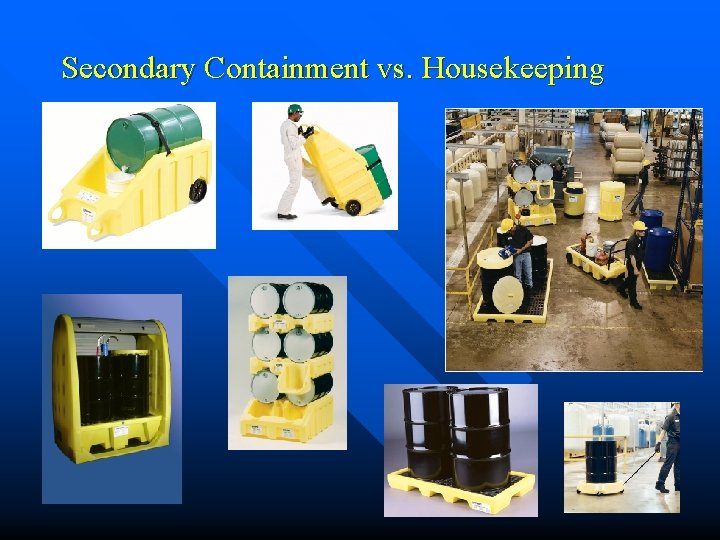
Secondary Containment vs. Housekeeping n What is Secondary Containment? – Defined in the US EPA regulations 40 CFR 264. 175: A device or area that prevents hazardous wastes from migrating from their primary storage area. – Requirements: » Secondary Containment must be equal to the volume of the largest container being stored, » Or, 10% of the aggregate volume of the containers being contained, » Whichever is greater.
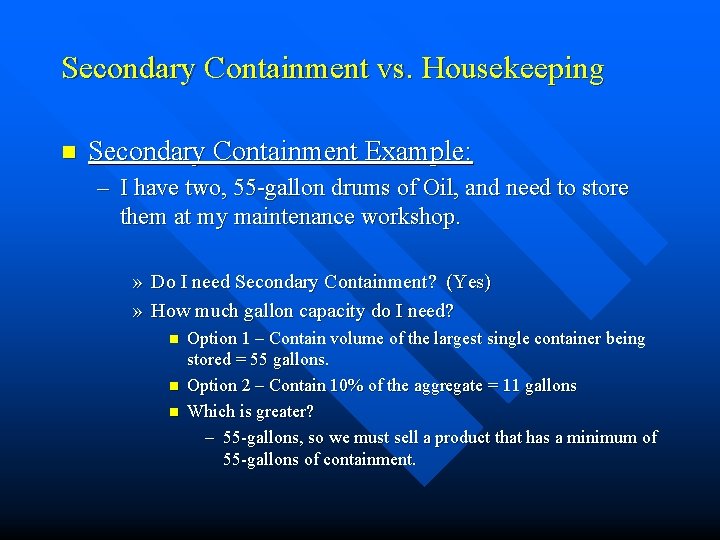
Secondary Containment vs. Housekeeping n Secondary Containment Example: – I have two, 55 -gallon drums of Oil, and need to store them at my maintenance workshop. » Do I need Secondary Containment? (Yes) » How much gallon capacity do I need? n n n Option 1 – Contain volume of the largest single container being stored = 55 gallons. Option 2 – Contain 10% of the aggregate = 11 gallons Which is greater? – 55 -gallons, so we must sell a product that has a minimum of 55 -gallons of containment.
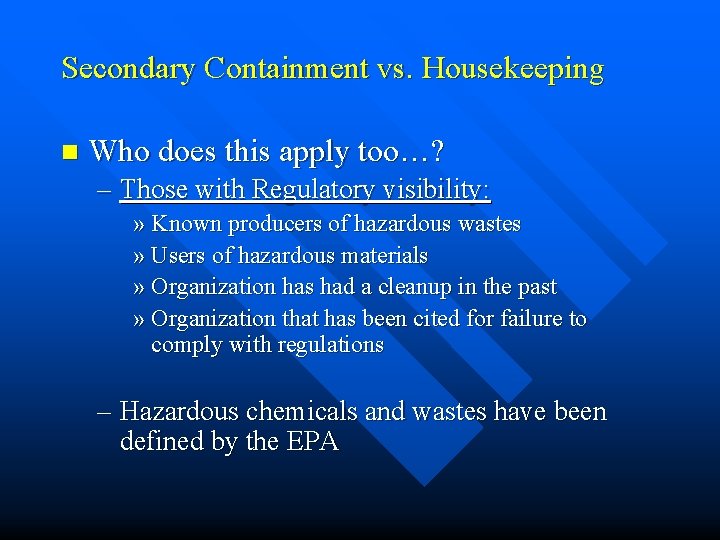
Secondary Containment vs. Housekeeping n Who does this apply too…? – Those with Regulatory visibility: » Known producers of hazardous wastes » Users of hazardous materials » Organization has had a cleanup in the past » Organization that has been cited for failure to comply with regulations – Hazardous chemicals and wastes have been defined by the EPA
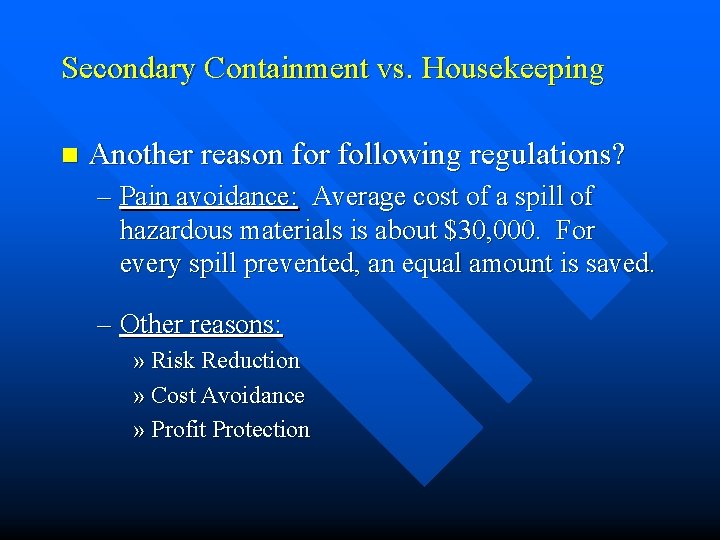
Secondary Containment vs. Housekeeping n Another reason for following regulations? – Pain avoidance: Average cost of a spill of hazardous materials is about $30, 000. For every spill prevented, an equal amount is saved. – Other reasons: » Risk Reduction » Cost Avoidance » Profit Protection
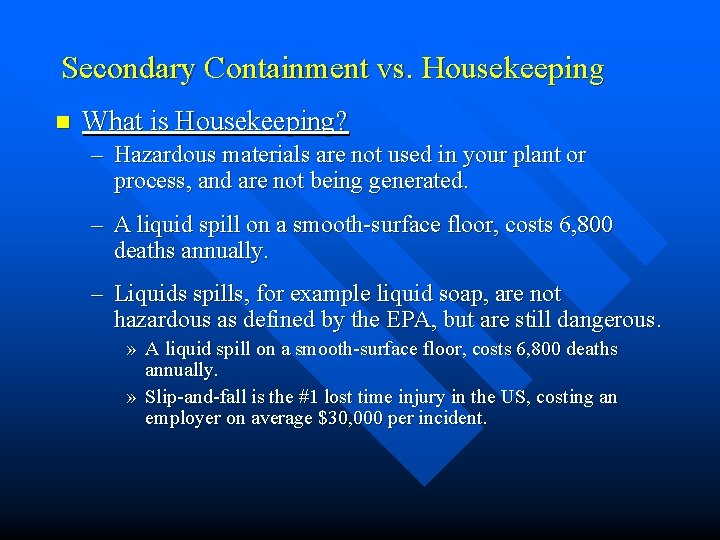
Secondary Containment vs. Housekeeping n What is Housekeeping? – Hazardous materials are not used in your plant or process, and are not being generated. – A liquid spill on a smooth-surface floor, costs 6, 800 deaths annually. – Liquids spills, for example liquid soap, are not hazardous as defined by the EPA, but are still dangerous. » A liquid spill on a smooth-surface floor, costs 6, 800 deaths annually. » Slip-and-fall is the #1 lost time injury in the US, costing an employer on average $30, 000 per incident.
Secondary Containment vs. Housekeeping n Housekeeping products work the same as Secondary Containment products, but may have different features, liquid capacity, and price point…. Know the difference! – For example: » Poly-Spillpallets are Secondary Containment n n n Hold minimum required volume capacities Higher sidewalls for volume capacity Higher price point » Workstations are Housekeeping n n Hold random volume capacities Lower sidewalls for volume capacity Lower price point However: 6 and 8 -Drum units are Secondary Containment products due to volume capacities.
Secondary Containment vs. Housekeeping n So what items are S. C. or H. K. ? – Secondary Containment: » Poly-Dolly(5300 -YE): Has internal sump, holds one 55 -gallon drum, and contains 80 -gallons. » AIRE-Stinger Berm: Designed for the storage and containment of vehicles, equipment, and drums. Can be both Secondary Containment and Housekeeping depending upon capacity required for the application. – Housekeeping: » 2 -Drum Workstation(5117 -YE): Storage of two 55 -gallon Drums, however contains only 22 -gallons. » Spill Scooter(5205 -YE): Transports one 55 -gallon Drum, however contains only 11 -gallons. » Dripillow Berm(5650 -YE) and Prowler Pool(5920 -YE): Storage for multiple products with leaks and drips, however contains only 1 -gallon and 20 -gallons respectively.
Secondary Containment vs. Housekeeping n Poly-Dolly – Product is made out of polyethylene, and has a wide range of chemical compatibility, coupled with excellent abuse resistance. – Ideal for the transport, storage and dispensing applications of 30 and 55 -gallon drums. – Ergonomic handle design allows for ease of use. – Internal sump provides Secondary Containment. – If catastrophic leak happens, Poly-Dolly can still be used, and drained later, allowing the end-user to finish the job.
Secondary Containment vs. Housekeeping n Workstations – Product is made out of polyethylene, and has a wide range of chemical compatibility, coupled with excellent abuse resistance. – Ideal for the storage and dispensing applications of drums of any size. – Link-Locks allow the separate units to be joined together, to make up a “workstation area. ” – Ramps also available. – Storage of batteries so they do not lose their charge is also an excellent application.
Secondary Containment vs. Housekeeping
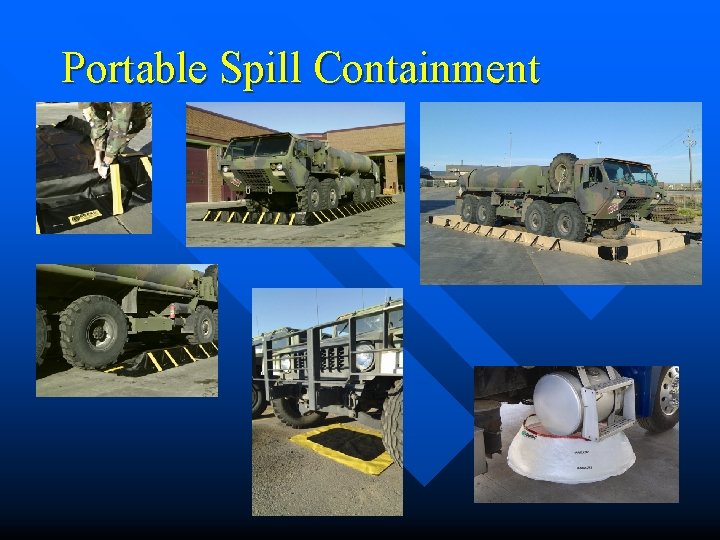
Portable Spill Containment n Products designed for ease of storage, shipment, and deployment in spill prevention or containment, manufactured out of chemical resistant fabrics/materials. – – n Prowler Pools Stinger Berms AIRE-Stinger Berms Dripillow Berms Products are Housekeeping and Secondary Containment, depending upon the application.
Portable Spill Containment n Prowler Pools – Product is made out of High Density Polyethylene, has a wide range of chemical compatibility, and a cold crack of – 60 F. – Compact design allows for easy storage and deployment. – Opaque in color, with marked gallonage so can see volume of liquids contained. – Available in 20, 66, 100, and 150 -gallon sizes. – Usage under leaking fuel lines, tankers, drums, etc…anywhere a leak/spill may occur.
Portable Spill Containment n Stinger and AIRE-Stinger Berms – Product is made out of XR-5, has a wide range of chemical compatibility, couple with excellent puncture, rip and tear properties. – Folded design, allows for compact storage. – Wide range of sizes available, customs too. – Additional protection available through use of Ground Pad (placed under berm) and Track Mat (for tread-wear or punctures on top-side of berm). – Rounded corners extend life, and abuse resistance. – Stinger – Lay down sidewalls for easy entrance and exit – AIRE-Stinger – Set-up and drive in and out at will, with foam log end walls.
Portable Spill Containment n Stinger and AIRE-Stinger Berms – Applications: » Construction sites for temporary drum storage. » Containment of large vessels of hazardous chemicals. » Transportation and Emergency Response Applications, for decontamination or clean-up needs. » Spill Containment for oil truck/tankers in industrial and military applications. » Temporary drum storage at an industrial facility of chemicals, and other liquids needing containment.
Portable Spill Containment n Dripillow Berm – Product is made out of yellow vinyl with an oil/hydrocarbons only absorbent pad. Compact design allows for easy storage and deployment. – Can handle 40 mph winds with weighted sand pockets. – Buckle strap allows for easy attachment. – Four sizes available, smallest unit absorbs 1 -gallon of absorbency. – Will not soak up water, so can be left outdoors yearround. – Absorbs oils, fuels, hydraulics, and other hydrocarbon based liquids. – Applications: Replaces plastic drip pans under vehicles or equipment.
Portable Spill Containment
Spillkits and Sorbents n Why? – Spillkits and Sorbents are a vital part of a Spill Prevention Plan that every manufacturing or industrial facility must put into action. – It is important to match the spill with the sorbents to make sure that chemical compatibility exists.
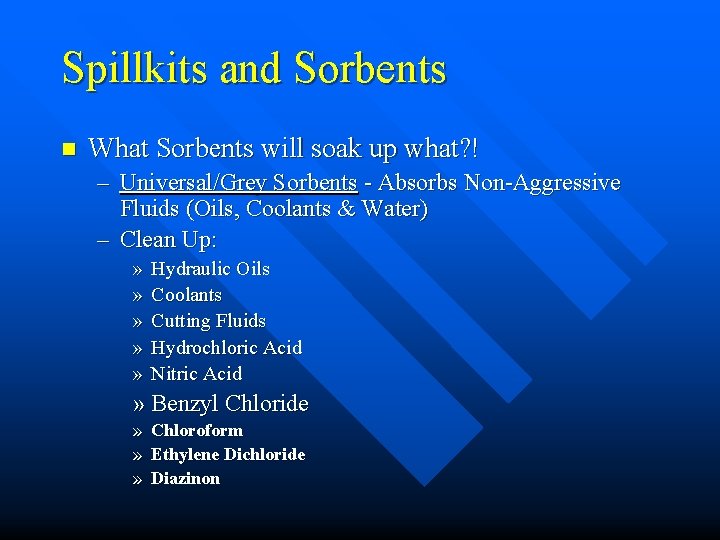
Spillkits and Sorbents n What Sorbents will soak up what? ! – Universal/Grey Sorbents - Absorbs Non-Aggressive Fluids (Oils, Coolants & Water) – Clean Up: » » » Hydraulic Oils Coolants Cutting Fluids Hydrochloric Acid Nitric Acid » Benzyl Chloride » » » Chloroform Ethylene Dichloride Diazinon
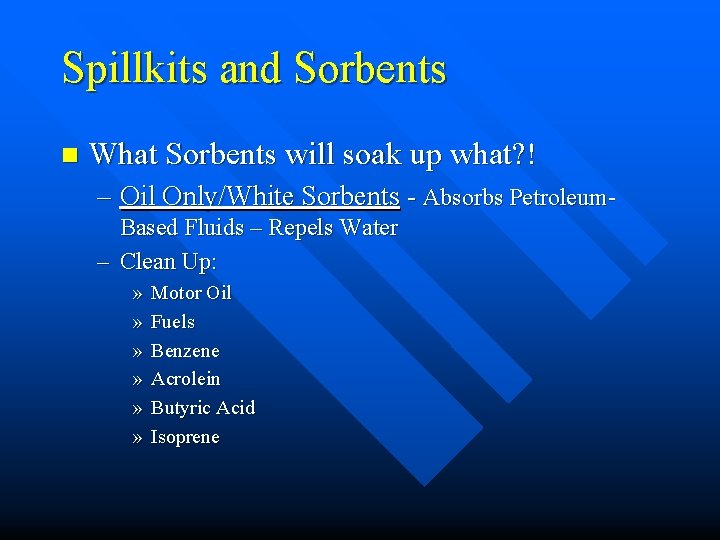
Spillkits and Sorbents n What Sorbents will soak up what? ! – Oil Only/White Sorbents - Absorbs Petroleum. Based Fluids – Repels Water – Clean Up: » » » Motor Oil Fuels Benzene Acrolein Butyric Acid Isoprene
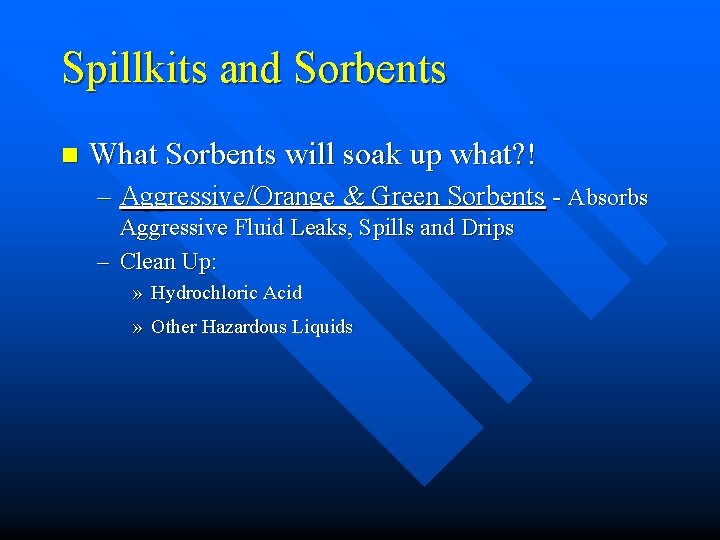
Spillkits and Sorbents n What Sorbents will soak up what? ! – Aggressive/Orange & Green Sorbents - Absorbs Aggressive Fluid Leaks, Spills and Drips – Clean Up: » Hydrochloric Acid » Other Hazardous Liquids
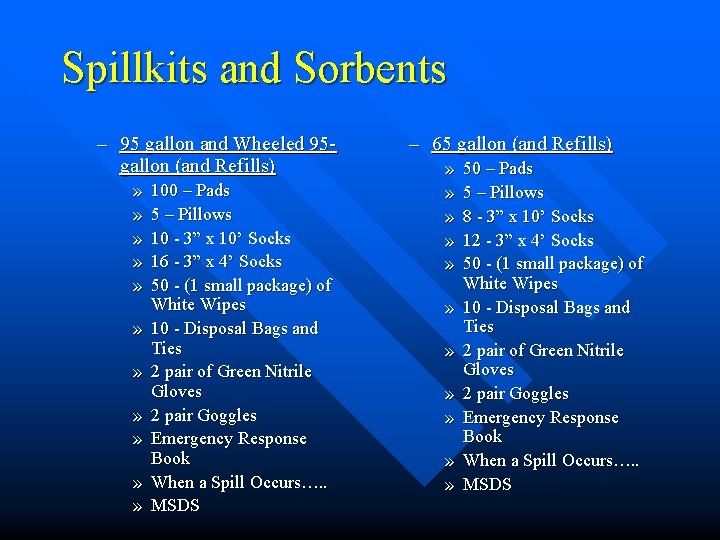
Spillkits and Sorbents – 95 gallon and Wheeled 95 gallon (and Refills) » » » 100 – Pads 5 – Pillows 10 - 3” x 10’ Socks 16 - 3” x 4’ Socks 50 - (1 small package) of White Wipes 10 - Disposal Bags and Ties 2 pair of Green Nitrile Gloves 2 pair Goggles Emergency Response Book When a Spill Occurs…. . MSDS – 65 gallon (and Refills) » » » 50 – Pads 5 – Pillows 8 - 3” x 10’ Socks 12 - 3” x 4’ Socks 50 - (1 small package) of White Wipes 10 - Disposal Bags and Ties 2 pair of Green Nitrile Gloves 2 pair Goggles Emergency Response Book When a Spill Occurs…. . MSDS
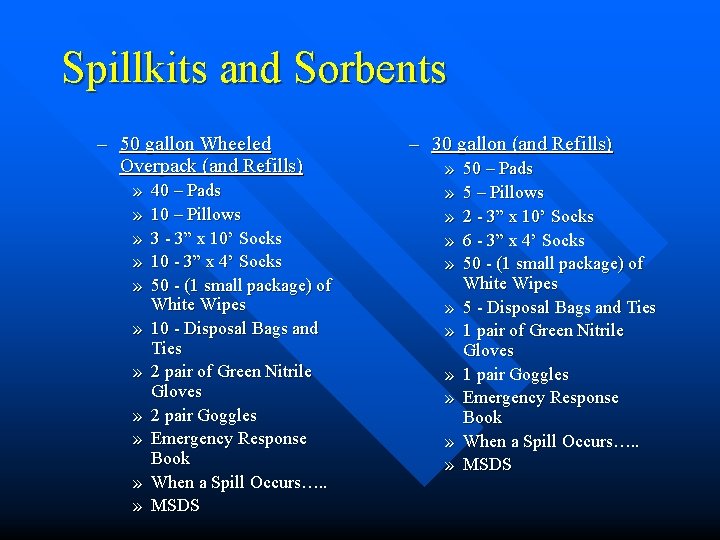
Spillkits and Sorbents – 50 gallon Wheeled Overpack (and Refills) » » » 40 – Pads 10 – Pillows 3 - 3” x 10’ Socks 10 - 3” x 4’ Socks 50 - (1 small package) of White Wipes 10 - Disposal Bags and Ties 2 pair of Green Nitrile Gloves 2 pair Goggles Emergency Response Book When a Spill Occurs…. . MSDS – 30 gallon (and Refills) » » » 50 – Pads 5 – Pillows 2 - 3” x 10’ Socks 6 - 3” x 4’ Socks 50 - (1 small package) of White Wipes 5 - Disposal Bags and Ties 1 pair of Green Nitrile Gloves 1 pair Goggles Emergency Response Book When a Spill Occurs…. . MSDS
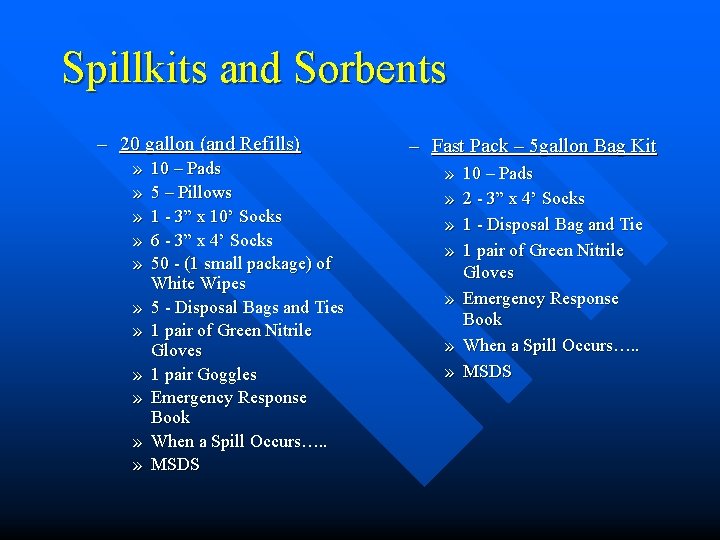
Spillkits and Sorbents – 20 gallon (and Refills) » » » 10 – Pads 5 – Pillows 1 - 3” x 10’ Socks 6 - 3” x 4’ Socks 50 - (1 small package) of White Wipes 5 - Disposal Bags and Ties 1 pair of Green Nitrile Gloves 1 pair Goggles Emergency Response Book When a Spill Occurs…. . MSDS – Fast Pack – 5 gallon Bag Kit » » » » 10 – Pads 2 - 3” x 4’ Socks 1 - Disposal Bag and Tie 1 pair of Green Nitrile Gloves Emergency Response Book When a Spill Occurs…. . MSDS
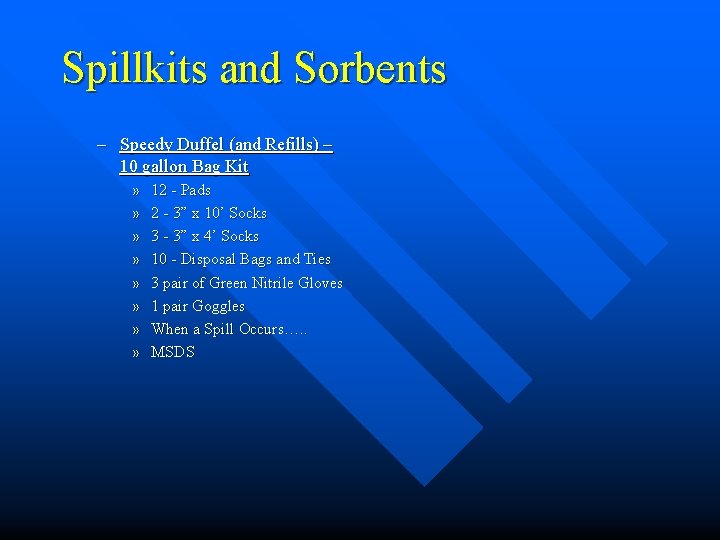
Spillkits and Sorbents – Speedy Duffel (and Refills) – 10 gallon Bag Kit » » » » 12 - Pads 2 - 3” x 10’ Socks 3 - 3” x 4’ Socks 10 - Disposal Bags and Ties 3 pair of Green Nitrile Gloves 1 pair Goggles When a Spill Occurs…. . MSDS
Spillkits and Sorbents
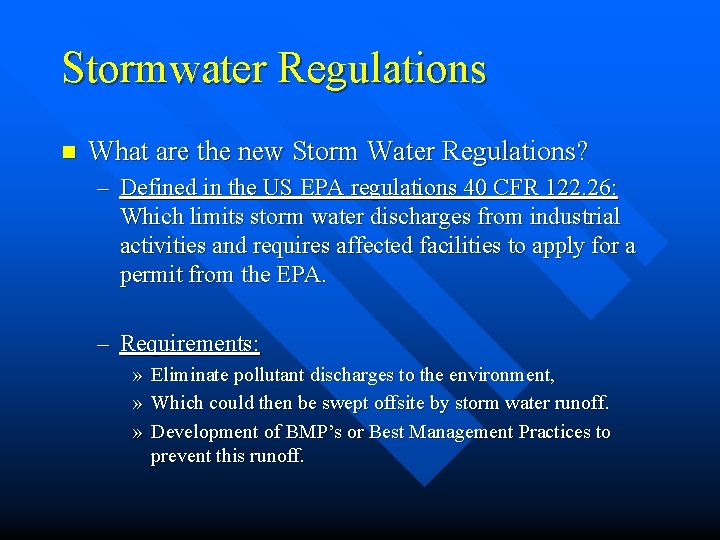
Stormwater Regulations n What are the new Storm Water Regulations? – Defined in the US EPA regulations 40 CFR 122. 26: Which limits storm water discharges from industrial activities and requires affected facilities to apply for a permit from the EPA. – Requirements: » Eliminate pollutant discharges to the environment, » Which could then be swept offsite by storm water runoff. » Development of BMP’s or Best Management Practices to prevent this runoff.
Stormwater Regulations n Who is affected? – – Dairy processing to nonferrous metal forming Lumber and wood products to ship and boat building Mineral mining and Oil & Gas extraction Hazardous waste treatment, storage, and disposal facilities – Landfills – Scrap yards, junk yards, and various recycling industries – Steam electric generating plants
Stormwater Regulations n Who is affected? (cont…) – Transportation: Including rail, trucking & warehousing, US Postal Service, water & air… – Vehicle maintenance, cleaning/washing, and airport deicing operations – Sewage treatment works – Construction activities 1 acre or more – Various light industries from food products to general warehousing and storage – Municipalities and municipal separate storm sewer systems (also known as MS 4’s)
Stormwater Regulations n What ENPAC products apply? – ALL! – Any product that contains or prohibits hazardous chemicals, silt, dirt, and/or prevents erosion from going down a storm drain. – Examples: » Stinger Berms at US Post Office, to prevent run off from cleaning of vehicles (dirt, oil, and grease). » Workstations to contain oil drips at a dispensing station. » Dripillow Berms placed under fleet vehicles to catch oil drips. » Spillkits and Sorbents
Questions? ? Thank you for your continued support!