
Enhancing Your Instruction Using Effective and Engaging Questioning
- Slides: 68
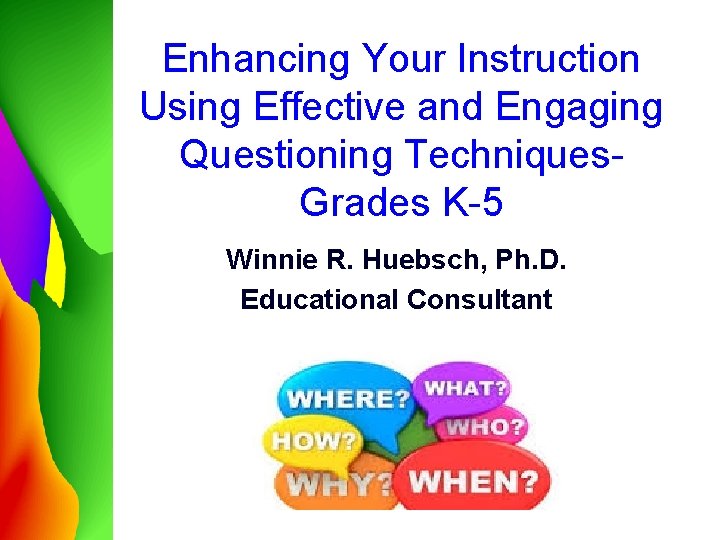
Enhancing Your Instruction Using Effective and Engaging Questioning Techniques. Grades K-5 Winnie R. Huebsch, Ph. D. Educational Consultant
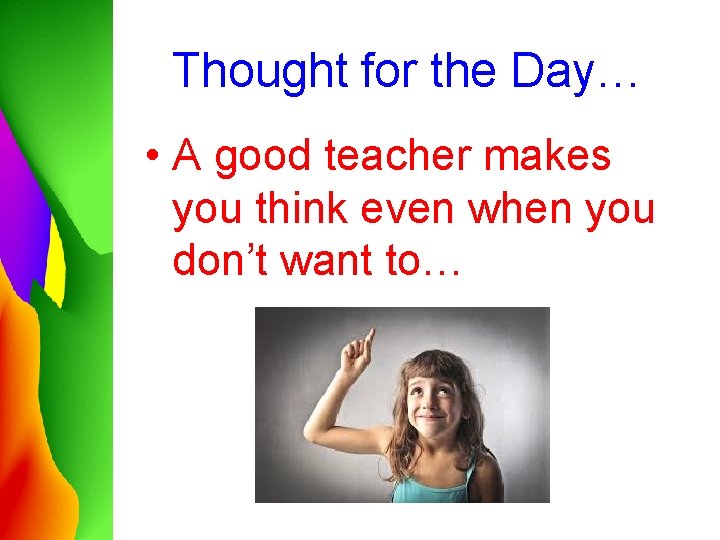
Thought for the Day… • A good teacher makes you think even when you don’t want to…
And… Good learning starts with questions, not answers… Guy Claxton, Professor in Education and Director of CLIO Development University of Bristol.
• With questions, you get what you ask for …. • In an era where computers are getting better at answering questions, we need to become much better at asking questions….
Session Objectives • To develop your own awareness of your questioning techniques • To identify the key features of good questioning • To enhance the planning of appropriate questioning
What is the purpose of Questioning? § To check on students’ prior knowledge § To actively involve them in a lesson § To increase their motivation
What is the purpose of Questioning? § To focus student thinking on key concepts and issues § To assess the knowledge or mastery of concepts
It’s a fact that… § An average teacher asks 400 questions in a day § That’s 70, 000 a year! § One-third of all teaching time is spent asking questions § Most questions are answered in less than a second
All Too Common Teaching Techniques 1. Students are engaged only in lower-order thinking; i. e. they receive or recite, or participate in routine practice. 2. In no activities during the lesson do students go beyond simple reproduction of knowledge.
Common Teaching Techniques 3. Students are primarily engaged in routine lower-order thinking for a good share of the lesson. But, one question or activity has students perform some higher-order thinking. 4. Almost all students, almost all of the time, are engaged in higher-order thinking. (quite rare)
What we need to do and what is hard to do… • Use ‘intentionality’… plan questions carefully • Construct the lesson around core essential knowledge and questions…
What we need to do and what is hard to do… • Take the time and thought to phrase a few excellent questions at the beginning of the lesson. • Have students answer the questions at the end of the lesson…
Pitfalls to Avoid • Asking students questions which can be answered by a yes or no • Asking too many closed questions
Pitfalls to Avoid • Asking too many short answer, recall based questions • Focusing on too few students and not involving the whole class
Pitfalls to Avoid • Making the sequence of questions too rigid • Not giving enough ‘wait time’ for a student to think before answering
Did you know…? • The typical teacher pauses, on the average, between 0. 7 and 1. 4 seconds after his/her question before continuing to talk or call on a student…. • Pretty fast….
What is…‘Wait time’ or ‘Think time’ • Periods of silence by the teacher following a question… • Suggested wait time – 5 seconds or more
Benefits of ‘Wait’ time • The length and correctness of responses increase • The number of “I don’t know” and “no” responses decreases • The number of volunteered answers increases • Achievement scores increase
When teachers give more wait time… • Questioning is more varied and flexible • Increase in the quality and variety of their questions • They ask additional questions which require higher order thinking
Remember Bloom And his Taxonomy…? ? • In 1956, Benjamin developed a classification of levels of intellectual behavior important in learning. • Bloom found that over 95 % of test questions students encountered required them to think only at the lowest level. . . the recall of information.
Remember Bloom And his Taxonomy…? ? • Bloom identified six levels within the cognitive domain, from the simple recall or recognition of facts, to very sophisticated thinking, classified as evaluation.
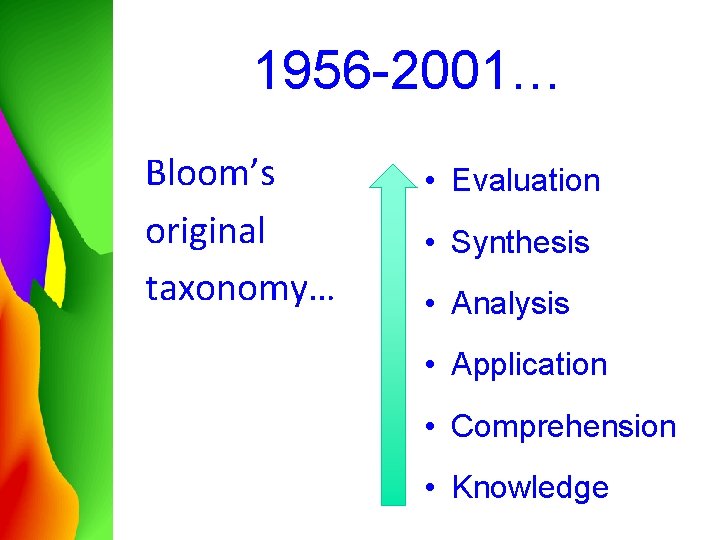
1956 -2001… Bloom’s original taxonomy… • Evaluation • Synthesis • Analysis • Application • Comprehension • Knowledge
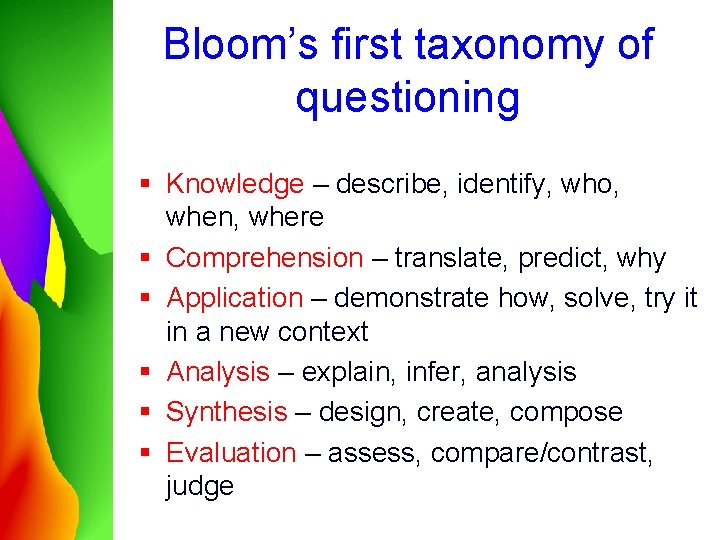
Bloom’s first taxonomy of questioning § Knowledge – describe, identify, who, when, where § Comprehension – translate, predict, why § Application – demonstrate how, solve, try it in a new context § Analysis – explain, infer, analysis § Synthesis – design, create, compose § Evaluation – assess, compare/contrast, judge
Bloom’s Taxonomy A Worthwhile Revision • Revision began in November of 1996 • Draft completed in 2000; text published in 2001.
Why the Revised Taxonomy? ? • The use of verbs in the new taxonomy, rather than nouns, is critical • The verbs represent the cognitive processes that students use on or with the content so that learning occurs.
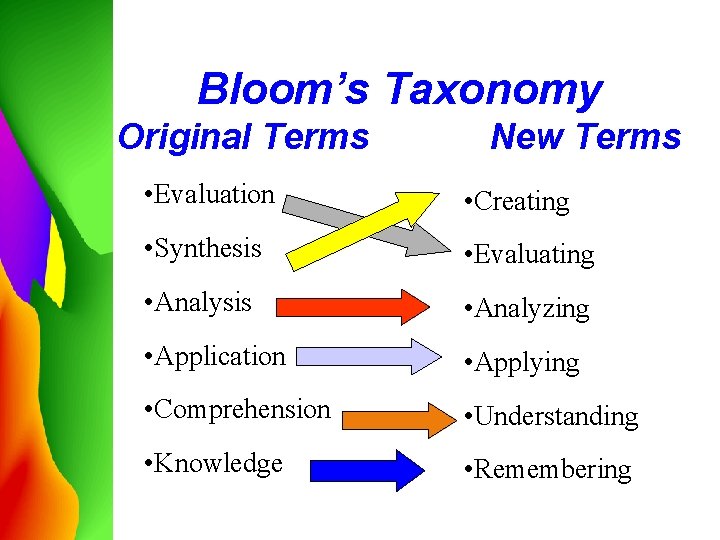
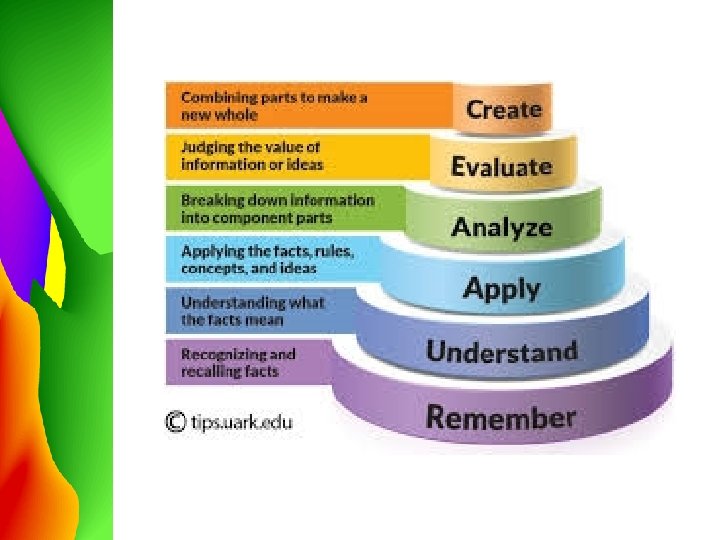
Bloom’s Taxonomy Original Terms New Terms • Evaluation • Creating • Synthesis • Evaluating • Analysis • Analyzing • Application • Applying • Comprehension • Understanding • Knowledge • Remembering
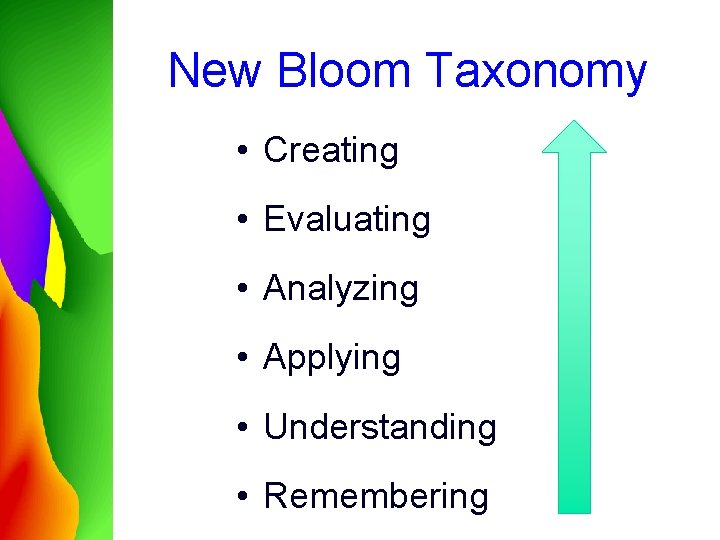
New Bloom Taxonomy • Creating • Evaluating • Analyzing • Applying • Understanding • Remembering
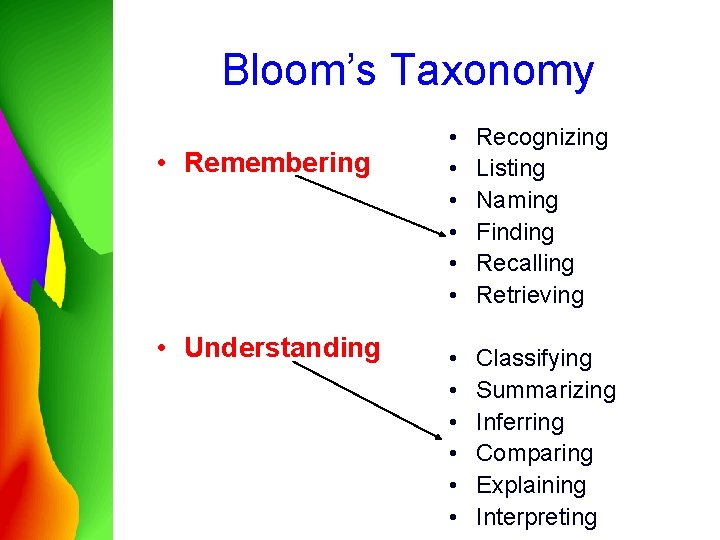
Bloom’s Taxonomy • Remembering • Understanding • • • Recognizing Listing Naming Finding Recalling Retrieving • • • Classifying Summarizing Inferring Comparing Explaining Interpreting
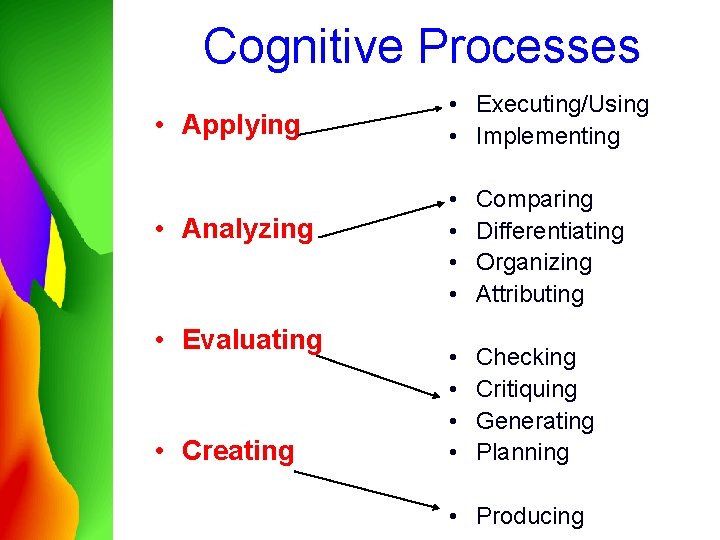
Cognitive Processes • Applying • Analyzing • Evaluating • Creating • Executing/Using • Implementing • • Comparing Differentiating Organizing Attributing • • Checking Critiquing Generating Planning • Producing
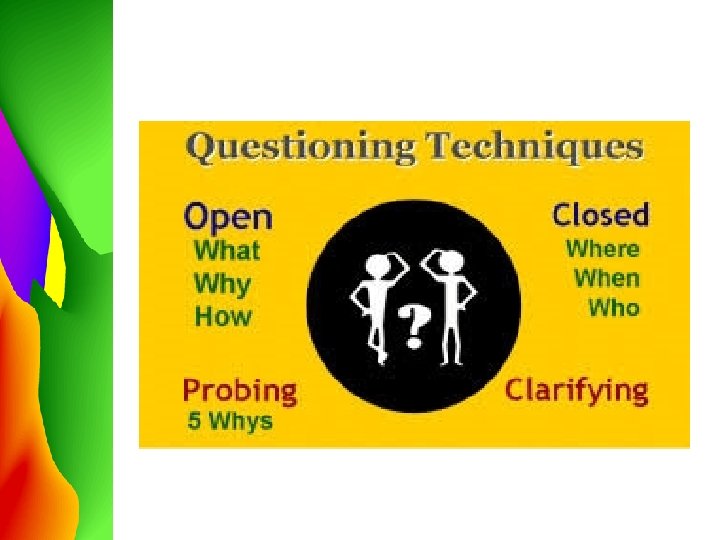
Keep questions simple! Examples: • What do you think? • Why do you think this? • How do you know this? • Can you tell me more? • What questions do you still have?
Young students are quite literal… • The first three levels of Bloom’s Taxonomy are most commonly assessed in grades K-5. They are: • Remembering • Understanding • Applying
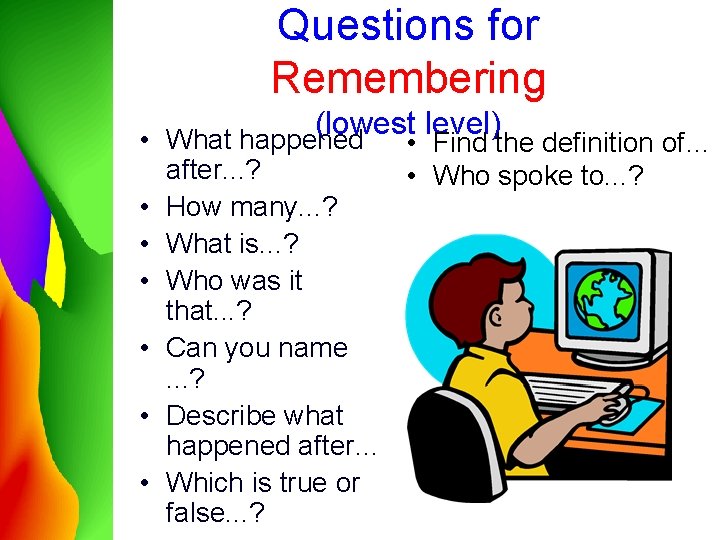
Questions for Remembering (lowest level) • What happened • Find the definition of… • • • after. . . ? • Who spoke to. . . ? How many. . . ? What is. . . ? Who was it that. . . ? Can you name. . . ? Describe what happened after… Which is true or false. . . ?
‘Remembering’ continued § § § § § List Underline Memorize Show Locate Give example Label Recall Know • • Group Choose Recite Quote Match Select Sort Repeat Recall or recognition of specific information Products include: • Quiz • Label • Definition • List • Fact • Workbook • Worksheet • Vocabulary • Test
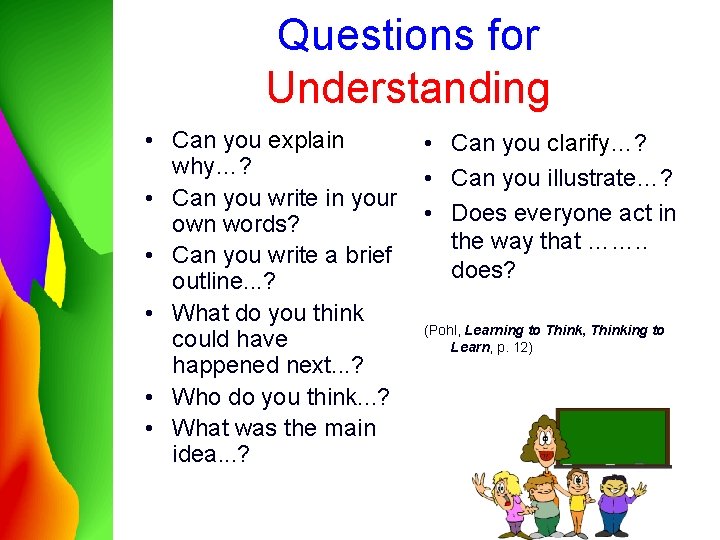
Questions for Understanding • Can you explain why…? • Can you write in your own words? • Can you write a brief outline. . . ? • What do you think could have happened next. . . ? • Who do you think. . . ? • What was the main idea. . . ? • Can you clarify…? • Can you illustrate…? • Does everyone act in the way that ……. . does? (Pohl, Learning to Think, Thinking to Learn, p. 12)
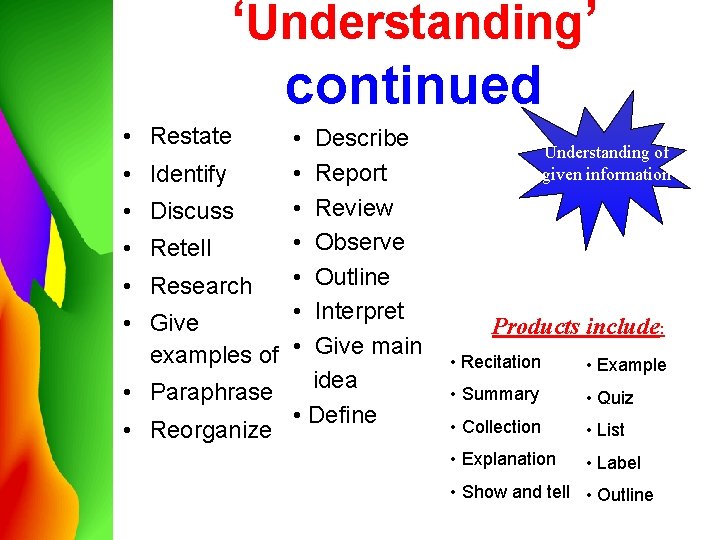
‘Understanding’ continued • Restate • • • Identify • Discuss • Retell • Research • Give examples of • Describe Report Review Observe Outline Interpret Give main idea Paraphrase • Define Reorganize Understanding of given information Products include: • Recitation • Example • Summary • Quiz • Collection • List • Explanation • Label • Show and tell • Outline
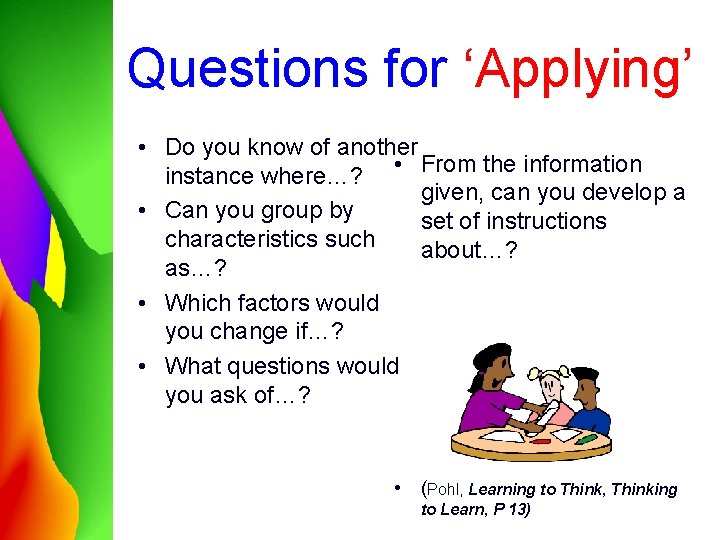
Questions for ‘Applying’ • Do you know of another • From the information instance where…? given, can you develop a • Can you group by set of instructions characteristics such about…? as…? • Which factors would you change if…? • What questions would you ask of…? • (Pohl, Learning to Think, Thinking to Learn, P 13)
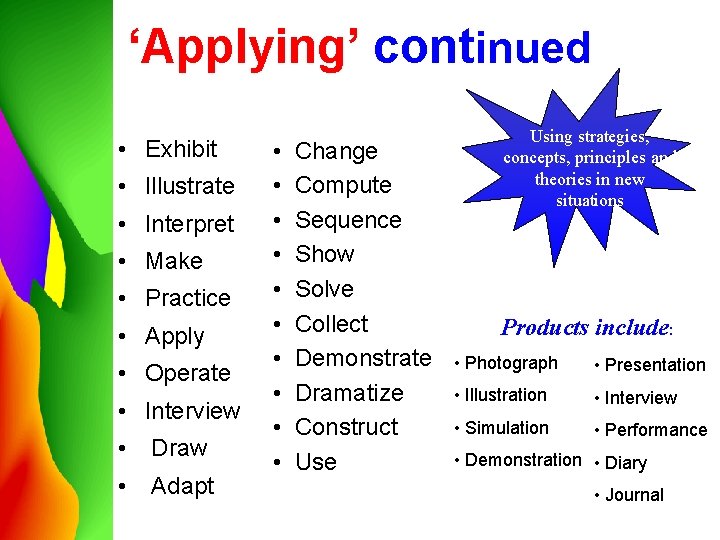
‘Applying’ continued • Exhibit • Illustrate • Interpret • Make • Practice • Apply • Operate • Interview • Draw • Adapt • • • Change Compute Sequence Show Solve Collect Demonstrate Dramatize Construct Use Using strategies, concepts, principles and theories in new situations Products include: • Photograph • Presentation • Illustration • Interview • Simulation • Performance • Demonstration • Diary • Journal
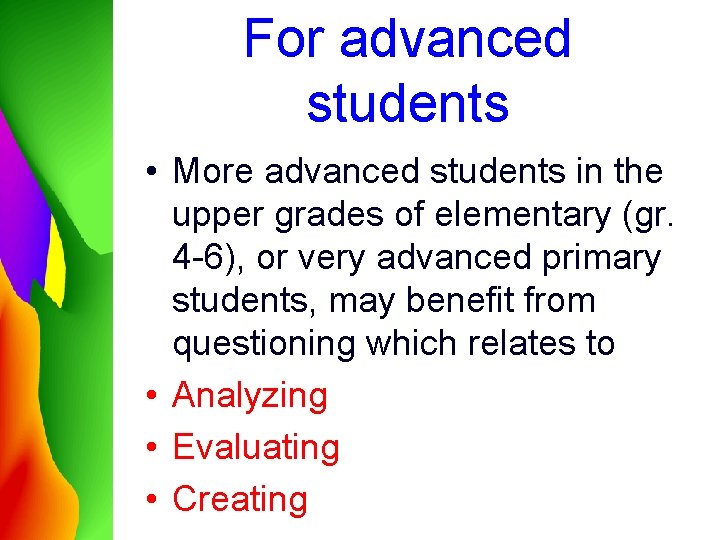
For advanced students • More advanced students in the upper grades of elementary (gr. 4 -6), or very advanced primary students, may benefit from questioning which relates to • Analyzing • Evaluating • Creating
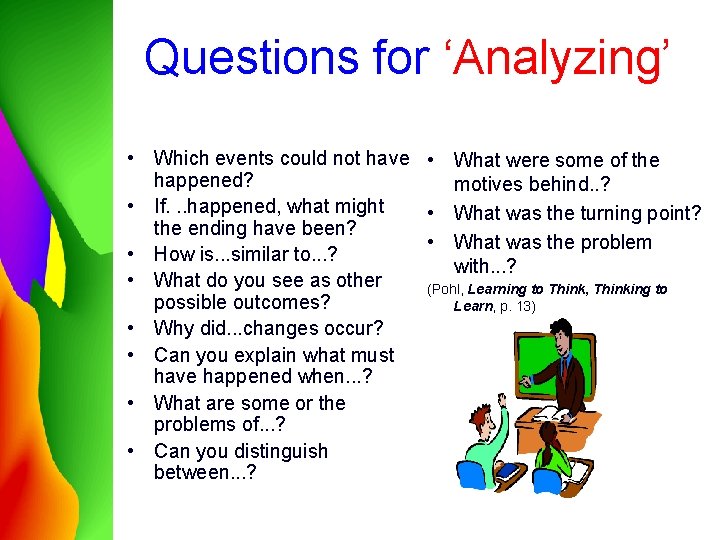
Questions for ‘Analyzing’ • Which events could not have • What were some of the happened? motives behind. . ? • If. . . happened, what might • What was the turning point? the ending have been? • What was the problem • How is. . . similar to. . . ? with. . . ? • What do you see as other (Pohl, Learning to Think, Thinking to possible outcomes? Learn, p. 13) • Why did. . . changes occur? • Can you explain what must have happened when. . . ? • What are some or the problems of. . . ? • Can you distinguish between. . . ?
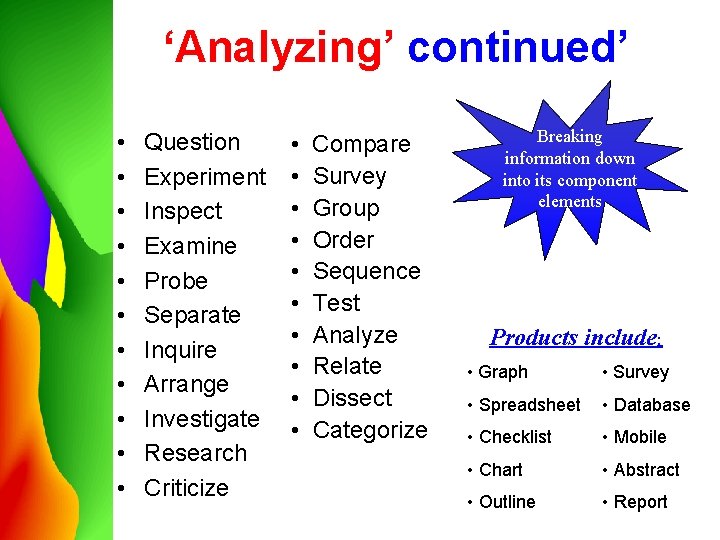
‘Analyzing’ continued’ • • • Question Experiment Inspect Examine Probe Separate Inquire Arrange Investigate Research Criticize • • • Compare Survey Group Order Sequence Test Analyze Relate Dissect Categorize Breaking information down into its component elements Products include: • Graph • Survey • Spreadsheet • Database • Checklist • Mobile • Chart • Abstract • Outline • Report
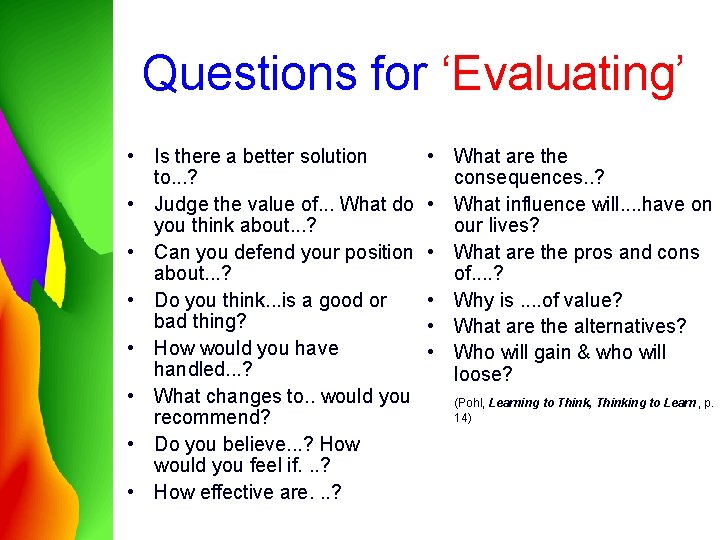
Questions for ‘Evaluating’ • Is there a better solution to. . . ? • Judge the value of. . . What do you think about. . . ? • Can you defend your position about. . . ? • Do you think. . . is a good or bad thing? • How would you have handled. . . ? • What changes to. . would you recommend? • Do you believe. . . ? How would you feel if. . . ? • How effective are. . . ? • What are the consequences. . ? • What influence will. . have on our lives? • What are the pros and cons of. . ? • Why is. . of value? • What are the alternatives? • Who will gain & who will loose? (Pohl, Learning to Think, Thinking to Learn, p. 14)
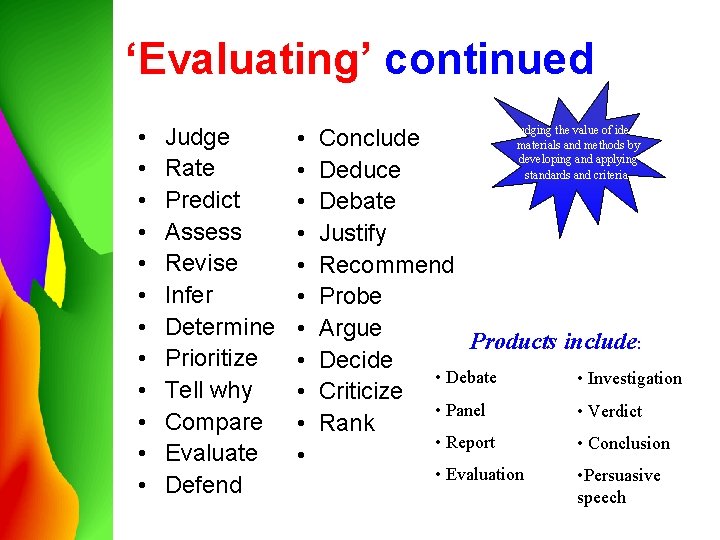
‘Evaluating’ continued • • • Judge Rate Predict Assess Revise Infer Determine Prioritize Tell why Compare Evaluate Defend • • • Judging the value of ideas, Conclude materials and methods by developing and applying Deduce standards and criteria. Debate Justify Recommend Probe Argue Products include: Decide • Debate • Investigation Criticize • Panel • Verdict Rank • Report • Conclusion • Evaluation • Persuasive speech
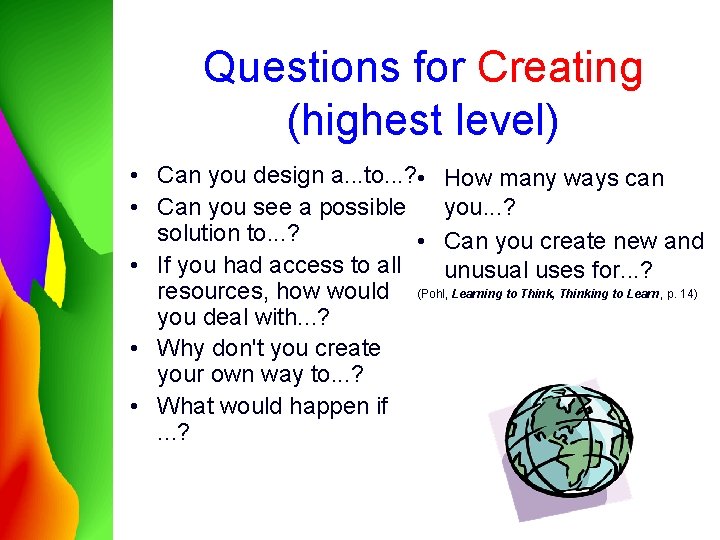
Questions for Creating (highest level) • Can you design a. . . to. . . ? • How many ways can you. . . ? • Can you see a possible solution to. . . ? • Can you create new and • If you had access to all unusual uses for. . . ? resources, how would (Pohl, Learning to Think, Thinking to Learn, p. 14) you deal with. . . ? • Why don't you create your own way to. . . ? • What would happen if. . . ?
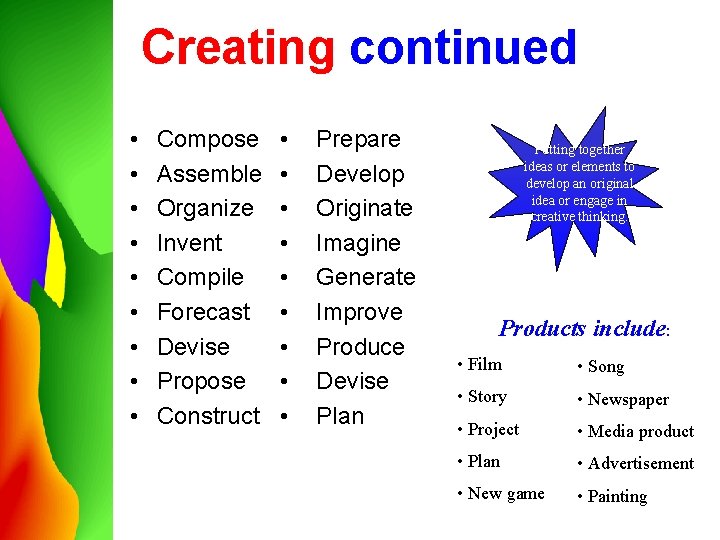
Creating continued • • • Compose Assemble Organize Invent Compile Forecast Devise Propose Construct • • • Prepare Develop Originate Imagine Generate Improve Produce Devise Plan Putting together ideas or elements to develop an original idea or engage in creative thinking. Products include: • Film • Song • Story • Newspaper • Project • Media product • Plan • Advertisement • New game • Painting
Let’s Use Bloom’s Taxonomy for a selection… • What categories would the following questions from the Three Little Pigs fall into? (Next slide)
The Three Little Pigs § § § What would you have done? Can you think of a different ending? What happened in the story? What would you have built your home from? Give examples of how the third pig showed his cunning. § How did the wolf manage to blow down the two homes? § How would you defend the wolf’s action? • Why did the three little pigs have to leave home?
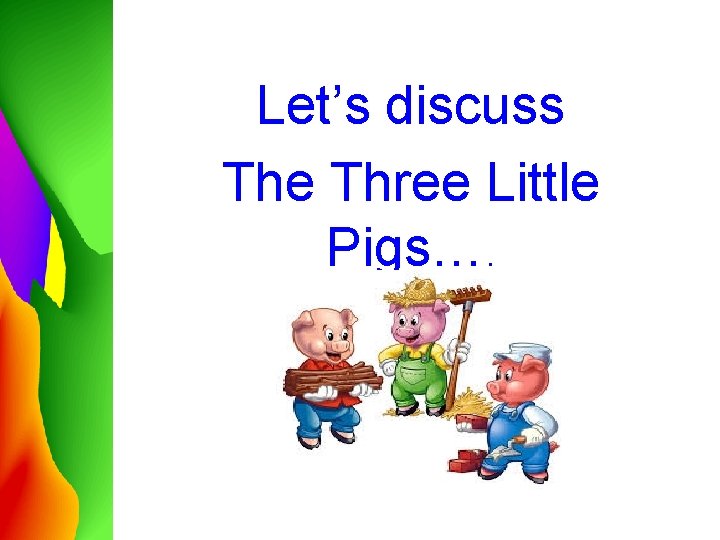
Let’s discuss The Three Little Pigs….
Tips § Plan for questioning § Know the answers to your questions § Review the questions at the end of a lesson
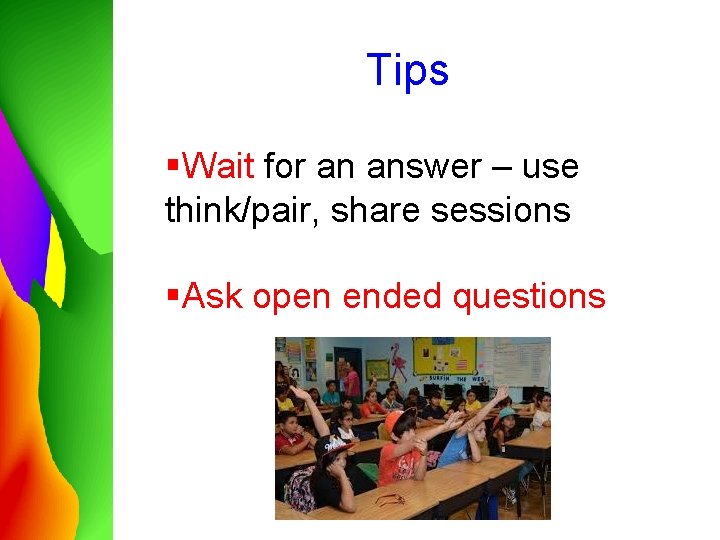
Tips §Wait for an answer – use think/pair, share sessions §Ask open ended questions
Consider these tips… (before the lesson) • Establish your expectations for behavior before beginning the questioning period. • Write out some questions when planning the lesson
Tips for Questioning… (during the lesson) • Phrase the questions clearly and specifically. • Keep the discussion focused. • Follow up on students' responses and invite elaboration.
Tips for Questioning… (during the lesson) • Stimulate the discussion with probing questions. • Periodically summarize (e. g. on blackboard, Smartboard) what has been discussed.
Tips for Questioning (during the lesson) • Cue students before asking the question • Wait Time: Provide students with sufficient wait time after asking a question and before responding to their comments. – Maintain silence and wait at least 5 to 10 seconds for students to respond
Tips for Questioning (during the lesson) • Ask questions that are the appropriate level for each student. • Vary the way students respond to questions. • Vary the person who responds to the questions • Respond to every answer and correct errors. • Ask follow-up questions.
Questions to Think • Do I decide About… on the goals or purposes of my questions? • Do I choose important--rather than trivial--material to emphasize students' in-depth exploration of essential/key questions? • Do I encourage discussion in my classroom by using open-ended questions?
Questions to Think About… • Do I make certain that all students develop a deep understanding of key concepts and skills (i. e. , facts, concepts, generalizations, and principles) and procedural (i. e. , skills, processes, • Do I emphasize higher-order questioning when possible?
Questions to Think About… • Do I avoid "yes" and "no" questions? • Do I use "probe" questions to encourage students to elaborate and support assertions • Do I decide on the goals or purposes of my questions?
Questions to Think About… • Do I ensure that students clearly understand my questions--and avoid a “guessing game? ” • Do I avoid questions that "contain the answer"?
Questions to Think About… • Do I use purposeful strategies for helping students deal with incorrect responses? • Do I anticipate students' responses to my questions, yet allow for divergent thinking and original responses? • Do I make effective use of Wait Time?
Video on Questioning • https: //www. youtube. com/watc h? v=1 d. O 0 d. O__wm. E (5. 35 minutes)
Remember… “If you want a wise answer, ask a reasonable question. ” Johann Wolfgang Van Goethe, German Poet (1749 -1832)
And… “The important thing is not to stop questioning!” Albert Einstein
References • Duncan, D. (2008). Blooms’ Taxonomy in relation to Social Studies. Powerpoint Presentation. • Bloom's(1956) Revised Taxonomy http: //rite. ed. qut. edu. au/ozteachernet/training/bloom. html • Bloom’s Revised Taxonomy http: //coe. sdsu. edu/eet/articles/bloomrev/index. htm • http: //www. fno. org/nov 97/toolkit. html • http: //rite. ed. qut. edu. au/oz-teachernet/training/bloom. html • http: //serc. carleton. edu/introgeo/socratic/guiding. html • http: //serc. carleton. edu/introgeo/socratic/third. html • Pohl, Michael. (2000). Learning to Think, Thinking to Learn: Models and Strategies to Develop a Classroom Culture of Thinking. Cheltenham, Vic. : Hawker Brownlow.
References • http: //teachertools. londongt. org/index. php? page= questioning. Techniques • http: //images. google. com/images? hl=en&q=Que stioning&um=1&ie=UTF-8&sa=N&tab=wi • Tarlinton, D. (2003) Bloom’s Revised Taxonomy. bloomspres. ppt. Powerpoint Presentation. • http: //changingminds. org/techniques/questioning/ questioning. html • http: //serc. carleton. edu/introgeo/socratic/second. h tml • ls. londongt. org/? page=questioning. Techniques • http: //www. petalschools. com/Page/89
References • http: //www. edutopia. org/blog/fiv e-powerful-questions-teachersask-students-rebecca-alber • http: //www. ericdigests. org/1995 -1/think. htm