
Enhancing the Properties of Biochar Producing Fit for
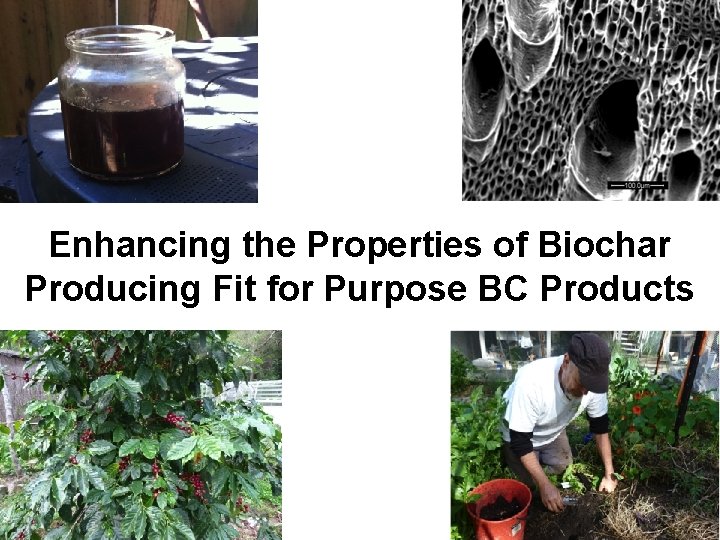
Enhancing the Properties of Biochar Producing Fit for Purpose BC Products
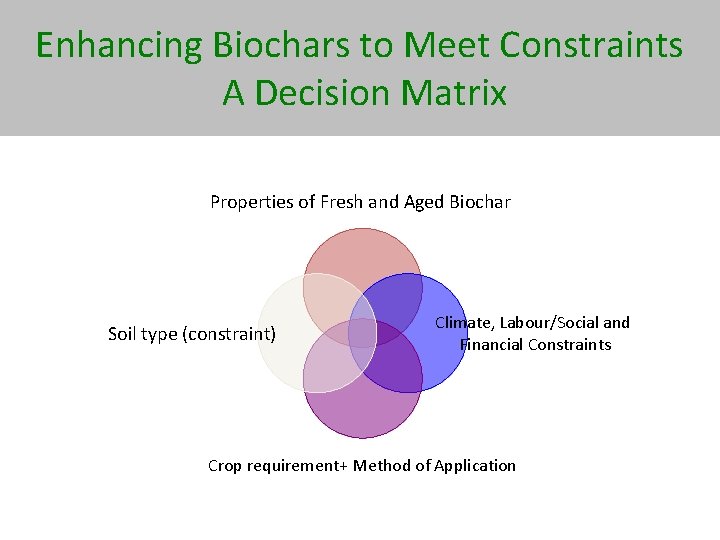
Enhancing Biochars to Meet Constraints A Decision Matrix Properties of Fresh and Aged Biochar Soil type (constraint) Climate, Labour/Social and Financial Constraints Crop requirement+ Method of Application
The Context 1. Most trials carried out with high application rates (> 2 tonnes/ha) with fine dusty material 2. Many commercial biochars are expensive (>$300/tonne) 3. Most unprocessed biochars difficult to apply 4. Results in terms of yields have been variable 5. Very few economic studies and many of those indicate marginal or no financial benefits to farmers.
Criteria for Fit For Purpose Engineered Biochars 1. Utilise local resources as much as possible 2. Can be applied at a rate that increases farmer profits through increasing yield and/or reducing fertiliser/water/pesticide/labour requirements. 3. Improve profitability for biochar producer by selling a higher value product that provides benefits at low application rates 4. Meets national objective such as reduction in greenhouse gas emissions, heavy metal uptake, eutrophication, increase local employment, reduce expenditure on imported fertiliser
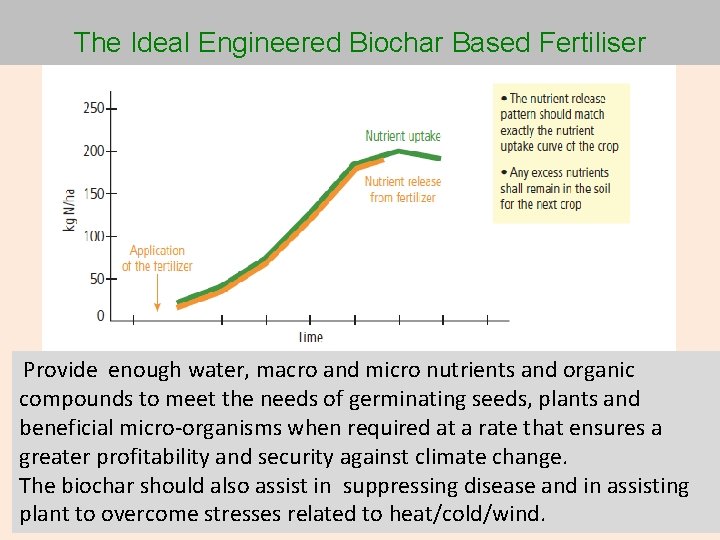
The Ideal Engineered Biochar Based Fertiliser suppressing diseaase Provide enough water, macro and micro nutrients and organic compounds to meet the needs of germinating seeds, plants and beneficial micro-organisms when required at a rate that ensures a greater profitability and security against climate change. The biochar should also assist in suppressing disease and in assisting plant to overcome stresses related to heat/cold/wind.
Why Do We Enhance Biochars; General Objectives 1. To increase the return to the farmer through either increasing yield and reducing labour requirements 2. To improve the profitability for the producer of the biochar 3. To improve the effectiveness of the biochar for a specific use.
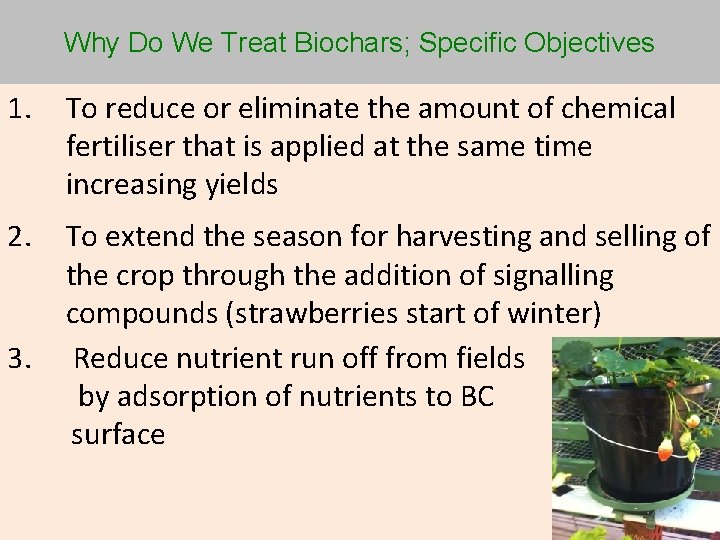
Why Do We Treat Biochars; Specific Objectives 1. To reduce or eliminate the amount of chemical fertiliser that is applied at the same time increasing yields 2. To extend the season for harvesting and selling of the crop through the addition of signalling compounds (strawberries start of winter) Reduce nutrient run off from fields by adsorption of nutrients to BC surface 3.
Why Do We Treat Biochars; Specific Objectives 1. To improve specific soil properties such as water holding capacity, p. H, soil carbon, porosity, bulk density 2. Increase resistance of plants and animals to disease or other stresses 3. To reduce take up of heavy metals by plants
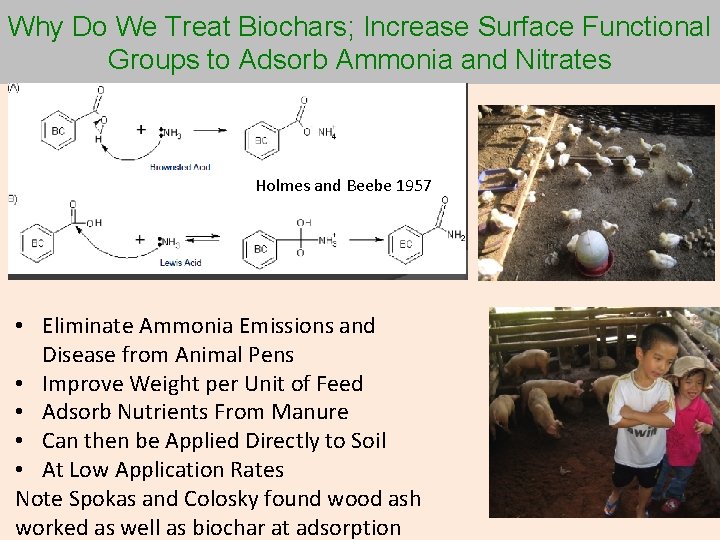
Why Do We Treat Biochars; Increase Surface Functional Groups to Adsorb Ammonia and Nitrates Ho Holmes and Beebe 1957 Holmes • Eliminate Ammonia Emissions and Disease from Animal Pens • Improve Weight per Unit of Feed • Adsorb Nutrients From Manure • Can then be Applied Directly to Soil • At Low Application Rates Note Spokas and Colosky found wood ash worked as well as biochar at adsorption
Why Do We Treat Biochars; Specific Objectives 1. To increase the concentration of beneficial micro-organisms especially non nodularising nitrogen fixers and make P available 2. To make specific nutrients more available that are locked up in soils especially P 3. To increase the ability to adsorb ammonia and other harmful gases and liquids in animal pens, toilets and biodigestors
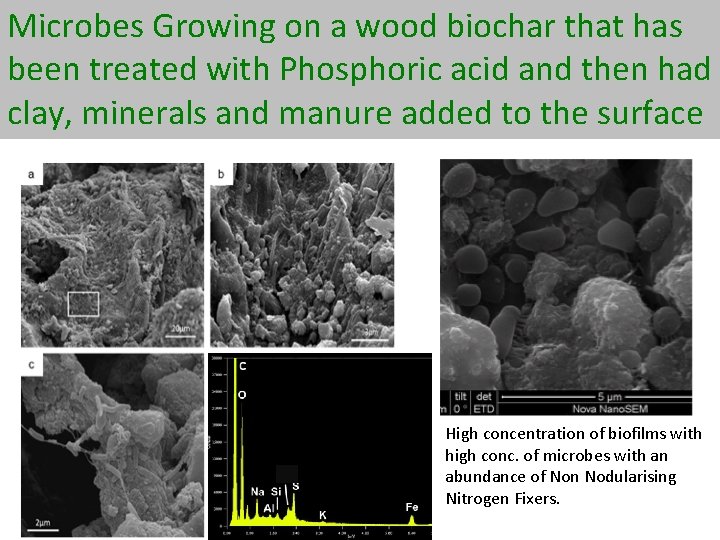
Microbes Growing on a wood biochar that has been treated with Phosphoric acid and then had clay, minerals and manure added to the surface High concentration of biofilms with high conc. of microbes with an abundance of Non Nodularising Nitrogen Fixers.
: Methods of Pretreatment of Mixed Biomass Feed • Mix Biomass with wet high iron bearing clay, iron sulphate, ash, other minerals as needed • Partial aerobic composting with minerals and wet manure; • Soaking in nutrient rich ponds and solar drying • Passing nutrient rich liquid through a biofilter Note; Some species of wood and bamboo are the most effective at soaking up nutrients
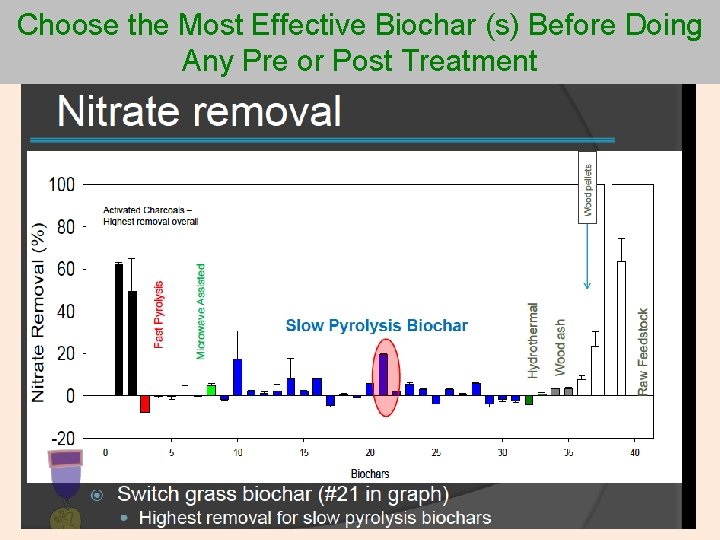
Choose the Most Effective Biochar (s) Before Doing Any Pre or Post Treatment
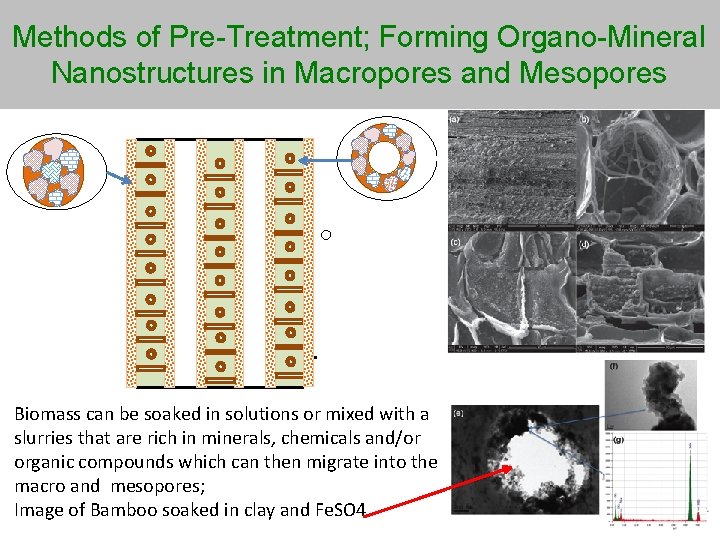
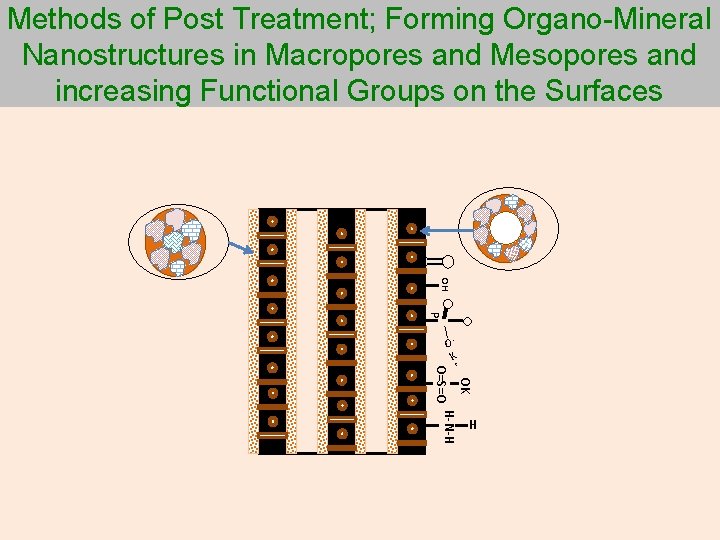
Methods of Pre-Treatment; Forming Organo-Mineral Nanostructures in Macropores and Mesopores Biomass can be soaked in solutions or mixed with a slurries that are rich in minerals, chemicals and/or organic compounds which can then migrate into the macro and mesopores; Image of Bamboo soaked in clay and Fe. SO 4
: Methods of Pretreatment of Mixed Biomass Feed 1. Mixing with a phosphorous rich acid or a potassium rich alkali, 2. Adding small amounts of urea, KCl and or DAP with an expanding clay and adjusting p. H to 7. The clay helps to prevent loss of N 3. Coating the biomass in a slurry of manure, clay, ash and rock dust
: Key Points; Biochar Can Act as a Catalyst 1. Adding small amounts of pre and post treated biochar (<150 kg/ha) can have a larger affect especially if added with NPK 2. Pretreteated Biochar can improve the quality and effectiveness of compost if added at around 500 kg/ha 3. Ash that is high in Amorphous Silica seems to promote plant resistance to stress and also is involved in locking up heavy metals. In rice systems if appears associated with fungal growth
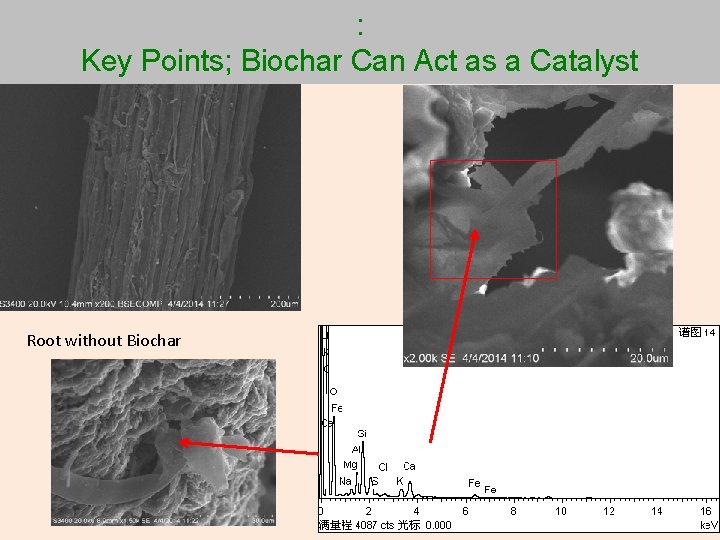
: Key Points; Biochar Can Act as a Catalyst Root without Biochar
: Key Points; Biochar Can Act as a Catalyst 1. Ash that is high in Amorphous Silica seems to promote plant resistance to stress and also is involved in locking up heavy metals. 2. Nanophase iron (Fe) particles appear to be very important in a range of biotic and abiotic processes involved in making N and P more available to plants 3. Fungi may migrate to pores that have high contents of P Ca, Clay and also K(need more evidence)
Why do We Make Biochar From Mixed Feed Stock, Clay, Ash and Rock Dust • To increase the amount and range of macro (NPK) and micro nutrients. • Some clays can increase the Cation Exchange Capacity by increasing the number of acid functional groups • To increase the yield of the biochar by condensing smoke on the surface of the clay and other minerals • To provide a range of smoke water chemicals (phenols, ketones, carboxylic acids) for increased germination and resistance to disease
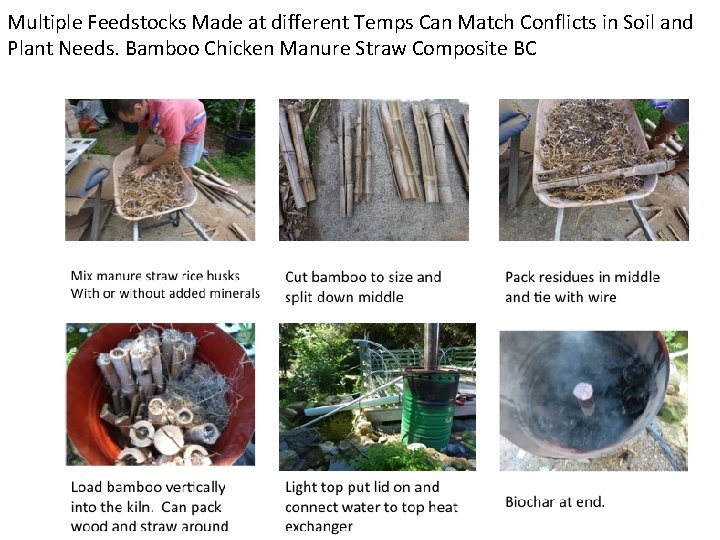
Multiple Feedstocks Made at different Temps Can Match Conflicts in Soil and Plant Needs. Bamboo Chicken Manure Straw Composite BC
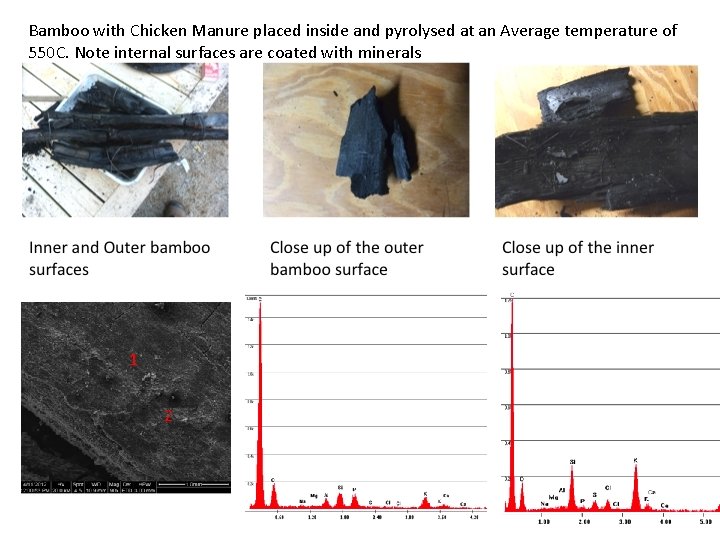
Bamboo with Chicken Manure placed inside and pyrolysed at an Average temperature of 550 C. Note internal surfaces are coated with minerals 1 2
Long Term Field Testing of Wood, Rice Straw Rice Husks Clay Activated Biochar with NPK or Compost and NPK ; Hypotheses • Significant increase in yields with reduced greenhouse gas emissions can be achieved by adding small quantities of biochar made from mixed feedstock applied with NPK when applied to sandy loam soils • Making compost with 5% biochar (250 kg/ha) and applying at 5 tonnes/ha with NPK every crop cycle will result in an increase in yield an increase in organic carbon. • Addition of 50% of farmer practice of NPK plus with biochar can achieve the same rice yield as adding 100% NPK.
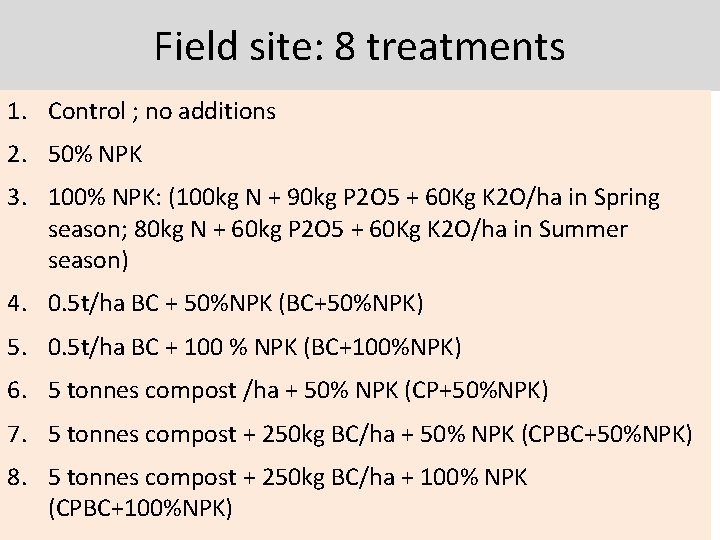
Field site: 8 treatments 1. Control ; no additions 2. 50% NPK 3. 100% NPK: (100 kg N + 90 kg P 2 O 5 + 60 Kg K 2 O/ha in Spring season; 80 kg N + 60 kg P 2 O 5 + 60 Kg K 2 O/ha in Summer season) 4. 0. 5 t/ha BC + 50%NPK (BC+50%NPK) 5. 0. 5 t/ha BC + 100 % NPK (BC+100%NPK) 6. 5 tonnes compost /ha + 50% NPK (CP+50%NPK) 7. 5 tonnes compost + 250 kg BC/ha + 50% NPK (CPBC+50%NPK) 8. 5 tonnes compost + 250 kg BC/ha + 100% NPK (CPBC+100%NPK)
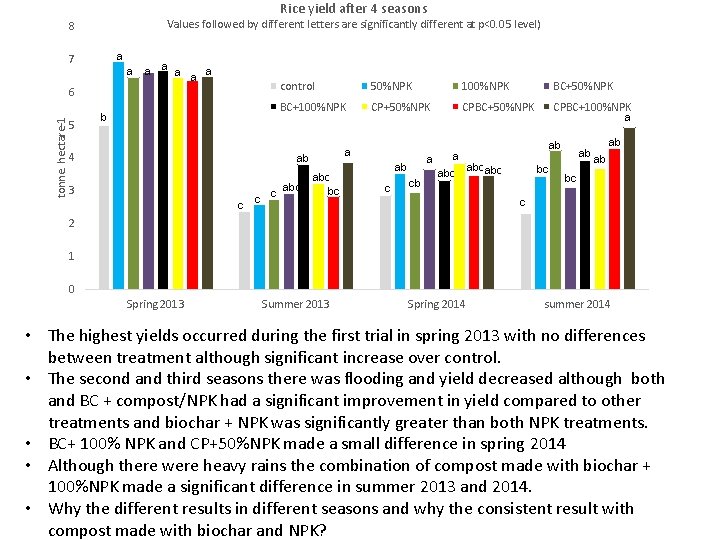
Rice yield after 4 seasons Values followed by different letters are significantly different at p<0. 05 level) 8 a 7 a a a tonne. hectare-1 6 5 b 4 control 50%NPK 100%NPK BC+50%NPK BC+100%NPK CP+50%NPK CPBC+100%NPK a ab 3 c c c abc bc a ab c cb a abc a ab abcabc bc ab ab ab bc c 2 1 0 Spring 2013 Summer 2013 Spring 2014 summer 2014 • The highest yields occurred during the first trial in spring 2013 with no differences between treatment although significant increase over control. • The second and third seasons there was flooding and yield decreased although both and BC + compost/NPK had a significant improvement in yield compared to other treatments and biochar + NPK was significantly greater than both NPK treatments. • BC+ 100% NPK and CP+50%NPK made a small difference in spring 2014 • Although there were heavy rains the combination of compost made with biochar + 100%NPK made a significant difference in summer 2013 and 2014. • Why the different results in different seasons and why the consistent result with compost made with biochar and NPK?
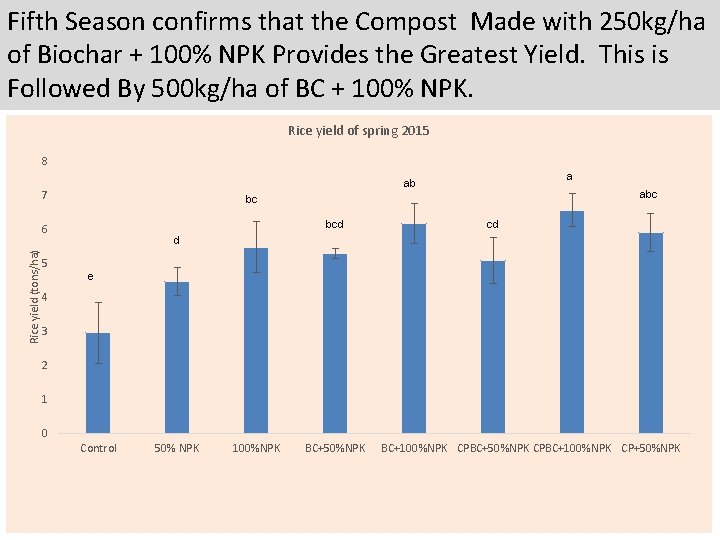
Fifth Season confirms that the Compost Made with 250 kg/ha of Biochar + 100% NPK Provides the Greatest Yield. This is Followed By 500 kg/ha of BC + 100% NPK. Rice yield of spring 2015 8 7 abc bc bcd 6 Rice yield (tons/ha) a ab cd d 5 e 4 3 2 1 0 Control 50% NPK 100%NPK BC+50%NPK BC+100%NPK CPBC+50%NPK CPBC+100%NPK CP+50%NPK
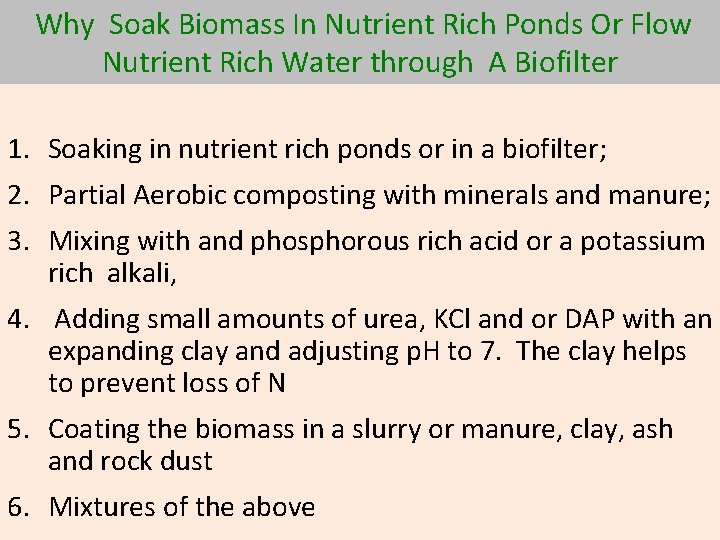
Why Soak Biomass In Nutrient Rich Ponds Or Flow Nutrient Rich Water through A Biofilter 1. Soaking in nutrient rich ponds or in a biofilter; 2. Partial Aerobic composting with minerals and manure; 3. Mixing with and phosphorous rich acid or a potassium rich alkali, 4. Adding small amounts of urea, KCl and or DAP with an expanding clay and adjusting p. H to 7. The clay helps to prevent loss of N 5. Coating the biomass in a slurry or manure, clay, ash and rock dust 6. Mixtures of the above
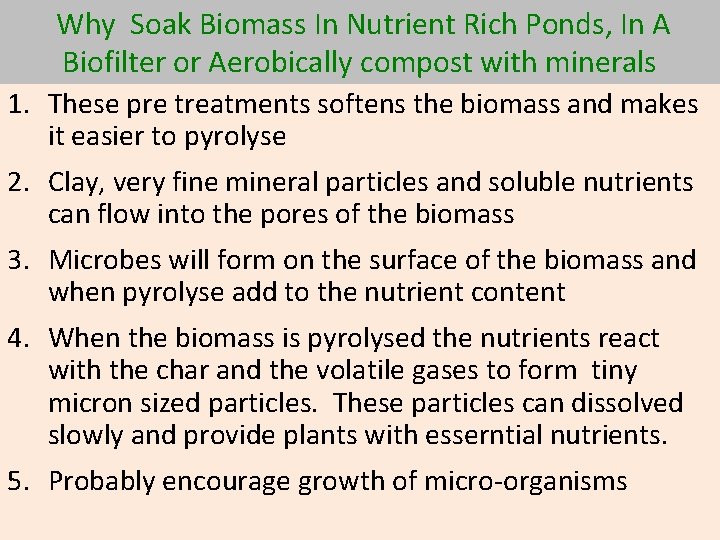
Why Soak Biomass In Nutrient Rich Ponds, In A Biofilter or Aerobically compost with minerals 1. These pre treatments softens the biomass and makes it easier to pyrolyse 2. Clay, very fine mineral particles and soluble nutrients can flow into the pores of the biomass 3. Microbes will form on the surface of the biomass and when pyrolyse add to the nutrient content 4. When the biomass is pyrolysed the nutrients react with the char and the volatile gases to form tiny micron sized particles. These particles can dissolved slowly and provide plants with esserntial nutrients. 5. Probably encourage growth of micro-organisms
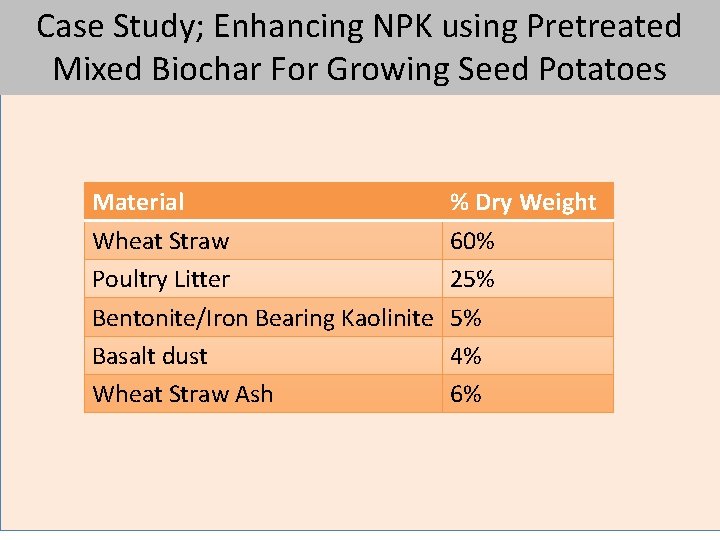
Case Study; Enhancing NPK using Pretreated Mixed Biochar For Growing Seed Potatoes Material Wheat Straw Poultry Litter Bentonite/Iron Bearing Kaolinite Basalt dust Wheat Straw Ash % Dry Weight 60% 25% 5% 4% 6%
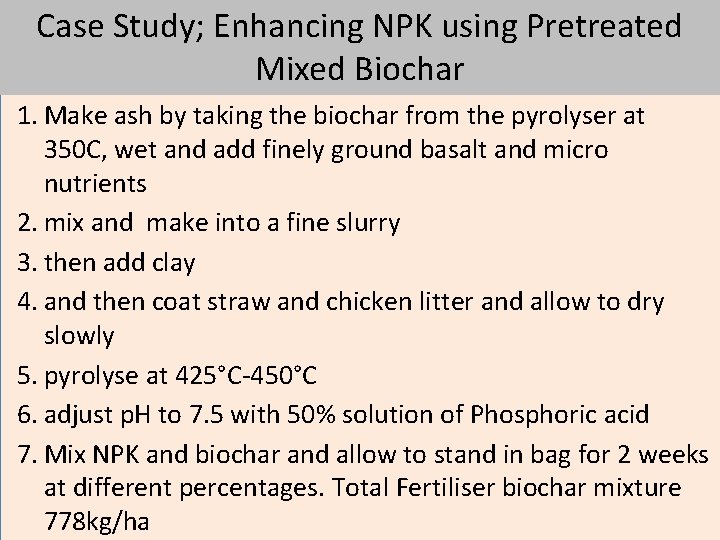
Case Study; Enhancing NPK using Pretreated Mixed Biochar 1. Make ash by taking the biochar from the pyrolyser at 350 C, wet and add finely ground basalt and micro nutrients 2. mix and make into a fine slurry 3. then add clay 4. and then coat straw and chicken litter and allow to dry slowly 5. pyrolyse at 425°C-450°C 6. adjust p. H to 7. 5 with 50% solution of Phosphoric acid 7. Mix NPK and biochar and allow to stand in bag for 2 weeks at different percentages. Total Fertiliser biochar mixture 778 kg/ha
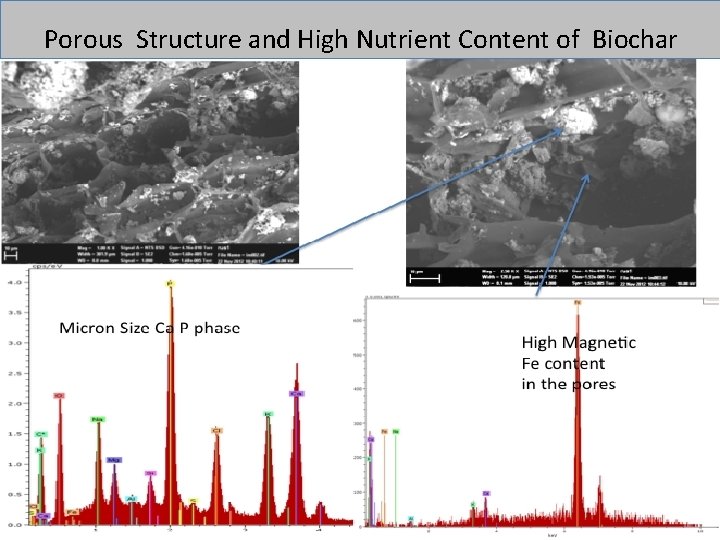
Porous Structure and High Nutrient Content of Biochar
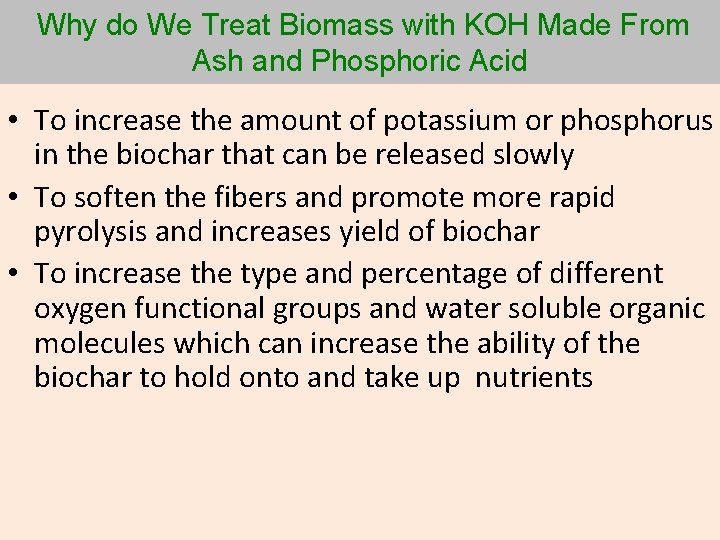
Why do We Treat Biomass with KOH Made From Ash and Phosphoric Acid • To increase the amount of potassium or phosphorus in the biochar that can be released slowly • To soften the fibers and promote more rapid pyrolysis and increases yield of biochar • To increase the type and percentage of different oxygen functional groups and water soluble organic molecules which can increase the ability of the biochar to hold onto and take up nutrients
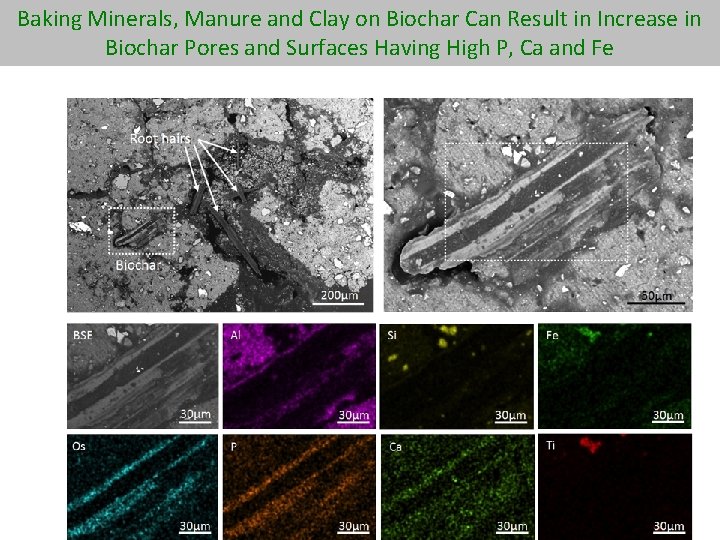
Baking Minerals, Manure and Clay on Biochar Can Result in Increase in Biochar Pores and Surfaces Having High P, Ca and Fe
Adding Urea, DAP, Rock Phosphate and or KCl with Clay to Biomass 1. To increase the concentration of macronutrients that will be slowly released. Note pyrolysis must be carried out at low temperature reduce loss of N 2. To Increase the Cation Exchange Capacity of the biochar and adsorb toxic metals and organic compounds 3. To potentially increase the stability of the biochar when Apatite is added
Adding Iron oxide (Rust) and or Bentonite of Kaolinitc Clay to Biomass 1)Improves the ability of biochar to adsorb and release plant available nutrients especially nitrates when biochars made at temperatures over 700 C and phosphates at temperatures of less than 425 C 2)With Iron makes biochar magnetic and helps to lock up heavy metals and toxic organic compounds and help reduce Greenhouse gas emissions 3)Can increase the CEC and stability of the biochar.
: Methods of Post - Treatment of Biochar • Activating the surface of the biochar by quenching biochar with fine mist of water in the pyrolyser has the following affect 1. Increases the cation exchange capacity of the biochar by increasing the number of COOH and C=O groups which in turn can increase the amount of nutrients that can be retained 2. Increases the surface area and pore volume for adsorption of water and nutrients
Methods of Post Treatment; Forming Organo-Mineral Nanostructures in Macropores and Mesopores and increasing Functional Groups on the Surfaces OH P OK OK O=S=O + H-N-H H
Adding mixture of clay, minerals, digestate, manure, ash to hot biochar • The manures and digestate provide additional N and P as well as a range of to the surface • The manures and digestate can also be food for micro-organisms. • The ash provides a range of micronutrients and usually K and Si and some P, Ca and Mg
: Methods of Post -treatment of Biochar • Feeding biochar to animals and then pelleting/granulating manure/biochar with clay, and other sources of micro and macronutrients • Composting the biochar and then removing biochar from compost and adding additional N and/or P liquid. • Boiling biochar in water and then filtering. Add biochar to the NPK fertiliser at about 10%. The ilquid is used as a foliar spray • Boil biochar with KOH and then add Phosphoric acid and Fe. SO 4
: Methods of Post -treatment of Biochar • Mixing biochar with clay, other minerals, KCl, urea, diamonium phosphate and allowing to stand in closed vessels. • Boiling biochar in water and then filtering. The liquid is used as a foliar spray. The biochar can then be further processed by adding into compost/acidified and/or mixed with source of N/P/K • Boil biochar with KOH and then add Phosphoric acid and Fe. SO 4 to produce a liquid fertiliser
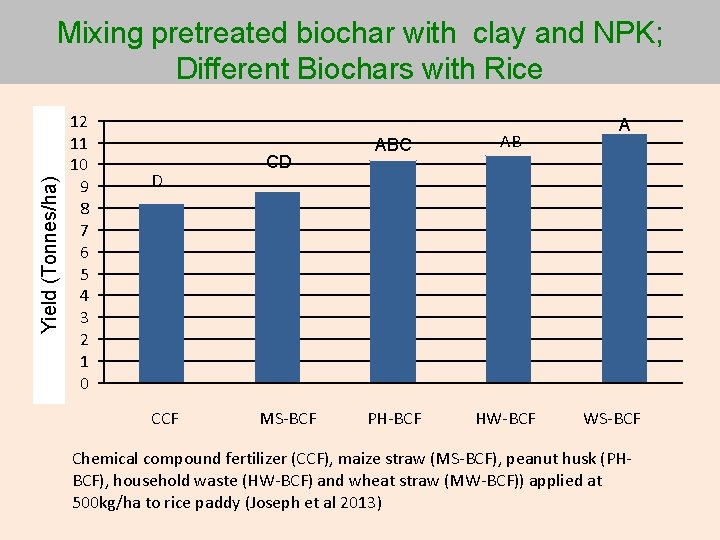
Yield (Tonnes/ha) Mixing pretreated biochar with clay and NPK; Different Biochars with Rice 12 11 10 9 8 7 6 5 4 3 2 1 0 D CCF CD MS-BCF ABC AB PH-BCF HW-BCF A WS-BCF Chemical compound fertilizer (CCF), maize straw (MS-BCF), peanut husk (PHBCF), household waste (HW-BCF) and wheat straw (MW-BCF)) applied at 500 kg/ha to rice paddy (Joseph et al 2013)
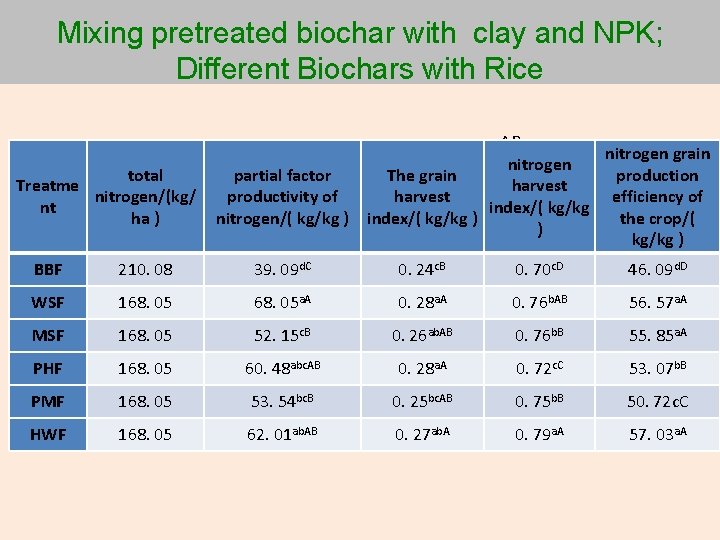
Mixing pretreated biochar with clay and NPK; Different Biochars with Rice total D Treatme nitrogen/(kg/ nt ha ) partial factor productivity of nitrogen/( kg/kg ) AB nitrogen grain nitrogen The grain production harvest efficiency of index/( kg/kg ) the crop/( ) kg/kg ) BBF 210. 08 39. 09 d. C 0. 24 c. B 0. 70 c. D 46. 09 d. D WSF 168. 05 a. A 0. 28 a. A 0. 76 b. AB 56. 57 a. A MSF 168. 05 52. 15 c. B 0. 26 ab. AB 0. 76 b. B 55. 85 a. A PHF 168. 05 60. 48 abc. AB 0. 28 a. A 0. 72 c. C 53. 07 b. B PMF 168. 05 53. 54 bc. B 0. 25 bc. AB 0. 75 b. B 50. 72 c. C HWF 168. 05 62. 01 ab. AB 0. 27 ab. A 0. 79 a. A 57. 03 a. A
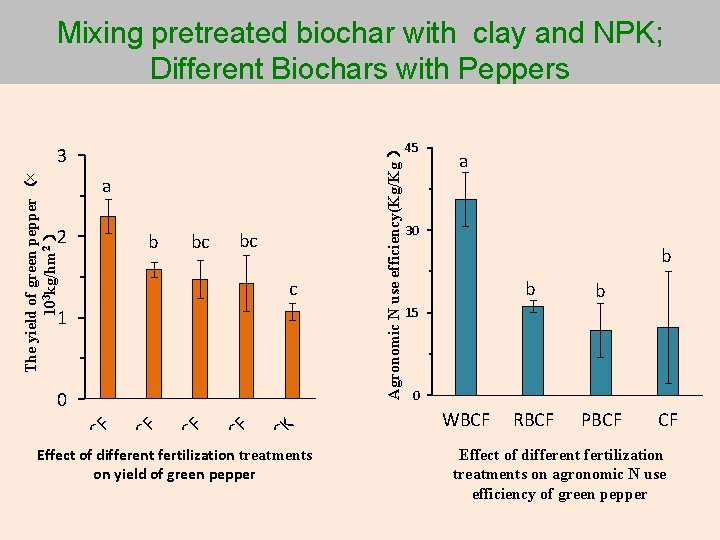
3 The yield of green pepper (× 103 kg/hm 2 ) a 2 b bc bc c 1 CK CF F PB C CF RB BC F 0 W Effect of different fertilization treatments on yield of green pepper Agronomic N use efficiency(Kg/Kg ) Mixing pretreated biochar with clay and NPK; Different Biochars with Peppers 45 a 30 b b b RBCF PBCF 15 0 WBCF CF Effect of different fertilization treatments on agronomic N use efficiency of green pepper
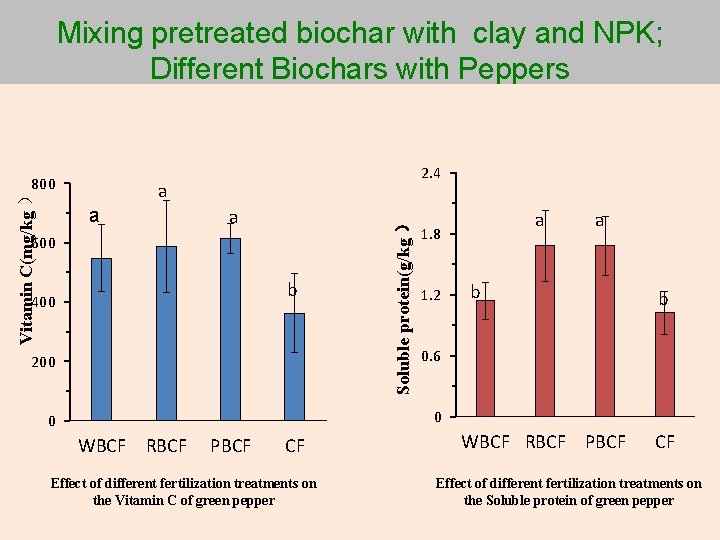
Mixing pretreated biochar with clay and NPK; Different Biochars with Peppers 2. 4 a a a 600 b 400 200 Soluble protein(g/kg ) Vitamin C(mg/kg ) 800 a 1. 8 1. 2 a b b 0. 6 0 0 WBCF RBCF PBCF CF Effect of different fertilization treatments on the Vitamin C of green pepper WBCF RBCF PBCF CF Effect of different fertilization treatments on the Soluble protein of green pepper
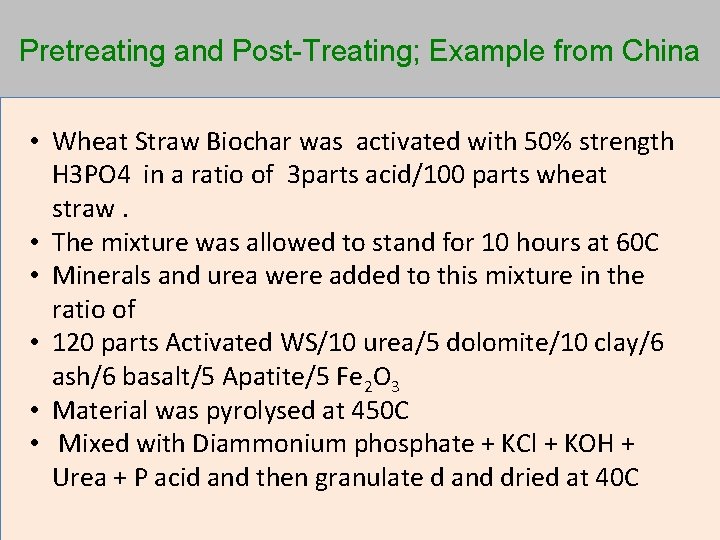
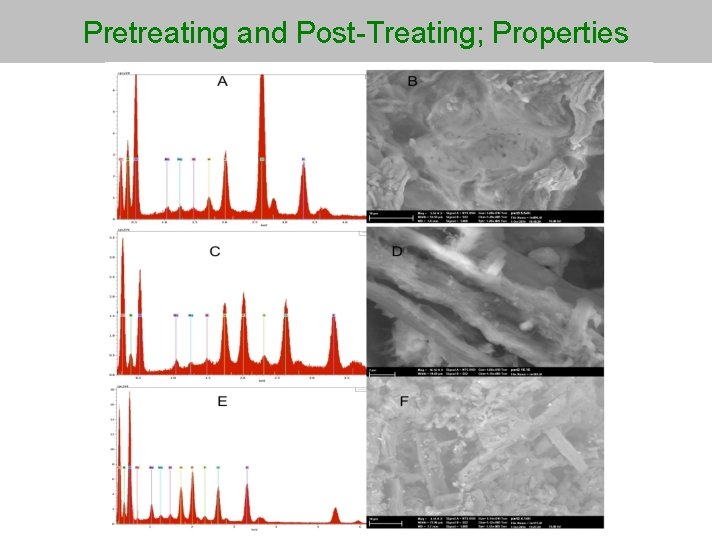
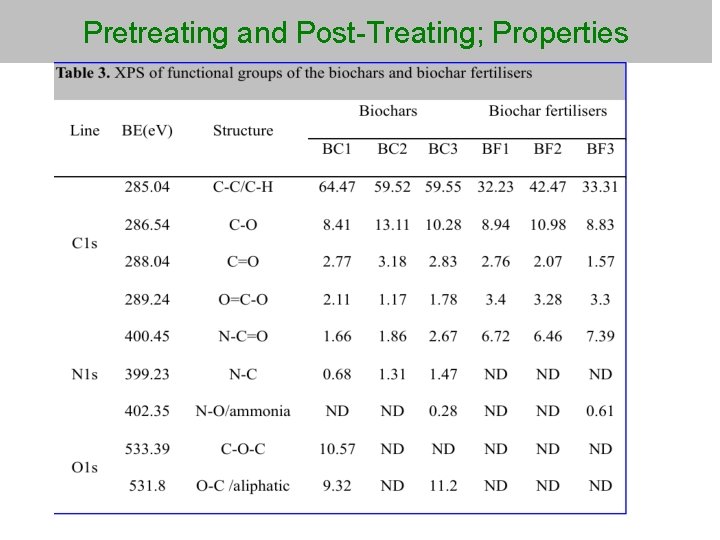
Pretreating and Post-Treating; Example from China • Wheat Straw Biochar was activated with 50% strength H 3 PO 4 in a ratio of 3 parts acid/100 parts wheat straw. • The mixture was allowed to stand for 10 hours at 60 C • Minerals and urea were added to this mixture in the ratio of • 120 parts Activated WS/10 urea/5 dolomite/10 clay/6 ash/6 basalt/5 Apatite/5 Fe 2 O 3 • Material was pyrolysed at 450 C • Mixed with Diammonium phosphate + KCl + KOH + Urea + P acid and then granulate d and dried at 40 C
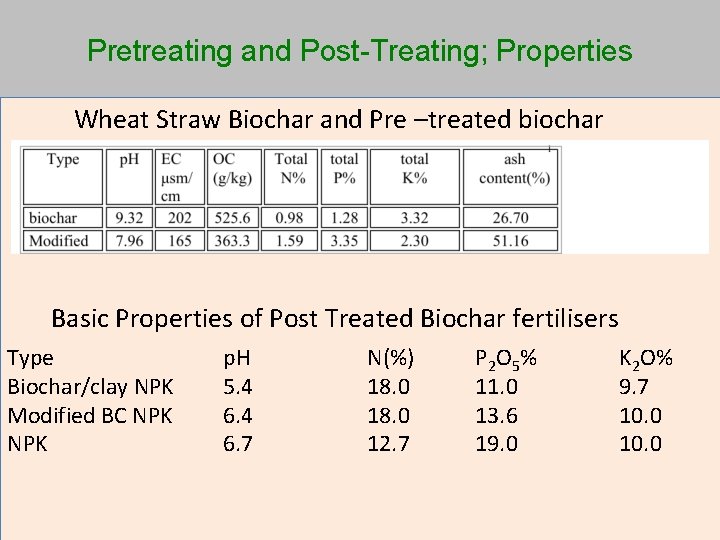
Pretreating and Post-Treating; Properties Wheat Straw Biochar and Pre –treated biochar Basic Properties of Post Treated Biochar fertilisers Type Biochar/clay NPK Modified BC NPK p. H 5. 4 6. 7 N(%) 18. 0 12. 7 P 2 O 5 % 11. 0 13. 6 19. 0 K 2 O% 9. 7 10. 0
Pretreating and Post-Treating; Properties
Pretreating and Post-Treating; Properties
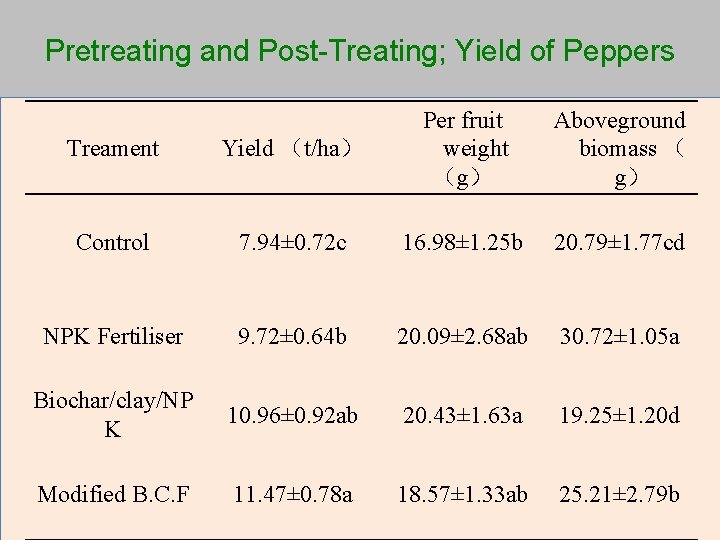
Pretreating and Post-Treating; Yield of Peppers Treament Yield (t/ha) Per fruit weight (g) Aboveground biomass ( g) Control 7. 94± 0. 72 c 16. 98± 1. 25 b 20. 79± 1. 77 cd NPK Fertiliser 9. 72± 0. 64 b 20. 09± 2. 68 ab 30. 72± 1. 05 a Biochar/clay/NP K 10. 96± 0. 92 ab 20. 43± 1. 63 a 19. 25± 1. 20 d Modified B. C. F 11. 47± 0. 78 a 18. 57± 1. 33 ab 25. 21± 2. 79 b
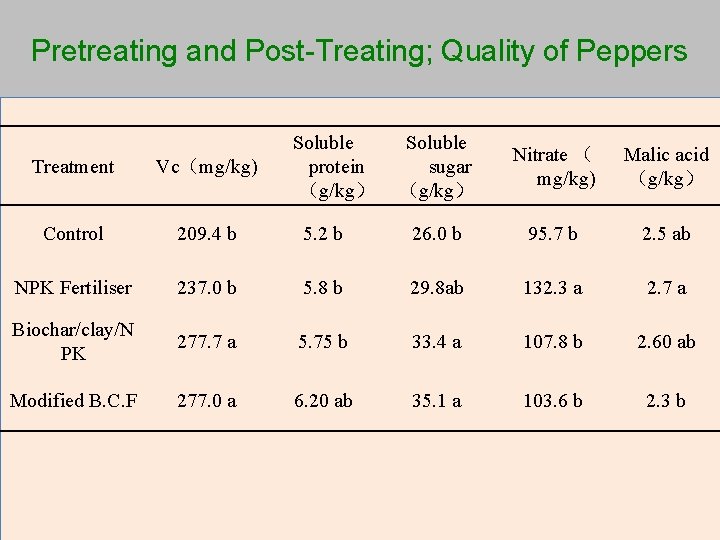
Pretreating and Post-Treating; Quality of Peppers Soluble protein (g/kg) Soluble sugar (g/kg) Nitrate ( mg/kg) Malic acid (g/kg) Treatment Vc(mg/kg) Control 209. 4 b 5. 2 b 26. 0 b 95. 7 b 2. 5 ab NPK Fertiliser 237. 0 b 5. 8 b 29. 8 ab 132. 3 a 2. 7 a Biochar/clay/N PK 277. 7 a 5. 75 b 33. 4 a 107. 8 b 2. 60 ab Modified B. C. F 277. 0 a 6. 20 ab 35. 1 a 103. 6 b 2. 3 b
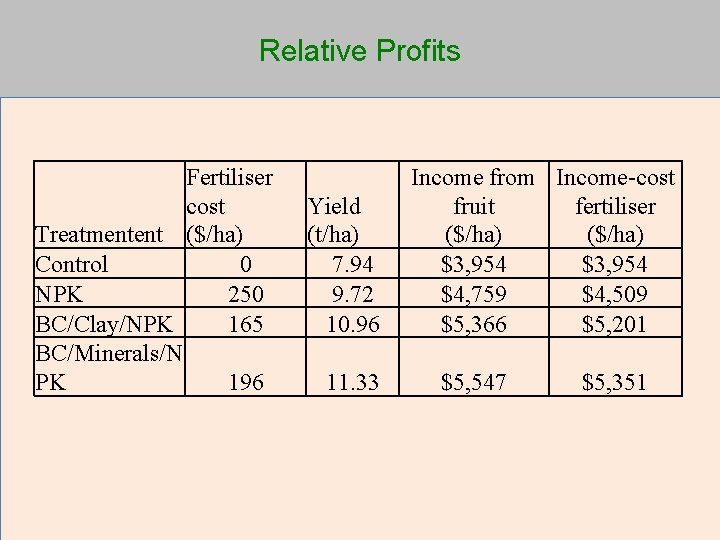
Relative Profits Fertiliser cost Treatmentent ($/ha) Control 0 NPK 250 BC/Clay/NPK 165 BC/Minerals/N PK 196 Yield (t/ha) 7. 94 9. 72 10. 96 11. 33 Income from Income-cost fruit fertiliser ($/ha) $3, 954 $4, 759 $4, 509 $5, 366 $5, 201 $5, 547 $5, 351
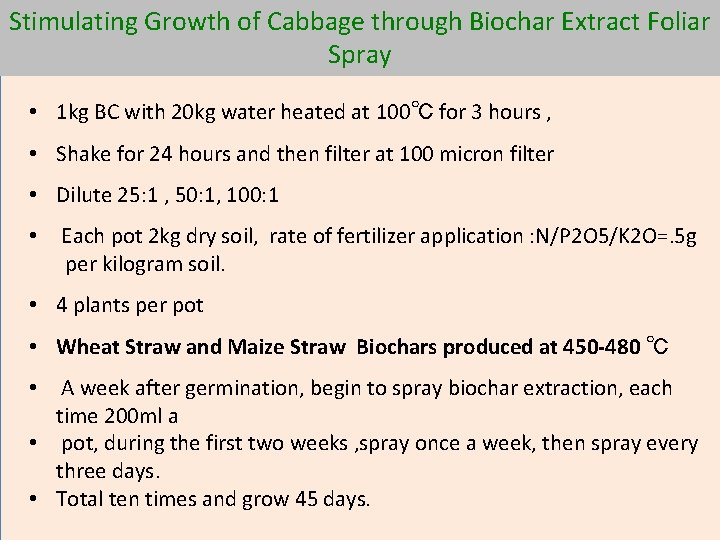
Stimulating Growth of Cabbage through Biochar Extract Foliar Spray • 1 kg BC with 20 kg water heated at 100℃ for 3 hours , • Shake for 24 hours and then filter at 100 micron filter • Dilute 25: 1 , 50: 1, 100: 1 • Each pot 2 kg dry soil, rate of fertilizer application : N/P 2 O 5/K 2 O=. 5 g per kilogram soil. • 4 plants per pot • Wheat Straw and Maize Straw Biochars produced at 450 -480 ℃ A week after germination, begin to spray biochar extraction, each time 200 ml a • pot, during the first two weeks , spray once a week, then spray every three days. • Total ten times and grow 45 days. •
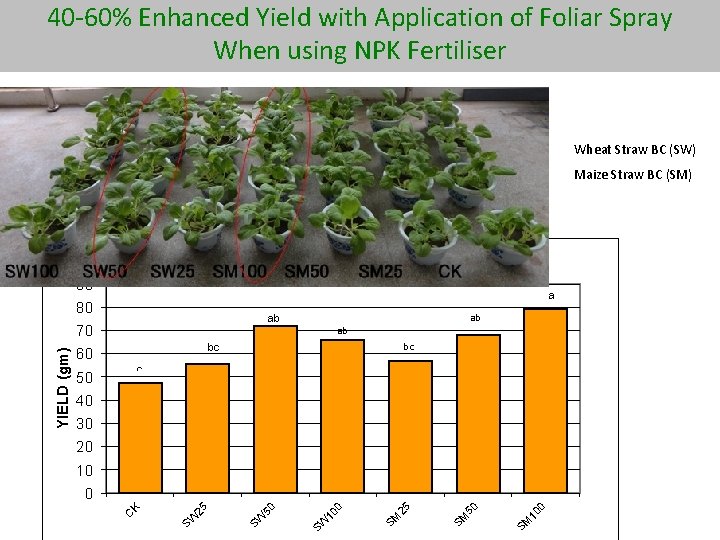
40 -60% Enhanced Yield with Application of Foliar Spray When using NPK Fertiliser Wheat Straw BC (SW) Maize Straw BC (SM) 90 a 80 ab bc bc 60 c 50 40 30 20 10 SM 50 SM 25 SM 0 10 SW 50 SW 25 SW K 0 C YIELD (gm) 70 ab ab
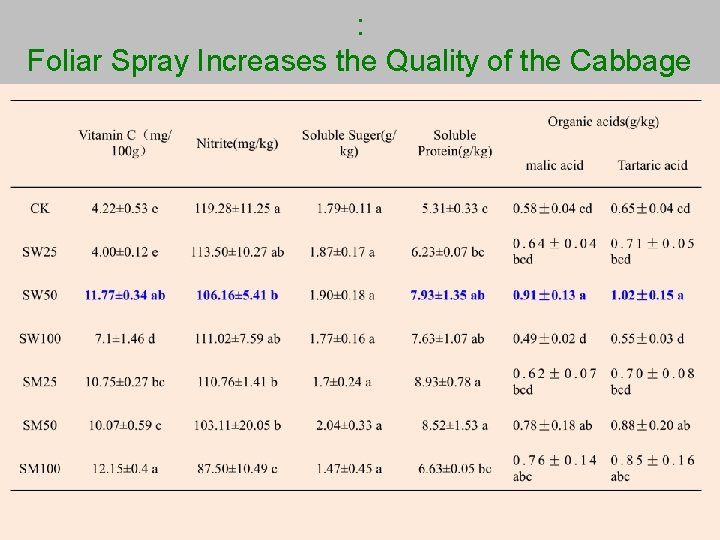
: Foliar Spray Increases the Quality of the Cabbage
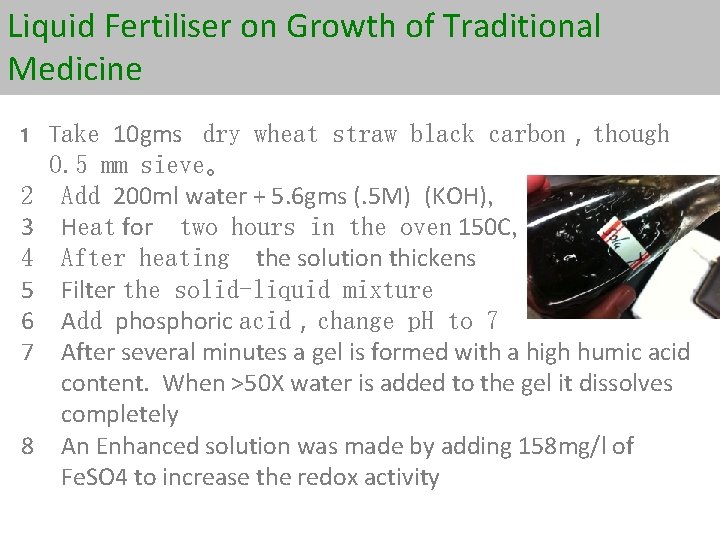
Liquid Fertiliser on Growth of Traditional Medicine 1 2 3 4 5 6 7 8 Take 10 gms dry wheat straw black carbon,though 0. 5 mm sieve。 Add 200 ml water + 5. 6 gms (. 5 M) (KOH), Heat for two hours in the oven 150 C, After heating the solution thickens Filter the solid-liquid mixture Add phosphoric acid,change p. H to 7 After several minutes a gel is formed with a high humic acid content. When >50 X water is added to the gel it dissolves completely An Enhanced solution was made by adding 158 mg/l of Fe. SO 4 to increase the redox activity
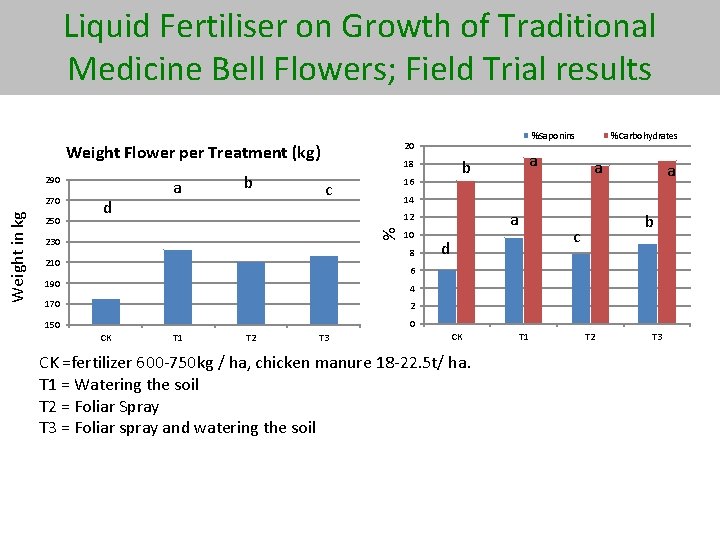
Liquid Fertiliser on Growth of Traditional Medicine Bell Flowers; Field Trial results Weight Flower per Treatment (kg) 290 250 d a b 16 c 10 8 210 %Carbohydrates a a 14 a 12 230 a b 18 % Weight in kg 270 %Saponins 20 b c d 6 190 4 170 2 150 0 CK T 1 T 2 T 3 CK CK =fertilizer 600 -750 kg / ha, chicken manure 18 -22. 5 t/ ha. T 1 = Watering the soil T 2 = Foliar Spray T 3 = Foliar spray and watering the soil T 1 T 2 T 3
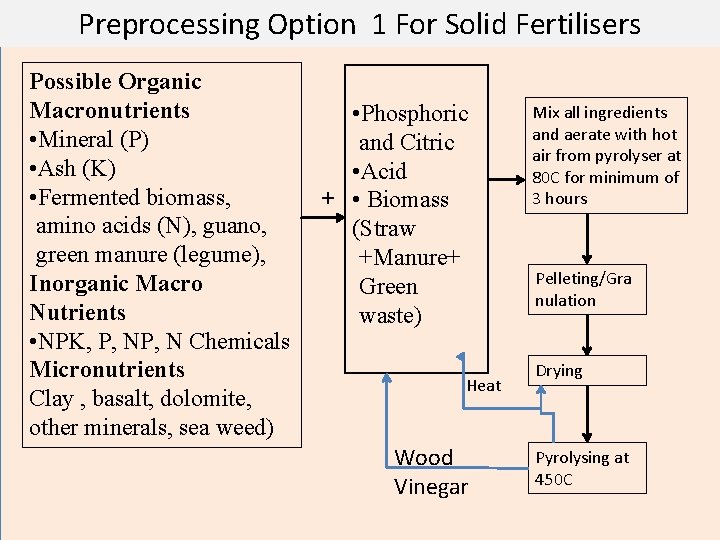
Preprocessing Option 1 For Solid Fertilisers Possible Organic Macronutrients • Mineral (P) • Ash (K) • Fermented biomass, amino acids (N), guano, green manure (legume), Inorganic Macro Nutrients • NPK, P, N Chemicals Micronutrients Clay , basalt, dolomite, other minerals, sea weed) • Phosphoric and Citric • Acid + • Biomass (Straw +Manure+ Green waste) Heat Wood Vinegar Mix all ingredients and aerate with hot air from pyrolyser at 80 C for minimum of 3 hours Pelleting/Gra nulation Drying Pyrolysing at 450 C
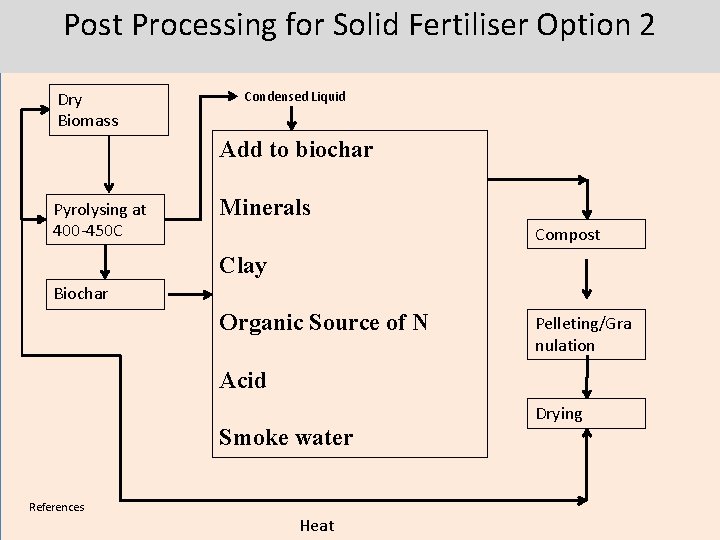
Post Processing for Solid Fertiliser Option 2 Dry Biomass Condensed Liquid Add to biochar Pyrolysing at 400 -450 C Minerals Compost Clay Biochar Organic Source of N Pelleting/Gra nulation Acid Smoke water References Heat Drying
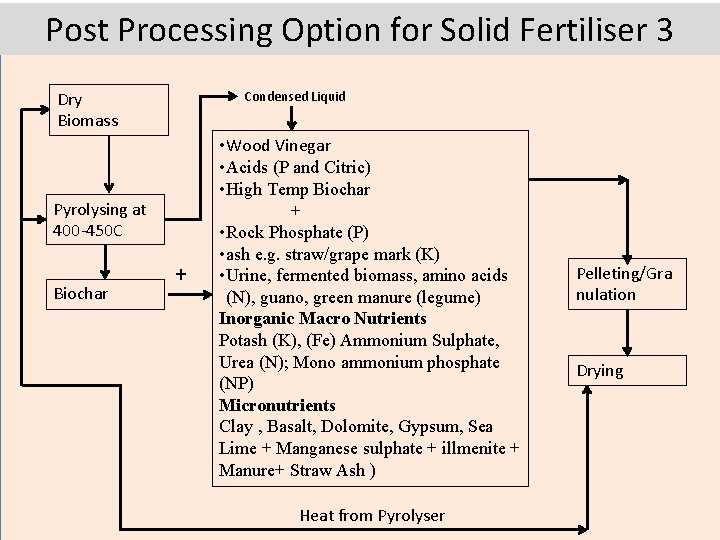
Post Processing Option for Solid Fertiliser 3 Dry Biomass Condensed Liquid Pyrolysing at 400 -450 C Biochar + • Wood Vinegar • Acids (P and Citric) • High Temp Biochar + • Rock Phosphate (P) • ash e. g. straw/grape mark (K) • Urine, fermented biomass, amino acids (N), guano, green manure (legume) Inorganic Macro Nutrients Potash (K), (Fe) Ammonium Sulphate, Urea (N); Mono ammonium phosphate (NP) Micronutrients Clay , Basalt, Dolomite, Gypsum, Sea Lime + Manganese sulphate + illmenite + Manure+ Straw Ash ) Heat from Pyrolyser Pelleting/Gra nulation Drying
- Slides: 58