
Enhancing the Educational Development of Individuals in Group

- Slides: 15
Enhancing the Educational Development of Individuals in Group Projects Paul Hermon Programme Director, Product Design & Development School of Mechanical and Aerospace Engineering 5 th International CDIO Conference Singapore Polytechnic 7 - 10 June 2009
Overview • CDIO Standard 5 • Integrated curriculum with group DBT projects at core of each year • Staged educational development • Mechanisms for enhancing learning • Observations
CDIO Standard 5 – Design Build Experiences A curriculum that includes two or more design-build experiences, including one at a basic level and one at an advanced level Armstrong, P. J. & Niewoehner, R. , The CDIO Approach to the Development of Student Skills and Attributes, 4 th International CDIO Conference (2008) Suggested that standard 5 should be extended to include a project based course in every year of a program and that these projects should progressively include more lifecycle stages in each year building towards the capstone
Educational Psychology Perry, W. G. , Forms of Ethical and Intellectual Development in the College Years: A Scheme, Holt, Rinehart, & Winston (1970) Cognitive development is a multi stage process with growth happening in major steps as a response to challenges just above the current level of ability. Csikszentmihalyi, M. , Flow – The Psychology of Optimal Experience, Harper & Row (1990) Defined a +1 principle of tasks of an appropriate level; between boredom, where no learning occurs and panic, where survival strategies rather than deep learning dominate.
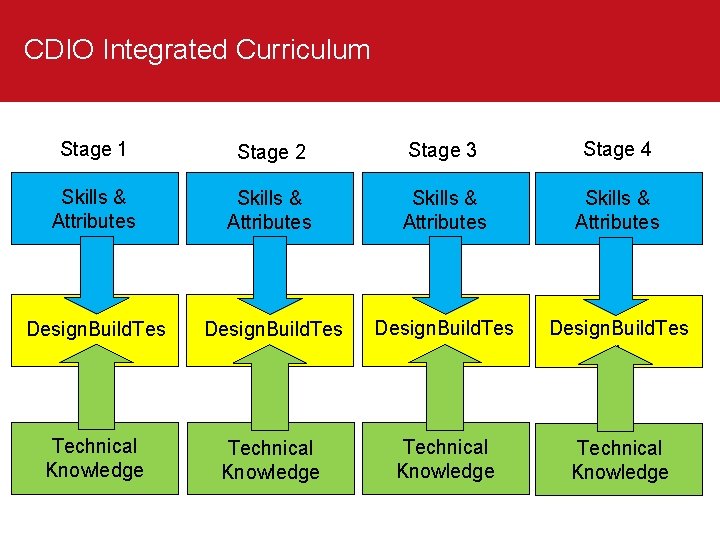
CDIO Integrated Curriculum Stage 1 Stage 2 Stage 3 Stage 4 Skills & Attributes Design. Build. Tes t Technical Knowledge
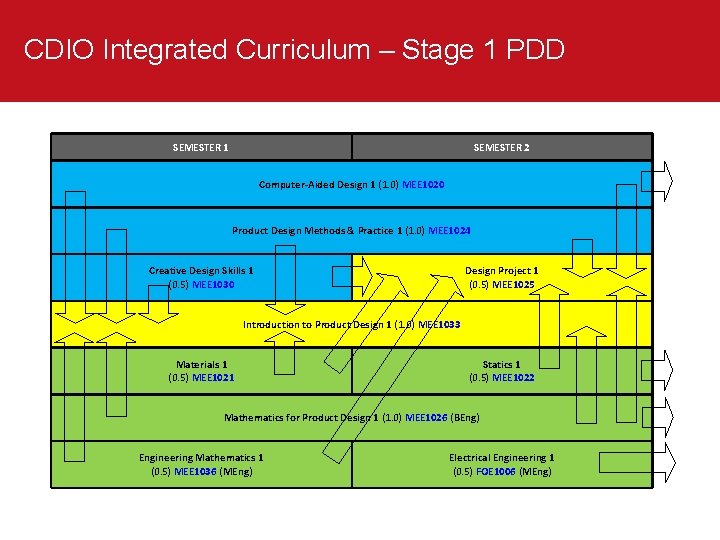
CDIO Integrated Curriculum – Stage 1 PDD SEMESTER 1 SEMESTER 2 Computer-Aided Design 1 (1. 0) MEE 1020 Product Design Methods & Practice 1 (1. 0) MEE 1024 Creative Design Skills 1 (0. 5) MEE 1030 Design Project 1 (0. 5) MEE 1025 Introduction to Product Design 1 (1. 0) MEE 1033 Materials 1 (0. 5) MEE 1021 Statics 1 (0. 5) MEE 1022 Mathematics for Product Design 1 (1. 0) MEE 1026 (BEng) Engineering Mathematics 1 (0. 5) MEE 1036 (MEng) Electrical Engineering 1 (0. 5) FOE 1006 (MEng)
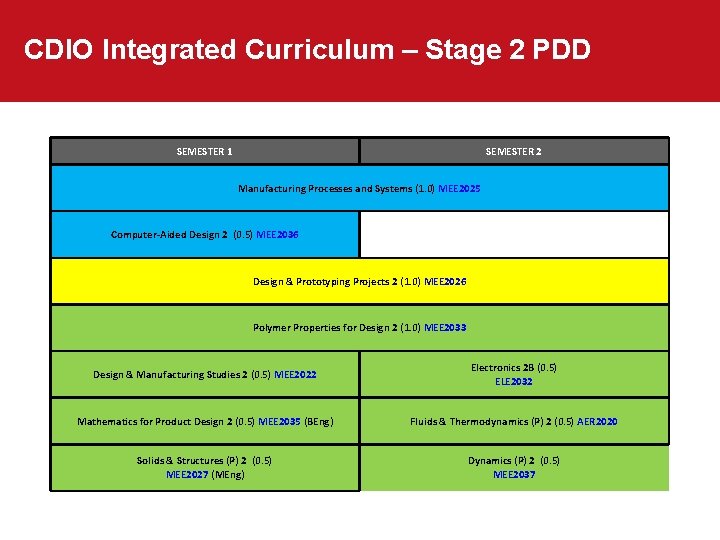
CDIO Integrated Curriculum – Stage 2 PDD SEMESTER 1 SEMESTER 2 Manufacturing Processes and Systems (1. 0) MEE 2025 Computer-Aided Design 2 (0. 5) MEE 2036 Design & Prototyping Projects 2 (1. 0) MEE 2026 Polymer Properties for Design 2 (1. 0) MEE 2033 Design & Manufacturing Studies 2 (0. 5) MEE 2022 Electronics 2 B (0. 5) ELE 2032 Mathematics for Product Design 2 (0. 5) MEE 2035 (BEng) Fluids & Thermodynamics (P) 2 (0. 5) AER 2020 Solids & Structures (P) 2 (0. 5) MEE 2027 (MEng) Dynamics (P) 2 (0. 5) MEE 2037
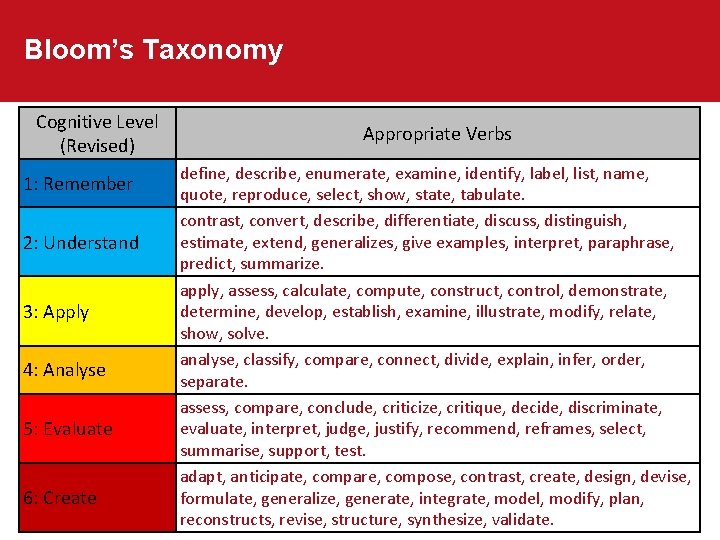
Bloom’s Taxonomy Cognitive Level (Revised) 1: Remember 2: Understand 3: Apply 4: Analyse 5: Evaluate 6: Create Appropriate Verbs define, describe, enumerate, examine, identify, label, list, name, quote, reproduce, select, show, state, tabulate. contrast, convert, describe, differentiate, discuss, distinguish, estimate, extend, generalizes, give examples, interpret, paraphrase, predict, summarize. apply, assess, calculate, compute, construct, control, demonstrate, determine, develop, establish, examine, illustrate, modify, relate, show, solve. analyse, classify, compare, connect, divide, explain, infer, order, separate. assess, compare, conclude, criticize, critique, decide, discriminate, evaluate, interpret, judge, justify, recommend, reframes, select, summarise, support, test. adapt, anticipate, compare, compose, contrast, create, design, devise, formulate, generalize, generate, integrate, model, modify, plan, reconstructs, revise, structure, synthesize, validate.
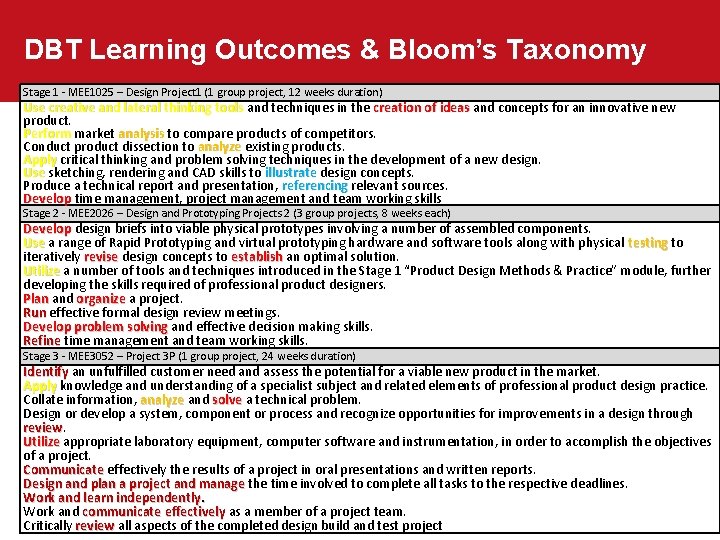
DBT Learning Outcomes & Bloom’s Taxonomy Stage 1 - MEE 1025 – Design Project 1 (1 group project, 12 weeks duration) Use creative and lateral thinking tools and techniques in the creation of ideas and concepts for an innovative new product. Perform market analysis to compare products of competitors. Conduct product dissection to analyze existing products. Apply critical thinking and problem solving techniques in the development of a new design. Use sketching, rendering and CAD skills to illustrate design concepts. Produce a technical report and presentation, referencing relevant sources. Develop time management, project management and team working skills Stage 2 - MEE 2026 – Design and Prototyping Projects 2 (3 group projects, 8 weeks each) Develop design briefs into viable physical prototypes involving a number of assembled components. Use a range of Rapid Prototyping and virtual prototyping hardware and software tools along with physical testing to iteratively revise design concepts to establish an optimal solution. Utilize a number of tools and techniques introduced in the Stage 1 “Product Design Methods & Practice” module, further developing the skills required of professional product designers. Plan and organize a project. Run effective formal design review meetings. Develop problem solving and effective decision making skills. Refine time management and team working skills. Stage 3 - MEE 3052 – Project 3 P (1 group project, 24 weeks duration) Identify an unfulfilled customer need and assess the potential for a viable new product in the market. Apply knowledge and understanding of a specialist subject and related elements of professional product design practice. Collate information, analyze and solve a technical problem. Design or develop a system, component or process and recognize opportunities for improvements in a design through review Utilize appropriate laboratory equipment, computer software and instrumentation, in order to accomplish the objectives of a project. Communicate effectively the results of a project in oral presentations and written reports. Design and plan a project and manage the time involved to complete all tasks to the respective deadlines. Work and learn independently. Work and communicate effectively as a member of a project team. Critically review all aspects of the completed design build and test project
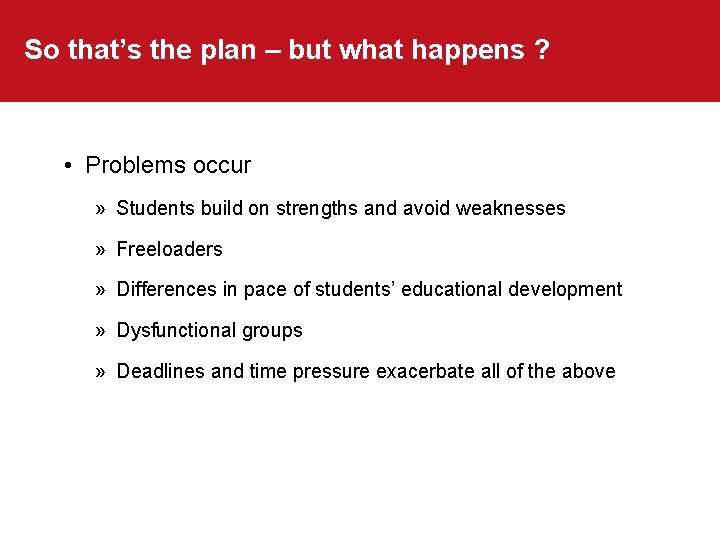
So that’s the plan – but what happens ? • Problems occur » Students build on strengths and avoid weaknesses » Freeloaders » Differences in pace of students’ educational development » Dysfunctional groups » Deadlines and time pressure exacerbate all of the above
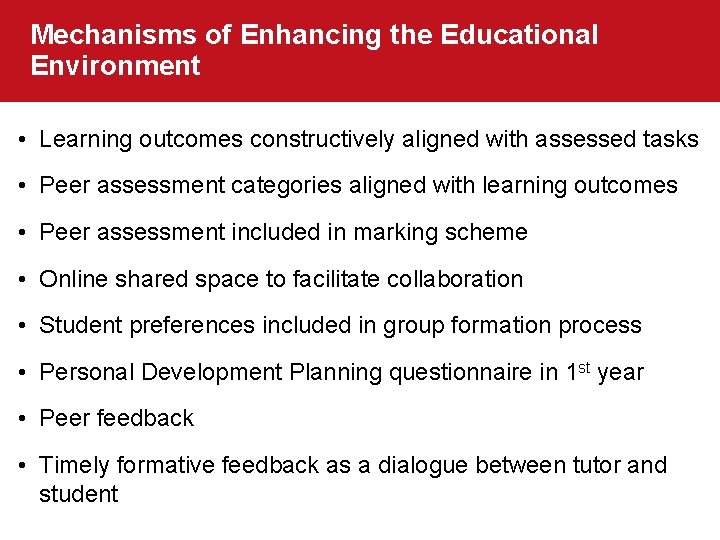
Mechanisms of Enhancing the Educational Environment • Learning outcomes constructively aligned with assessed tasks • Peer assessment categories aligned with learning outcomes • Peer assessment included in marking scheme • Online shared space to facilitate collaboration • Student preferences included in group formation process • Personal Development Planning questionnaire in 1 st year • Peer feedback • Timely formative feedback as a dialogue between tutor and student
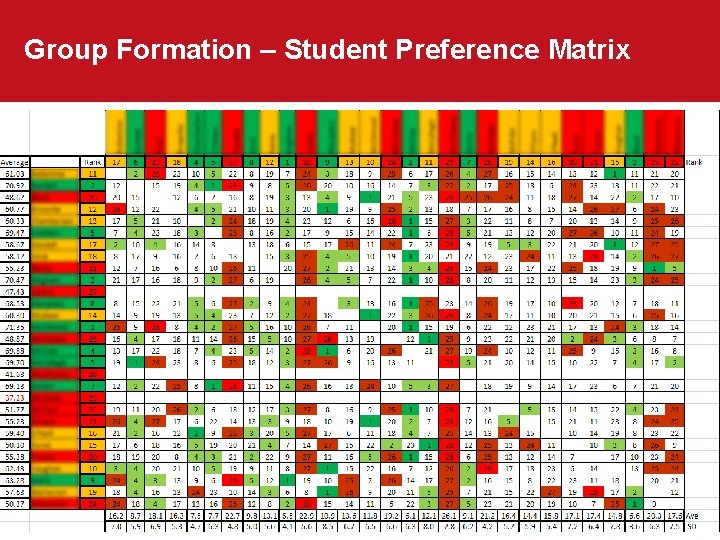
Group Formation – Student Preference Matrix
Personal Development Planning • Self assessment questionnaire • Students keep progress file • Focussed on skills and attributes • Personal tutor assistance • Plan of action, opportunities in curriculum • Responsibility for own learning • Develop CPD attitude
Observations • Building the curriculum is only the start • Continual critical review is necessary • Students respond well to efforts to improve their learning environment • Facilitators of learning not teachers in DBT projects