
Enhancing The Basic Crisis Intervention Team CIT Curriculum
Enhancing The Basic Crisis Intervention Team (CIT) Curriculum Nicholas Greco, M. S. , BCETS, CATSM, FAAETS – C 3 Education and Research, Inc. Lt. Antoinette Ursitti, Ed. D – Chicago Police Department Kasey Franco, M. A. – NAMI Chicago
Learning Objectives Identify CALEA and Law Enforcement Board Standards that enhance the Basic CIT Curriculum Summarize key areas for organizing a successful, comprehensive workgroup of subject matter experts to implement standards Explain how to integrate academic, law enforcement, and mental health perspectives into your workgroup Examine the workgroup process in two Basic CIT modules Recognize the positive outcomes of the workgroup process
Overview Basic CIT Curriculum Defined CPD Basic CIT Curriculum Matrix – 2018 CALEA Lesson Plans ILETSB Instructor Requirements, Instructional Goals, Student Performance Objectives CPD/NAMI Chicago Basic CIT Curriculum Proposal, Teams, Schedule, Logistics Industry Standards – Academic, Law Enforcement, Mental Health Workgroup Process for Two Modules Evaluating Positive Outcomes of Workgroup Questions
Basic CIT Curriculum Defined The Basic Crisis Intervention Team (CIT) Curriculum is a course designed to train officers in mental health awareness: Identify signs and symptoms of mental illness De-escalate situations involving individuals who appear to be experiencing a mental health crisis Connect individuals experiencing a mental health crisis to treatment
Basic CIT Curriculum Defined General Guidelines for Basic (CIT) Curriculum: “Memphis Model” Specialized Designation Length and Continuity of the Course Voluntary Participation
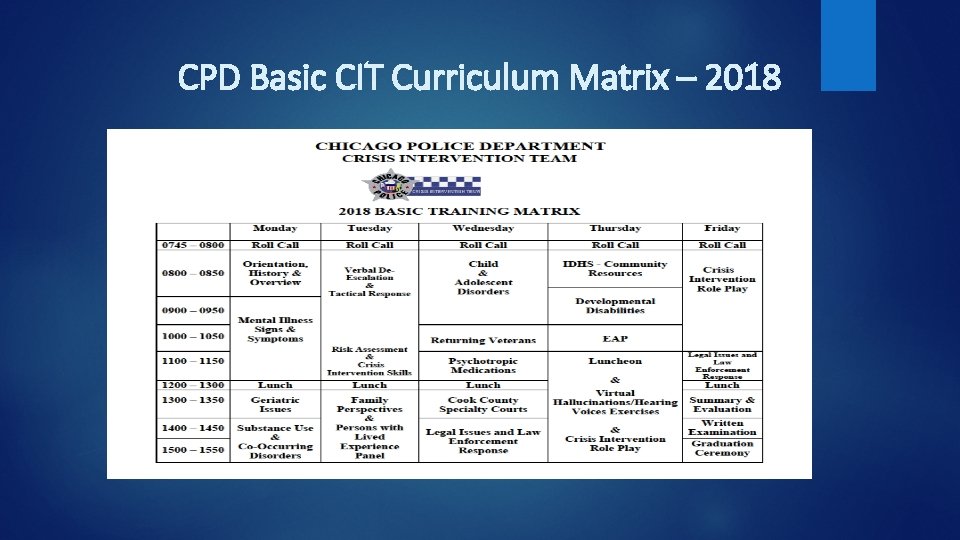
CPD Basic CIT Curriculum Matrix – 2018
CALEA Commission on Accreditation for Law Enforcement Agencies Improve law enforcement services by creating a national body of standards developed by law enforcement professionals Standards reflect current thinking and experience of law enforcement practitioners and researchers Recognized as benchmark for professional law enforcement agencies by: Major law enforcement associations Leading educational and training institutions Governmental agencies Law enforcement executives
CALEA – Lesson Plans Lesson Plan Requirements – 33. 1. 4 A statement of performance and job-related objectives; The content of the training and specification of the appropriate instructional techniques; A process for approval of lesson plans; Identification of any tests used in the training process
CALEA – Lesson Plans CPD Lesson Plans: Title Introduction Duration Development Materials, Equipment, Logistics Conclusion Required Learner’s Materials Ethical Supplement Methodology Instructor Tips and Clues Performance and Job-Related Objectives CPD Resources References Course Editorial History Evaluation and Assessment
ILETSB Illinois Law Enforcement Training and Standards Board (ILETSB) Crisis Intervention Team – Basic Curriculum – Version 1. 3 Developed and revised to meet requirements of the Illinois Police Training Act – 50 ILCS 705/10. 17 Curriculum Arrangement: Segment Title/Class Time Instructor Requirements Instructional Goal Student Performance Objective
CPD/NAMI Chicago Basic CIT Curriculum Proposal Identify and confirm subject matter expert teams for each module Establish Workgroup Schedule for Teams Phase I: Teams Review ILETSB Instructional Goal, ILETSB SPO’s, and Existing Curriculum Phase II: Teams submit draft Power. Point and Lesson Plans Phase III: Provide Team Feedback Phase IV: Submit Final Power. Point and Lesson Plans to Co-Chairs
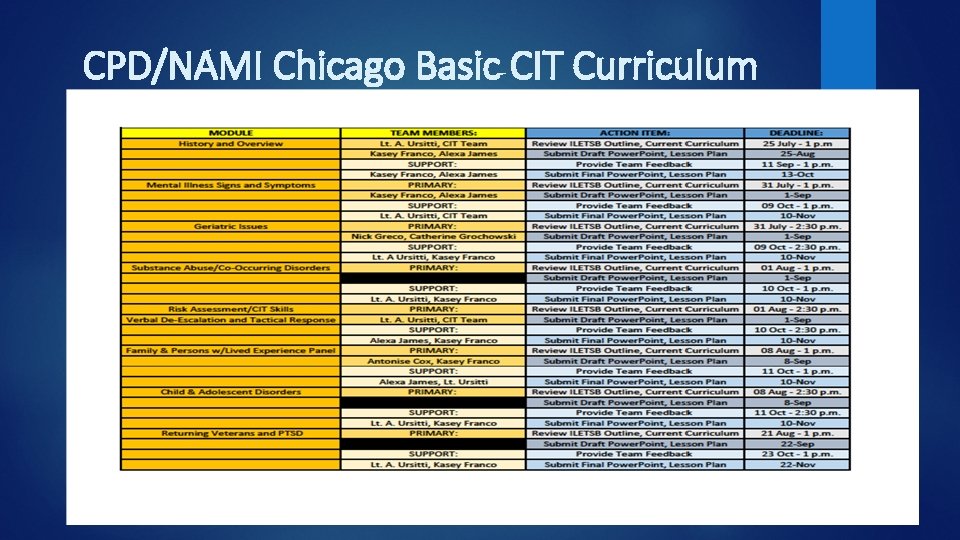
CPD/NAMI Chicago Basic CIT Curriculum
CPD/NAMI Chicago Basic CIT Curriculum Logistics Invitation Meeting location Agenda and booklet Flash drive with materials for participants Conference phone line Instructional Design and Quality Control Review Legal Review Submission to ILETSB
Industry Standards Academic: Methodology Appropriate for Target Audience Law Enforcement: ILETSB CALEA Mental Health: APA, DSM-5, PDR ILETSB, CALEA
Workgroup Process – Geriatric Issues Evaluated existing material by cross-checking ILETSB Instructional Goal, ILETSB SPO’s, and Existing Curriculum Topics updated: Normal aspects of aging Psychiatric Emergency criteria Agitation – exacerbation, late onset, and link to violence Substance abuse in older people Medical conditions leading to psychosis and delirium Wandering Communication techniques
Workgroup Process – Geriatric Issues Topics Eliminated: Certificate and Petition Overreliance on nonessential pictures Outdated data, graphs PET scans, MRI scans CPD specific policies Reorganization of entire PPT for flow and cohesion
Workgroup Process – Geriatric Issues Phase II: Teams submit draft Power. Point and Lesson Plans Regular meetings One person took the lead on PPT and lesson plan Division of work Phase III: Provide Team Feedback CPD and NAMI Phase IV: Submit Final Power. Point and Lesson Plans to Co-Chairs
Workgroup Process – Medical Conditions and Psychotropic Medications Evaluated existing material by cross-checking ILETSB Instructional Goal, ILETSB SPO’s, and Existing Curriculum Topics updated: Psychiatric medication updates Digestible material – e. g. neurotransmitters, EPS, TD, NMS Emphasis on medical conditions which can appear as mental illness Head injuries (TBI) Excited Delirium Treatments other than medication and importance of EMS transport
Workgroup Process – Medical Conditions and Psychotropic Medications No topics were eliminated Module was lean already and needed additions only Difficulty was maintaining presentation time restraints Module was in good shape so no major changes compared to Geriatric Issues Added enduring material Psychiatric Medication Quick List Brief articles
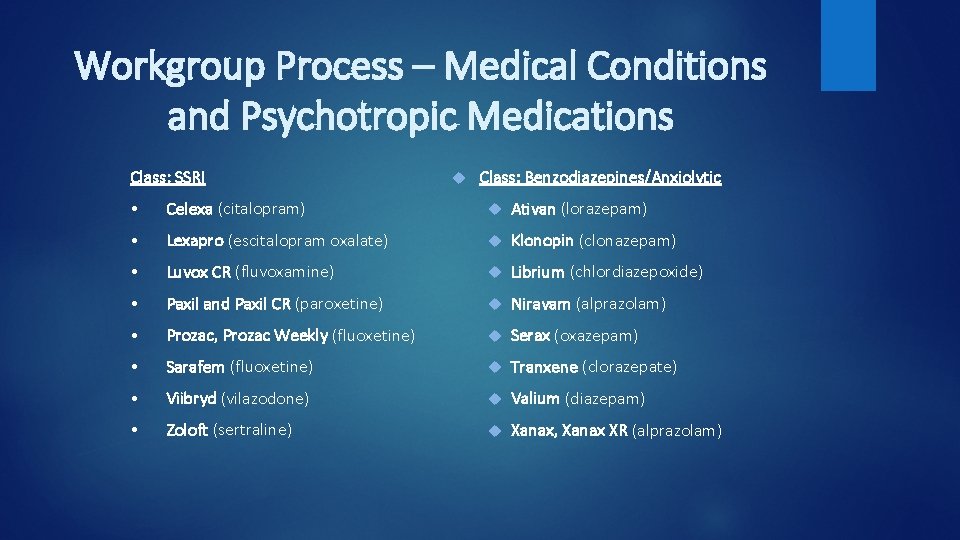
Workgroup Process – Medical Conditions and Psychotropic Medications Class: SSRI Class: Benzodiazepines/Anxiolytic • Celexa (citalopram) Ativan (lorazepam) • Lexapro (escitalopram oxalate) Klonopin (clonazepam) • Luvox CR (fluvoxamine) Librium (chlordiazepoxide) • Paxil and Paxil CR (paroxetine) Niravam (alprazolam) • Prozac, Prozac Weekly (fluoxetine) Serax (oxazepam) • Sarafem (fluoxetine) Tranxene (clorazepate) • Viibryd (vilazodone) Valium (diazepam) • Zoloft (sertraline) Xanax, Xanax XR (alprazolam)
Workgroup Process – Medical Conditions and Psychotropic Medications Phase II: Teams submit draft Power. Point and Lesson Plans Regular meetings One person took the lead on PPT and lesson plan Utilized e-mail but we did an in-person dry run with all 3 members Phase III: Provide Team Feedback CPD and NAMI Phase IV: Submit Final Power. Point and Lesson Plans to Co-Chairs
Positive Outcomes and Lessons Learned Set up an aggressive timeline with room for unforeseen delays Communication is key Be prepared to reorganize, refocus, reassign Selection of experts is essential to success of your program Cannot rely on in-house staff Experience, education, fresh focus Additional Instructors
Positive Outcomes and Lessons Learned Involve regulatory agencies early on to avoid surprises Always remember audience when designing modules
Contact Information Nicholas Greco, M. S. , BCETS, CATSM, FAAETS Direct: 708 -764 -5180 E-Mail: Psychcomm@yahoo. com Website: www. c 3 educationandresearch. com Lt. Antoinette Ursitti, Ed. D – Chicago Police Department Direct: 312 -746 -6476 E-Mail: Antoinett. Ursitti@chicagopolice. org Kasey Franco, M. A. – NAMI Chicago Direct: 312 -563 -0445 E-Mail: kasey@namichicago. org
- Slides: 24