
Enhancing Student Understanding of Course Concepts Integration of
- Slides: 14
Enhancing Student Understanding of Course Concepts: Integration of Service Learning in Online Geoscience Courses Jennifer Nelson, Lecturer, IUPUI Department of Earth Sciences, jsembach@iupui. edu, 317‐ 274‐ 7732 Sarah Goss, IUPUI Department of Earth Sciences, sarmgoss@iupui. edu Danielle Follette, IUPUI Center for Earth and Environmental Science, ddfollet@iupui. edu
Overview • Why Service Learning? • Why the Online Classroom? • Teaching Model for Online Classes • G 115 Introduction to Oceanography • IUPUI Center for Earth and Environmental Science • Data Collection, Preliminary Results • Where are we? • Recommendations for Practice
Why service learning? • Application of interdisciplinary concepts • Practice Civic Engagement • Increases content knowledge • Foster interpersonal skills • Environmental service learning: projects aimed at restoring or protecting the environment • Practice solving environmental issues • Environmental literacy Service Learning is a “course-based, credit bearing educational experience in which students (a) participate in an organized service activity that meets identified community needs, and (b) reflect on the service activity in such a way as to gain further understanding of course content, a broader appreciation of the discipline, and an enhanced sense of personal values and civic responsibility” (Bringle and Hatcher, 1995, p. 112)
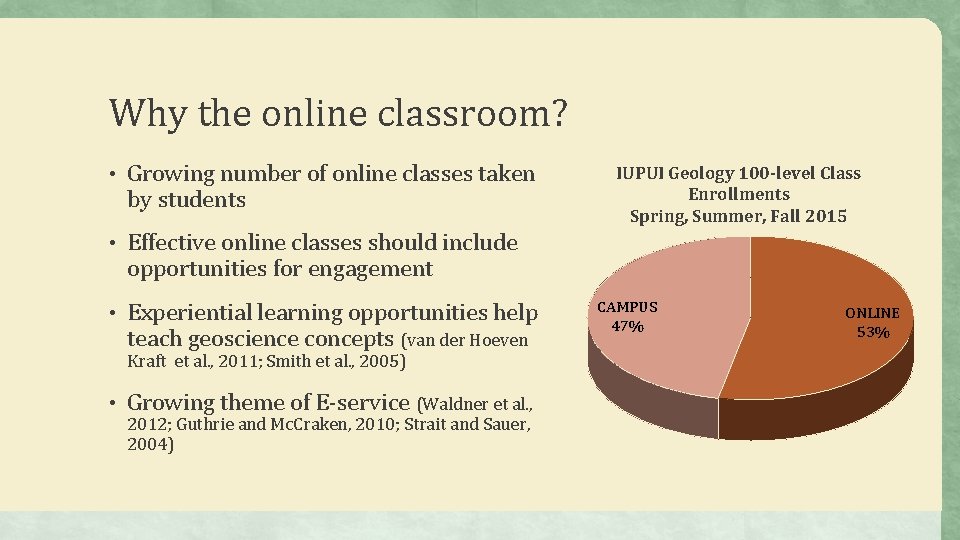
Why the online classroom? • Growing number of online classes taken by students IUPUI Geology 100 -level Class Enrollments Spring, Summer, Fall 2015 • Effective online classes should include opportunities for engagement • Experiential learning opportunities help teach geoscience concepts (van der Hoeven Kraft et al. , 2011; Smith et al. , 2005) • Growing theme of E‐service (Waldner et al. , 2012; Guthrie and Mc. Craken, 2010; Strait and Sauer, 2004) CAMPUS 47% ONLINE 53%
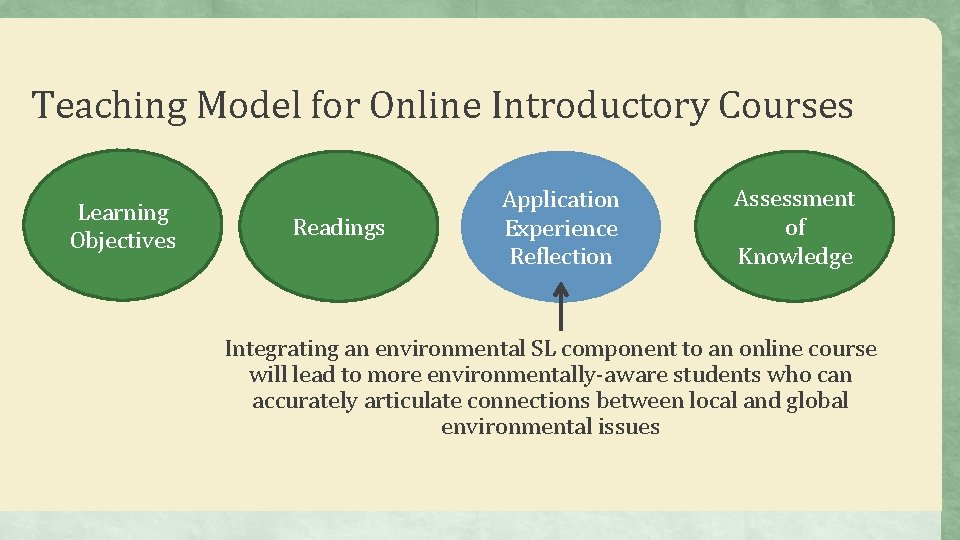
Teaching Model for Online Introductory Courses Learning Objectives Readings Application Experience Reflection Assessment of Knowledge Integrating an environmental SL component to an online course will lead to more environmentally‐aware students who can accurately articulate connections between local and global environmental issues
G 115 Introduction to Oceanography • Students have choice to participate in a SL project and submit a researched essay and reflection • http: //serc. carleton. edu/NAGTWorkshops/servicelearning/activities /137886. html • Projects run by IUPUI Center for Earth and Environmental Science (CEES) = minimal faculty time • SL project provides an experiential learning option to relate Indiana environmental issues to oceanic environmental issues. • Over past 3 semesters, 24 out of 292 students have chosen this option
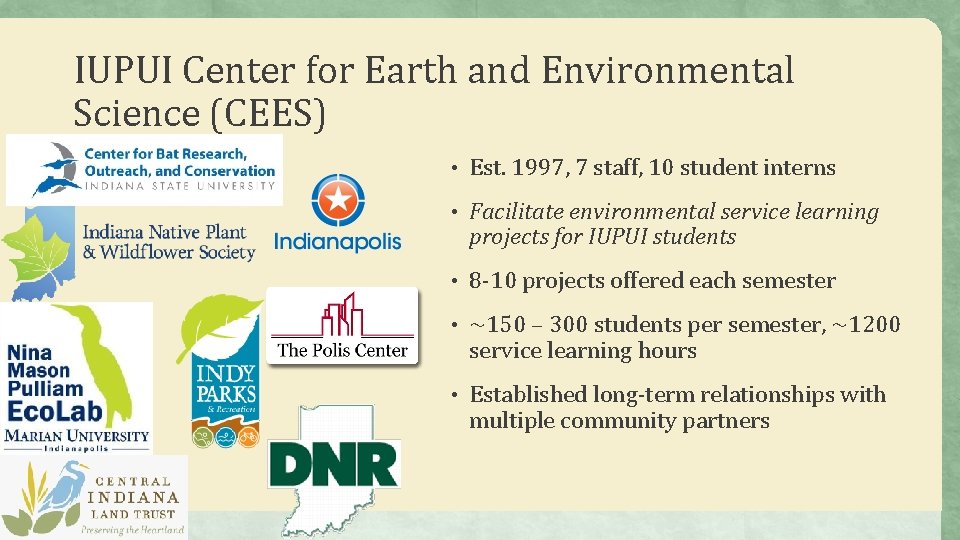
IUPUI Center for Earth and Environmental Science (CEES) • Est. 1997, 7 staff, 10 student interns • Facilitate environmental service learning projects for IUPUI students • 8‐ 10 projects offered each semester • ~150 – 300 students per semester, ~1200 service learning hours • Established long‐term relationships with multiple community partners
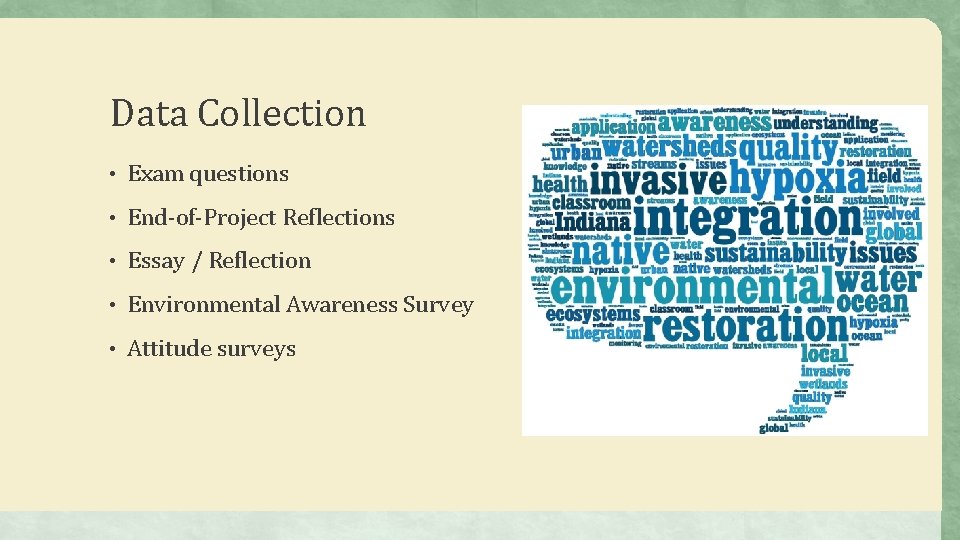
Data Collection • Exam questions • End‐of‐Project Reflections • Essay / Reflection • Environmental Awareness Survey • Attitude surveys
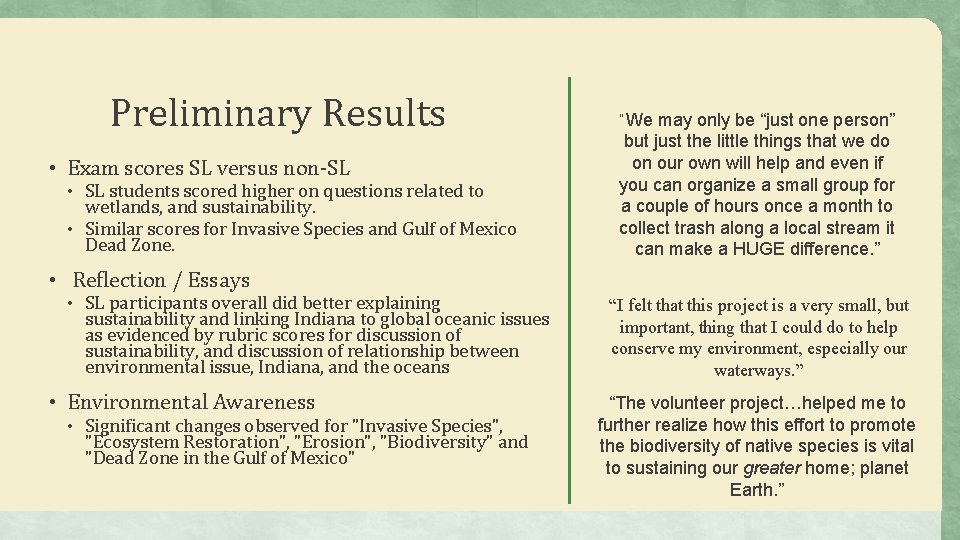
Preliminary Results • Exam scores SL versus non‐SL • SL students scored higher on questions related to wetlands, and sustainability. • Similar scores for Invasive Species and Gulf of Mexico Dead Zone. “We may only be “just one person” but just the little things that we do on our own will help and even if you can organize a small group for a couple of hours once a month to collect trash along a local stream it can make a HUGE difference. ” • Reflection / Essays • SL participants overall did better explaining sustainability and linking Indiana to global oceanic issues as evidenced by rubric scores for discussion of sustainability, and discussion of relationship between environmental issue, Indiana, and the oceans • Environmental Awareness • Significant changes observed for "Invasive Species", "Ecosystem Restoration", "Erosion", "Biodiversity" and "Dead Zone in the Gulf of Mexico" “I felt that this project is a very small, but important, thing that I could do to help conserve my environment, especially our waterways. ” “The volunteer project…helped me to further realize how this effort to promote the biodiversity of native species is vital to sustaining our greater home; planet Earth. ”
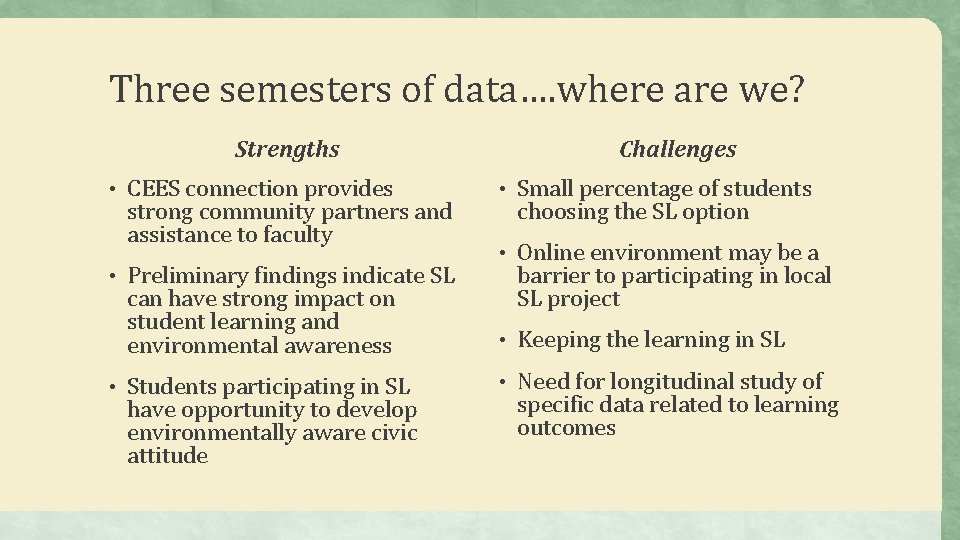
Three semesters of data…. where are we? Strengths • CEES connection provides strong community partners and assistance to faculty • Preliminary findings indicate SL can have strong impact on student learning and environmental awareness • Students participating in SL have opportunity to develop environmentally aware civic attitude Challenges • Small percentage of students choosing the SL option • Online environment may be a barrier to participating in local SL project • Keeping the learning in SL • Need for longitudinal study of specific data related to learning outcomes
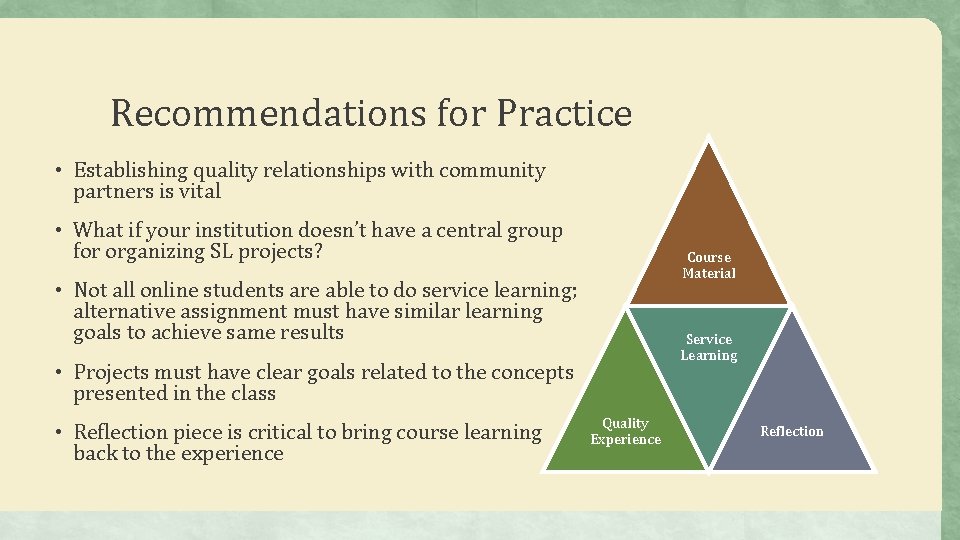
Recommendations for Practice • Establishing quality relationships with community partners is vital • What if your institution doesn’t have a central group for organizing SL projects? Course Material • Not all online students are able to do service learning; alternative assignment must have similar learning goals to achieve same results Service Learning • Projects must have clear goals related to the concepts presented in the class • Reflection piece is critical to bring course learning back to the experience Quality Experience Reflection
Questions?
References • Ash, S. L. , & Clayton, P. H. (2009). Generating, Deepening, and Documenting Learning: The Power of Critical Reflection in Applied Learning. Journal of Applied Learning in Higher Education, Vol. 1( Fall 2009), 25‐ 48. • Ash, S. L. , Clayton, P. H. , & Atkinson, M. P. (2005). Integrating Reflection and Assessment to Capture and Improve Student Learning. Michigan Journal of Community Service Learning, 49‐ 60. • Bringle, Robert G. , and Julie A. Hatcher. "Reflection in Service Learning: Making Meaning or Experience. " Educational Horizons (1999): 179. • Bringle, R. , & Hatcher, J. (1995). A service learning curriculum for faculty. Michigan Journal of Community Service Learning, 2, 112‐ 122. • Davies, Caroline P. "Implementing earth systems science curriculum: Evaluating the integration of urban environments for an urban audience. "Journal of Geoscience Education 54, no. 3 (2006): 364‐ 373 • Eyler, Janet, et al. "At a glance: What we know about the effects of service‐learning on college students, faculty, institutions and communities, 1993‐ 2000. " (2001). • Eyler, J. S. & Giles, D. E. , Jr. (1999). Where's the Learning in Service‐ Learning? San Francisco, CA: Jossey‐Bass, Inc. • Felten, P. , Gilchrist, L. Z. , & Darby, A. (2006). Emotion and Learning: Feeling our Way Toward a New Theory of Reflection in Service‐ Learning. Michigan Journal of Community Service Learning, 38‐ 46.
References • Guthrie, Kathy L. , and Holly Mc. Cracken. "Making a difference online: Facilitating service‐learning through distance education. " The Internet and Higher Education 13. 3 (2010): 153‐ 157. • Hatcher, J. A. , Bringle, R. G. , & Muthiah, R. (2004). Designing Effective Reflection: What Matters to Service‐Learning. Michigan Journal of Community Service Learning, 38‐ 46. • Mitchell, T. D. , Richard, F. D. , Battistoni, R. M. , Rost‐Banik, C. , Netz, R. , & Zakoske, C. (2015). Reflective Practice that Persists: Connections Between Reflection in Service‐Learning Programs and in Current Life. Michigan Journal of Community Service Learning, 49‐ 63. • Smith, Karl A. , Sheri D. Sheppard, David W. Johnson, and Roger T. Johnson. "Pedagogies of engagement: Classroom‐based practices. " Journal of engineering education 94, no. 1 (2005): 87‐ 101 • Strait, Jean, and Tim Sauer. "Constructing experiential learning for online courses: The birth of e‐Service. " Educause Quarterly 27. 1 (2004): 62‐ 65. • van der Hoeven Kraft, K. J. , Srogi, L. , Husman, J. , Semken, S. , & Fuhrman, M "Engaging students to learn through the affective domain: A new framework for teaching in the geosciences. " Journal of Geoscience Education 59. 2 (2011): 71‐ 84. • Waldner, Leora S. , Sue Y. Mc. Gorry, and Murray C. Widener. "E‐Service ‐Learning: The Evolution of Service‐Learning to Engage a Growing Online Student Population. " Journal of Higher Education Outreach and Engagement 16. 2 (2012): 123‐ 150.