
Enhancing social tagging with a knowledge organization system



- Slides: 33
Enhancing social tagging with a knowledge organization system Brian Matthews STFC
Outline Who are STFC ? Controlled Vocabulary Social Tagging En. Tag – Aims – Glamorgan/UKOLN/Intute Experiment – STFC Experiment SKOS
Science and Technology Facilities Council Provide large-scale scientific facilities for UK Science – particularly in physics and astronomy E-Science Centre – at RAL and DL – Provides advanced IT development and services to the STFC Science Programme – Also includes library and institutional repository – Strong interest in Digital Curation of our science data – Keep the results alive and available – R&D Programme: • DCC, CASPAR • En. Tag
Controlled Vocabulary Traditional way of providing subject classification – For shelf-marking – For searching – For association of resources Several different types used, such as – Subject Classification – Keyword lists – Thesaurus Each has different characteristics
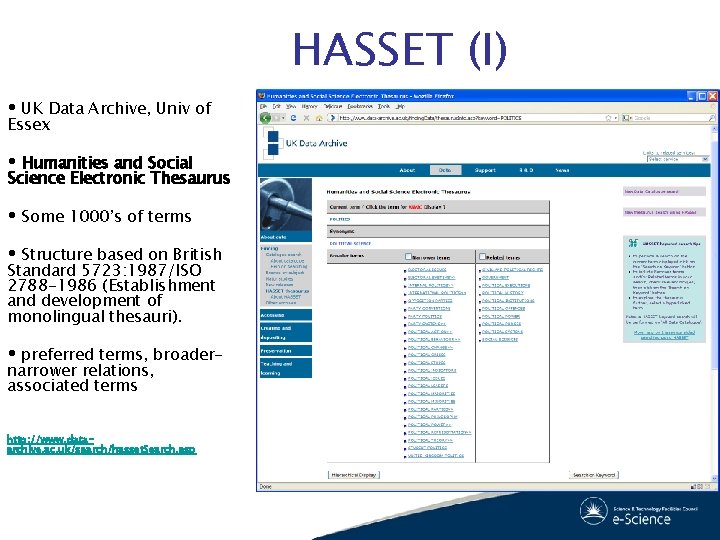
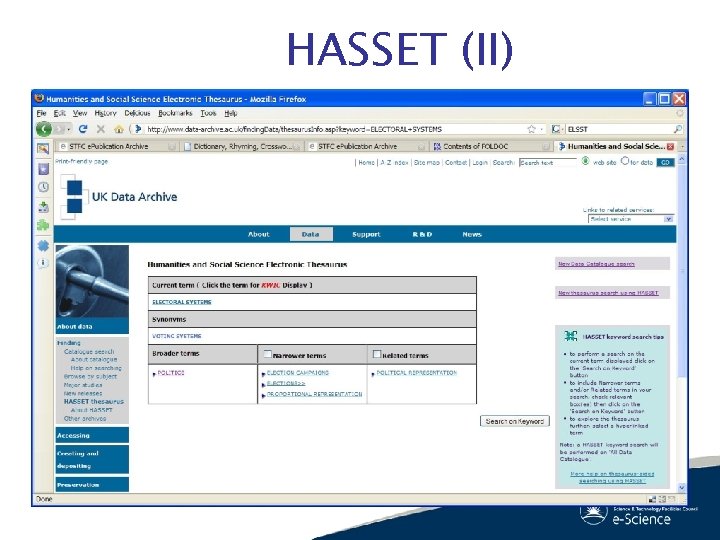
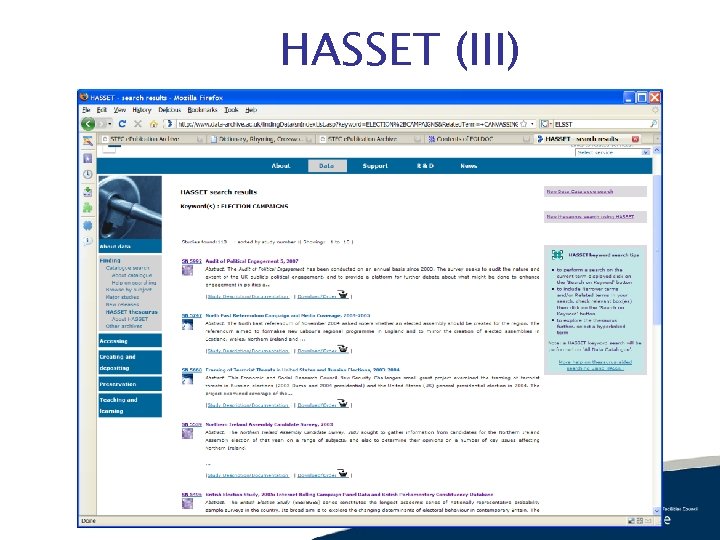
HASSET (I) UK Data Archive, Univ of Essex Humanities and Social Science Electronic Thesaurus Some 1000’s of terms Structure based on British Standard 5723: 1987/ISO 2788 -1986 (Establishment and development of monolingual thesauri). preferred terms, broadernarrower relations, associated terms http: //www. dataarchive. ac. uk/search/hasset. Search. asp
HASSET (II)
HASSET (III)
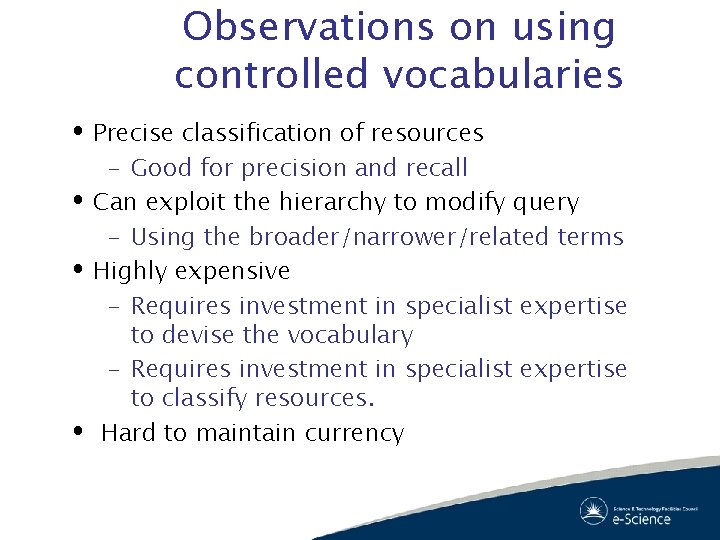
Observations on using controlled vocabularies Precise classification of resources – Good for precision and recall Can exploit the hierarchy to modify query – Using the broader/narrower/related terms Highly expensive – Requires investment in specialist expertise to devise the vocabulary – Requires investment in specialist expertise to classify resources. Hard to maintain currency
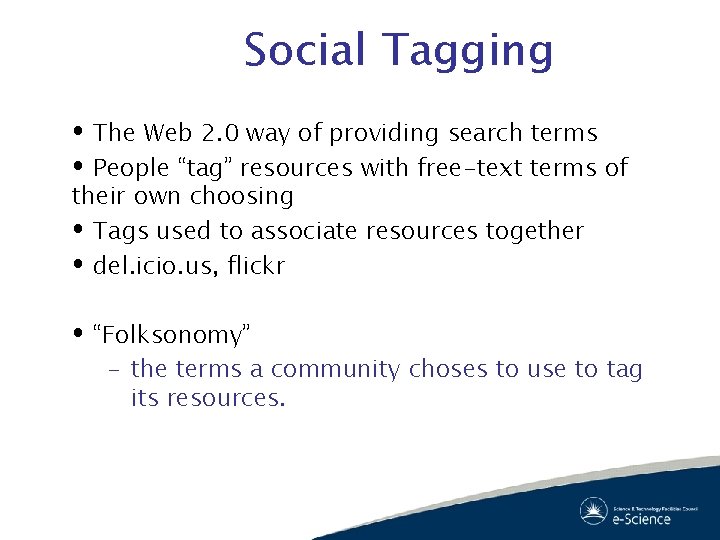
Social Tagging The Web 2. 0 way of providing search terms People “tag” resources with free-text terms of their own choosing Tags used to associate resources together del. icio. us, flickr “Folksonomy” – the terms a community choses to use to tag its resources.
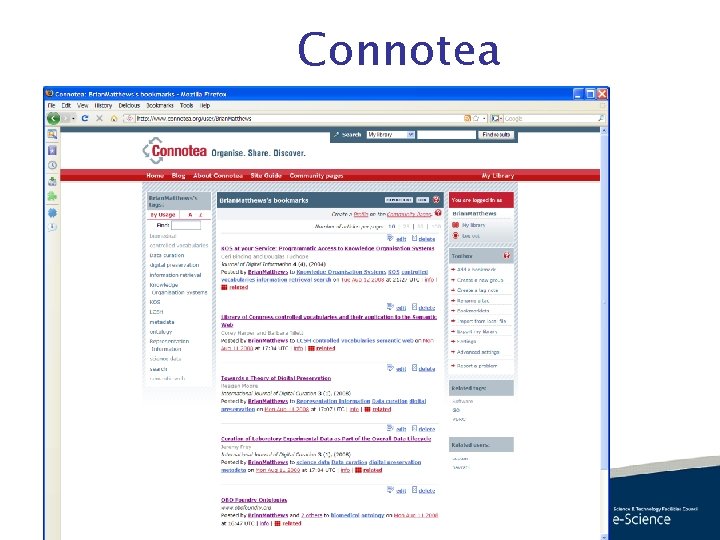
Connotea
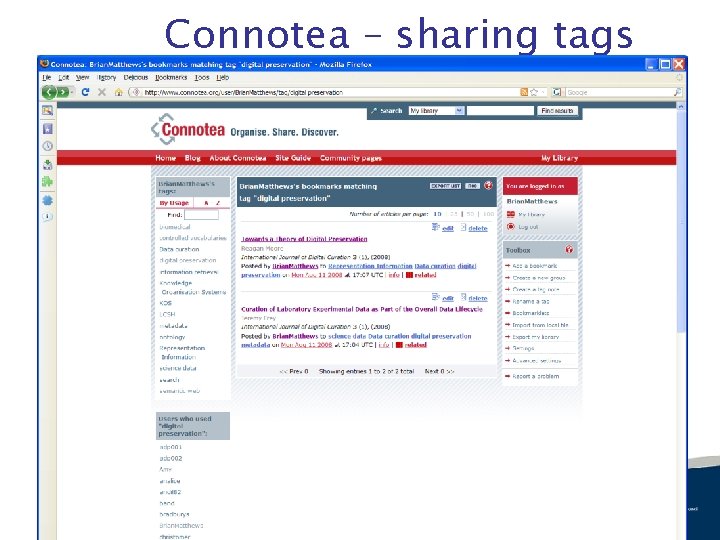
Connotea – sharing tags
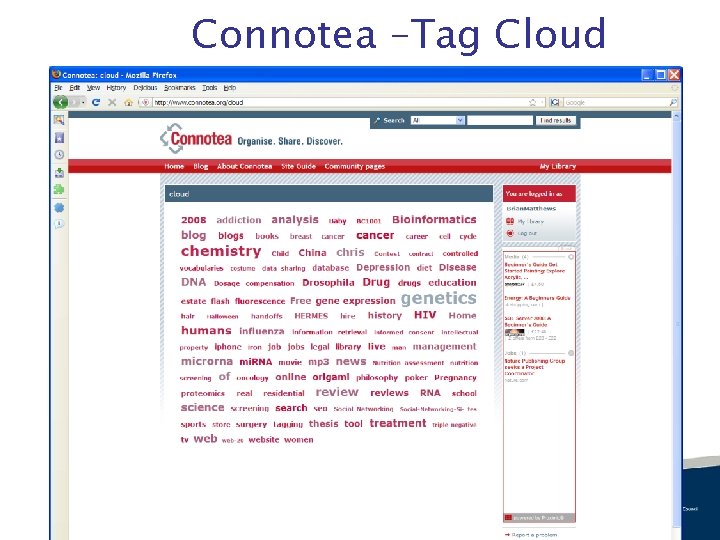
Connotea –Tag Cloud
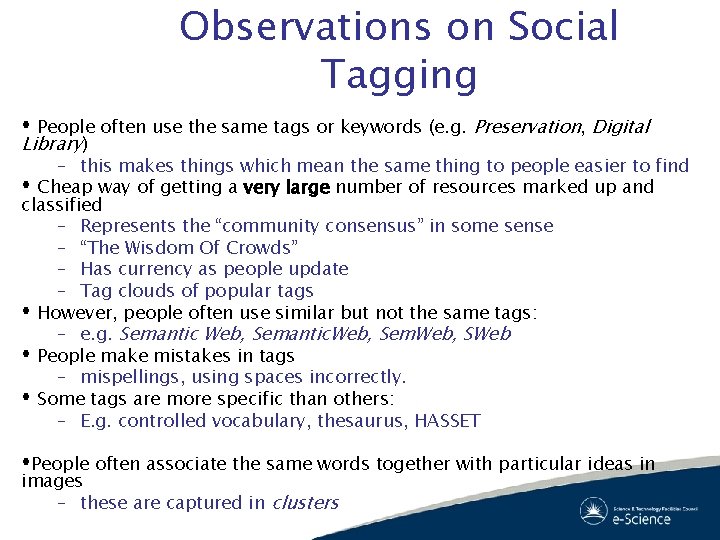
Observations on Social Tagging People often use the same tags or keywords (e. g. Preservation, Digital Library) – this makes things which mean the same thing to people easier to find Cheap way of getting a very large number of resources marked up and classified – Represents the “community consensus” in some sense – “The Wisdom Of Crowds” – Has currency as people update – Tag clouds of popular tags However, people often use similar but not the same tags: – e. g. Semantic Web, Semantic. Web, Sem. Web, SWeb People make mistakes in tags – mispellings, using spaces incorrectly. Some tags are more specific than others: – E. g. controlled vocabulary, thesaurus, HASSET People often associate the same words together with particular ideas in images – these are captured in clusters
En. Tag Project Enhanced tagging for discovery JISC funded project Partners – UKOLN – University of Glamorgan – STFC – Intute – Non-funded • OCLC Office of Research, USA • Danish Royal School of Library and Information Science Period: 1 Sep 2007 -- 30 Sep 2008 http: //www. ukoln. ac. uk/projects/enhanced-tagging/
En. Tag Background Controlled vocabularies – Improve information retrieval and discovery • – But, costly to index with, especially the amount of digital documents – Require subject and classification experts Social tagging – – Holds the promise of reducing indexing costs Uses terms describing how people see the resource Serendipity But, tags uncontrolled, • • • missed associations Relating different views Highly personal (“me”, “important”), Quality and ranking Depth of term
En. Tag Purpose Investigate the combination of controlled and social tagging approaches to support resource discovery in repositories and digital collections Aim to investigate – whether use of an established controlled vocabulary can help move social tagging beyond personal bookmarking to aid resource discovery
En. Tag Objectives Investigate indexing aspects when using only social tagging versus when using social tagging in combination with a controlled vocabulary In particular, does this lead to: Improve tagging – Relevance of tags (perspective, aspects, specificity, exhaustivity, terminology (linguistic level, semantic level, contextual level) – Consistency – Efficiency (time used, user satisfaction) – Use (tags selected, clouds consulted, order of consultation) Improve retrieval – Effectiveness (degree of match between user and system terminology) In two different contexts: – Tagging by readers – Tagging by authors
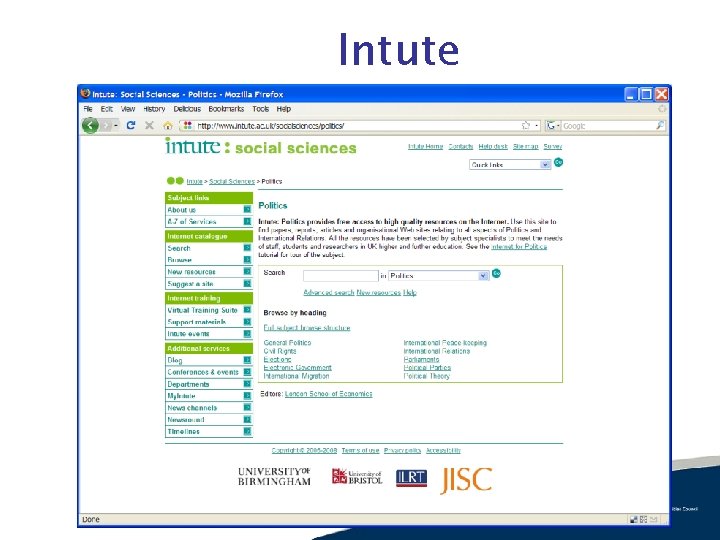
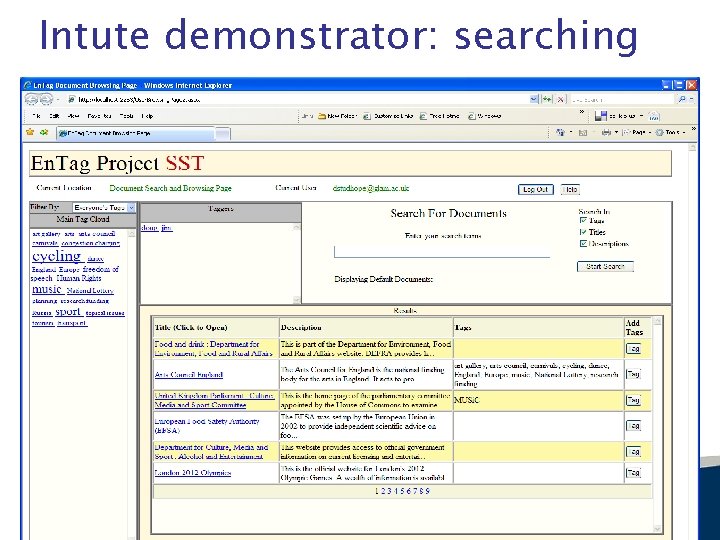
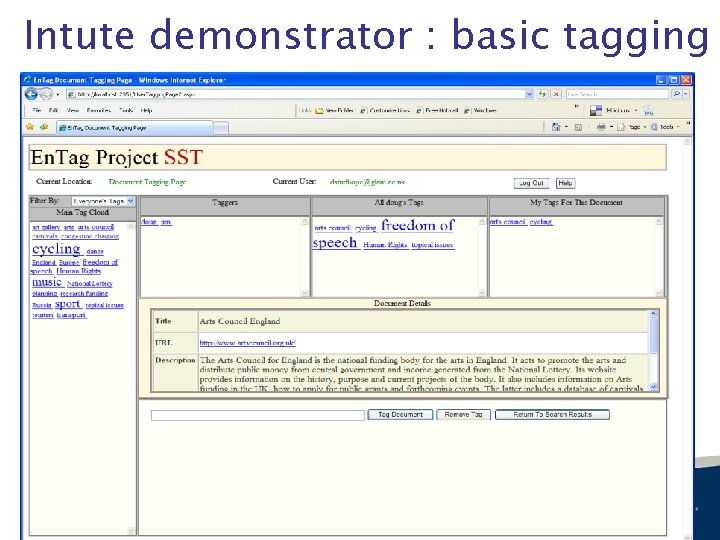
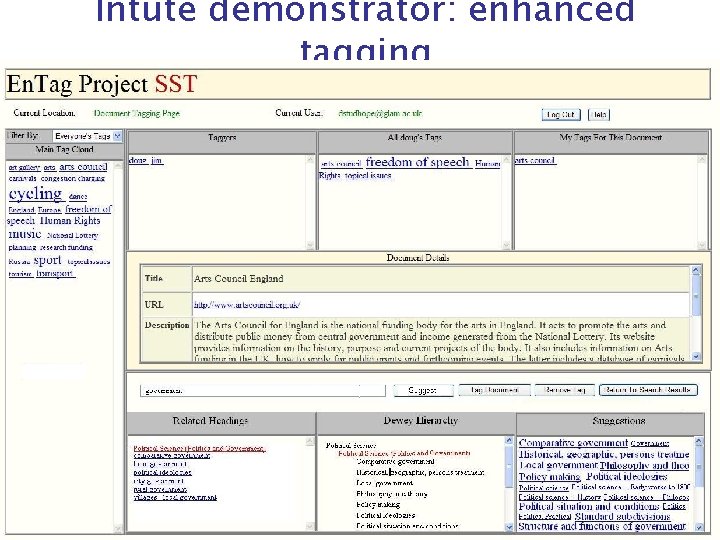
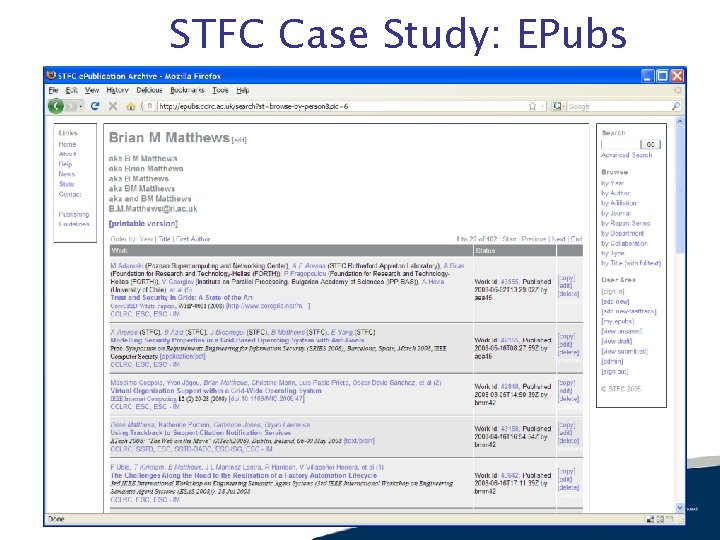
Testing Approach Main focus: – free tagging with no instructions Versus – tagging using a combined system and guidance for users Two demonstrators Intute digital collection http: //www. intute. ac. uk – Major development – Tagging by reader – DDC STFC repository http: //epubs. cclrc. ac. uk/ – Complementary development – Tagging by author – A more qualitative approach
Intute
Intute demonstrator: searching
Intute demonstrator : basic tagging
Intute demonstrator: enhanced tagging
En. Tag: Intute user study (II) Test setting – 50 graduate students in political science – 60 documents, covering up to four topics of relevance for the students Data collection – Logging time spent, selection patterns, – Pre- and post-questionnaires
En. Tag: Intute user study (I) Test: – – – comparison of basic and advanced system: Indexing Perspective, specificity, exhaustivity Linguistics (word class, single word/compound, spelling, language) – Consistency – Efficiency (time used, user satisfaction) – Use (tags selected, clouds consulted, order of consultation) – Retrieval efficiency Degree of match between user and system terminology – user tags, DDC tags, controlled Intute keywords, title terms, text terms
STFC Case Study: EPubs
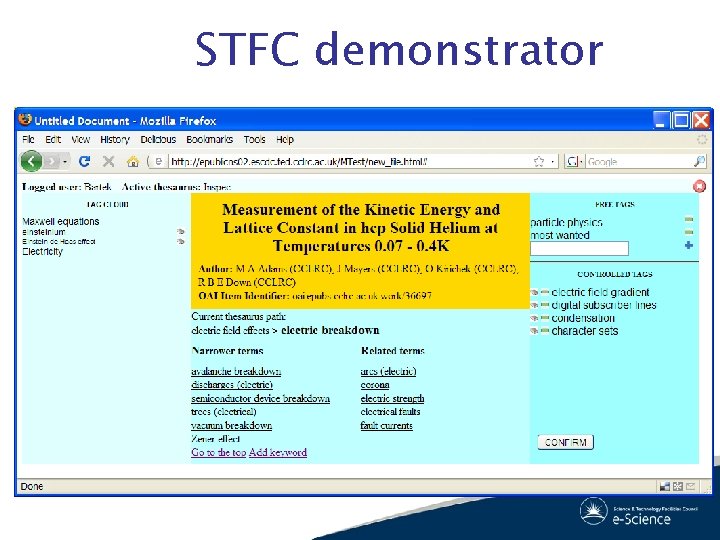
STFC demonstrator
STFC Author study A study on a Authors of papers – Smaller number - c. 10 -12. – Regular depositors ( > 10 papers each) – Subject experts Expect that they would want their papers accurately tagged so that they are precisely found A more qualitative study
Expected Feedback Relative value of tagging vs. controlled terms – Does it give more satisfactory (accurate, consistent) tags? – Does it lead to the consideration of tags they would not have thought of? – Do they select deeply in the hierarchy? – Is this something they would like to see supported more, and would use? – Is it worth the overhead? How we should use a combination of tagging and controlled vocab in our system ? To Be Continued…. .
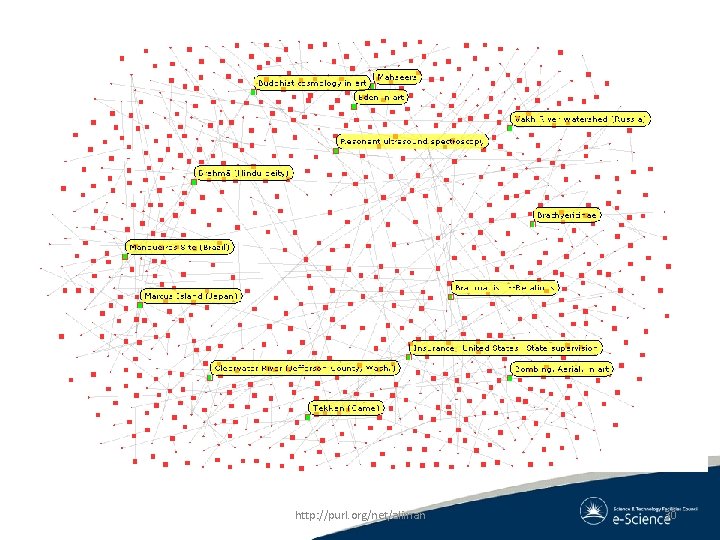
Building a Web of Knowledge Social tagging and controlled vocabulary complement each other – Tagging entry level, quick, does the job, but error prone, fuzzy – Controlled vocabulary, accurate, but slow and expensive Use one to leverage the other Use both to build a “Web of knowledge” – The things in the world and their link via their subjects – Get the users to build the means of organising the knowledge
http: //purl. org/net/aliman 30
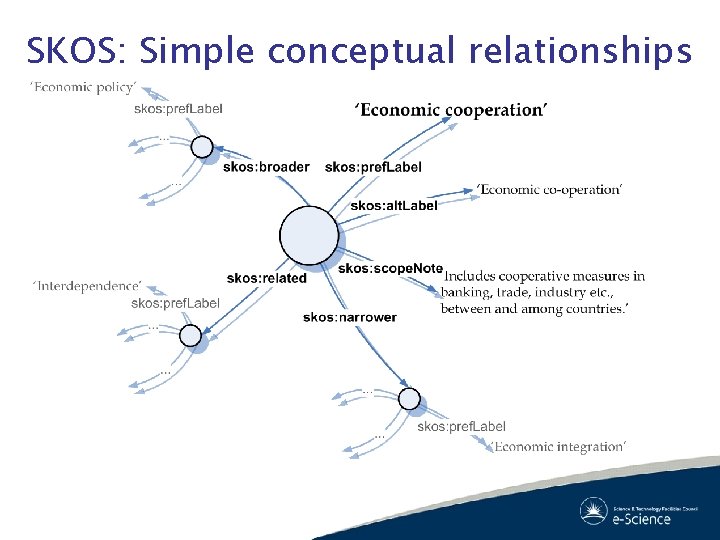
SKOS: Simple conceptual relationships
Conclusions Controlled vocabulary and Tags complement each other Hope to get some interesting evidence over the next month as the studies are complete. Web 2. 0 world offers the possibility of combining these results – SKOS a format to use both tags and controlled vocabulary as part of the Web of Linked Data – Also use Web 2. 0 to build the vocab themselves.
Questions? b. m. matthews@rl. ac. uk