
Enhancing Reliability through HALT Introduction to HALT Benefits

Enhancing Reliability through HALT
àIntroduction to HALT àBenefits of HALT à The HALT process

Objective HALT - Highly Accelerated Life Test TO IMPROVE RELIABILITY reduce warranty claims release product to market earlier extend warranty periods
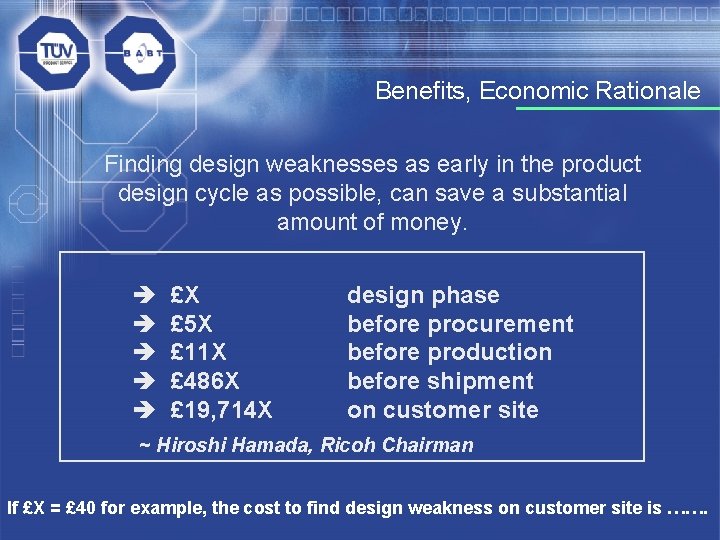
Benefits, Economic Rationale Finding design weaknesses as early in the product design cycle as possible, can save a substantial amount of money. è è è £X £ 5 X £ 11 X £ 486 X £ 19, 714 X design phase before procurement before production before shipment on customer site ~ Hiroshi Hamada, Ricoh Chairman If £X = £ 40 for example, the cost to find design weakness on customer site is …….
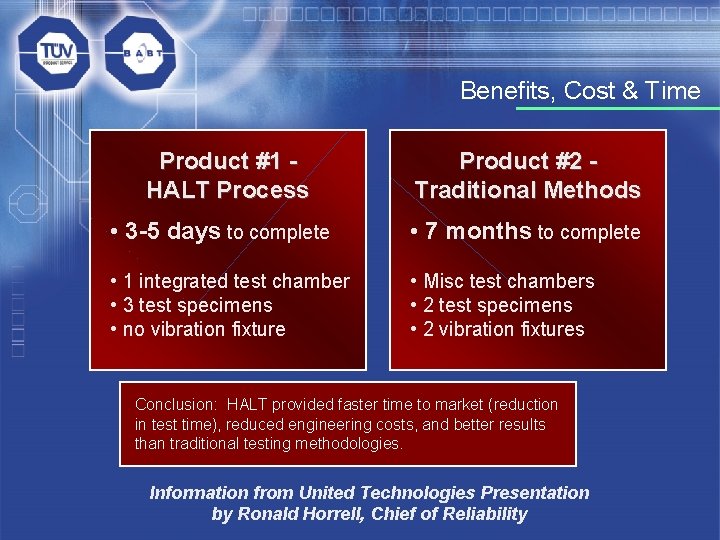
Benefits, Cost & Time Product #1 HALT Process Product #2 Traditional Methods • 3 -5 days to complete • 7 months to complete • 1 integrated test chamber • 3 test specimens • no vibration fixture • Misc test chambers • 2 test specimens • 2 vibration fixtures Conclusion: HALT provided faster time to market (reduction in test time), reduced engineering costs, and better results than traditional testing methodologies. Information from United Technologies Presentation by Ronald Horrell, Chief of Reliability

Benefits, Faster Market Release for LESS Spending Rate 6 HALT 5 Market Release 4 Market Release 3 2 1 0 Savings 1 2 3 4 5 6 7 8 9 10 11 12 13 14 15 16 17 18 19 20 21 22 23 24 25 26 Time
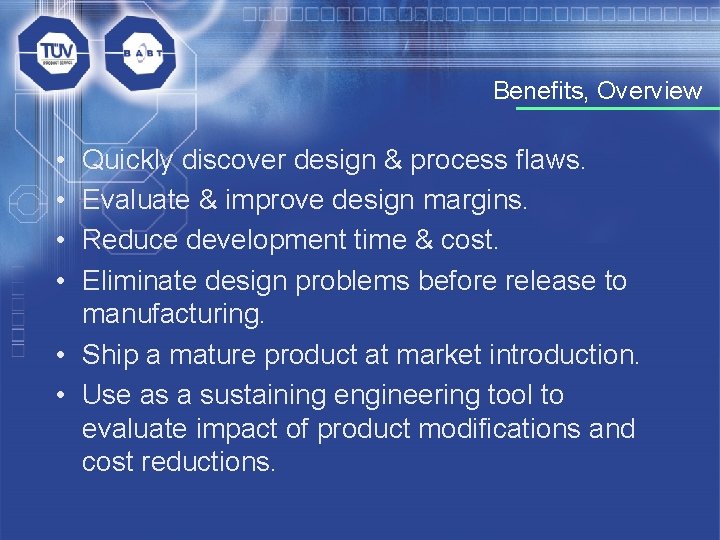
Benefits, Overview • • Quickly discover design & process flaws. Evaluate & improve design margins. Reduce development time & cost. Eliminate design problems before release to manufacturing. • Ship a mature product at market introduction. • Use as a sustaining engineering tool to evaluate impact of product modifications and cost reductions.
Definition of HALT A process used during the design stage of a product that provides a stringent environment to force design and process maturity Although normally performed before manufacturing release, a HALT can be beneficial in finding product weaknesses at any point in a product’s life

Example “No fault found” following product return Dissatisfied client Sample put through HALT which stresses the product Identification of same failure as experienced by client
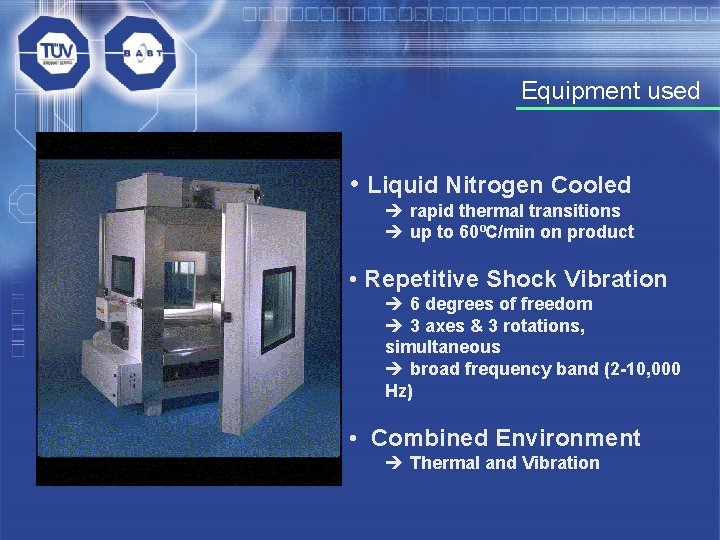
Equipment used • Liquid Nitrogen Cooled è rapid thermal transitions è up to 60ºC/min on product • Repetitive Shock Vibration è 6 degrees of freedom è 3 axes & 3 rotations, simultaneous è broad frequency band (2 -10, 000 Hz) • Combined Environment è Thermal and Vibration
HALT Process 1 Test Plan Development (incorporate product specific stress sources, develop functional tests with good coverage, define what constitutes a failure, . . . ) 2 Determine method of attachment to vibration table 3 Ensure adequate airflow within the product (modify the case if required) 4 Verify Functionality 5 Run HALT 6 Failure Analysis 7 Implement Corrective Action 8 Verify corrective actions by repeating HALT It is not just the testing - you also benefit from test plan development verification of the functionality and the analysis of the results
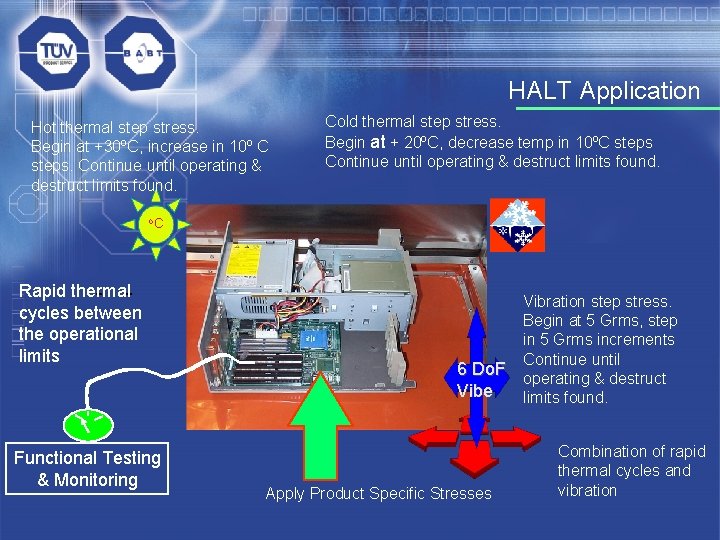
HALT Application Hot thermal step stress. Begin at +30ºC, increase in 10º C steps. Continue until operating & destruct limits found. Cold thermal step stress. Begin at + 20ºC, decrease temp in 10ºC steps Continue until operating & destruct limits found. o. C Rapid thermal cycles between the operational limits Functional Testing & Monitoring 6 Do. F Vibe Apply Product Specific Stresses Vibration step stress. Begin at 5 Grms, step in 5 Grms increments Continue until operating & destruct limits found. Combination of rapid thermal cycles and vibration
When failures occur during HALT ð Stop test & record failure mode & stress level ð Use isolation techniques to identify failure location ð Determine root cause analysis ~ May require further investigation, or, Implement temporary fix ð Continue testing to try to induce additional failures

How long does a HALT take? 3 to 5 Days!!!
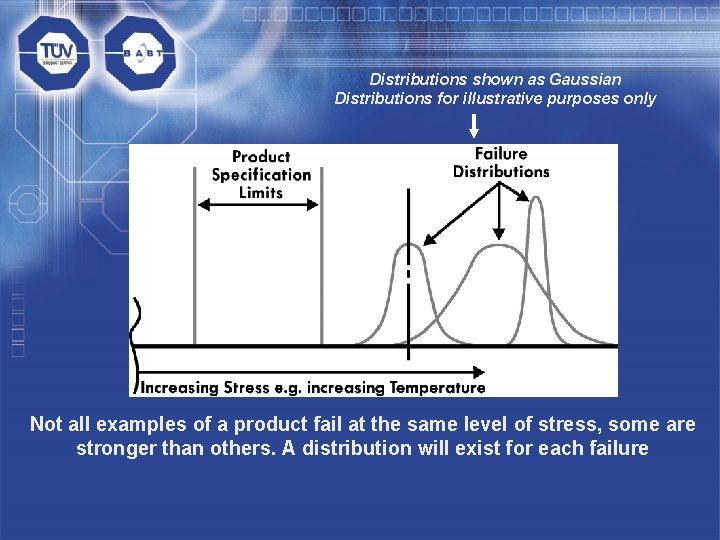
Distributions shown as Gaussian Distributions for illustrative purposes only Not all examples of a product fail at the same level of stress, some are stronger than others. A distribution will exist for each failure
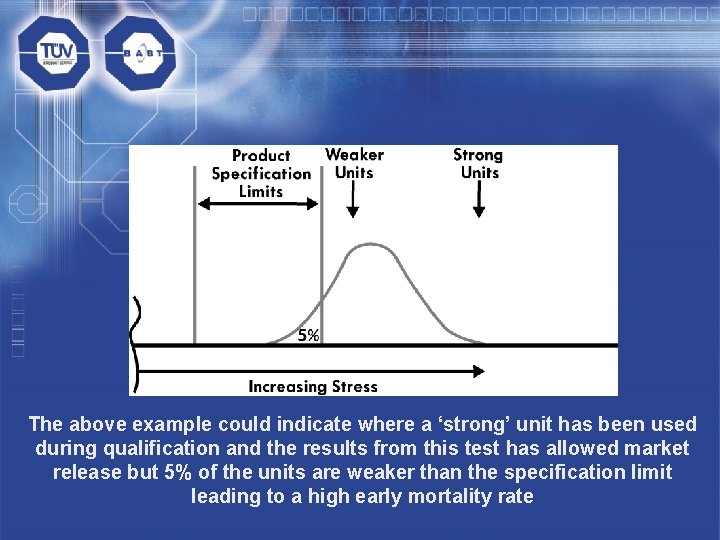
The above example could indicate where a ‘strong’ unit has been used during qualification and the results from this test has allowed market release but 5% of the units are weaker than the specification limit leading to a high early mortality rate
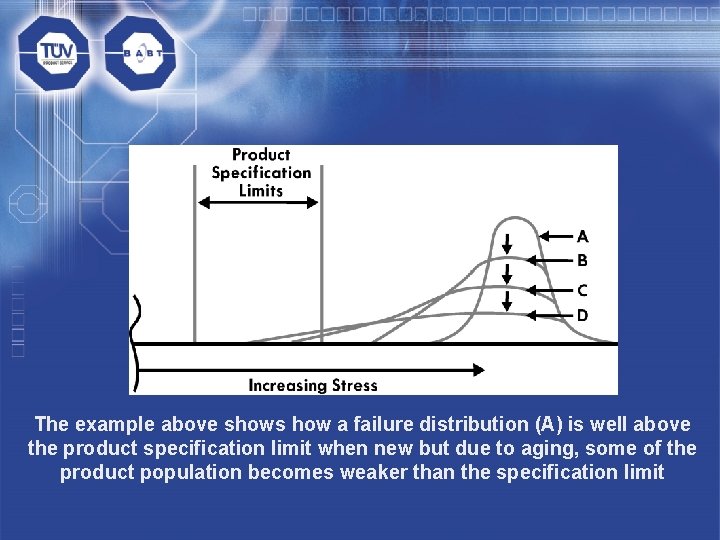
The example above shows how a failure distribution (A) is well above the product specification limit when new but due to aging, some of the product population becomes weaker than the specification limit
The link with HASS Highly Accelerated Stress Screen HALT Knowledge A process used in manufacturing, to allow discovery of process changes and prevent products with latent defects from getting into the field.
The application of HALT and HASS plays a critical role in improving the in-service reliability of a product through better, more robust, designs and manufacturing processes.
Benefits, Overview • • Quickly discover design & process flaws. Evaluate & improve design margins. Reduce development time & cost. Eliminate design problems before release to manufacturing. • Ship a mature product at market introduction. • Use as a sustaining engineering tool to evaluate impact of product modifications and cost reductions.

Contact Us TUV Product Service Ltd Segensworth Road, Fareham, Hampshire, PO 15 5 RH, UK Email: info@tuvps. co. uk Web: www. tuvps. co. uk Tel: +44 (0) 1329 443300 Fax: +44 (0) 1329 443421
- Slides: 21