
Enhancing Quality Supporting IFAC Membership IESBA New York
Enhancing Quality & Supporting IFAC Membership IESBA New York, USA March 14, 2018 Joseph Bryson, Director Quality & Development Page 1 | Proprietary and Copyrighted Information
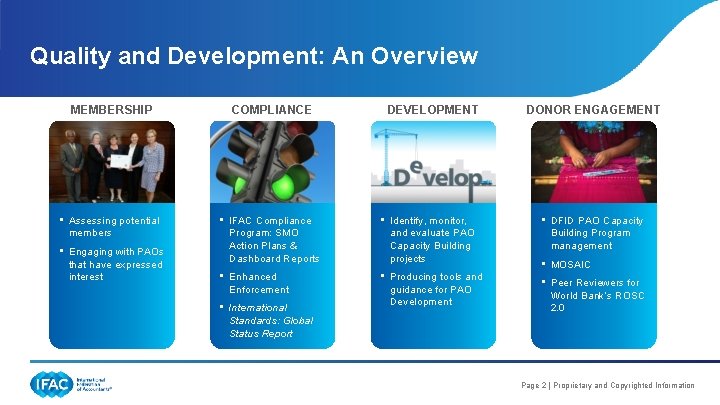
Quality and Development: An Overview MEMBERSHIP COMPLIANCE • Assessing potential members • IFAC Compliance Program: SMO Action Plans & Dashboard Reports • Identify, monitor, and evaluate PAO Capacity Building projects • Enhanced Enforcement • Producing tools and guidance for PAO Development • Engaging with PAOs that have expressed interest • International Standards: Global Status Report DEVELOPMENT DONOR ENGAGEMENT • DFID PAO Capacity Building Program management • MOSAIC • Peer Reviewers for World Bank’s ROSC 2. 0 Page 2 | Proprietary and Copyrighted Information
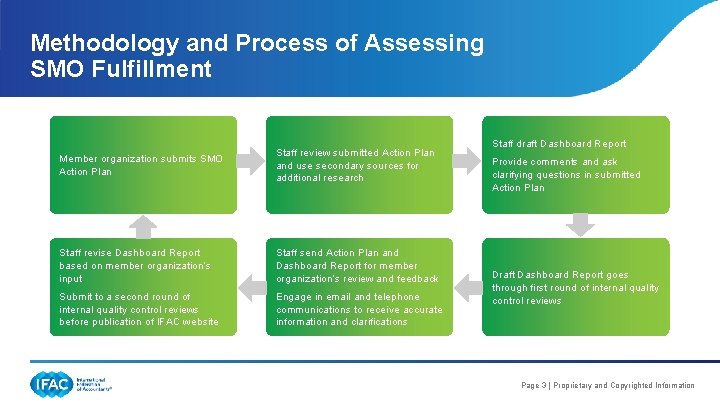
Methodology and Process of Assessing SMO Fulfillment Member organization submits SMO Action Plan Staff review submitted Action Plan and use secondary sources for additional research Staff revise Dashboard Report based on member organization’s input Staff send Action Plan and Dashboard Report for member organization’s review and feedback Submit to a second round of internal quality control reviews before publication of IFAC website Engage in email and telephone communications to receive accurate information and clarifications Staff draft Dashboard Report Provide comments and ask clarifying questions in submitted Action Plan Draft Dashboard Report goes through first round of internal quality control reviews Page 3 | Proprietary and Copyrighted Information
Adoption and SMO Fulfillment Status Report • Second annual report based on DBR initiative – 104 profiles – 80 jurisdictions – Toolboxes with key resources, fundamentals of new standards, and examples of best practices – Representative sample of IFAC membership • Identify challenges and tools needed Page 4 | Proprietary and Copyrighted Information

Distribution of Jurisdictions and Member Organizations REPORT COVERAGE: 80 Jurisdictions / 104 Member Organizations Middle East Americas & Caribbean 15% (12) Asia-Pacific Middle East TOTAL IFAC MEMBERSHIP: 131 Jurisdictions/ 177 Member Organizations 30% (24) 10% (8) 6% (8) Africa Europe 9% (7) 36% (29) Europe 20% (27) 37% (48) Africa 19% (25) Americas & Caribbean 18% (23) Asia-Pacific Page 5 | Proprietary and Copyrighted Information
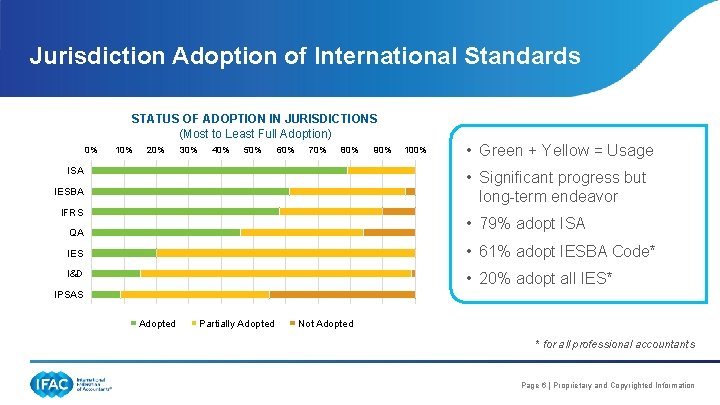
Jurisdiction Adoption of International Standards STATUS OF ADOPTION IN JURISDICTIONS (Most to Least Full Adoption) 0% 10% 20% 30% 40% 50% 60% 70% 80% ISA 90% 100% • Green + Yellow = Usage • Significant progress but long-term endeavor IESBA IFRS • 79% adopt ISA QA IES • 61% adopt IESBA Code* I&D • 20% adopt all IES* IPSAS Adopted Partially Adopted Not Adopted * for all professional accountants Page 6 | Proprietary and Copyrighted Information
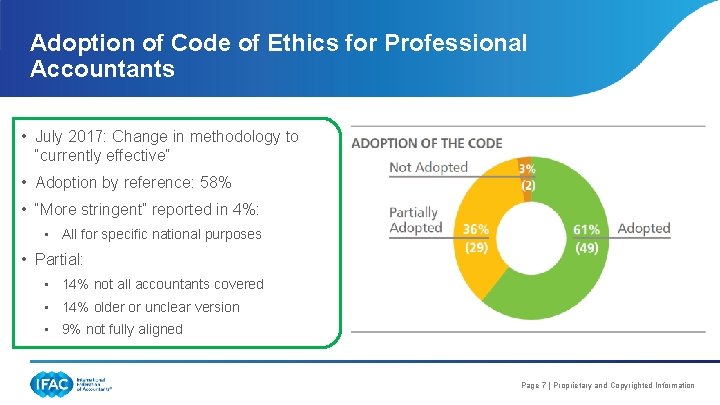
Adoption of Code of Ethics for Professional Accountants • July 2017: Change in methodology to “currently effective” • Adoption by reference: 58% • “More stringent” reported in 4%: • All for specific national purposes • Partial: • 14% not all accountants covered • 14% older or unclear version • 9% not fully aligned Page 7 | Proprietary and Copyrighted Information
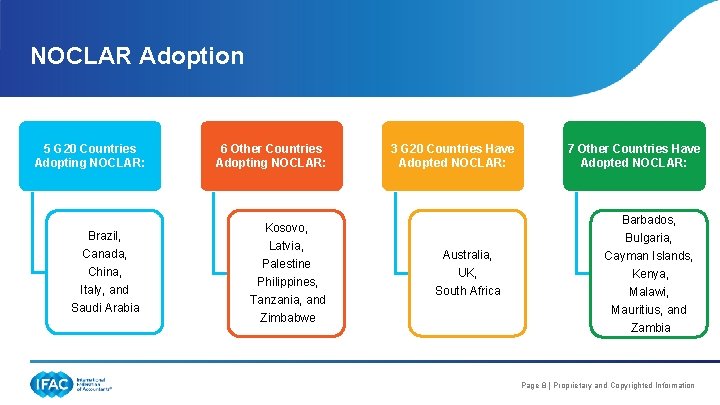
NOCLAR Adoption 5 G 20 Countries Adopting NOCLAR: Brazil, Canada, China, Italy, and Saudi Arabia 6 Other Countries Adopting NOCLAR: Kosovo, Latvia, Palestine Philippines, Tanzania, and Zimbabwe 3 G 20 Countries Have Adopted NOCLAR: 7 Other Countries Have Adopted NOCLAR: Barbados, Australia, UK, South Africa Bulgaria, Cayman Islands, Kenya, Malawi, Mauritius, and Zambia Page 8 | Proprietary and Copyrighted Information
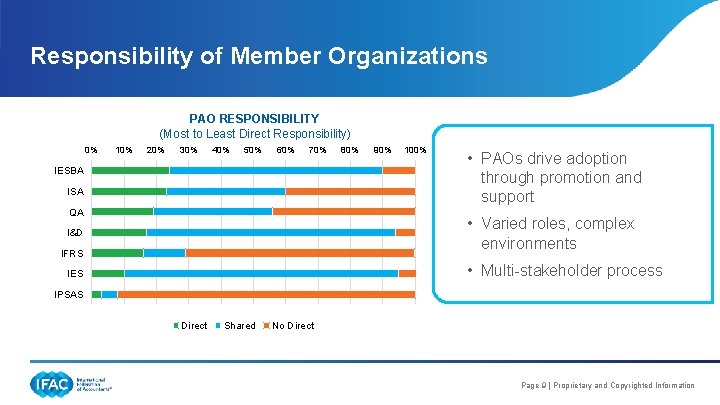
Responsibility of Member Organizations PAO RESPONSIBILITY (Most to Least Direct Responsibility) 0% 10% 20% 30% 40% 50% 60% 70% IESBA ISA QA 80% 90% 100% • PAOs drive adoption through promotion and support • Varied roles, complex environments I&D IFRS • Multi-stakeholder process IES IPSAS Direct Shared No Direct Page 9 | Proprietary and Copyrighted Information
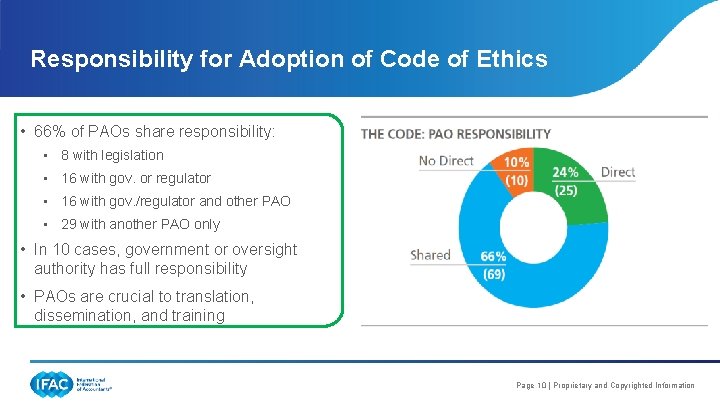
Responsibility for Adoption of Code of Ethics • 66% of PAOs share responsibility: • 8 with legislation • 16 with gov. or regulator • 16 with gov. /regulator and other PAO • 29 with another PAO only • In 10 cases, government or oversight authority has full responsibility • PAOs are crucial to translation, dissemination, and training Page 10 | Proprietary and Copyrighted Information
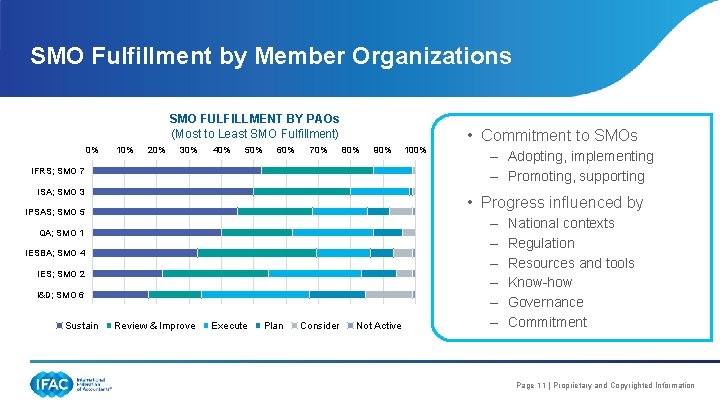
SMO Fulfillment by Member Organizations SMO FULFILLMENT BY PAOs (Most to Least SMO Fulfillment) 0% 10% 20% 30% 40% 50% 60% 70% • Commitment to SMOs 80% 90% IFRS; SMO 7 ISA; SMO 3 – Adopting, implementing – Promoting, supporting • Progress influenced by IPSAS; SMO 5 QA; SMO 1 IESBA; SMO 4 IES; SMO 2 I&D; SMO 6 Sustain 100% Review & Improve Execute Plan Consider Not Active – – – National contexts Regulation Resources and tools Know-how Governance Commitment Page 11 | Proprietary and Copyrighted Information
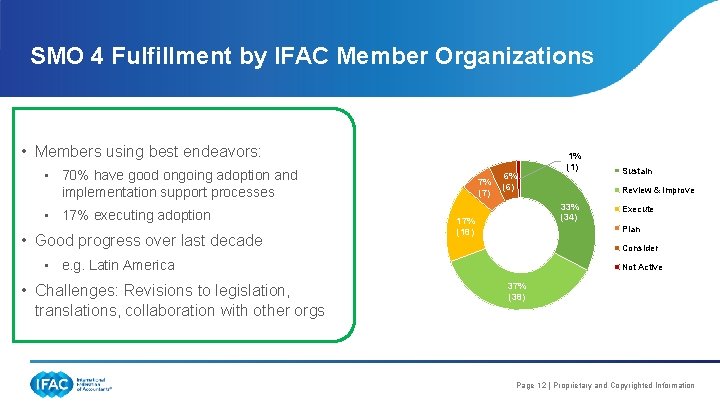
SMO 4 Fulfillment by IFAC Member Organizations • Members using best endeavors: • 70% have good ongoing adoption and implementation support processes • 17% executing adoption • Good progress over last decade 7% (7) 6% (6) Sustain Review & Improve 33% (34) 17% (18) Execute Plan Consider • e. g. Latin America • Challenges: Revisions to legislation, translations, collaboration with other orgs 1% (1) Not Active 37% (38) Page 12 | Proprietary and Copyrighted Information
Key Findings: Overall • Main adoption and implementation challenges for PAOs – – Educational standards (IES), especially 2015 revised IES Quality assurance review systems; and Investigative and disciplinary (I&D) systems Suitable PAO governance structures, operational capacity, and financial sustainability need to be in place Page 13 | Proprietary and Copyrighted Information
Key Findings: Overall • With additional support, PAOs are well-positioned to advocate on importance of topics – Often there is low awareness and/or capacity amongst relevant stakeholders to effectively implement these best practices. • Capacity building initiatives could help enhance the adoption and implementation of international standards and strong economic ecosystems by addressing underlying barriers – Suitable PAO governance structures, operational capacity, and financial sustainability need to be in place Page 14 | Proprietary and Copyrighted Information
www. ifac. org
- Slides: 15