
Enhancing Public Transport in the Kinta Valley Summit
Enhancing Public Transport… …in the Kinta Valley Summit on Urban Public Transport 09 November, 2008
So…who are you? l l The Association for the Improvement of Mass -Transit (TRANSIT), Klang Valley A diverse group of public transport users A united voice for the passenger Our Goal l l to ensure the voice of the passenger is heard in public transport planning, regulation, and operations To increase awareness about what public transport can bring to our communities
Resolving Public Transport Issues in Malaysia MYTH: l Public Transport is a mobility service for poor people Hence the following misunderstandings: l l l Investment in private transport is more important for the nation than investment in public transport Supporting the needs of private transport users is a priority in Malaysia There are no “choice users” of public transport We should give the users (those poor souls) the cheap, basic service that they want/need Real improvement to public transport requires largescale investments such as LRT or monorail
Resolving Public Transport Issues in Malaysia FACT: l Public transport provides 3 functions for society l l l Mobility for those not using private transport Development tool to reduce infrastructure costs A business operation with potential for profits Investment in public transport is investment in critical communications infrastructure Far less money has been invested properly into public transport than in other infrastructure
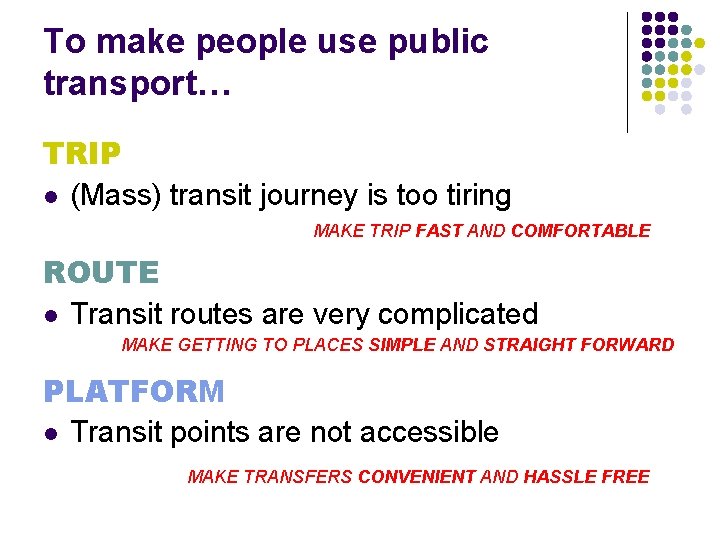
To make people use public transport… TRIP l (Mass) transit journey is too tiring MAKE TRIP FAST AND COMFORTABLE ROUTE l Transit routes are very complicated MAKE GETTING TO PLACES SIMPLE AND STRAIGHT FORWARD PLATFORM l Transit points are not accessible MAKE TRANSFERS CONVENIENT AND HASSLE FREE
Organization and Regulation l l l Too many government agencies Not enough power/ability/willingness to enforce regulations Incomplete understanding of what public transport can offer to a community l l l Focus on the “Lower-income group” low expectations Competition does not help the public transportation industry Operators may sacrifice quality, service, mobility, safety, rights of workers, etc.
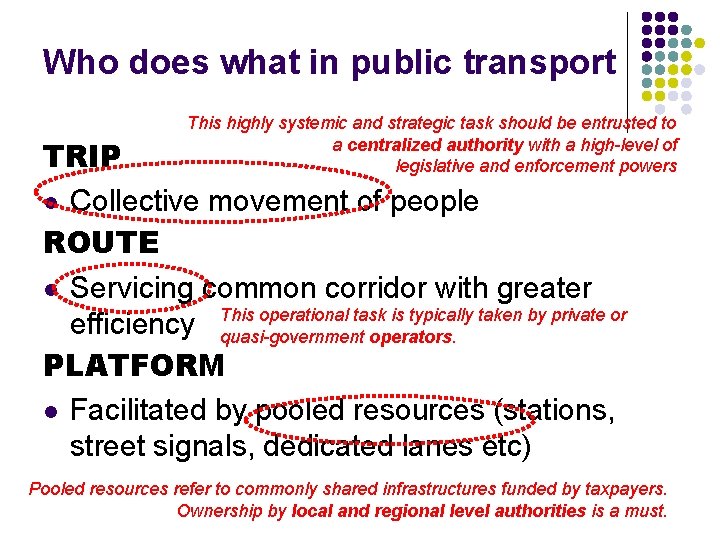
Who does what in public transport This highly systemic and strategic task should be entrusted to a centralized authority with a high-level of legislative and enforcement powers TRIP l Collective movement of people ROUTE l Servicing common corridor with greater operational task is typically taken by private or efficiency This quasi-government operators. PLATFORM l Facilitated by pooled resources (stations, street signals, dedicated lanes etc) Pooled resources refer to commonly shared infrastructures funded by taxpayers. Ownership by local and regional level authorities is a must.
Regional / local planning l l Local governments focus on traffic management and cater to cars Development planning does not include public transportation early enough Planning is not coordinated with other governments within the region Private model – improvements/proposals often focus on increasing operator profits rather than mobility
Real Investments in Public Transportation l l l Change of Attitude – We are investing in infrastructure which is an asset for this nation Rail infrastructure is the most efficient way to move people and goods Complete, accessible rapid-transit networks increase people’s mobility Better planning + mobility = better quality of life Remove thousands of cars from our roads daily Fewer jams = greater economic productivity & economic growth
Universal Accessibility/Design l NOT just “facilities for the disabled” l l l simplify access to life for everyone Meet the needs of people of all ages and abilities "Universal design is the design of products and environments to be usable by all people, to the greatest extent possible, without the need for adaptation or specialized design. " –Ron Mace
Enhancing Development and Reducing Infrastructure Costs l l Urban growth may be “planned” but often leads to urban sprawl More than 1000 suburban “housing estates” in the Klang Valley Suburban and exurban communities are often “lowdensity” Transport infrastructure is often inadequate l Providing infrastructure is costly for local councils/government l Mobility requires private transportation money “Automobile apartheid” l l Infrastructure is inadequate How long can it last?
Transit-oriented Development l l l Communities designed around public transport hubs Pedestrian and people friendly Environmentally friendly Economically sustainable if planned properly Lowers taxes and infrastructure costs
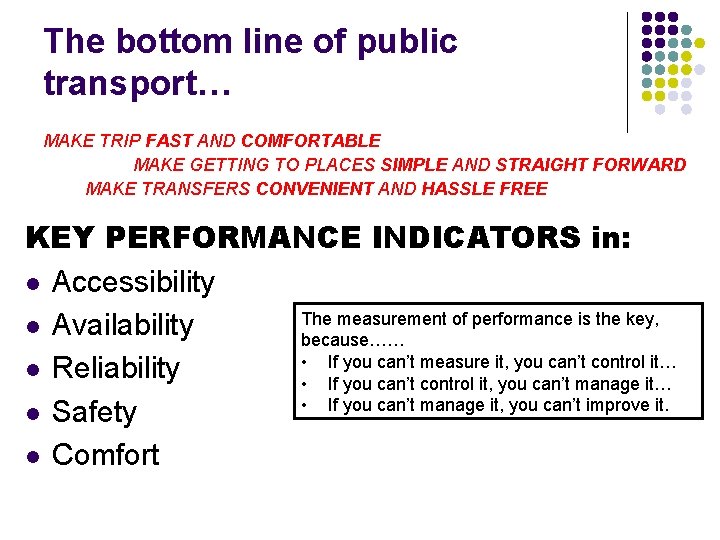
The bottom line of public transport… MAKE TRIP FAST AND COMFORTABLE MAKE GETTING TO PLACES SIMPLE AND STRAIGHT FORWARD MAKE TRANSFERS CONVENIENT AND HASSLE FREE KEY PERFORMANCE INDICATORS in: l Accessibility The measurement of performance is the key, l Availability because…… • If you can’t measure it, you can’t control it… l Reliability • If you can’t control it, you can’t manage it… • If you can’t manage it, you can’t improve it. l Safety l Comfort
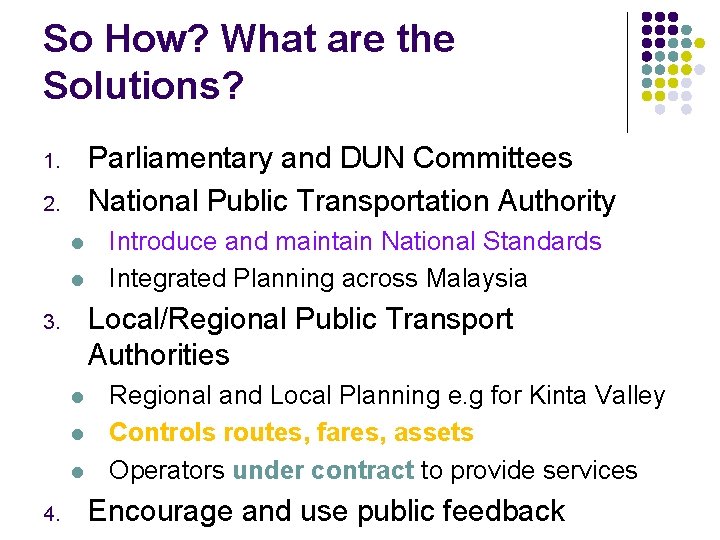
So How? What are the Solutions? Parliamentary and DUN Committees National Public Transportation Authority 1. 2. l l Local/Regional Public Transport Authorities 3. l l l 4. Introduce and maintain National Standards Integrated Planning across Malaysia Regional and Local Planning e. g for Kinta Valley Controls routes, fares, assets Operators under contract to provide services Encourage and use public feedback
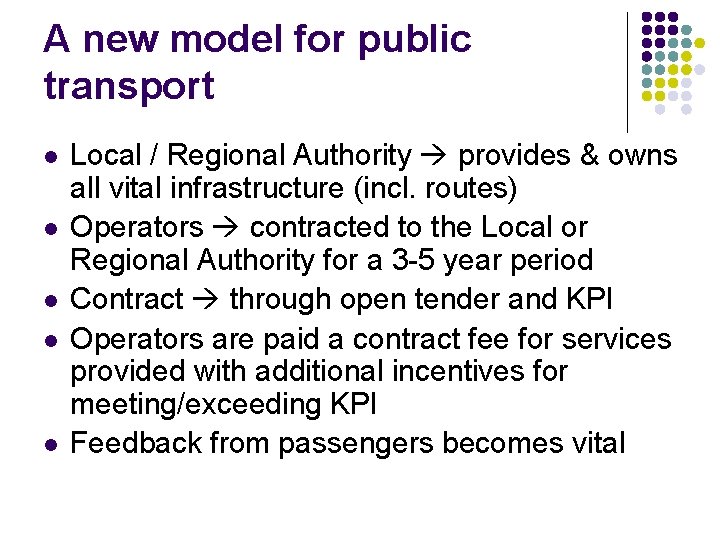
A new model for public transport l l l Local / Regional Authority provides & owns all vital infrastructure (incl. routes) Operators contracted to the Local or Regional Authority for a 3 -5 year period Contract through open tender and KPI Operators are paid a contract fee for services provided with additional incentives for meeting/exceeding KPI Feedback from passengers becomes vital
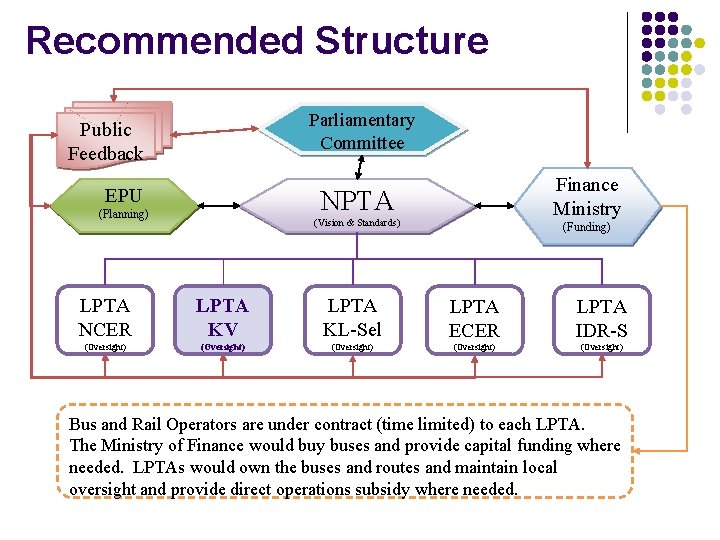
Recommended Structure Parliamentary Committee Public Feedback EPU Finance Ministry NPTA (Planning) (Vision & Standards) (Funding) LPTA NCER LPTA KV LPTA KL-Sel LPTA ECER LPTA IDR-S (Oversight) (Oversight) Bus and Rail Operators are under contract (time limited) to each LPTA. The Ministry of Finance would buy buses and provide capital funding where needed. LPTAs would own the buses and routes and maintain local oversight and provide direct operations subsidy where needed.
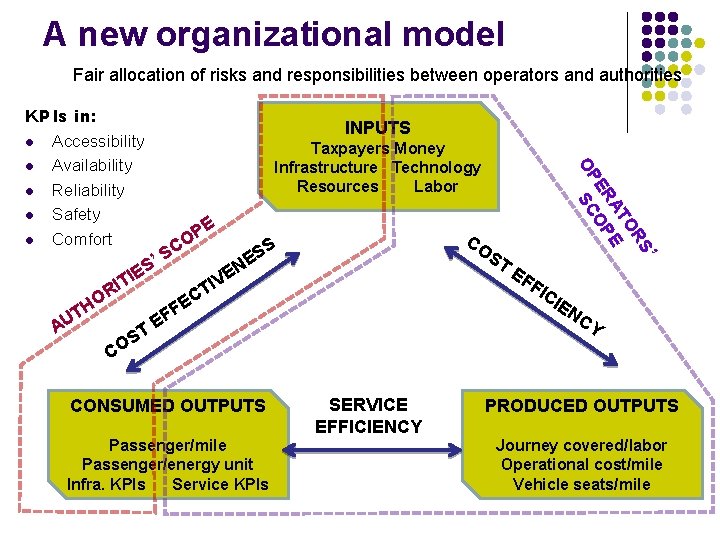
A new organizational model Fair allocation of risks and responsibilities between operators and authorities TI I OR TH U A ’ ES S CO INPUTS Taxpayers Money Infrastructure Technology Resources Labor E P O C S CO S ES ST EN TIV C E F Passenger/mile Passenger/energy unit Infra. KPIs Service KPIs EF FI CI E NC Y F E T CONSUMED OUTPUTS S’ OR AT E ER OP OP SC KPIs in: l Accessibility l Availability l Reliability l Safety l Comfort SERVICE EFFICIENCY PRODUCED OUTPUTS Journey covered/labor Operational cost/mile Vehicle seats/mile
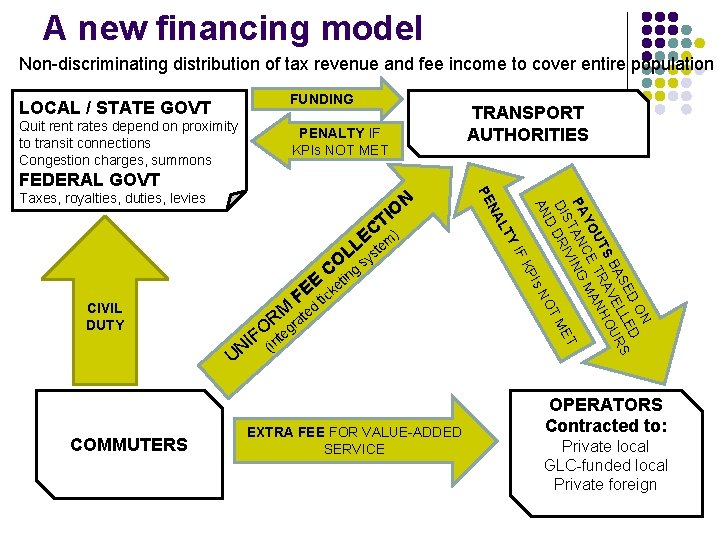
A new financing model Non-discriminating distribution of tax revenue and fee income to cover entire population LOCAL / STATE GOVT FUNDING Quit rent rates depend on proximity to transit connections Congestion charges, summons PENALTY IF KPIs NOT MET TRANSPORT AUTHORITIES FEDERAL GOVT CIVIL DUTY COMMUTERS d RMgrate FOinte I ( UN EXTRA FEE FOR VALUE-ADDED SERVICE ON ED ED AS ELL URS S B AV O UT TR NH YO CE MA PA TAN ING IV ET DIS R TM DD NO AN PIs t FK E e FE tick YI COing s LT m LL yste NA N IO T EC ) PE Taxes, royalties, duties, levies OPERATORS Contracted to: Private local GLC-funded local Private foreign
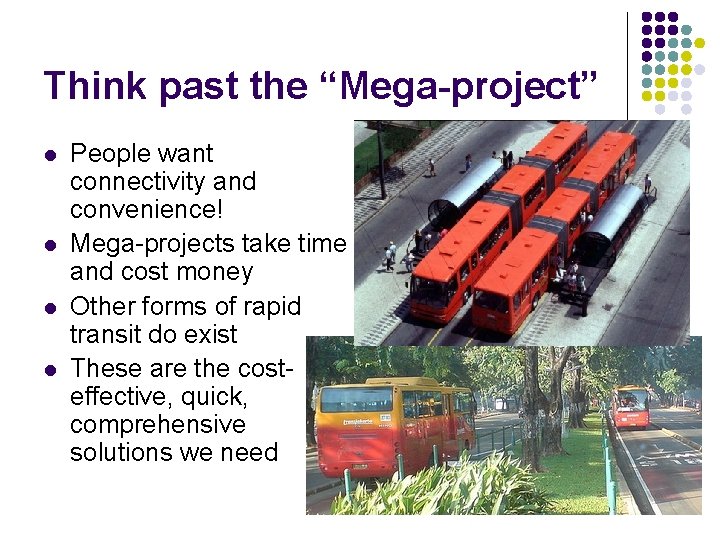
Think past the “Mega-project” l l People want connectivity and convenience! Mega-projects take time and cost money Other forms of rapid transit do exist These are the costeffective, quick, comprehensive solutions we need
The view from TRANSIT l l l Indiscriminate expansion not needed Go back to the “hub-and-spoke” model Make it work! l l Authority builds vital infrastructure (hubs, lanes) Authority directs local councils to identify bus routes All bus operators under contract to Authority Packaging of “Areas” will combine lucrative trunk routes with express and suburban routes
A Plan for Action l Short-Term (up to Dec 2009) l Present the view of public transport users as a single voice l Ensure that the revamp by Combined Bus Services (CBS) includes public feedback – get yourselves to the table! l Make sure that Ipoh Council and CBS enforce existing regulations (no Pajak system) l Improve accessibility of bus services
A Plan for Action l Mid-Term (up to 2012) l Work with Ipoh Council and Perak government to fill in “missing links” in infrastructure (hubs, bus lanes) and network (more “rapid-transit” lines) l Further investment in “rapid-transit” networks l Invest in expansion of KTM Komuter (fleet, frequency, services) to link Ipoh to KL and Penang
THANK YOU FOR YOUR TIME M Zulkarnain Hamzah Sek 4, Shah Alam 019 -280 -0608 zk 9@hotmail. com http: //transitmy. org klangvalley. transit@gmail. com It is easy to join TRANSIT’s online discussion group. Just email klangvalley_transit-subscribe@yahoogroups. com!
- Slides: 23