
Enhancing Osteoarthritis Care in Europe The JIGSAWE Project
- Slides: 17
Enhancing Osteoarthritis Care in Europe The JIGSAW-E Project
JIGSAW Project aims to: • Implement NICE OA Guideline more uniformly – Involve practice nurses and others more in OA care – Enable and support self-management by patients • Reduce GP workload for OA • Rationalise orthopaedic referrals for OA – Appropriate patients and timing – Better prepared for better outcomes
The rationale • • • Epidemiology Natural history Impact on patients’ lives Impact on other long-term conditions Impact on NHS Lack of systematic management approach
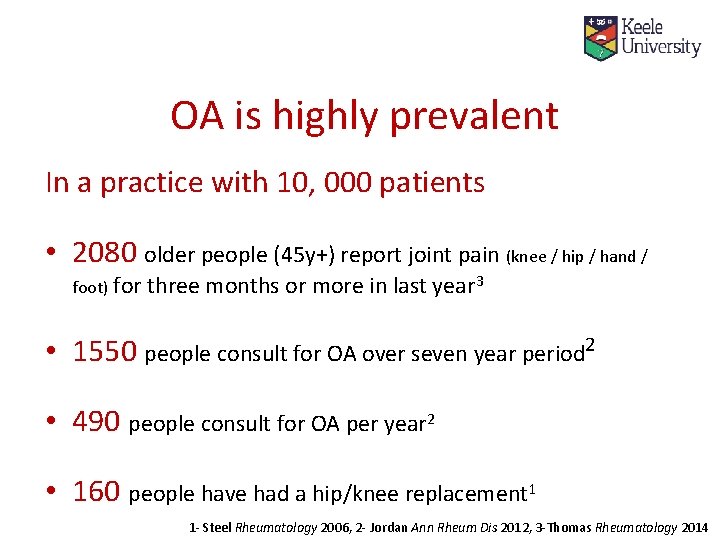
OA is highly prevalent In a practice with 10, 000 patients • 2080 older people (45 y+) report joint pain (knee / hip / hand / foot) for three months or more in last year 3 • 1550 people consult for OA over seven year period 2 • 490 people consult for OA per year 2 • 160 people have had a hip/knee replacement 1 1 - Steel Rheumatology 2006, 2 - Jordan Ann Rheum Dis 2012, 3 -Thomas Rheumatology 2014
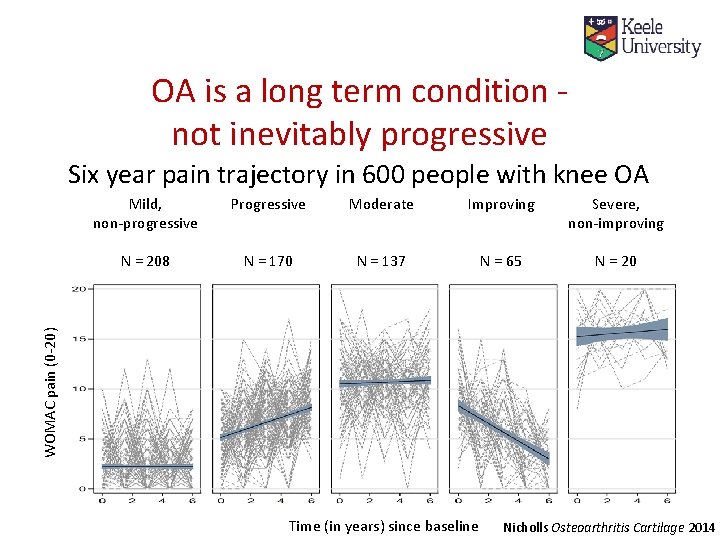
OA is a long term condition not inevitably progressive Six year pain trajectory in 600 people with knee OA Progressive Moderate Improving Severe, non-improving N = 208 N = 170 N = 137 N = 65 N = 20 WOMAC pain (0 -20) Mild, non-progressive Time (in years) since baseline Nicholls Osteoarthritis Cartilage 2014
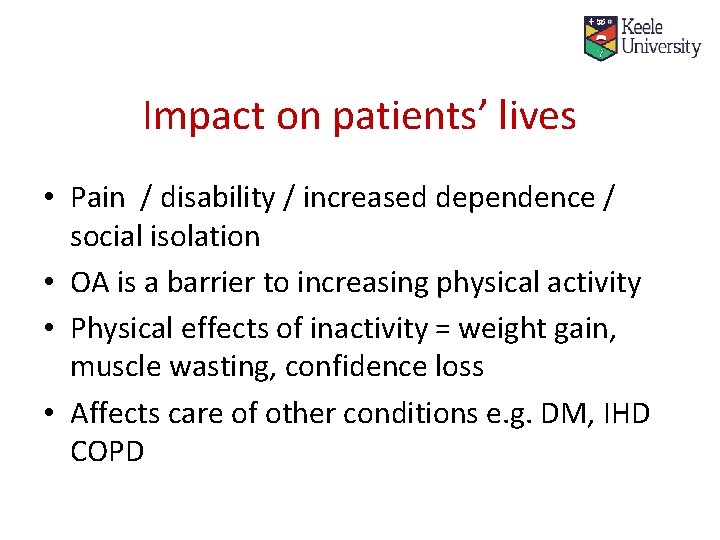
Impact on patients’ lives • Pain / disability / increased dependence / social isolation • OA is a barrier to increasing physical activity • Physical effects of inactivity = weight gain, muscle wasting, confidence loss • Affects care of other conditions e. g. DM, IHD COPD
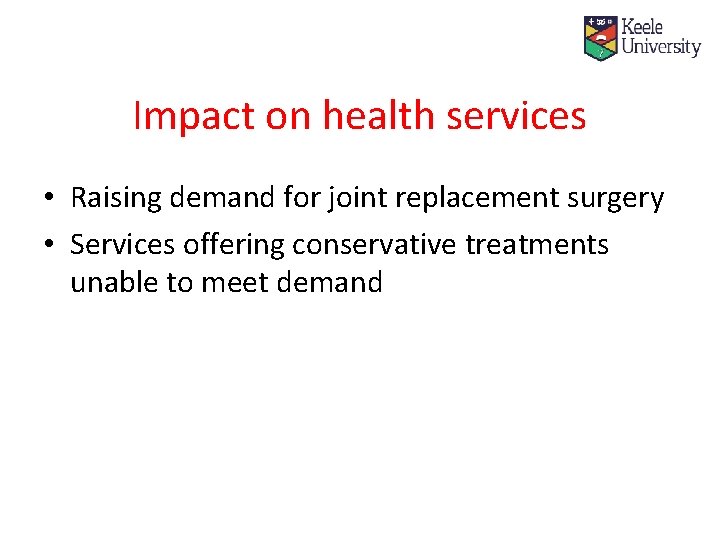
Impact on health services • Raising demand for joint replacement surgery • Services offering conservative treatments unable to meet demand
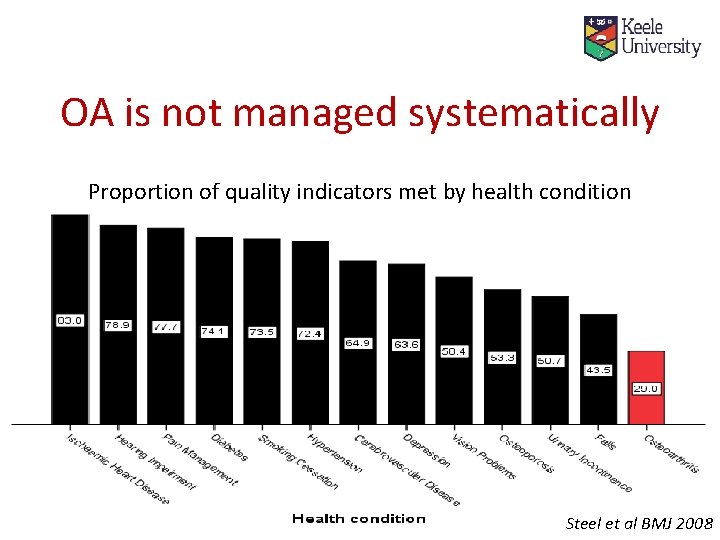
OA is not managed systematically Proportion of quality indicators met by health condition Steel et al BMJ 2008
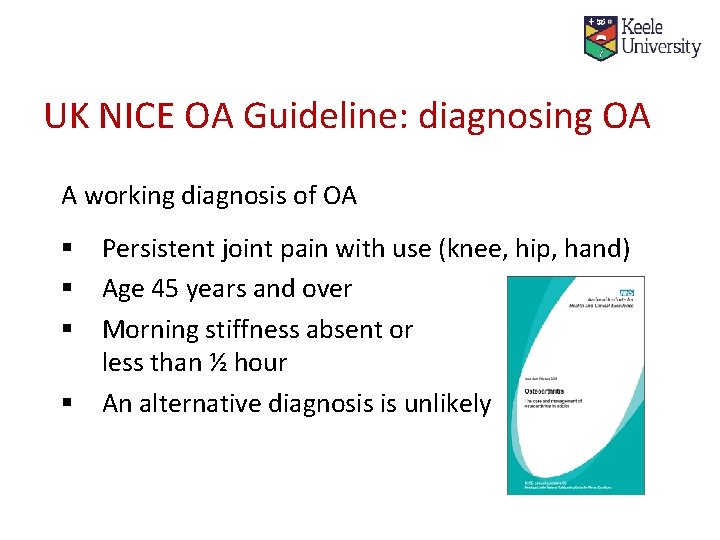
UK NICE OA Guideline: diagnosing OA A working diagnosis of OA § Persistent joint pain with use (knee, hip, hand) § Age 45 years and over § Morning stiffness absent or less than ½ hour § An alternative diagnosis is unlikely
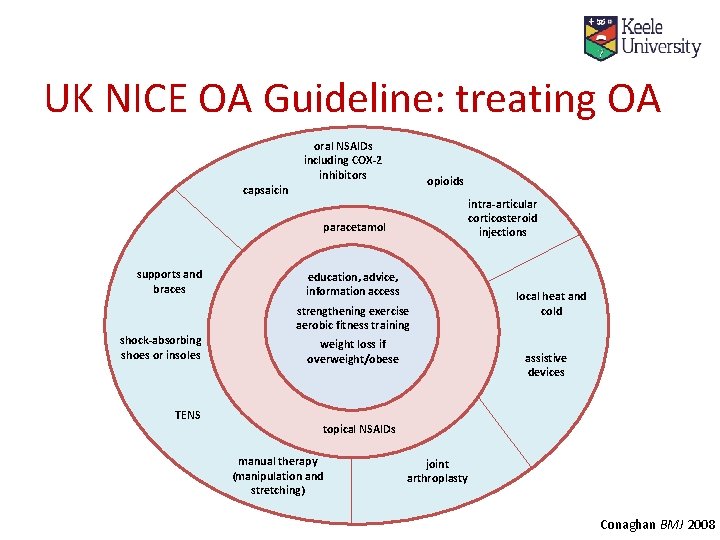
UK NICE OA Guideline: treating OA oral NSAIDs including COX-2 inhibitors opioids capsaicin intra-articular corticosteroid injections paracetamol supports and braces education, advice, information access strengthening exercise aerobic fitness training shock-absorbing shoes or insoles TENS weight loss if overweight/obese local heat and cold assistive devices topical NSAIDs manual therapy (manipulation and stretching) joint arthroplasty Conaghan BMJ 2008
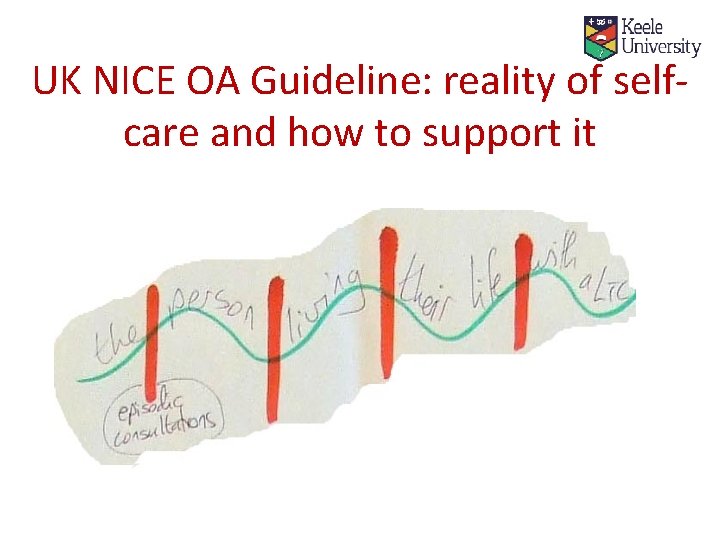
UK NICE OA Guideline: reality of selfcare and how to support it
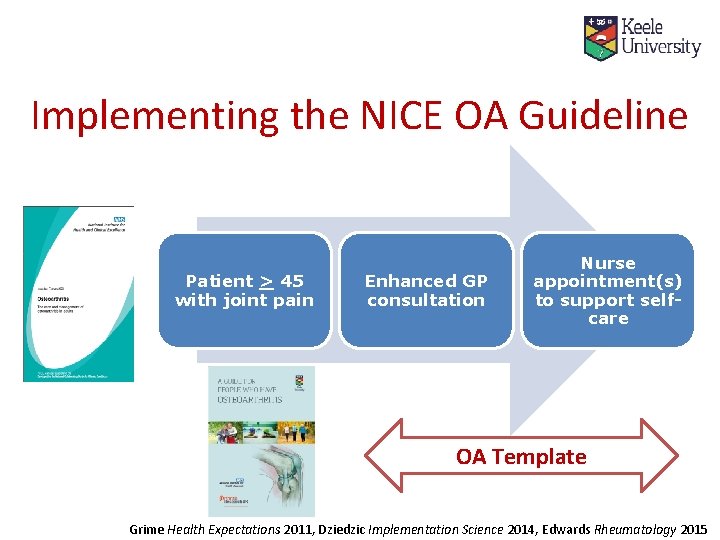
Implementing the NICE OA Guideline Patient > 45 with joint pain Enhanced GP consultation Nurse appointment(s) to support selfcare OA Template Grime Health Expectations 2011, Dziedzic Implementation Science 2014, Edwards Rheumatology 2015
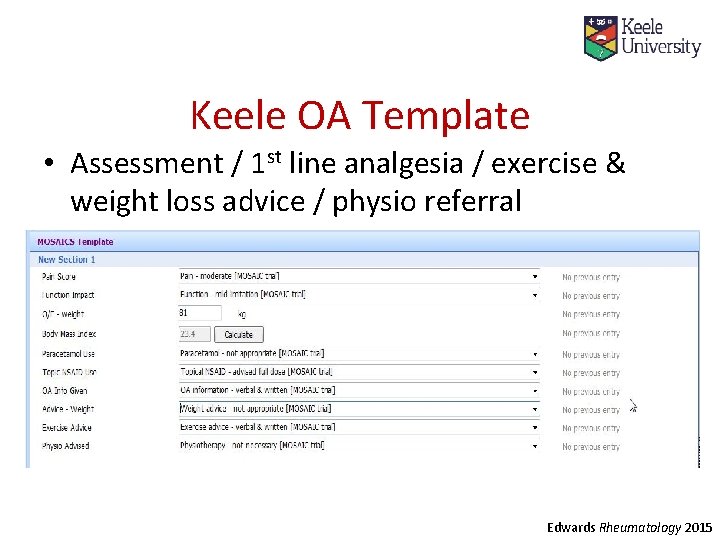
Keele OA Template • Assessment / 1 st line analgesia / exercise & weight loss advice / physio referral Edwards Rheumatology 2015
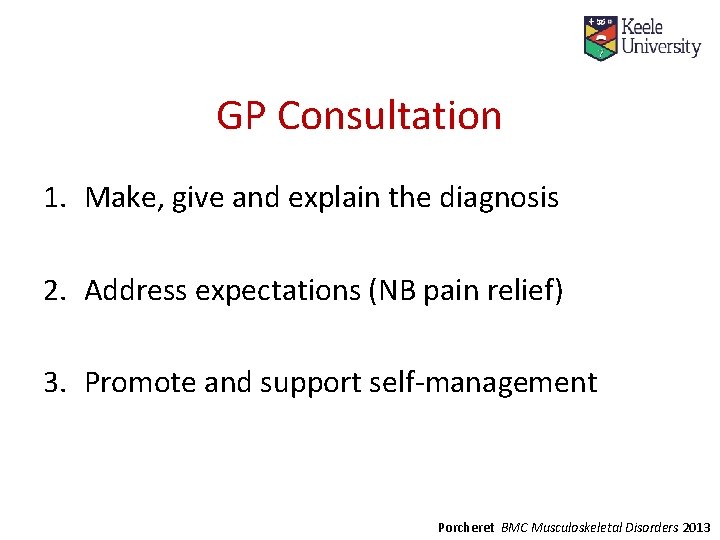
GP Consultation 1. Make, give and explain the diagnosis 2. Address expectations (NB pain relief) 3. Promote and support self-management Porcheret BMC Musculoskeletal Disorders 2013
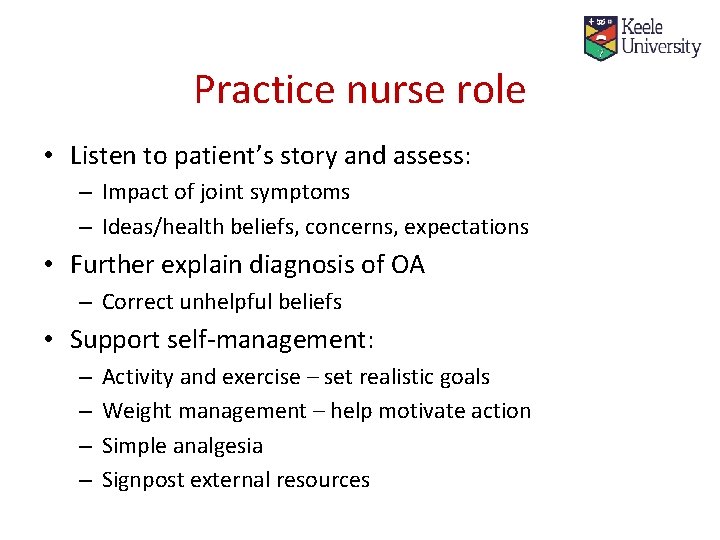
Practice nurse role • Listen to patient’s story and assess: – Impact of joint symptoms – Ideas/health beliefs, concerns, expectations • Further explain diagnosis of OA – Correct unhelpful beliefs • Support self-management: – – Activity and exercise – set realistic goals Weight management – help motivate action Simple analgesia Signpost external resources
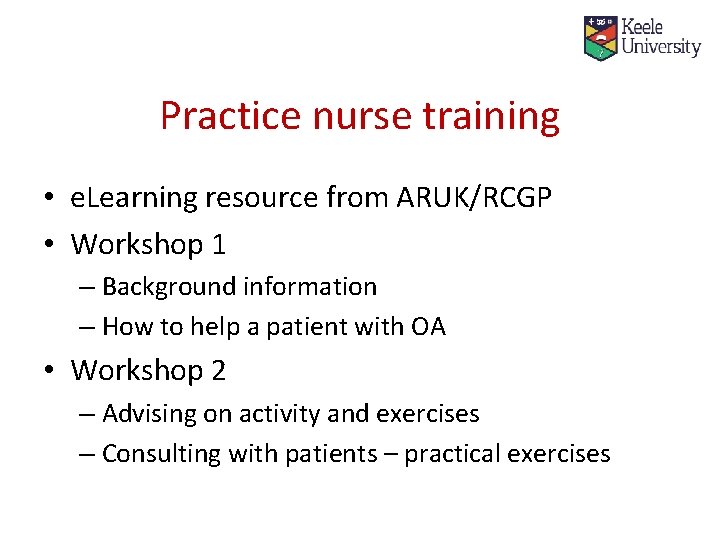
Practice nurse training • e. Learning resource from ARUK/RCGP • Workshop 1 – Background information – How to help a patient with OA • Workshop 2 – Advising on activity and exercises – Consulting with patients – practical exercises
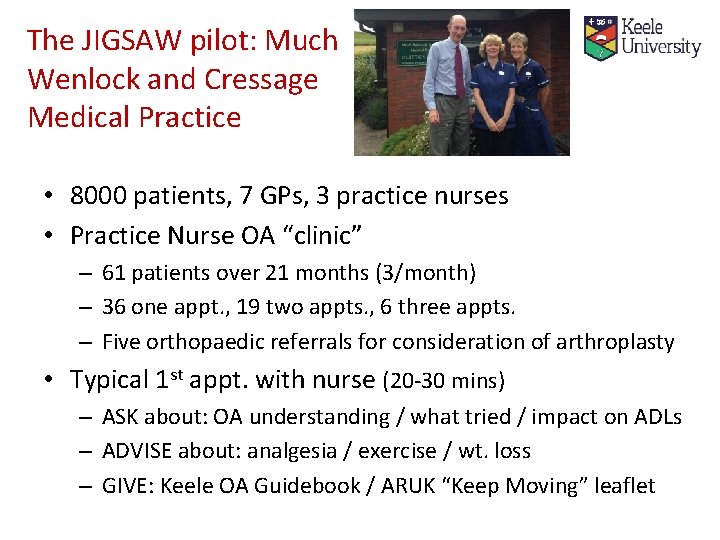
The JIGSAW pilot: Much Wenlock and Cressage Medical Practice • 8000 patients, 7 GPs, 3 practice nurses • Practice Nurse OA “clinic” – 61 patients over 21 months (3/month) – 36 one appt. , 19 two appts. , 6 three appts. – Five orthopaedic referrals for consideration of arthroplasty • Typical 1 st appt. with nurse (20 -30 mins) – ASK about: OA understanding / what tried / impact on ADLs – ADVISE about: analgesia / exercise / wt. loss – GIVE: Keele OA Guidebook / ARUK “Keep Moving” leaflet