
Enhancing Environmental Performance and Climate Proofing of Infrastructure



- Slides: 17
Enhancing Environmental Performance and Climate Proofing of Infrastructure Investments in the Western Balkan Region from an EU integration perspective
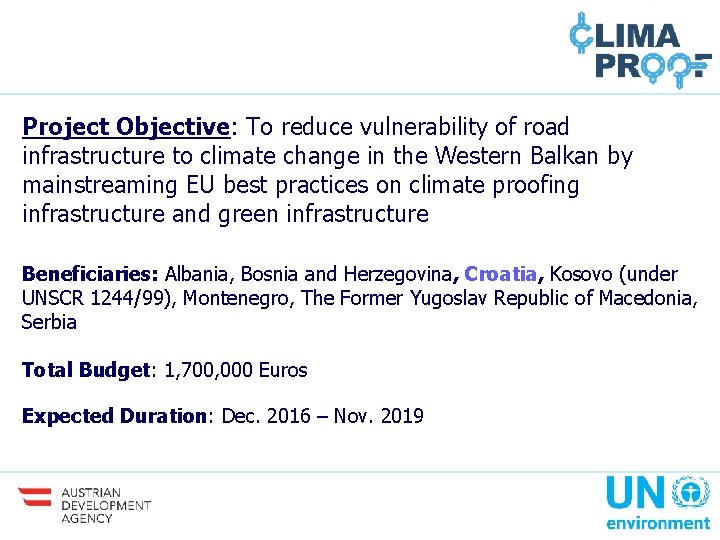
Project Objective: To reduce vulnerability of road infrastructure to climate change in the Western Balkan by mainstreaming EU best practices on climate proofing infrastructure and green infrastructure Beneficiaries: Albania, Bosnia and Herzegovina, Croatia, Kosovo (under UNSCR 1244/99), Montenegro, The Former Yugoslav Republic of Macedonia, Serbia Total Budget: 1, 700, 000 Euros Expected Duration: Dec. 2016 – Nov. 2019
ADA Finances the activities of the project “Enhancing Environmental Performance and Climate Proofing of Infrastructure Investments in the Western Balkan Region from an EU integration perspective”. Supporting the implementation of the SEE 2020 Strategy is among the strategic objectives of ADA. RCC Coordinates the implementation of the SEE 2020 Strategy. RWG as a steering mechanism. UN Environment Co-finances the activities of the project and is responsible for its implementation
Overall Objective / SEE 2020 – objectives under Dimension J - Environment Dimension targets: • Increase adaptive capacity Measure: • Increase adaptive capacity through awareness raising and education on climate change adaptation
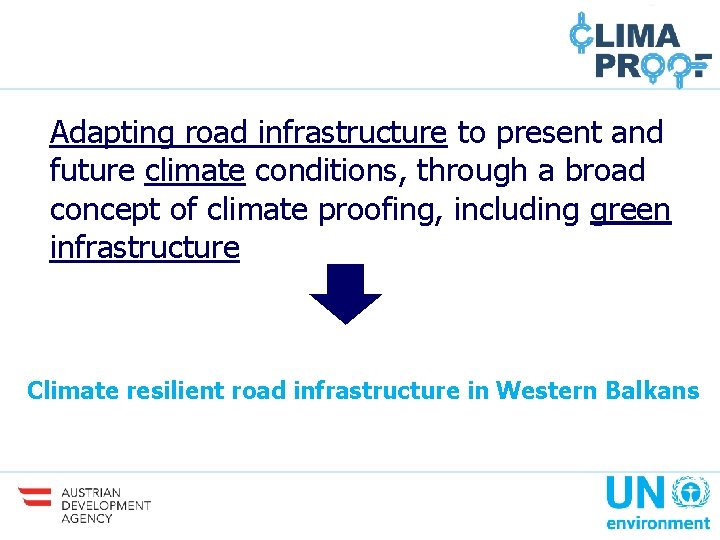
Adapting road infrastructure to present and future climate conditions, through a broad concept of climate proofing, including green infrastructure Climate resilient road infrastructure in Western Balkans
Adapting road infrastructure to present and future climate conditions, through a broad concept of climate proofing, including green infrastructure
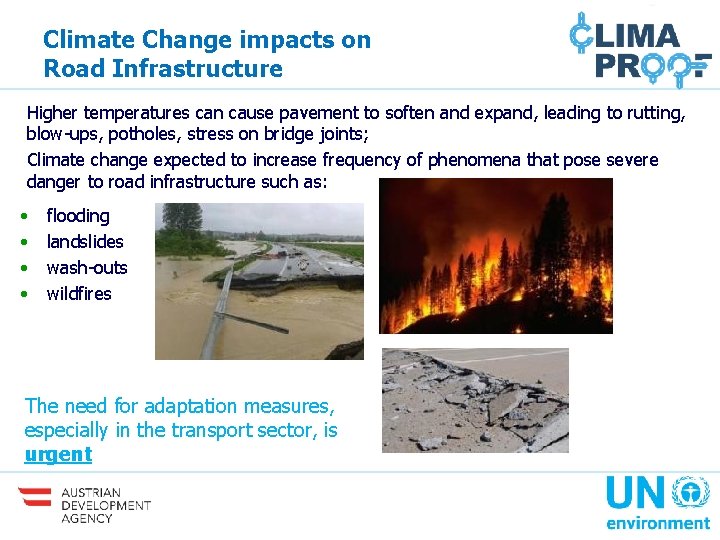
Climate Change impacts on Road Infrastructure Higher temperatures can cause pavement to soften and expand, leading to rutting, blow-ups, potholes, stress on bridge joints; Climate change expected to increase frequency of phenomena that pose severe danger to road infrastructure such as: • • flooding landslides wash-outs wildfires The need for adaptation measures, especially in the transport sector, is urgent
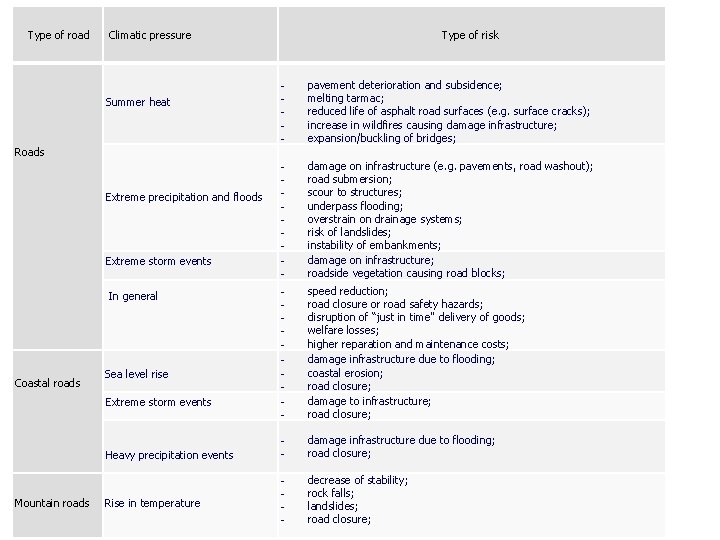
Type of road Climatic pressure Summer heat Type of risk - pavement deterioration and subsidence; melting tarmac; reduced life of asphalt road surfaces (e. g. surface cracks); increase in wildfires causing damage infrastructure; expansion/buckling of bridges; - damage on infrastructure (e. g. pavements, road washout); road submersion; scour to structures; underpass flooding; overstrain on drainage systems; risk of landslides; instability of embankments; damage on infrastructure; roadside vegetation causing road blocks; - speed reduction; road closure or road safety hazards; disruption of “just in time" delivery of goods; welfare losses; higher reparation and maintenance costs; damage infrastructure due to flooding; coastal erosion; road closure; damage to infrastructure; road closure; - damage infrastructure due to flooding; road closure; - decrease of stability; rock falls; landslides; road closure; Roads Extreme precipitation and floods Extreme storm events Coastal roads In general Sea level rise Extreme storm events Mountain roads Heavy precipitation events Rise in temperature
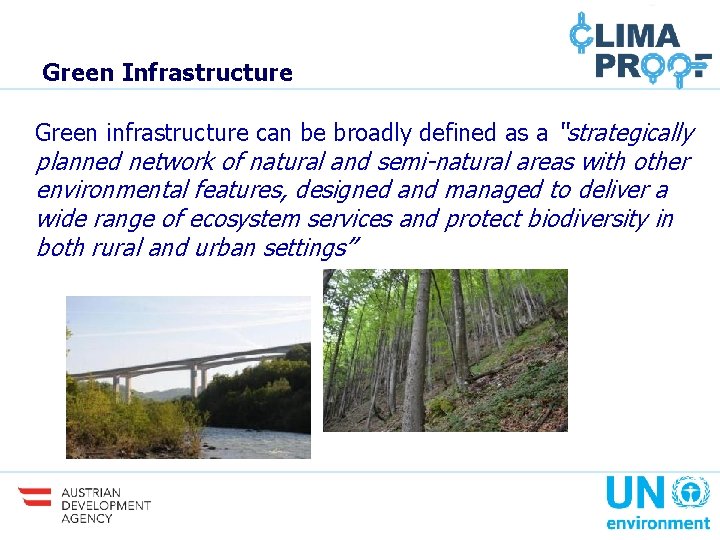
Green Infrastructure Green infrastructure can be broadly defined as a “strategically planned network of natural and semi-natural areas with other environmental features, designed and managed to deliver a wide range of ecosystem services and protect biodiversity in both rural and urban settings”
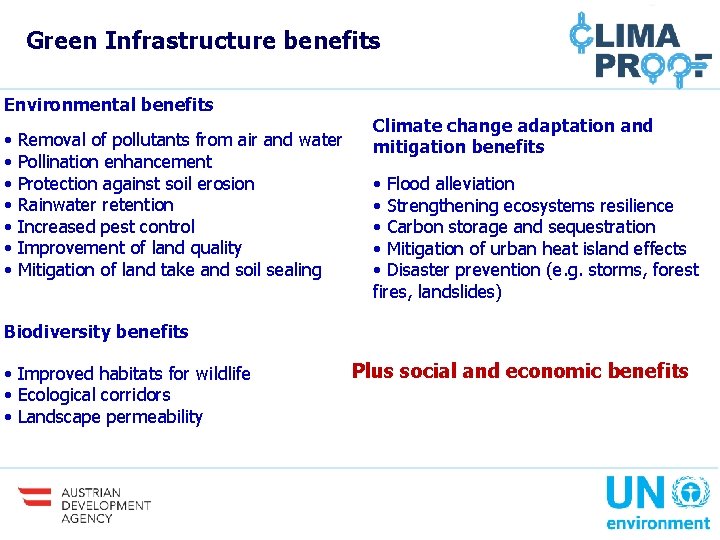
Green Infrastructure benefits Environmental benefits • Removal of pollutants from air and water • Pollination enhancement • Protection against soil erosion • Rainwater retention • Increased pest control • Improvement of land quality • Mitigation of land take and soil sealing Climate change adaptation and mitigation benefits • Flood alleviation • Strengthening ecosystems resilience • Carbon storage and sequestration • Mitigation of urban heat island effects • Disaster prevention (e. g. storms, forest fires, landslides) Biodiversity benefits • Improved habitats for wildlife • Ecological corridors • Landscape permeability Plus social and economic benefits
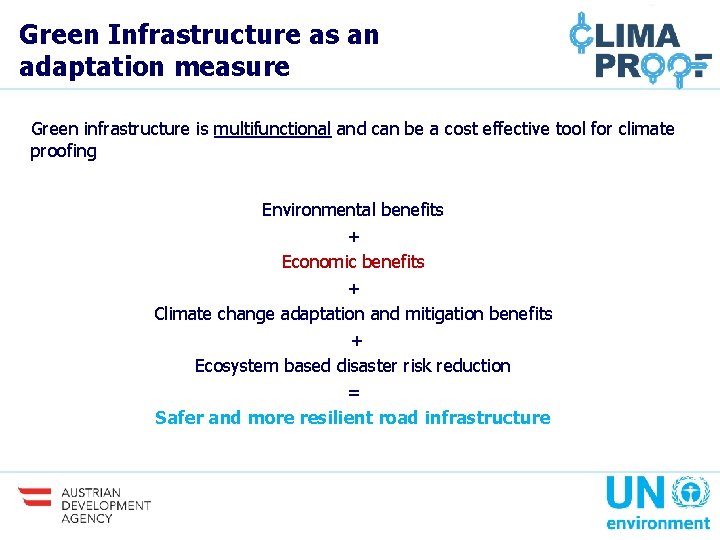
Green Infrastructure as an adaptation measure Green infrastructure is multifunctional and can be a cost effective tool for climate proofing Environmental benefits + Economic benefits + Climate change adaptation and mitigation benefits + Ecosystem based disaster risk reduction = Safer and more resilient road infrastructure
The project will focus on: Understanding future climate and weather patterns: strengthening national capacities to understand climate change related risks in the region through improvement of the information base; Planning for the future climate and weather patterns: strengthening national capacities to integrate climate change projections, climate proofing and green infrastructure in infrastructure development on a national and regional level; Building infrastructure adapted to the future climate and weather patterns: creating an enabling environment for regional cooperation and investments in climate resilient infrastructure in the Western Balkans;
Understanding future climate and weather patterns • Detailed gap analysis on the state of climate change in the WB region; • Methodology for high resolution climate change projections in the WB region; • Enhanced technical capacity to develop high resolution climate change projections;
Understanding future climate and weather patterns • Development of high resolution, localised, bias corrected scenarios for the whole target region • Development of an easy to handle program for bias correction that allow the integration of additional local observations • Winter school on the use of localized climate change scenarios and the production of improved scenarios on local areas with additional meteorological observations Beneficiaries: national experts from Hydro-meteorological institutes
Planning for the future climate and weather patterns • Assessment of climate change adaptation policies and EIA and SEA procedures in place in the countries of the WB region; • Enhanced technical capacity of relevant national stakeholders to effectively respond to climate change related risks through climate proofing measures, including green infrastructure; and to integrate climate change projections and climate proofing measures into infrastructure development, in accordance with EU best practices; • Guidelines on integrating climate change in EIA and SEA procedures; • Improved awareness of both relevant stakeholders and general public climate change impacts on road infrastructure, including increased resilience options such as green infrastructure;
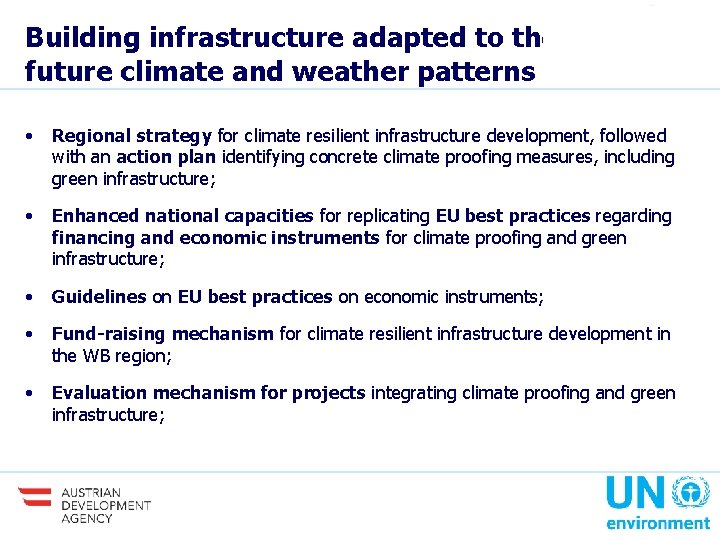
Building infrastructure adapted to the future climate and weather patterns • Regional strategy for climate resilient infrastructure development, followed with an action plan identifying concrete climate proofing measures, including green infrastructure; • Enhanced national capacities for replicating EU best practices regarding financing and economic instruments for climate proofing and green infrastructure; • Guidelines on EU best practices on economic instruments; • Fund-raising mechanism for climate resilient infrastructure development in the WB region; • Evaluation mechanism for projects integrating climate proofing and green infrastructure;
Thank you for your attention! Ana Vukoje UN Environment Vienna Programme Office ana. vukoje@un. org