
Enhancing and Identifying Cloning Attacks in Online Social

- Slides: 14
Enhancing and Identifying Cloning Attacks in Online Social Networks Zifei Shan, Haowen Cao, Jason Lv, Cong Yan, Annie Liu Peking University, China 1
Outline � Motivation � Background: Cloning Attack � An enhanced attack pattern � Experiment: Attacking Renren � Detecting Cloning Attacks � Conclusion 2
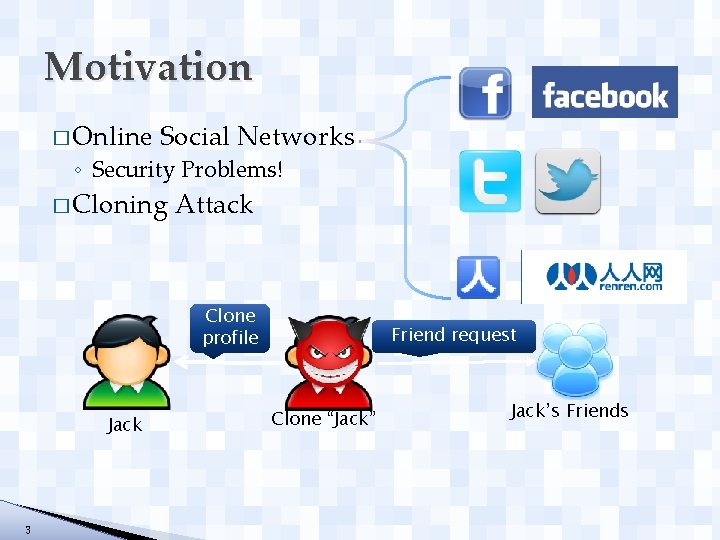
Motivation � Online Social Networks ◦ Security Problems! � Cloning Attack Clone profile Jack 3 Friend request Clone “Jack” Jack’s Friends
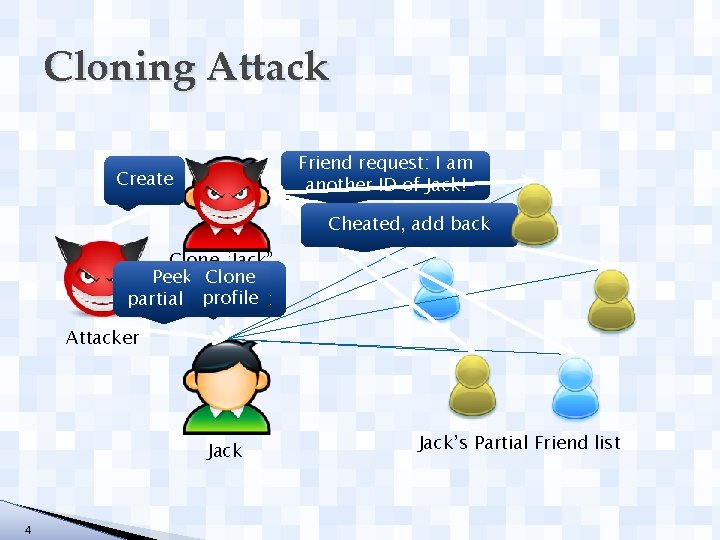
Cloning Attack Friend request: I am another ID of Jack! Create Cheated, add back Clone “Jack” Clone Peek, get a profile partial friend list Attacker Jack 4 Jack’s Partial Friend list
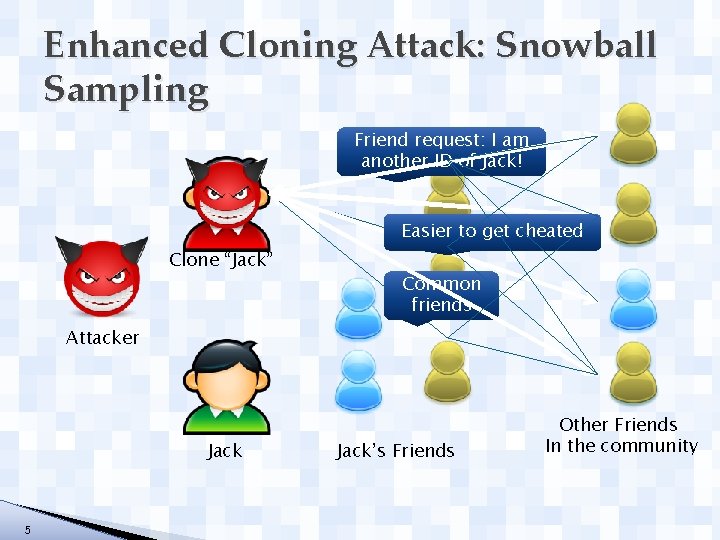
Enhanced Cloning Attack: Snowball Sampling Friend request: I am another ID of Jack! Easier to get cheated Clone “Jack” Common friends Attacker Jack 5 Jack’s Friends Other Friends In the community
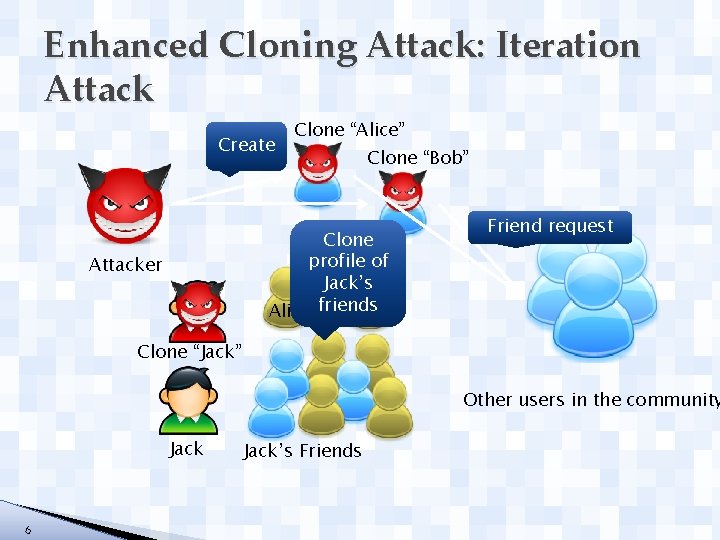
Enhanced Cloning Attack: Iteration Attack Create Clone “Alice” Clone “Bob” Clone profile of Jack’s Alice friends Bob Attacker Friend request Clone “Jack” Other users in the community Jack 6 Jack’s Friends
Experiments: Attacking Renren � Renren: Chinese largest online social network � We conduct a series of experiments to test the threat of traditional sybil attacks, original cloning attacks, and improved cloning attacks. different attack patterns Experiment 7
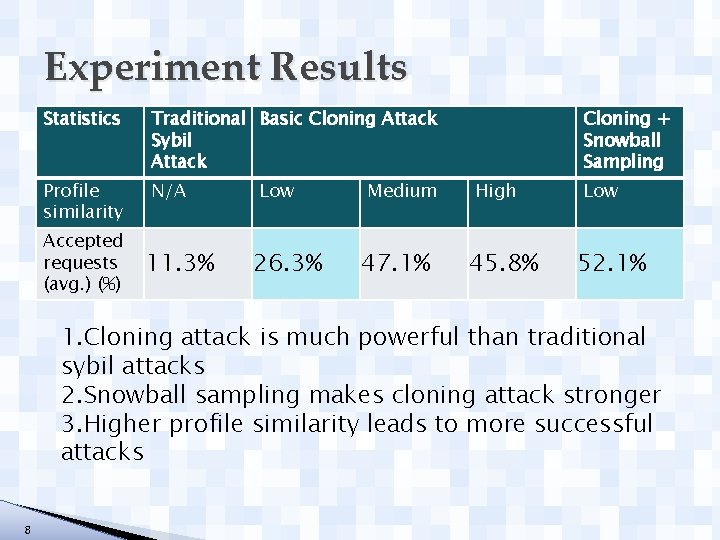
Experiment Results Statistics Traditional Basic Cloning Attack Sybil Attack Profile similarity N/A Accepted requests (avg. ) (%) 11. 3% Low 26. 3% Medium 47. 1% Cloning + Snowball Sampling High 45. 8% Low 52. 1% 1. Cloning attack is much powerful than traditional sybil attacks 2. Snowball sampling makes cloning attack stronger 3. Higher profile similarity leads to more successful attacks 8
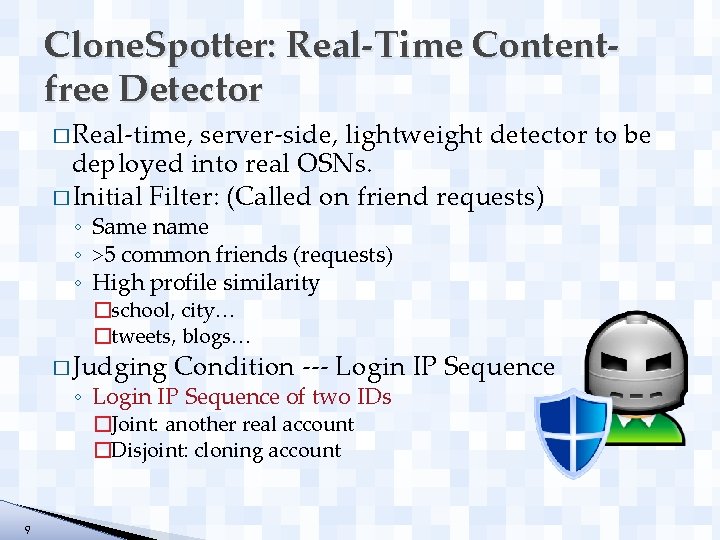
Clone. Spotter: Real-Time Contentfree Detector � Real-time, server-side, lightweight detector to be deployed into real OSNs. � Initial Filter: (Called on friend requests) ◦ Same name ◦ >5 common friends (requests) ◦ High profile similarity �school, city… �tweets, blogs… � Judging Condition --- Login IP Sequence ◦ Login IP Sequence of two IDs �Joint: another real account �Disjoint: cloning account 9
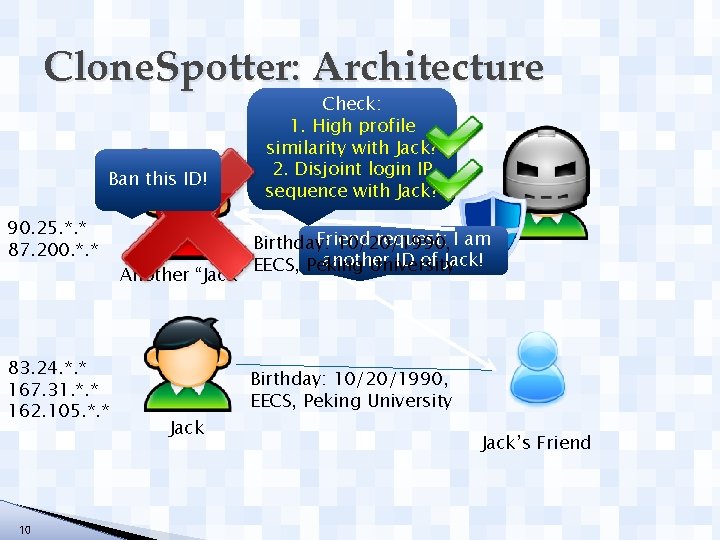
Clone. Spotter: Architecture Ban this ID! 90. 25. *. * 87. 200. *. * 83. 24. *. * 167. 31. *. * 162. 105. *. * 10 Another “Jack” Jack Check: 1. High profile similarity with Jack? 2. Disjoint login IP sequence with Jack? Friend request: I am Birthday: 10/20/1990, another ID of Jack! EECS, Peking University Birthday: 10/20/1990, EECS, Peking University Jack’s Friend
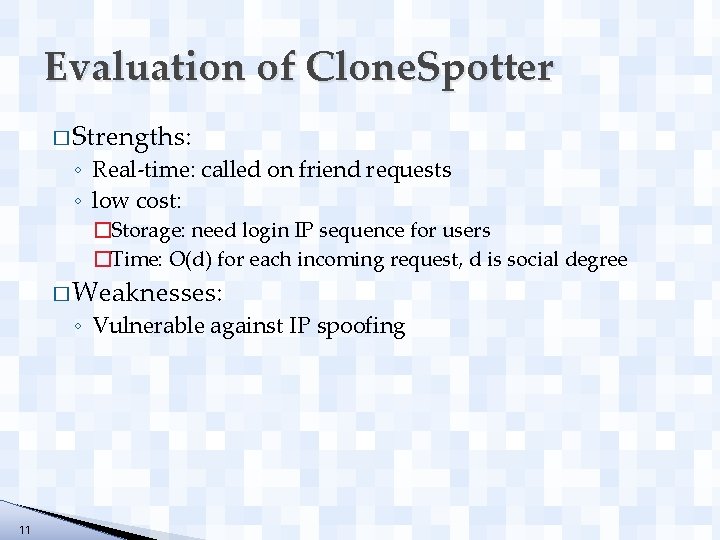
Evaluation of Clone. Spotter � Strengths: ◦ Real-time: called on friend requests ◦ low cost: �Storage: need login IP sequence for users �Time: O(d) for each incoming request, d is social degree � Weaknesses: ◦ Vulnerable against IP spoofing 11
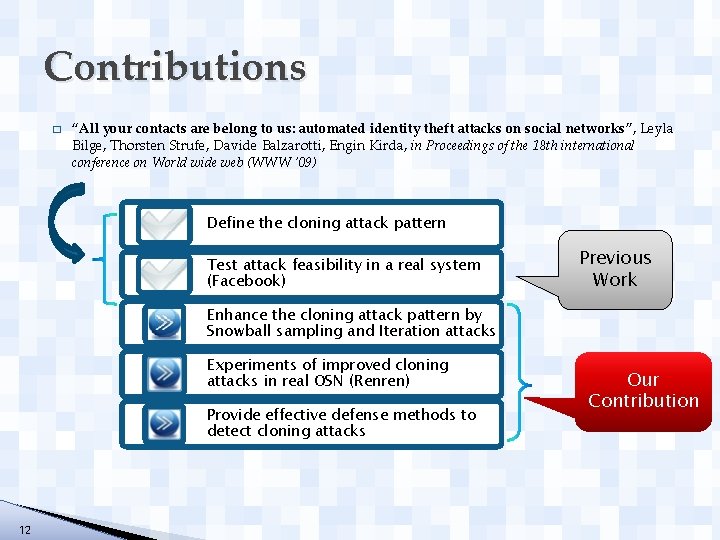
Contributions � “All your contacts are belong to us: automated identity theft attacks on social networks”, Leyla Bilge, Thorsten Strufe, Davide Balzarotti, Engin Kirda, in Proceedings of the 18 th international conference on World wide web (WWW ‘ 09) Define the cloning attack pattern Test attack feasibility in a real system (Facebook) Previous Work Enhance the cloning attack pattern by Snowball sampling and Iteration attacks Experiments of improved cloning attacks in real OSN (Renren) Provide effective defense methods to detect cloning attacks 12 Our Contribution
Future work � Deploy into real systems � Measure detected users ◦ Action patterns ◦ Malicious activities � Further detecting methods ◦ Content-free: User action logs, Click-patterns, Action Time ◦ Content-related: semantics analysis 13
Thanks! Contact: Zifei Shan Peking University, China shanzifei@pku. edu. cn http: //www. zifeishan. org 14