
Enhanced Visual Inspection of Flexible Endoscopes Interpretation of
Enhanced Visual Inspection of Flexible Endoscopes: Interpretation of Results Mary Ann Drosnock, MS, CIC, CFER, RM (NRCM), FAPIC Manager of Clinical Education, Endoscopy Healthmark Industries Co-chair AAMI WG 84 for Endoscope Reprocessing ST 91
Objectives • Define visually clean and enhanced visual inspection for endoscopes • Review the latest information from various organizations on enhanced visual inspection using a borescope • Define best practices for enhanced visual inspection of medical devices
Overview of the Levels of Inspection • All scopes must be visually inspected after manual cleaning: Look for debris and damage • Standards and professional guidelines also call for lighted magnification to be used for this step • Cleaning verification tests are used to check for internal retained patient debris • AAMI and AORN recommend use of a borescope for internal inspection
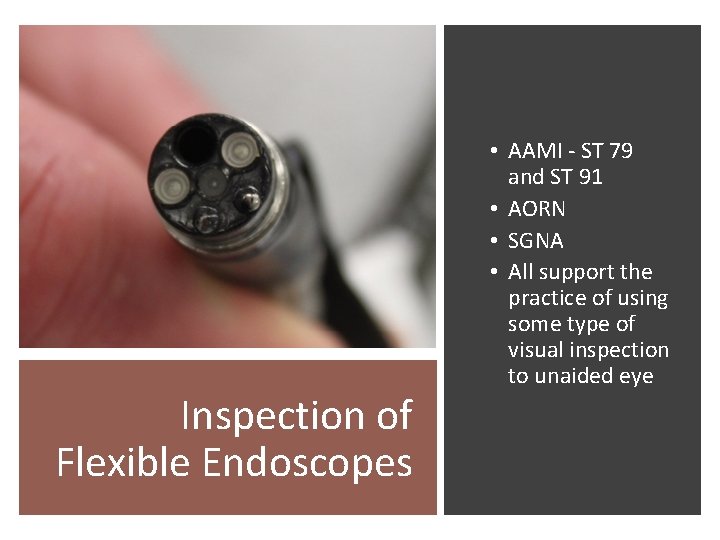
Inspection of Flexible Endoscopes • AAMI - ST 79 and ST 91 • AORN • SGNA • All support the practice of using some type of visual inspection to unaided eye
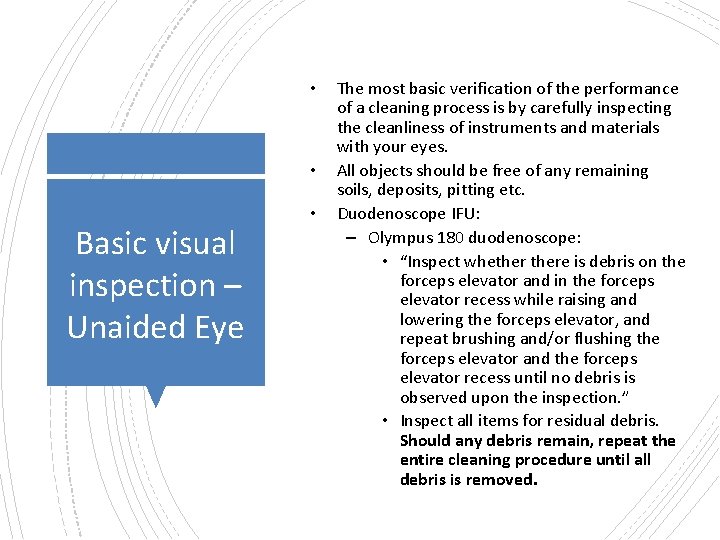
• • Basic visual inspection – Unaided Eye • The most basic verification of the performance of a cleaning process is by carefully inspecting the cleanliness of instruments and materials with your eyes. All objects should be free of any remaining soils, deposits, pitting etc. Duodenoscope IFU: – Olympus 180 duodenoscope: • “Inspect whethere is debris on the forceps elevator and in the forceps elevator recess while raising and lowering the forceps elevator, and repeat brushing and/or flushing the forceps elevator and the forceps elevator recess until no debris is observed upon the inspection. ” • Inspect all items for residual debris. Should any debris remain, repeat the entire cleaning procedure until all debris is removed.
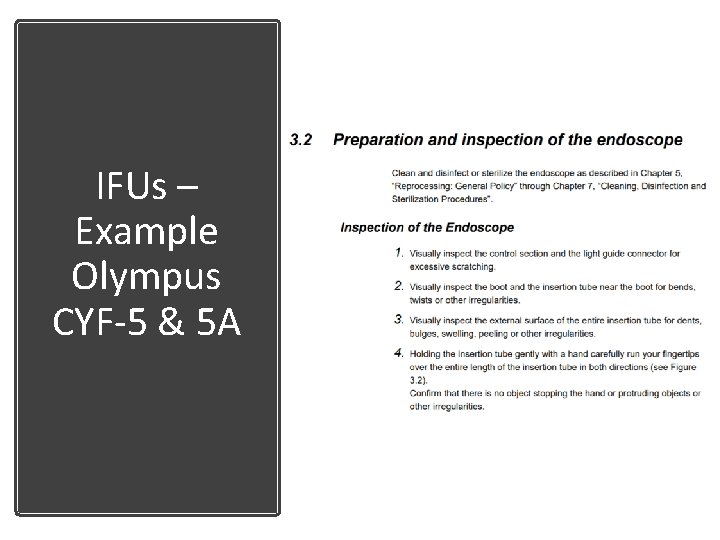
IFUs – Example Olympus CYF-5 & 5 A
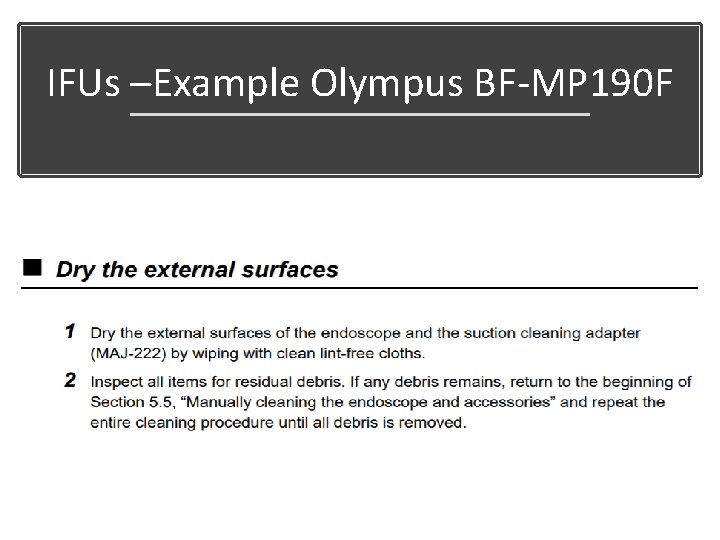
IFUs –Example Olympus BF-MP 190 F
SGNA – Endoscope Inspection • • • Treat as a safety stop or “time out” to ensure the endoscope is visually clean before proceeding to the next step of HLD. Visually inspect for conditions that could affect the disinfection process (e. g. , cracks, corrosion, discoloration, retained debris). Repeat manual cleaning step(s) if not clean. Minimum standard for cleaning assessment of scopes. Need adequate lighting
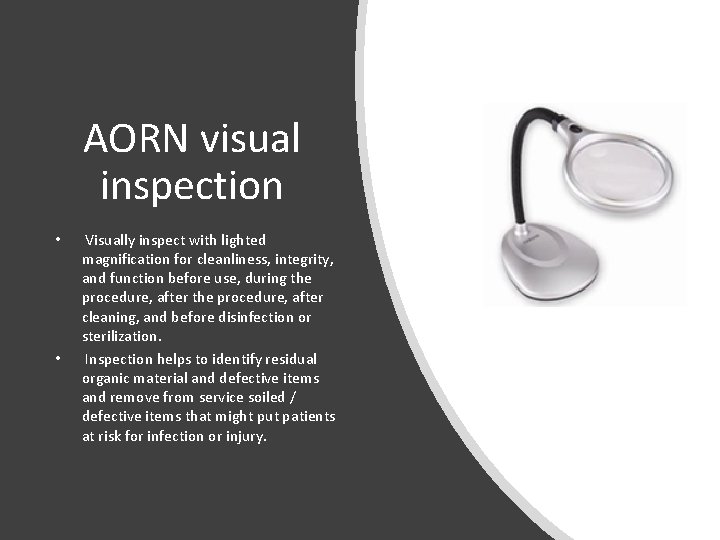
AORN visual inspection • • Visually inspect with lighted magnification for cleanliness, integrity, and function before use, during the procedure, after cleaning, and before disinfection or sterilization. Inspection helps to identify residual organic material and defective items and remove from service soiled / defective items that might put patients at risk for infection or injury.
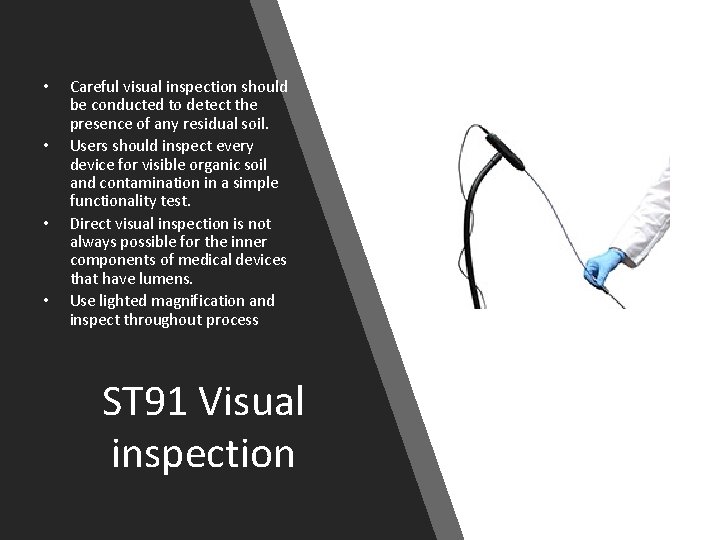
• • Careful visual inspection should be conducted to detect the presence of any residual soil. Users should inspect every device for visible organic soil and contamination in a simple functionality test. Direct visual inspection is not always possible for the inner components of medical devices that have lumens. Use lighted magnification and inspect throughout process ST 91 Visual inspection
APIC Duodenoscope Inspection • Because duodenoscopes are more complex than other endoscope instruments, it requires meticulous attention to detail and step-by-step precision to render them safe for re-use. • After observing the cleaning and disinfecting processes and asking questions so that each step of the process is understood, the IP or HE may visit the department regularly to observe scope cleaning practices and reinforce the importance of the work being done. • The IP or HE will evaluate human factors, including ensuring that the cleaning area is set up with a bright light and magnification so all sections of the scope being cleaned can be well visualized. • http: //www. apic. org/Resource_/Tiny. Mce. File. Mana ger/media. Images/ERCP_Press_Release_APIC_SHEA _02242015. pdf
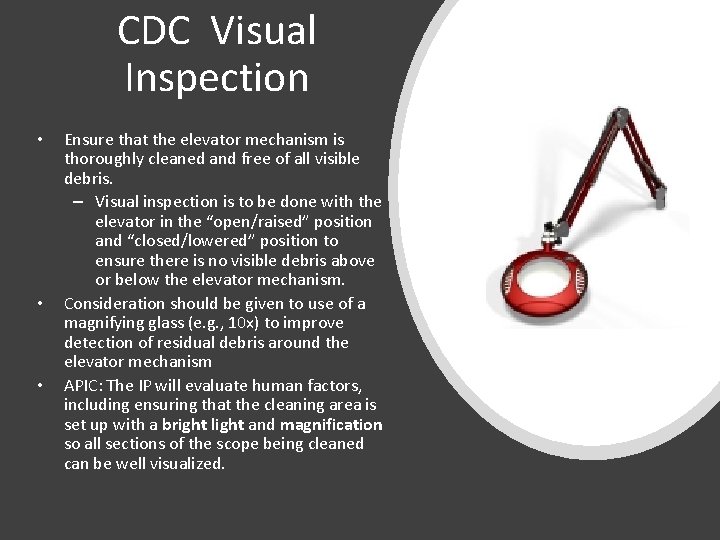
CDC Visual Inspection • • • Ensure that the elevator mechanism is thoroughly cleaned and free of all visible debris. – Visual inspection is to be done with the elevator in the “open/raised” position and “closed/lowered” position to ensure there is no visible debris above or below the elevator mechanism. Consideration should be given to use of a magnifying glass (e. g. , 10 x) to improve detection of residual debris around the elevator mechanism APIC: The IP will evaluate human factors, including ensuring that the cleaning area is set up with a bright light and magnification so all sections of the scope being cleaned can be well visualized.
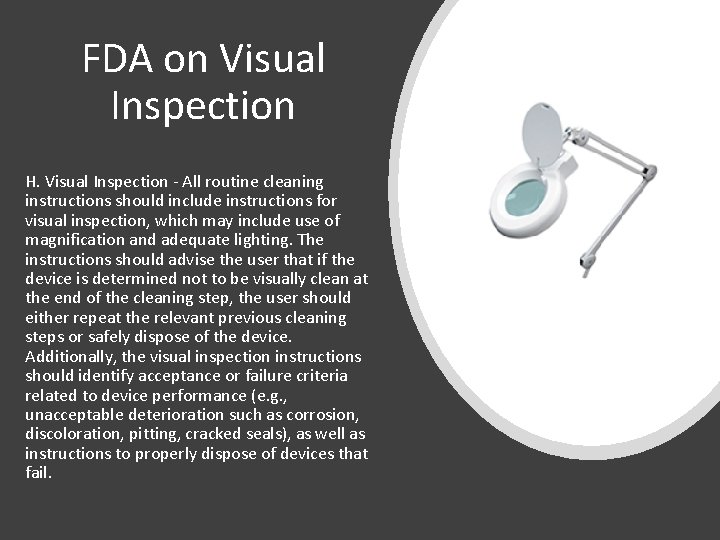
FDA on Visual Inspection H. Visual Inspection - All routine cleaning instructions should include instructions for visual inspection, which may include use of magnification and adequate lighting. The instructions should advise the user that if the device is determined not to be visually clean at the end of the cleaning step, the user should either repeat the relevant previous cleaning steps or safely dispose of the device. Additionally, the visual inspection instructions should identify acceptance or failure criteria related to device performance (e. g. , unacceptable deterioration such as corrosion, discoloration, pitting, cracked seals), as well as instructions to properly dispose of devices that fail.
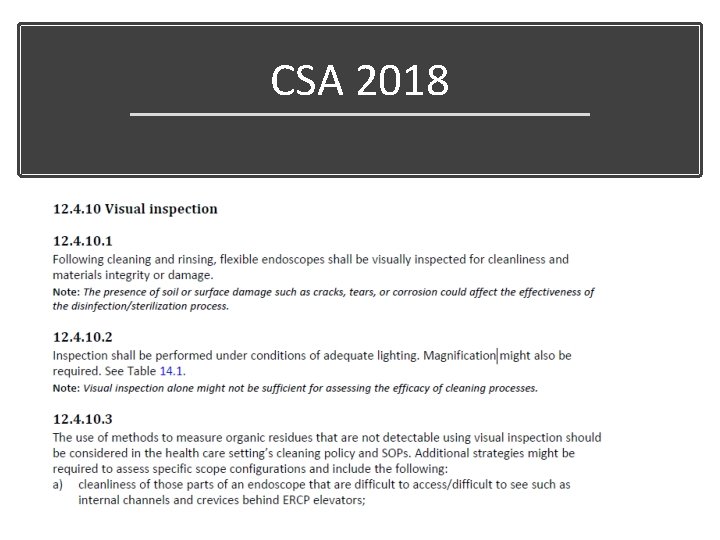
CSA 2018
CSA – Decontamination of Medical Devices • Insertion tub should be assessed to determine if the outer surface is damaged or punctured • Distal end and cap should be round and smooth • Lens at distal end or objective lens should not be cracked or dirty • Biopsy channel recessed hole should be round, smooth and not impacted or cracked
CSA – Decontamination of Medical Devices • Remove damaged or defective scopes from service. • Routine visual inspection and preventative maintenance of each endoscope provides valuable info about the scope’s condition and can uncover the need for repair. • Use of damaged or unclean endoscopes is a risk to patient safety. • Identifying wear and tear, damage or deterioration is essential to good endoscope care.
CSA – Decontamination of Medical Devices • 11. 2 – Endoscope inspection process • A diligent inspection of the entire endoscopes shall be performed after each use shall include at minimum: – An overall assessment of the cosmetic appearance – No discoloration – No cracks – No sharp edges – No holes or other degradation – No peeling or pitting of adhesives
CSA – Decontamination of Medical Devices • Water resistant cap should be watertight – If fluid is present after the disinfection process, the leak test should be re-done. – If leak test is negative, then likely the cap is not water resistant • The integrity of the cap should be assessed for missing, damaged or stretched o-rings • Light guide connector prong should be checked to ensure that it is tight – Tighten if loose
CSA – Decontamination of Medical Devices • Knobs should not be cracked, looks, leak or have a grinding feeling when turned. • Endoscope should angulate smoothly without tightness or play • Bending section should not bend irregularly • Degree of angulations should be checked – Refer to scope IFU for angulation charts
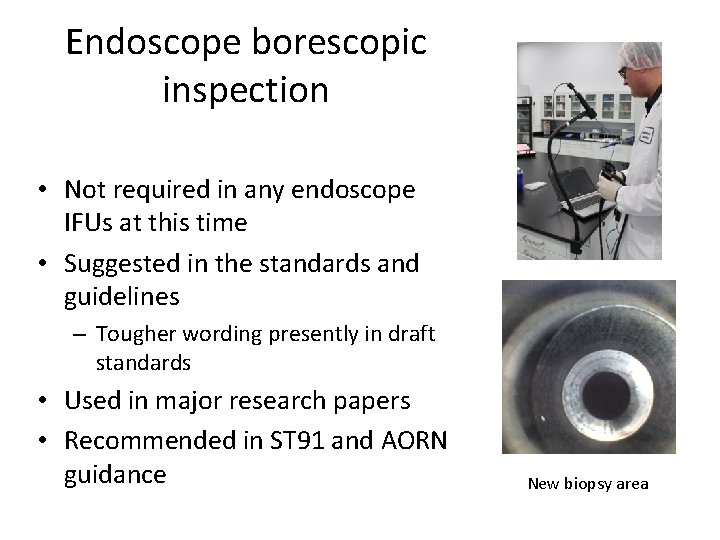
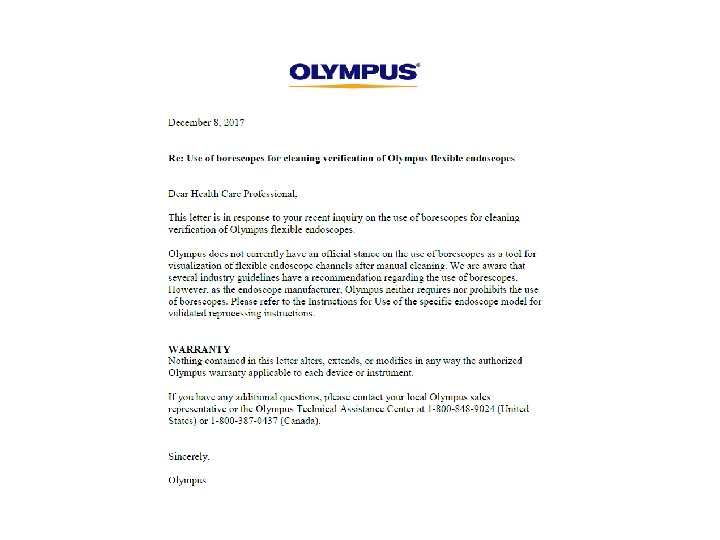
Endoscope borescopic inspection • Not required in any endoscope IFUs at this time • Suggested in the standards and guidelines – Tougher wording presently in draft standards • Used in major research papers • Recommended in ST 91 and AORN guidance New biopsy area
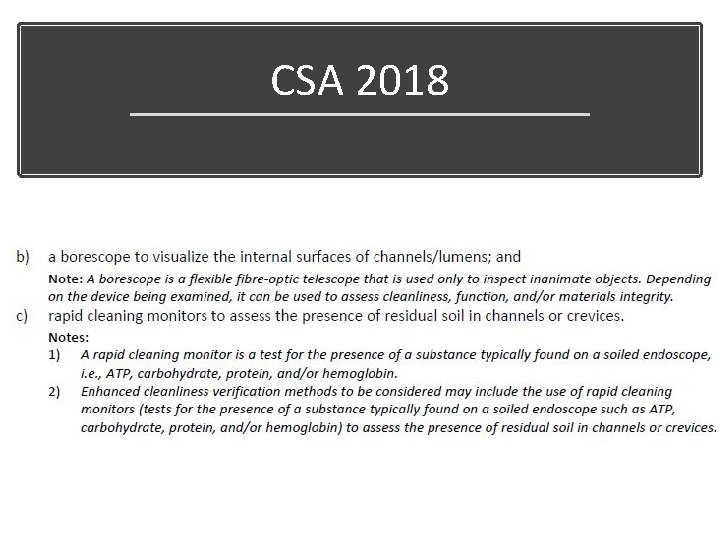
CSA 2018
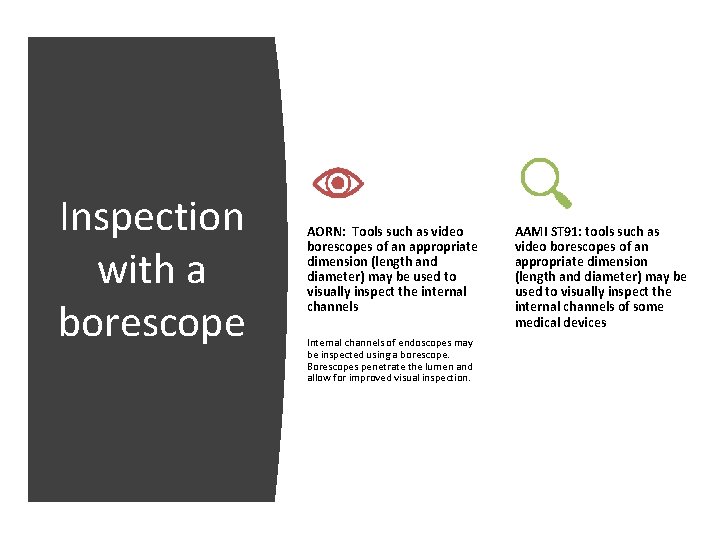
Inspection with a borescope AORN: Tools such as video borescopes of an appropriate dimension (length and diameter) may be used to visually inspect the internal channels Internal channels of endoscopes may be inspected using a borescope. Borescopes penetrate the lumen and allow for improved visual inspection. AAMI ST 91: tools such as video borescopes of an appropriate dimension (length and diameter) may be used to visually inspect the internal channels of some medical devices
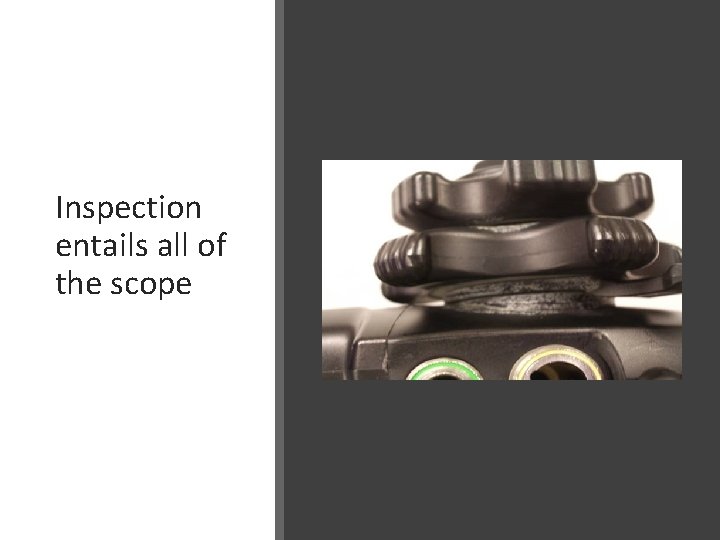
Inspection entails all of the scope
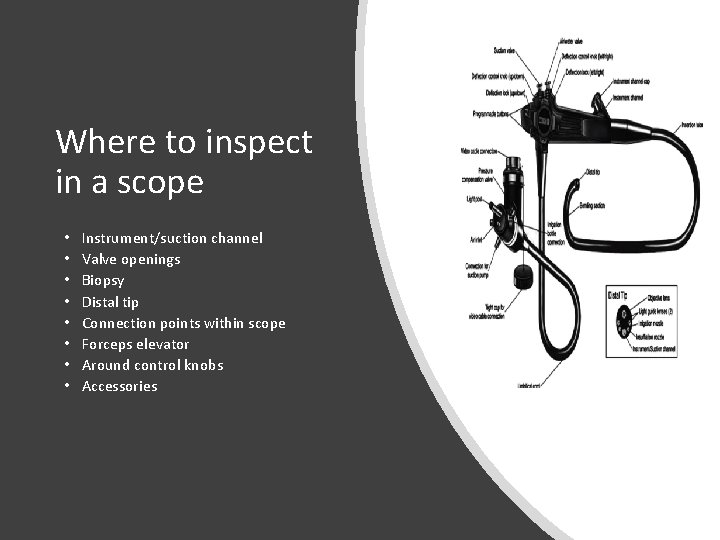
Where to inspect in a scope • • Instrument/suction channel Valve openings Biopsy Distal tip Connection points within scope Forceps elevator Around control knobs Accessories
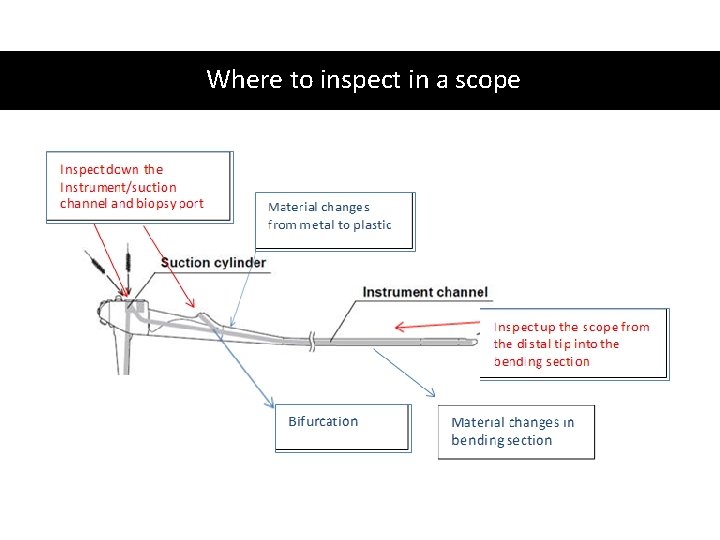
Where to inspect in a scope
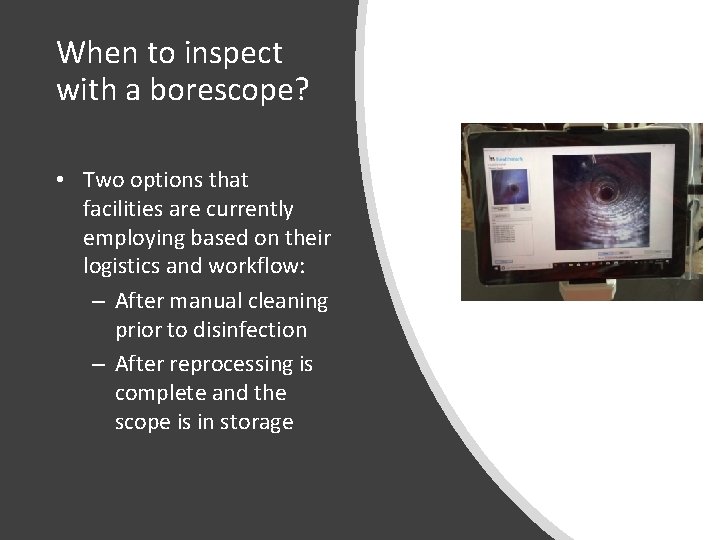
When to inspect with a borescope? • Two options that facilities are currently employing based on their logistics and workflow: – After manual cleaning prior to disinfection – After reprocessing is complete and the scope is in storage
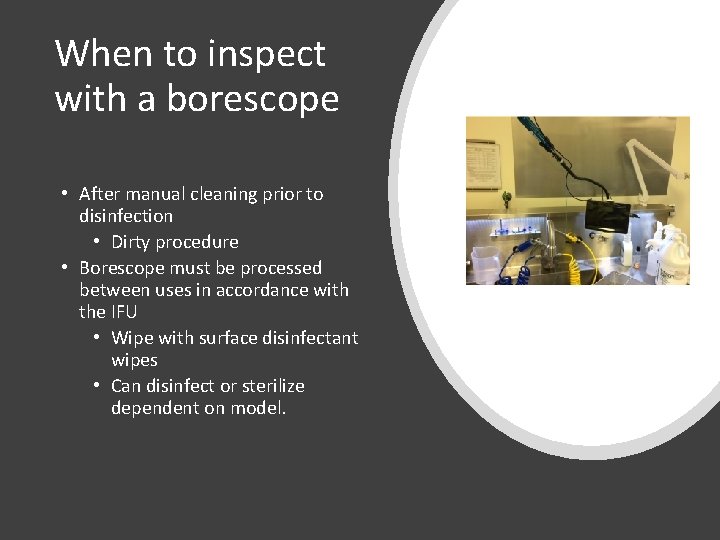
When to inspect with a borescope • After manual cleaning prior to disinfection • Dirty procedure • Borescope must be processed between uses in accordance with the IFU • Wipe with surface disinfectant wipes • Can disinfect or sterilize dependent on model.
When to inspect with a borescope • • • After disinfection and endoscope is in storage – Clean procedure Borescope must be reprocessed after use Endoscopes must be completely reprocessed after inspection (rerun through cleaning and disinfection) • • Used as a quality tool to inspect endoscopes on a periodic interval established by the facility Looking for retained debris, damage and moisture – Endoscopes should be dry at this point since they are in storage!
BORESCOPE INFORMATION • Many different types of borescopes are available • Various sizes • Make sure to know inventory to pick the correct size borescope • Video and fiber scopes available • Different manufacturers • Different chemical compatibilities • Disinfection • Sterilization

INTERPRETATION OF RESULTS: SUPPORTING RESEARCH AND DOCUMENTS
What to do with the results? • Take photos or videos of new scopes to compare to later – People become used to what they see over time • Review latest research findings to help in decisions of what’s critical and what’s noncritical for inspection • More info to come (ST 91)
Prints available here
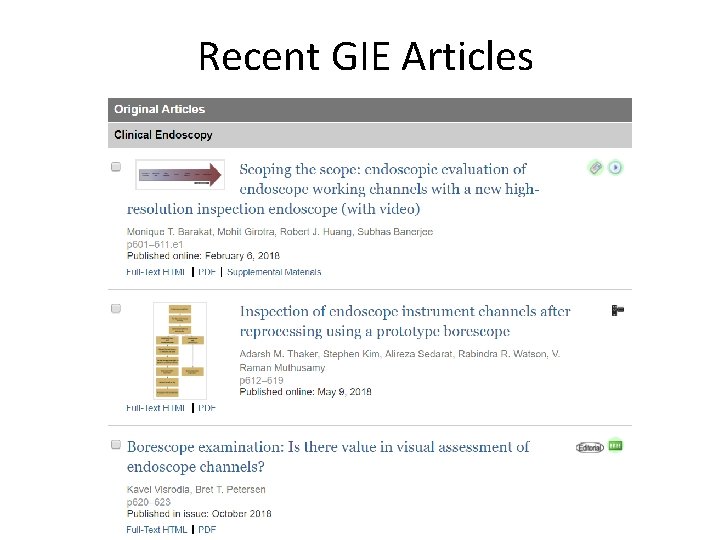
Recent GIE Articles
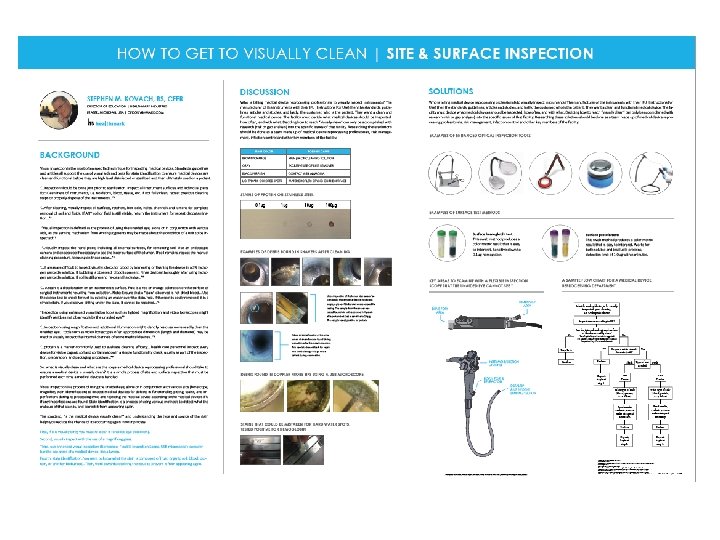
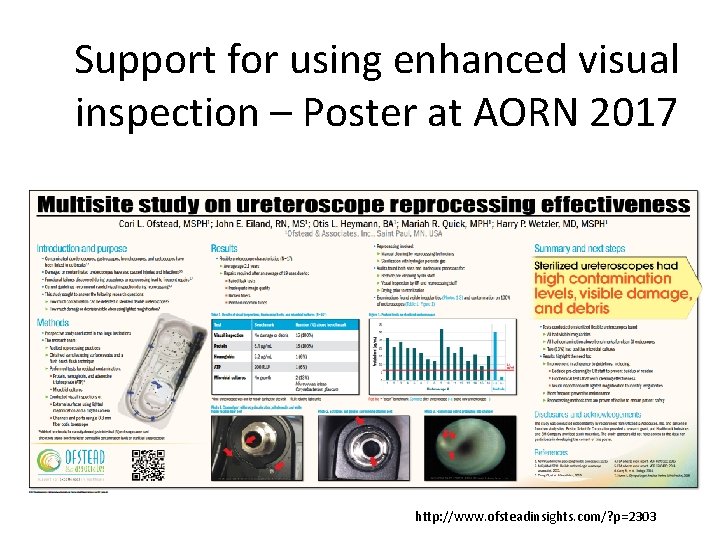
Support for using enhanced visual inspection – Poster at AORN 2017 http: //www. ofsteadinsights. com/? p=2303
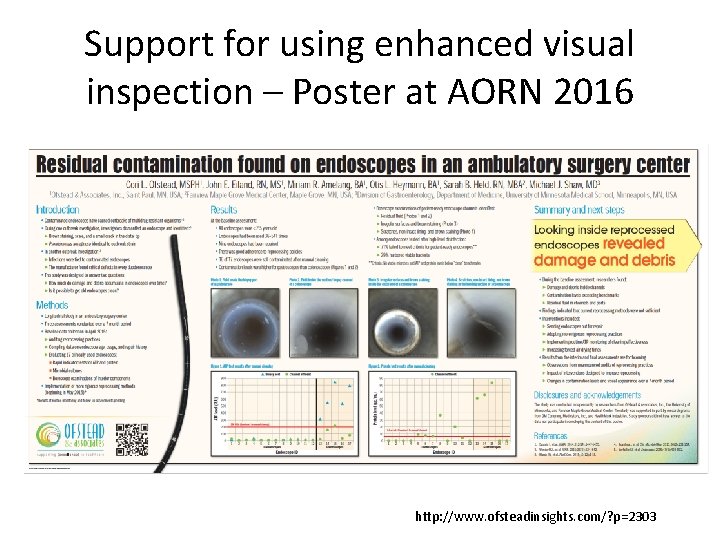
Support for using enhanced visual inspection – Poster at AORN 2016 http: //www. ofsteadinsights. com/? p=2303

Poster at SGNA 2016 http: //www. ofsteadinsights. com//wp-content/uploads/Ofstead_SGNA_Poster_Board_2016_SENT. pdf
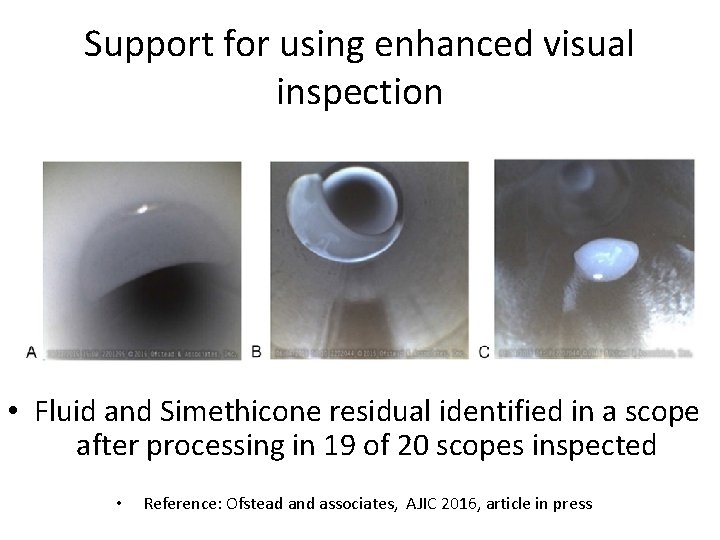
Support for using enhanced visual inspection • Fluid and Simethicone residual identified in a scope after processing in 19 of 20 scopes inspected • Reference: Ofstead and associates, AJIC 2016, article in press
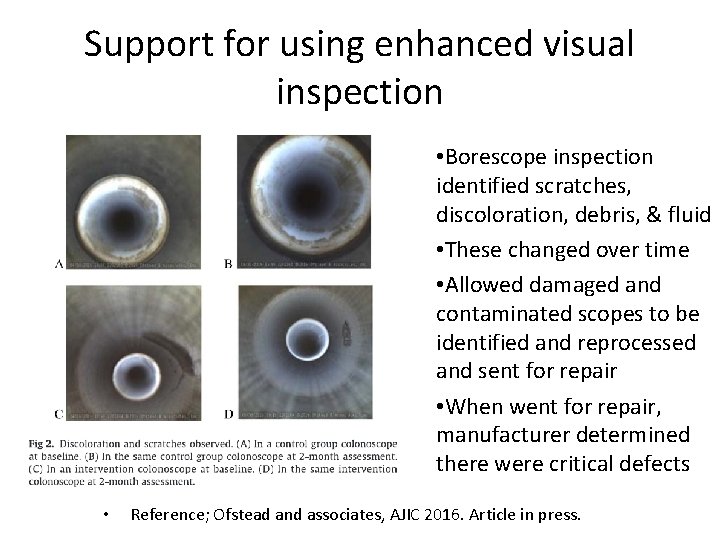
Support for using enhanced visual inspection • Borescope inspection identified scratches, discoloration, debris, & fluid • These changed over time • Allowed damaged and contaminated scopes to be identified and reprocessed and sent for repair • When went for repair, manufacturer determined there were critical defects • Reference; Ofstead and associates, AJIC 2016. Article in press.
AAMI ST 91 • Informative Annex Being Developed to help with interpretation of results • Photos • Where to inspect
INTERPRETATION: PHOTOS TAKEN WITH A BORESCOPE
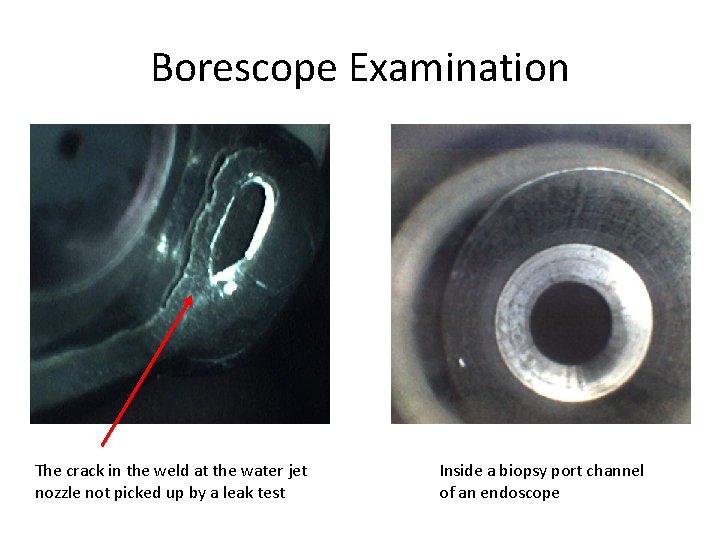
Borescope Examination The crack in the weld at the water jet nozzle not picked up by a leak test Inside a biopsy port channel of an endoscope
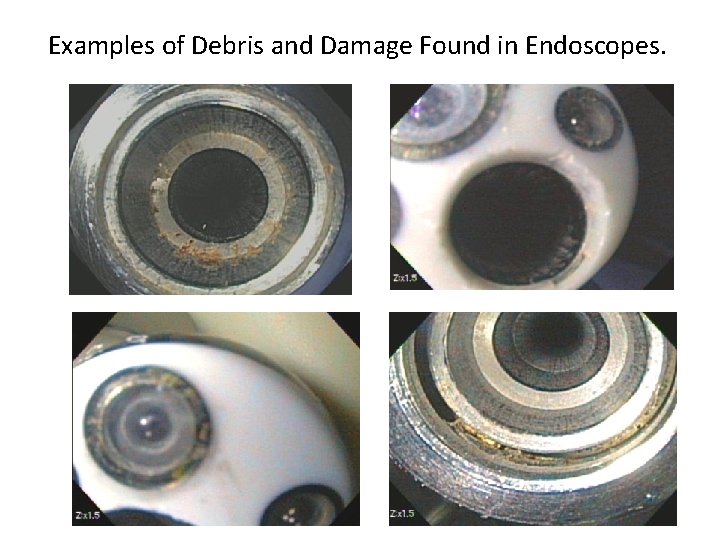
Examples of Debris and Damage Found in Endoscopes.
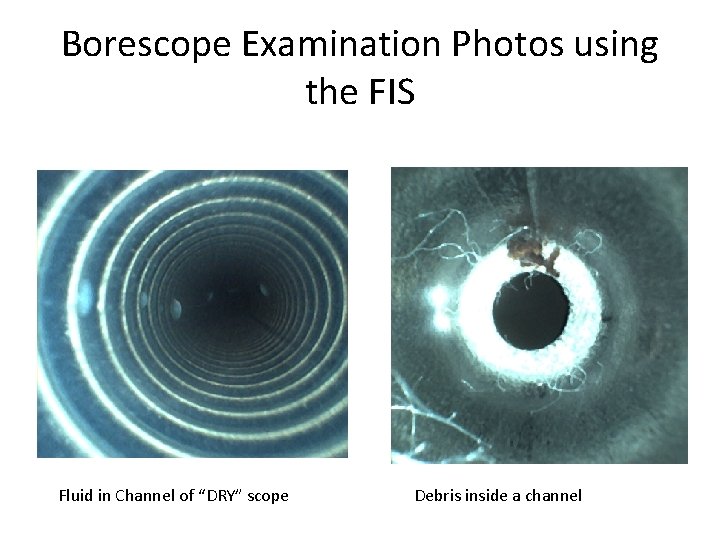
Borescope Examination Photos using the FIS Fluid in Channel of “DRY” scope Debris inside a channel
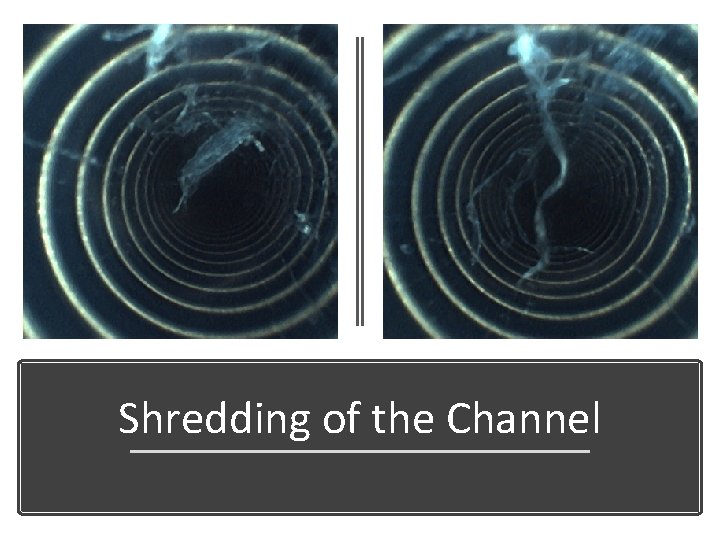
Shredding of the Channel
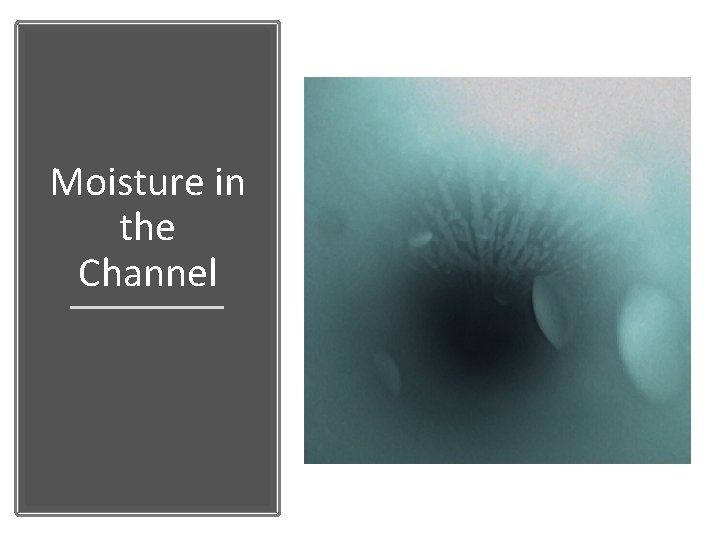
Moisture in the Channel
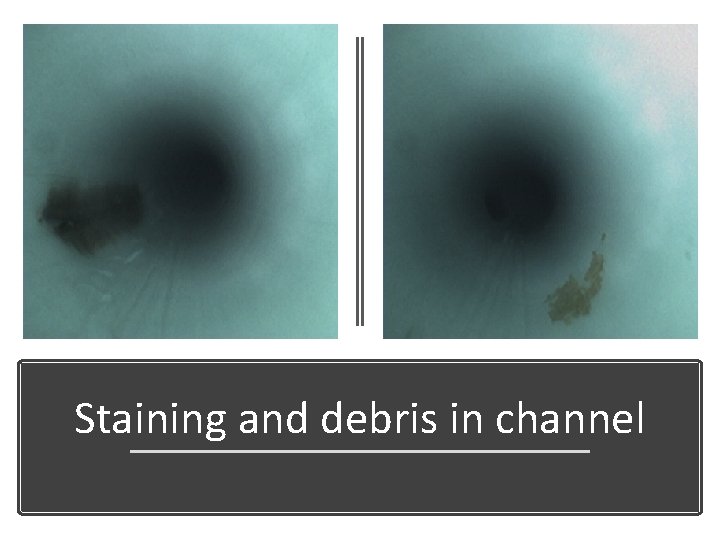
Staining and debris in channel
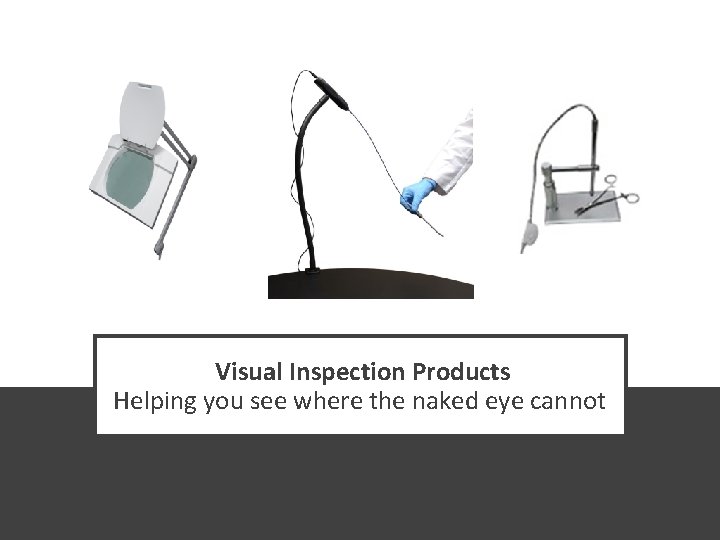
Visual Inspection Products Helping you see where the naked eye cannot

MARY ANN DROSNOCK SENIOR MANAGER OF CLINICAL EDUCATION AND CO-CHAIR OF AAMI ST 91 MDROSNOCK@HMARK. COM Thank you! Questions?
- Slides: 50