
Enhanced Space Weather Monitoring System SWEX ESA L

- Slides: 20
Enhanced Space Weather Monitoring System ‘SWE-X’ ESA L 1/L 5 Mission and Instrumentation Phase-0 Studies Overview 6. 3. 2017, L 5 in Tandem with L 1 ESA UNCLASSIFIED - For Official Use
Consultants Mark Gibbs and David Jackson (Met Office, UK) Yulia Bogdanova, Jackie Davies, Richard Harrison, Mario Bisi, Mike Hapgood, Chris Eyles, James Tappin and Ian Tosh (RAL Space, STFC, UK) Lucie Green, Bob Bentley, Andrew Fazakerley, Rob Wicks and Dhiren Kataria (Mullard Space Science Laboratory, UCL, UK) Jonathan Eastwood, Chris Carr, Vratislav Krupar, Helen O’Brien and Barry Whiteside (Imperial College London, UK) Pierre Rochus, Laurence Rossi (Centre Spatial Liège, Be) Acknowledgements: Milan Maksimovic (LESIA, France), Jan Soucek (Czech Academy of Sciences, Czech Republic) Jasmina Magdalenic (ROB, Belgium) Juhani Huovelin (University of Helsinki, Finland), Sami Solanki (Max-Planck-Institut für Sonnensystemforschung, Germany) System Study Primes (see following presentations) OHB Systems AG, Germany supported by DEIMOS Airbus Defence & Space (Germany, UK) ESA UNCLASSIFIED - For Official Use Stefan Kraft, ESA | 6/3/2017 | Slide 2
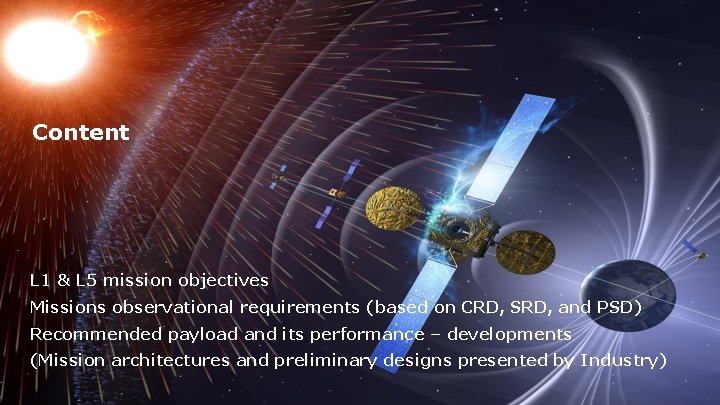
Content L 1 & L 5 mission objectives Missions observational requirements (based on CRD, SRD, and PSD) Recommended payload and its performance – developments (Mission architectures and preliminary designs presented Stefan by Industry) Kraft, ESA | 6/3/2017 | Slide ESA UNCLASSIFIED - For Official Use 3
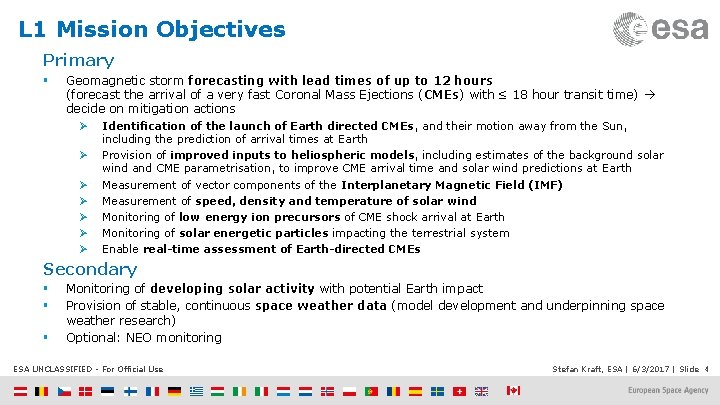
L 1 Mission Objectives Primary § Geomagnetic storm forecasting with lead times of up to 12 hours (forecast the arrival of a very fast Coronal Mass Ejections (CMEs) with ≤ 18 hour transit time) decide on mitigation actions Ø Identification of the launch of Earth directed CMEs, and their motion away from the Sun, Ø Ø Ø including the prediction of arrival times at Earth Provision of improved inputs to heliospheric models, including estimates of the background solar wind and CME parametrisation, to improve CME arrival time and solar wind predictions at Earth Measurement of vector components of the Interplanetary Magnetic Field (IMF) Measurement of speed, density and temperature of solar wind Monitoring of low energy ion precursors of CME shock arrival at Earth Monitoring of solar energetic particles impacting the terrestrial system Enable real-time assessment of Earth-directed CMEs Secondary § § § Monitoring of developing solar activity with potential Earth impact Provision of stable, continuous space weather data (model development and underpinning space weather research) Optional: NEO monitoring ESA UNCLASSIFIED - For Official Use Stefan Kraft, ESA | 6/3/2017 | Slide 4
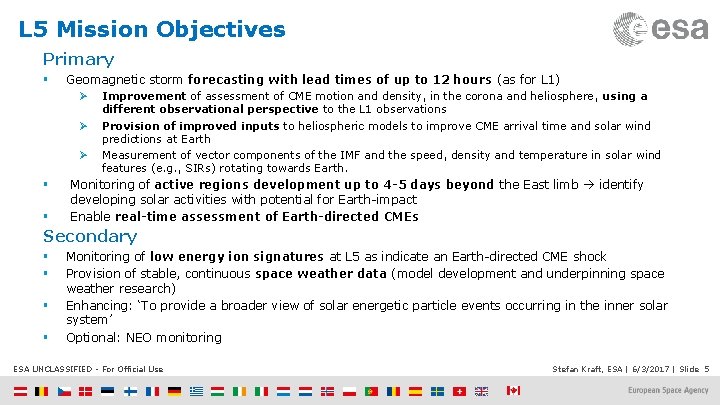
L 5 Mission Objectives Primary § Geomagnetic storm forecasting with lead times of up to 12 hours (as for L 1) Ø Improvement of assessment of CME motion and density, in the corona and heliosphere, using a Ø Ø § § different observational perspective to the L 1 observations Provision of improved inputs to heliospheric models to improve CME arrival time and solar wind predictions at Earth Measurement of vector components of the IMF and the speed, density and temperature in solar wind features (e. g. , SIRs) rotating towards Earth. Monitoring of active regions development up to 4 -5 days beyond the East limb identify developing solar activities with potential for Earth-impact Enable real-time assessment of Earth-directed CMEs Secondary § § Monitoring of low energy ion signatures at L 5 as indicate an Earth-directed CME shock Provision of stable, continuous space weather data (model development and underpinning space weather research) Enhancing: ‘To provide a broader view of solar energetic particle events occurring in the inner solar system’ Optional: NEO monitoring ESA UNCLASSIFIED - For Official Use Stefan Kraft, ESA | 6/3/2017 | Slide 5
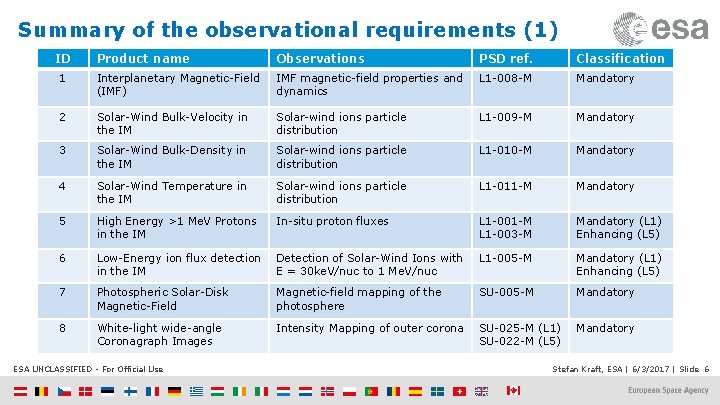
Summary of the observational requirements (1) ID Product name Observations PSD ref. Classification 1 Interplanetary Magnetic-Field (IMF) IMF magnetic-field properties and dynamics L 1 -008 -M Mandatory 2 Solar-Wind Bulk-Velocity in the IM Solar-wind ions particle distribution L 1 -009 -M Mandatory 3 Solar-Wind Bulk-Density in the IM Solar-wind ions particle distribution L 1 -010 -M Mandatory 4 Solar-Wind Temperature in the IM Solar-wind ions particle distribution L 1 -011 -M Mandatory 5 High Energy >1 Me. V Protons in the IM In-situ proton fluxes L 1 -001 -M L 1 -003 -M Mandatory (L 1) Enhancing (L 5) 6 Low-Energy ion flux detection in the IM Detection of Solar-Wind Ions with E = 30 ke. V/nuc to 1 Me. V/nuc L 1 -005 -M Mandatory (L 1) Enhancing (L 5) 7 Photospheric Solar-Disk Magnetic-Field Magnetic-field mapping of the photosphere SU-005 -M Mandatory 8 White-light wide-angle Coronagraph Images Intensity Mapping of outer corona SU-025 -M (L 1) SU-022 -M (L 5) Mandatory ESA UNCLASSIFIED - For Official Use Stefan Kraft, ESA | 6/3/2017 | Slide 6
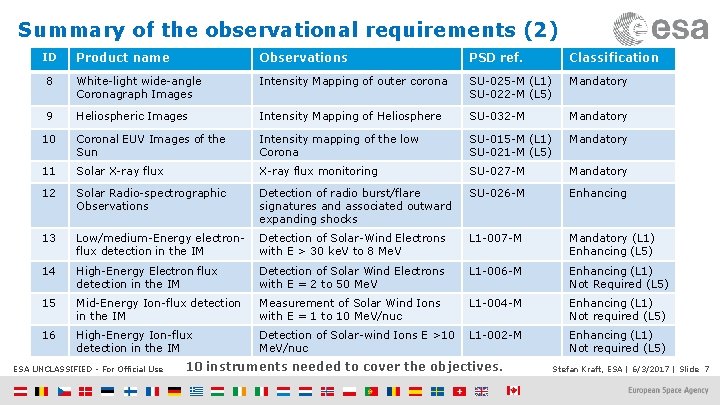
Summary of the observational requirements (2) Product name Observations PSD ref. Classification 8 White-light wide-angle Coronagraph Images Intensity Mapping of outer corona SU-025 -M (L 1) SU-022 -M (L 5) Mandatory 9 Heliospheric Images Intensity Mapping of Heliosphere SU-032 -M Mandatory 10 Coronal EUV Images of the Sun Intensity mapping of the low Corona SU-015 -M (L 1) SU-021 -M (L 5) Mandatory 11 Solar X-ray flux monitoring SU-027 -M Mandatory 12 Solar Radio-spectrographic Observations Detection of radio burst/flare signatures and associated outward expanding shocks SU-026 -M Enhancing 13 Low/medium-Energy electronflux detection in the IM Detection of Solar-Wind Electrons with E > 30 ke. V to 8 Me. V L 1 -007 -M Mandatory (L 1) Enhancing (L 5) 14 High-Energy Electron flux detection in the IM Detection of Solar Wind Electrons with E = 2 to 50 Me. V L 1 -006 -M Enhancing (L 1) Not Required (L 5) 15 Mid-Energy Ion-flux detection in the IM Measurement of Solar Wind Ions with E = 1 to 10 Me. V/nuc L 1 -004 -M Enhancing (L 1) Not required (L 5) 16 High-Energy Ion-flux detection in the IM Detection of Solar-wind Ions E >10 Me. V/nuc L 1 -002 -M Enhancing (L 1) Not required (L 5) ID ESA UNCLASSIFIED - For Official Use 10 instruments needed to cover the objectives. Stefan Kraft, ESA | 6/3/2017 | Slide 7
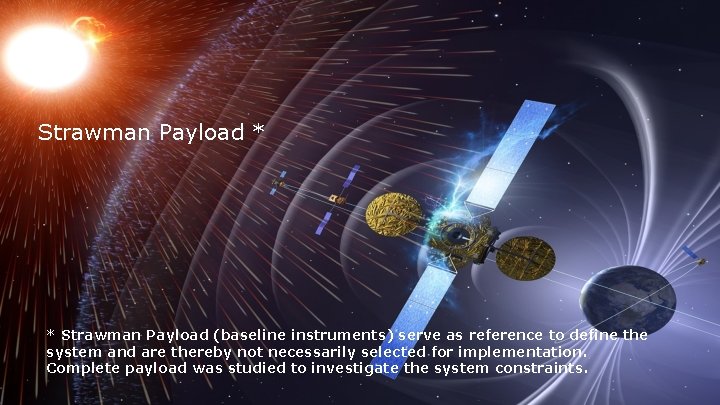
Strawman Payload * * Strawman Payload (baseline instruments) serve as reference to define the system and are thereby not necessarily selected for implementation. ESA UNCLASSIFIED - For Official Use Stefan Kraft, ESA | 6/3/2017 | Slide Complete payload was studied to investigate the system constraints. 8
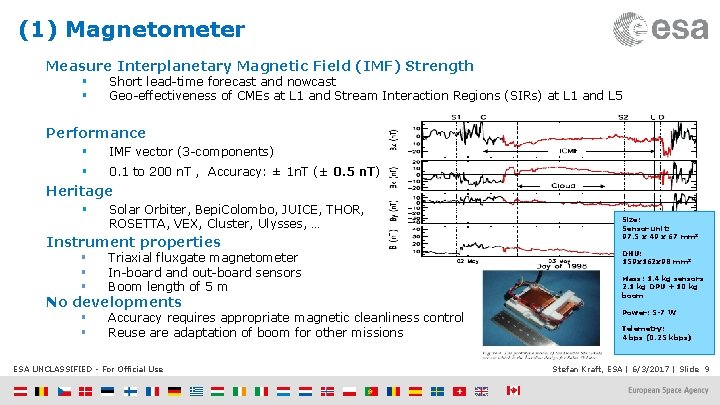
(1) Magnetometer Measure Interplanetary Magnetic Field (IMF) Strength § § Short lead-time forecast and nowcast Geo-effectiveness of CMEs at L 1 and Stream Interaction Regions (SIRs) at L 1 and L 5 Performance § IMF vector (3 -components) § 0. 1 to 200 n. T , Accuracy: ± 1 n. T (± 0. 5 n. T) Heritage § Solar Orbiter, Bepi. Colombo, JUICE, THOR, ROSETTA, VEX, Cluster, Ulysses, … Instrument properties Size: Sensor unit: 97. 5 x 49 x 67 mm 3 § § § Triaxial fluxgate magnetometer In-board and out-board sensors Boom length of 5 m DHU: 159 x 162 x 98 mm 3 § § Accuracy requires appropriate magnetic cleanliness control Reuse are adaptation of boom for other missions Power: 5 -7 W No developments ESA UNCLASSIFIED - For Official Use Mass: 1. 4 kg sensors 2. 1 kg DPU + 10 kg boom Telemetry: 4 bps (0. 25 kbps) Stefan Kraft, ESA | 6/3/2017 | Slide 9
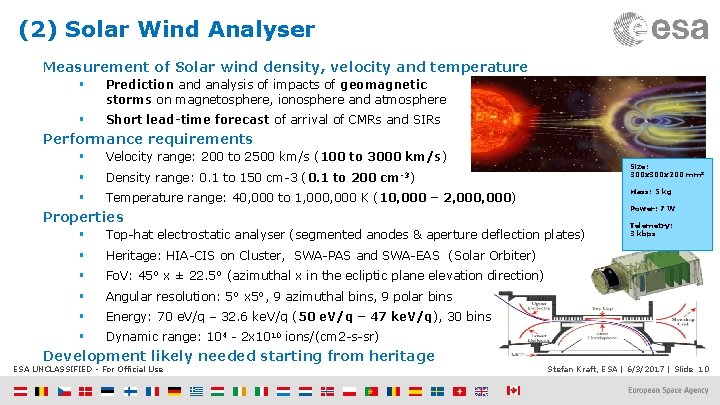
(2) Solar Wind Analyser Measurement of Solar wind density, velocity and temperature § Prediction and analysis of impacts of geomagnetic storms on magnetosphere, ionosphere and atmosphere § Short lead-time forecast of arrival of CMRs and SIRs Performance requirements § Velocity range: 200 to 2500 km/s (100 to 3000 km/s) § Density range: 0. 1 to 150 cm-3 (0. 1 to 200 cm-3) § Temperature range: 40, 000 to 1, 000 K (10, 000 – 2, 000) Size: 300 x 200 mm 3 Mass: 5 kg Power: 7 W Properties § Top-hat electrostatic analyser (segmented anodes & aperture deflection plates) § Heritage: HIA-CIS on Cluster, SWA-PAS and SWA-EAS (Solar Orbiter) § Fo. V: 45⁰ x ± 22. 5⁰ (azimuthal x in the ecliptic plane elevation direction) § Angular resolution: 5⁰ x 5⁰, 9 azimuthal bins, 9 polar bins § Energy: 70 e. V/q – 32. 6 ke. V/q (50 e. V/q – 47 ke. V/q), 30 bins § Dynamic range: 104 - 2 x 10¹⁰ ions/(cm 2 -s-sr) Telemetry: 3 kbps Development likely needed starting from heritage ESA UNCLASSIFIED - For Official Use Stefan Kraft, ESA | 6/3/2017 | Slide 10
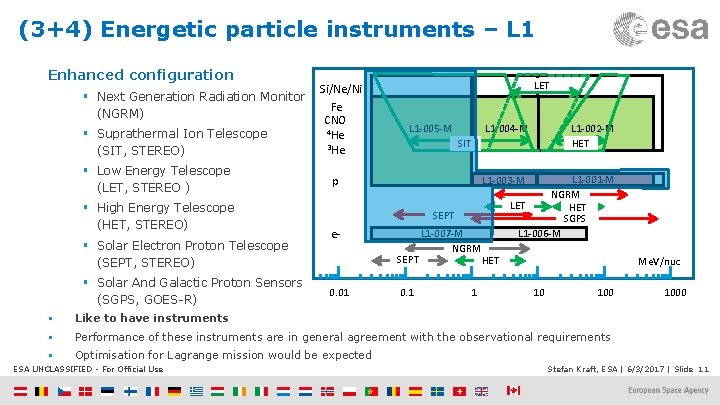
(3+4) Energetic particle instruments – L 1 Enhanced configuration § Next Generation Radiation Monitor (NGRM) § Suprathermal Ion Telescope (SIT, STEREO) § Low Energy Telescope (LET, STEREO ) § High Energy Telescope (HET, STEREO) § Solar Electron Proton Telescope (SEPT, STEREO) § Solar And Galactic Proton Sensors (SGPS, GOES-R) LET Si/Ne/Ni Fe CNO 4 He 3 He L 1 -005 -M SIT L 1 -001 -M NGRM LET HET SGPS L 1 -006 -M L 1 -003 -M p SEPT e. SEPT 0. 01 L 1 -002 -M HET L 1 -004 -M 0. 1 L 1 -007 -M NGRM 1 HET Me. V/nuc 10 100 § Like to have instruments § Performance of these instruments are in general agreement with the observational requirements § Optimisation for Lagrange mission would be expected ESA UNCLASSIFIED - For Official Use 1000 Stefan Kraft, ESA | 6/3/2017 | Slide 11
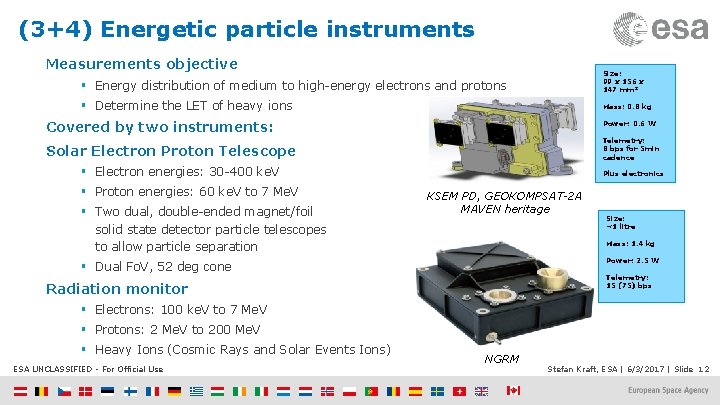
(3+4) Energetic particle instruments Measurements objective § Energy distribution of medium to high-energy electrons and protons Size: 99 x 156 x 147 mm 3 § Determine the LET of heavy ions Mass: 0. 8 kg Covered by two instruments: Power: 0. 6 W Telemetry: 8 bps for 5 min cadence Solar Electron Proton Telescope § Electron energies: 30 -400 ke. V § Proton energies: 60 ke. V to 7 Me. V § Two dual, double-ended magnet/foil solid state detector particle telescopes to allow particle separation Plus electronics KSEM PD, GEOKOMPSAT-2 A MAVEN heritage Size: ~1 litre Mass: 1. 4 kg Power: 2. 5 W § Dual Fo. V, 52 deg cone Telemetry: 15 (75) bps Radiation monitor § Electrons: 100 ke. V to 7 Me. V § Protons: 2 Me. V to 200 Me. V § Heavy Ions (Cosmic Rays and Solar Events Ions) ESA UNCLASSIFIED - For Official Use NGRM Stefan Kraft, ESA | 6/3/2017 | Slide 12
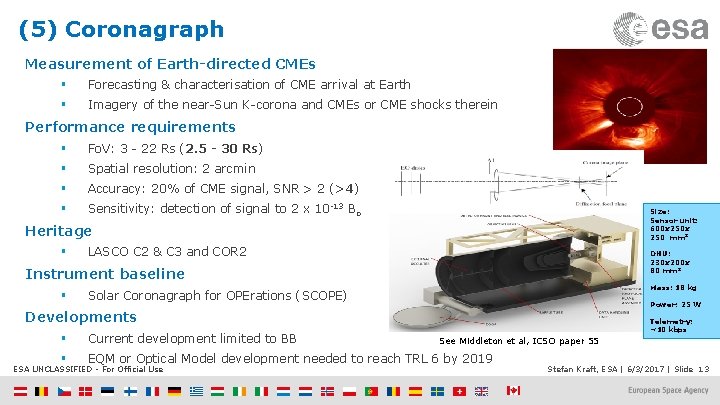
(5) Coronagraph Measurement of Earth-directed CMEs § Forecasting & characterisation of CME arrival at Earth § Imagery of the near-Sun K-corona and CMEs or CME shocks therein Performance requirements § Fo. V: 3 - 22 Rs (2. 5 - 30 Rs) § Spatial resolution: 2 arcmin § Accuracy: 20% of CME signal, SNR > 2 (>4) § Sensitivity: detection of signal to 2 x 10 -13 Bo Size: Sensor unit: 600 x 250 mm 3 Heritage § LASCO C 2 & C 3 and COR 2 DHU: 230 x 200 x 80 mm 3 Instrument baseline § Mass: 18 kg Solar Coronagraph for OPErations (SCOPE) Power: 25 W Developments Telemetry: ~10 kbps § Current development limited to BB § EQM or Optical Model development needed to reach TRL 6 by 2019 ESA UNCLASSIFIED - For Official Use See Middleton et al, ICSO paper 55 Stefan Kraft, ESA | 6/3/2017 | Slide 13
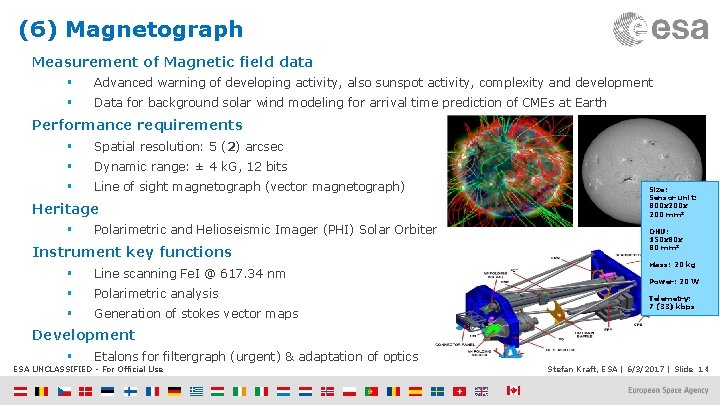
(6) Magnetograph Measurement of Magnetic field data § Advanced warning of developing activity, also sunspot activity, complexity and development § Data for background solar wind modeling for arrival time prediction of CMEs at Earth Performance requirements § Spatial resolution: 5 (2) arcsec § Dynamic range: ± 4 k. G, 12 bits § Line of sight magnetograph (vector magnetograph) Heritage § Polarimetric and Helioseismic Imager (PHI) Solar Orbiter Instrument key functions § Line scanning Fe. I @ 617. 34 nm § Polarimetric analysis § Generation of stokes vector maps Size: Sensor unit: 800 x 200 mm 3 DHU: 150 x 80 mm 3 Mass: 20 kg Power: 20 W Telemetry: 7 (33) kbps Development § Etalons for filtergraph (urgent) & adaptation of optics ESA UNCLASSIFIED - For Official Use Stefan Kraft, ESA | 6/3/2017 | Slide 14
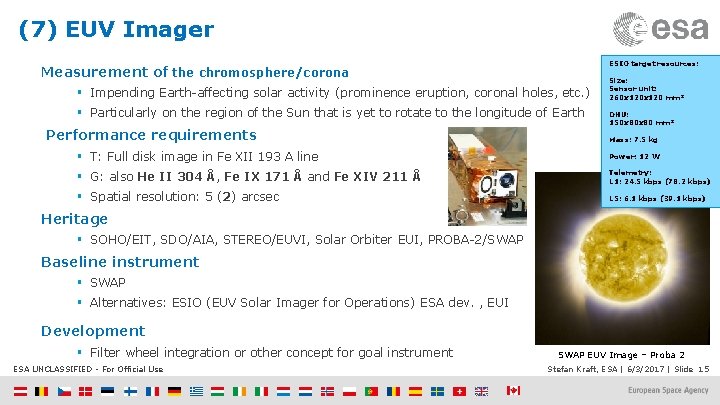
(7) EUV Imager ESIO target resources: Measurement of the chromosphere/corona § Impending Earth-affecting solar activity (prominence eruption, coronal holes, etc. ) § Particularly on the region of the Sun that is yet to rotate to the longitude of Earth Performance requirements Size: Sensor unit: 260 x 120 mm 3 DHU: 150 x 80 mm 3 Mass: 7. 5 kg § T: Full disk image in Fe XII 193 A line Power: 12 W § G: also He II 304 Å, Fe IX 171 Å and Fe XIV 211 Å Telemetry: L 1: 24. 5 kbps (78. 2 kbps) § Spatial resolution: 5 (2) arcsec L 5: 6. 1 kbps (39. 1 kbps) Heritage § SOHO/EIT, SDO/AIA, STEREO/EUVI, Solar Orbiter EUI, PROBA-2/SWAP Baseline instrument § SWAP § Alternatives: ESIO (EUV Solar Imager for Operations) ESA dev. , EUI Development § Filter wheel integration or other concept for goal instrument ESA UNCLASSIFIED - For Official Use SWAP EUV Image – Proba 2 Stefan Kraft, ESA | 6/3/2017 | Slide 15
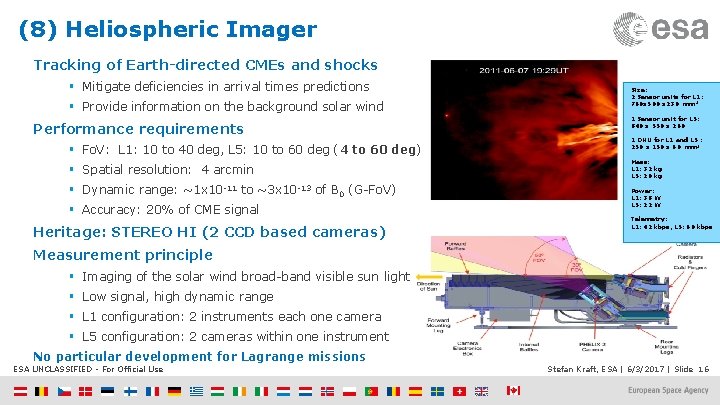
(8) Heliospheric Imager Tracking of Earth-directed CMEs and shocks § Mitigate deficiencies in arrival times predictions § Provide information on the background solar wind Performance requirements § Fo. V: L 1: 10 to 40 deg, L 5: 10 to 60 deg (4 to 60 deg) § Spatial resolution: 4 arcmin § Dynamic range: ~1 x 10 -11 to ~3 x 10 -13 of B 0 (G-Fo. V) § Accuracy: 20% of CME signal Heritage: STEREO HI (2 CCD based cameras) Size: 2 Sensor units for L 1: 760 x 500 x 230 mm 3 1 Sensor unit for L 5: 840 x 550 x 260 1 DHU for L 1 and L 5 : 250 x 150 x 60 mm 3 Mass: L 1: 32 kg L 5: 20 kg Power: L 1: 38 W L 5: 22 W Telemetry: L 1: 42 kbps, L 5: 60 kbps Measurement principle § Imaging of the solar wind broad-band visible sun light § Low signal, high dynamic range § L 1 configuration: 2 instruments each one camera § L 5 configuration: 2 cameras within one instrument No particular development for Lagrange missions ESA UNCLASSIFIED - For Official Use Stefan Kraft, ESA | 6/3/2017 | Slide 16
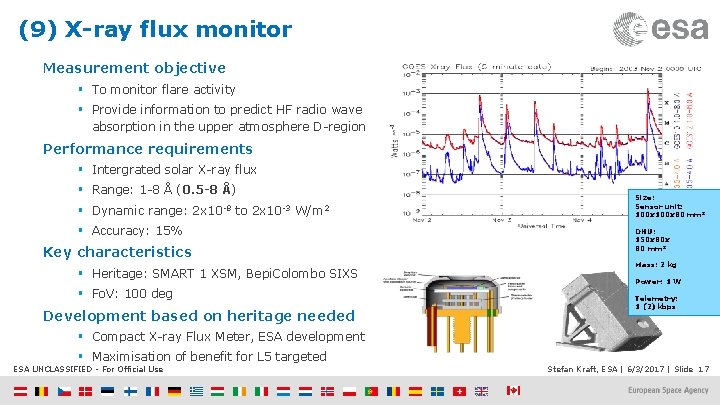
(9) X-ray flux monitor Measurement objective § To monitor flare activity § Provide information to predict HF radio wave absorption in the upper atmosphere D-region Performance requirements § Intergrated solar X-ray flux § Range: 1 -8 Å (0. 5 -8 Å) § Dynamic range: 2 x 10 -8 to 2 x 10 -3 W/m 2 § Accuracy: 15% Key characteristics § Heritage: SMART 1 XSM, Bepi. Colombo SIXS § Fo. V: 100 deg Development based on heritage needed Size: Sensor unit: 100 x 80 mm 3 DHU: 150 x 80 mm 3 Mass: 2 kg Power: 1 W Telemetry: 1 (2) kbps § Compact X-ray Flux Meter, ESA development § Maximisation of benefit for L 5 targeted ESA UNCLASSIFIED - For Official Use Stefan Kraft, ESA | 6/3/2017 | Slide 17
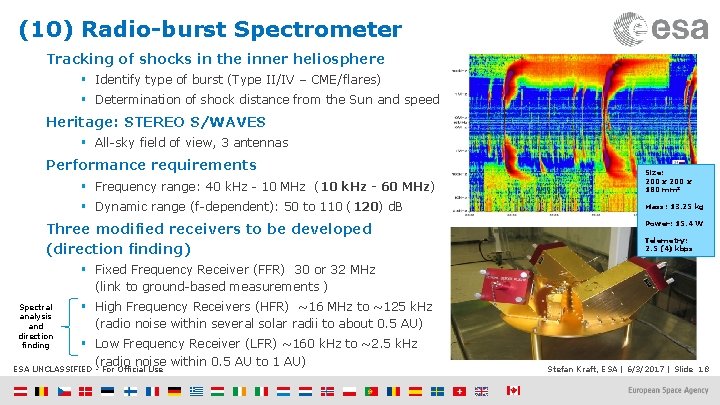
(10) Radio-burst Spectrometer Tracking of shocks in the inner heliosphere § Identify type of burst (Type II/IV – CME/flares) § Determination of shock distance from the Sun and speed Heritage: STEREO S/WAVES § All-sky field of view, 3 antennas Performance requirements § Frequency range: 40 k. Hz - 10 MHz (10 k. Hz - 60 MHz) Size: 200 x 180 mm 3 § Dynamic range (f-dependent): 50 to 110 (120) d. B Mass: 13. 25 kg Three modified receivers to be developed (direction finding) Power: 15. 4 W Telemetry: 2. 5 (4) kbps § Fixed Frequency Receiver (FFR) 30 or 32 MHz (link to ground-based measurements ) Spectral analysis and direction finding § High Frequency Receivers (HFR) ~16 MHz to ~125 k. Hz (radio noise within several solar radii to about 0. 5 AU) § Low Frequency Receiver (LFR) ~160 k. Hz to ~2. 5 k. Hz (radio noise within 0. 5 AU to 1 AU) ESA UNCLASSIFIED - For Official Use Stefan Kraft, ESA | 6/3/2017 | Slide 18
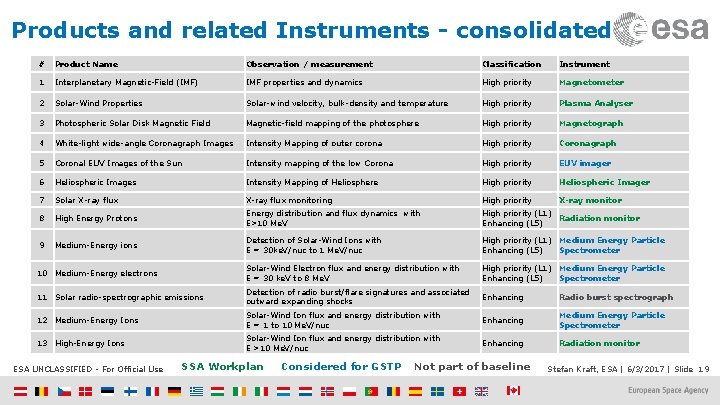
Products and related Instruments - consolidated # Product Name Observation / measurement Classification Instrument 1 Interplanetary Magnetic-Field (IMF) IMF properties and dynamics High priority Magnetometer 2 Solar-Wind Properties Solar-wind velocity, bulk-density and temperature High priority Plasma Analyser 3 Photospheric Solar Disk Magnetic Field Magnetic-field mapping of the photosphere High priority Magnetograph 4 White-light wide-angle Coronagraph Images Intensity Mapping of outer corona High priority Coronagraph 5 Coronal EUV Images of the Sun Intensity mapping of the low Corona High priority EUV imager 6 Heliospheric Images Intensity Mapping of Heliosphere High priority Heliospheric Imager 7 Solar X-ray flux monitoring High priority X-ray monitor 8 High Energy Protons Energy distribution and flux dynamics with E>10 Me. V High priority (L 1) Radiation monitor Enhancing (L 5) 9 Medium-Energy ions Detection of Solar-Wind Ions with E = 30 ke. V/nuc to 1 Me. V/nuc High priority (L 1) Medium Energy Particle Enhancing (L 5) Spectrometer 10 Medium-Energy electrons Solar-Wind Electron flux and energy distribution with E = 30 ke. V to 8 Me. V High priority (L 1) Medium Energy Particle Enhancing (L 5) Spectrometer 11 Solar radio-spectrographic emissions Detection of radio burst/flare signatures and associated outward expanding shocks Enhancing Radio burst spectrograph 12 Medium-Energy Ions Solar-Wind Ion flux and energy distribution with E = 1 to 10 Me. V/nuc Enhancing Medium Energy Particle Spectrometer 13 High-Energy Ions Solar-Wind Ion flux and energy distribution with E >10 Me. V/nuc Enhancing Radiation monitor ESA UNCLASSIFIED - For Official Use SSA Workplan Considered for GSTP Not part of baseline Stefan Kraft, ESA | 6/3/2017 | Slide 19
THANK YOU swe. ssa. esa. int www. esa. int ESA UNCLASSIFIED - For Official Use Stefan Kraft, ESA | 6/3/2017 | Slide 20