
Enhanced Resource Sharing in RD Environment CSIR NAL

- Slides: 60
Enhanced Resource Sharing in R&D Environment : CSIR –NAL Initiative Dr. Poornima Narayana Head, Information Center for Aerospace S&T (ICAST) CSIR-National Aerospace Laboratories (NAL) Bangalore -560017 INDIA DRDO Training/Workshop during 3 rd-7 th December 2012, CEPTAM Bangalore
Introduction The so-called ‘Information Revolution’ has made Libraries around the world to adopt new philosophies and technologies for information dissemination and also reduce the cost of information. Maintaining the dept and depths of collection of a single greatest challenge confronting libraries, be it, academic, special, national or public, Libraries have realized that although they are well funded, it is difficult to acquire all the materials needed by the clientele. In fact partnership and cooperation in local, national and international have become enviable for all libraries. In achieving resource sharing/library cooperation is through the establishment of consortium over networks.
Resource Sharing Resource sharing is a mode of library operation whereby all or part of the library functions are shared in common among several libraries, as the goal of resource sharing is to maximize the availability of materials and services at the minimum expense. Library resources comprise manpower material, function, method and services. Resource sharing encompasses information, bibliographical and textual database, cooperative acquisition, cataloguing, manpower, equipment, expertise and services. Resource sharing via network implies automation, data communication and effective cooperation
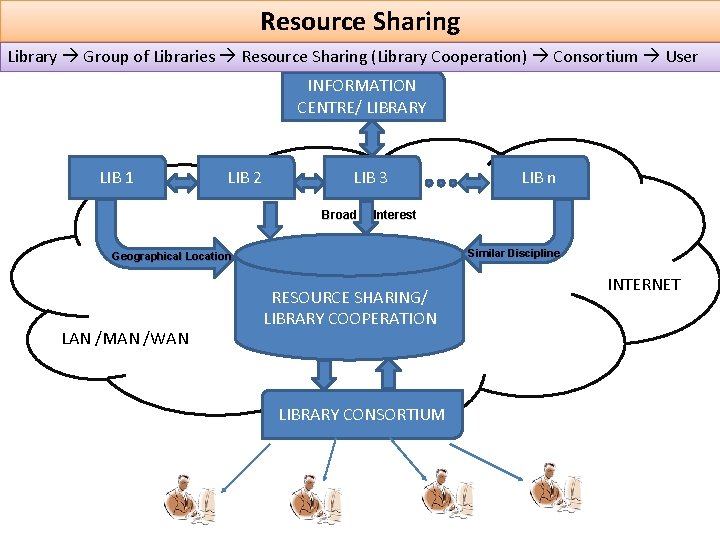
Resource Sharing Library Group of Libraries Resource Sharing (Library Cooperation) Consortium User INFORMATION CENTRE/ LIBRARY LIB 1 LIB 2 LIB 3 Broad Interest Similar Discipline Geographical Location LAN /MAN /WAN LIB n K RESOURCE SHARING/ LIBRARY COOPERATION LIBRARY CONSORTIUM INTERNET
Phases Of Development • First phase: several libraries come together for the mutual benefit of the respective users – Library Cooperation/ Resource sharing … • Second phase: Libraries are linked together with the help of ICT – Library Network • Third phase: Libraries come together to acquire and share e-resources – Library Consortium
Need for Resource Sharing Ø Proliferation of literature in each and every field of knowledge; Ø Multiplicity of documents in different subjects, languages and formats; Ø Development of new subjects and subject specialization; Ø Increase of reading community and information seekers; Ø Diversity of user groups and their information needs; Ø Demand of pinpointed, exhaustive and expeditious information services; Ø Increased access to information and services at existing cost; Ø Access to existing information and services at less cost; Ø Increase in Quantity/Cost; Ø Demand for expertise and rare documents; Ø Space constraint; Ø Budget constraint Ø Publisher’s Monopoly Ø Bundling/Boqueting of journal titles
Objectives of Resource Sharing Ø Optimization of information resources through shared cataloguing, ILL services, collection development and avoiding duplication. Ø Pooled resources can help to arrange greater resource centers. Ø Document selection. Ø Provide, through cooperative acquisition by voluntary organization, materials beyond the reach of individual libraries.
Areas of Resource Sharing Ø Inter-library loan Ø Cooperative acquisition Ø Specialized purchasing programs Ø Centralized processing Ø Shared Cataloguing Ø Sharing of bibliographical data Ø Centralized periodical collection for loan purposes Ø Cooperative microfilming Ø Preparation and maintenance of union catalogue and union list of serials Ø Exchange of publications Ø Exchange of expertise.
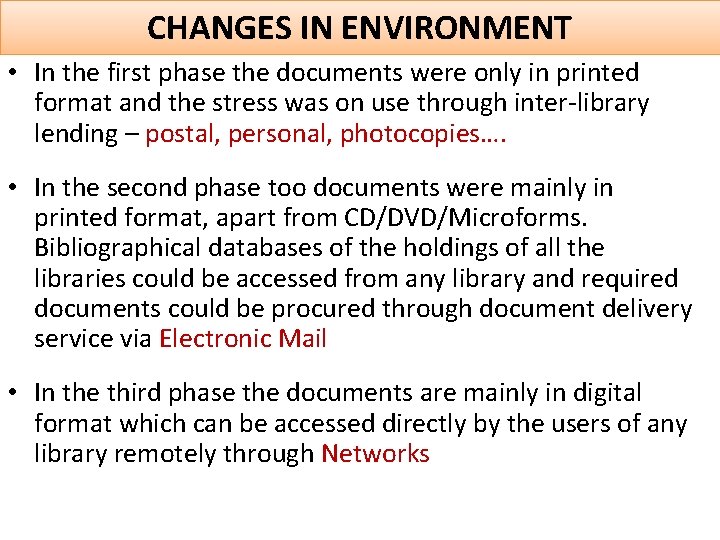
CHANGES IN ENVIRONMENT • In the first phase the documents were only in printed format and the stress was on use through inter-library lending – postal, personal, photocopies…. • In the second phase too documents were mainly in printed format, apart from CD/DVD/Microforms. Bibliographical databases of the holdings of all the libraries could be accessed from any library and required documents could be procured through document delivery service via Electronic Mail • In the third phase the documents are mainly in digital format which can be accessed directly by the users of any library remotely through Networks
Resource Sharing Through Networks In the past two decades, information technology has made significant progress. The current state of information handling is indeed sufficient to support and encourage the sharing of resources among libraries. The pace of technological improvement shows no signs of abatement and libraries will find it rewarding to explore the realm of networking possibilities that this new technology makes feasible. Especially, the present decade has seen a greatly renewed interest in library cooperation and mutual benefits, prominently at national and international levels.
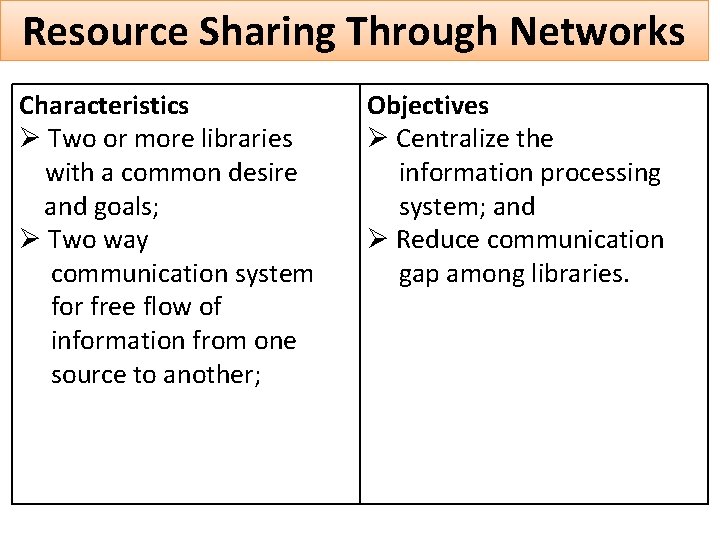
Resource Sharing Through Networks Characteristics Ø Two or more libraries with a common desire and goals; Ø Two way communication system for free flow of information from one source to another; Objectives Ø Centralize the information processing system; and Ø Reduce communication gap among libraries.
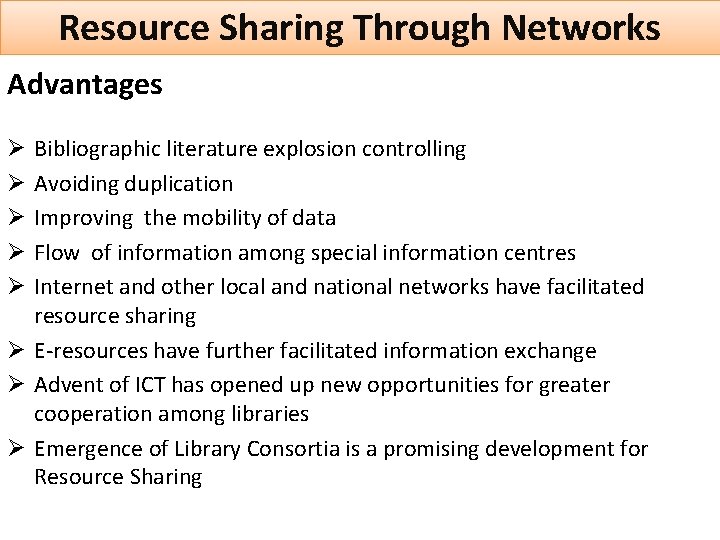
Resource Sharing Through Networks Advantages Bibliographic literature explosion controlling Avoiding duplication Improving the mobility of data Flow of information among special information centres Internet and other local and national networks have facilitated resource sharing Ø E-resources have further facilitated information exchange Ø Advent of ICT has opened up new opportunities for greater cooperation among libraries Ø Emergence of Library Consortia is a promising development for Resource Sharing Ø Ø Ø
LIBRARY CONSORTIA • Consortium literally means “temporary cooperation of several powers or large interests to effect some common purpose” • Library consortium is “a group of libraries that agree to pool their resources by allowing the user of each institution some type of access to resources of all other institutions” • “It is a community of value creating entities, generating value through an aggregation of library units within and across organizations”
Union Catalogue • Union catalog is a combined library catalog describing the collections of a number of libraries. Union catalogs have been created in a range of media, including book format, serials and more recently, networked electronic databases. Print union catalogs are typically arranged by title, author or subject (often employing a controlled vocabulary); electronic versions typically support keyword and Boolean queries. • Union catalogs are useful to librarians, as they assist in locating and requesting materials from other libraries through interlibrary loan service.
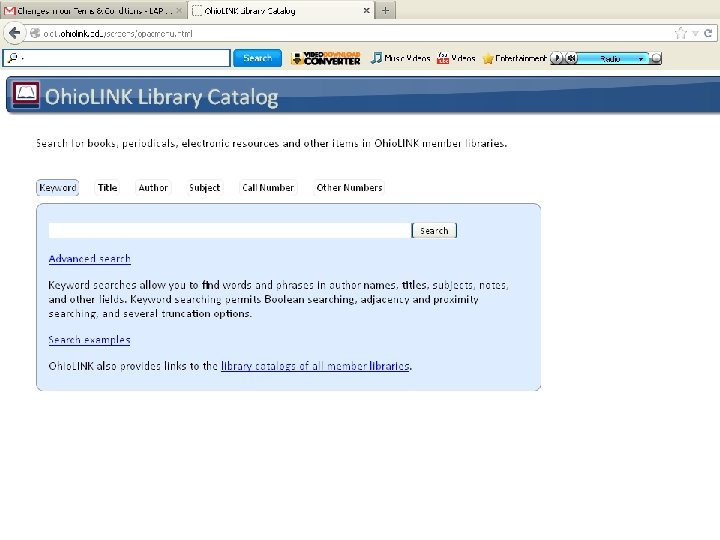
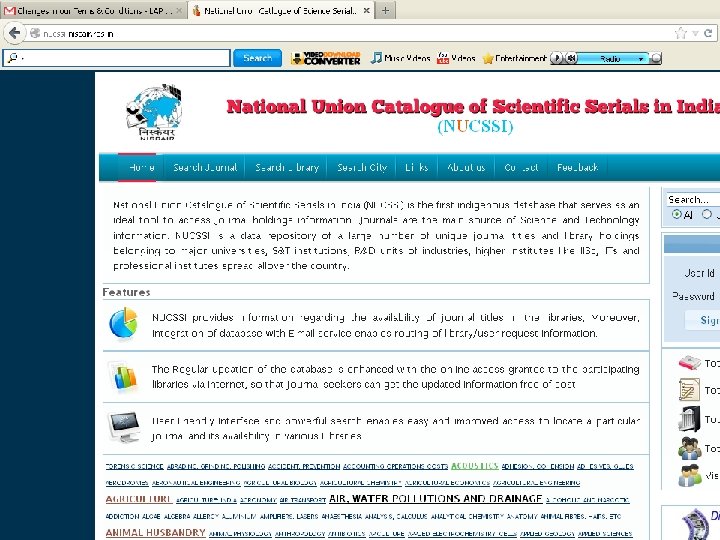
Union Catalogues: Few Examples • • • World. Cat (OCLC USA) Ohio. Link Sun. Cat (Serials Union Catalogue, UK) ECLAS (European Commission Libraries Catalogue) Library & Archives (National Union catalogue of Canada) Pro. Quest Serials Solutions Ulrich's(TM)Serials NUCSSI (National union catalogue of Scientific serials in ndia) LOCKSS (Lots of Copies Kept Stuff safe) CLOCKSS (Controlled “-” )
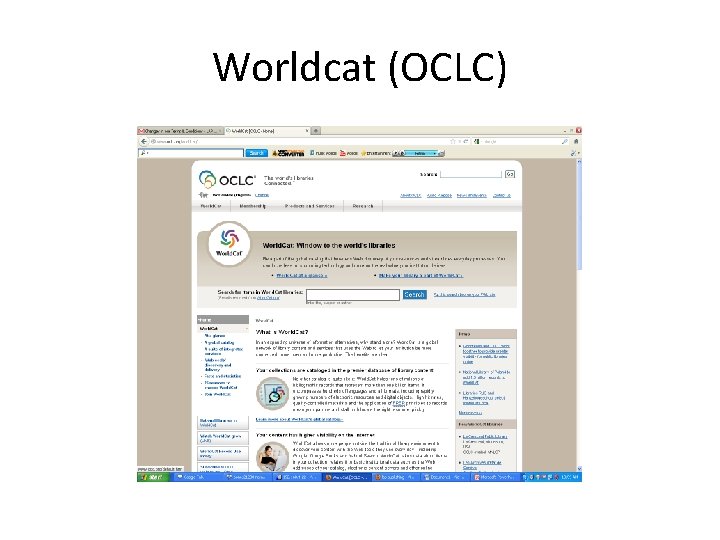
Worldcat (OCLC)
LOCKSS & CLOCKSS • The LOCKSS Program, based at Stanford University Libraries, provides libraries and publishers with awardwinning, low-cost, open source digital preservation tools to preserve and provide access to persistent and authoritative digital content. • CLOCKSS (Controlled LOCKSS) is a not for profit joint venture between the world’s leading scholarly publishers and research libraries whose mission is to build a sustainable, geographically distributed dark archive with which to ensure the long-term survival of Web-based scholarly publications for the benefit of the greater global research community.
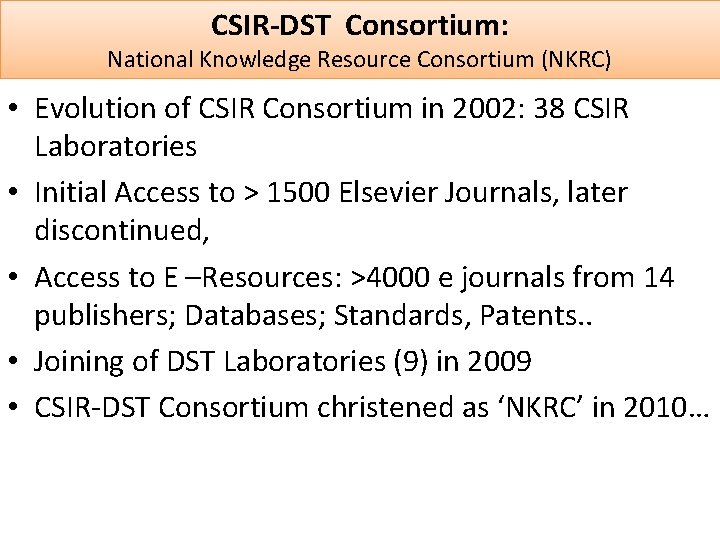
CSIR-DST Consortium: National Knowledge Resource Consortium (NKRC) • Evolution of CSIR Consortium in 2002: 38 CSIR Laboratories • Initial Access to > 1500 Elsevier Journals, later discontinued, • Access to E –Resources: >4000 e journals from 14 publishers; Databases; Standards, Patents. . • Joining of DST Laboratories (9) in 2009 • CSIR-DST Consortium christened as ‘NKRC’ in 2010…
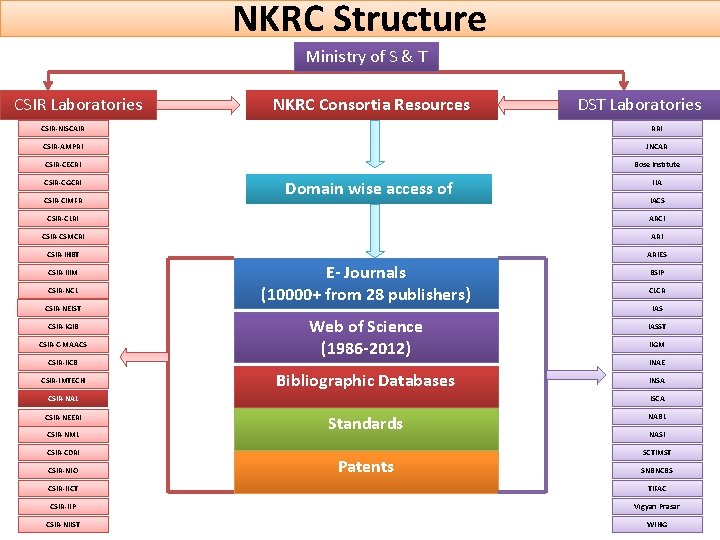
NKRC Structure Ministry of S & T CSIR Laboratories NKRC Consortia Resources DST Laboratories CSIR-NISCAIR RRI CSIR-AMPRI JNCAR CSIR-CECRI Bose Institute CSIR-CGCRI CSIR-CIMFR Domain wise access of IIA IACS CSIR-CLRI ARCI CSIR-CSMCRI ARI CSIR-IHBT ARIES CSIR-IIIM CSIR-NCL CSIR-NEIST CSIR-IGIB CSIR-C-MAACS CSIR-IICB CSIR-IMTECH E- Journals (10000+ from 28 publishers) Web of Science (1986 -2012) Bibliographic Databases CSIR-NAL CSIR-NEERI CSIR-NML CSIR-CDRI CSIR-NIO BSIP CLCR IASST IIGM INAE INSA ISCA Standards Patents NABL NASI SCTIMST SNBNCBS CSIR-IICT TIFAC CSIR-IIP Vigyan Prasar CSIR-NIIST WIHG
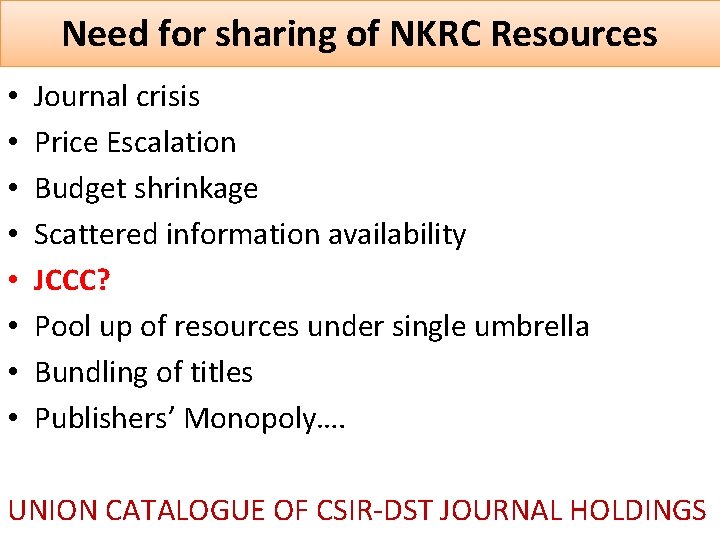
Need for sharing of NKRC Resources • • Journal crisis Price Escalation Budget shrinkage Scattered information availability JCCC? Pool up of resources under single umbrella Bundling of titles Publishers’ Monopoly…. UNION CATALOGUE OF CSIR-DST JOURNAL HOLDINGS
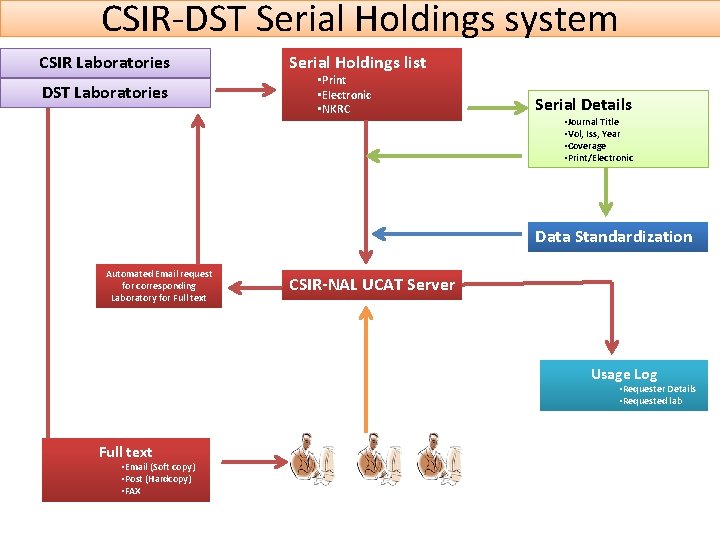
CSIR-DST Serial Holdings system CSIR Laboratories DST Laboratories Serial Holdings list • Print • Electronic • NKRC Serial Details • Journal Title • Vol, Iss, Year • Coverage • Print/Electronic Data Standardization Automated Email request for corresponding Laboratory for Full text CSIR-NAL UCAT Server Usage Log • Requester Details • Requested lab Full text • Email (Soft copy) • Post (Hardcopy) • FAX
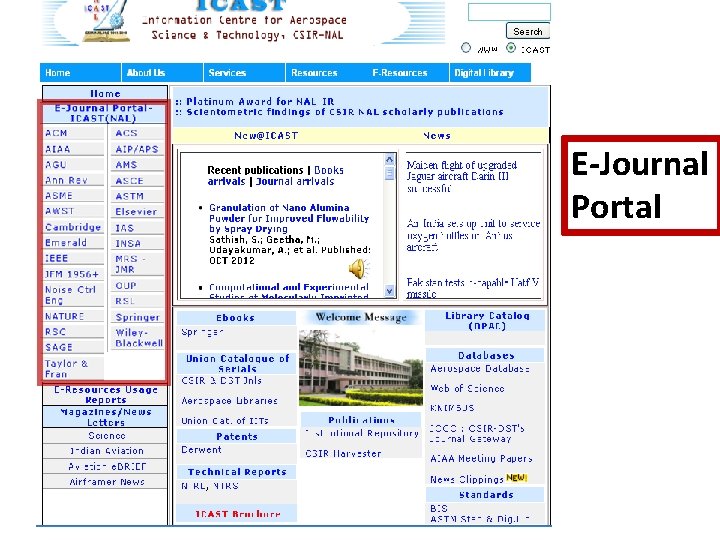
E-Journal Portal
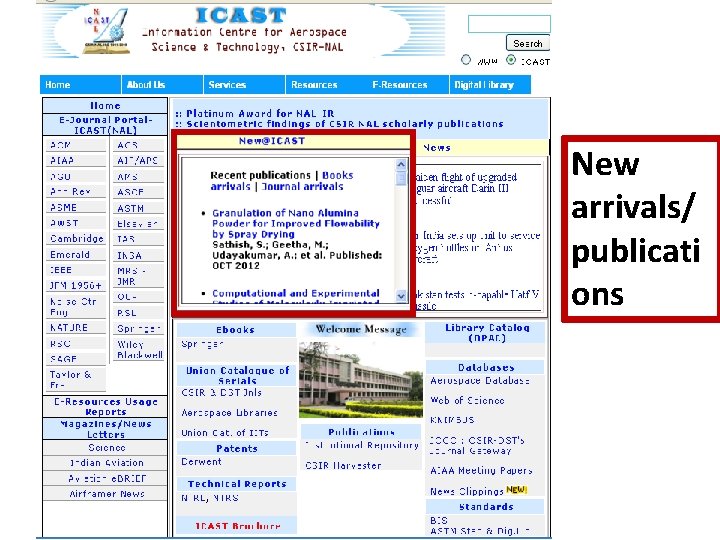
New arrivals/ publicati ons
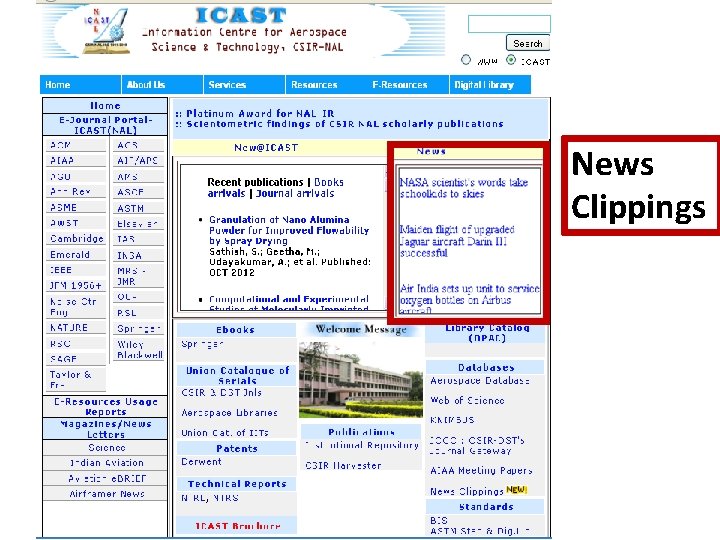
News Clippings
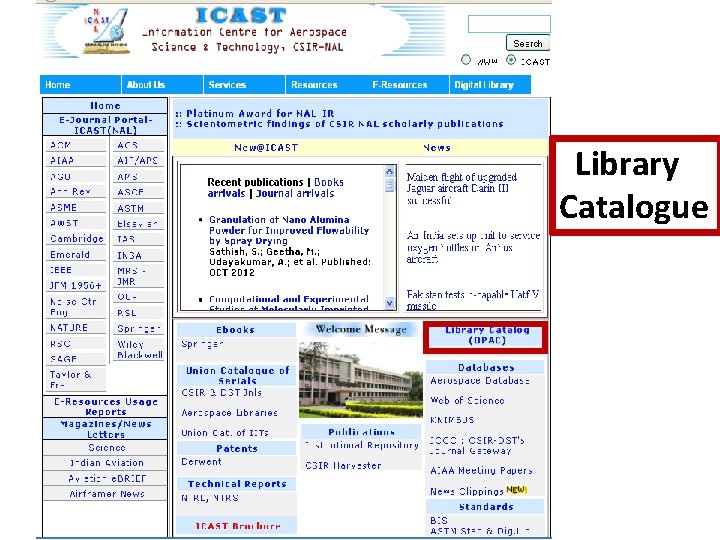
Library Catalogue
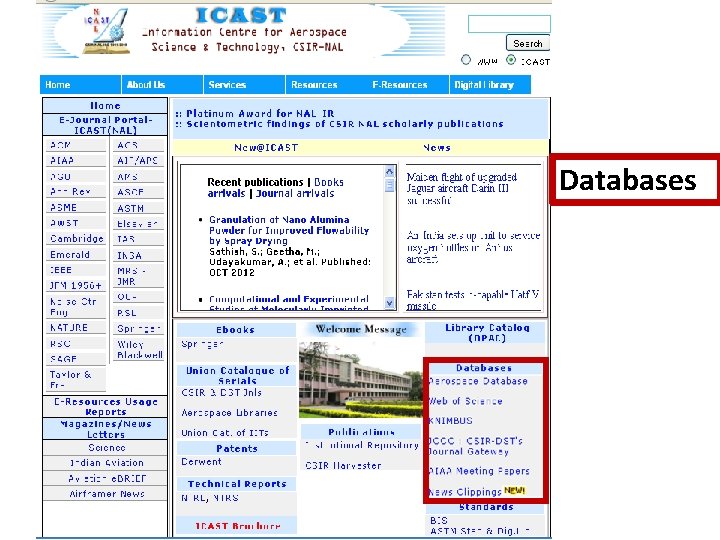
Databases
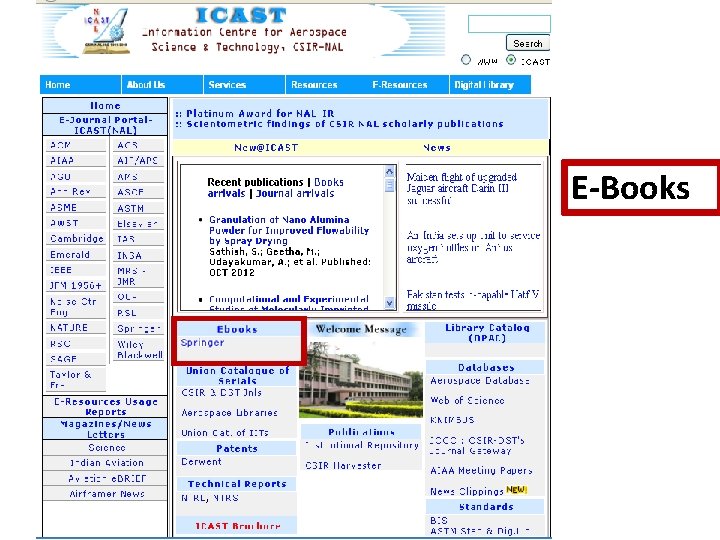
E-Books
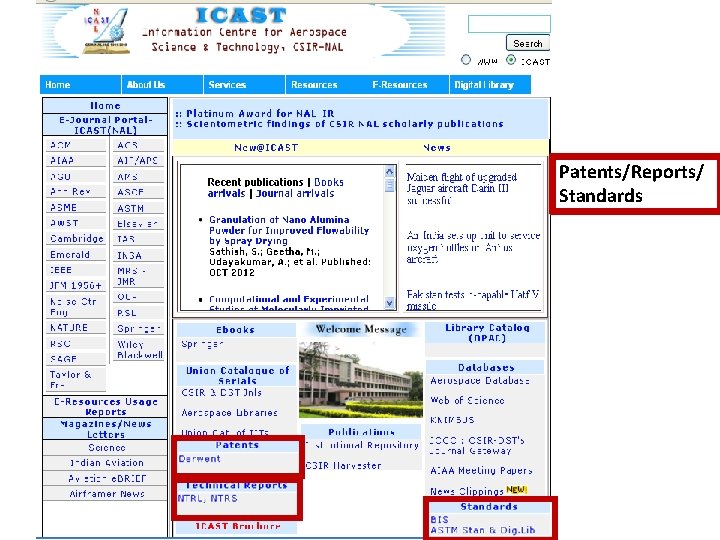
Patents/Reports/ Standards
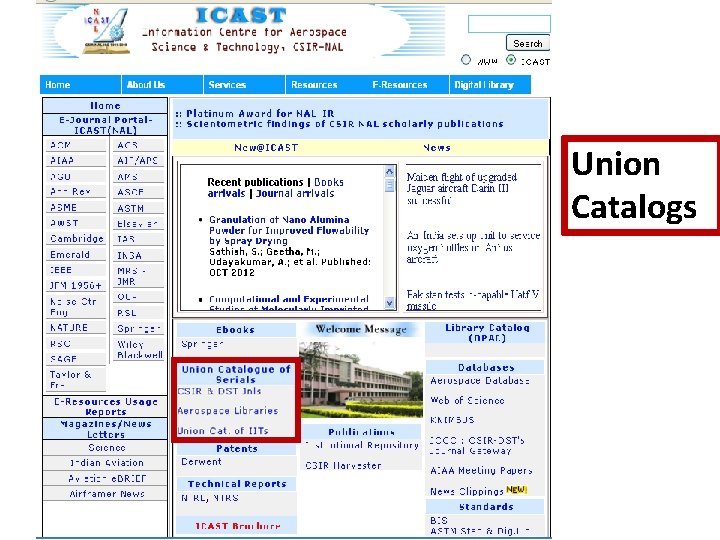
Union Catalogs
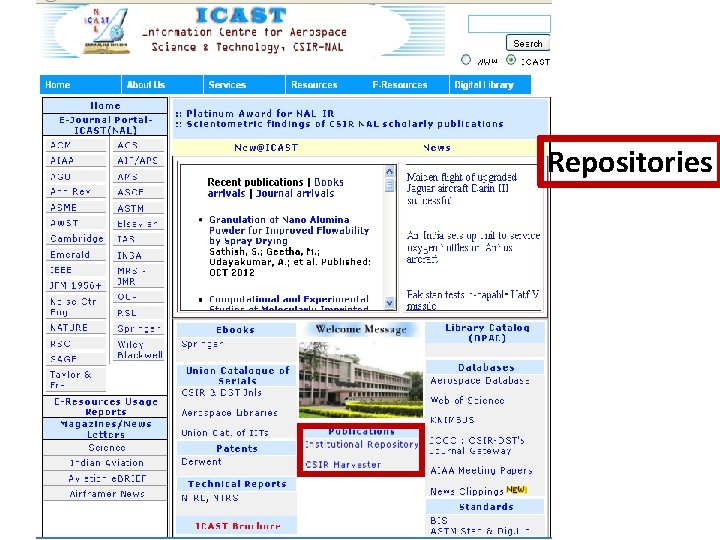
Repositories
CSIR-NAL Initiatives UCAT of CSIR & DST UCAT of Aerospace Laboratories
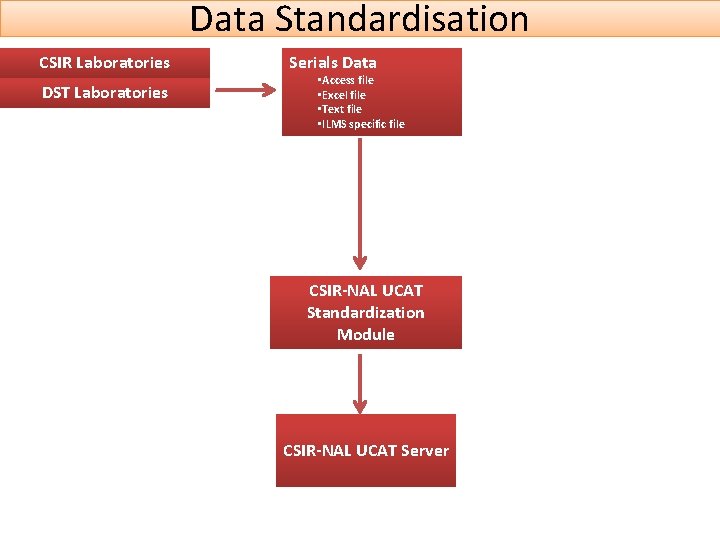
Data Standardisation CSIR Laboratories DST Laboratories Serials Data • Access file • Excel file • Text file • ILMS specific file CSIR-NAL UCAT Standardization Module CSIR-NAL UCAT Server
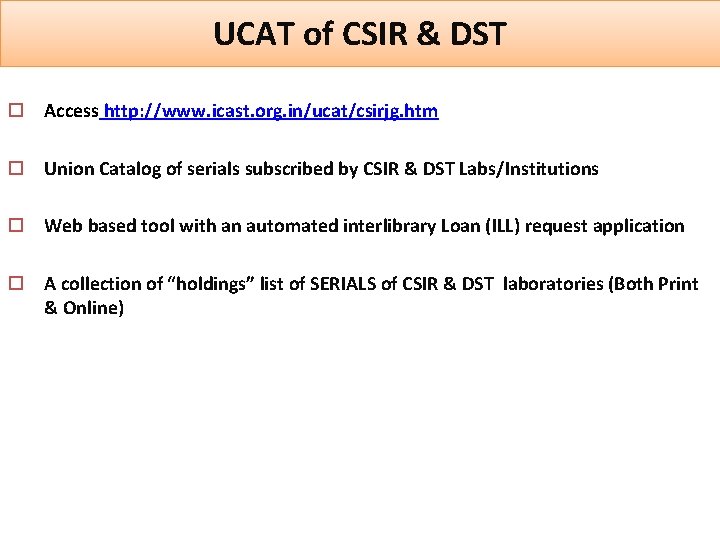
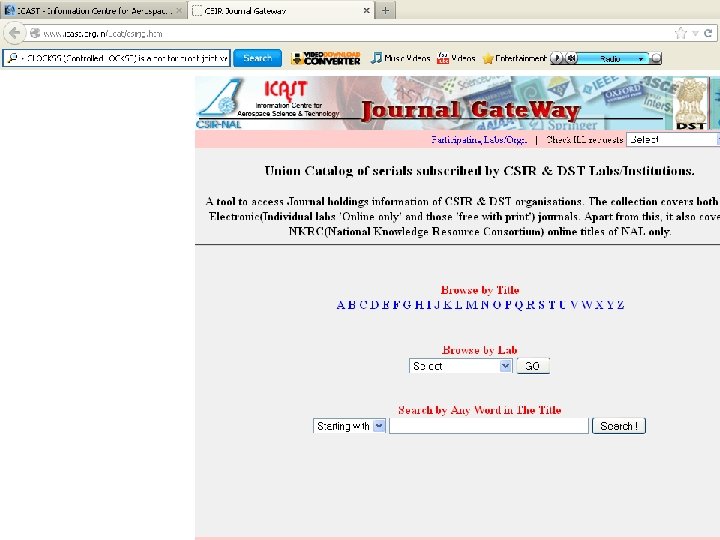
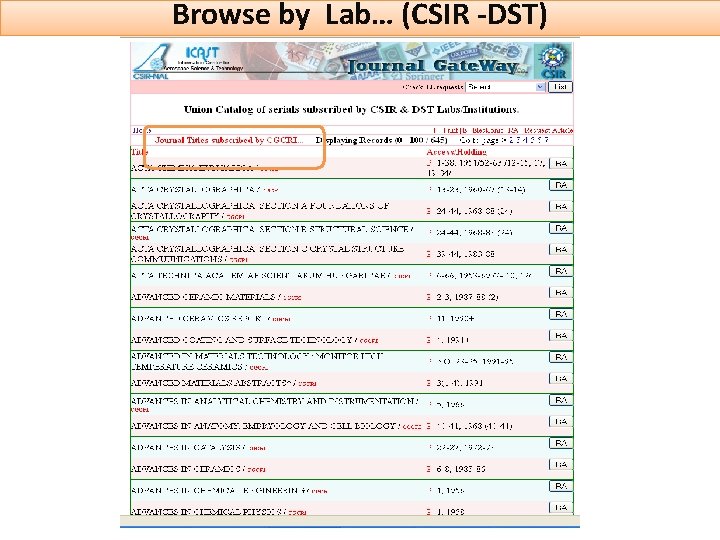
UCAT of CSIR & DST o Access http: //www. icast. org. in/ucat/csirjg. htm o Union Catalog of serials subscribed by CSIR & DST Labs/Institutions o Web based tool with an automated interlibrary Loan (ILL) request application o A collection of “holdings” list of SERIALS of CSIR & DST laboratories (Both Print & Online)
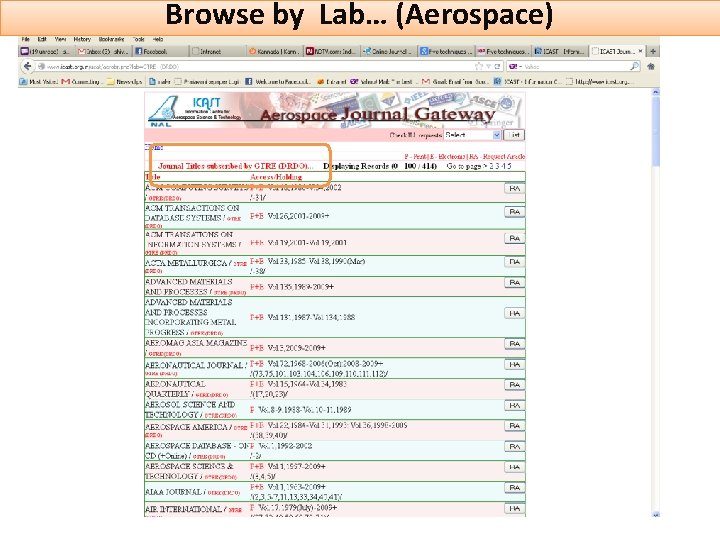
UCAT of Aerospace Laboratories o Access http: //www. icast. org. in/ucat/aerolibjg. htm o Union Catalog of serials subscribed by Aerospace Laboratories of India o National Aerospace Laboratories (NAL) o Gas Turbine Research Establishment (GTRE) o Indian Institute of Astrophysics o Indian institute of Karaghpur (Aero) o Web based tool with an automated interlibrary Loan (ILL) request application o A collection of “holdings” list of SERIALS of Aerospace Laboratories (Both Print & Online)
Challenges encountered • Data collection (delay in getting the lists) • Frequent Updation – Addition/Deletion of titles, contact Personnel • Data Format- variety of file formats • Compatibility • Response time of Article delivery
Technology Platform • Hardware – HP Proliant ML 150 G 3 – Processor: Dual Core Intel Xeon 5000 sequence processor – RAM 1 GB – HDD 250 GB • Software – Operating system: Linux RHEL 5. – Back end: My. SQL V 5. – Server: Apache. – Scripting languages: PHP, HTML. – Mail server
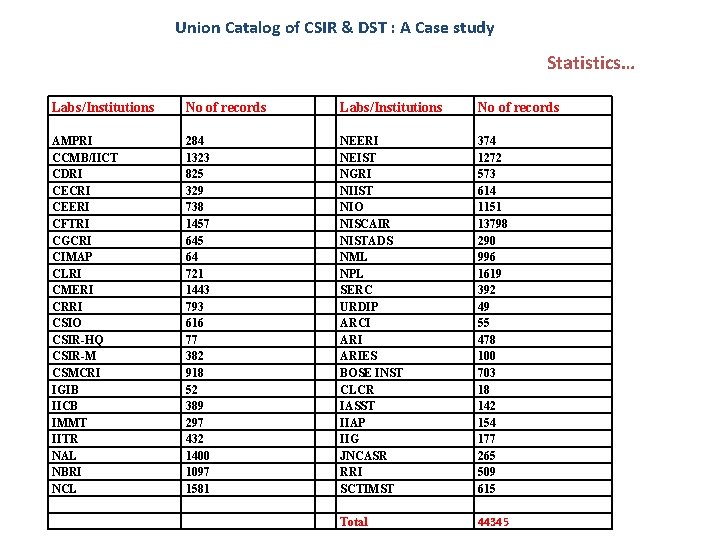
Knowledge Base • Participating Laboratories – CSIR Laboratories: 34 – DST Laboratories: 9 • Resources – Print – Electronic – NKRC resources • Number of Records – Total number of Records : 44345 – Total number of Unique titles: 29204
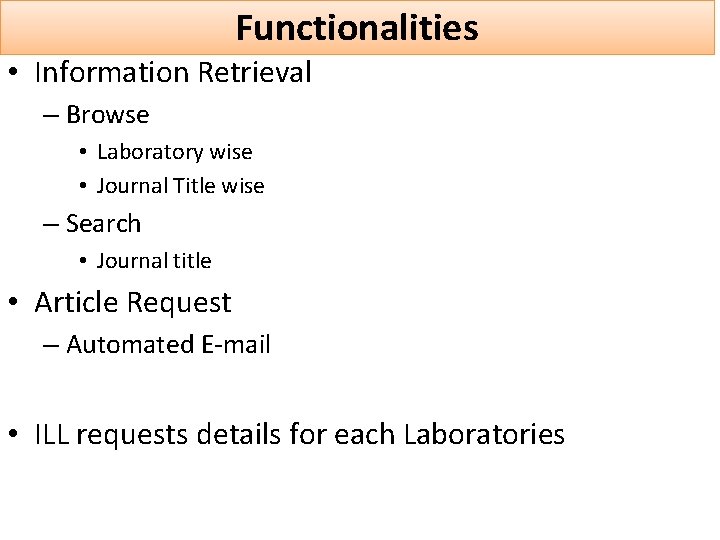
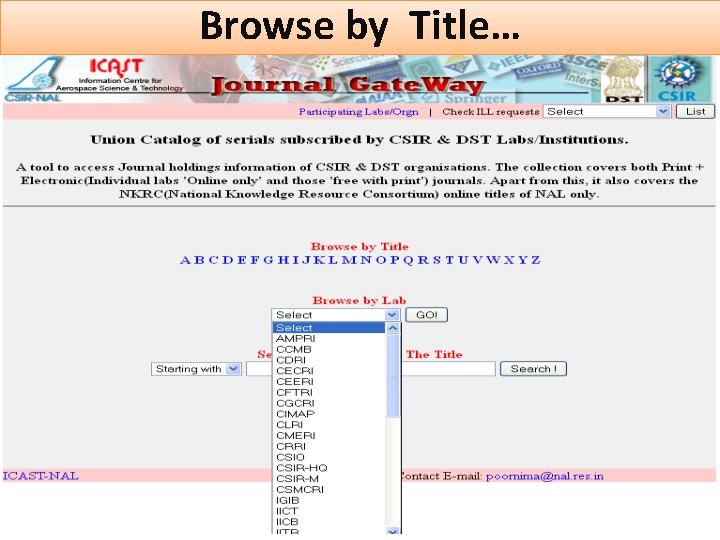
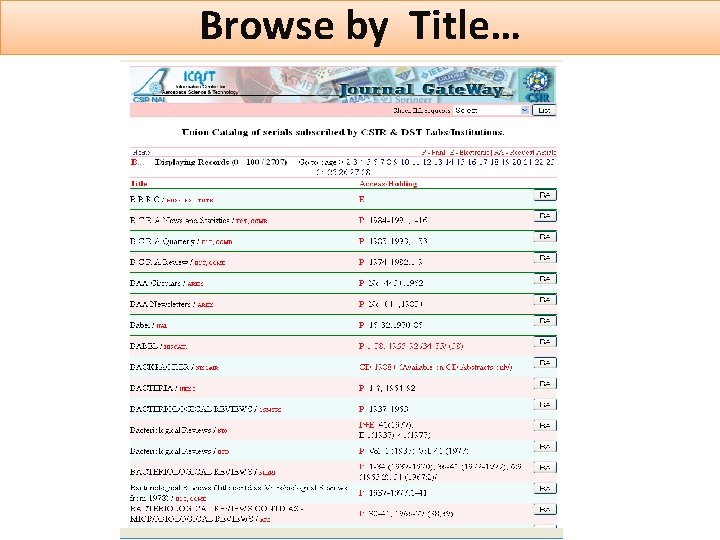
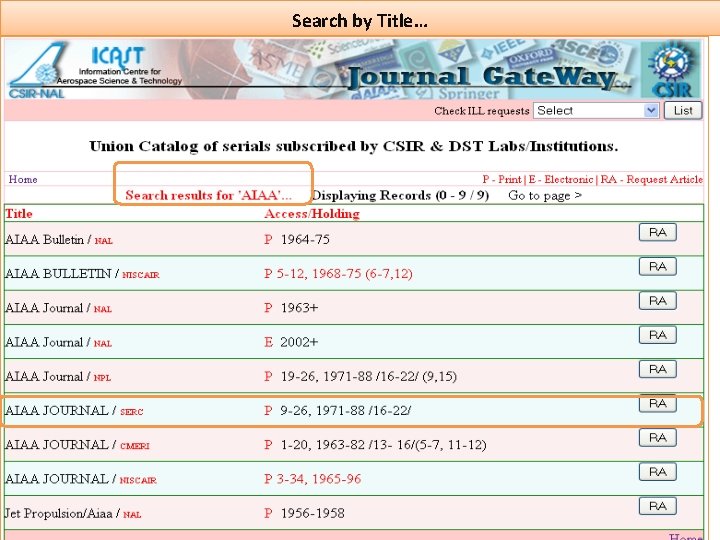
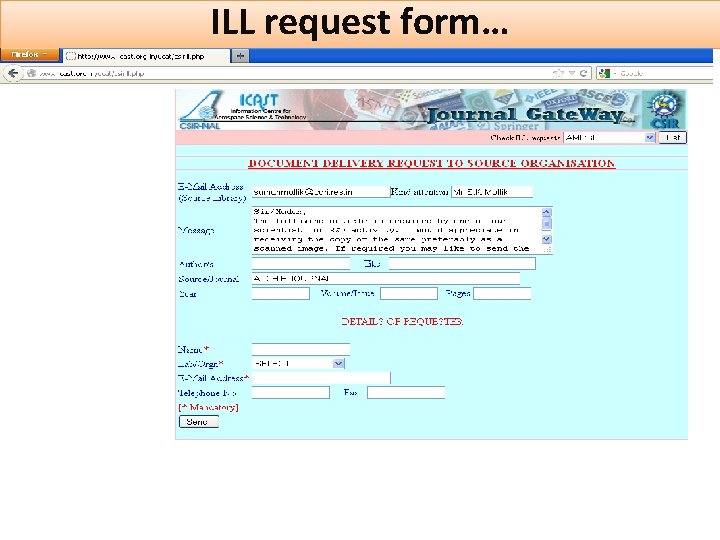
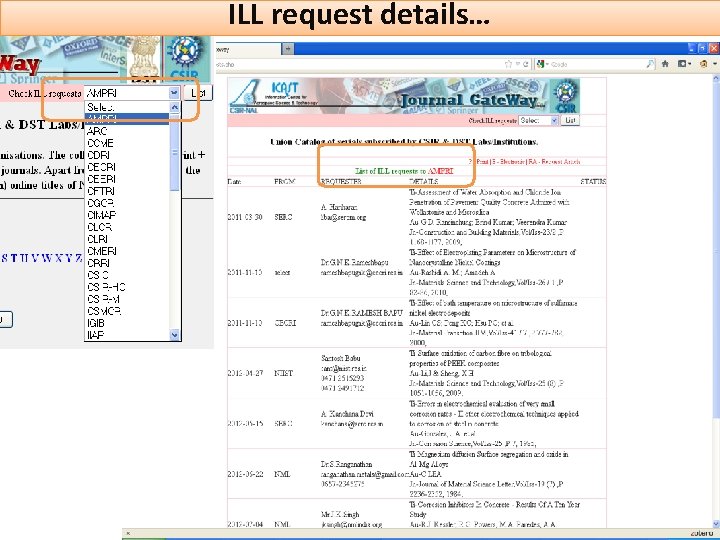
Functionalities • Information Retrieval – Browse • Laboratory wise • Journal Title wise – Search • Journal title • Article Request – Automated E-mail • ILL requests details for each Laboratories
Browse by Title…
Browse by Title…
Browse by Lab… (CSIR -DST)
Browse by Lab… (Aerospace)
Search by Title…
ILL request form…
ILL request details…
Union Catalog of CSIR & DST : A Case study Statistics… Labs/Institutions No of records AMPRI CCMB/IICT CDRI CECRI CEERI CFTRI CGCRI CIMAP CLRI CMERI CRRI CSIO CSIR-HQ CSIR-M CSMCRI IGIB IICB IMMT IITR NAL NBRI NCL 284 1323 825 329 738 1457 645 64 721 1443 793 616 77 382 918 52 389 297 432 1400 1097 1581 NEERI NEIST NGRI NIIST NIO NISCAIR NISTADS NML NPL SERC URDIP ARCI ARIES BOSE INST CLCR IASST IIAP IIG JNCASR RRI SCTIMST 374 1272 573 614 1151 13798 290 996 1619 392 49 55 478 100 703 18 142 154 177 265 509 615 Total 44345
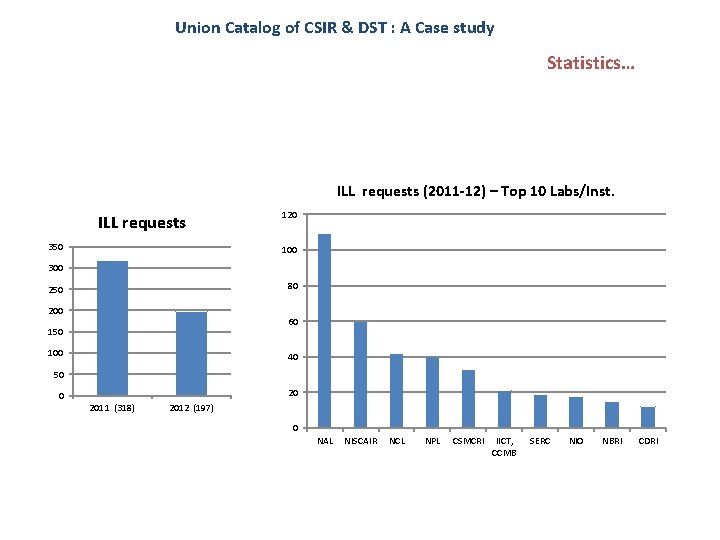
Union Catalog of CSIR & DST : A Case study Statistics… ILL requests (2011 -12) – Top 10 Labs/Inst. ILL requests 350 120 100 300 80 250 200 60 150 100 40 50 2011 (318) 2012 (197) 0 NAL NISCAIR NCL NPL CSMCRI IICT, CCMB SERC NIO NBRI CDRI
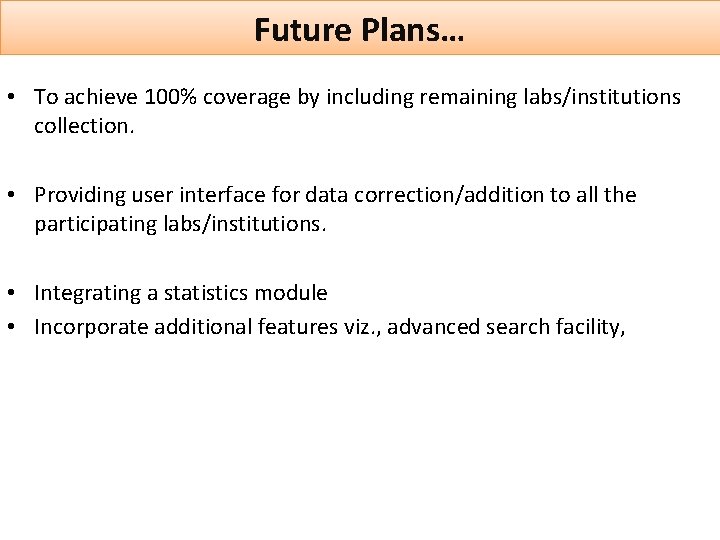
Future Plans… • To achieve 100% coverage by including remaining labs/institutions collection. • Providing user interface for data correction/addition to all the participating labs/institutions. • Integrating a statistics module • Incorporate additional features viz. , advanced search facility,
RESOURCE SHARING • Resource sharing does not merely mean mutual sharing of information sources among libraries • It will mean utilizing information resources of one library for generating services of another library • Information Resources and Library Resources are not synonymous • Library Resources may include other resources, besides information resources, like staff and equipment
Acknowledgement • • • DRDO: DESIDOC and INMAS Dr. Rajeev Vij Director, CSIR-NAL Ms. S Jayashree, Scientist, ICAST, CSIR-NAL Sri B S Shivaram, -”-” -
THANK YOU ANY QUESTIONS? ?
Union Catalog of CSIR & DST : A Case study Future Plans… • To achieve 100% coverage by including remaining labs/institutions collection. • Providing user interface for data correction/addition to all the participating labs/institutions. • Integrating a statistics module.
INDIAN LIBRARY CONSORTIA • Library consortia have been Operating throughout the world • Several consortia have come up in India too: – Forum for Resource Sharing in Astronomy and Astrophysics (FORSA) – Indian National Digital Library in Science & Technology (INDEST) – INFONET Project of UGC – Health Sciences Library & Information Network (HELINET) – CSIR -DST E-Resources Consortium (NKRC) – DAE Library Consortium – IIM Library Consortium - DRDO consortium………
Conclusion
Usage Statistics
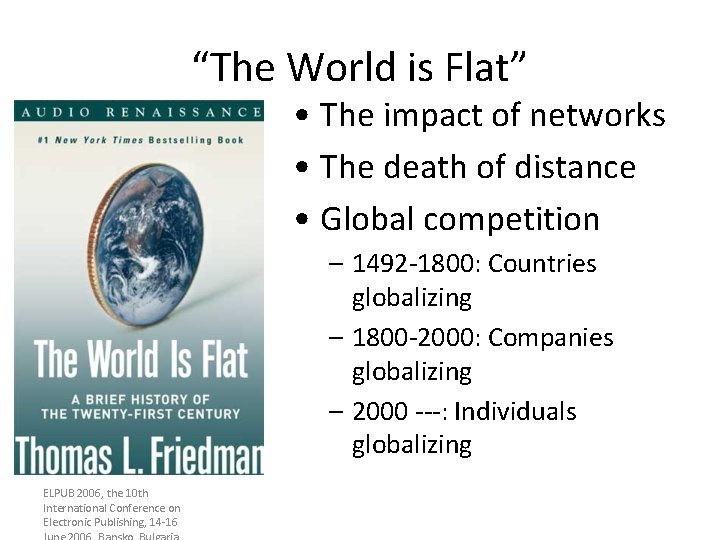
“The World is Flat” • The impact of networks • The death of distance • Global competition – 1492 -1800: Countries globalizing – 1800 -2000: Companies globalizing – 2000 ---: Individuals globalizing ELPUB 2006, the 10 th International Conference on Electronic Publishing, 14 -16