
Enhanced Predictability of Eastern North Pacific Tropical Cyclone
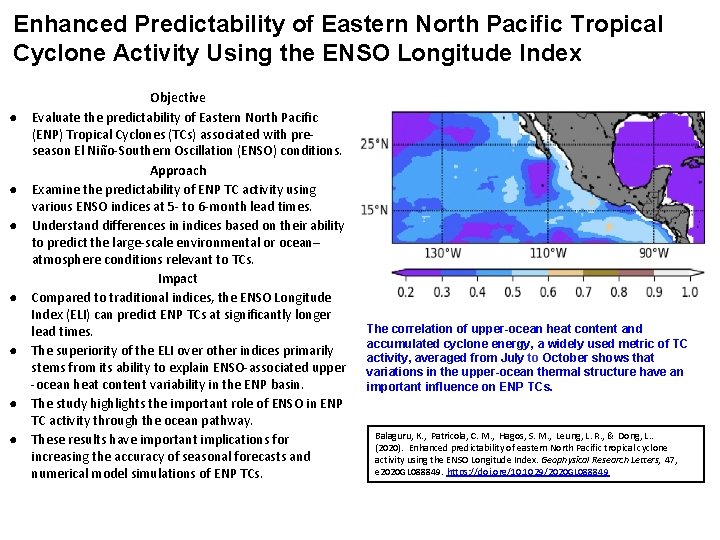
Enhanced Predictability of Eastern North Pacific Tropical Cyclone Activity Using the ENSO Longitude Index ● ● ● ● Objective Evaluate the predictability of Eastern North Pacific (ENP) Tropical Cyclones (TCs) associated with preseason El Niño-Southern Oscillation (ENSO) conditions. Approach Examine the predictability of ENP TC activity using various ENSO indices at 5 - to 6 -month lead times. Understand differences in indices based on their ability to predict the large-scale environmental or ocean– atmosphere conditions relevant to TCs. Impact Compared to traditional indices, the ENSO Longitude Index (ELI) can predict ENP TCs at significantly longer lead times. The superiority of the ELI over other indices primarily stems from its ability to explain ENSO-associated upper -ocean heat content variability in the ENP basin. The study highlights the important role of ENSO in ENP TC activity through the ocean pathway. These results have important implications for increasing the accuracy of seasonal forecasts and numerical model simulations of ENP TCs. The correlation of upper-ocean heat content and accumulated cyclone energy, a widely used metric of TC activity, averaged from July to October shows that variations in the upper-ocean thermal structure have an important influence on ENP TCs. Balaguru, K. , Patricola, C. M. , Hagos, S. M. , Leung, L. R. , & Dong, L. . (2020). Enhanced predictability of eastern North Pacific tropical cyclone activity using the ENSO Longitude Index. Geophysical Research Letters, 47, e 2020 GL 088849. https: //doi. org/10. 1029/2020 GL 088849
- Slides: 1