
Enhanced matrix multiplication algorithm for FPGA Tams Herendi

- Slides: 18
Enhanced matrix multiplication algorithm for FPGA Tamás Herendi, S. Roland Major UDT 2012
Introduction • The presented work is based on the algorithm by T. Herendi for constructing uniformly distributed linear recurring sequences to be used for pseudo-random number generation • The most time-consuming part is the exponentiation of large matrices to an extremely high power. • An extremely fast FPGA design is detailed that achieves a speedup factor of ~1000
Mathematical background • The algorithm constructs uniformly distributed linear recurring sequences modulo powers of 2 • The sequences can have arbitrarily large period lengths • New elements are easy to compute • Unpredictability does not hold
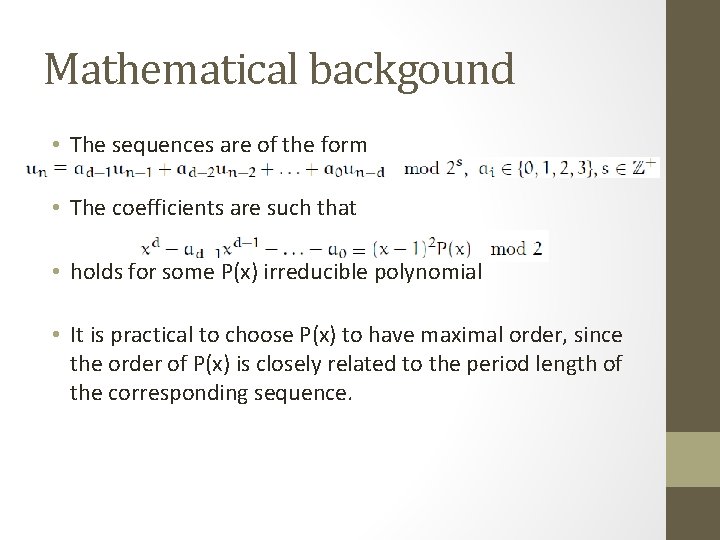
Mathematical backgound • The sequences are of the form • The coefficients are such that • holds for some P(x) irreducible polynomial • It is practical to choose P(x) to have maximal order, since the order of P(x) is closely related to the period length of the corresponding sequence.
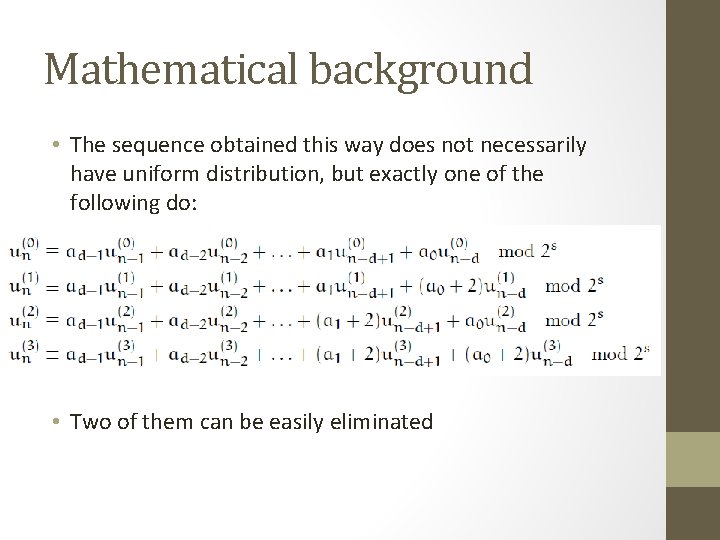
Mathematical background • The sequence obtained this way does not necessarily have uniform distribution, but exactly one of the following do: • Two of them can be easily eliminated
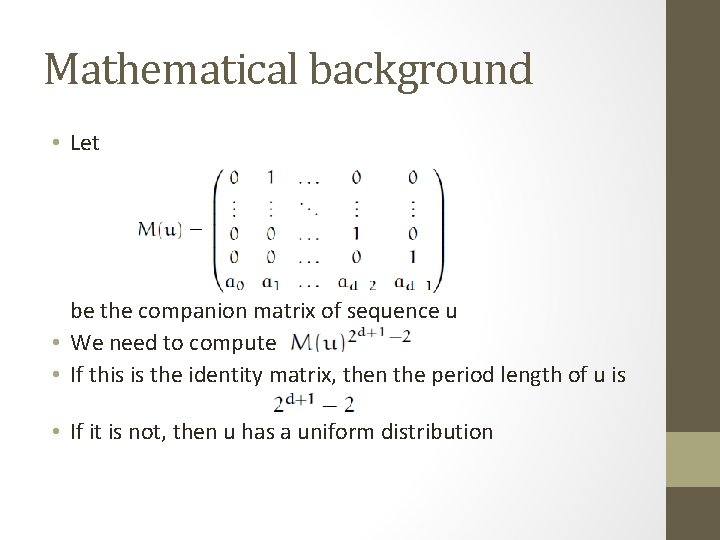
Mathematical background • Let be the companion matrix of sequence u • We need to compute • If this is the identity matrix, then the period length of u is • If it is not, then u has a uniform distribution
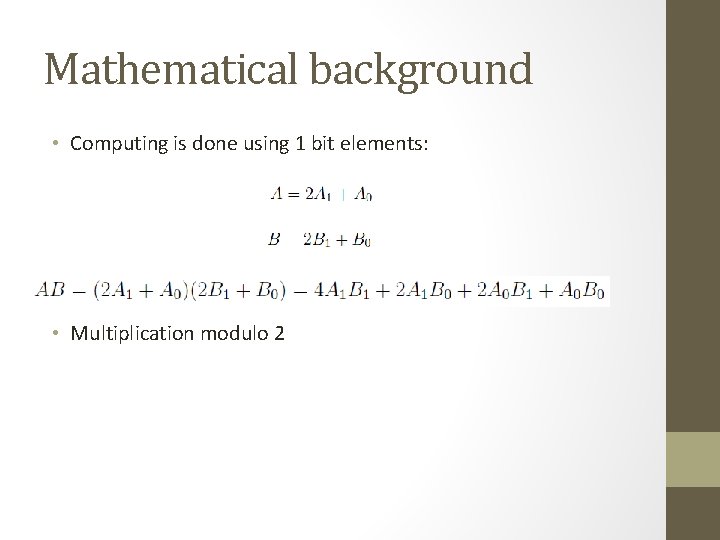
Mathematical background • Computing is done using 1 bit elements: • Multiplication modulo 2
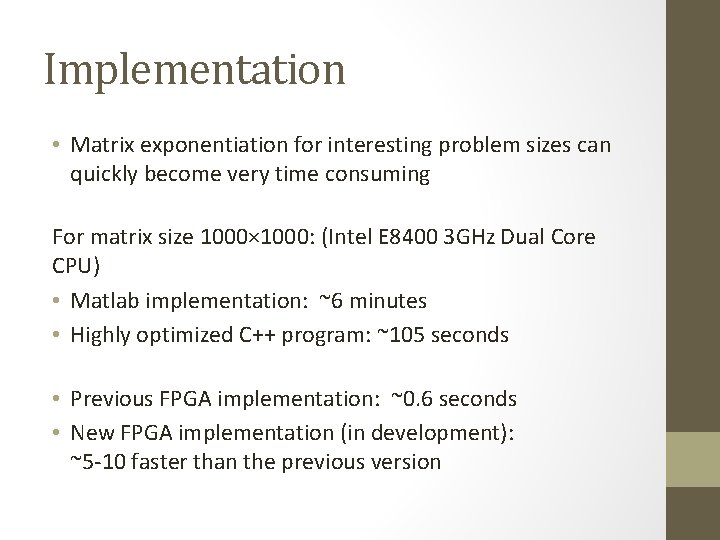
Implementation • Matrix exponentiation for interesting problem sizes can quickly become very time consuming For matrix size 1000× 1000: (Intel E 8400 3 GHz Dual Core CPU) • Matlab implementation: ~6 minutes • Highly optimized C++ program: ~105 seconds • Previous FPGA implementation: ~0. 6 seconds • New FPGA implementation (in development): ~5 -10 faster than the previous version
FPGA • Field-programmable gate array • Creates an application specific hardware solution (like an ASIC) • Grid of computing elements and connecting elements • Reprogrammable! • Look-up tables, registers, block RAMs, special multipliers, etc.
Look-up table • 6 -LUT: look-up table with 6 bit inputs: 64 bits of memory, addressed bit by bit • By manipulating this 64 bit value, it can be configured to compute any Boolean function with 6 bit input • Arranged into a grid on the chip, organized into „slices” containing usually 2 or 4 LUTs • Some have added functionality, like being used as shift registers • Additional features to increase efficiency (registers, carry chain, etc. )
FPGA • Solutions are extremely efficient • Supports massive parallelism • Best at algorithms performing many operations on relatively small amounts of data at a time • Departure from traditional Von Neumann architecture
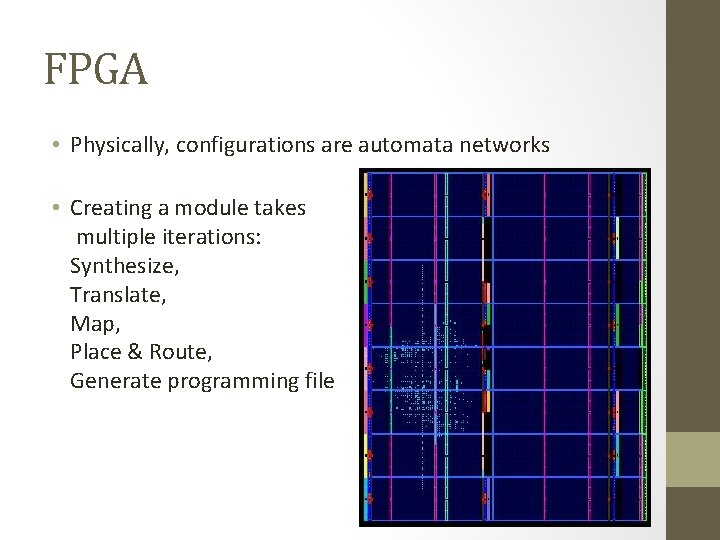
FPGA • Physically, configurations are automata networks • Creating a module takes multiple iterations: Synthesize, Translate, Map, Place & Route, Generate programming file
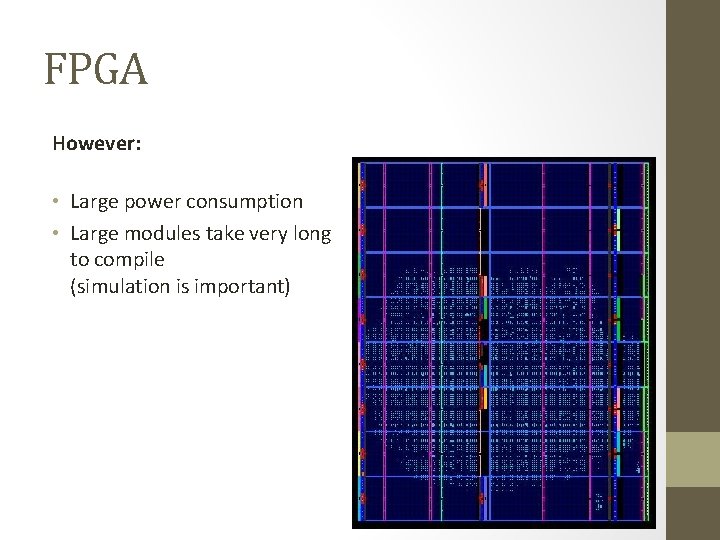
FPGA However: • Large power consumption • Large modules take very long to compile (simulation is important)
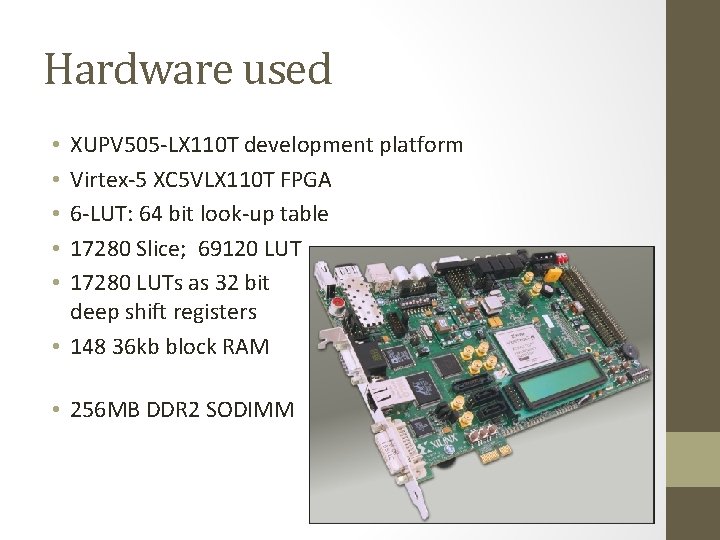
Hardware used XUPV 505 -LX 110 T development platform Virtex-5 XC 5 VLX 110 T FPGA 6 -LUT: 64 bit look-up table 17280 Slice; 69120 LUT 17280 LUTs as 32 bit deep shift registers • 148 36 kb block RAM • • • 256 MB DDR 2 SODIMM
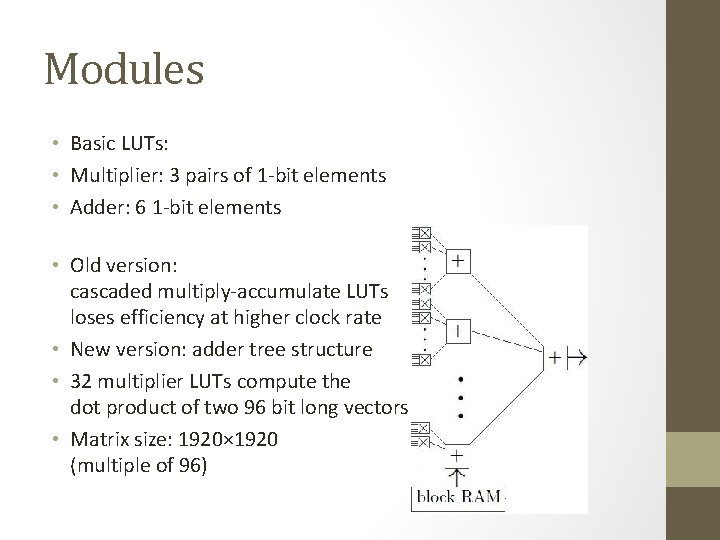
Modules • Basic LUTs: • Multiplier: 3 pairs of 1 -bit elements • Adder: 6 1 -bit elements • Old version: cascaded multiply-accumulate LUTs loses efficiency at higher clock rate • New version: adder tree structure • 32 multiplier LUTs compute the dot product of two 96 bit long vectors • Matrix size: 1920× 1920 (multiple of 96)
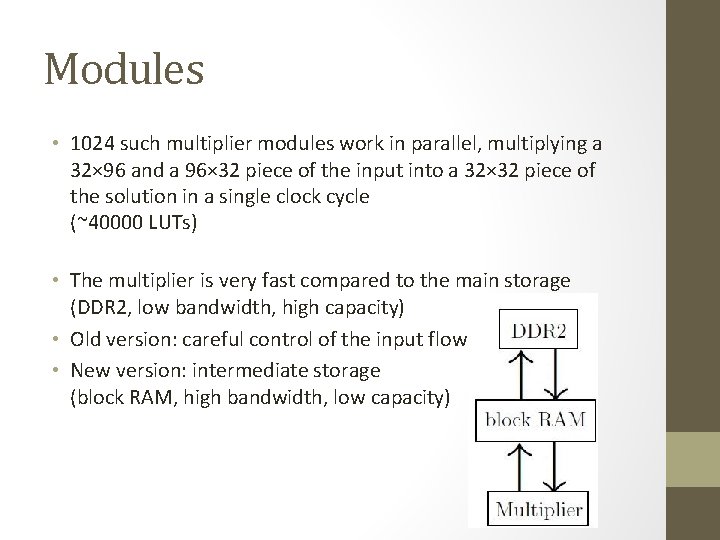
Modules • 1024 such multiplier modules work in parallel, multiplying a 32× 96 and a 96× 32 piece of the input into a 32× 32 piece of the solution in a single clock cycle (~40000 LUTs) • The multiplier is very fast compared to the main storage (DDR 2, low bandwidth, high capacity) • Old version: careful control of the input flow • New version: intermediate storage (block RAM, high bandwidth, low capacity)
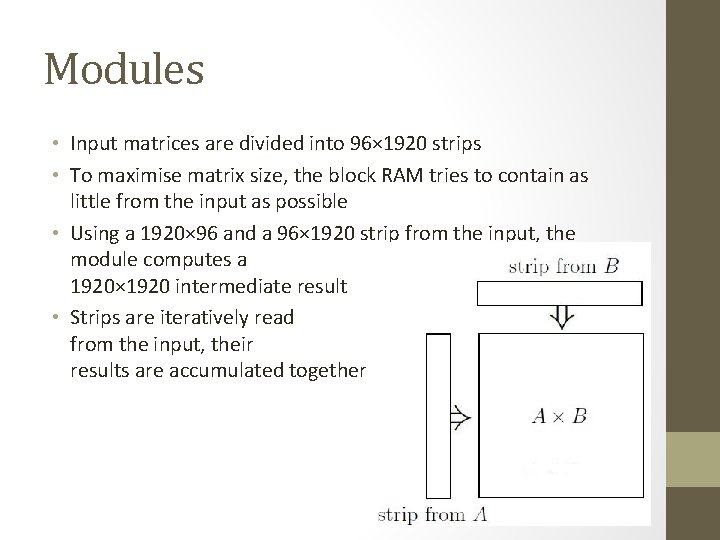
Modules • Input matrices are divided into 96× 1920 strips • To maximise matrix size, the block RAM tries to contain as little from the input as possible • Using a 1920× 96 and a 96× 1920 strip from the input, the module computes a 1920× 1920 intermediate result • Strips are iteratively read from the input, their results are accumulated together
Thank you for your attention.