
Enhanced Benefit Finding in Women with Early Stage
Enhanced Benefit Finding in Women with Early Stage Breast Cancer: The Mediational Role of Skill Building and Social Functioning Dissertation - August 2003
Outline 1. Introduction in brief 2. Method in brief 3. Preliminary Analyses 4. Changes in Skills 5. Changes in Social Relations 6. Predictors of Benefit Finding 7. Conclusion Dissertation - August 2003
Outline 1. Introduction in brief 2. Method in brief 3. Preliminary Analyses 4. Changes in Coping Skills 5. Changes in Social Relations 6. Predictors of Benefit Finding 7. Conclusion Dissertation - August 2003
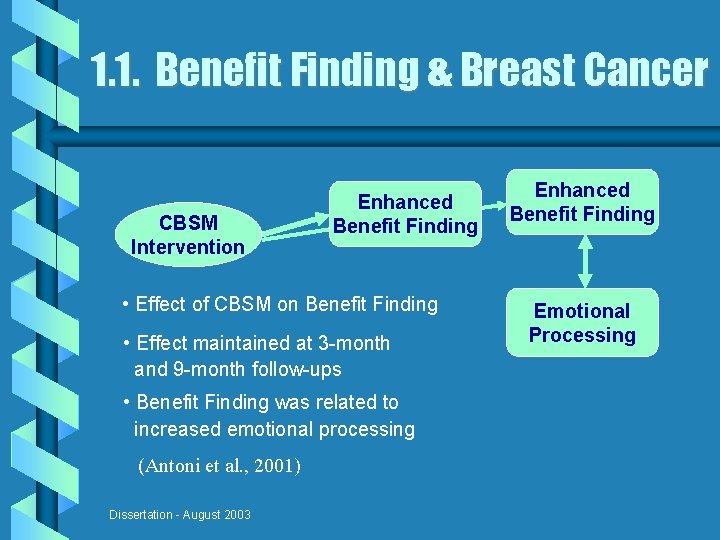
1. 1. Benefit Finding & Breast Cancer CBSM Intervention Enhanced Benefit Finding • Effect of CBSM on Benefit Finding • Effect maintained at 3 -month and 9 -month follow-ups • Benefit Finding was related to increased emotional processing (Antoni et al. , 2001) Dissertation - August 2003 Enhanced Benefit Finding Emotional Processing

1. 2. Goal 3 Questions: • Does the CBSM intervention contribute to generate changes in intrapersonal and interpersonal skills between pre- (T 1)and post-intervention (T 2) assessments? • Does the change in skills b/w T 1 and T 2 predict adjustment in social relations at 3 -month (T 3) and 9 month (T 4) follow-ups? • Does social relations at T 3/T 4 mediate the impact of CBSM on Benefit Finding at T 4? Dissertation - August 2003
Outline 1. Introduction in brief 2. Method in brief 3. Preliminary Analyses 4. Changes in Coping Skills 5. Changes in Social Relations 6. Predictors of Benefit Finding 7. Conclusion Dissertation - August 2003
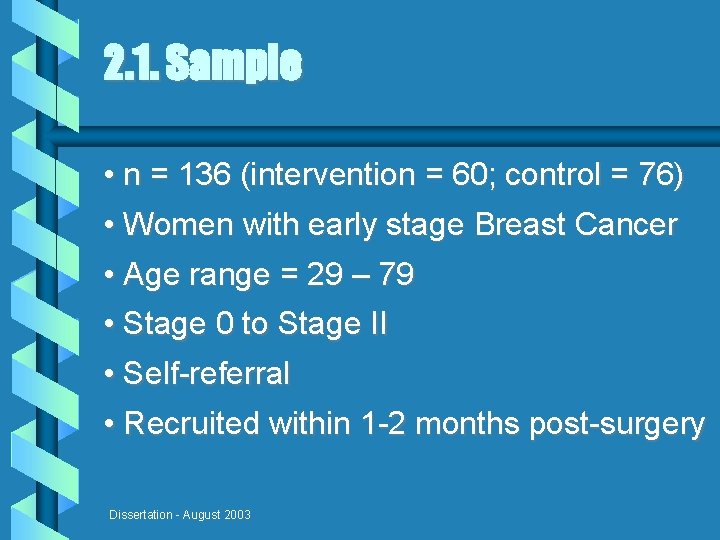
2. 1. Sample • n = 136 (intervention = 60; control = 76) • Women with early stage Breast Cancer • Age range = 29 – 79 • Stage 0 to Stage II • Self-referral • Recruited within 1 -2 months post-surgery Dissertation - August 2003
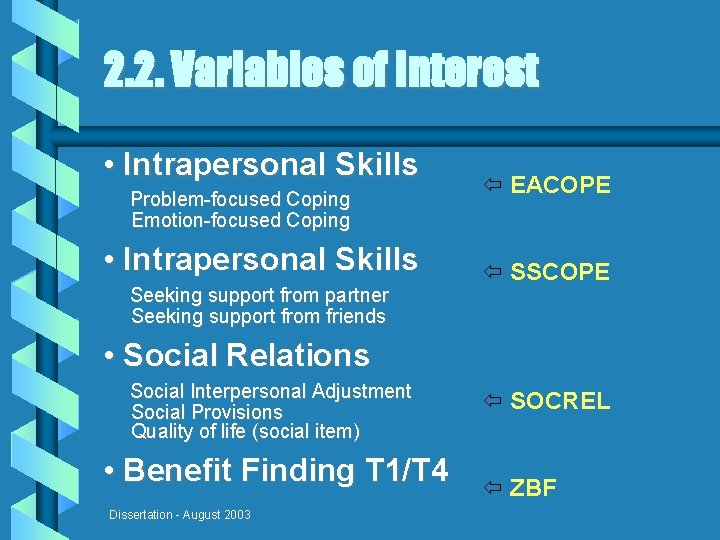
2. 2. Variables of Interest • Intrapersonal Skills Problem-focused Coping Emotion-focused Coping • Intrapersonal Skills Seeking support from partner Seeking support from friends EACOPE SSCOPE • Social Relations Social Interpersonal Adjustment Social Provisions Quality of life (social item) • Benefit Finding T 1/T 4 Dissertation - August 2003 SOCREL ZBF
Outline 1. Introduction in brief 2. Method in brief 3. Preliminary Analyses 4. Changes in Coping Skills 5. Changes in Social Relations 6. Predictors of Benefit Finding 7. Conclusion Dissertation - August 2003
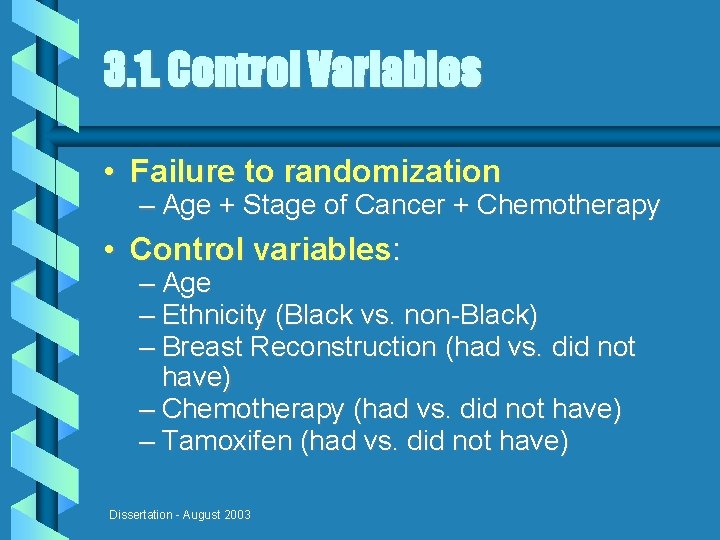
3. 1. Control Variables • Failure to randomization – Age + Stage of Cancer + Chemotherapy • Control variables: – Age – Ethnicity (Black vs. non-Black) – Breast Reconstruction (had vs. did not have) – Chemotherapy (had vs. did not have) – Tamoxifen (had vs. did not have) Dissertation - August 2003
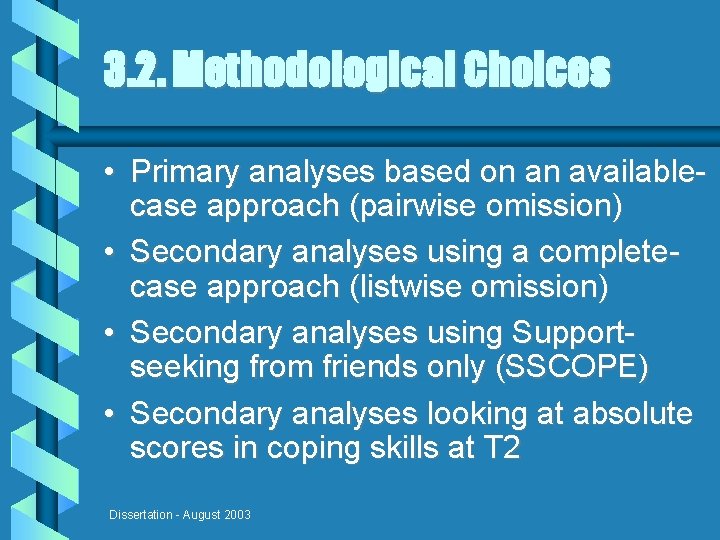
3. 2. Methodological Choices • Primary analyses based on an availablecase approach (pairwise omission) • Secondary analyses using a completecase approach (listwise omission) • Secondary analyses using Supportseeking from friends only (SSCOPE) • Secondary analyses looking at absolute scores in coping skills at T 2 Dissertation - August 2003
Presentation of Results For each hypothesis: a) Hypotheses tested b) Results c) Discussion d) Future Directions Dissertation - August 2003
Outline 1. Introduction in brief 2. Method in brief 3. Preliminary Analyses 4. Changes in Coping Skills 5. Changes in Social Relations 6. Predictors of Benefit Finding 7. Conclusion Dissertation - August 2003
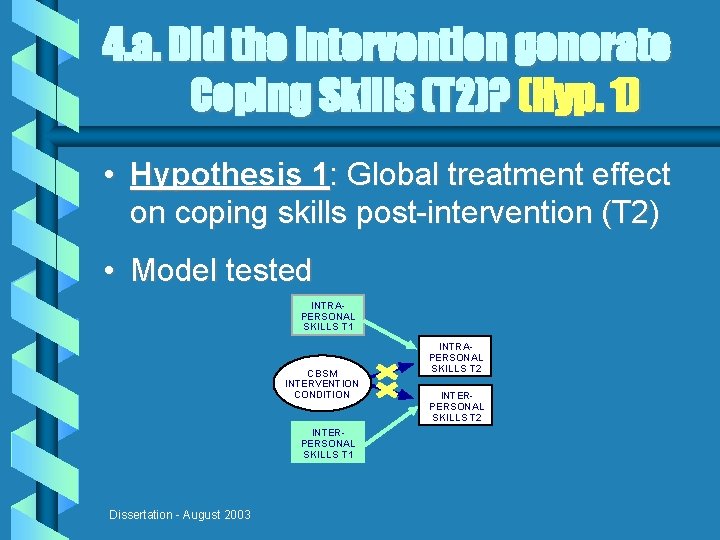
4. a. Did the intervention generate Coping Skills (T 2)? (Hyp. 1) • Hypothesis 1: Global treatment effect on coping skills post-intervention (T 2) • Model tested INTRAPERSONAL SKILLS T 1 CBSM INTERVENTION CONDITION INTERPERSONAL SKILLS T 1 Dissertation - August 2003 INTRAPERSONAL SKILLS T 2 INTERPERSONAL SKILLS T 2
4. b. Did the intervention generate Coping Skills (T 2)? (Results) • No effect of the intervention on – Intrapersonal Skills (EACOPE) at T 2 – Interpersonal Skills (SSCOPE) at T 2 • But effect of the intervention on emotional processing (EAC) at T 2, with a greater effect for those with lower EAC scores at T 1 • Continuous decrease in – other coping skills (COPE) from T 1 to T 4 – Interpersonal Skills (SSCOPE) from T 1 to T 4 Dissertation - August 2003
4. c. Did the intervention generate Coping Skills (T 2)? (Discussion) • Coping skills at T 1 predicted coping skills at T 2 Minimal changes from T 1 to T 2 • Measures of the use of coping skills Decrease in coping related to decrease in perceived stress? A shift from problem-focused coping to emotionfocused coping and reflection on existential issues? • Use of social support (SS) = only 1 distinction Intervention effective on other facets of SS (e. g. , sources, types and quality of SS)? Dissertation - August 2003
4. d. Did the intervention generate Coping Skills (T 2)? (Future Dir. ) • Use indicators of acquisition of new skills • Incorporate a measure of change in perceived stress concurrent to measure of use of coping skills • Select time points with greater variations in stress (e. g. , diagnosis vs. post-surgery) • Measure other facets of SS: those targeted in the intervention (e. g. sources, types, quality of social support) Dissertation - August 2003
Outline 1. Introduction in brief 2. Method in brief 3. Preliminary Analyses 4. Changes in Coping Skills 5. Changes in Social Relations 6. Predictors of Benefit Finding 7. Conclusion Dissertation - August 2003
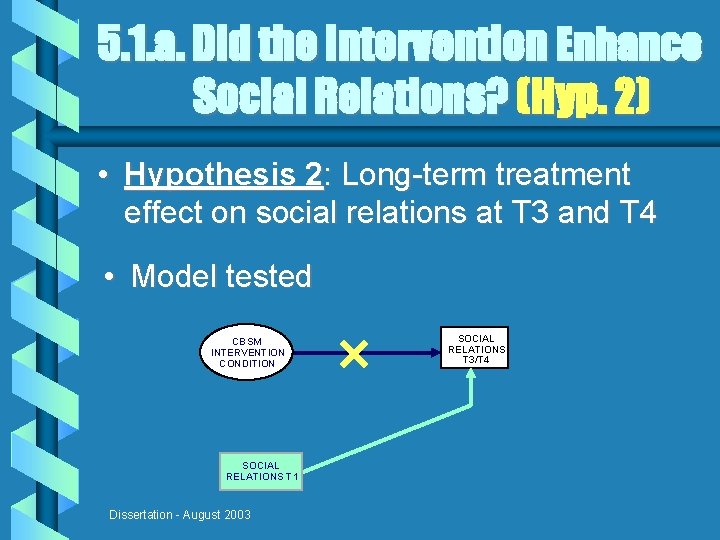
5. 1. a. Did the Intervention Enhance Social Relations? (Hyp. 2) • Hypothesis 2: Long-term treatment effect on social relations at T 3 and T 4 • Model tested CBSM INTERVENTION CONDITION SOCIAL RELATIONS T 1 Dissertation - August 2003 SOCIAL RELATIONS T 3/T 4
5. 1. b. Did the Intervention Enhance Social Relations? (Results) • No effect of the intervention on Social Relations as a whole at any time point Mediation of a treatment effect via skill building (Hyp. 3) could not be tested • T 1 reports predicted T 3/T 4 reports of social relations • Increase in social interactions from T 1 to T 3, in the absence of a treatment effect Dissertation - August 2003
5. 1. c. Did the Intervention Enhance Social Relations? (Discussion) • Improvement in social interactions in the absence of a treatment effect one of the benefits arising from the experience of breast cancer? the change in social relations from T 1 to T 3 that predicted long-term benefit finding Dissertation - August 2003
5. 1. d. Did the Intervention Enhance Social Relations? (Future Dir. ) • To revisit the construct of social relations; how does it differ from the beneficial outcomes measured in benefit finding? • Distinction between quantitative and qualitative measures of social relations – Frequency of social interactions – Quality of relationships with family and friends and quality of social provisions Dissertation - August 2003
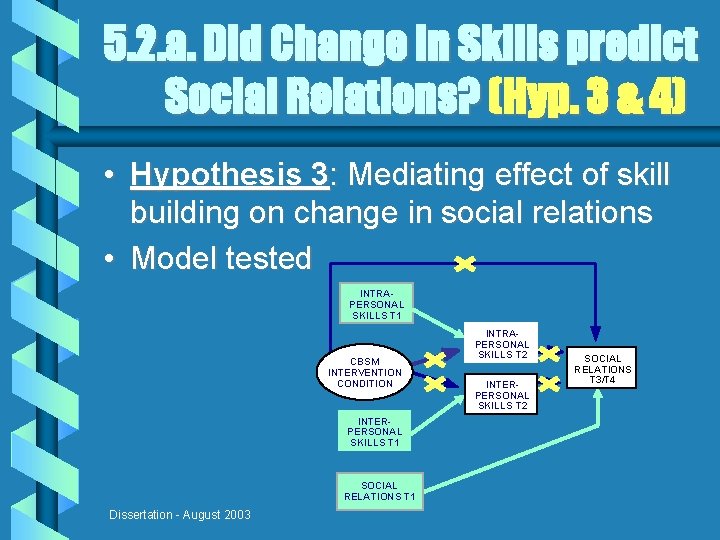
5. 2. a. Did Change in Skills predict Social Relations? (Hyp. 3 & 4) • Hypothesis 3: Mediating effect of skill building on change in social relations • Model tested INTRAPERSONAL SKILLS T 1 CBSM INTERVENTION CONDITION INTERPERSONAL SKILLS T 1 SOCIAL RELATIONS T 1 Dissertation - August 2003 INTRAPERSONAL SKILLS T 2 INTERPERSONAL SKILLS T 2 SOCIAL RELATIONS T 3/T 4
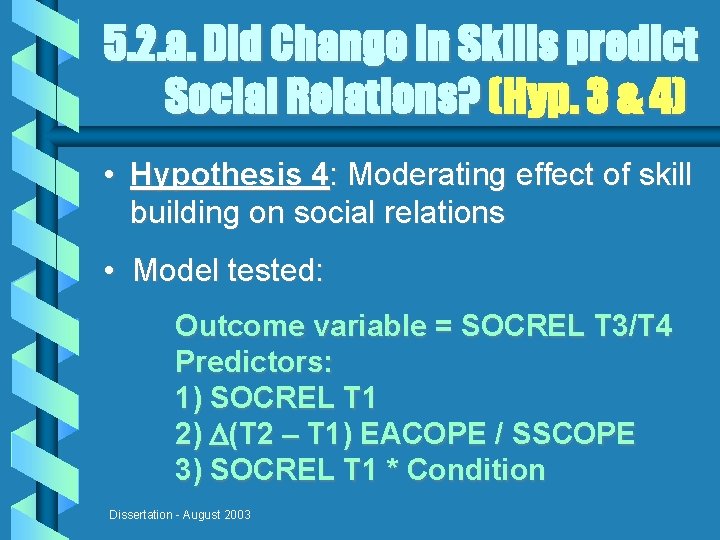
5. 2. a. Did Change in Skills predict Social Relations? (Hyp. 3 & 4) • Hypothesis 4: Moderating effect of skill building on social relations • Model tested: Outcome variable = SOCREL T 3/T 4 Predictors: 1) SOCREL T 1 2) (T 2 – T 1) EACOPE / SSCOPE 3) SOCREL T 1 * Condition Dissertation - August 2003
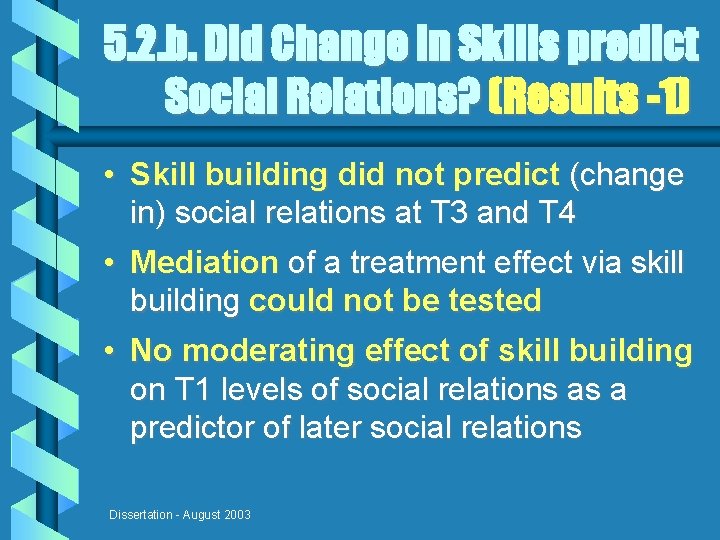
5. 2. b. Did Change in Skills predict Social Relations? (Results -1) • Skill building did not predict (change in) social relations at T 3 and T 4 • Mediation of a treatment effect via skill building could not be tested • No moderating effect of skill building on T 1 levels of social relations as a predictor of later social relations Dissertation - August 2003
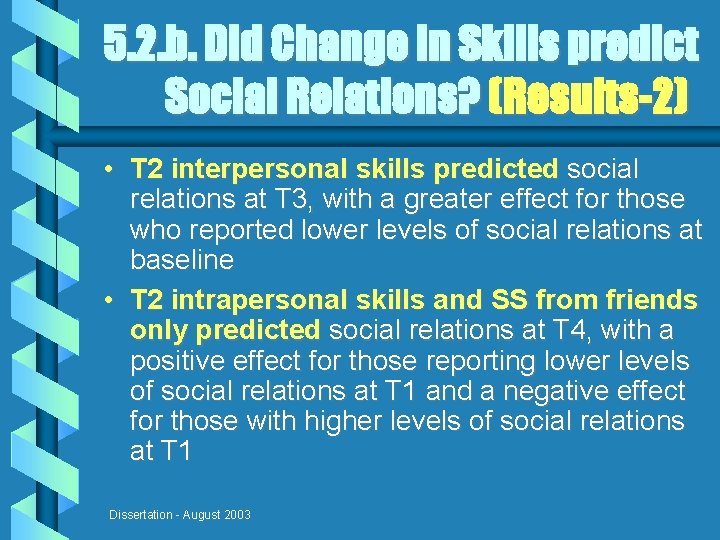
5. 2. b. Did Change in Skills predict Social Relations? (Results-2) • T 2 interpersonal skills predicted social relations at T 3, with a greater effect for those who reported lower levels of social relations at baseline • T 2 intrapersonal skills and SS from friends only predicted social relations at T 4, with a positive effect for those reporting lower levels of social relations at T 1 and a negative effect for those with higher levels of social relations at T 1 Dissertation - August 2003
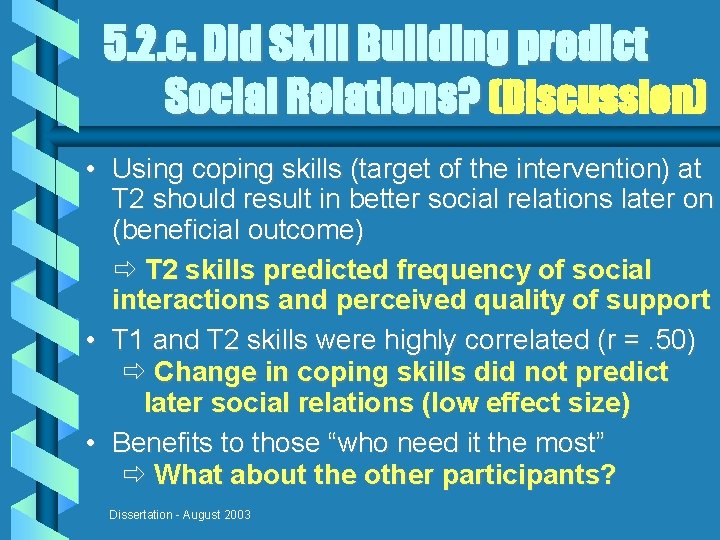
5. 2. c. Did Skill Building predict Social Relations? (Discussion) • Using coping skills (target of the intervention) at T 2 should result in better social relations later on (beneficial outcome) T 2 skills predicted frequency of social interactions and perceived quality of support • T 1 and T 2 skills were highly correlated (r =. 50) Change in coping skills did not predict later social relations (low effect size) • Benefits to those “who need it the most” What about the other participants? Dissertation - August 2003
5. 2. d. Did Skill Building predict Social Relations? (Future Dir. ) • Further explore the negative effects of the use of intrapersonal skills on those who reported higher levels of social relations at T 1 Dissertation - August 2003
Outline 1. Introduction in brief 2. Method in brief 3. Preliminary Analyses 4. Changes in Coping Skills 5. Changes in Social Relations 6. Predictors of Benefit Finding 7. Conclusion Dissertation - August 2003
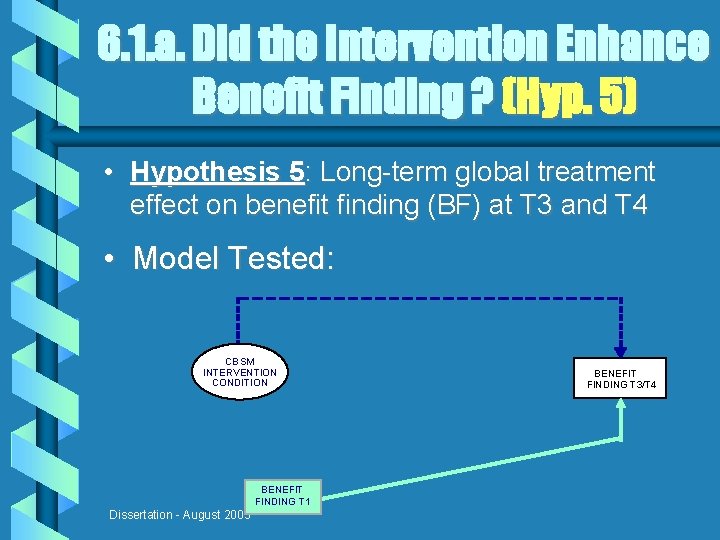
6. 1. a. Did the Intervention Enhance Benefit Finding ? (Hyp. 5) • Hypothesis 5: Long-term global treatment effect on benefit finding (BF) at T 3 and T 4 • Model Tested: CBSM INTERVENTION CONDITION BENEFIT FINDING T 1 Dissertation - August 2003 BENEFIT FINDING T 3/T 4
6. 1. b. Did the Intervention Enhance Benefit Finding ? (Results) • Effect of the intervention on benefit finding at T 3, not at T 4 Long-term effect of CBSM intervention • Greater positive effect for those who started with lower levels of benefit finding at baseline Positive effect on the participants “who needed it the most” Dissertation - August 2003
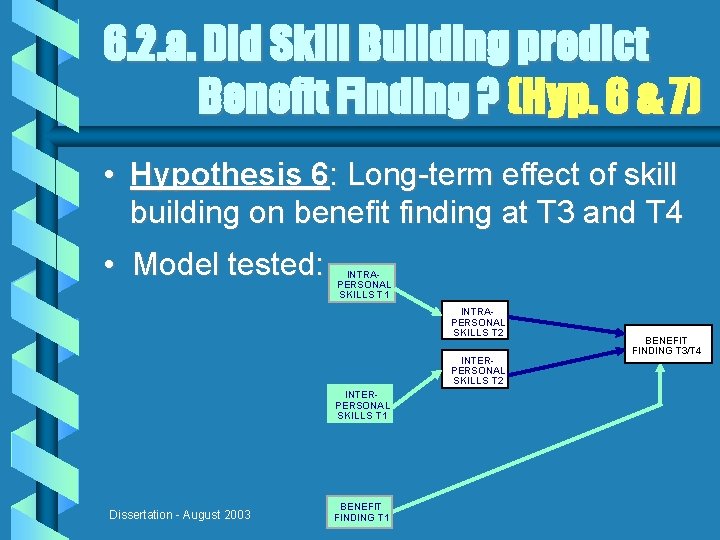
6. 2. a. Did Skill Building predict Benefit Finding ? (Hyp. 6 & 7) • Hypothesis 6: Long-term effect of skill building on benefit finding at T 3 and T 4 • Model tested: INTRAPERSONAL SKILLS T 1 INTRAPERSONAL SKILLS T 2 INTERPERSONAL SKILLS T 1 Dissertation - August 2003 BENEFIT FINDING T 1 BENEFIT FINDING T 3/T 4
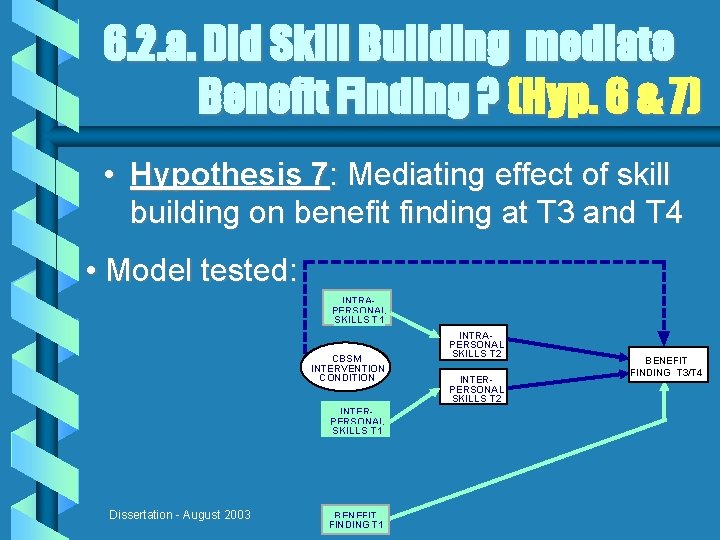
6. 2. a. Did Skill Building mediate Benefit Finding ? (Hyp. 6 & 7) • Hypothesis 7: Mediating effect of skill building on benefit finding at T 3 and T 4 • Model tested: INTRAPERSONAL SKILLS T 1 CBSM INTERVENTION CONDITION INTERPERSONAL SKILLS T 1 Dissertation - August 2003 BENEFIT FINDING T 1 INTRAPERSONAL SKILLS T 2 INTERPERSONAL SKILLS T 2 BENEFIT FINDING T 3/T 4
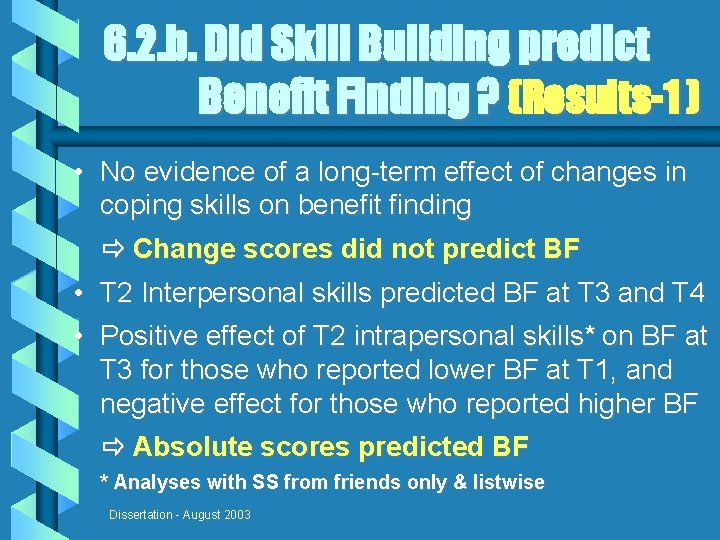
6. 2. b. Did Skill Building predict Benefit Finding ? (Results-1 ) • No evidence of a long-term effect of changes in coping skills on benefit finding Change scores did not predict BF • T 2 Interpersonal skills predicted BF at T 3 and T 4 • Positive effect of T 2 intrapersonal skills* on BF at T 3 for those who reported lower BF at T 1, and negative effect for those who reported higher BF Absolute scores predicted BF * Analyses with SS from friends only & listwise Dissertation - August 2003
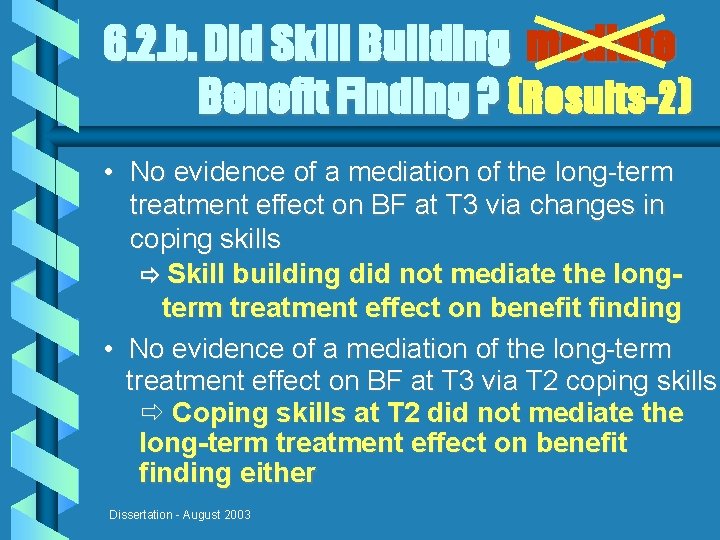
6. 2. b. Did Skill Building mediate Benefit Finding ? (Results-2) • No evidence of a mediation of the long-term treatment effect on BF at T 3 via changes in coping skills Skill building did not mediate the longterm treatment effect on benefit finding • No evidence of a mediation of the long-term treatment effect on BF at T 3 via T 2 coping skills Coping skills at T 2 did not mediate the long-term treatment effect on benefit finding either Dissertation - August 2003
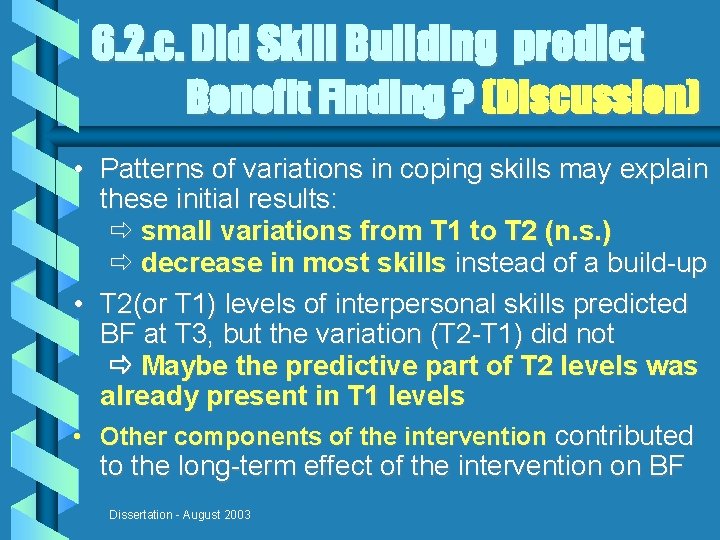
6. 2. c. Did Skill Building predict Benefit Finding ? (Discussion) • Patterns of variations in coping skills may explain these initial results: small variations from T 1 to T 2 (n. s. ) decrease in most skills instead of a build-up • T 2(or T 1) levels of interpersonal skills predicted BF at T 3, but the variation (T 2 -T 1) did not Maybe the predictive part of T 2 levels was already present in T 1 levels • Other components of the intervention contributed to the long-term effect of the intervention on BF Dissertation - August 2003
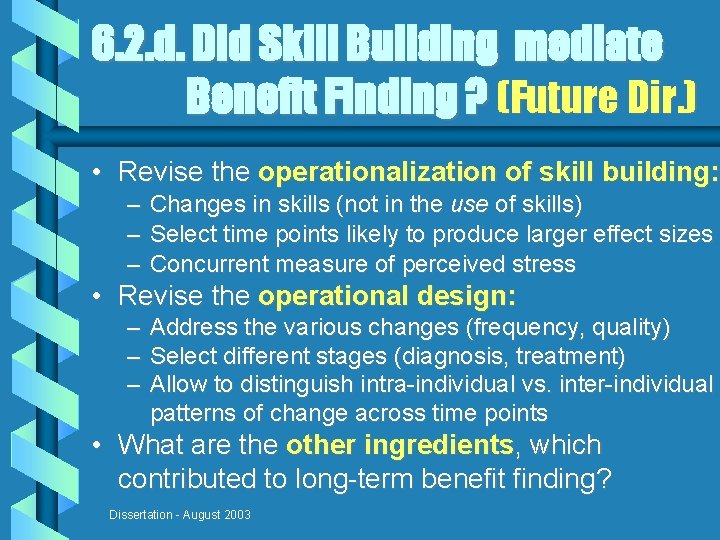
6. 2. d. Did Skill Building mediate Benefit Finding ? (Future Dir. ) • Revise the operationalization of skill building: – – – Changes in skills (not in the use of skills) Select time points likely to produce larger effect sizes Concurrent measure of perceived stress • Revise the operational design: – – – Address the various changes (frequency, quality) Select different stages (diagnosis, treatment) Allow to distinguish intra-individual vs. inter-individual patterns of change across time points • What are the other ingredients, which contributed to long-term benefit finding? Dissertation - August 2003
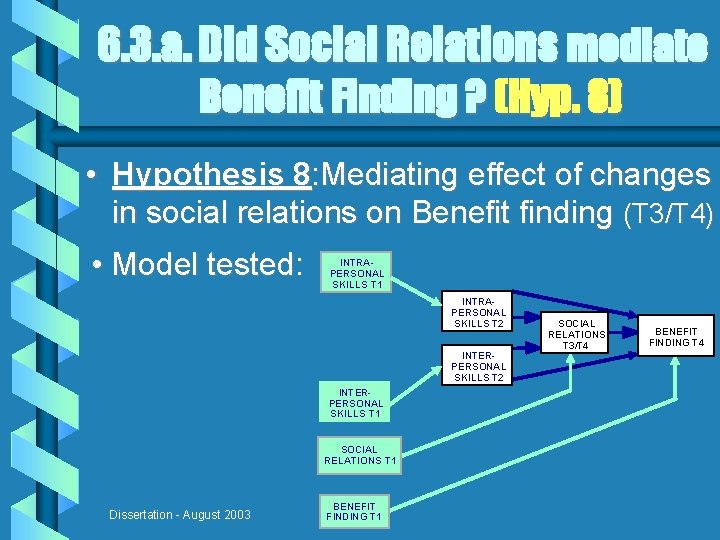
6. 3. a. Did Social Relations mediate Benefit Finding ? (Hyp. 8) • Hypothesis 8: Mediating effect of changes in social relations on Benefit finding (T 3/T 4) • Model tested: INTRAPERSONAL SKILLS T 1 INTRAPERSONAL SKILLS T 2 INTERPERSONAL SKILLS T 1 SOCIAL RELATIONS T 1 Dissertation - August 2003 BENEFIT FINDING T 1 SOCIAL RELATIONS T 3/T 4 BENEFIT FINDING T 4
6. 3. b. Did Social Relations mediate Benefit Finding ? (Results-1) • Changes in social relations from T 1 to T 3 predicted benefit finding at T 3 • Changes in social relations could not mediate the effect of skill building on benefit finding (absence of such an effect)* • Changes in social relations from T 1 to T 3 did not mediate the treatment effect on benefit finding at T 3 * Yet, mediation evidenced with an analysis listwise Dissertation - August 2003
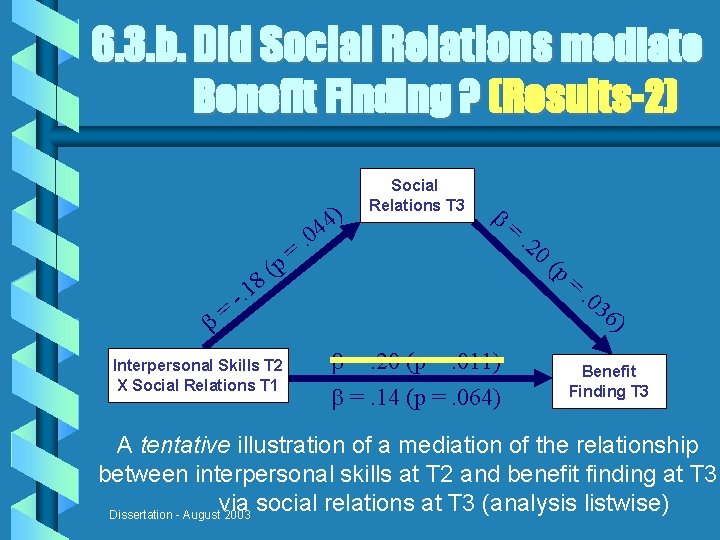
6. 3. b. Did Social Relations mediate Benefit Finding ? (Results-2) = -. 1 p= . 0 ) 4 4 Social Relations T 3 8( Interpersonal Skills T 2 X Social Relations T 1 =. 20 (p =. 011) =. 14 (p =. 064) = . 2 0 (p = . 0 36 ) Benefit Finding T 3 A tentative illustration of a mediation of the relationship between interpersonal skills at T 2 and benefit finding at T 3 via social relations at T 3 (analysis listwise) Dissertation - August 2003
6. 3. c. Did Social Relations mediate Benefit Finding ? (Discussion) • Improvement in social interactions from T 1 to T 3 contributed to explain enhanced benefit finding at T 3 • The absence of a mediating effect of social relations again suggests that other products of the intervention contributed to the long-term effect of the intervention on benefit finding Dissertation - August 2003
6. 3. d. Did Social Relations mediate Benefit Finding ? (Future Dir. ) • Could the results obtained with a complete-case approach be reproduced with a larger and more complete sample? Replicate the study, with a new methodology: – Revise the operationalization of variables – Incorporate a measure of perceived stress – Multiple imputations to handle missing data – Hierarchical modeling statistical procedure – Eventually, collect data prior to surgery Dissertation - August 2003
Outline 1. Introduction in brief 2. Method in brief 3. Preliminary Analyses 4. Results 5. Discussion 6. Methodological Limitations 7. Conclusion Dissertation - August 2003
7. 1. Conclusion 3 Factors predicted Benefit Finding at T 3: • Emotional processing and other coping skills at T 2 for those who reported lower levels of benefit finding at baseline • Support-seeking behaviors at T 2 • Changes in social relations from T 1 to T 3 But did not mediate the treatment effect observed at T 3 Dissertation - August 2003
7. 2. Conclusion (Cont’d) • Diversity of beneficial outcomes for a limited range of coping tools some facets of BF may not be influenced by the CBSM intervention • What is measured in the BF scale may be largely independent from what is targeted in the CBSM modules (e. g. , life readjustment, shift in life priorities and relationships, enhanced sense of purpose) Existential/Experiential dimension of BF Dissertation - August 2003
7. 3. Conclusion (Cont’d) • Early detection of perceived benefits Existential content in the intervention as early as at the treatment stage Need for indicators of those facets of benefit finding to measure the impact of the intervention and variations across time and situations Dissertation - August 2003
- Slides: 46