
ENGR 1182 AEV Lab Proficiency Quiz Review Rules

ENGR 1182 AEV Lab Proficiency Quiz Review
Rules for the Lab Proficiency Quiz § A 30 minute quiz on Carmen § Closed book/notes § Equation sheet will be provided § Cell phones off § Test is done individually § Be on time § Bring a calculator and a pencil or pen § Location: Your lab room at the beginning of Lab 8 § Format • Short Answer • Calculations • Multiple choice
Lab 2: Arduino Programming Basics § Give a brief explanation of the following: • celerate(1, 0, 20, 5); ¡ Accelerate motor 1 from 0% to 20% in 5 seconds • motor. Speed(4, 23); ¡ Set motor speed to 23% for all motors • go. For(3); ¡ Continue previous statement for 3 seconds • brake(4); ¡ Brake all motors
Lab 2: Arduino Programming Basics § If I have to write a very simple code I will • A. ) not forget the semi-colon ; • B. ) not forget what letters are in CAPS (syntax) • C. ) Remember the proper arguments for 7 basic commands • D. ) not forget the semi-colon ; • E. ) All of the above because I studied my stuff and I am going to ace this test!
Lab 2: Arduino Programming Basics Continued § go. For(____); has one argument inside the parenthesis. What is that argument and how is it inputted? • Time, in seconds. § reverse(____); what argument goes inside the parenthesis? • Motor number

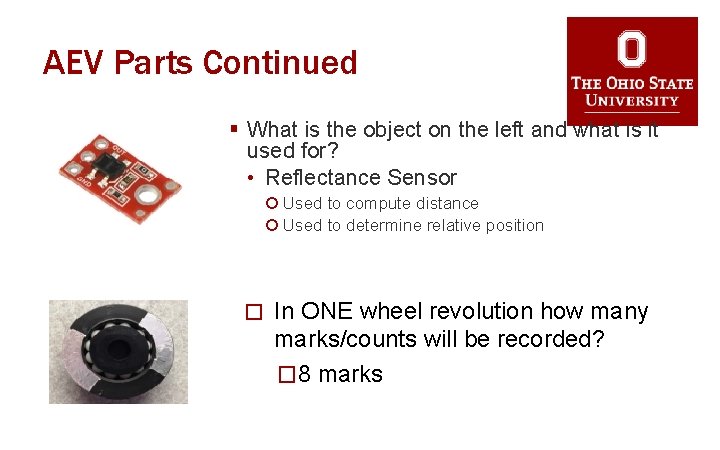
AEV Parts Continued § What is the object on the left and what is it used for? • Reflectance Sensor ¡ Used to compute distance ¡ Used to determine relative position � In ONE wheel revolution how many marks/counts will be recorded? � 8 marks
Lab 4: External Sensors § go. To. Relative. Position( ____ ); • I want the AEV to go for 4 feet (48 inches), what do I put as the input in the function call above? • Note: There are 0. 4875 inches/mark. Round to the nearest whole number. ¡ Marks = 48/. 4875 = 98. 4615 = 98 marks. § go. To. Absolute. Position( ____ ); • Same functionality as go. To. Relative. Position(), but what is different?
Lab 2: Arduino Programming Basics Continued § I want to write a code to have the AEV • Accelerate all motors from 0 to 26 percent power in 4 seconds. ¡ celerate(4, 0, 26, 4); • Set motor 1 motor speed to 30 percent power. ¡ motor. Speed(1, 30); • Continue the previous statement for 10 seconds. ¡ go. For(10); • Decelerate motor 2 to zero percent power in 9 seconds ¡ celerate(2, 26, 0, 9);
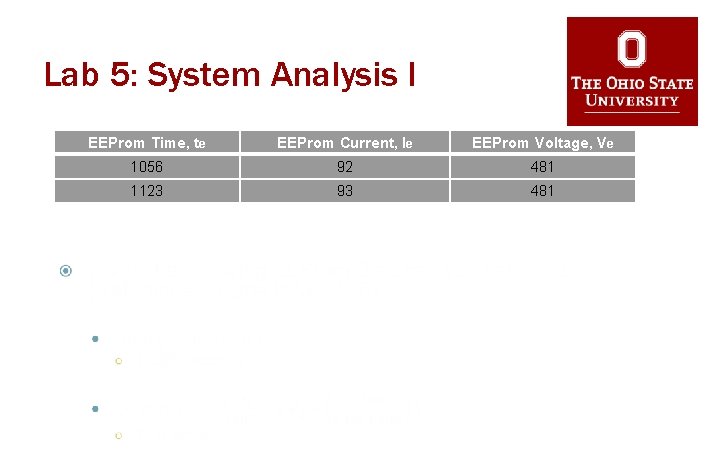
Lab 5: System Analysis I EEProm Time, te EEProm Current, Ie EEProm Voltage, Ve 1056 92 481 1123 93 481
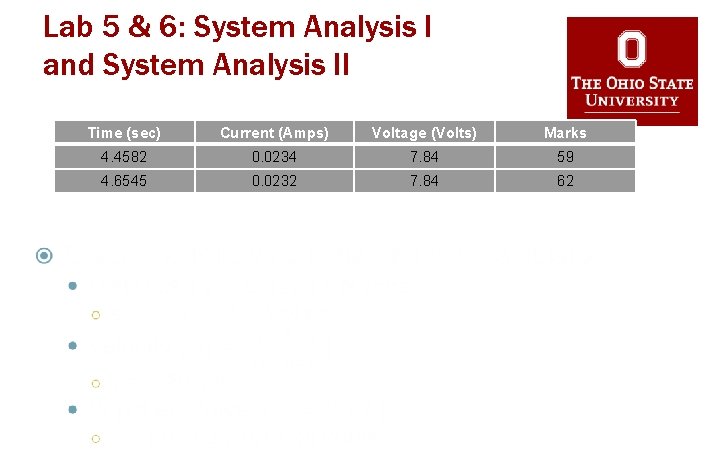
Lab 5 & 6: System Analysis I and System Analysis II Time (sec) Current (Amps) Voltage (Volts) Marks 4. 4582 0. 0234 7. 84 59 4. 6545 0. 0232 7. 84 62
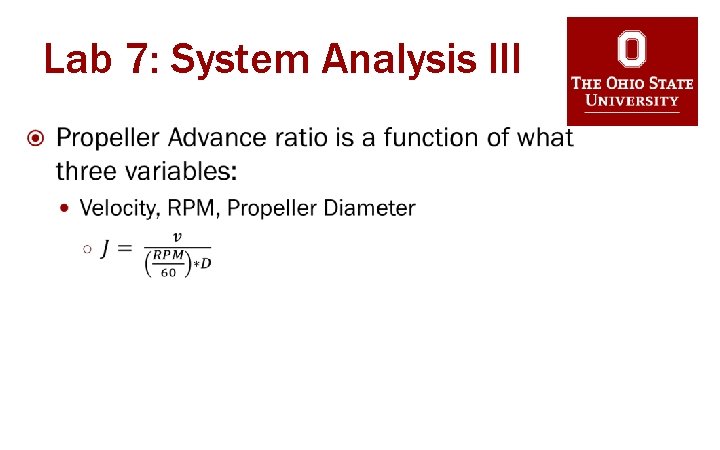
Lab 7: System Analysis III
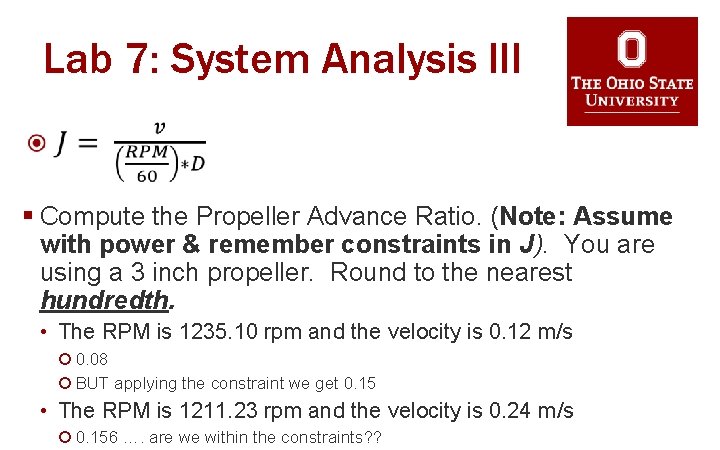
Lab 7: System Analysis III § Compute the Propeller Advance Ratio. (Note: Assume with power & remember constraints in J). You are using a 3 inch propeller. Round to the nearest hundredth. • The RPM is 1235. 10 rpm and the velocity is 0. 12 m/s ¡ 0. 08 ¡ BUT applying the constraint we get 0. 15 • The RPM is 1211. 23 rpm and the velocity is 0. 24 m/s ¡ 0. 156 …. are we within the constraints? ?
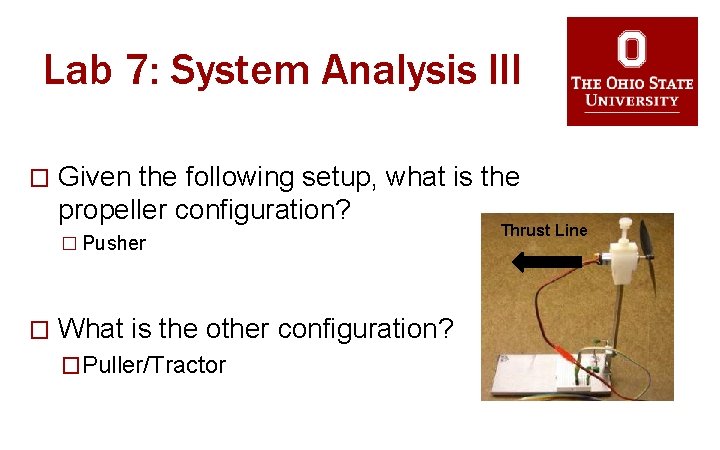
Lab 7: System Analysis III � Given the following setup, what is the propeller configuration? � Pusher � What is the other configuration? �Puller/Tractor Thrust Line
- Slides: 14