
English versus French Determinants of eye movement control
- Slides: 1
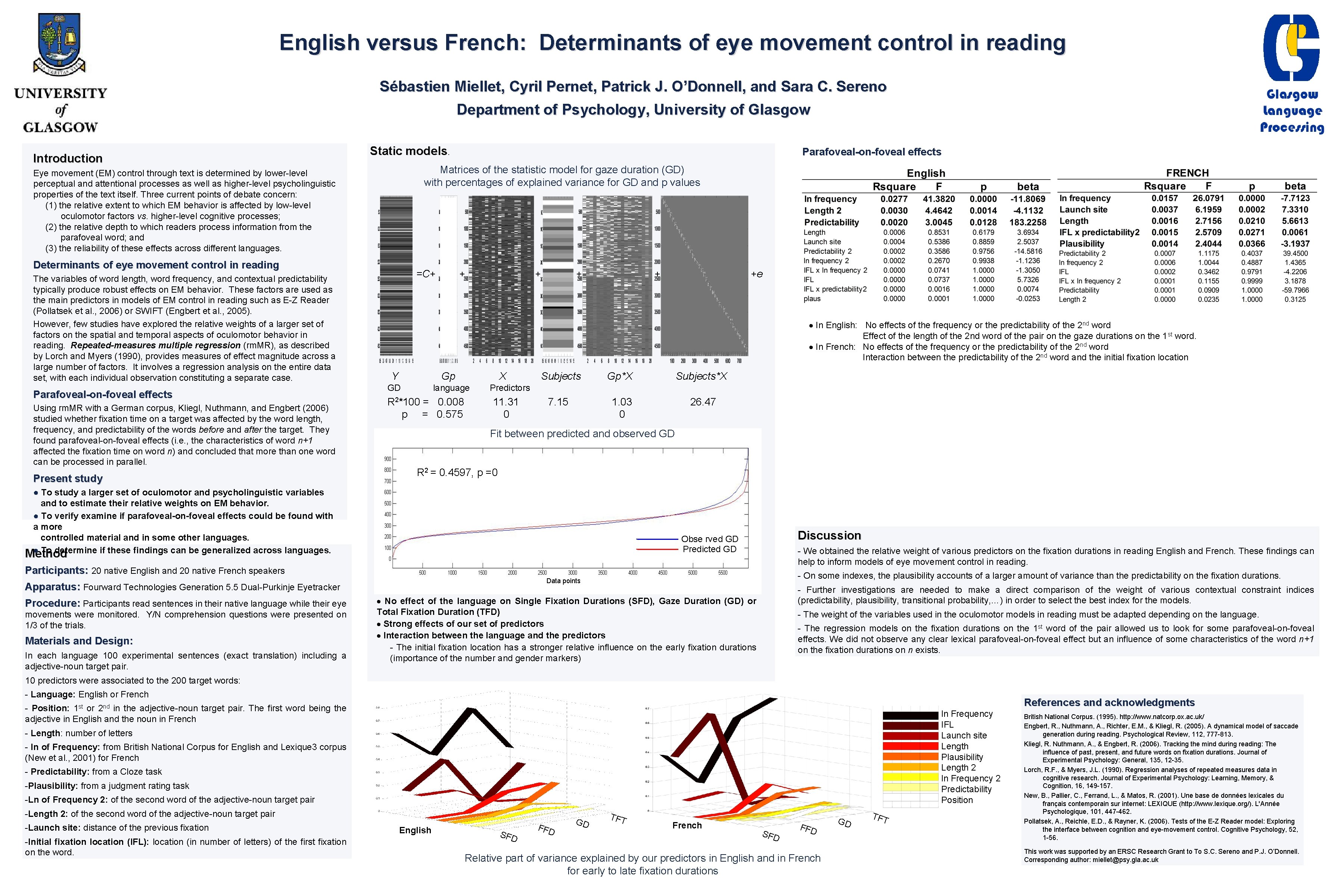
English versus French: Determinants of eye movement control in reading Sébastien Miellet, Cyril Pernet, Patrick J. O’Donnell, and Sara C. Sereno Department of Psychology, University of Glasgow Introduction Static models. Matrices of the statistic model for gaze duration (GD) with percentages of explained variance for GD and p values Eye movement (EM) control through text is determined by lower-level perceptual and attentional processes as well as higher-level psycholinguistic properties of the text itself. Three current points of debate concern: (1) the relative extent to which EM behavior is affected by low-level oculomotor factors vs. higher-level cognitive processes; (2) the relative depth to which readers process information from the parafoveal word; and (3) the reliability of these effects across different languages. Determinants of eye movement control in reading =C+ The variables of word length, word frequency, and contextual predictability typically produce robust effects on EM behavior. These factors are used as the main predictors in models of EM control in reading such as E-Z Reader (Pollatsek et al. , 2006) or SWIFT (Engbert et al. , 2005). However, few studies have explored the relative weights of a larger set of factors on the spatial and temporal aspects of oculomotor behavior in reading. Repeated-measures multiple regression (rm. MR), as described by Lorch and Myers (1990), provides measures of effect magnitude across a large number of factors. It involves a regression analysis on the entire data set, with each individual observation constituting a separate case. Present study + + +e · In English: No effects of the frequency or the predictability of the 2 nd word Effect of the length of the 2 nd word of the pair on the gaze durations on the 1 st word. · In French: No effects of the frequency or the predictability of the 2 nd word Interaction between the predictability of the 2 nd word and the initial fixation location Y Gp GD Parafoveal-on-foveal effects Using rm. MR with a German corpus, Kliegl, Nuthmann, and Engbert (2006) studied whether fixation time on a target was affected by the word length, frequency, and predictability of the words before and after the target. They found parafoveal-on-foveal effects (i. e. , the characteristics of word n+1 affected the fixation time on word n) and concluded that more than one word can be processed in parallel. Parafoveal-on-foveal effects X language R 2*100 = 0. 008 p = 0. 575 Subjects Gp*X Subjects*X 7. 15 1. 03 0 26. 47 Predictors 11. 31 0 Fit between predicted and observed GD ms R 2 = 0. 4597, p =0 ● To study a larger set of oculomotor and psycholinguistic variables and to estimate their relative weights on EM behavior. ● To verify examine if parafoveal-on-foveal effects could be found with a more controlled material and in some other languages. ● To determine if these findings can be generalized across languages. Method Discussion Obse rved GD Predicted GD - We obtained the relative weight of various predictors on the fixation durations in reading English and French. These findings can help to inform models of eye movement control in reading. Participants: 20 native English and 20 native French speakers Apparatus: Fourward Technologies Generation 5. 5 Dual-Purkinje Eyetracker Procedure: Participants read sentences in their native language while their eye movements were monitored. Y/N comprehension questions were presented on 1/3 of the trials. Materials and Design: In each language 100 experimental sentences (exact translation) including a adjective-noun target pair. - On some indexes, the plausibility accounts of a larger amount of variance than the predictability on the fixation durations. Data points - Further investigations are needed to make a direct comparison of the weight of various contextual constraint indices (predictability, plausibility, transitional probability, …) in order to select the best index for the models. · No effect of the language on Single Fixation Durations (SFD), Gaze Duration (GD) or Total Fixation Duration (TFD) · Strong effects of our set of predictors · Interaction between the language and the predictors - The initial fixation location has a stronger relative influence on the early fixation durations (importance of the number and gender markers) - The weight of the variables used in the oculomotor models in reading must be adapted depending on the language. - The regression models on the fixation durations on the 1 st word of the pair allowed us to look for some parafoveal-on-foveal effects. We did not observe any clear lexical parafoveal-on-foveal effect but an influence of some characteristics of the word n+1 on the fixation durations on n exists. 10 predictors were associated to the 200 target words: - Language: English or French References and acknowledgments - Position: or in the adjective-noun target pair. The first word being the adjective in English and the noun in French 1 st 2 nd ln Frequency IFL Launch site Length Plausibility Length 2 ln Frequency 2 Predictability Position - Length: number of letters - ln of Frequency: from British National Corpus for English and Lexique 3 corpus (New et al. , 2001) for French - Predictability: from a Cloze task -Plausibility: from a judgment rating task -Ln of Frequency 2: of the second word of the adjective-noun target pair -Length 2: of the second word of the adjective-noun target pair -Launch site: distance of the previous fixation -Initial fixation location (IFL): location (in number of letters) of the first fixation on the word. English SFD FFD GD TFT French SFD FFD Relative part of variance explained by our predictors in English and in French for early to late fixation durations GD TFT British National Corpus. (1995). http: //www. natcorp. ox. ac. uk/ Engbert, R. , Nuthmann, A. , Richter, E. M. , & Kliegl, R. (2005). A dynamical model of saccade generation during reading. Psychological Review, 112, 777 -813. Kliegl, R. Nuthmann, A. , & Engbert, R. (2006). Tracking the mind during reading: The influence of past, present, and future words on fixation durations. Journal of Experimental Psychology: General, 135, 12 -35. Lorch, R. F. , & Myers, J. L. (1990). Regression analyses of repeated measures data in cognitive research. Journal of Experimental Psychology: Learning, Memory, & Cognition, 16, 149 -157. New, B. , Pallier, C. , Ferrand, L. , & Matos, R. (2001). Une base de données lexicales du français contemporain sur internet: LEXIQUE (http: //www. lexique. org/). L'Année Psychologique, 101, 447 -462. Pollatsek, A. , Reichle, E. D. , & Rayner, K. (2006). Tests of the E-Z Reader model: Exploring the interface between cognition and eye-movement control. Cognitive Psychology, 52, 1 -56. This work was supported by an ERSC Research Grant to To S. C. Sereno and P. J. O’Donnell. Corresponding author: miellet@psy. gla. ac. uk