
English translation of Einsteins 1905 paper on special


- Slides: 15
English translation of Einstein’s 1905 paper on special relativity http: //www. fourmilab. ch/etexts/einstein/specrel/www/ Copyright © 2012 Pearson Education Inc.
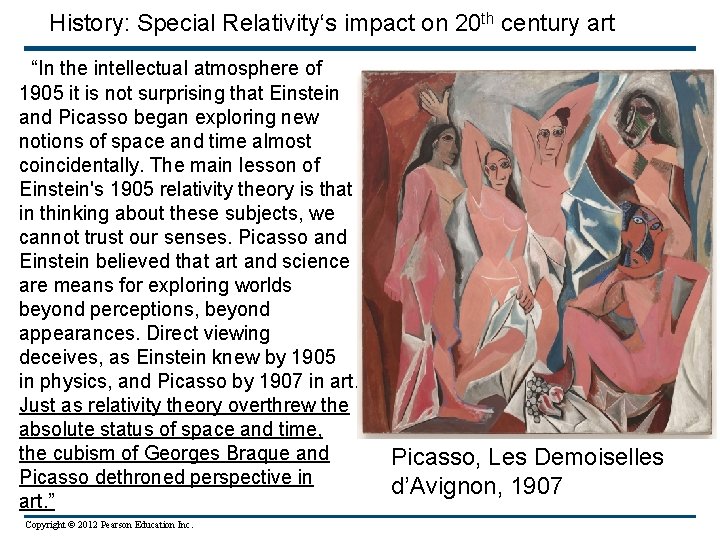
History: Special Relativity‘s impact on 20 th century art “In the intellectual atmosphere of 1905 it is not surprising that Einstein and Picasso began exploring new notions of space and time almost coincidentally. The main lesson of Einstein's 1905 relativity theory is that in thinking about these subjects, we cannot trust our senses. Picasso and Einstein believed that art and science are means for exploring worlds beyond perceptions, beyond appearances. Direct viewing deceives, as Einstein knew by 1905 in physics, and Picasso by 1907 in art. Just as relativity theory overthrew the absolute status of space and time, the cubism of Georges Braque and Picasso dethroned perspective in art. ” Copyright © 2012 Pearson Education Inc. Picasso, Les Demoiselles d’Avignon, 1907
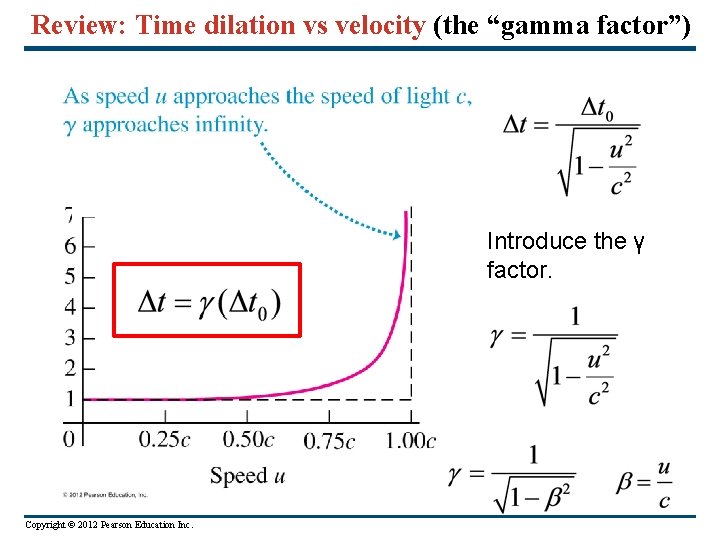
Review: Time dilation vs velocity (the “gamma factor”) Introduce the γ factor. Copyright © 2012 Pearson Education Inc.
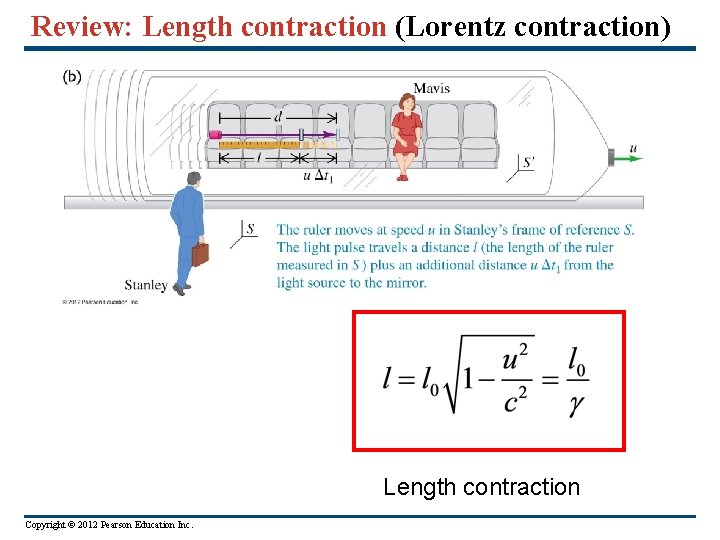
Review: Length contraction (Lorentz contraction) Length contraction Copyright © 2012 Pearson Education Inc.
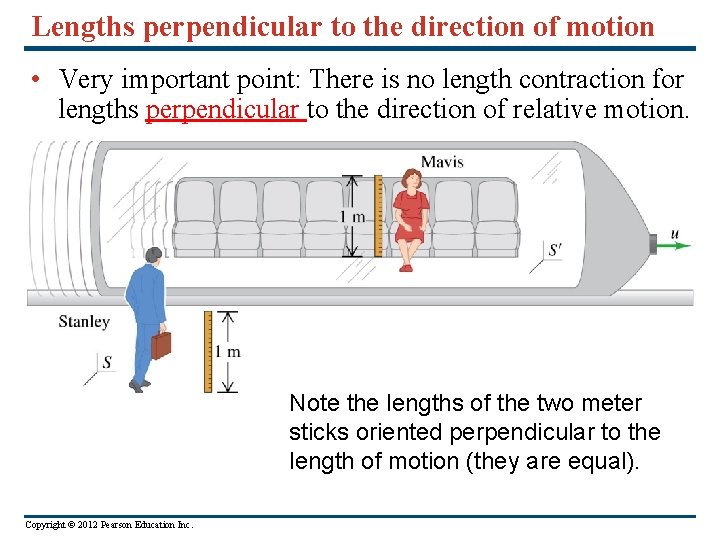
Lengths perpendicular to the direction of motion • Very important point: There is no length contraction for lengths perpendicular to the direction of relative motion. Note the lengths of the two meter sticks oriented perpendicular to the length of motion (they are equal). Copyright © 2012 Pearson Education Inc.
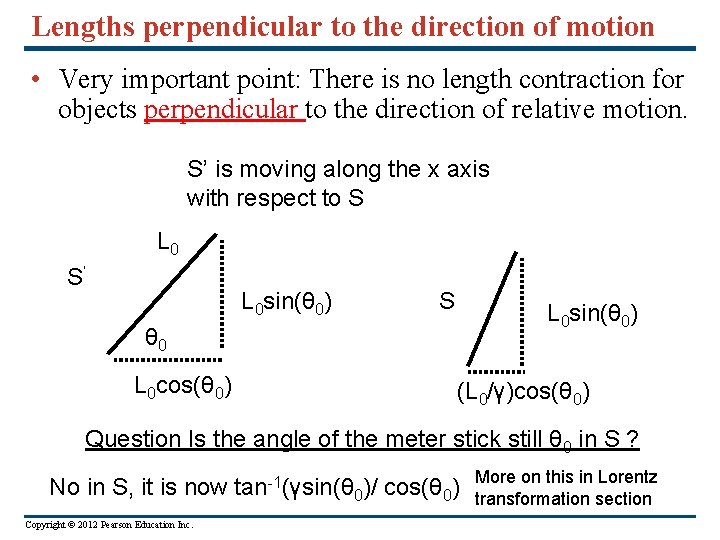
Lengths perpendicular to the direction of motion • Very important point: There is no length contraction for objects perpendicular to the direction of relative motion. S’ is moving along the x axis with respect to S L 0 S’ L 0 sin(θ 0) S L 0 sin(θ 0) θ 0 L 0 cos(θ 0) (L 0/γ)cos(θ 0) Question Is the angle of the meter stick still θ 0 in S ? No in S, it is now tan-1(γsin(θ 0)/ cos(θ 0) Copyright © 2012 Pearson Education Inc. More on this in Lorentz transformation section
Example of length contraction (or Lorentz contraction) A spaceship flies past earth at 0. 990 c. A crew member on-board measures its length and obtains 400 m. Question: What do observers on earth measure ? Copyright © 2012 Pearson Education Inc.
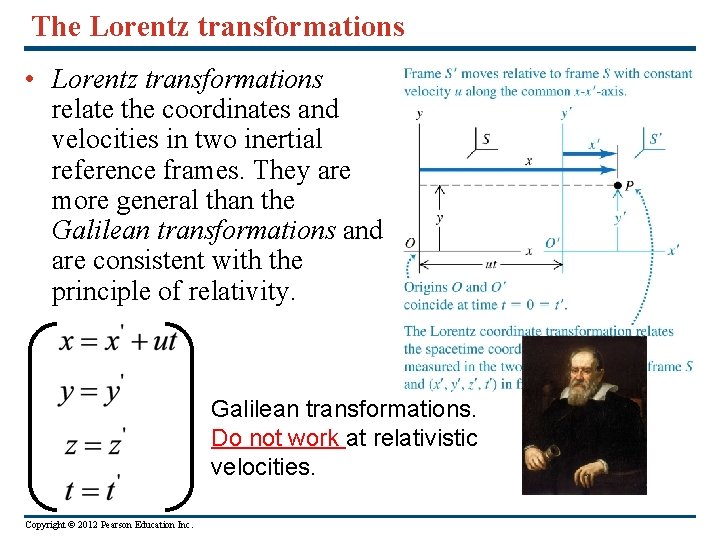
The Lorentz transformations • Lorentz transformations relate the coordinates and velocities in two inertial reference frames. They are more general than the Galilean transformations and are consistent with the principle of relativity. Galilean transformations. Do not work at relativistic velocities. Copyright © 2012 Pearson Education Inc.
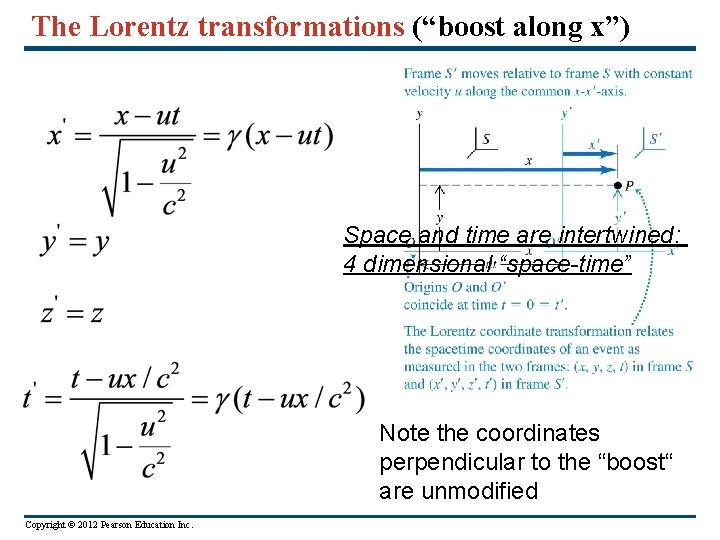
The Lorentz transformations (“boost along x”) Space and time are intertwined: 4 dimensional “space-time” Note the coordinates perpendicular to the “boost“ are unmodified Copyright © 2012 Pearson Education Inc.
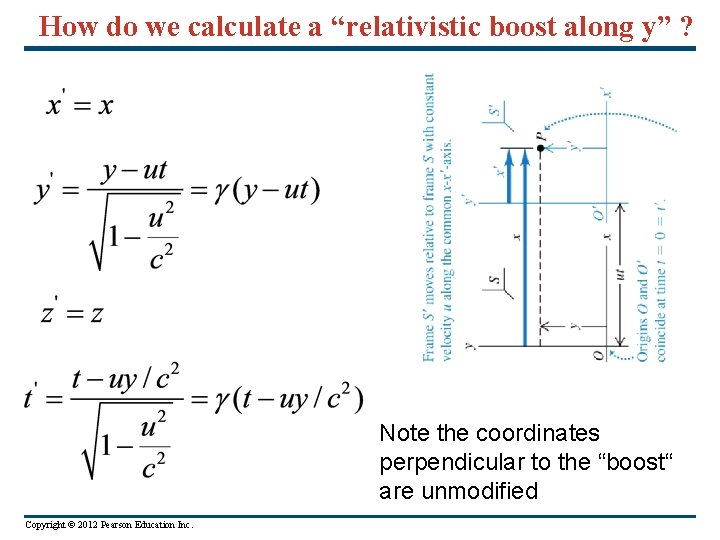
How do we calculate a “relativistic boost along y” ? Note the coordinates perpendicular to the “boost“ are unmodified Copyright © 2012 Pearson Education Inc.
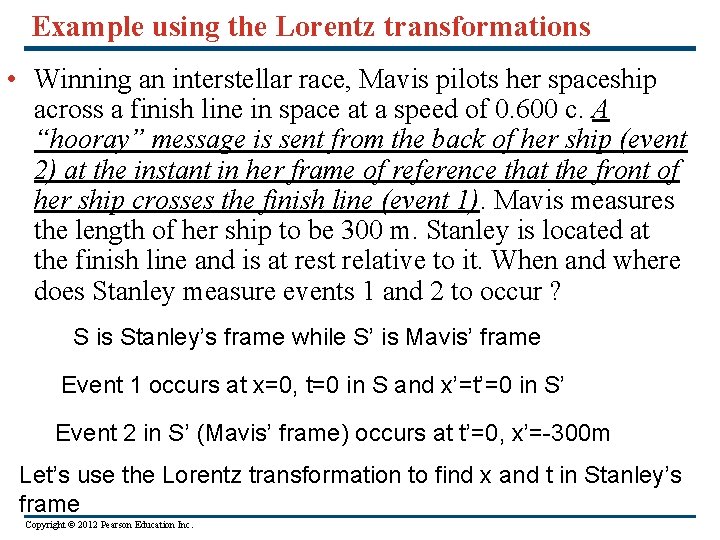
Example using the Lorentz transformations • Winning an interstellar race, Mavis pilots her spaceship across a finish line in space at a speed of 0. 600 c. A “hooray” message is sent from the back of her ship (event 2) at the instant in her frame of reference that the front of her ship crosses the finish line (event 1). Mavis measures the length of her ship to be 300 m. Stanley is located at the finish line and is at rest relative to it. When and where does Stanley measure events 1 and 2 to occur ? S is Stanley’s frame while S’ is Mavis’ frame Event 1 occurs at x=0, t=0 in S and x’=t’=0 in S’ Event 2 in S’ (Mavis’ frame) occurs at t’=0, x’=-300 m Let’s use the Lorentz transformation to find x and t in Stanley’s frame Copyright © 2012 Pearson Education Inc.
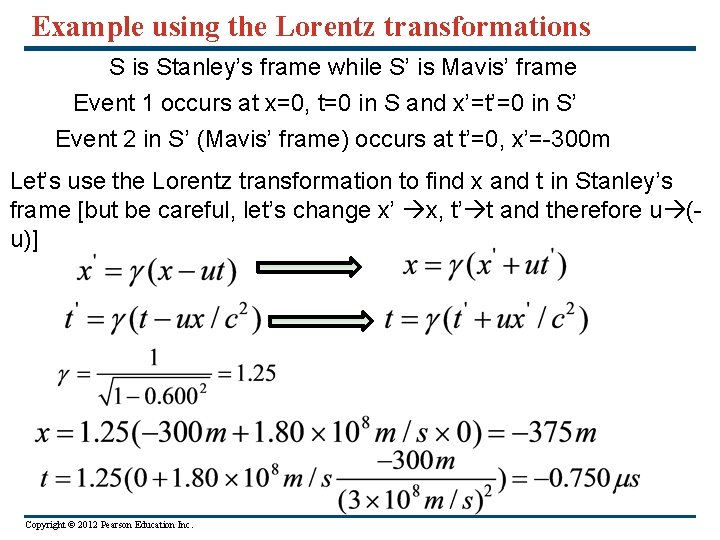
Example using the Lorentz transformations S is Stanley’s frame while S’ is Mavis’ frame Event 1 occurs at x=0, t=0 in S and x’=t’=0 in S’ Event 2 in S’ (Mavis’ frame) occurs at t’=0, x’=-300 m Let’s use the Lorentz transformation to find x and t in Stanley’s frame [but be careful, let’s change x’ x, t’ t and therefore u (u)] Copyright © 2012 Pearson Education Inc.
Relativistic addition of velocities (take differentials) Copyright © 2012 Pearson Education Inc.
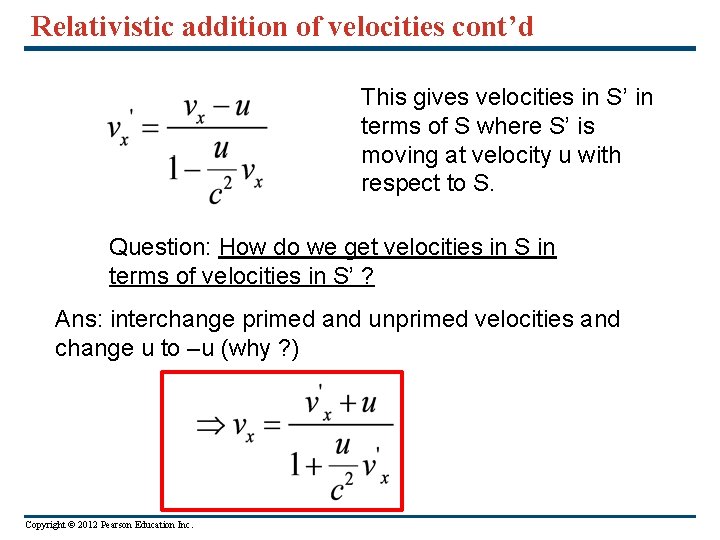
Relativistic addition of velocities cont’d This gives velocities in S’ in terms of S where S’ is moving at velocity u with respect to S. Question: How do we get velocities in S in terms of velocities in S’ ? Ans: interchange primed and unprimed velocities and change u to –u (why ? ) Copyright © 2012 Pearson Education Inc.
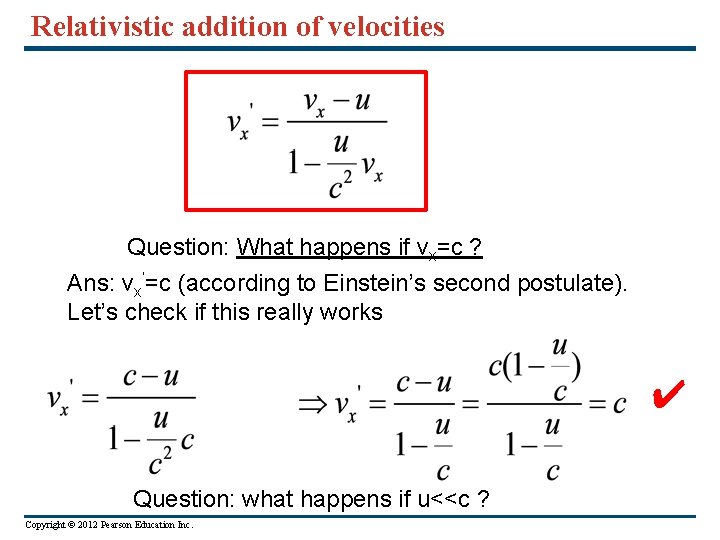
Relativistic addition of velocities Question: What happens if vx=c ? Ans: vx’=c (according to Einstein’s second postulate). Let’s check if this really works ✔ Question: what happens if u<<c ? Copyright © 2012 Pearson Education Inc.