
English SA 2 Revision 1 SubjectVerbAgreement Ensure the

English SA 2 Revision
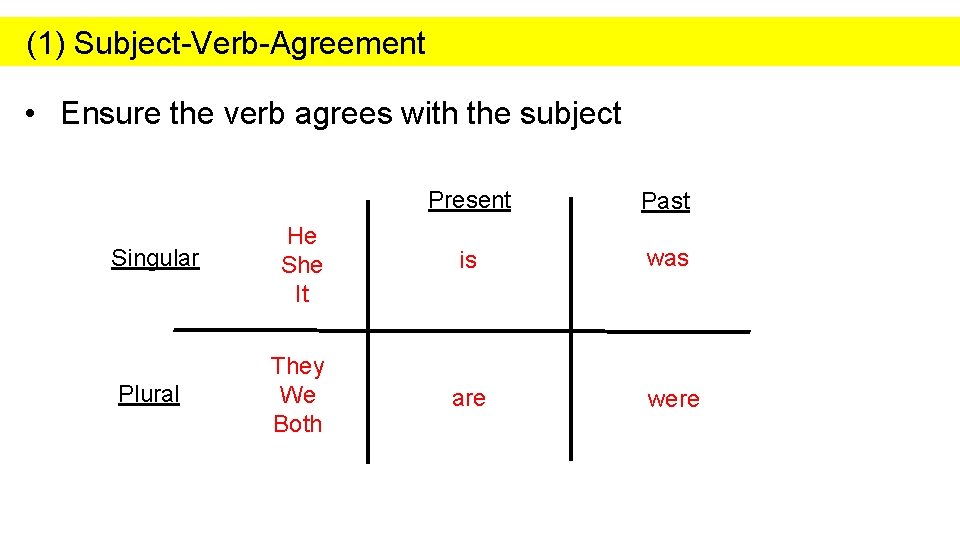
(1) Subject-Verb-Agreement • Ensure the verb agrees with the subject Present Past Singular He She It is was Plural They We Both are were
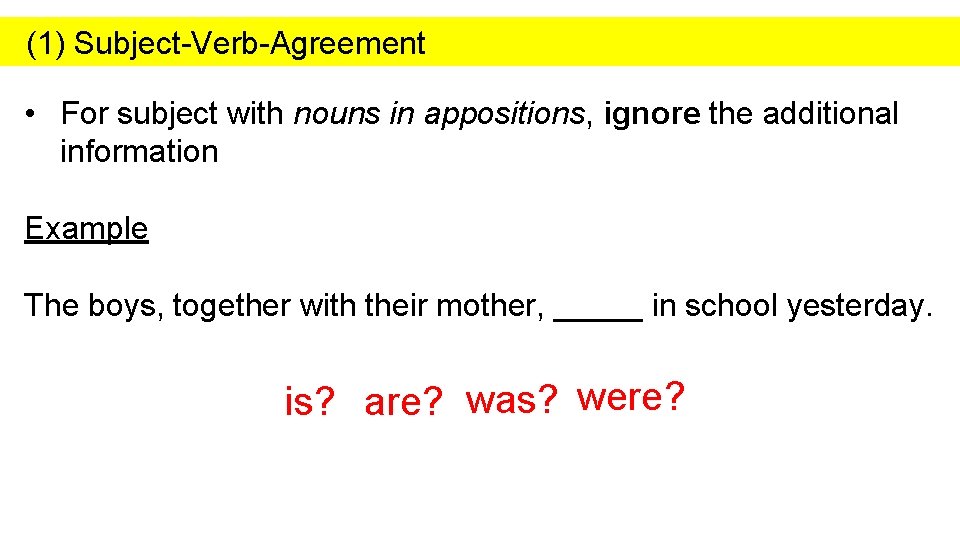
(1) Subject-Verb-Agreement • For subject with nouns in appositions, ignore the additional information Example The boys, together with their mother, _____ in school yesterday. is? are? was? were?
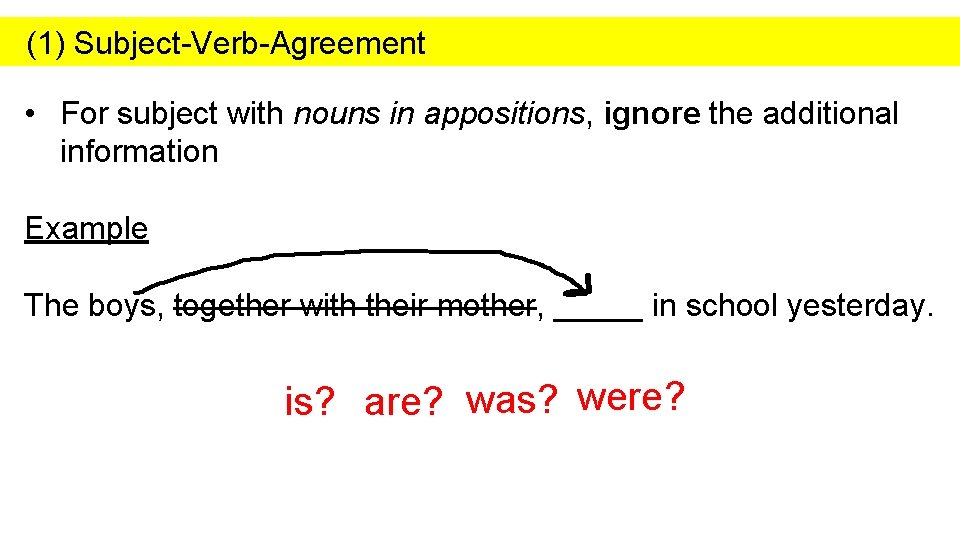
(1) Subject-Verb-Agreement • For subject with nouns in appositions, ignore the additional information Example The boys, together with their mother, _____ in school yesterday. is? are? was? were?
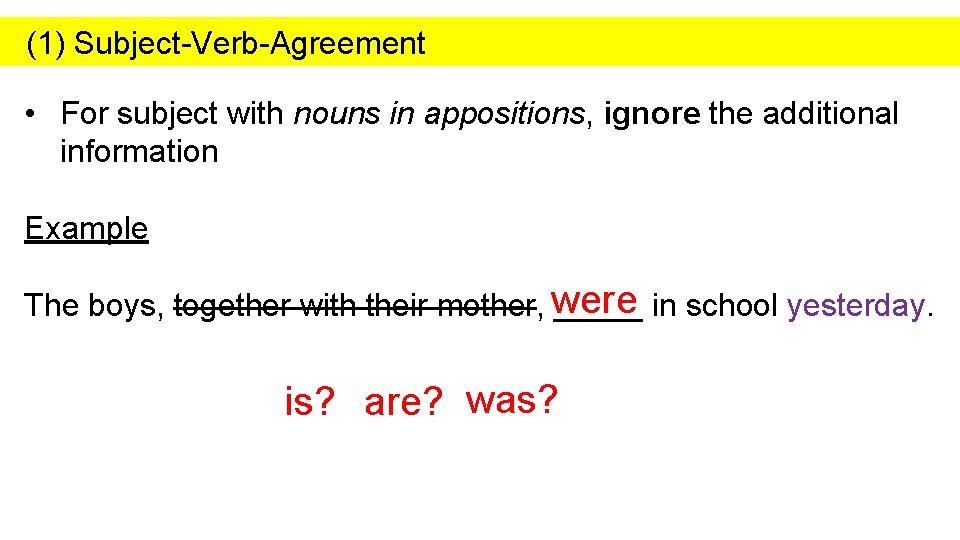
(1) Subject-Verb-Agreement • For subject with nouns in appositions, ignore the additional information Example The boys, together with their mother, were _____ in school yesterday. is? are? was?
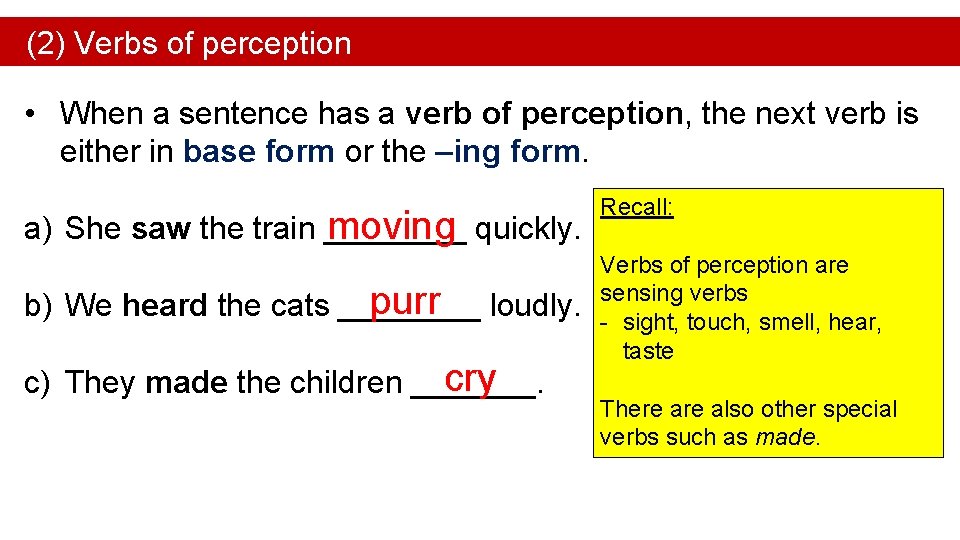
(2) Verbs of perception • When a sentence has a verb of perception, the next verb is either in base form or the –ing form. a) She saw the train ____ moving quickly. purr loudly. b) We heard the cats ____ cry c) They made the children _______. Recall: Verbs of perception are sensing verbs - sight, touch, smell, hear, taste There also other special verbs such as made.
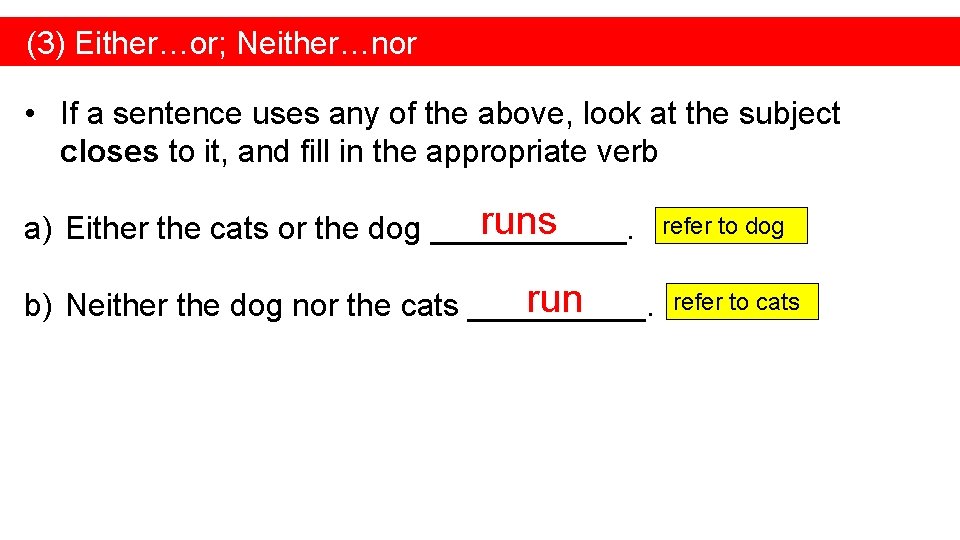
(3) Either…or; Neither…nor • If a sentence uses any of the above, look at the subject closes to it, and fill in the appropriate verb runs a) Either the cats or the dog ______. run b) Neither the dog nor the cats _____. refer to dog refer to cats
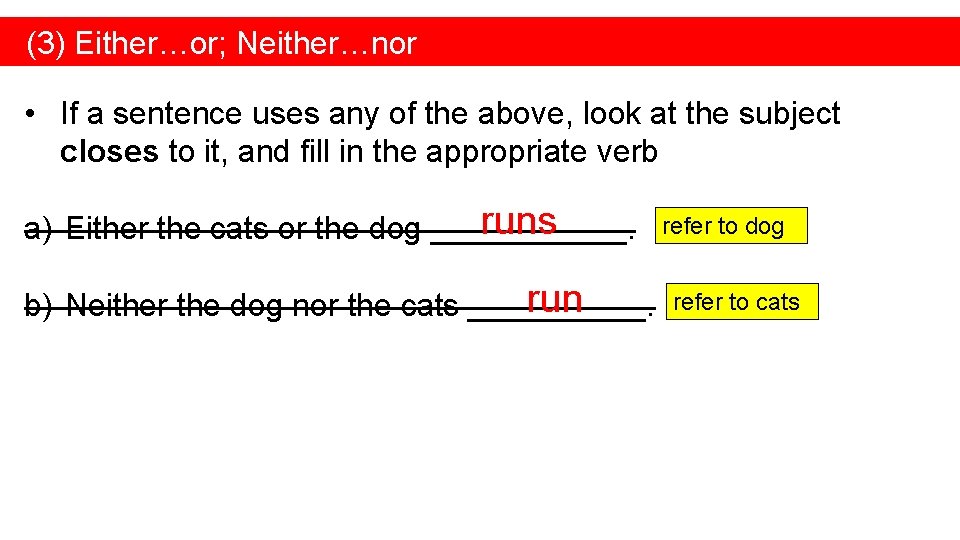
(3) Either…or; Neither…nor • If a sentence uses any of the above, look at the subject closes to it, and fill in the appropriate verb runs a) Either the cats or the dog ______. run b) Neither the dog nor the cats _____. refer to dog refer to cats
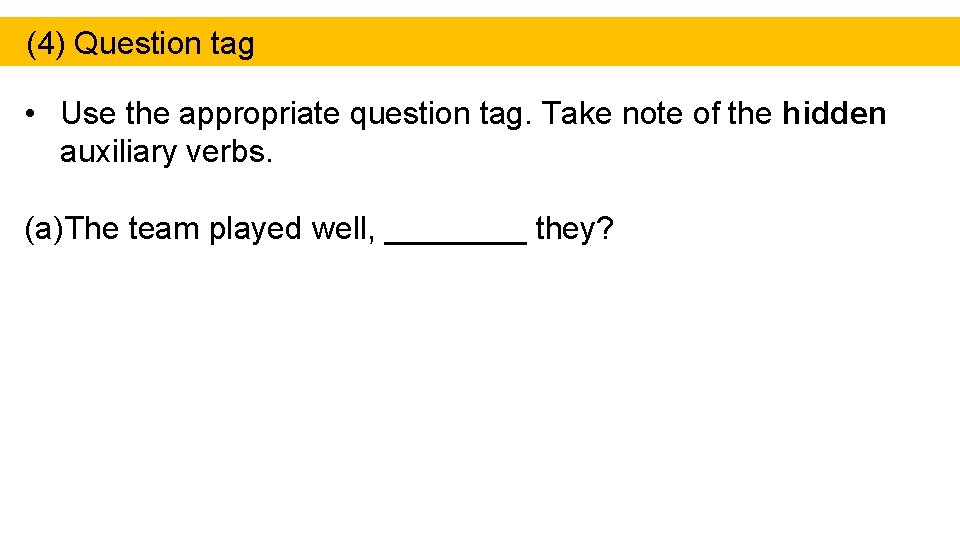
(4) Question tag • Use the appropriate question tag. Take note of the hidden auxiliary verbs. (a)The team played well, ____ they?
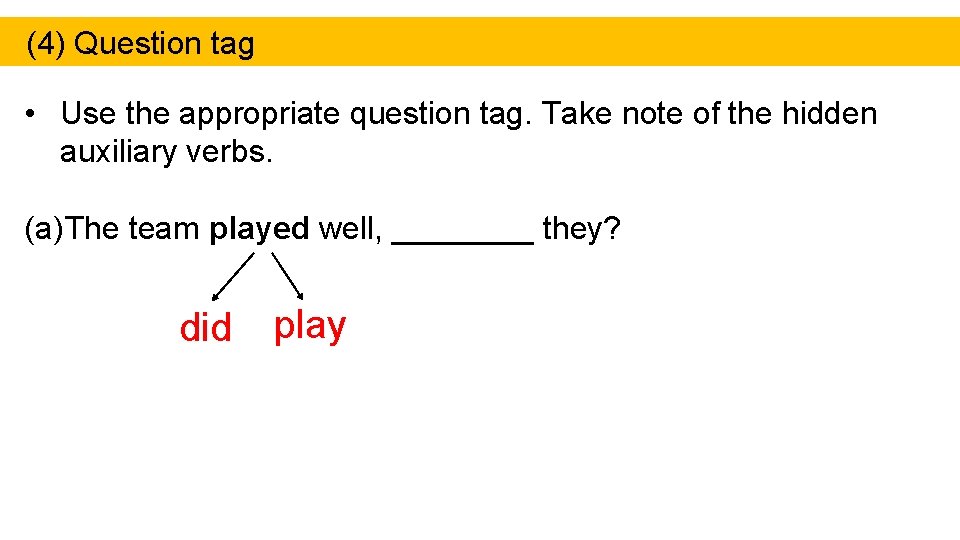
(4) Question tag • Use the appropriate question tag. Take note of the hidden auxiliary verbs. (a)The team played well, ____ they? did play
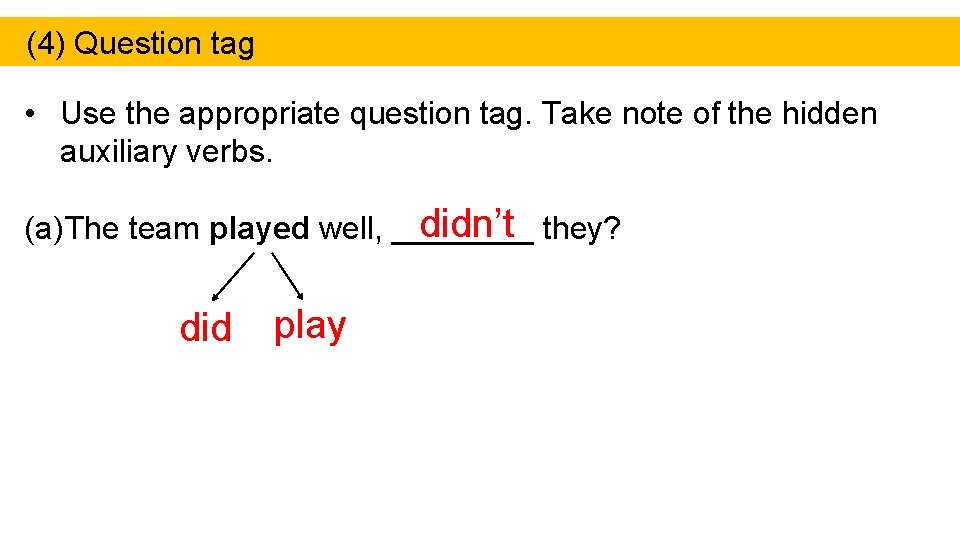
(4) Question tag • Use the appropriate question tag. Take note of the hidden auxiliary verbs. didn’t they? (a)The team played well, ____ did play
(5) Vocabulary and Vocabulary Cloze • Select the MOST appropriate word to fill in each blank • All options might have similar meaning but only ONE is suitable • If you are not sure, eliminate one by one
(6) Visual Text • Read analyse the visual text carefully • When answering the questions, think of the following: What is the person who made the poster/flyer trying to tell the audience? What is the purpose of this poster/flyer? If I were to see this poster/flyer, would I be interested to take part/attend/sign up? • Answer the questions by eliminating the options one by one
(7) Grammar Cloze • Read the cloze passage once fully! • Fill in the appropriate words. Check again before moving on to the next question • Ensure that you only use the word ONCE • Read the passage AGAIN after you have filled in the words.
(8) Editing • DO NOT fix the spelling of words that are already correct. They are most probably grammatical errors. • DO NOT change the tenses of the words if it is a spelling error: Example disabliteis disabilities (and not disabled; disability)
(9) Comprehension Cloze • Read the text first to get an idea of what it is about • Fill in the blanks with suitable word. ONE word in ONE blank • Use the strategies we have learnt: Forward referencing Backward referencing Synonym/Antonym
(10) Synthesis and Transformation • Do not change the meaning of the sentence. • Do not break up the sentence. The answer MUST be in one complete sentence • For reported speech, change the four where necessary: Pronoun, Verb, Position, Adverbial of time
(11) Comprehension OE • Read the text fully to understand the story • Read the questions • Read the text again to identify the main points and to fit in some of the answers into the questions • Underline the important points in the story • Annotate the main idea/topic sentence in each paragraph
(11) Comprehension OE • For vocabulary/sentence questions, make sure the word or sentence is copied ACCURATELY • Answer in full sentence (with full stop) • You will need to INFER…a lot. Use your thinking skills • You are not allowed to LIFT the answer directly. Change a few words (especially pronouns from I to he/she)
(11) Comprehension OE • When you sequence and order the sentences according to the story, take note that you order them based on the “story flow” and not whether it comes first in the text • Do not answer questions with “It is because” or “Because”
(11) Comprehension OE Example Why did the cat run away? a) It is because the cat was hungry. b) Because the cat was hungry. c) The cat was hungry.
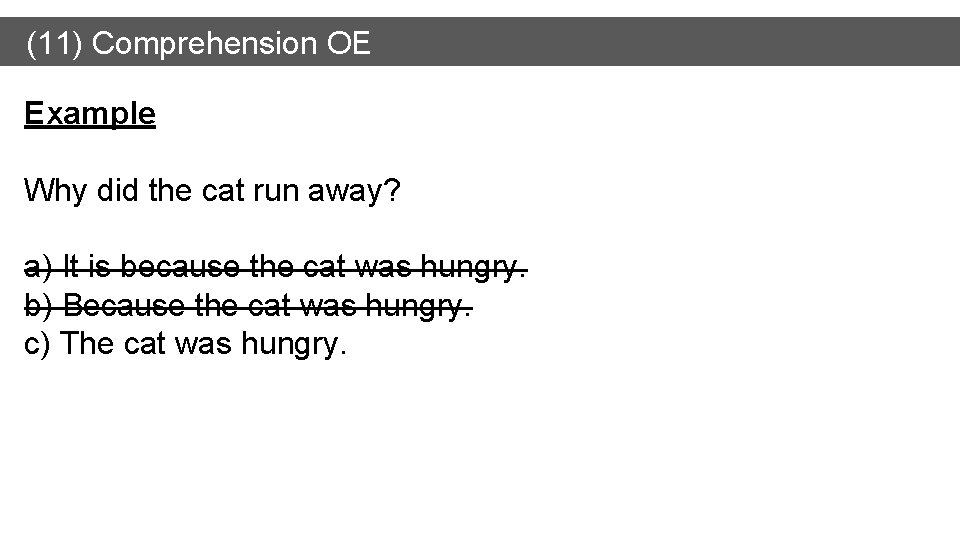
(11) Comprehension OE Example Why did the cat run away? a) It is because the cat was hungry. b) Because the cat was hungry. c) The cat was hungry.
FINALLY… 1) Do not waste time on questions you do not know how to do. Come back to it later. 2) Spend your time wisely. 3) CHECK, CHECK and CHECK!

- Slides: 24