
English Political Revolution WEEK 6 II The Restoration
- Slides: 13
English Political Revolution WEEK 6
II. The Restoration and the Glorious Revolution The Restoration settlement l Political Settlement l Religious settlement l Financial settlement A. B. The Glorious Revolution C. The Hanoverian regime
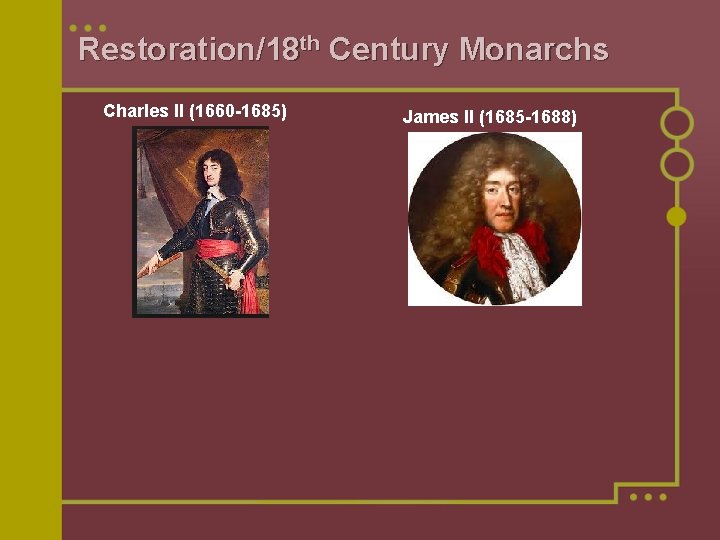
Restoration/18 th Century Monarchs Charles II (1660 -1685) James II (1685 -1688)
Charles II (1660 -1685) l Nicknamed “the Merry Monarch” because he restored theatres (comedies favored), sporting events, dancing, merrymaking in the country. l He had the body of Oliver Cromwell disinterred, hanged, and beheaded in 1661. l He was received into the Roman Catholic church just before his death
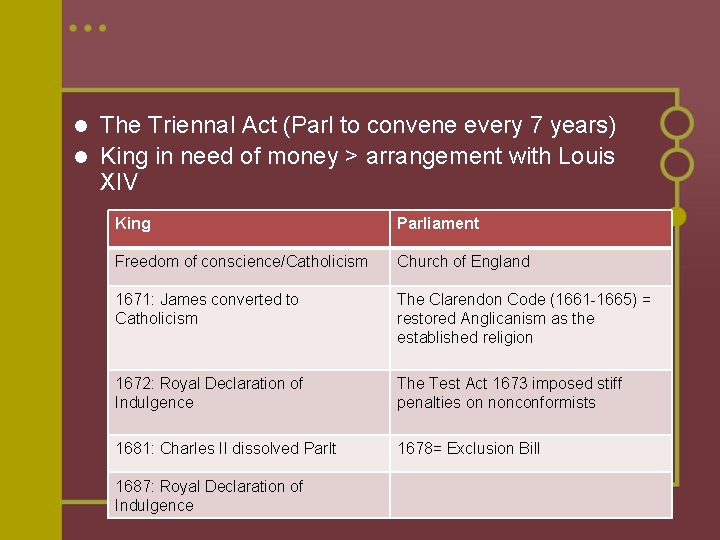
The Triennal Act (Parl to convene every 7 years) l King in need of money > arrangement with Louis XIV l King Parliament Freedom of conscience/Catholicism Church of England 1671: James converted to Catholicism The Clarendon Code (1661 -1665) = restored Anglicanism as the established religion 1672: Royal Declaration of Indulgence The Test Act 1673 imposed stiff penalties on nonconformists 1681: Charles II dissolved Parlt 1678= Exclusion Bill 1687: Royal Declaration of Indulgence
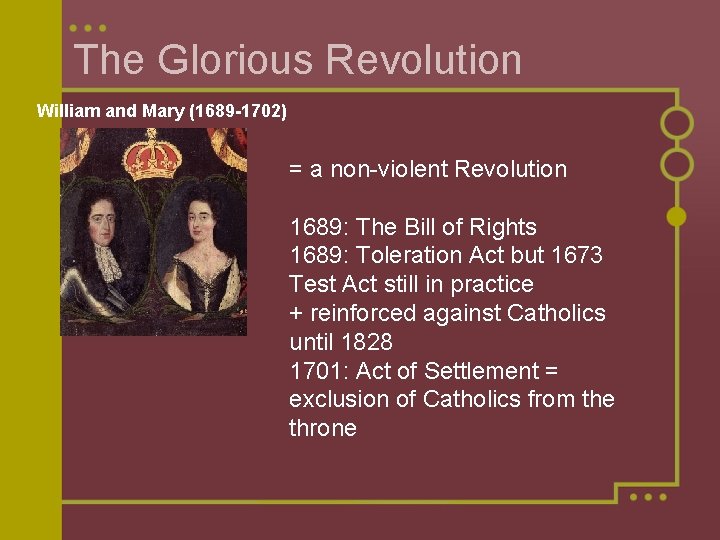
The Glorious Revolution William and Mary (1689 -1702) = a non-violent Revolution 1689: The Bill of Rights 1689: Toleration Act but 1673 Test Act still in practice + reinforced against Catholics until 1828 1701: Act of Settlement = exclusion of Catholics from the throne
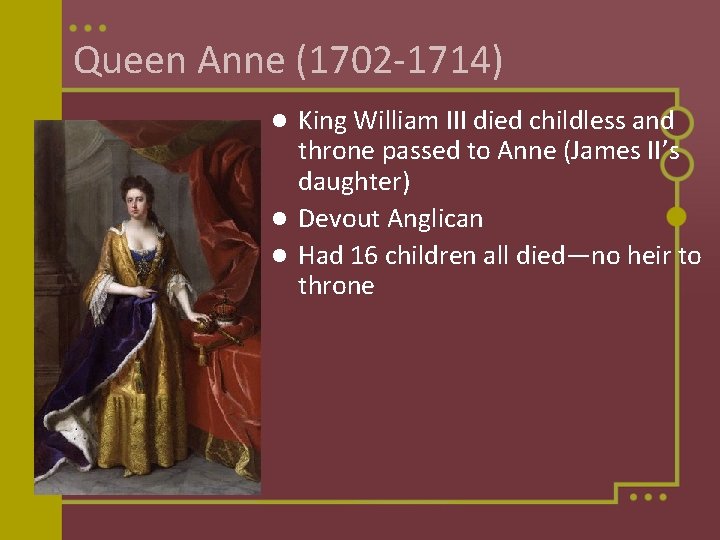
Queen Anne (1702 -1714) King William III died childless and throne passed to Anne (James II’s daughter) l Devout Anglican l Had 16 children all died—no heir to throne l
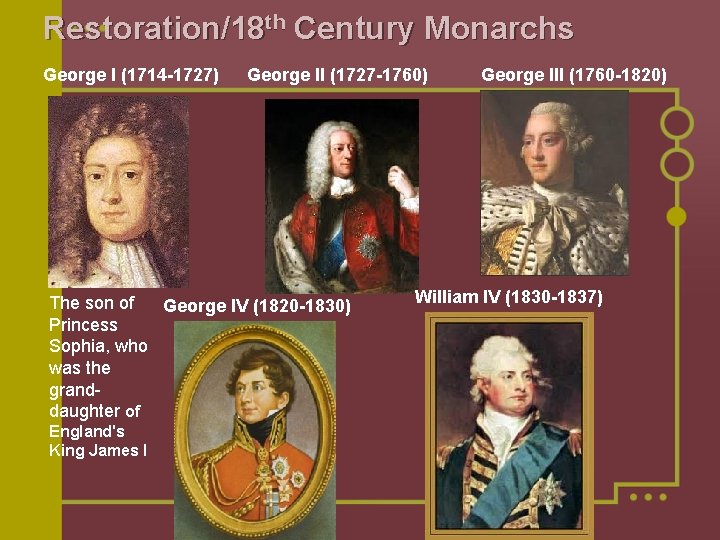
Restoration/18 th Century Monarchs George I (1714 -1727) George II (1727 -1760) The son of George IV (1820 -1830) Princess Sophia, who was the granddaughter of England's King James I George III (1760 -1820) William IV (1830 -1837)
The heritage of the Glorious Revolution l Parliamentary sovereignty l A constitutional monarchy l Crown-in-Parliament (dual sovereignty) l New party politics whigs/tories l Emergence of the Prime Minister l Cabinet system of Government
Whigs Tories Both relatively conservative & upper-class bias, anti-Catholic at times l l l l Opposition to absolutism parliament Power residing in people Gentry Career politicians Non-Anglicans (dissenters) Expansion of suffrage, industrialists and urban dwellers Evolved into Liberal Party Robert Walpole first PM Supported the monarchy (the Stuarts) = Jacobites l Established Church l Associated with “old” landowning gentry against ‘new money’/Workers against industrialists supported status quo & privileges & exclusions l Evolved into Conservative Party l
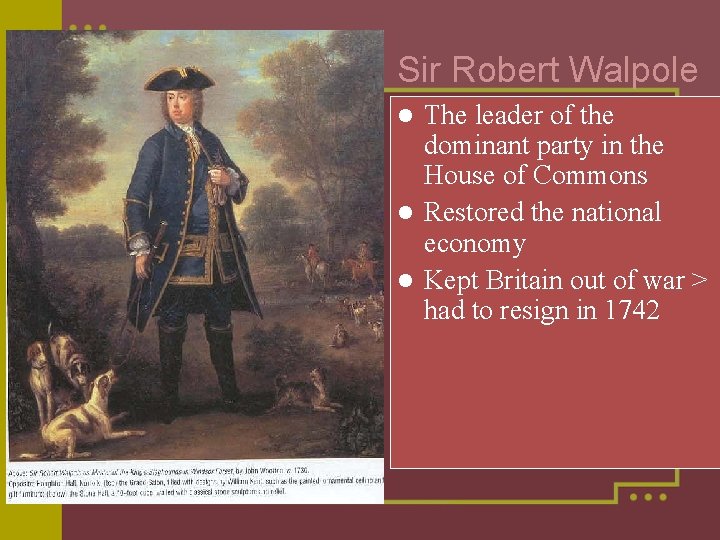
Sir Robert Walpole The leader of the dominant party in the House of Commons l Restored the national economy l Kept Britain out of war > had to resign in 1742 l
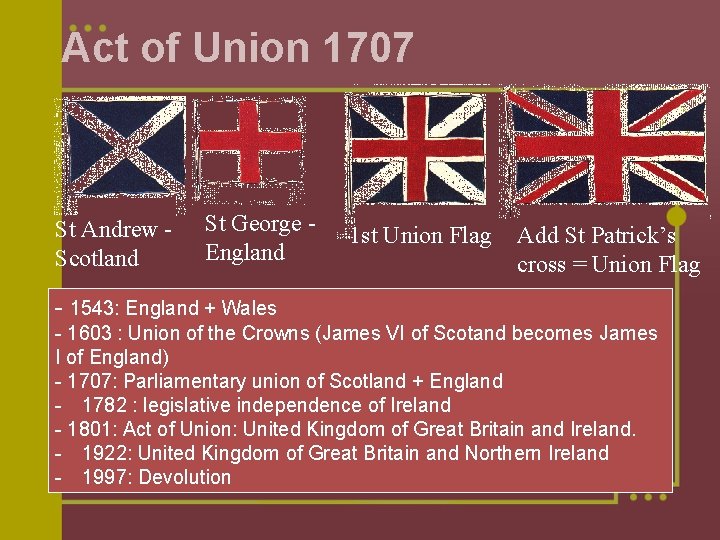
Act of Union 1707 St Andrew Scotland St George England 1 st Union Flag Add St Patrick’s cross = Union Flag - 1543: England + Wales - 1603 : Union of the Crowns (James VI of Scotand becomes James I of England) - 1707: Parliamentary union of Scotland + England - 1782 : legislative independence of Ireland - 1801: Act of Union: United Kingdom of Great Britain and Ireland. - 1922: United Kingdom of Great Britain and Northern Ireland - 1997: Devolution
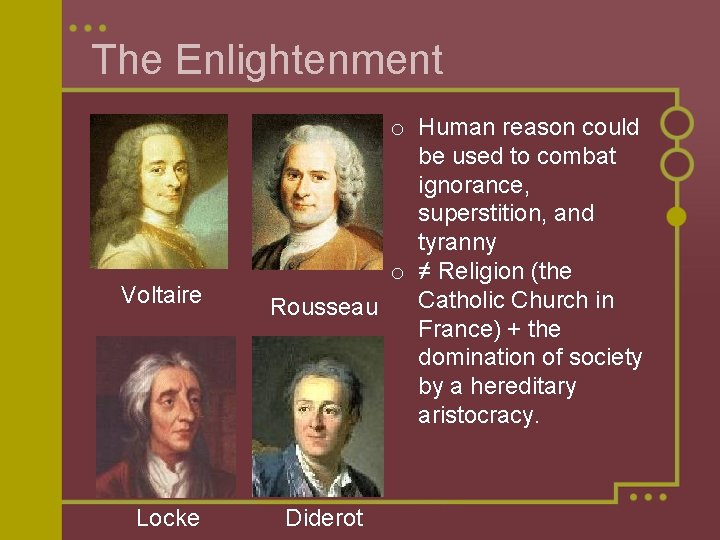
The Enlightenment Voltaire Locke o Human reason could be used to combat ignorance, superstition, and tyranny o ≠ Religion (the Catholic Church in Rousseau France) + the domination of society by a hereditary aristocracy. Diderot