
English Modal Verbs Section One Basic Information about
English Modal Verbs ?
Section One Basic Information about Modal Verbs Section Two Simple Modal Verbs Section Three Past forms of Modal Verbs and their functions Section Four Compound Modal Verbs and their functions
What are Modal Verbs ? l Modal verbs are special verbs which behave very differently from normal verbs. Here are some important differences:
1. Modal verbs do not take "-s" in the third person. l EXAMPLES: He can speak Russian. She should go now. My wife may join us for the dinner.
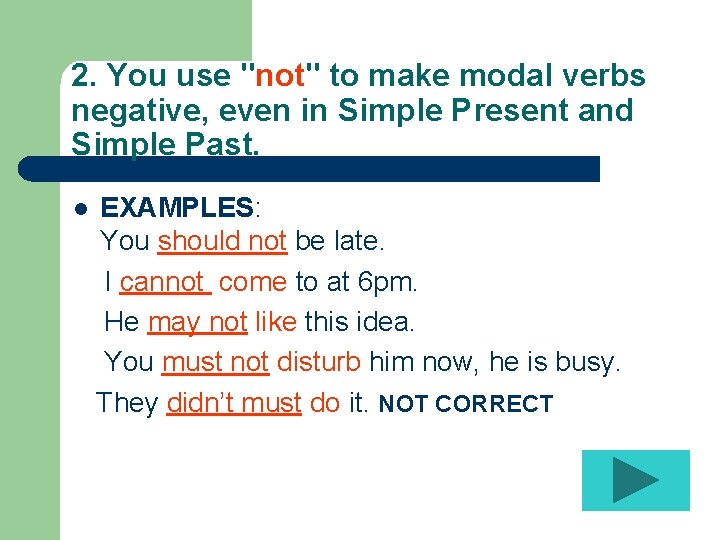
2. You use "not" to make modal verbs negative, even in Simple Present and Simple Past. l EXAMPLES: You should not be late. I cannot come to at 6 pm. He may not like this idea. You must not disturb him now, he is busy. They didn’t must do it. NOT CORRECT
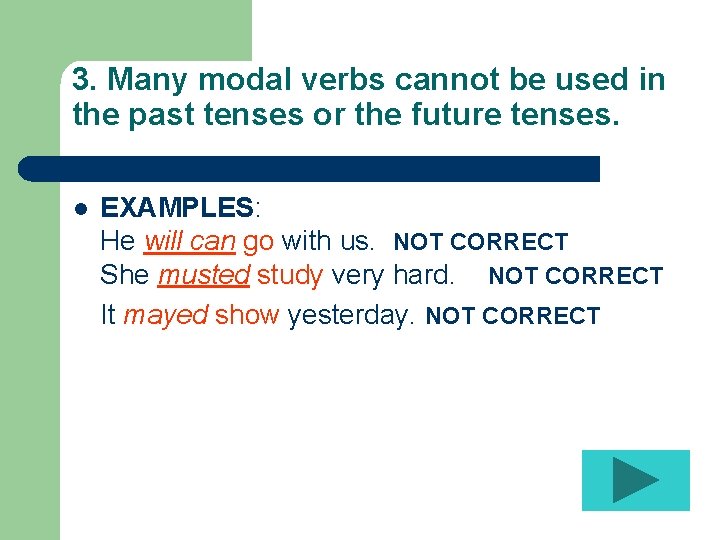
3. Many modal verbs cannot be used in the past tenses or the future tenses. l EXAMPLES: He will can go with us. NOT CORRECT She musted study very hard. NOT CORRECT It mayed show yesterday. NOT CORRECT
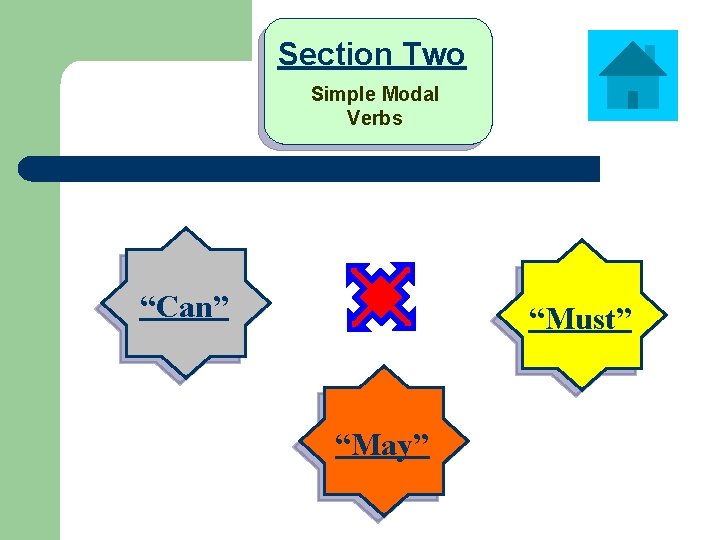
Section Two Simple Modal Verbs “Can” “Must” “May”
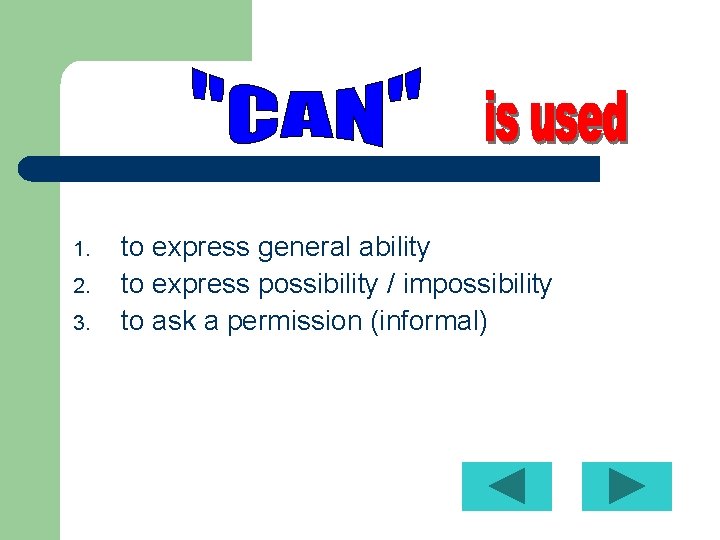
1. 2. 3. to express general ability to express possibility / impossibility to ask a permission (informal)
EXAMPLES: l l l I can sing and play the guitar. Anyone can learn how to use Computers if they want to. Can you help me to fix my door? Back to section two
1. 2. 3. to express possibility to ask or to give a permission (formal) to make requests
EXAMPLES: l l l He may come late today. You may use my Computer now. May I make a phone call? Back to section two
1. 2. 3. to express certainty to express necessity to make a strong recommendation
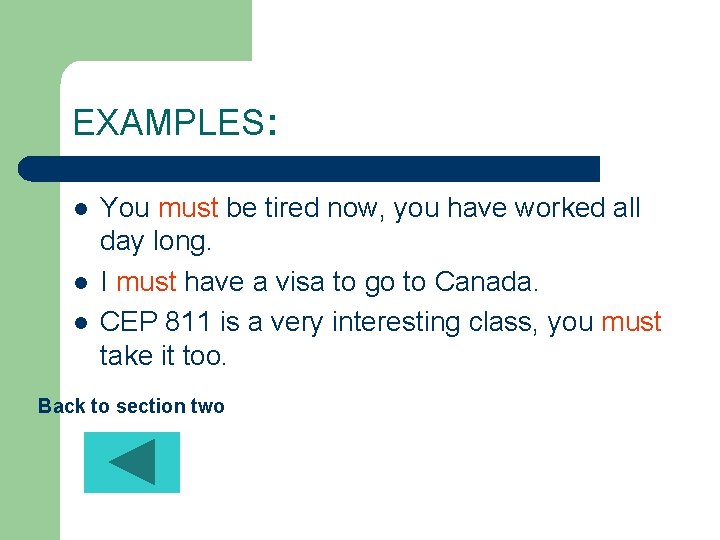
EXAMPLES: l l l You must be tired now, you have worked all day long. I must have a visa to go to Canada. CEP 811 is a very interesting class, you must take it too. Back to section two
Section Three Past forms of Modal Verbs and their functions “Could” “Would” “Might” “Should/ Ought To”
1. 2. 3. 4. to express general ability in the past, because it is the past form of the “Can” to express possible future actions similar to “May and Might” in meaning to make a request or ask something to express unreal or impossible actions
EXAMPLES: l l l We tried hard but we could not persuade them to come with us. My grandfather could not swim. When you go to Uzbekistan, you could stay with me. Could you tell me what time it is? I don’t know how she works 14 hours a day in front of the computer, I could not do this. Back to section three Take the test #1 Take the test #2
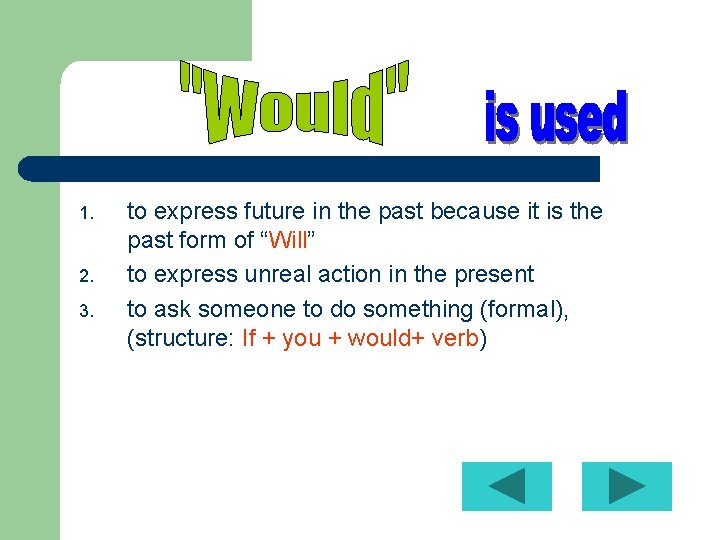
1. 2. 3. to express future in the past because it is the past form of “Will” to express unreal action in the present to ask someone to do something (formal), (structure: If + you + would+ verb)
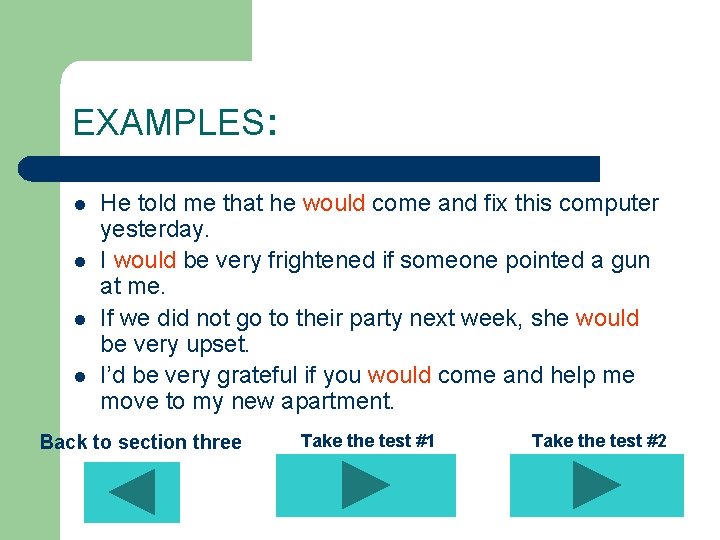
EXAMPLES: l l He told me that he would come and fix this computer yesterday. I would be very frightened if someone pointed a gun at me. If we did not go to their party next week, she would be very upset. I’d be very grateful if you would come and help me move to my new apartment. Back to section three Take the test #1 Take the test #2
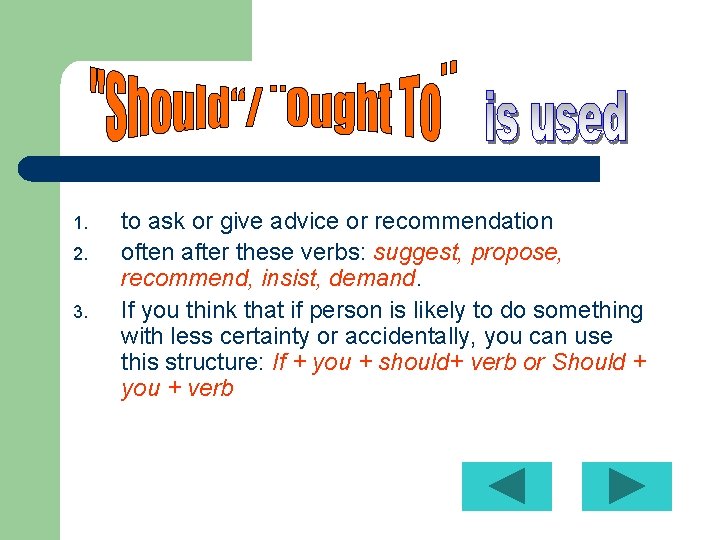
1. 2. 3. to ask or give advice or recommendation often after these verbs: suggest, propose, recommend, insist, demand. If you think that if person is likely to do something with less certainty or accidentally, you can use this structure: If + you + should+ verb or Should + you + verb
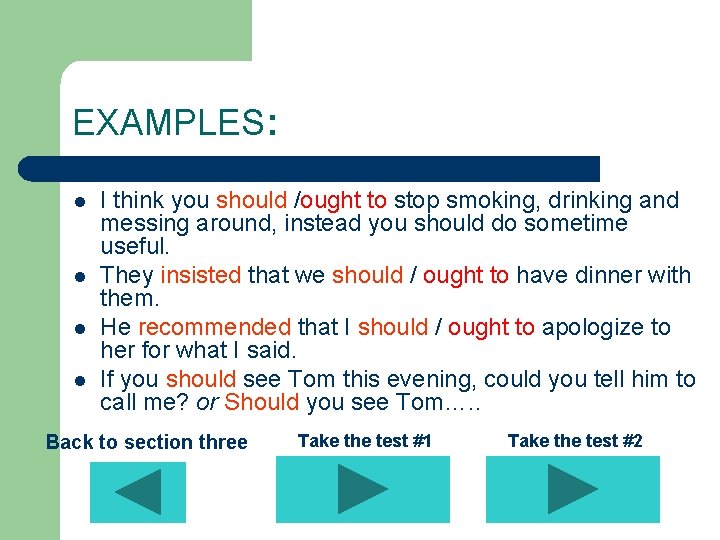
EXAMPLES: l l I think you should /ought to stop smoking, drinking and messing around, instead you should do sometime useful. They insisted that we should / ought to have dinner with them. He recommended that I should / ought to apologize to her for what I said. If you should see Tom this evening, could you tell him to call me? or Should you see Tom…. . Back to section three Take the test #1 Take the test #2
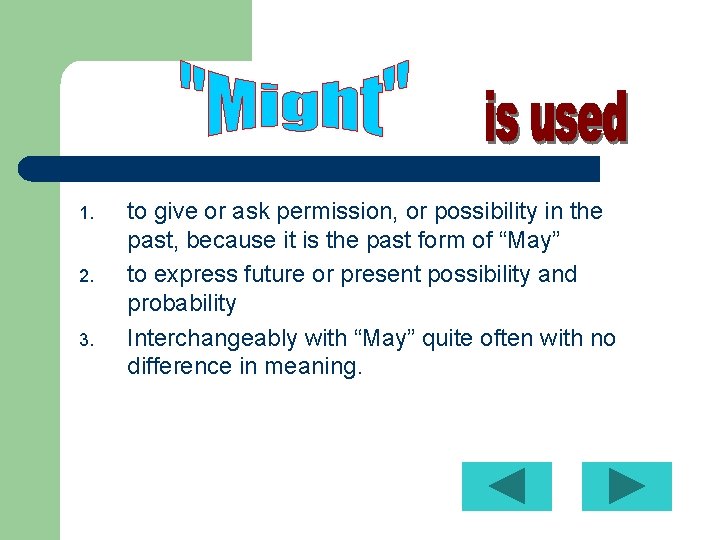
1. 2. 3. to give or ask permission, or possibility in the past, because it is the past form of “May” to express future or present possibility and probability Interchangeably with “May” quite often with no difference in meaning.
EXAMPLES: l l l She told that he might come in and use her stove. He might be having lunch now. It might rain tomorrow. There may/might not be a meeting tonight, because the director is ill. I may/might go to Italy this summer. Back to section three
Section Four Compound Modal Verbs and their functions Modal Verbs + Perfectives? Quit Continue
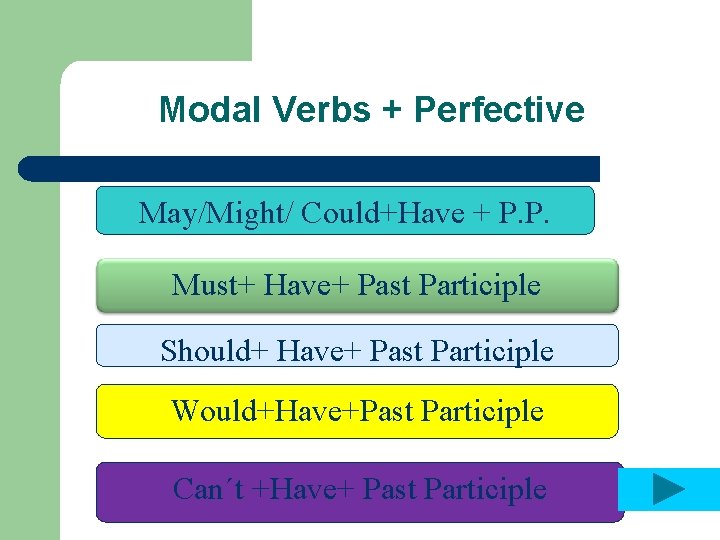
Modal Verbs + Perfective May/Might/ Could+Have + P. P. Must+ Have+ Past Participle Should+ Have+ Past Participle Would+Have+Past Participle Can´t +Have+ Past Participle
Modal Verbs+ Perfective Could+ Have+Past Participle
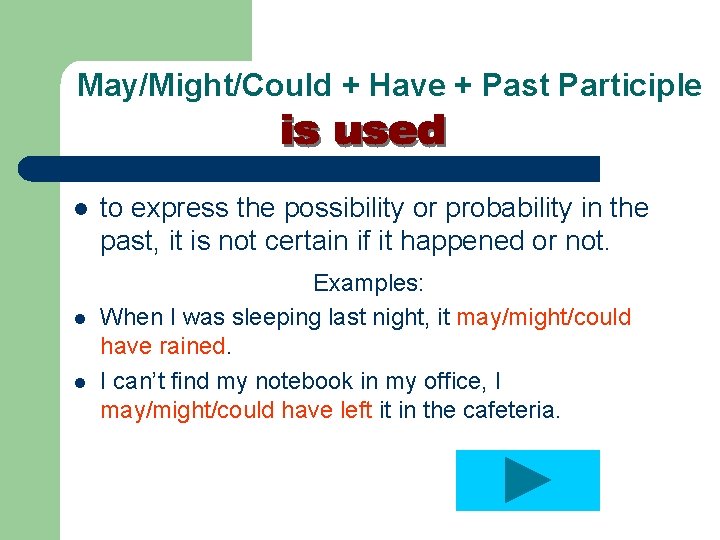
May/Might/Could + Have + Past Participle l l l to express the possibility or probability in the past, it is not certain if it happened or not. Examples: When I was sleeping last night, it may/might/could have rained. I can’t find my notebook in my office, I may/might/could have left it in the cafeteria.
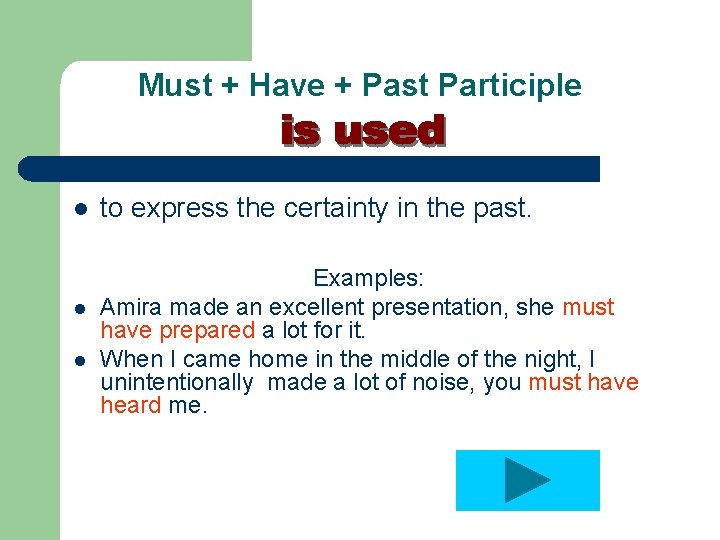
Must + Have + Past Participle l l l to express the certainty in the past. Examples: Amira made an excellent presentation, she must have prepared a lot for it. When I came home in the middle of the night, I unintentionally made a lot of noise, you must have heard me.
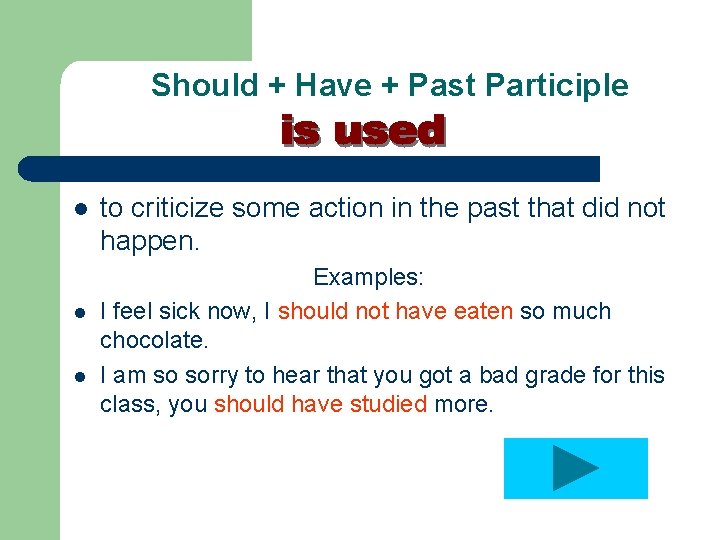
Should + Have + Past Participle l l l to criticize some action in the past that did not happen. Examples: I feel sick now, I should not have eaten so much chocolate. I am so sorry to hear that you got a bad grade for this class, you should have studied more.
Would + Have + Past Participle l l l to talk about unreal situations in the past, usually in If sentences. Examples: Why didn’t you call me? I would have come and helped you, and you wouldn’t have received this bill. If I had known that you were in Washington DC, I would have made arrangements to see you.
Could+ Have+ Past Participle is used l To talk about an alternative past action. Examples: I could have called you but I didn’t have time. She could have done the exercise but she didn’t feel like it.
Can’t+ Have+ Past Partciple is used l To talk about an impossible situation in the past (impossibility in the past). Examples: It can’t have been Peter because he is not in London. They can’t have called since they don’t know our phone number.
- Slides: 31