
English Literature Component 2 Section B Silas Marner
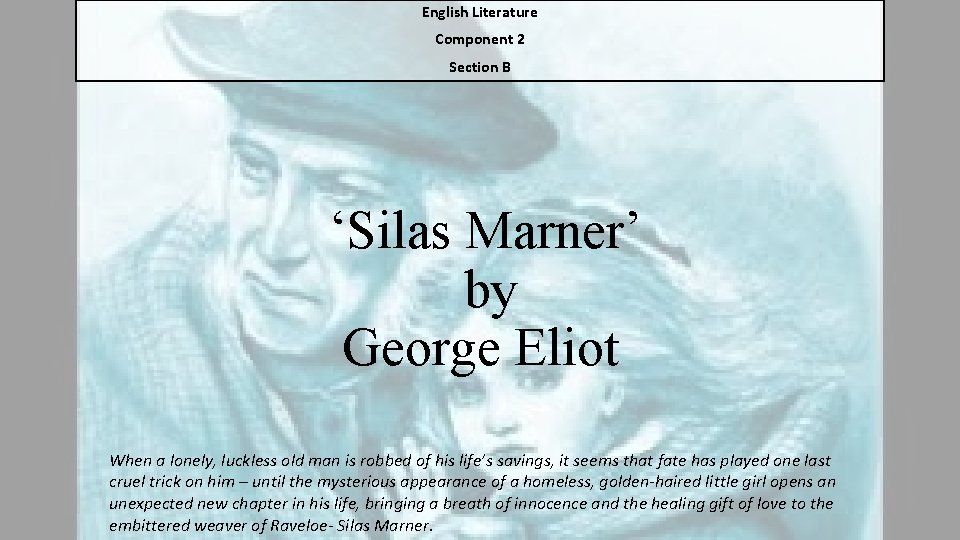
English Literature Component 2 Section B ‘Silas Marner’ by George Eliot When a lonely, luckless old man is robbed of his life’s savings, it seems that fate has played one last cruel trick on him – until the mysterious appearance of a homeless, golden-haired little girl opens an unexpected new chapter in his life, bringing a breath of innocence and the healing gift of love to the embittered weaver of Raveloe- Silas Marner.
Engage Chapters Two
https: //year 11 misscandiano. wordpress. com Learning objectives To FOCUS on the events and characters in the novel. To RECORD what we learn about Silas Marner in Chapter Two and analyse how he is presented through Elliot’s use of language.

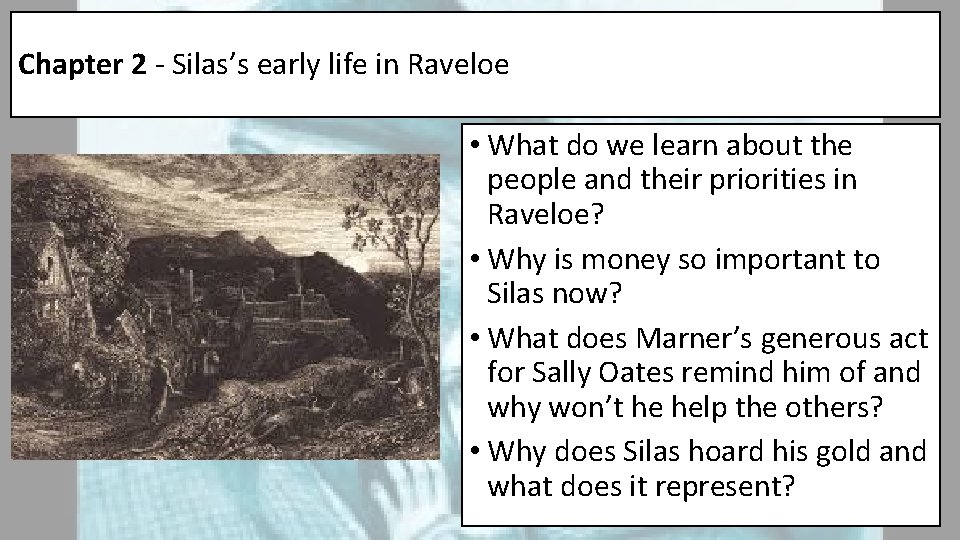
Chapter 2 - Silas’s early life in Raveloe • What do we learn about the people and their priorities in Raveloe? • Why is money so important to Silas now? • What does Marner’s generous act for Sally Oates remind him of and why won’t he help the others? • Why does Silas hoard his gold and what does it represent?
1. Why are weavers typically objects of suspicion in Silas’s day? (A) They are seen as doing womanly work (B) They are rootless and have specialized knowledge (C) They wear only linen clothing (D) They have bad eyesight
How does Silas know about herbal medicine? (A) His mother taught him (B) It was part of the training from his religious sect in Lantern Yard (C) He has read up on the topic (D) He doesn’t, he only pretends to
3. What is dropsy? (A) A part of a loom (B) A traditional British breakfast drink (C) The name of Silas’s pet bunny rabbit (D) A disease that causes abnormal swelling in the body
4. Why doesn’t Silas protest his innocence when he is framed for theft? (A) He is not allowed to speak (B) He is having a cataleptic fit at the time (C) He believes God will clear him (D) He believes he actually did steal the money while having a cataleptic fit
5. During the period in his life when all he does is work and hoard money, Silas is likened to: (A) A spider (B) A narrow, nearly dried-up rivulet (C) A handle or crooked tube (D) All of the above
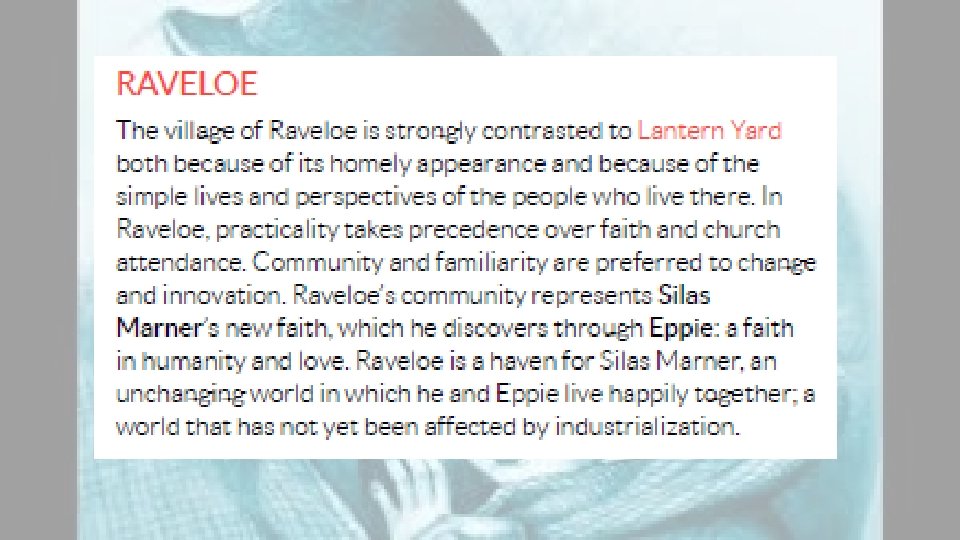
Look at the underlined words and phrases. How do they affect our ideas about raveloe? • And what could be more unlike that Lantern Yard world than the world in Raveloe? —orchards looking lazy with neglected plenty; the large church in the wide churchyard, which men gazed at lounging at their own doors in service-time; the purple-faced farmers jogging along the lanes or turning in at the Rainbow; homesteads, where men supped heavily and slept in the light of the evening hearth, and where women seemed to be laying up a stock of linen for the life to come. There were no lips in Raveloe from which a word could fall that would stir Silas Marner's benumbed faith to a sense of pain. In the early ages of the world, we know, it was believed that each territory was inhabited and ruled by its own divinities, so that a man could cross the bordering heights and be out of the reach of his native gods, whose presence was confined to the streams and the groves and the hills among which he had lived from his birth. And poor Silas was vaguely conscious of something not unlike the feeling of primitive men, when they fled thus, in fear or in sullenness, from the face of an unpropitious deity. It seemed to him that the Power he had vainly trusted in among the streets and at the prayer-meetings, was very far away from this land in which he had taken refuge, where men lived in careless abundance, knowing and needing nothing of that trust, which, for him, had been turned to bitterness. The little light he possessed spread its beams so narrowly, that frustrated belief was a curtain broad enough to create for him the blackness of night.
Language focus Simile VS. metaphor • He seemed to weave, like the spider, from pure impulse, without reflection. Every man's work, pursued steadily, tends in this way to become an end in itself, and so to bridge over the loveless chasms of his life.
How has marner been physically affected? What might this suggest about the impact on him mentally and physically? • Strangely Marner's face and figure shrank and bent themselves into a constant mechanical relation to the objects of his life, so that he produced the same sort of impression as a handle or a crooked tube, which has no meaning standing apart. The prominent eyes that used to look trusting and dreamy, now looked as if they had been made to see only one kind of thing that was very small, like tiny grain, for which they hunted everywhere: and he was so withered and yellow, that, though he was not yet forty, the children always called him "Old Master Marner".
Language focus Choose one of the underlined words or phrases and explain its effect. • How the guineas shone as they came pouring out of the dark leather mouths! The silver bore no large proportion in amount to the gold, because the long pieces of linen which formed his chief work were always partly paid for in gold, and out of the silver he supplied his own bodily wants, choosing always the shillings and sixpences to spend in this way. He loved the guineas best, but he would not change the silver—the crowns and half-crowns that were his own earnings, begotten by his labour; he loved them all. He spread them out in heaps and bathed his hands in them; then he counted them and set them up in regular piles, and felt their rounded outline between his thumb and fingers, and thought fondly of the guineas that were only half-earned by the work in his loom, as if they had been unborn children—thought of the guineas that were coming slowly through the coming years, through all his life, which spread far away before him, the end quite hidden by countless days of weaving.
Why does Silas help sally? What does the modal verb ‘might’ suggest about the actual effect of his ‘charity’? • He felt a rush of pity at the mingled sight and remembrance, and, recalling the relief his mother had found from a simple preparation of foxglove, he promised Sally Oates to bring her something that would ease her, since the doctor did her no good. In this office of charity, Silas felt, for the first time since he had come to Raveloe, a sense of unity between his past and present life, which might have been the beginning of his rescue from the insect-like existence into which his nature had shrunk
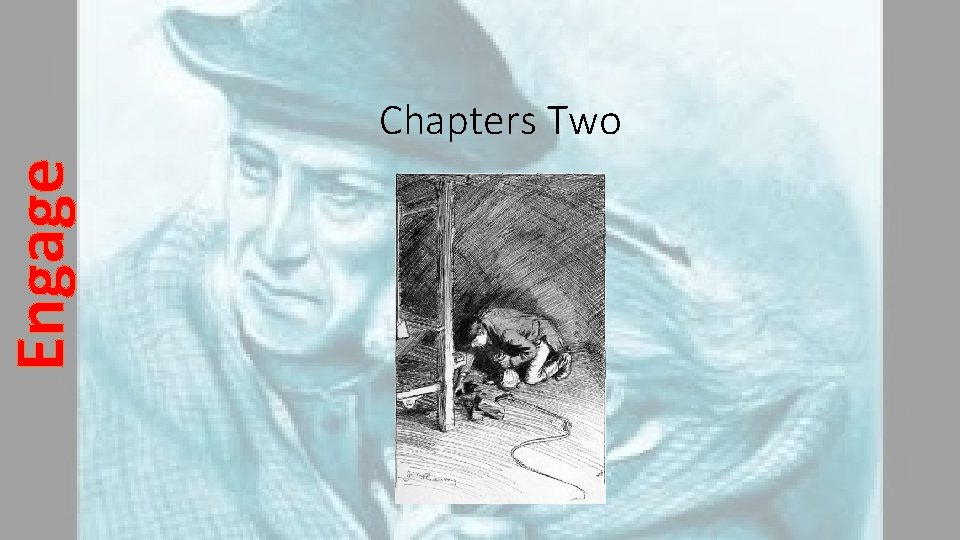
Independent ten: how does eliot present silas’s growing attachment to his gold? • Gradually the guineas, the crowns, and the half-crowns grew to a heap, and Marner drew less and less for his own wants, trying to solve the problem of keeping himself strong enough to work sixteen hours a-day on as small an outlay as possible. Have not men, shut up in solitary imprisonment, found an interest in marking the moments by straight strokes of a certain length on the wall, until the growth of the sum of straight strokes, arranged in triangles, has become a mastering purpose? Do we not wile away moments of inanity or fatigued waiting by repeating some trivial movement or sound, until the repetition has bred a want, which is incipient habit? That will help us to understand how the love of accumulating money grows an absorbing passion in men whose imaginations, even in the very beginning of their hoard, showed them no purpose beyond it. Marner wanted the heaps of ten to grow into a square, and then into a larger square; and every added guinea, while it was itself a satisfaction, bred a new desire. In this strange world, made a hopeless riddle to him, he might, if he had a less intense nature, have sat weaving, weaving —looking towards the end of his pattern, or towards the end of his web, till he forgot the riddle, and everything else but his immediate sensations; but the money had come to mark off his weaving into periods, and the money not only grew, but it remained with him. He began to think it was conscious of him, as his loom was, and he would on no account have exchanged those coins, which had become his familiars, for other coins with unknown faces. He handled them, he counted them, till their form and colour were like the satisfaction of a thirst to him; but it was only in the night, when his work was done, that he drew them out to enjoy their companionship. He had taken up some bricks in his floor underneath his loom, and here he had made a hole in which he set the iron pot that contained his guineas and silver coins, covering the bricks with sand whenever he replaced them.
- Slides: 17