
ENGLISH LITERARY CRITICISM AND THEORY LECTURE 11 MODERNISM





- Slides: 27
ENGLISH LITERARY CRITICISM AND THEORY LECTURE 11: MODERNISM vs. POSTMODERNISM. POSTCOLONIAL CRITICISM AND ORIENTALISM
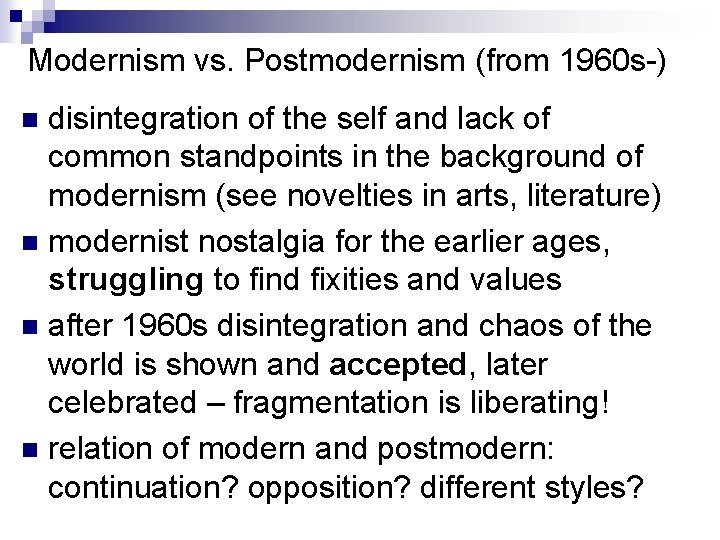
Modernism vs. Postmodernism (from 1960 s-) disintegration of the self and lack of common standpoints in the background of modernism (see novelties in arts, literature) n modernist nostalgia for the earlier ages, struggling to find fixities and values n after 1960 s disintegration and chaos of the world is shown and accepted, later celebrated – fragmentation is liberating! n relation of modern and postmodern: continuation? opposition? different styles? n
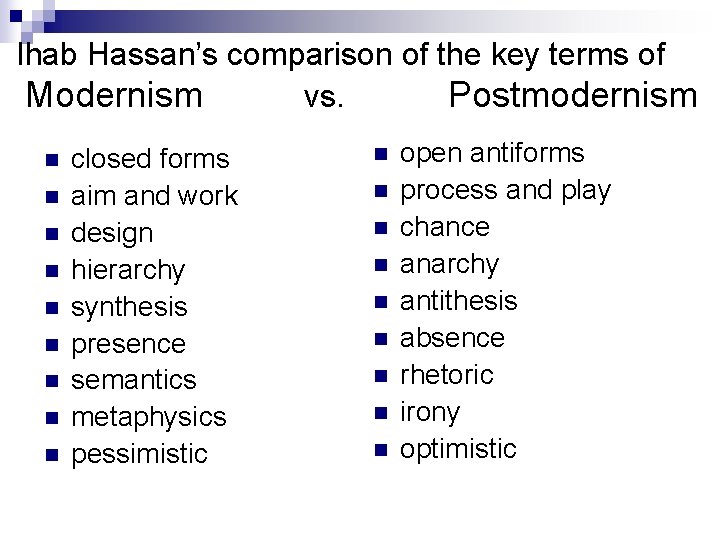
Ihab Hassan’s comparison of the key terms of Modernism vs. Postmodernism n n n n n closed forms aim and work design hierarchy synthesis presence semantics metaphysics pessimistic n n n n n open antiforms process and play chance anarchy antithesis absence rhetoric irony optimistic
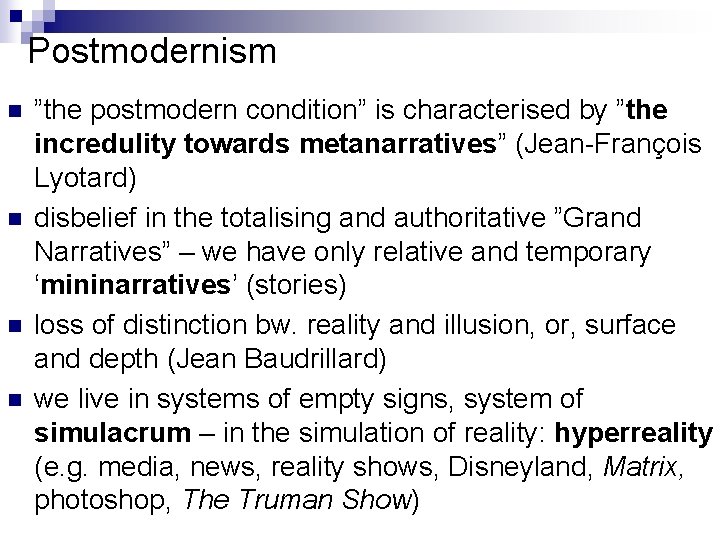
Postmodernism n n ”the postmodern condition” is characterised by ”the incredulity towards metanarratives” (Jean-François Lyotard) disbelief in the totalising and authoritative ”Grand Narratives” – we have only relative and temporary ‘mininarratives’ (stories) loss of distinction bw. reality and illusion, or, surface and depth (Jean Baudrillard) we live in systems of empty signs, system of simulacrum – in the simulation of reality: hyperreality (e. g. media, news, reality shows, Disneyland, Matrix, photoshop, The Truman Show)
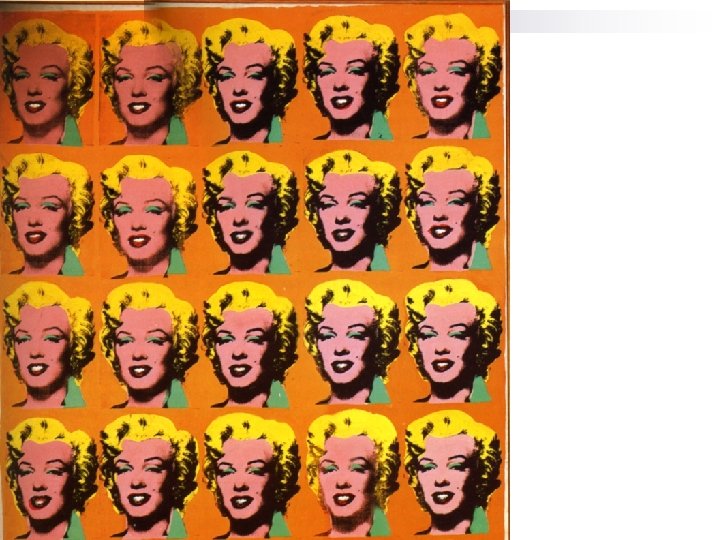
Postmodernist Criticism gets rid of distinction between ‘high’ and ‘low’ culture – popular culture is studied (vs. modernist elitism) n analyses of new genres, mixing of forms (e. g. thrillers, Gothic novels, detective stories, blogs, soap operas, pop songs, sci-fi) n foregrounds intertextual elements (parodies, adaptations) n focuses on language games and their irony n emphasises ‘the jokes’ of narrative techniques n
Postcolonial Criticism (from 1980 s) arose in the wake of the turbulent struggles for national independence of many African, Asian and Latin-American countries, being under the rule of European colonial empires through the mid-20 th centuries (e. g. India, Cyprus, Kenya, Pakistan, Egypt, Sri Lanka, Philippines etc. ) n attacks the timeless and universal quality of ‘great literature’ – universalism of white Eurocentric norms and practices is rejected (Eurocentrism) n Edward Said, Homi K. Bhabha, Gayatri Spivak n
Postcolonial Criticism – key ideas 1. 2. 3. 4. the ex-colonised peoples should find their own voice so as to re-discover their own past (having been devalued by the colonising power) to find their language and forms of writing (think of Yeats’ fighting for the usage of Irish Gaelic and mythology in his poems written in English) to question double identity, mixing, hybridity to stress cross-cultural interactions
Postcolonial Criticism – key ideas 2 three stages of postcolonial literatures: adopt (acceptance) adapt (changes) adept (mastering) n influenced by poststructuralist and feminist approaches of ”New English Literature” n re-reads works related to colonisation and imperialism (e. g. Conrad, Kipling, Forster) n examines representation of otherness, focusing on cultural differences (e. g. Salman Rushdie) n celebrates hybridity, marginality and plurality as sources of energy and potential changes n
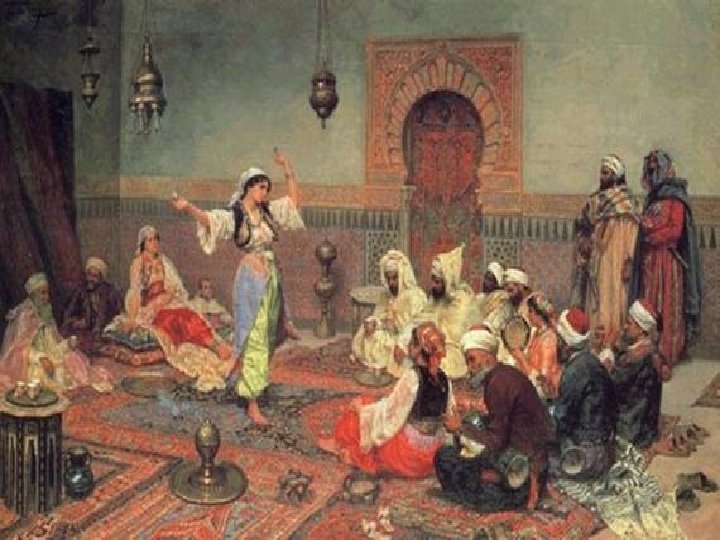
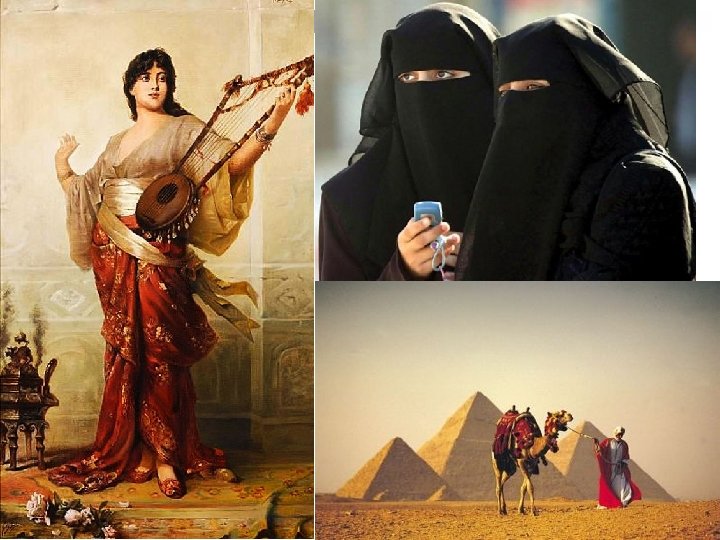
Edward Said, Orientalism (1978) CP 138 -149 American critic, was brought up in Palestine and in Egypt (personal dimension, CP 148 A) n ”Introduction” on the concept of ”the Orient” n it is a European invention based on stereotypes n ‘oriental’ equals exotic, sensual, erotic (e. g. Egyptian bellydancers) and also wise & cultural n geographically and historically, the place of Europe’s richest colonies and ancient civilizations – images of the Other n academic meaning, cf. Oriental Studies n
Edward Said, Orientalism 2 historically, the dominated parts of the world n ”the Orient”/ East ”the Occident”/ West (ontologically) n Said’s main concern is how the West defined the East, how it restructured and had authority over it in the term, ”Orientalism” from the 18 th century n BUT interdependence of the terms! (CP 139) n the West ”gained in strength and identity by setting itself off against the Orient as a sort of surrogate and even underground self” n East and West support and reflect each other n
Edward Said, Orientalism 3 the Orient was made up, ”Orientalized”, in the relationship of power and dominance with the Occident n the East was submitted to become the Oriental in the stereotypes of hegemonic and superior culture of the West n the aim of Orientalist Criticism to understand incorporate the East as ”a manifestly different world”; a special discourse, existing in an exchange with political, intellectual, cultural, or moral power of the West (CP 142 B) n ‘we’ vs. ‘they’ n
Edward Said, Orientalism 4 Said studies Orientalism of the 3 great empires; more exactly, ”the Anglo-French-American experience of the Arabs and Islam” n focusing on representations of the Orient by outsider Orientalists e. g. in literary works, travel books, political tracts, journalistic pieces or religious texts (Byron, Beckford, Darwin, Freud) n he is against ”racism, cultural stereotypes, political imperialism, dehumanizing ideology” n
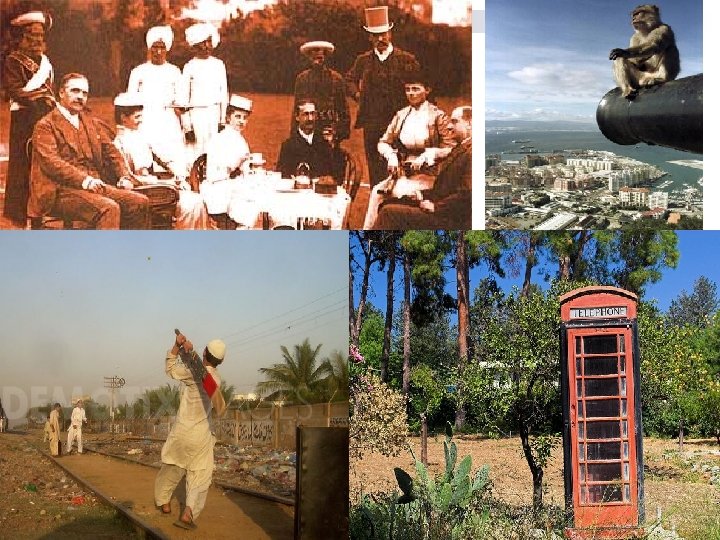
Homi K. Bhabha, ”Of Mimicry and Man” (1983) attacks such dichotomies as West vs. East, central vs. peripherial, the oppressor vs. the oppressed, the self vs. the other n he believes in hybridity – the mixing of ethnicities, identities, and nationalities n from Lacan, he takes mimicry, imitation (cf. to mimic, mime) CP 134 n the colonial exercises its power and the colonised tries to imitate the coloniser n the other is different, ”almost the same, but not quite” – the Anglicized mimic man n
Homi K. Bhabha, ”Of Mimicry and Man” 2 n n n mimicry is profound and disturbing (e. g. tea party in Forster’s A Passage to India) mimicry is ”resemblance and menace” 135 A the coloniser thinks it to be a form of control while it can become the form of parody, ironising the coloniser in its double vision ironically, mimicry is forced by the coloniser in his narcissistic egoism (educational-cultural force) camouflage: the other is able to pretend to be the self (criticism in disguise) – who is the master?
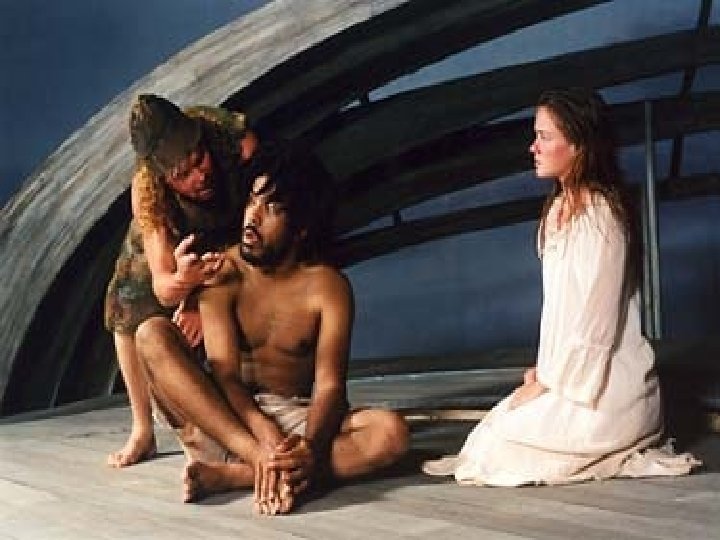
J. M Coetzee, Foe (1986) South-African white novelist, who won the Nobel Prize in 2003 n his poetic masterpiece (cf. adept) is a parody of the very first colonial novel, Daniel Defoe’s Robinson Crusoe (1710 s) n the crazy character of Cruso, who dies on a ship, leaving the island n the narrator is Susan Barton, aka ‘Mrs Cruso’, who takes the mute and castrated Friday to London (dancing is his language!) n she tells the story to Foe, who steals her story n