
English Learner Service Model Secondary Schools Specialized Services
- Slides: 8
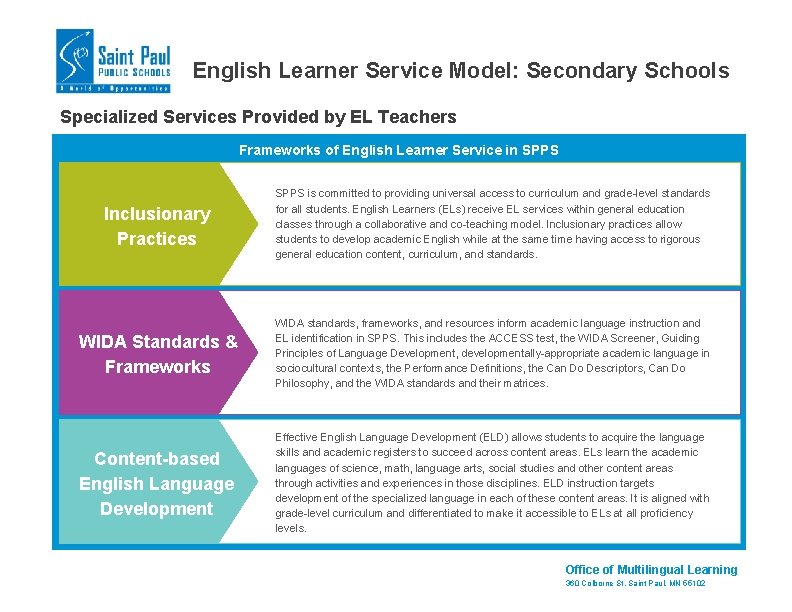
English Learner Service Model: Secondary Schools Specialized Services Provided by EL Teachers Frameworks of English Learner Service in SPPS Inclusionary Practices SPPS is committed to providing universal access to curriculum and grade-level standards for all students. English Learners (ELs) receive EL services within general education classes through a collaborative and co-teaching model. Inclusionary practices allow students to develop academic English while at the same time having access to rigorous general education content, curriculum, and standards. WIDA Standards & Frameworks WIDA standards, frameworks, and resources inform academic language instruction and EL identification in SPPS. This includes the ACCESS test, the WIDA Screener, Guiding Principles of Language Development, developmentally-appropriate academic language in sociocultural contexts, the Performance Definitions, the Can Do Descriptors, Can Do Philosophy, and the WIDA standards and their matrices. Content-based English Language Development Effective English Language Development (ELD) allows students to acquire the language skills and academic registers to succeed across content areas. ELs learn the academic languages of science, math, language arts, social studies and other content areas through activities and experiences in those disciplines. ELD instruction targets development of the specialized language in each of these content areas. It is aligned with grade-level curriculum and differentiated to make it accessible to ELs at all proficiency levels. Office of Multilingual Learning 360 Colborne St, Saint Paul, MN 55102
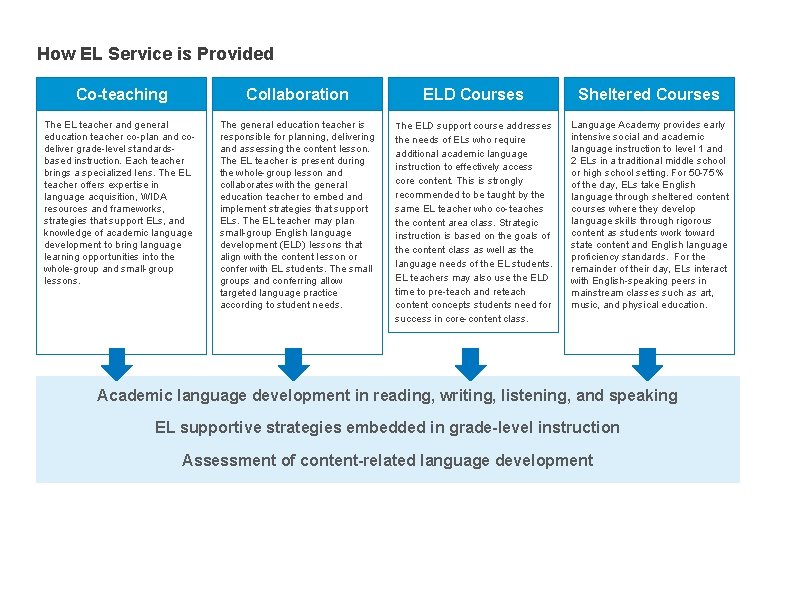
How EL Service is Provided Co-teaching Collaboration ELD Courses Sheltered Courses The EL teacher and general education teacher co-plan and codeliver grade-level standardsbased instruction. Each teacher brings a specialized lens. The EL teacher offers expertise in language acquisition, WIDA resources and frameworks, strategies that support ELs, and knowledge of academic language development to bring language learning opportunities into the whole-group and small-group lessons. The general education teacher is responsible for planning, delivering and assessing the content lesson. The EL teacher is present during the whole-group lesson and collaborates with the general education teacher to embed and implement strategies that support ELs. The EL teacher may plan small-group English language development (ELD) lessons that align with the content lesson or confer with EL students. The small groups and conferring allow targeted language practice according to student needs. The ELD support course addresses Language Academy provides early intensive social and academic language instruction to level 1 and 2 ELs in a traditional middle school or high school setting. For 50 -75% of the day, ELs take English language through sheltered content courses where they develop language skills through rigorous content as students work toward state content and English language proficiency standards. For the remainder of their day, ELs interact with English-speaking peers in mainstream classes such as art, music, and physical education. the needs of ELs who require additional academic language instruction to effectively access core content. This is strongly recommended to be taught by the same EL teacher who co-teaches the content area class. Strategic instruction is based on the goals of the content class as well as the language needs of the EL students. EL teachers may also use the ELD time to pre-teach and reteach content concepts students need for success in core-content class. Academic language development in reading, writing, listening, and speaking EL supportive strategies embedded in grade-level instruction Assessment of content-related language development
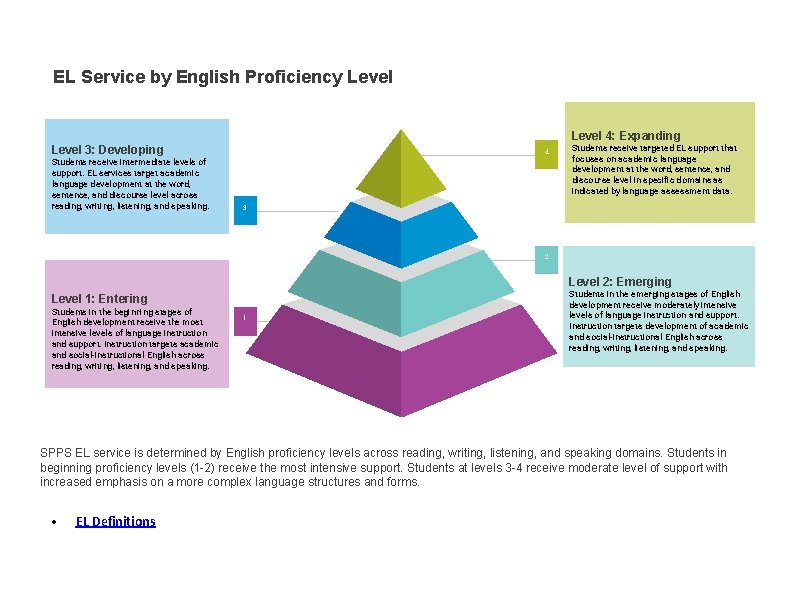
EL Service by English Proficiency Level 4: Expanding Level 3: Developing Students receive intermediate levels of support. EL services target academic language development at the word, sentence, and discourse level across reading, writing, listening, and speaking. 4 Students receive targeted EL support that focuses on academic language development at the word, sentence, and discourse level in specific domains as indicated by language assessment data. 3 2 Level 2: Emerging Level 1: Entering Students in the beginning stages of English development receive the most intensive levels of language instruction and support. Instruction targets academic and social-instructional English across reading, writing, listening, and speaking. 1 Students in the emerging stages of English development receive moderately intensive levels of language instruction and support. Instruction targets development of academic and social-instructional English across reading, writing, listening, and speaking. SPPS EL service is determined by English proficiency levels across reading, writing, listening, and speaking domains. Students in beginning proficiency levels (1 -2) receive the most intensive support. Students at levels 3 -4 receive moderate level of support with increased emphasis on a more complex language structures and forms. • EL Definitions
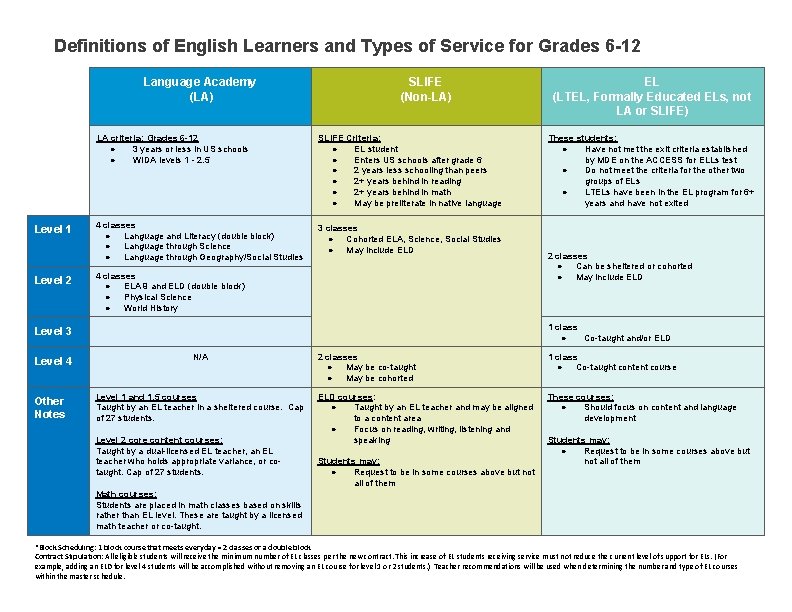
Definitions of English Learners and Types of Service for Grades 6 -12 Language Academy (LA) Level 1 Level 2 SLIFE (Non-LA) LA criteria: Grades 6 -12 ● 3 years or less in US schools ● WIDA levels 1 - 2. 5 SLIFE Criteria: ● EL student ● Enters US schools after grade 6 ● 2 years less schooling than peers ● 2+ years behind in reading ● 2+ years behind in math ● May be preliterate in native language 4 classes ● Language and Literacy (double block) ● Language through Science ● Language through Geography/Social Studies 3 classes ● Cohorted ELA, Science, Social Studies ● May include ELD 4 classes ● ELA 9 and ELD (double block) ● Physical Science ● World History Other Notes These students: ● Have not met the exit criteria established by MDE on the ACCESS for ELLs test ● Do not meet the criteria for the other two groups of ELs ● LTELs have been in the EL program for 6+ years and have not exited 2 classes ● Can be sheltered or cohorted ● May include ELD 1 class ● Co-taught and/or ELD Level 3 Level 4 EL (LTEL, Formally Educated ELs, not LA or SLIFE) N/A Level 1 and 1. 5 courses Taught by an EL teacher in a sheltered course. Cap of 27 students. Level 2 core content courses: Taught by a dual-licensed EL teacher, an EL teacher who holds appropriate variance, or cotaught. Cap of 27 students. 2 classes ● May be co-taught ● May be cohorted 1 class ● Co-taught content course ELD courses: ● Taught by an EL teacher and may be aligned to a content area ● Focus on reading, writing, listening and speaking These courses: ● Should focus on content and language development Students may: ● Request to be in some courses above but not all of them Math courses: Students are placed in math classes based on skills rather than EL level. These are taught by a licensed math teacher or co-taught. *Block Scheduling: 1 block course that meets everyday = 2 classes or a double block Contract Stipulation: All eligible students will receive the minimum number of EL classes per the new contract. This increase of EL students receiving service must not reduce the current level of support for ELs. (For example, adding an ELD for level 4 students will be accomplished without removing an EL course for level 1 or 2 students. ) Teacher recommendations will be used when determining the number and type of EL courses within the master schedule.
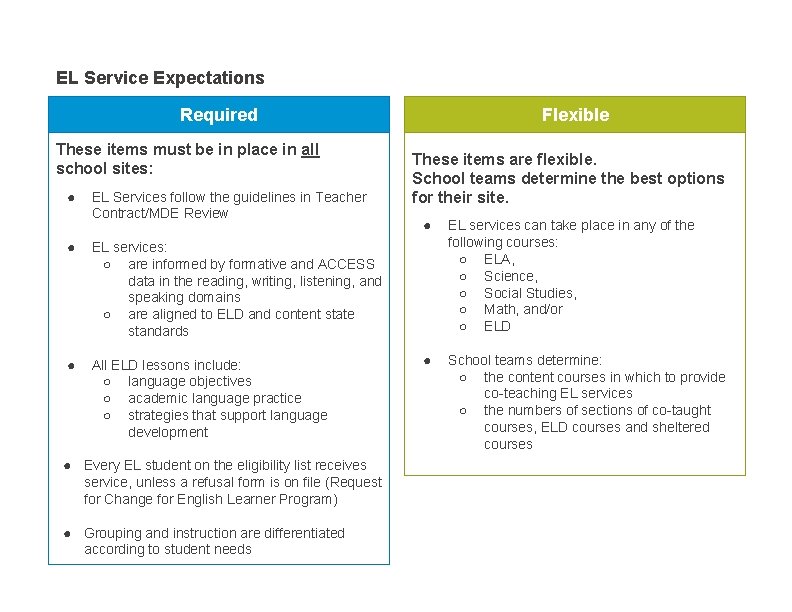
EL Service Expectations Required These items must be in place in all school sites: ● EL Services follow the guidelines in Teacher Contract/MDE Review ● EL services: ○ are informed by formative and ACCESS data in the reading, writing, listening, and speaking domains ○ are aligned to ELD and content state standards ● All ELD lessons include: ○ language objectives ○ academic language practice ○ strategies that support language development ● Every EL student on the eligibility list receives service, unless a refusal form is on file (Request for Change for English Learner Program) ● Grouping and instruction are differentiated according to student needs Flexible These items are flexible. School teams determine the best options for their site. ● EL services can take place in any of the following courses: ○ ELA, ○ Science, ○ Social Studies, ○ Math, and/or ○ ELD ● School teams determine: ○ the content courses in which to provide co-teaching EL services ○ the numbers of sections of co-taught courses, ELD courses and sheltered courses
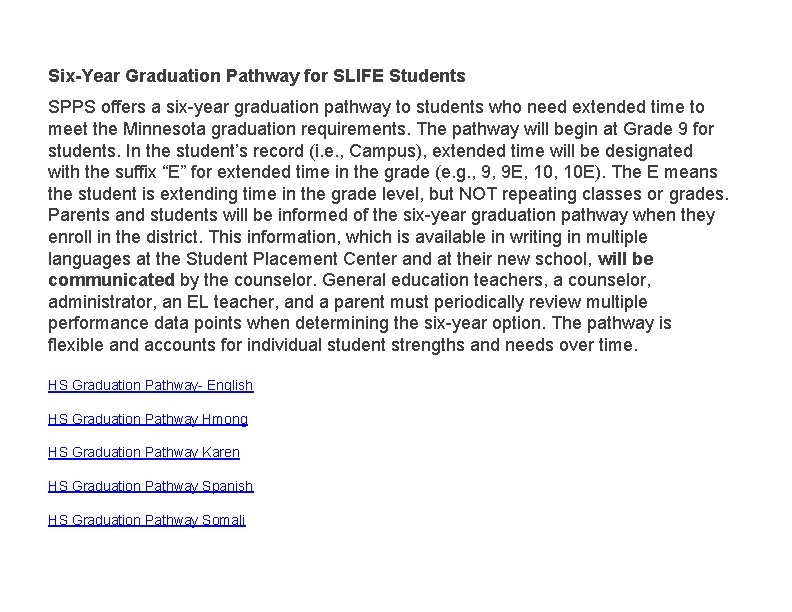
Six-Year Graduation Pathway for SLIFE Students SPPS offers a six-year graduation pathway to students who need extended time to meet the Minnesota graduation requirements. The pathway will begin at Grade 9 for students. In the student’s record (i. e. , Campus), extended time will be designated with the suffix “E” for extended time in the grade (e. g. , 9, 9 E, 10 E). The E means the student is extending time in the grade level, but NOT repeating classes or grades. Parents and students will be informed of the six-year graduation pathway when they enroll in the district. This information, which is available in writing in multiple languages at the Student Placement Center and at their new school, will be communicated by the counselor. General education teachers, a counselor, administrator, an EL teacher, and a parent must periodically review multiple performance data points when determining the six-year option. The pathway is flexible and accounts for individual student strengths and needs over time. HS Graduation Pathway- English HS Graduation Pathway Hmong HS Graduation Pathway Karen HS Graduation Pathway Spanish HS Graduation Pathway Somali
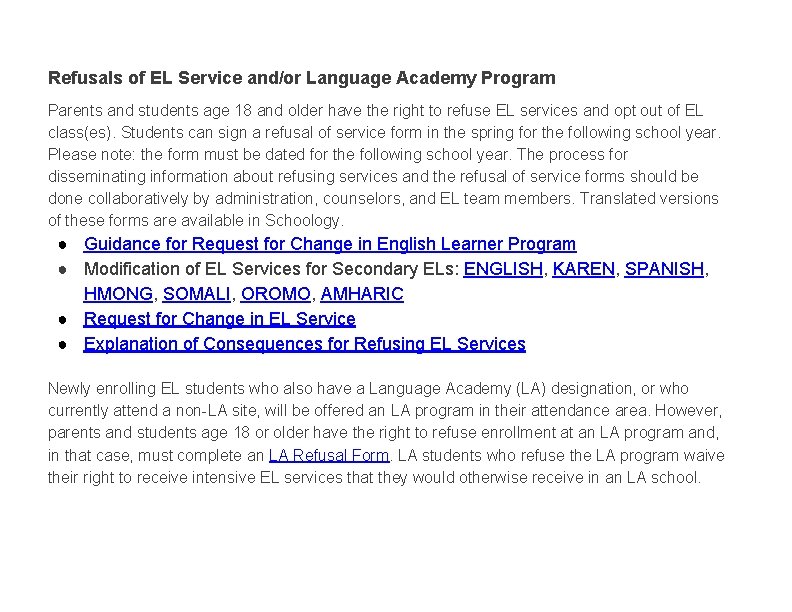
Refusals of EL Service and/or Language Academy Program Parents and students age 18 and older have the right to refuse EL services and opt out of EL class(es). Students can sign a refusal of service form in the spring for the following school year. Please note: the form must be dated for the following school year. The process for disseminating information about refusing services and the refusal of service forms should be done collaboratively by administration, counselors, and EL team members. Translated versions of these forms are available in Schoology. ● Guidance for Request for Change in English Learner Program ● Modification of EL Services for Secondary ELs: ENGLISH, KAREN, SPANISH, HMONG, SOMALI, OROMO, AMHARIC ● Request for Change in EL Service ● Explanation of Consequences for Refusing EL Services Newly enrolling EL students who also have a Language Academy (LA) designation, or who currently attend a non-LA site, will be offered an LA program in their attendance area. However, parents and students age 18 or older have the right to refuse enrollment at an LA program and, in that case, must complete an LA Refusal Form. LA students who refuse the LA program waive their right to receive intensive EL services that they would otherwise receive in an LA school.
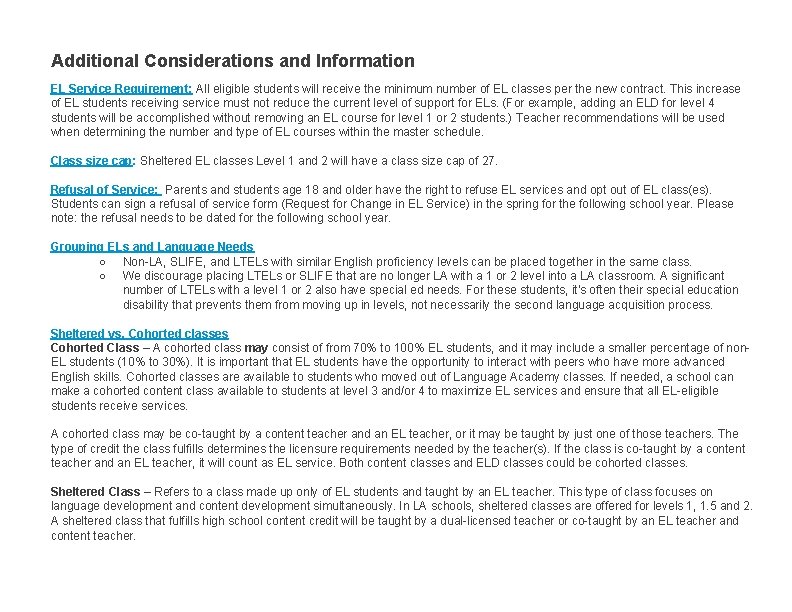
Additional Considerations and Information EL Service Requirement: All eligible students will receive the minimum number of EL classes per the new contract. This increase of EL students receiving service must not reduce the current level of support for ELs. (For example, adding an ELD for level 4 students will be accomplished without removing an EL course for level 1 or 2 students. ) Teacher recommendations will be used when determining the number and type of EL courses within the master schedule. Class size cap: Sheltered EL classes Level 1 and 2 will have a class size cap of 27. Refusal of Service: Parents and students age 18 and older have the right to refuse EL services and opt out of EL class(es). Students can sign a refusal of service form (Request for Change in EL Service) in the spring for the following school year. Please note: the refusal needs to be dated for the following school year. Grouping ELs and Language Needs ○ Non-LA, SLIFE, and LTELs with similar English proficiency levels can be placed together in the same class. ○ We discourage placing LTELs or SLIFE that are no longer LA with a 1 or 2 level into a LA classroom. A significant number of LTELs with a level 1 or 2 also have special ed needs. For these students, it's often their special education disability that prevents them from moving up in levels, not necessarily the second language acquisition process. Sheltered vs. Cohorted classes Cohorted Class – A cohorted class may consist of from 70% to 100% EL students, and it may include a smaller percentage of non. EL students (10% to 30%). It is important that EL students have the opportunity to interact with peers who have more advanced English skills. Cohorted classes are available to students who moved out of Language Academy classes. If needed, a school can make a cohorted content class available to students at level 3 and/or 4 to maximize EL services and ensure that all EL-eligible students receive services. A cohorted class may be co-taught by a content teacher and an EL teacher, or it may be taught by just one of those teachers. The type of credit the class fulfills determines the licensure requirements needed by the teacher(s). If the class is co-taught by a content teacher and an EL teacher, it will count as EL service. Both content classes and ELD classes could be cohorted classes. Sheltered Class – Refers to a class made up only of EL students and taught by an EL teacher. This type of class focuses on language development and content development simultaneously. In LA schools, sheltered classes are offered for levels 1, 1. 5 and 2. A sheltered class that fulfills high school content credit will be taught by a dual-licensed teacher or co-taught by an EL teacher and content teacher.