
English Learner Series Linguistically Appropriate Goals January 16

- Slides: 32
English Learner Series: Linguistically Appropriate Goals January 16, 2019 Joanna V. Della Gatta, Director, Transition And Technology Yanka Ricklefs, Director, Personnel Development www. vcselpa. org
Why is it important to talk about English Learners? • A Moral & Legal Obligation • Individuals with Disabilities Education Act 2004 (IDEA) • Preventing Disproportionality • In 2017 -2018, English learners constituted 20% of all students in CA schools and English learners with disabilities 30% of students with disabilities. • In 2017 -2018, English learners constituted 22% of all students in Ventura county and constituted 26% of all students with disabilities in Ventura County (12/1/17 CASEMIS). • Most “at-risk” learner subgroup
Education Code EC 56345 (b) (2) For individuals whose native language is other than English, linguistically appropriate goals, objectives, programs, and services.
California Code of Regulations The IEP team must consider the language needs of the student as those needs relate to the student’s IEP. Specifically, the IEP must include “linguistically appropriate goals, objectives, programs and services”.
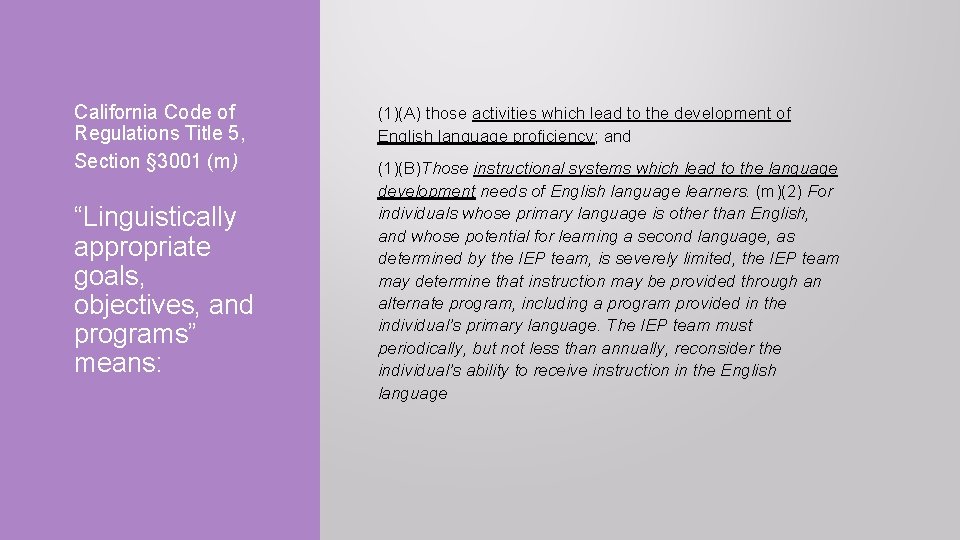
California Code of Regulations Title 5, Section § 3001 (m) “Linguistically appropriate goals, objectives, and programs” means: (1)(A) those activities which lead to the development of English language proficiency; and (1)(B)Those instructional systems which lead to the language development needs of English language learners. (m)(2) For individuals whose primary language is other than English, and whose potential for learning a second language, as determined by the IEP team, is severely limited, the IEP team may determine that instruction may be provided through an alternate program, including a program provided in the individual’s primary language. The IEP team must periodically, but not less than annually, reconsider the individual’s ability to receive instruction in the English language
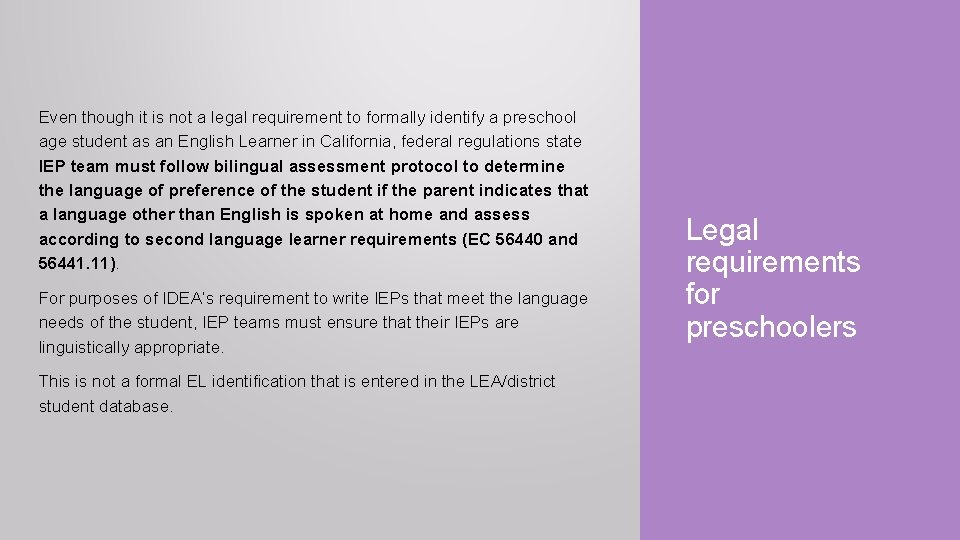
Even though it is not a legal requirement to formally identify a preschool age student as an English Learner in California, federal regulations state IEP team must follow bilingual assessment protocol to determine the language of preference of the student if the parent indicates that a language other than English is spoken at home and assess according to second language learner requirements (EC 56440 and 56441. 11). For purposes of IDEA’s requirement to write IEPs that meet the language needs of the student, IEP teams must ensure that their IEPs are linguistically appropriate. This is not a formal EL identification that is entered in the LEA/district student database. Legal requirements for preschoolers
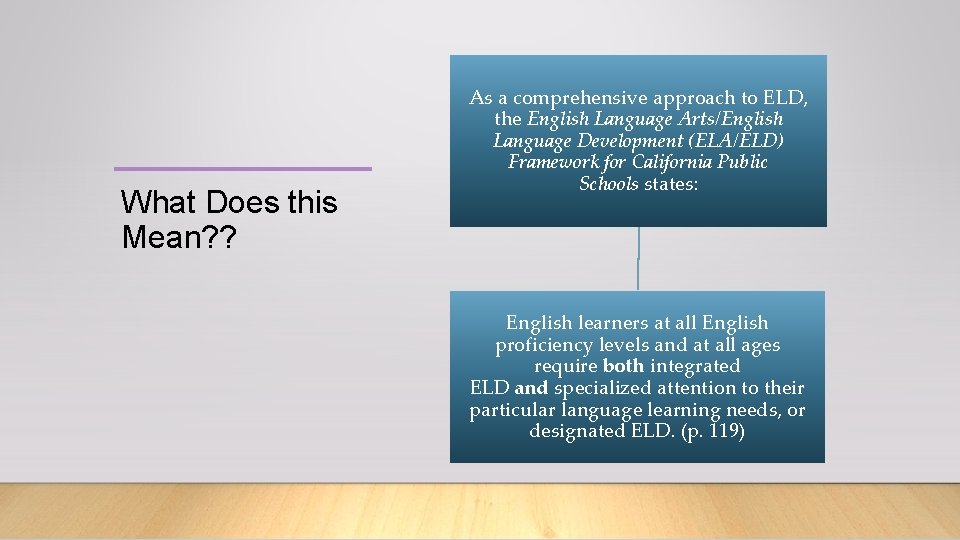
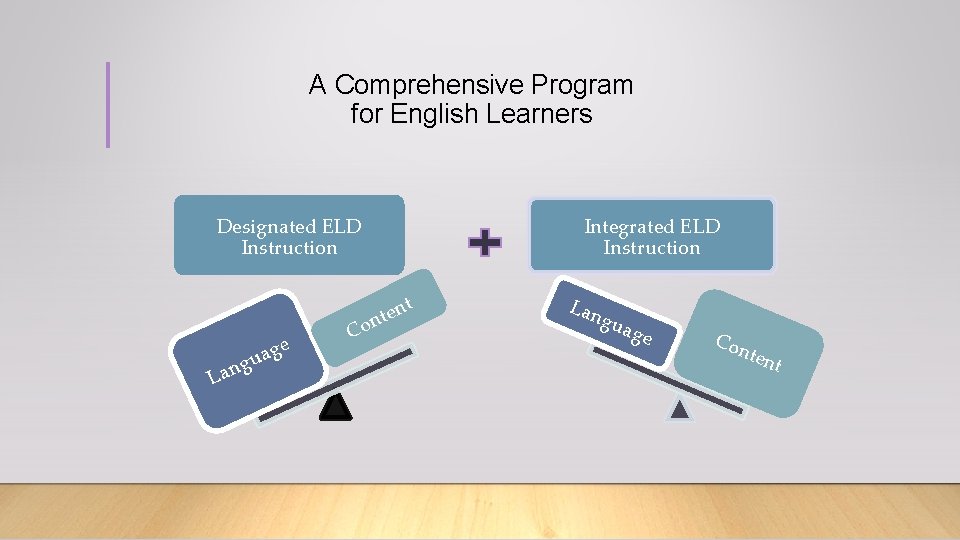
What Does this Mean? ? As a comprehensive approach to ELD, the English Language Arts/English Language Development (ELA/ELD) Framework for California Public Schools states: English learners at all English proficiency levels and at all ages require both integrated ELD and specialized attention to their particular language learning needs, or designated ELD. (p. 119)
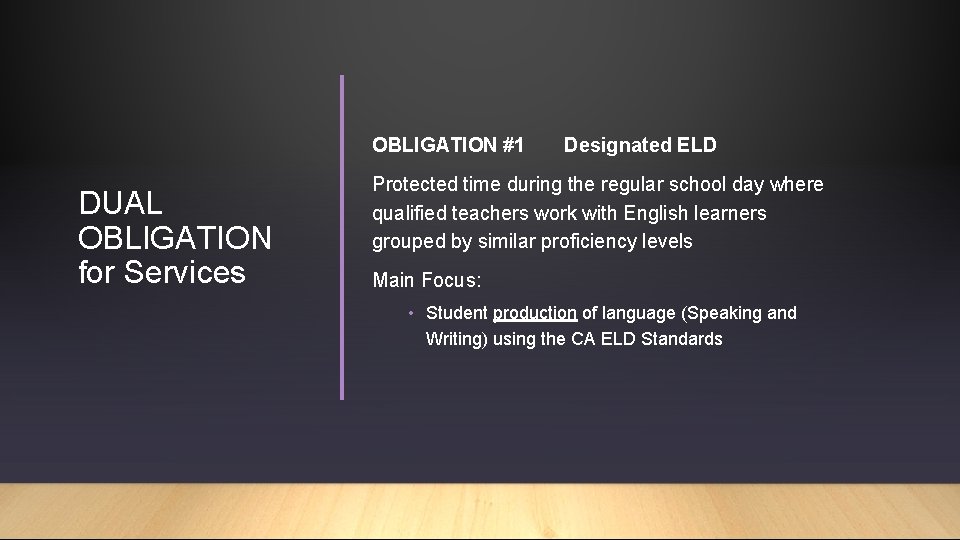
OBLIGATION #1 DUAL OBLIGATION for Services Designated ELD Protected time during the regular school day where qualified teachers work with English learners grouped by similar proficiency levels Main Focus: • Student production of language (Speaking and Writing) using the CA ELD Standards
OBLIGATION #2 DUAL OBLIGATION for Services Integrated ELD Provide meaningful access to ALL grade-level CCSS academic content through research-based strategies and techniques (SDAIE) used in tandem with ELD Standards Main Focus: • Accessing & mastering content standards across all disciplines while using ELD standards to amplifying/highlight the key language knowledge and skills needed for ELs to succeed
A Comprehensive Program for English Learners Designated ELD Instruction Lan ge a u g Integrated ELD Instruction t Co n nte Lan gua ge Con ten t
ELD Standards Ø Language acquisition is treated as a nonlinear linguistic and social process Ø Asset vs. deficit approach literacy foundational skills target varying profiles of ELs, tapping linguistic resources Ø Focus on teaching academic English
Three Critical Principles for Developing Language and Cognition in Academic Contexts ELD Standards 1. Interacting in meaningful ways 2. Learning about how English works 3. Using foundational literacy skills
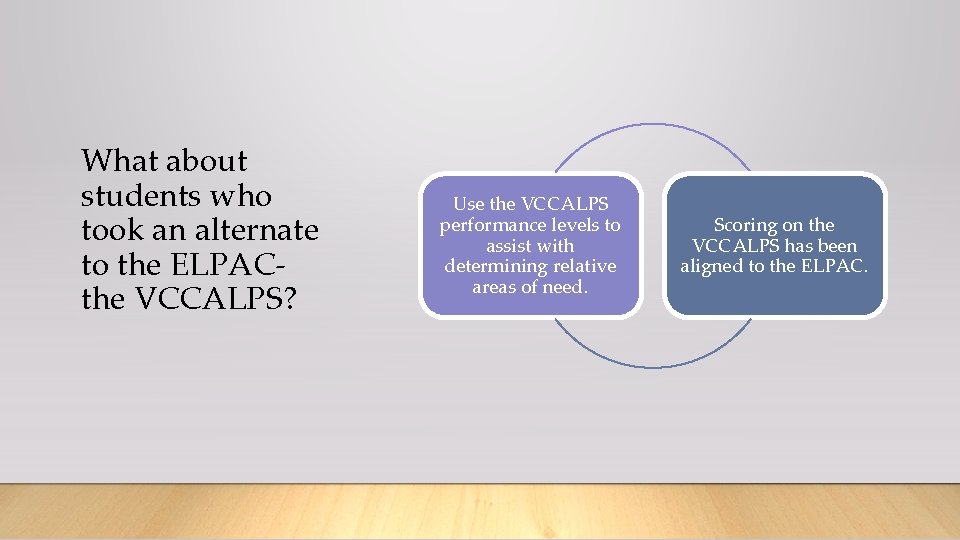
What about students who took an alternate to the ELPAC- the VCCALPS? Use the VCCALPS performance levels to assist with determining relative areas of need. Scoring on the VCCALPS has been aligned to the ELPAC.
Foundations in English Language Development: • Listening Preschool Goals • Speaking • Reading • Writing
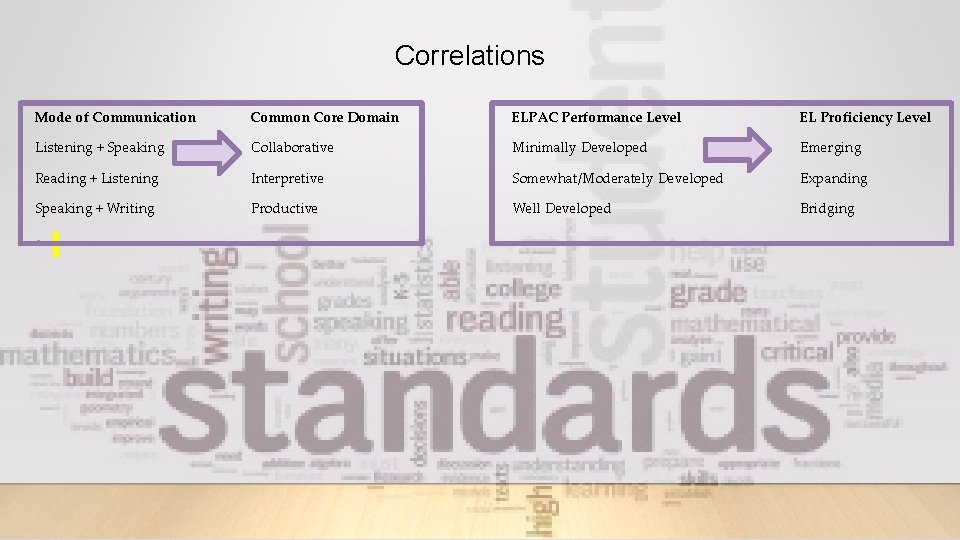
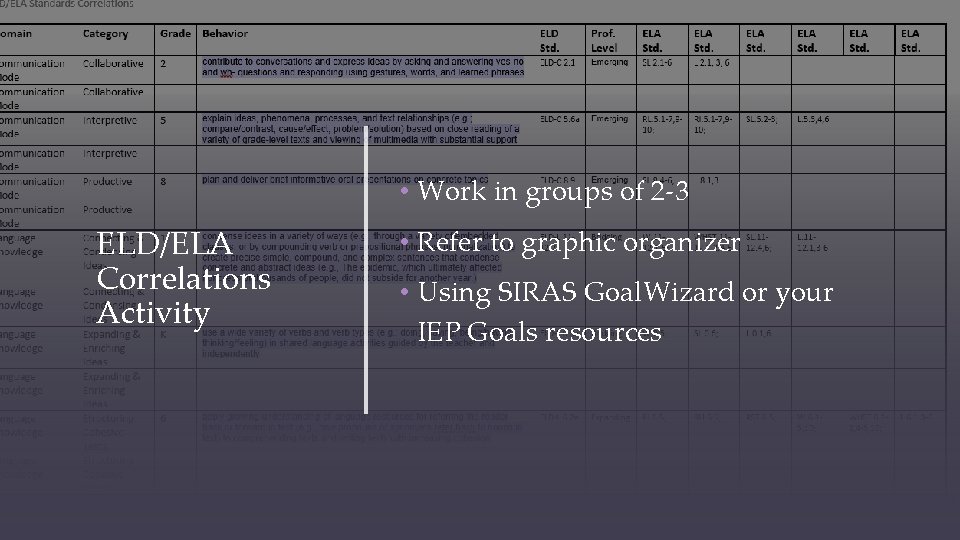
Correlations Mode of Communication Common Core Domain ELPAC Performance Level EL Proficiency Level Listening + Speaking Collaborative Minimally Developed Emerging Reading + Listening Interpretive Somewhat/Moderately Developed Expanding Speaking + Writing Productive Well Developed Bridging •
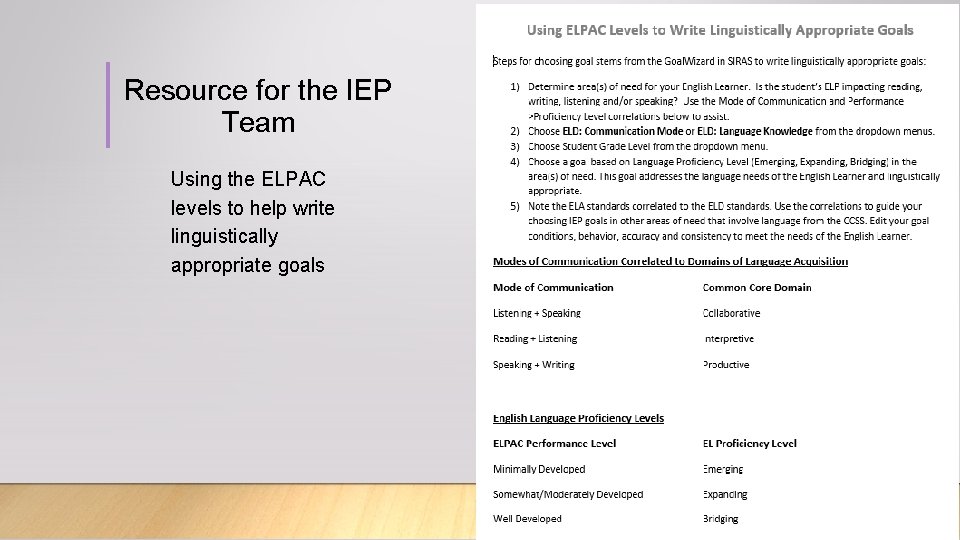
Resource for the IEP Team Using the ELPAC levels to help write linguistically appropriate goals
• Work in groups of 2 -3 ELD/ELA Correlations Activity • Refer to graphic organizer • Using SIRAS Goal. Wizard or your IEP Goals resources
How might an EL expert assist with developing linguistically appropriate goals?
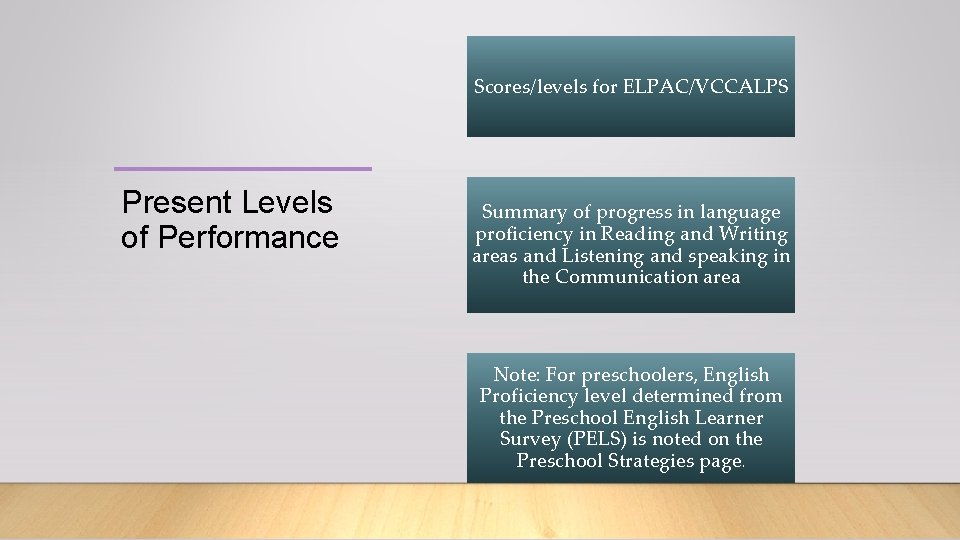
Scores/levels for ELPAC/VCCALPS Present Levels of Performance Summary of progress in language proficiency in Reading and Writing areas and Listening and speaking in the Communication area Note: For preschoolers, English Proficiency level determined from the Preschool English Learner Survey (PELS) is noted on the Preschool Strategies page.
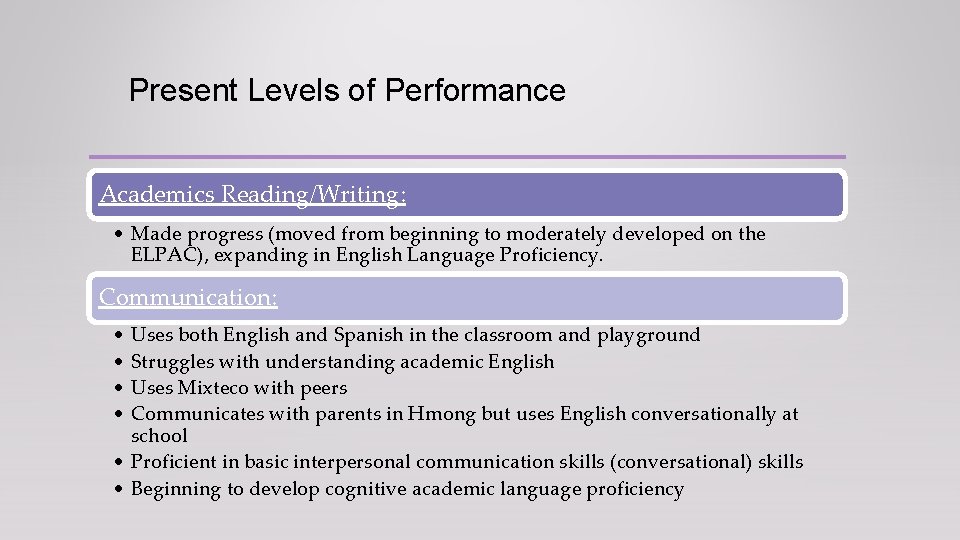
Present Levels of Performance Academics Reading/Writing: • Made progress (moved from beginning to moderately developed on the ELPAC), expanding in English Language Proficiency. Communication: • Uses both English and Spanish in the classroom and playground • Struggles with understanding academic English • Uses Mixteco with peers • Communicates with parents in Hmong but uses English conversationally at school • Proficient in basic interpersonal communication skills (conversational) skills • Beginning to develop cognitive academic language proficiency
Three things to consider when addressing language needs • Language proficiency • Level of functioning • Student’s disability J. Butterfield, 2016
IEP Goals • State present levels: strengths and weaknesses • Include assessment results (English and Native Language performance and proficiency) • Determine areas of need
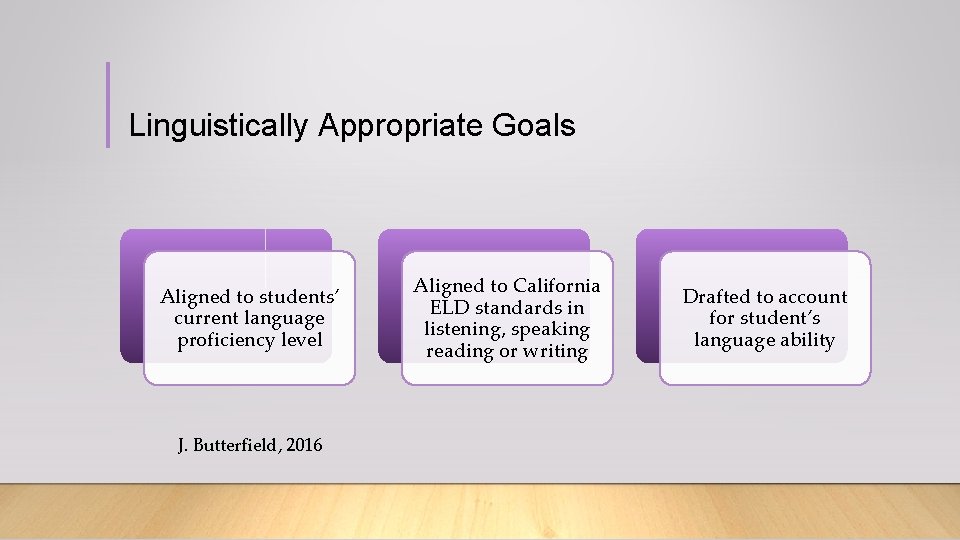
Linguistically Appropriate Goals Aligned to students’ current language proficiency level J. Butterfield, 2016 Aligned to California ELD standards in listening, speaking reading or writing Drafted to account for student’s language ability
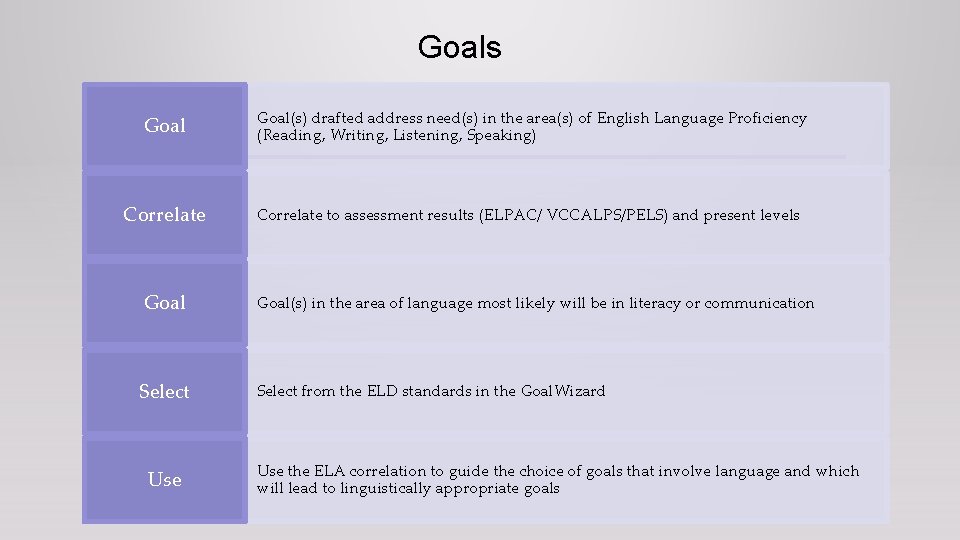
Goals Goal Correlate Goal(s) drafted address need(s) in the area(s) of English Language Proficiency (Reading, Writing, Listening, Speaking) Correlate to assessment results (ELPAC/ VCCALPS/PELS) and present levels Goal(s) in the area of language most likely will be in literacy or communication Select from the ELD standards in the Goal. Wizard Use the ELA correlation to guide the choice of goals that involve language and which will lead to linguistically appropriate goals
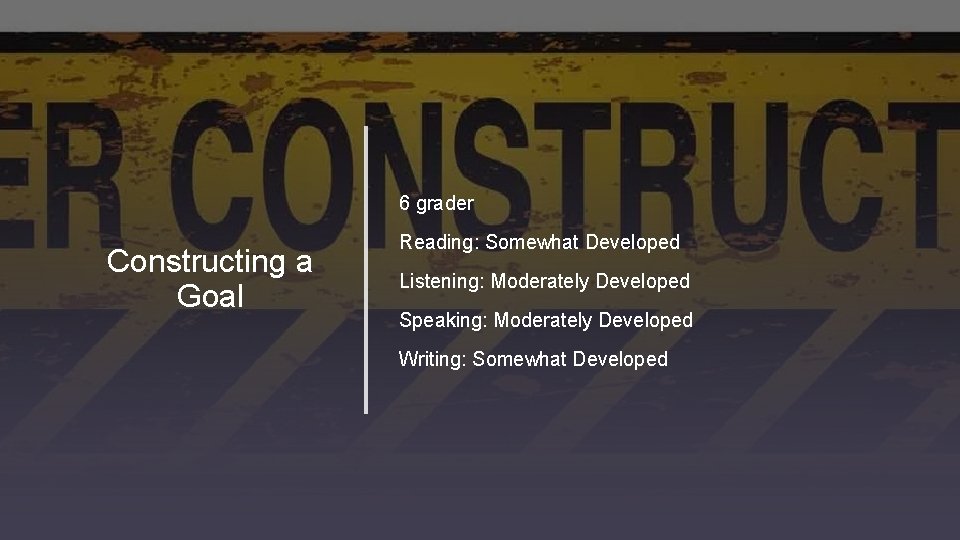
6 grader Constructing a Goal Reading: Somewhat Developed Listening: Moderately Developed Speaking: Moderately Developed Writing: Somewhat Developed
How might an EL expert assist with developing linguistically appropriate goals?
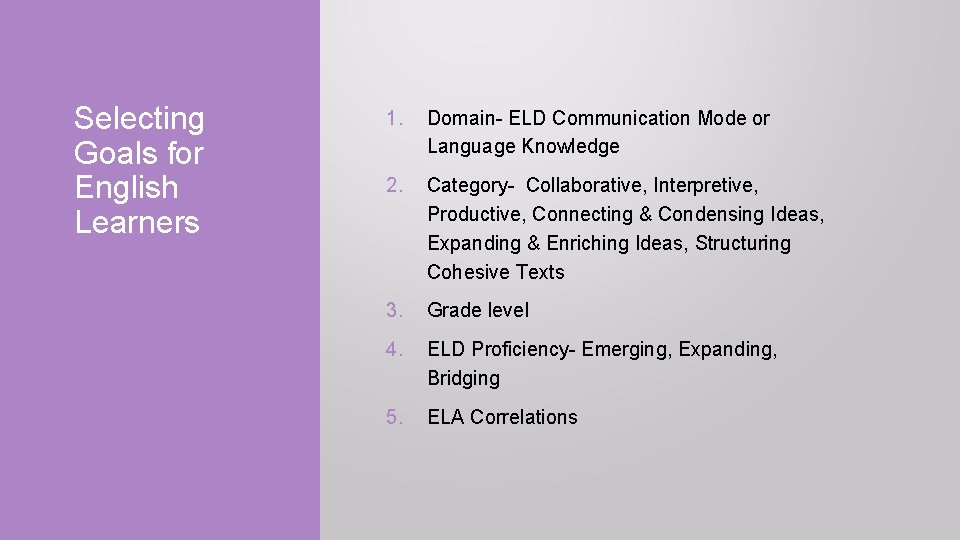
Selecting Goals for English Learners 1. Domain- ELD Communication Mode or Language Knowledge 2. Category- Collaborative, Interpretive, Productive, Connecting & Condensing Ideas, Expanding & Enriching Ideas, Structuring Cohesive Texts 3. Grade level 4. ELD Proficiency- Emerging, Expanding, Bridging 5. ELA Correlations
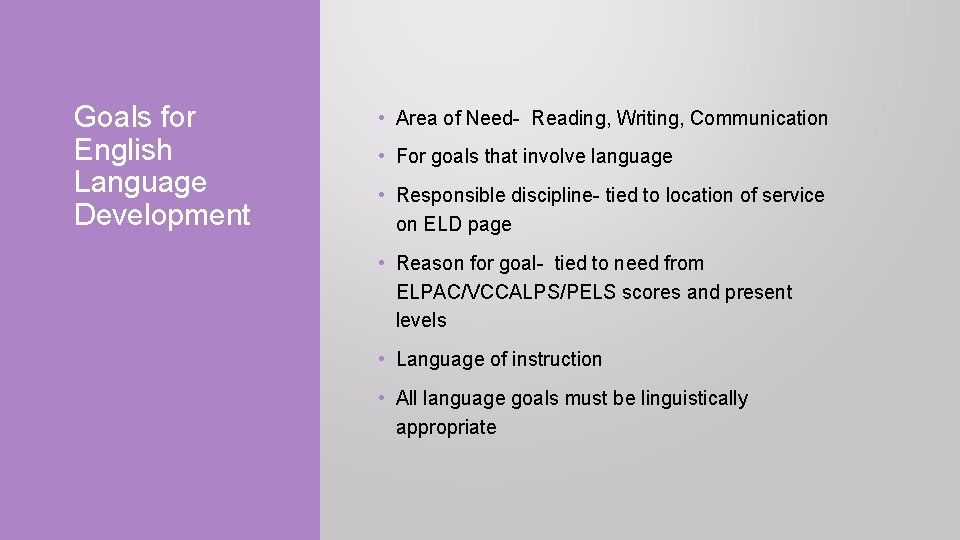
Goals for English Language Development • Area of Need- Reading, Writing, Communication • For goals that involve language • Responsible discipline- tied to location of service on ELD page • Reason for goal- tied to need from ELPAC/VCCALPS/PELS scores and present levels • Language of instruction • All language goals must be linguistically appropriate
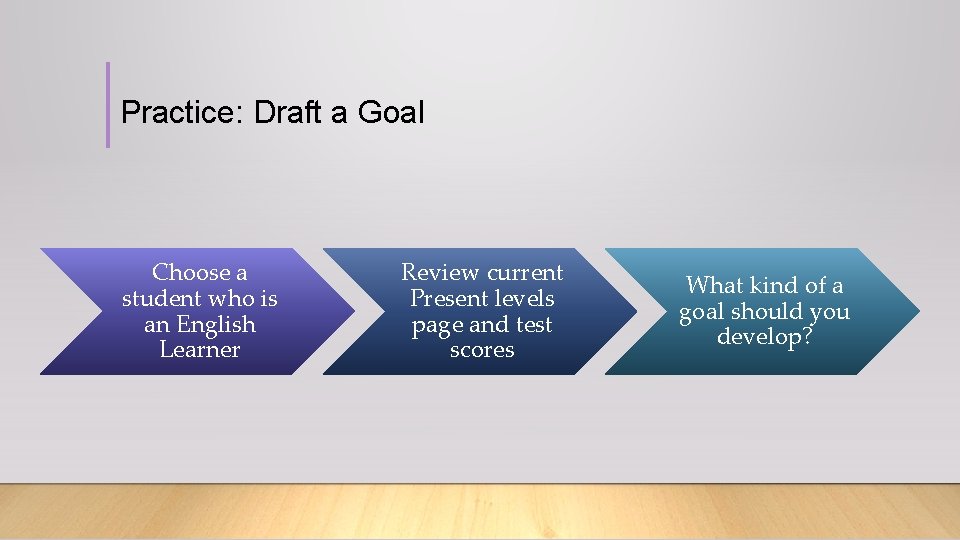
Practice: Draft a Goal Choose a student who is an English Learner Review current Present levels page and test scores What kind of a goal should you develop?
Questions?
Resources • Ventura County SELPA: www. vcselpa. org • ELD Standards: https: //www. cde. ca. gov/sp/el/er/eldstandards. asp