
English Language Writers Viewpoints and Perspectives NonFiction Extracts
- Slides: 2
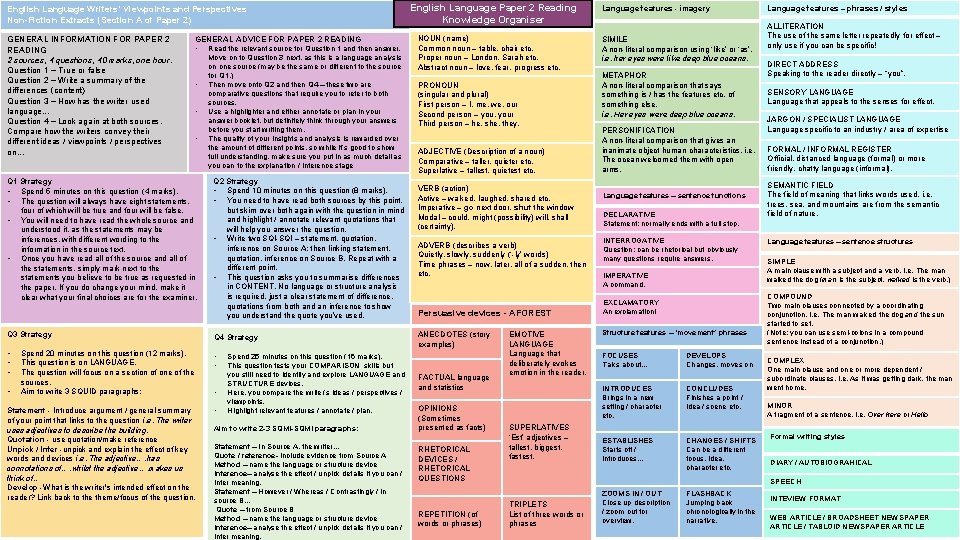
English Language Writers’ Viewpoints and Perspectives Non-Fiction Extracts (Section A of Paper 2) GENERAL INFORMATION FOR PAPER 2 READING 2 sources, 4 questions, 40 marks, one hour. Question 1 – True or false Question 2 – Write a summary of the differences (content) Question 3 – How has the writer used language… Question 4 – Look again at both sources. Compare how the writers convey their different ideas / viewpoints / perspectives on… GENERAL ADVICE FOR PAPER 2 READING • Read the relevant source for Question 1 and then answer. • • • Q 1 Strategy • Spend 5 minutes on this question (4 marks). • The question will always have eight statements, four of which will be true and four will be false. • You will need to have read the whole source and understood it, as the statements may be inferences, with different wording to the information in the source text. • Once you have read all of the source and all of the statements, simply mark next to the statements you believe to be true as requested in the paper. If you do change your mind, make it clear what your final choices are for the examiner. Move on to Question 3 next, as this is a language analysis on one source (may be the same or different to the source for Q 1. ) Then move onto Q 2 and then Q 4 – these two are comparative questions that require you to refer to both sources. Use a highlighter and either annotate or plan in your answer booklet, but definitely think through your answers before you start writing them. The quality of your insights and analysis is rewarded over the amount of different points, so while it’s good to show full understanding, make sure you put in as much detail as you can to the explanation / inference stage. Q 2 Strategy • Spend 10 minutes on this question (8 marks). • You need to have read both sources by this point, but skim over both again with the question in mind and highlight / annotate relevant quotations that will help you answer the question. • Write two SQI-SQI – statement, quotation, inference on Source A; then linking statement, quotation, inference on Source B. Repeat with a different point. • This question asks you to summarise differences in CONTENT. No language or structure analysis is required, just a clear statement of difference, quotations from both and an inference to show you understand the quote you’ve used. Q 3 Strategy Q 4 Strategy • • • Spend 20 minutes on this question (12 marks). This question is on LANGUAGE. The question will focus on a section of one of the sources. Aim to write 3 SQUID paragraphs: • • Statement - Introduce argument / general summary of your point that links to the question i. e. The writer uses adjectives to describe the building. Quotation - use quotation/make reference Unpick / Infer -unpick and explain the effect of key words and devices i. e. The adjective…. has connotations of…. whilst the adjective…. makes us think of… Develop -What is the writer's intended effect on the reader? Link back to theme/focus of the question. • • • Spend 25 minutes on this question (16 marks). This question tests your COMPARISON skills but you still need to identify and explore LANGUAGE and STRUCTURE devices. Here, you compare the writer’s ideas / perspectives / viewpoints. Highlight relevant features / annotate / plan. Aim to write 2 -3 SQMI-SQMI paragraphs: Statement – In Source A, the writer… Quote / reference- Include evidence from Source A Method – name the language or structure device Inference– analyse the effect / unpick details if you can / infer meaning. Statement – However / Whereas / Contrastingly / In source B… Quote – from Source B Method – name the language or structure device Inference– analyse the effect / unpick details if you can / infer meaning. English Language Paper 2 Reading Knowledge Organiser NOUN (name) Common noun – table, chair etc. Proper noun – London, Sarah etc. Abstract noun – love, fear, progress etc. PRONOUN (singular and plural) First person – I, me, we, our Second person – you, your Third person – he, she, they. ADJECTIVE (Description of a noun) Comparative – taller, quieter etc. Superlative – tallest, quietest etc. VERB (action) Active – walked, laughed, shared etc. Imperative – go next door, shut the window Modal – could, might (possibility) will, shall (certainty). ADVERB (describes a verb) Quietly, slowly, suddenly (‘-ly’ words) Time phrases – now, later, all of a sudden, then etc. Persuasive devices - AFOREST ANECDOTES (story examples) FACTUAL language and statistics OPINIONS (Sometimes presented as facts) RHETORICAL DEVICES / RHETORICAL QUESTIONS REPETITION (of words or phrases) EMOTIVE LANGUAGE Language that deliberately evokes emotion in the reader. Language features - imagery SIMILE A non-literal comparison using ‘like’ or ‘as’. i. e. her eyes were like deep blue oceans. METAPHOR A non-literal comparison that says something is / has the features etc. of something else. i. e. Her eyes were deep blue oceans. PERSONIFICATION A non-literal comparison that gives an inanimate object human characteristics, i. e. The ocean welcomed them with open arms. Language features – sentence functions DECLARATIVE Statement; normally ends with a full stop. INTERROGATIVE Question; can be rhetorical but obviously many questions require answers. IMPERATIVE A command. EXCLAMATORY An exclamation! Structure features – ‘movement’ phrases FOCUSES Talks about… DEVELOPS Changes, moves on INTRODUCES Brings in a new setting / character etc. CONCLUDES Finishes a point / idea / scene etc. SUPERLATIVES ‘Est’ adjectives – tallest, biggest, fastest. ESTABLISHES Starts off / introduces… CHANGES / SHIFTS Can be a different focus, idea, character etc. TRIPLETS List of three words or phrases ZOOMS IN / OUT Close up description / zoom out for overview. FLASHBACK Jumping back chronologically in the narrative. Language features – phrases / styles ALLITERATION The use of the same letter repeatedly for effect – only use if you can be specific! DIRECT ADDRESS Speaking to the reader directly – “you”. SENSORY LANGUAGE Language that appeals to the senses for effect. JARGON / SPECIALIST LANGUAGE Language specific to an industry / area of expertise FORMAL / INFORMAL REGISTER Official, distanced language (formal) or more friendly, chatty language (informal). SEMANTIC FIELD The field of meaning that links words used, i. e. trees, sea, and mountains are from the semantic field of nature. Language features – sentence structures SIMPLE A main clause with a subject and a verb, i. e. The man walked the dog (man is the subject, walked is the verb. ) COMPOUND Two main clauses connected by a coordinating conjunction, i. e. The man walked the dog and the sun started to set. (Note: you can use semi-colons in a compound sentence instead of a conjunction. ) COMPLEX One main clause and one or more dependent / subordinate clauses, i. e. As it was getting dark, the man went home. MINOR A fragment of a sentence, i. e. Over here or Hello. Formal writing styles DIARY / AUTOBIOGRAHICAL SPEECH INTEVIEW FORMAT WEB ARTICLE / BROADSHEET NEWSPAPER ARTICLE / TABLOID NEWSPAPER ARTICLE
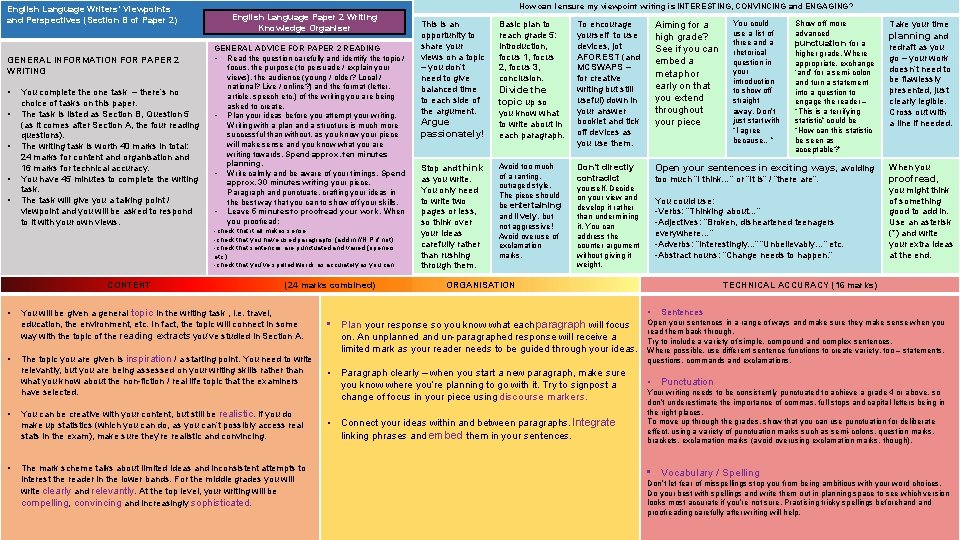
English Language Writers’ Viewpoints and Perspectives (Section B of Paper 2) GENERAL INFORMATION FOR PAPER 2 WRITING • • • You complete the one task – there’s no choice of tasks on this paper. The task is listed as Section B, Question 5 (as it comes after Section A, the four reading questions). The writing task is worth 40 marks in total: 24 marks for content and organisation and 16 marks for technical accuracy. You have 45 minutes to complete the writing task. The task will give you a talking point / viewpoint and you will be asked to respond to it with your own views. How can I ensure my viewpoint writing is INTERESTING, CONVINCING and ENGAGING? English Language Paper 2 Writing Knowledge Organiser GENERAL ADVICE FOR PAPER 2 READING • Read the question carefully and identify the topic / focus, the purpose (to persuade / explain your views), the audience (young / older? Local / national? Live / online? ) and the format (letter, article, speech etc. ) of the writing you are being asked to create. • Plan your ideas before you attempt your writing. Writing with a plan and a structure is much more successful than without, as you know your piece will make sense and you know what you are writing towards. Spend approx. ten minutes planning. • Write calmly and be aware of your timings. Spend approx. 30 minutes writing your piece. Paragraph and punctuate, crafting your ideas in the best way that you can to show off your skills. • Leave 5 minutes to proofread your work. When you proofread: -check that it all makes sense; -check that you have used paragraphs (add in //N. P if not); -check that sentences are punctuated and varied (openers etc. ); -check that you’ve spelled words as accurately as you can. CONTENT • • (24 marks combined) You will be given a general topic in the writing task , i. e. travel, education, the environment, etc. In fact, the topic will connect in some way with the topic of the reading extracts you’ve studied in Section A. The topic you are given is inspiration / a starting point. You need to write relevantly, but you are being assessed on your writing skills rather than what you know about the non-fiction / real life topic that the examiners have selected. • You can be creative with your content, but still be realistic. If you do make up statistics (which you can do, as you can’t possibly access real stats in the exam), make sure they’re realistic and convincing. • The mark scheme talks about limited ideas and inconsistent attempts to interest the reader in the lower bands. For the middle grades you will write clearly and relevantly. At the top level, your writing will be compelling, convincing and increasingly sophisticated. This is an opportunity to share your views on a topic – you don’t need to give balanced time to each side of the argument. Argue passionately! Stop and think as you write. You only need to write two pages or less, so think over your ideas carefully rather than rushing through them. Basic plan to reach grade 5: introduction, focus 1, focus 2, focus 3, conclusion. Divide the topic up so you know what to write about in each paragraph. Avoid too much of a ranting, outraged style. The piece should be entertaining and lively, but not aggressive! Avoid overuse of exclamation marks. You could use a list of three and a rhetorical question in your introduction to show off straight away. Don’t just start with “I agree because…” Show off more advanced To encourage yourself to use devices, jot AFOREST (and MCSWAPS – for creative writing but still useful) down in your answer booklet and tick off devices as you use them. Aiming for a high grade? See if you can embed a Don’t directly contradict Open your sentences in exciting ways, avoiding metaphor early on that you extend throughout your piece. yourself. Decide on your view and develop it rather than undermining it. You can address the counter argument without giving it weight. • Paragraph clearly – when you start a new paragraph, make sure you know where you’re planning to go with it. Try to signpost a change of focus in your piece using discourse markers. • Connect your ideas within and between paragraphs. Integrate linking phrases and embed them in your sentences. When you proofread, You could use: -Verbs: “Thinking about…” -Adjectives: “Broken, disheartened teenagers everywhere…” -Adverbs: “Interestingly. . . ” “Unbelievably…” etc. -Abstract nouns: “Change needs to happen. ” you might think of something good to add in. Use an asterisk (*) and write your extra ideas at the end. TECHNICAL ACCURACY (16 marks) • on. An unplanned and un-paragraphed response will receive a limited mark as your reader needs to be guided through your ideas. higher grade. Where appropriate, exchange ‘and’ for a semi-colon and turn a statement into a question to engage the reader – “This is a terrifying statistic” could be “How can this statistic be seen as acceptable? ” too much “I think…” or “It is” / “there are”. ORGANISATION • Plan your response so you know what each paragraph will focus punctuation for a Take your time planning and redraft as you go – your work doesn’t need to be flawlessly presented, just clearly legible. Cross out with a line if needed. Sentences Open your sentences in a range of ways and make sure they make sense when you read them back through. Try to include a variety of simple, compound and complex sentences. Where possible, use different sentence functions to create variety, too – statements, questions, commands and exclamations. • Punctuation Your writing needs to be consistently punctuated to achieve a grade 4 or above, so don’t underestimate the importance of commas, full stops and capital letters being in the right places. To move up through the grades, show that you can use punctuation for deliberate effect, using a variety of punctuation marks such as semi-colons, question marks, brackets, exclamation marks (avoid overusing exclamation marks, though). • Vocabulary / Spelling Don’t let fear of misspellings stop you from being ambitious with your word choices. Do your best with spellings and write them out in planning space to see which version looks most accurate if you’re not sure. Practising tricky spellings beforehand proofreading carefully after writing will help.