
English Language Teaching Institute IASE Bikaner presents EContents

English Language Teaching Institute IASE, Bikaner presents E-Contents for class X First Flight

Our request Dear All We have used data from different sources like Google, guides and NCERT books. We are not aware about the copyright related to the materials, we have used. If anyone has problem with this material please do inform us, so that we can edit it. Thanking you ELTI team
Amanda! By Robin Mc. Maugh Klein
About the poetess Robin Mc. Maugh Klein is an Australian author of books for children. She was born 28 February 1936, in Kempsey, New South Wales and now resides near Melbourne.
About the poem Amanda is a poem that records a child's dream of freedom as she is being conditioned on doing things and living life in all probability by a nagging parent.
Amanda! ØEvery child feels that she/he is controlled and instructed not to do one thing or another. Ø You too may feel that your freedom is curtailed. ØWrite down some of the things you want to do, but your parents/elders do not allow you to. Ø To read the poem aloud, form pairs, each reading alternate stanzas. You are in for a surprise!
Main Idea Of The Poem The presented poetry piece “Amanda!” has been composed by Robin Klein. The poet had drawn the living picture of a young girl who is longing to be free from continuous control and instructions of her mother. Due to restrictions, she has become sad, heady and moody
Parental Restrictions: - ØRobin Klein says that Amanda was very sad because she was controlled by her mother all the time. She was restricted to do any thing without permission. ØAmanda was asked not bite her nails and sends her shoulder. She was instructed to sit upright and not to sit in bad posture.
ØThe mother of Amanda asked if she had done her home work, made her room tidy and cleaned her shoes. Ø She asked her not to eat chocolate and be careful to pimples. ØAmanda was also instructed to stop sulking.
Wishes Of Ignorance: - Ø Amanda was very innocent. She did not know the fruitful results of parental restrictions in future. Ø She wished that she should have been mermaid and drift happily in the streets. She would make footprints of the soft dust with her bare feet. Ø She too, wished to be Rapunzel where she would live peacefully and freely in the tower. In the tower she would not let her bright hair down like Rapunzel
Theme of the poem Robin Klein wants to make us clear that every child should be give freedom to enjoy his childhood. Unnecessary parental restriction may affect the growth of child adversely. He has proved the fact giving an example of a young girl Amanda. She is tired of her mother’s instructions and controls. She is sad. Resultantly Amanda has became moody and sulking natured.
Glossary: languid: relaxed drifting: moving slowly pattern: make patterns tranquil: calm Nagged : complaining or criticizing: Sulking : to be silent and childishly refuse to smile tranquil : calm and peaceful and without noise, violence, anxiety, etc: Rare: not common; very unusual: sole : being one only; single: Inhabitant: a person or animal that lives in a particular place a mermaid: an imaginary creature described in stories, with the upper body of a woman and the tail of a fish blissful: in an extremely happy way:
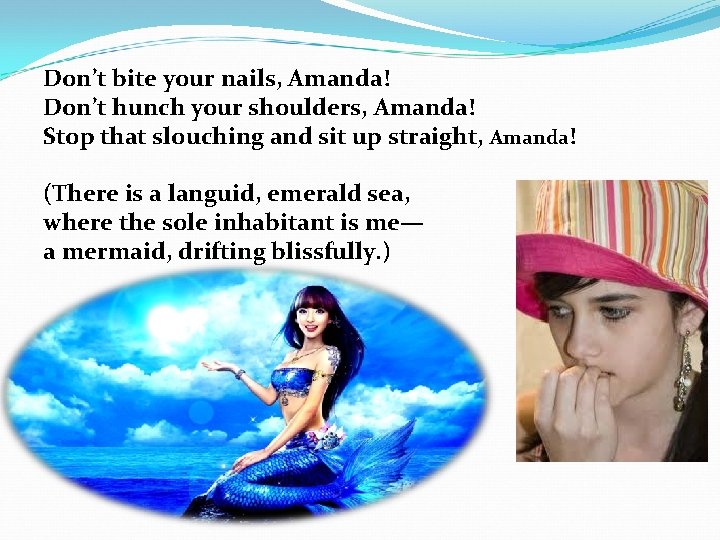
Don’t bite your nails, Amanda! Don’t hunch your shoulders, Amanda! Stop that slouching and sit up straight, Amanda! (There is a languid, emerald sea, where the sole inhabitant is me— a mermaid, drifting blissfully. )
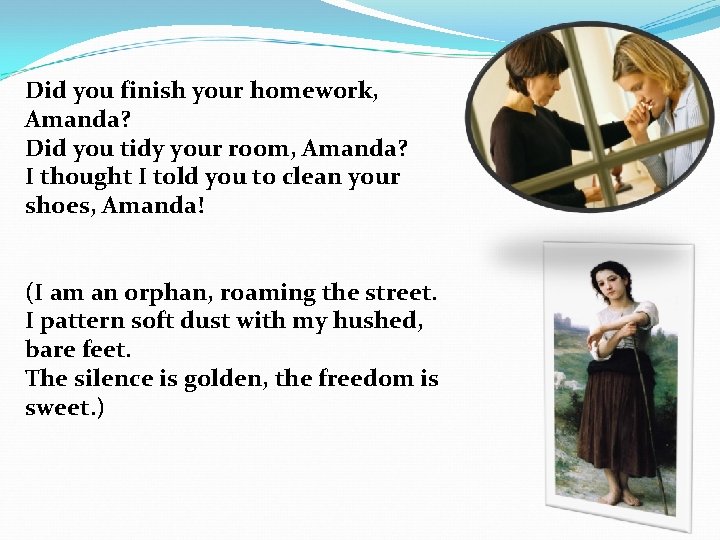
Did you finish your homework, Amanda? Did you tidy your room, Amanda? I thought I told you to clean your shoes, Amanda! (I am an orphan, roaming the street. I pattern soft dust with my hushed, bare feet. The silence is golden, the freedom is sweet. )
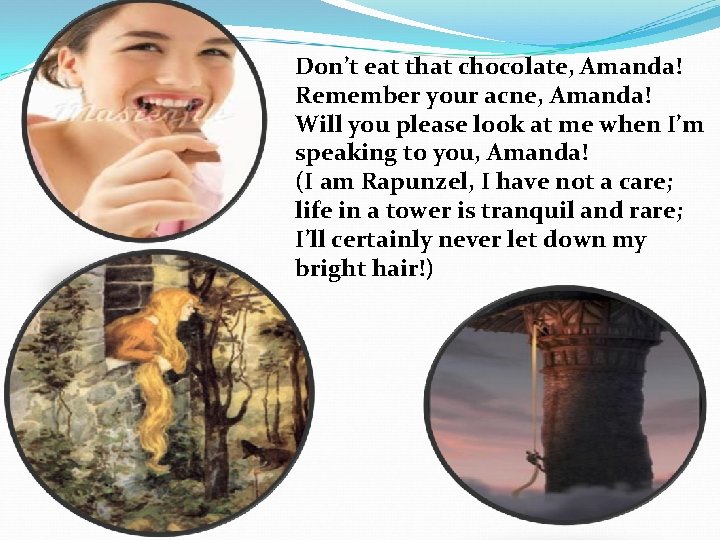
Don’t eat that chocolate, Amanda! Remember your acne, Amanda! Will you please look at me when I’m speaking to you, Amanda! (I am Rapunzel, I have not a care; life in a tower is tranquil and rare; I’ll certainly never let down my bright hair!)
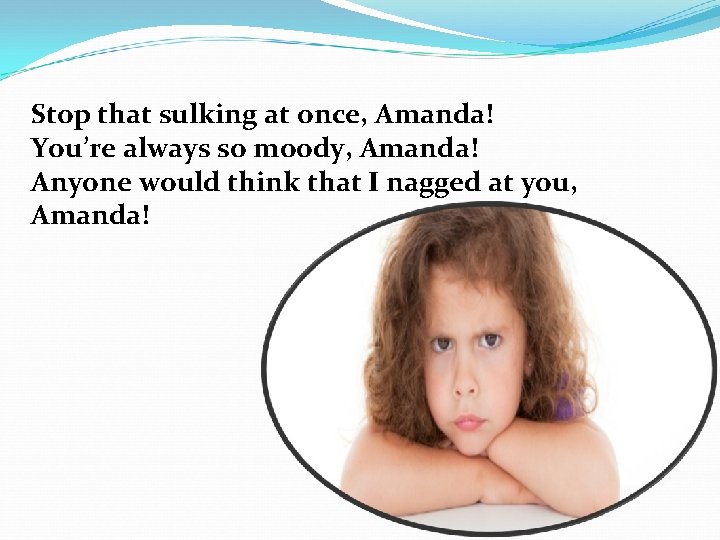
Stop that sulking at once, Amanda! You’re always so moody, Amanda! Anyone would think that I nagged at you, Amanda!
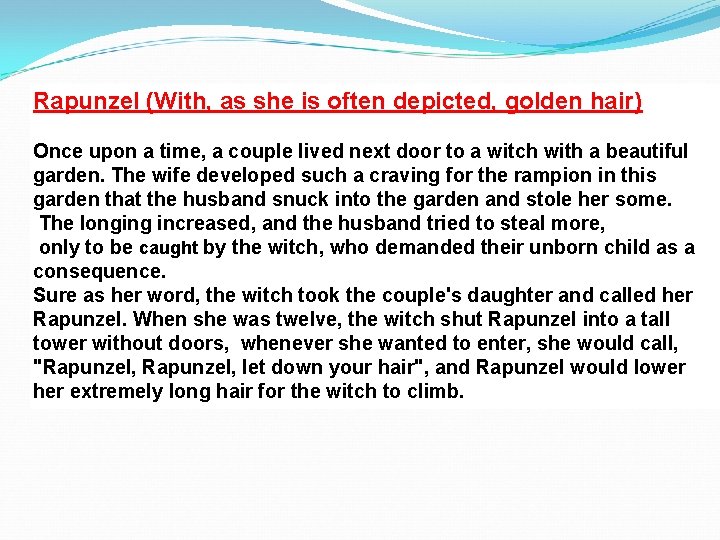
Rapunzel (With, as she is often depicted, golden hair) Once upon a time, a couple lived next door to a witch with a beautiful garden. The wife developed such a craving for the rampion in this garden that the husband snuck into the garden and stole her some. The longing increased, and the husband tried to steal more, only to be caught by the witch, who demanded their unborn child as a Rapunzel consequence. Sure as her word, the witch took the couple's daughter and called her Rapunzel. When she was twelve, the witch shut Rapunzel into a tall tower without doors, whenever she wanted to enter, she would call, "Rapunzel, let down your hair", and Rapunzel would lower her extremely long hair for the witch to climb.
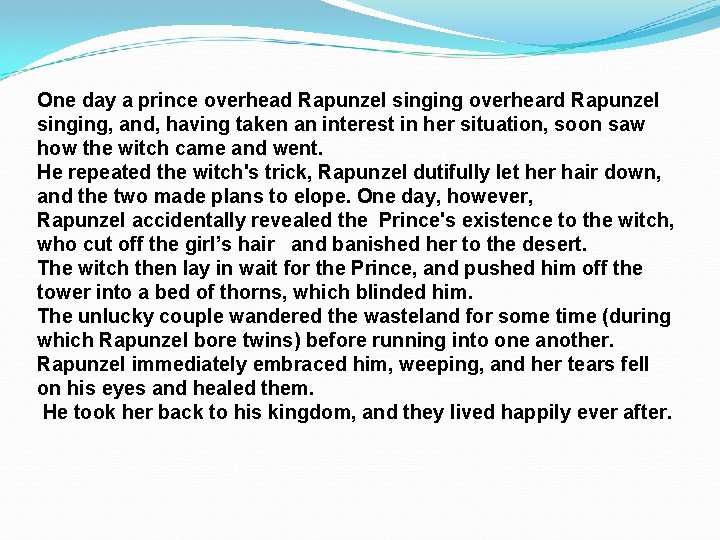
One day a prince overhead Rapunzel singing overheard Rapunzel singing, and, having taken an interest in her situation, soon saw how the witch came and went. He repeated the witch's trick, Rapunzel dutifully let her hair down, and the two made plans to elope. One day, however, Rapunzel accidentally revealed the Prince's existence to the witch, who cut off the girl’s hair and banished her to the desert. The witch then lay in wait for the Prince, and pushed him off the tower into a bed of thorns, which blinded him. The unlucky couple wandered the wasteland for some time (during which Rapunzel bore twins) before running into one another. Rapunzel immediately embraced him, weeping, and her tears fell on his eyes and healed them. He took her back to his kingdom, and they lived happily ever after.
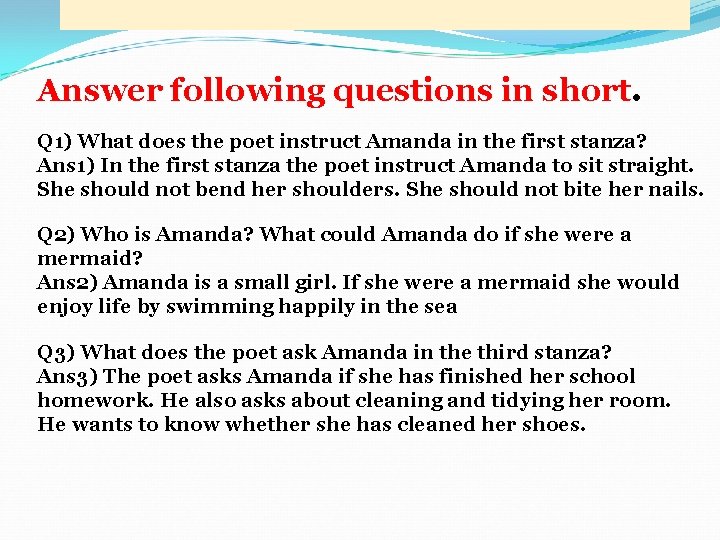
Answer following questions in short. Q 1) What does the poet instruct Amanda in the first stanza? Ans 1) In the first stanza the poet instruct Amanda to sit straight. She should not bend her shoulders. She should not bite her nails. Q 2) Who is Amanda? What could Amanda do if she were a mermaid? Ans 2) Amanda is a small girl. If she were a mermaid she would enjoy life by swimming happily in the sea Q 3) What does the poet ask Amanda in the third stanza? Ans 3) The poet asks Amanda if she has finished her school homework. He also asks about cleaning and tidying her room. He wants to know whether she has cleaned her shoes.
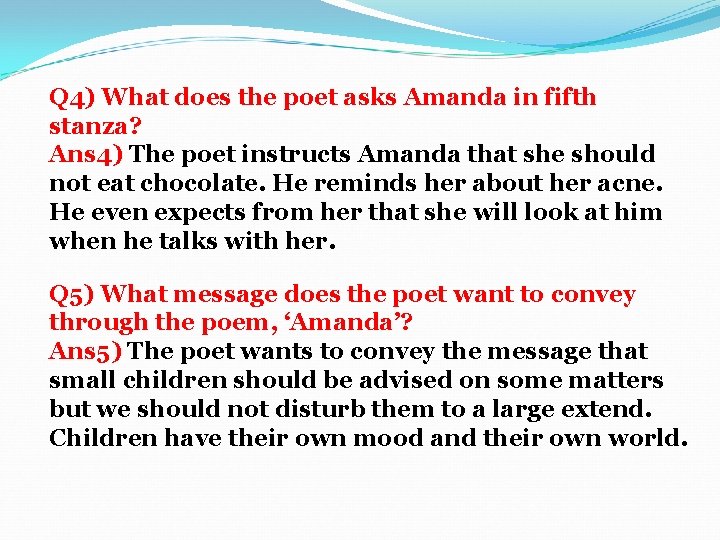
Q 4) What does the poet asks Amanda in fifth stanza? Ans 4) The poet instructs Amanda that she should not eat chocolate. He reminds her about her acne. He even expects from her that she will look at him when he talks with her. Q 5) What message does the poet want to convey through the poem, ‘Amanda’? Ans 5) The poet wants to convey the message that small children should be advised on some matters but we should not disturb them to a large extend. Children have their own mood and their own world.

Prepared by Poonam Yadav Senior Teacher of English GGSSS, LBD, Raghunathsar Kuan, Bikaner Mob: 01512231253 Rajendra Prasad Lecturer in English GSSS, Suratgarh (Sri Ganganagar) Mob: 9929842897

Academic Support Ram Gopal Sharma Chief Resource Person ELTI, IASE, Bikaner Edited by Rameshwar Lal Basera Reader, ELTI, IASE, Bikaner Facilitated by Yashoda Khatri Resource Person, ELTI, IASE, Bikaner Issued by CM Gangwal Director ELTI, IASE, Bikaner

English Language Teaching Institute IASE Campus, Opposite Dr. Karni Singh Stadium Bikaner (Rajasthan) India 334001 Material available for download at http: //eltirajasthan. wordpress. com eltirajasthan@gmail. com Also visit us eltirajasthan @eltirajasthan
- Slides: 23