
English Language Revision A 2 Unit 3 Developing
- Slides: 45
English Language Revision A 2 Unit 3 – Developing Language Change
English Language Revision A 2 Unit 3 – Developing Language: Language Change This revision session will cover: • • The Exam: structure and requirements Examiners’ Feedback A concise history of the English Language Applying the Linguistic Methods
The Exam Let’s begin by briefly recapping how you will be examined …and how you can gain marks We’ll go through this bit quickly for now… but you should download this presentation and go through the following pages more thoroughly in your own time
Unit 3 – ENGB 3 Remember how Change fits into the overall A 2 Assessment A 2 Language Exam • 30% of A Level • 2 hour 30 minutes written examination • 96 marks Builds on AS knowledge and skills, with an additional focus on two new areas of language study: Child Language Acquisition and Language Change.
Unit 3 – ENGB 3 You are expected to develop your skills and knowledge from your AS studies, with an additional focus on two new topics: • the acquisition of language by children • the development of and changes in English over time. This unit takes further the study of social contexts, genres of speech, writing and multi-modal texts first explored at AS by embedding questions about language development in particular contexts of use.
Section B – Language Change This topic area explores historical and contemporary changes in the English Language from Late Modern English (1700+) to the present day, alongside explanations of their causes and impact. This module will focus on the following areas for study: • attitudes towards language change and the impact of language standardisation • changes in orthography, grammar, lexis and punctuation • changes in written and spoken style • the impact of social and political forces upon language usage and change • changes in layout and text design in written texts.
Mode of Assessment will be by one written paper of 2 ½ hours. You will be required to answer two questions based on a selection of data relating to the topic areas, one on Language Acquisition and one on Language Change. You will have a choice of two questions for each topic. Each question will be worth a maximum of 48 marks. The maximum total mark for this paper is 96.
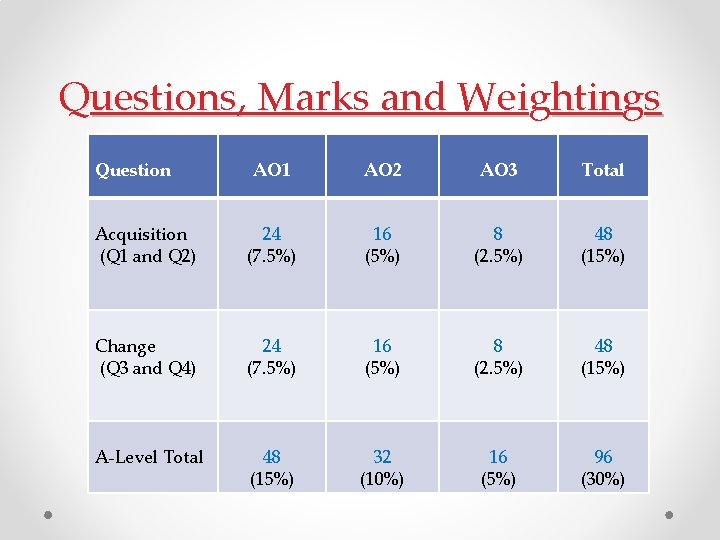
Questions, Marks and Weightings Question AO 1 AO 2 AO 3 Total Acquisition (Q 1 and Q 2) 24 (7. 5%) 16 (5%) 8 (2. 5%) 48 (15%) Change (Q 3 and Q 4) 24 (7. 5%) 16 (5%) 8 (2. 5%) 48 (15%) A-Level Total 48 (15%) 32 (10%) 16 (5%) 96 (30%)
Assessment Objectives (AOs) AO 1 Select and apply a range of linguistic methods to communicate relevant knowledge using appropriate terminology and coherent, accurate written expression AO 2 Demonstrate critical understanding of a range of concepts and issues related to the construction and analysis of meanings in spoken and written language, using knowledge of linguistic approaches AO 3 Analyse and evaluate the influence of contextual factors on the production and reception of spoken and written language, showing knowledge of the key constituents of language
Quality of Written Communication (QWC) In GCE specifications which require you to produce written material in English, you must: • ensure that text is legible and that spelling, punctuation and grammar are accurate so that meaning is clear • select and use a form and style of writing appropriate to purpose and to complex subject matter • organise information clearly and coherently, using specialist vocabulary when appropriate. In this specification QWC will be assessed in all units by means of AO 1.
The Synoptic Element This “Synoptic” Assessment in A 2 English Language requires you to synthesise the insights you have developed through the application of linguistic knowledge to the study of speech and writing, including multimodal texts. Critical understanding of meaning and variation in language will be informed by the appropriate use of linguistic analyses. You will need to demonstrate your skills of interpretation and expression in insightful, accurate, well-argued responses.
The Synoptic Element In Unit 3, Developing Language, you will be assessed on your ability to analyse and evaluate spoken and written language in both its immediate and wider contexts. You will be expected to develop further your knowledge and understanding of key concepts and theories about language. Your will build on your AS study by working with data on a more demanding level in order to frame responses to questions. Questions on language change will require you to work with data in order to explore historical and contemporary changes in the English language, alongside explanations of their causes and their impact.
The Synoptic Element So, A 2 / Unit 3 is designed to stretch and challenge by asking you to: • make connections across all units • demonstrate your knowledge and understanding of major research ideas • study language beyond its immediate context by looking at geographical, social and temporal contexts • develop your skills of working with more demanding data in order to develop critical insights informed by ideas from language study
Feedback from the Examiners • The best responses are the ones that take the most interesting starting points for paragraphs of analysis; these could be linguistically led, theory led or context led. • At the highest level students are open minded, tentative and selective in what they choose to discuss. They have also spent time reading the data, annotating it carefully to get a sense of overview and have thought about how to structure their answers before putting pen to paper. • Synopticity was evident and many students were writing convincingly about features of the change data especially which related to AS topics, such as power, technology and gender. Students who only concentrated on AS issues, although gaining credit, perhaps missed out on ‘range’ because they did not demonstrate their A 2 knowledge of change concepts.
Feedback from the Examiners • On the final unit of an A Level English Language paper it is reasonable to expect high standards of mechanical control and accuracy; some students do not take advantage of the time allowed for planning and proof-reading. The fluency and readability of responses was greatly enhanced where students had learned the basic techniques of quotation and comment (eg grouping multiple examples of similar features) and were able to use appropriate terminology accurately. • AO 1 not only encompasses the application of linguistic methods and the use of appropriate terminology but also refers to the need to communicate knowledge with ‘coherent, accurate written expression’. • If the response is overly descriptive, then it is placed in the 4 -9 band (AO 1). Students need to offer explanations/analysis of features to move to the ‘some’ and above bands.
Feedback from the Examiners • The best responses went beyond the surface features which were relatively easy to identify and discuss, and also engaged with the underlying pragmatic and contextual issues. Most students attempting these questions are able to make some valid links to their understanding of trends in language change, with far fewer attempts simply to reproduce a chronological history of English. • Responses that scored less highly often included lengthy digressions addressing either concepts/theories or contexts which moved away from the data towards much broader socio-historicalcultural -linguistic theory. • Less successful students tended to lack overview and focused on describing isolated examples of dated language use.
Feedback from the Examiners • There can be a tendency to structure essays with conclusions but these rarely add to the overall marks, as they mostly contained repeated information. Students would be better served by spending their time offering another analytical paragraph that made new creditable points. • Candidates performed best in their Change answers if they had considered the genre of the texts. This then assisted them to focus on interesting linguistic features and select relevant language concepts, instead of feature spotting. Those candidates with an awareness of why writers of texts might use certain language features, or why they might adopt a particular style or tone, could engage both with linguistic choices and make sensible comments on changes over time.
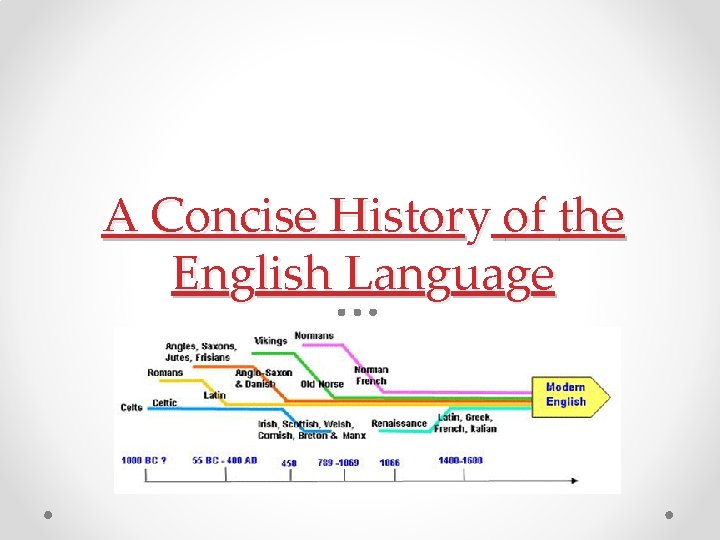
A Concise History of the English Language
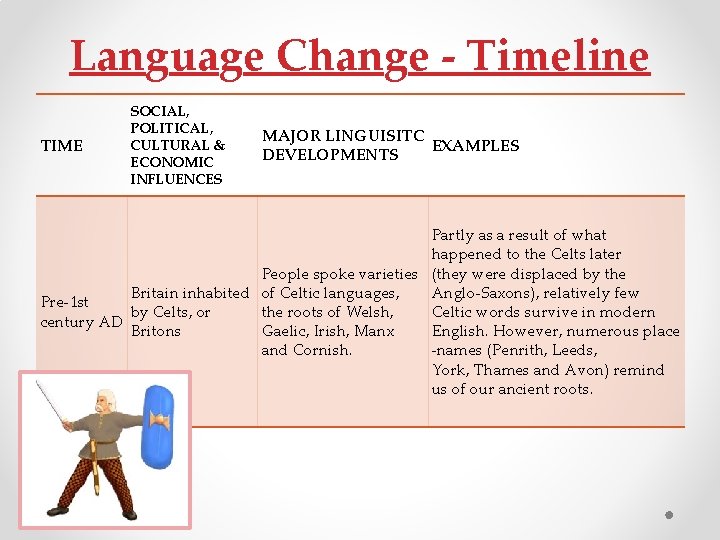
The History of English Before English began - up to ca. 450 AD • British (Celtic) tribes - language related to modern Welsh, Scots Gaelic and Irish ( Erse). Only real connection with Modern English is in lexis (mostly in place names). Origins of English - ca. 450 AD to 1066 • Angles, Saxons and Jutes arrive from north Germany · Language (Old English) is at first spoken · only writing is runes · Written form comes from Latin-speaking monks, who use Roman alphabet, with new letters (æ, ð and þ - spoken as "ash", "eth" and "thorn") · About half of common vocabulary of modern English comes from Old English · Word forms vary according to syntax (inflection, case endings and declension) and grammatical gender · Vikings establish Danelaw · some erosion of grammar and addition of new vocabulary. Middle English Period - 1066 to 1485 • Lexis - terms for law and politics from Norman French · General expansion of lexis, esp. abstract terms · Case-endings, declension and gender disappear · Inflection goes except in pronouns and related forms · Writers concerned about change · want to stabilize language · 1458 - Gutenberg invents printing (1475 Caxton introduces it to England) · the press enables some standardizing. Tudor Period - 1485 to 1603 • Rise of nationalism linked to desire for more expressive language · Flowering of literature and experiments in style · idea of elevated diction · Vocabulary enlarged by new learning Renaissance) · imports from Greek and Latin · Lexis expanded by travel to New World, and ideas in maths and science · English settlers begin to found colonies in North America. In 1582 Richard Mulcaster publishes a list of 7, 000 words with spelling forms, but this does not become a universal standard
The History of English The 17 th Century • Influences of Puritanism and Catholicism (Roundhead and Cavalier) and of science · Puritan ideas of clarity and simplicity influence writing of prose· reasonableness and less verbose language · English preferred to Dutch as official tongue of American colonies. The 18 th Century • Age of reason · Ideas of order and priority · Standardizing of spelling (Johnson' s Dictionary of the English Language in 1755) and grammar (Robert Lowth's Short Introduction to English Grammar in 1762 and Lindley Murray's English Grammar in 1794)· Classical languages are seen as paradigms (ideal models) for English · Romantic Movement begins · interest in regional and social class varieties of English. The 19 th Century • Interest in past · use of archaic words · Noan Webster publishes American Dictionary of the English Language in 1828 · British Empire causes huge lexical growth · English travels to other countries and imports many loanwords · Modern language science begins with Jakob Grimm and others · James Murray begins to compile the New English Dictionary (which later becomes the Oxford English Dictionary) in 1879 The 20 th Century and beyond • Modern language science developed · descriptive not prescriptive · Non-standard varieties have raised status · Ideas of formal and informal change · Modern recording technology allows study of spoken English · Influence of overseas forms grows · US and International English dominant · English becomes global language (e. g. in computing, communications, entertainment).
Language Change - Timeline TIME SOCIAL, POLITICAL, CULTURAL & ECONOMIC INFLUENCES MAJOR LINGUISITC EXAMPLES DEVELOPMENTS Partly as a result of what happened to the Celts later People spoke varieties (they were displaced by the Britain inhabited of Celtic languages, Anglo-Saxons), relatively few Pre-1 st by Celts, or the roots of Welsh, Celtic words survive in modern century AD Britons Gaelic, Irish, Manx English. However, numerous place and Cornish. -names (Penrith, Leeds, York, Thames and Avon) remind us of our ancient roots.
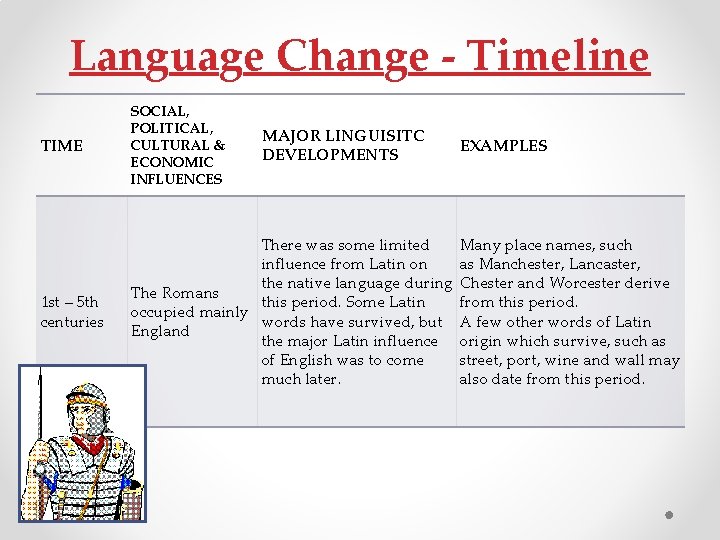
Language Change - Timeline TIME SOCIAL, POLITICAL, CULTURAL & ECONOMIC INFLUENCES 1 st – 5 th centuries There was some limited influence from Latin on the native language during The Romans this period. Some Latin occupied mainly words have survived, but England the major Latin influence of English was to come much later. MAJOR LINGUISITC DEVELOPMENTS EXAMPLES Many place names, such as Manchester, Lancaster, Chester and Worcester derive from this period. A few other words of Latin origin which survive, such as street, port, wine and wall may also date from this period.
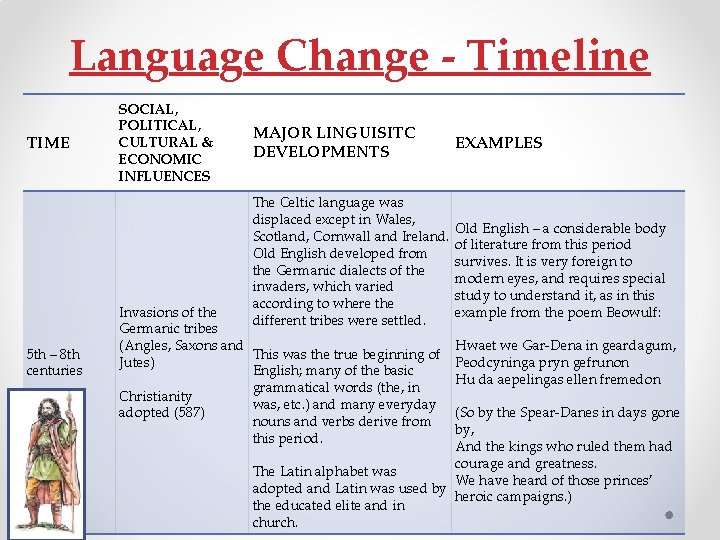
Language Change - Timeline TIME SOCIAL, POLITICAL, CULTURAL & ECONOMIC INFLUENCES MAJOR LINGUISITC DEVELOPMENTS The Celtic language was displaced except in Wales, Scotland, Cornwall and Ireland. Old English developed from the Germanic dialects of the invaders, which varied according to where the different tribes were settled. 5 th – 8 th centuries Invasions of the Germanic tribes (Angles, Saxons and This was the true beginning of Jutes) English; many of the basic grammatical words (the, in Christianity was, etc. ) and many everyday adopted (587) nouns and verbs derive from this period. EXAMPLES Old English – a considerable body of literature from this period survives. It is very foreign to modern eyes, and requires special study to understand it, as in this example from the poem Beowulf: Hwaet we Gar-Dena in geardagum, Peodcyninga pryn gefrunon Hu da aepelingas ellen fremedon (So by the Spear-Danes in days gone by, And the kings who ruled them had courage and greatness. The Latin alphabet was We have heard of those princes’ adopted and Latin was used by heroic campaigns. ) the educated elite and in church.
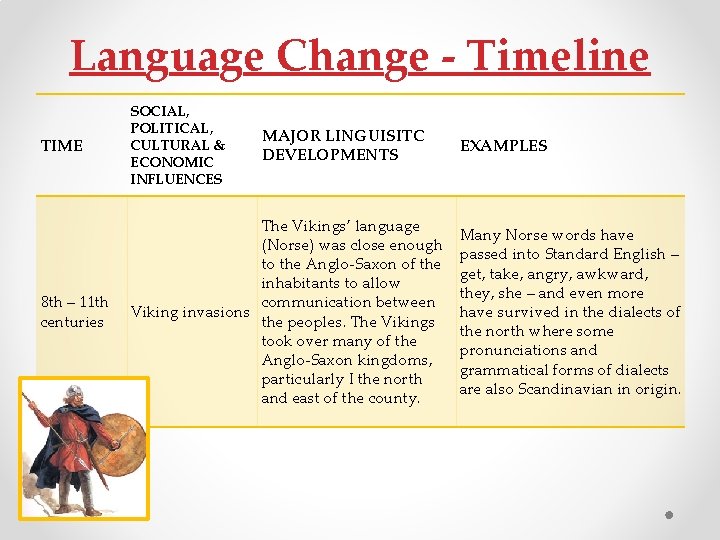
Language Change - Timeline TIME SOCIAL, POLITICAL, CULTURAL & ECONOMIC INFLUENCES 8 th – 11 th centuries The Vikings’ language (Norse) was close enough to the Anglo-Saxon of the inhabitants to allow communication between Viking invasions the peoples. The Vikings took over many of the Anglo-Saxon kingdoms, particularly I the north and east of the county. MAJOR LINGUISITC DEVELOPMENTS EXAMPLES Many Norse words have passed into Standard English – get, take, angry, awkward, they, she – and even more have survived in the dialects of the north where some pronunciations and grammatical forms of dialects are also Scandinavian in origin.
Language Change - Timeline TIME 11 th – 14 th centuries SOCIAL, POLITICAL, CULTURAL & ECONOMIC INFLUENCES MAJOR LINGUISITC DEVELOPMENTS 1066: the Normans invaded, led by William the Conqueror Norman French and English co-existed This was the beginning of the Middle English period; there was an inevitable flow of vocabulary from Norman Following the Norman invasion, French (itself heavily based on Latin) into English not only there was a French-speaking power bas – the court, the church survived but was enriched by the language of the invaders. and major landowners were mainly French-speaking, while This period also saw the loss of many the populace spoke English. Old English word endings (inflections), many of which were During the twelfth century replaced with the prepositions by, English was more widely used by the upper classes and in 1362 with, from etc. was used for the first time at the Much Middle English literature state opening of parliament. By survives and is reasonably accessible 1425 English was used universally in speech and writing. to patient modern readers. This period also saw the beginnings of a major change in English pronunciation: the Great Vowel Shift. EXAMPLES
Language Change - Timeline TIME SOCIAL, POLITICAL, CULTURAL & ECONOMIC INFLUENCES MAJOR LINGUISITC DEVELOPMENTS EXAMPLES Early modern English: In the period 1500 – 1700 many more words entered the language than at any other period. 15 th- 17 th centuries Printing invented (William Caxton set up his press in There was a gradual acceptance of a standard form 1746) of English, made necessary by the increasing dissemination Many Greek and Latin texts were of printed materials. translated into English New words were needed for new concepts and an influx of Latin and French words resulted. This period of world exploration also brought words from the language of Africa, Asia and the New World. The Great Vowel Shift was completed – and the pronunciation of English began to stabilise. This was also the age of Shakespeare, himself a great coiner of words.
Language Change - Timeline TIME SOCIAL, POLITICAL, CULTURAL & ECONOMIC INFLUENCES The search for a 18 th – 19 th standard, pure centuries form of English MAJOR LINGUISITC DEVELOPMENTS EXAMPLES Attempts to define the vocabulary and grammar of English led to the establishment of the prescriptive ideas about correctness. Non-standard varieties were viewed as inferior; Latin was upheld as an ideal language and a model for English dictionary writers and grammarians tried to lay down rules for correct usage. • This was the age of the dictionary, when writers tried to ‘fix’ spellings and meanings. 1721 – Nathaniel’s Bailey’s Universal Etymological Dictionary • 1755 – Samuel Johnson’s English Dictionary • 1762 – Robert Lowth’s Short Introduction to English Grammar • 1762 – Lindley Murray’s English Grammar
Language Change - Timeline TIME SOCIAL, POLITICAL, CULTURAL & ECONOMIC INFLUENCES The Expansion of 19 th century British and – present American English MAJOR LINGUISITC DEVELOPMENTS In the nineteenth century, rail travel colonial expansion, the spread of literacy and education and the printed word extended access to standard and written forms of English. EXAMPLES American English was starting to become noticeably different from British English continues to absorb loan words from language across the world. Grammar and pronunciation see few major changes, but in the late twentieth and early twenty-first centuries, a Electronic media extended this drift towards more colloquial and process in the twentieth casual styles of language in many century; meanwhile, American contexts reflect major social economic and political power changes. succeeded that of the British empire to ensure the spread of American English increasingly English as a world language. influence British English and English worldwide.
Change is All Around Us As society change, so does language. We are living in a world that has become technical (language and technology). Are we becoming lazier with language? Lifestyles have changed and the pace of life is quicker; we expect instant communication (text messaging, e-mails). Features language change include controversy, resistance and social values.
Changes in Accent and Dialect • William Labov study (Martha’s vineyard) • Urban accents (Estuary English) • Prestige (BBC English, RP) • 15 th Century – The Great Vowel Shift Tochter – daughter Nacht – night – nite? Leisure – ‘zh’ pronunciation, also applies to measure, pleasure and treasure Swan and man; obey and tea (word that used to rhyme and few centuries ago but not today. Interest, every, factory, nursery, cursory, desultory – ‘uh’ sound (ə = schwa)
Attitudes to Language Change • Standard English – right and wrong (National Curriculum, for example). Should it remain constant or should it change? People start making judgements about language change. • Prescriptive – laying down rules which are very exact, for example, compu’er (the ‘t’ must be added). In other words, what English language SHOULD be like. • Descriptive – language change is inevitable, for example, Sainsbury’s (some add the apostrophe, others do not). In other words, what English language IS like. • Golden Age - when did people, speak the same, write in the same handwriting and spell coherently? • It is almost impossible to stop language changing (evolution) • What is proper English? Issues of race, class, gender and location.
The Beginnings of Global English • Significant period in English: Middle English – Early Modern English (15 th, 16 and 17 th centuries). • There should not have been any reason for language change because people never travelled far (within three miles) and only talked about predictable things (weather, money, work, family, food etc). • Over the past thousand years, language change was very slow, until invaders visited the country. • The Renaissance – rediscovery of learning occurred during the 15 th century. More people were educated and breaking away form the repressive authority from the church, which controlled learning. People were travelling frequently, more medical discoveries and freedom of thought. • Many borrowings from Latin, Greek (languages of education and thought), French (language of luxury and style) and Italian (language of the arts – growth of theatre encouraged new words). Words became naturalised in English language. This is still very consistent in the 21 st century.
The Beginnings of Global English • Shakespeare invented over 3000 words such as lovely, skim milk and mountaineer. He mainly extended words or put two words together. • 16 th and 17 th centuries were the age of travel. There were borrowings from Spanish and Portuguese languages (words tended to end with vowel sounds such as banana, tobacco and canoe) and settlement from America, which was already settled by the Spanish. Many cigarette companies are named after American towns, for example, Marlboro (a town in West Virginia). • English was looked down upon and then became as good as Latin when expressing love, due to Shakespeare’s work. It is beginning to become a global language. • Lexis was borrowed from explorations, nowadays the main influence is media and technology. • 1610 – The Authorised Version of the Bible was published for the masses. Full of phrases such as eat sour grapes, the skin of my teeth and the salt of the earth. • The main five world languages originate from Indo-European languages, but have evolved sounds which cannot be understood in English language, for example, China, Japan and India.
Applying the Linguistic Methods
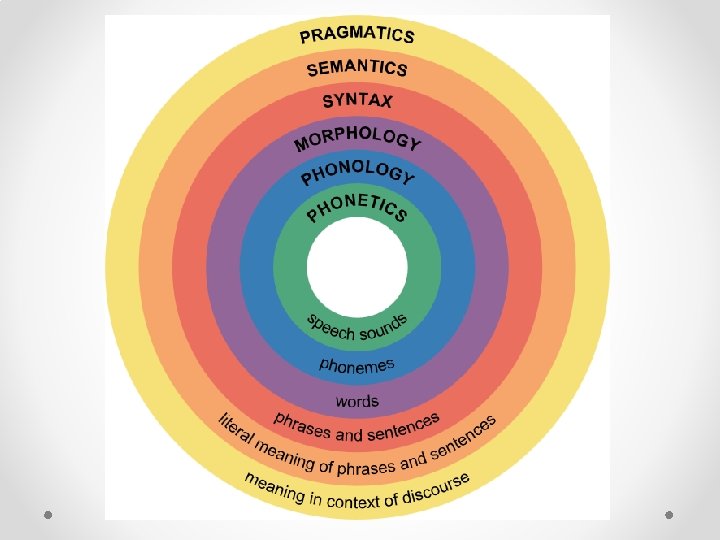
Discourse • How is cohesion created? • Is there evidence of contrasting registers? • Is there evidence of dialogue or narrative structures? Are there any interpersonal features? • Is there evidence of different discourse conventions? • Is there one general viewpoint or several? • Is the register formal or informal? • Is there a difference in purpose between the texts or in an older text compared to your knowledge of modern texts?
Pragmatics • Is the reader expected to recognise and identify with specific societal roles? • Is the reader expected to share social codes and values? • Is the reader expected to accept particular roles and responsibilities? • Is the reader expected to accept particular social attitudes/ cultural assumptions? • What attitude is expressed about language: prescriptive or descriptive? • Are assumptions made about the readers’ knowledge and understanding? • Is there evidence of changing values or ideologies?
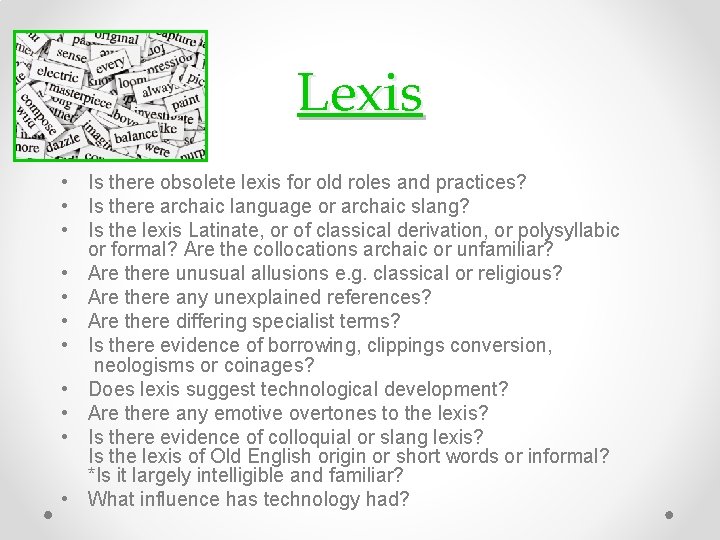
Lexis • Is there obsolete lexis for old roles and practices? • Is there archaic language or archaic slang? • Is the lexis Latinate, or of classical derivation, or polysyllabic or formal? Are the collocations archaic or unfamiliar? • Are there unusual allusions e. g. classical or religious? • Are there any unexplained references? • Are there differing specialist terms? • Is there evidence of borrowing, clippings conversion, neologisms or coinages? • Does lexis suggest technological development? • Are there any emotive overtones to the lexis? • Is there evidence of colloquial or slang lexis? Is the lexis of Old English origin or short words or informal? *Is it largely intelligible and familiar? • What influence has technology had?
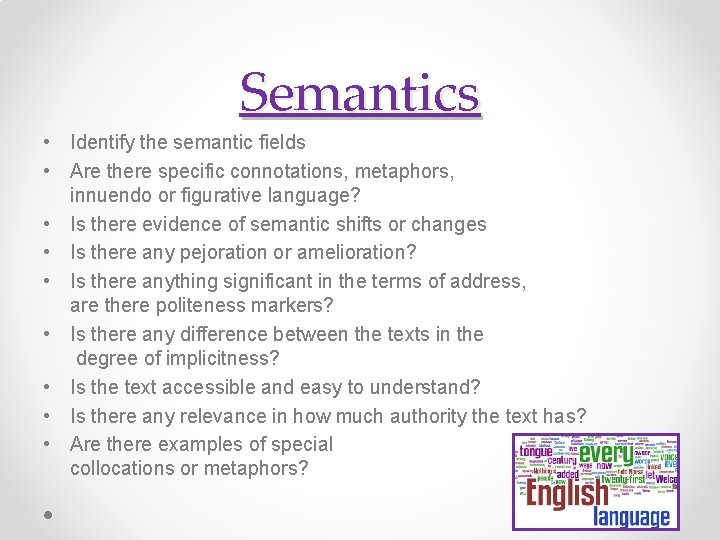
Semantics • Identify the semantic fields • Are there specific connotations, metaphors, innuendo or figurative language? • Is there evidence of semantic shifts or changes • Is there any pejoration or amelioration? • Is there anything significant in the terms of address, are there politeness markers? • Is there any difference between the texts in the degree of implicitness? • Is the text accessible and easy to understand? • Is there any relevance in how much authority the text has? • Are there examples of special collocations or metaphors?
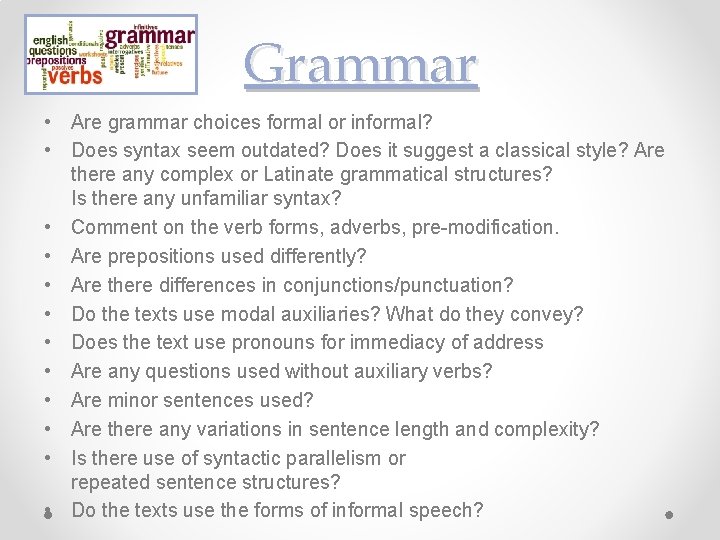
Grammar • Are grammar choices formal or informal? • Does syntax seem outdated? Does it suggest a classical style? Are there any complex or Latinate grammatical structures? Is there any unfamiliar syntax? • Comment on the verb forms, adverbs, pre-modification. • Are prepositions used differently? • Are there differences in conjunctions/punctuation? • Do the texts use modal auxiliaries? What do they convey? • Does the text use pronouns for immediacy of address • Are any questions used without auxiliary verbs? • Are minor sentences used? • Are there any variations in sentence length and complexity? • Is there use of syntactic parallelism or repeated sentence structures? • Do the texts use the forms of informal speech?
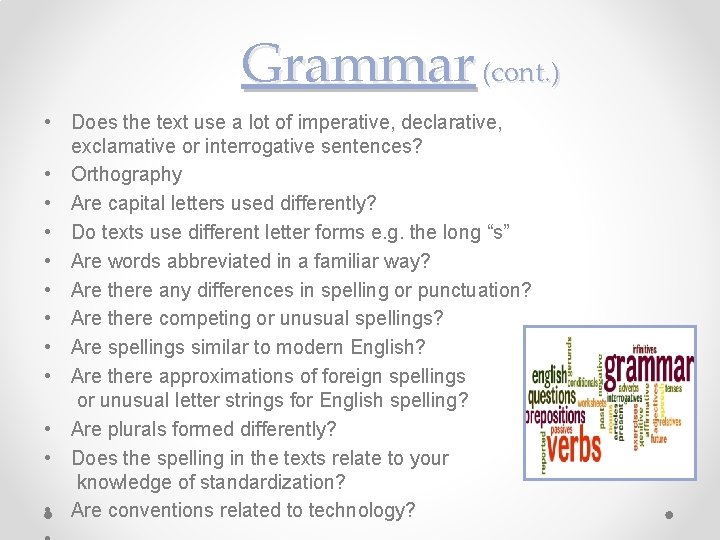
Grammar (cont. ) • Does the text use a lot of imperative, declarative, exclamative or interrogative sentences? • Orthography • Are capital letters used differently? • Do texts use different letter forms e. g. the long “s” • Are words abbreviated in a familiar way? • Are there any differences in spelling or punctuation? • Are there competing or unusual spellings? • Are spellings similar to modern English? • Are there approximations of foreign spellings or unusual letter strings for English spelling? • Are plurals formed differently? • Does the spelling in the texts relate to your knowledge of standardization? • Are conventions related to technology?
Graphology • How are fonts used, for example - to assist discourse structure/for emphasis? • How are illustrations used? • Are there different design or layout conventions, for example - bar code, price and logo slogans? • Is there a greater use of graphological devices to signal text structure, for example - space-shifting, textboxes, bullet points; or systematic, colour coded layout, headings. •
Bring In Your Wider Knowledge • Stronger answers will place the text within a sociolinguistic and socio -cultural perspective. • Some students will be able to make connections between this text and other texts they have encountered. • There may be references to other developments relevant to language change including those in education, economic development and popular culture. • Can you show differences in situational as well as temporal variation - you are aware of how the situation in which this text is produced influences the language as well as when it was produced.
Try to Ask Yourself • • • What sort of societal roles are implied? How does the text position the reader? What attitudes to the text are assumed? Is there an authoritative tone? Is there a religious context assumed? Is there an assumption about the reader’s education? • Is there evidence of a prescriptivist attitude?
Try To Ask Yourself • • • What can be assumed about the audience? What is the social and linguistic context? What evidence does it supply about attitudes to language change? What evidence is there of attitudes to gender, class and ethnicity? What evidence is there of the society’s different technologies and priorities? What sort of situation produced this text? What are the genre conventions of this text? Does it reflect specific economic or scientific priorities of the time? What comparisons can you make to modern texts/use of language? Does the text represent the views of a particular section of society?
Remember the Following • The pre-eminence enjoyed by English in the world today is a result of political and economic factors – first, the extension of the British Empire, and in the twentieth century, the power of the USA. • Observable changes in accent can take place over a relatively short period of time, and are closely related to questions of social class and identity. • Linguistic change is constant and inevitable, but can also be the subject of complaint and controversy.