
English Language Paper 2 Close Language Analysis Tasks
- Slides: 11
English Language Paper 2 Close Language Analysis Tasks Year 10
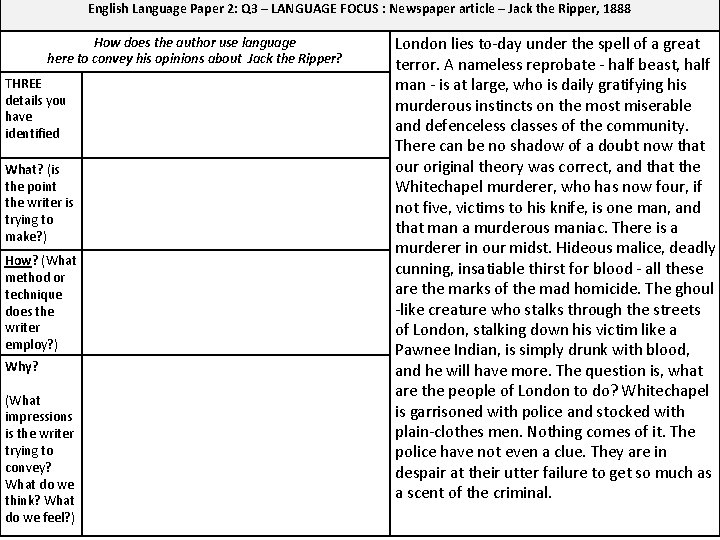
English Language Paper 2: Q 3 – LANGUAGE FOCUS : Newspaper article – Jack the Ripper, 1888 How does the author use language here to convey his opinions about Jack the Ripper? THREE details you have identified What? (is the point the writer is trying to make? ) How? (What method or technique does the writer employ? ) Why? (What impressions is the writer trying to convey? What do we think? What do we feel? ) London lies to-day under the spell of a great terror. A nameless reprobate - half beast, half man - is at large, who is daily gratifying his murderous instincts on the most miserable and defenceless classes of the community. There can be no shadow of a doubt now that our original theory was correct, and that the Whitechapel murderer, who has now four, if not five, victims to his knife, is one man, and that man a murderous maniac. There is a murderer in our midst. Hideous malice, deadly cunning, insatiable thirst for blood - all these are the marks of the mad homicide. The ghoul -like creature who stalks through the streets of London, stalking down his victim like a Pawnee Indian, is simply drunk with blood, and he will have more. The question is, what are the people of London to do? Whitechapel is garrisoned with police and stocked with plain-clothes men. Nothing comes of it. The police have not even a clue. They are in despair at their utter failure to get so much as a scent of the criminal.
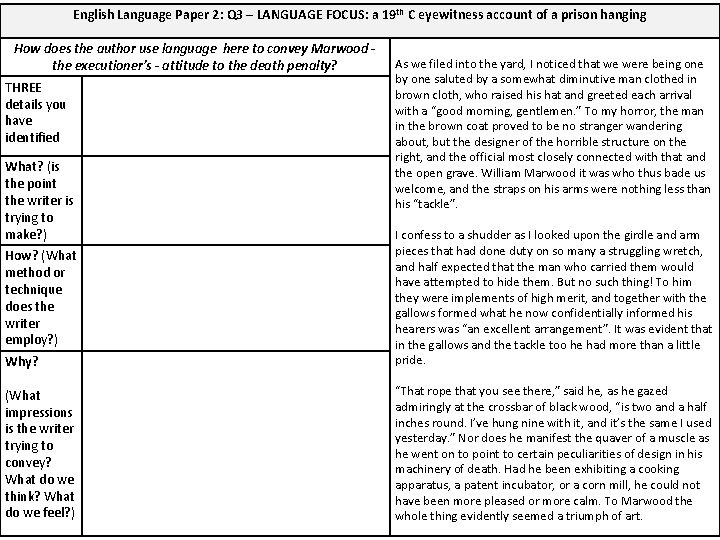
English Language Paper 2: Q 3 – LANGUAGE FOCUS: a 19 th C eyewitness account of a prison hanging How does the author use language here to convey Marwood the executioner’s - attitude to the death penalty? THREE details you have identified What? (is the point the writer is trying to make? ) As we filed into the yard, I noticed that we were being one by one saluted by a somewhat diminutive man clothed in brown cloth, who raised his hat and greeted each arrival with a “good morning, gentlemen. ” To my horror, the man in the brown coat proved to be no stranger wandering about, but the designer of the horrible structure on the right, and the official most closely connected with that and the open grave. William Marwood it was who thus bade us welcome, and the straps on his arms were nothing less than his “tackle”. Why? I confess to a shudder as I looked upon the girdle and arm pieces that had done duty on so many a struggling wretch, and half expected that the man who carried them would have attempted to hide them. But no such thing! To him they were implements of high merit, and together with the gallows formed what he now confidentially informed his hearers was “an excellent arrangement”. It was evident that in the gallows and the tackle too he had more than a little pride. (What impressions is the writer trying to convey? What do we think? What do we feel? ) “That rope that you see there, ” said he, as he gazed admiringly at the crossbar of black wood, “is two and a half inches round. I’ve hung nine with it, and it’s the same I used yesterday. ” Nor does he manifest the quaver of a muscle as he went on to point to certain peculiarities of design in his machinery of death. Had he been exhibiting a cooking apparatus, a patent incubator, or a corn mill, he could not have been more pleased or more calm. To Marwood the whole thing evidently seemed a triumph of art. How? (What method or technique does the writer employ? )
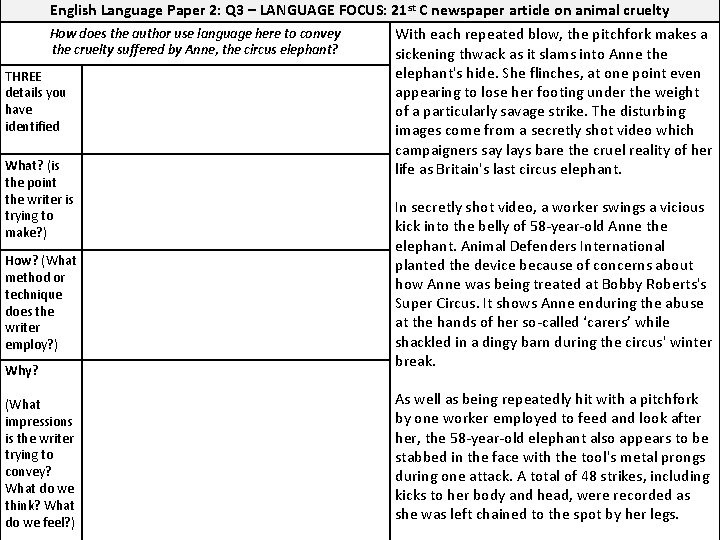
English Language Paper 2: Q 3 – LANGUAGE FOCUS: 21 st C newspaper article on animal cruelty How does the author use language here to convey the cruelty suffered by Anne, the circus elephant? THREE details you have identified What? (is the point the writer is trying to make? ) How? (What method or technique does the writer employ? ) Why? (What impressions is the writer trying to convey? What do we think? What do we feel? ) With each repeated blow, the pitchfork makes a sickening thwack as it slams into Anne the elephant's hide. She flinches, at one point even appearing to lose her footing under the weight of a particularly savage strike. The disturbing images come from a secretly shot video which campaigners say lays bare the cruel reality of her life as Britain's last circus elephant. In secretly shot video, a worker swings a vicious kick into the belly of 58 -year-old Anne the elephant. Animal Defenders International planted the device because of concerns about how Anne was being treated at Bobby Roberts's Super Circus. It shows Anne enduring the abuse at the hands of her so-called ‘carers’ while shackled in a dingy barn during the circus' winter break. As well as being repeatedly hit with a pitchfork by one worker employed to feed and look after her, the 58 -year-old elephant also appears to be stabbed in the face with the tool's metal prongs during one attack. A total of 48 strikes, including kicks to her body and head, were recorded as she was left chained to the spot by her legs.
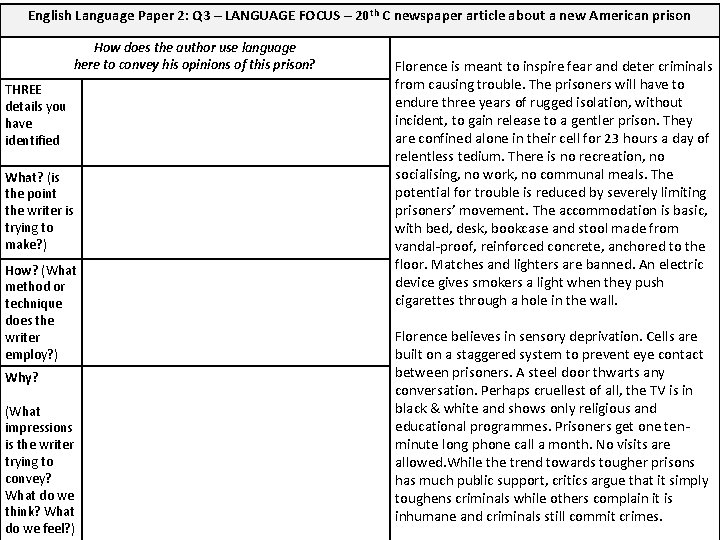
English Language Paper 2: Q 3 – LANGUAGE FOCUS – 20 th C newspaper article about a new American prison How does the author use language here to convey his opinions of this prison? THREE details you have identified What? (is the point the writer is trying to make? ) How? (What method or technique does the writer employ? ) Why? (What impressions is the writer trying to convey? What do we think? What do we feel? ) Florence is meant to inspire fear and deter criminals from causing trouble. The prisoners will have to endure three years of rugged isolation, without incident, to gain release to a gentler prison. They are confined alone in their cell for 23 hours a day of relentless tedium. There is no recreation, no socialising, no work, no communal meals. The potential for trouble is reduced by severely limiting prisoners’ movement. The accommodation is basic, with bed, desk, bookcase and stool made from vandal-proof, reinforced concrete, anchored to the floor. Matches and lighters are banned. An electric device gives smokers a light when they push cigarettes through a hole in the wall. Florence believes in sensory deprivation. Cells are built on a staggered system to prevent eye contact between prisoners. A steel door thwarts any conversation. Perhaps cruellest of all, the TV is in black & white and shows only religious and educational programmes. Prisoners get one tenminute long phone call a month. No visits are allowed. While the trend towards tougher prisons has much public support, critics argue that it simply toughens criminals while others complain it is inhumane and criminals still commit crimes.
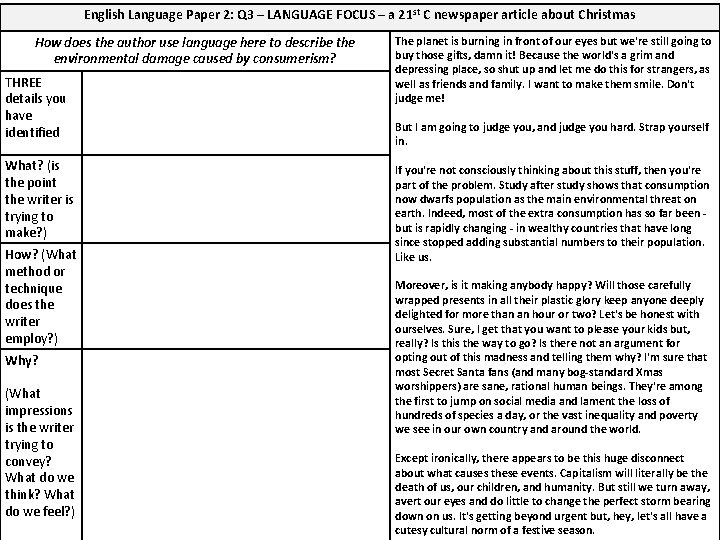
English Language Paper 2: Q 3 – LANGUAGE FOCUS – a 21 st C newspaper article about Christmas How does the author use language here to describe the environmental damage caused by consumerism? THREE details you have identified What? (is the point the writer is trying to make? ) How? (What method or technique does the writer employ? ) Why? (What impressions is the writer trying to convey? What do we think? What do we feel? ) The planet is burning in front of our eyes but we're still going to buy those gifts, damn it! Because the world's a grim and depressing place, so shut up and let me do this for strangers, as well as friends and family. I want to make them smile. Don't judge me! But I am going to judge you, and judge you hard. Strap yourself in. If you're not consciously thinking about this stuff, then you're part of the problem. Study after study shows that consumption now dwarfs population as the main environmental threat on earth. Indeed, most of the extra consumption has so far been but is rapidly changing - in wealthy countries that have long since stopped adding substantial numbers to their population. Like us. Moreover, is it making anybody happy? Will those carefully wrapped presents in all their plastic glory keep anyone deeply delighted for more than an hour or two? Let's be honest with ourselves. Sure, I get that you want to please your kids but, really? Is this the way to go? Is there not an argument for opting out of this madness and telling them why? I'm sure that most Secret Santa fans (and many bog-standard Xmas worshippers) are sane, rational human beings. They're among the first to jump on social media and lament the loss of hundreds of species a day, or the vast inequality and poverty we see in our own country and around the world. Except ironically, there appears to be this huge disconnect about what causes these events. Capitalism will literally be the death of us, our children, and humanity. But still we turn away, avert our eyes and do little to change the perfect storm bearing down on us. It's getting beyond urgent but, hey, let's all have a cutesy cultural norm of a festive season.
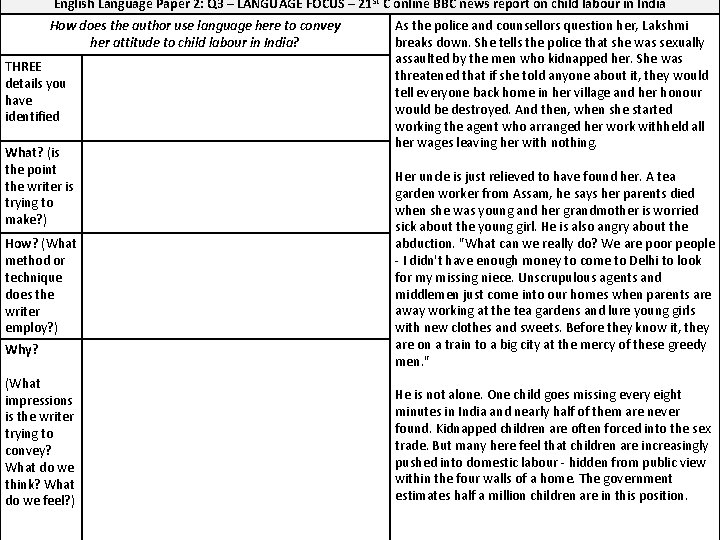
English Language Paper 2: Q 3 – LANGUAGE FOCUS – 21 st C online BBC news report on child labour in India How does the author use language here to convey her attitude to child labour in India? THREE details you have identified What? (is the point the writer is trying to make? ) How? (What method or technique does the writer employ? ) Why? (What impressions is the writer trying to convey? What do we think? What do we feel? ) As the police and counsellors question her, Lakshmi breaks down. She tells the police that she was sexually assaulted by the men who kidnapped her. She was threatened that if she told anyone about it, they would tell everyone back home in her village and her honour would be destroyed. And then, when she started working the agent who arranged her work withheld all her wages leaving her with nothing. Her uncle is just relieved to have found her. A tea garden worker from Assam, he says her parents died when she was young and her grandmother is worried sick about the young girl. He is also angry about the abduction. "What can we really do? We are poor people - I didn't have enough money to come to Delhi to look for my missing niece. Unscrupulous agents and middlemen just come into our homes when parents are away working at the tea gardens and lure young girls with new clothes and sweets. Before they know it, they are on a train to a big city at the mercy of these greedy men. " He is not alone. One child goes missing every eight minutes in India and nearly half of them are never found. Kidnapped children are often forced into the sex trade. But many here feel that children are increasingly pushed into domestic labour - hidden from public view within the four walls of a home. The government estimates half a million children are in this position.
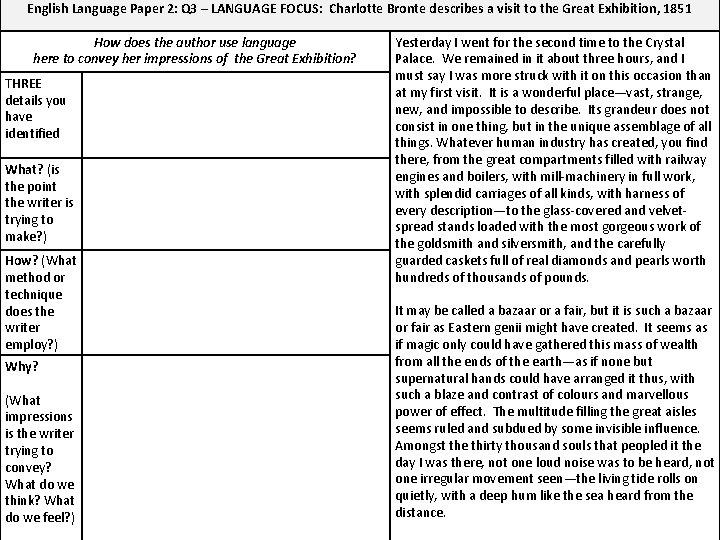
English Language Paper 2: Q 3 – LANGUAGE FOCUS: Charlotte Bronte describes a visit to the Great Exhibition, 1851 How does the author use language here to convey her impressions of the Great Exhibition? THREE details you have identified What? (is the point the writer is trying to make? ) How? (What method or technique does the writer employ? ) Why? (What impressions is the writer trying to convey? What do we think? What do we feel? ) Yesterday I went for the second time to the Crystal Palace. We remained in it about three hours, and I must say I was more struck with it on this occasion than at my first visit. It is a wonderful place—vast, strange, new, and impossible to describe. Its grandeur does not consist in one thing, but in the unique assemblage of all things. Whatever human industry has created, you find there, from the great compartments filled with railway engines and boilers, with mill-machinery in full work, with splendid carriages of all kinds, with harness of every description—to the glass-covered and velvetspread stands loaded with the most gorgeous work of the goldsmith and silversmith, and the carefully guarded caskets full of real diamonds and pearls worth hundreds of thousands of pounds. It may be called a bazaar or a fair, but it is such a bazaar or fair as Eastern genii might have created. It seems as if magic only could have gathered this mass of wealth from all the ends of the earth—as if none but supernatural hands could have arranged it thus, with such a blaze and contrast of colours and marvellous power of effect. The multitude filling the great aisles seems ruled and subdued by some invisible influence. Amongst the thirty thousand souls that peopled it the day I was there, not one loud noise was to be heard, not one irregular movement seen—the living tide rolls on quietly, with a deep hum like the sea heard from the distance.
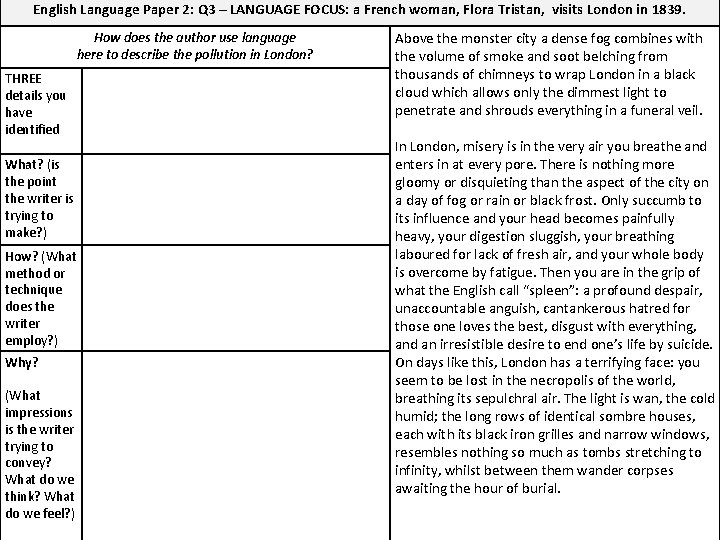
English Language Paper 2: Q 3 – LANGUAGE FOCUS: a French woman, Flora Tristan, visits London in 1839. How does the author use language here to describe the pollution in London? THREE details you have identified What? (is the point the writer is trying to make? ) How? (What method or technique does the writer employ? ) Why? (What impressions is the writer trying to convey? What do we think? What do we feel? ) Above the monster city a dense fog combines with the volume of smoke and soot belching from thousands of chimneys to wrap London in a black cloud which allows only the dimmest light to penetrate and shrouds everything in a funeral veil. In London, misery is in the very air you breathe and enters in at every pore. There is nothing more gloomy or disquieting than the aspect of the city on a day of fog or rain or black frost. Only succumb to its influence and your head becomes painfully heavy, your digestion sluggish, your breathing laboured for lack of fresh air, and your whole body is overcome by fatigue. Then you are in the grip of what the English call “spleen”: a profound despair, unaccountable anguish, cantankerous hatred for those one loves the best, disgust with everything, and an irresistible desire to end one’s life by suicide. On days like this, London has a terrifying face: you seem to be lost in the necropolis of the world, breathing its sepulchral air. The light is wan, the cold humid; the long rows of identical sombre houses, each with its black iron grilles and narrow windows, resembles nothing so much as tombs stretching to infinity, whilst between them wander corpses awaiting the hour of burial.
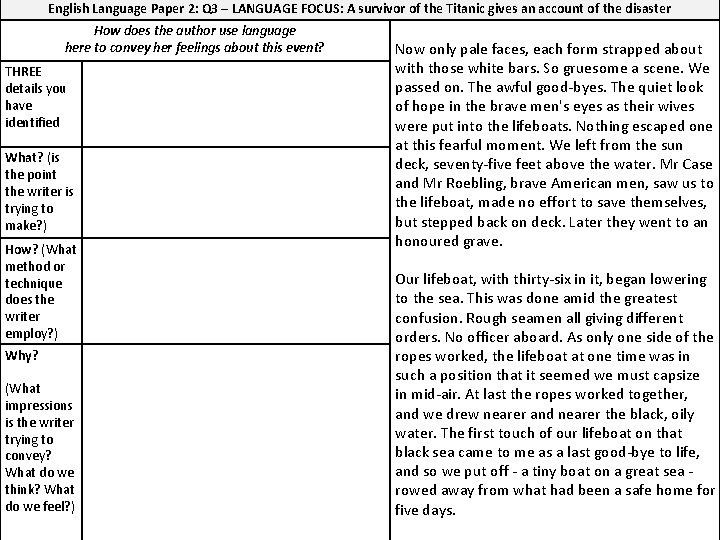
English Language Paper 2: Q 3 – LANGUAGE FOCUS: A survivor of the Titanic gives an account of the disaster How does the author use language here to convey her feelings about this event? THREE details you have identified What? (is the point the writer is trying to make? ) How? (What method or technique does the writer employ? ) Why? (What impressions is the writer trying to convey? What do we think? What do we feel? ) Now only pale faces, each form strapped about with those white bars. So gruesome a scene. We passed on. The awful good-byes. The quiet look of hope in the brave men's eyes as their wives were put into the lifeboats. Nothing escaped one at this fearful moment. We left from the sun deck, seventy-five feet above the water. Mr Case and Mr Roebling, brave American men, saw us to the lifeboat, made no effort to save themselves, but stepped back on deck. Later they went to an honoured grave. Our lifeboat, with thirty-six in it, began lowering to the sea. This was done amid the greatest confusion. Rough seamen all giving different orders. No officer aboard. As only one side of the ropes worked, the lifeboat at one time was in such a position that it seemed we must capsize in mid-air. At last the ropes worked together, and we drew nearer and nearer the black, oily water. The first touch of our lifeboat on that black sea came to me as a last good-bye to life, and so we put off - a tiny boat on a great sea rowed away from what had been a safe home for five days.
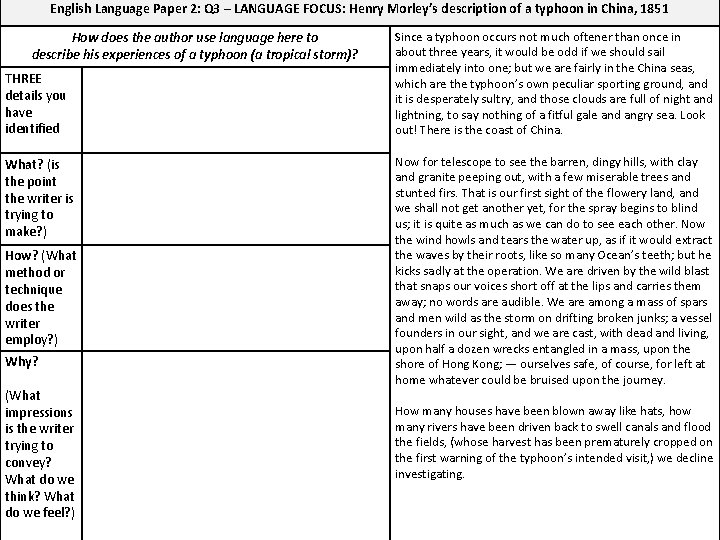
English Language Paper 2: Q 3 – LANGUAGE FOCUS: Henry Morley’s description of a typhoon in China, 1851 How does the author use language here to describe his experiences of a typhoon (a tropical storm)? THREE details you have identified What? (is the point the writer is trying to make? ) How? (What method or technique does the writer employ? ) Why? (What impressions is the writer trying to convey? What do we think? What do we feel? ) Since a typhoon occurs not much oftener than once in about three years, it would be odd if we should sail immediately into one; but we are fairly in the China seas, which are the typhoon’s own peculiar sporting ground, and it is desperately sultry, and those clouds are full of night and lightning, to say nothing of a fitful gale and angry sea. Look out! There is the coast of China. Now for telescope to see the barren, dingy hills, with clay and granite peeping out, with a few miserable trees and stunted firs. That is our first sight of the flowery land, and we shall not get another yet, for the spray begins to blind us; it is quite as much as we can do to see each other. Now the wind howls and tears the water up, as if it would extract the waves by their roots, like so many Ocean’s teeth; but he kicks sadly at the operation. We are driven by the wild blast that snaps our voices short off at the lips and carries them away; no words are audible. We are among a mass of spars and men wild as the storm on drifting broken junks; a vessel founders in our sight, and we are cast, with dead and living, upon half a dozen wrecks entangled in a mass, upon the shore of Hong Kong; — ourselves safe, of course, for left at home whatever could be bruised upon the journey. How many houses have been blown away like hats, how many rivers have been driven back to swell canals and flood the fields, (whose harvest has been prematurely cropped on the first warning of the typhoon’s intended visit, ) we decline investigating.