
English Language Development for Students With Significant Cognitive
- Slides: 29
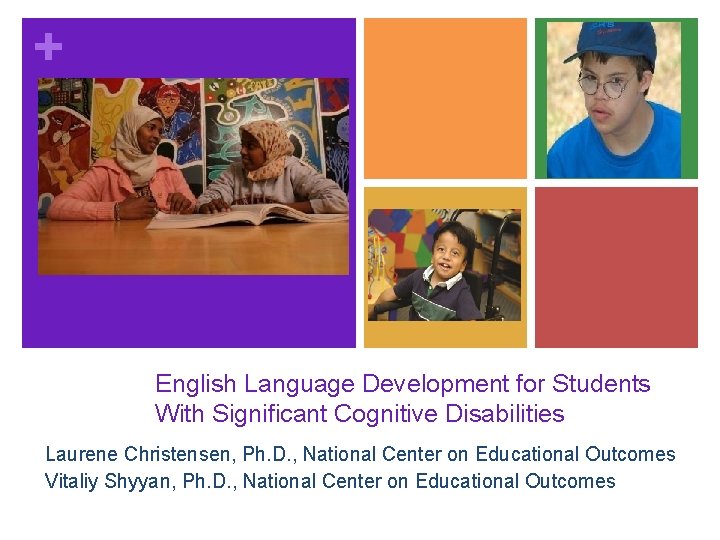
+ English Language Development for Students With Significant Cognitive Disabilities Laurene Christensen, Ph. D. , National Center on Educational Outcomes Vitaliy Shyyan, Ph. D. , National Center on Educational Outcomes
+ What does NCEO do? Mission: To support the development of inclusive assessment in a rapidly changing state (and consortium) assessment system environment in order to promote improved educational results for students with disabilities. www. nceo. info
+ Today’s Essential Questions n Who are students with significant cognitive disabilities? n Who are ELLs with significant cognitive disabilities? n What do we believe about students with significant cognitive disabilities related to their receptive and expressive language development? n How do we separate English language development from language development of for students with significant cognitive disabilities? n What is the difference between language and communication? n How does what we know about language systems affect the socio-cultural implications of including these learners in ESL programming?
+ Who Are Students With Significant Cognitive Disabilities? 4
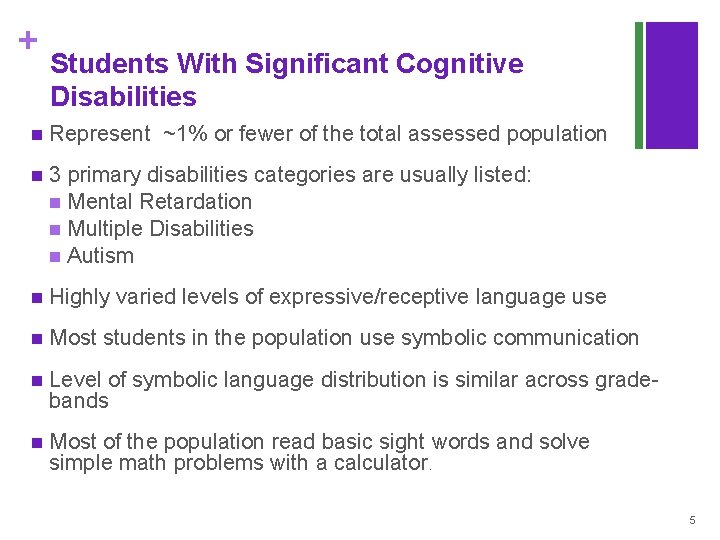
+ Students With Significant Cognitive Disabilities n Represent ~1% or fewer of the total assessed population n 3 primary disabilities categories are usually listed: n Mental Retardation n Multiple Disabilities n Autism n Highly varied levels of expressive/receptive language use n Most students in the population use symbolic communication n Level of symbolic language distribution is similar across gradebands n Most of the population read basic sight words and solve simple math problems with a calculator. 5
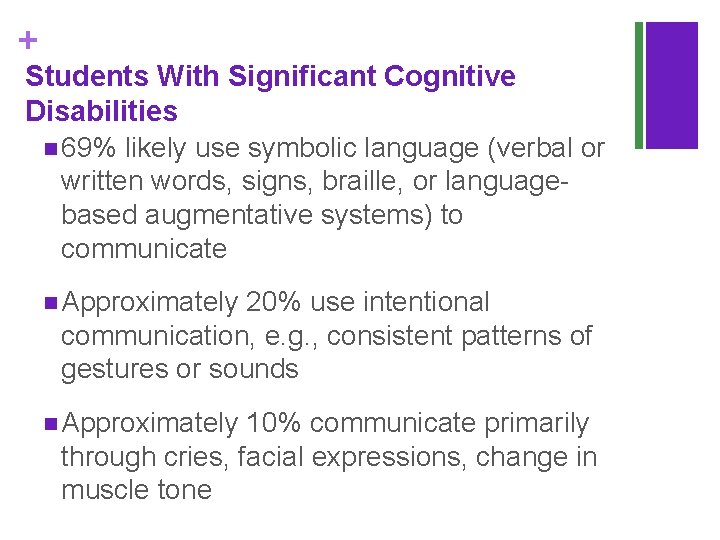
+ Students With Significant Cognitive Disabilities n 69% likely use symbolic language (verbal or written words, signs, braille, or languagebased augmentative systems) to communicate n Approximately 20% use intentional communication, e. g. , consistent patterns of gestures or sounds n Approximately 10% communicate primarily through cries, facial expressions, change in muscle tone
+ Who Are ELLs With Significant Cognitive Disabilities? 7
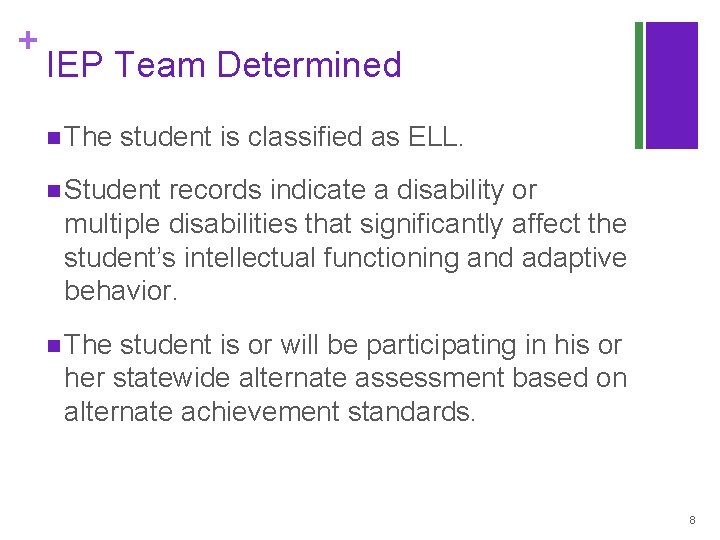
+ IEP Team Determined n The student is classified as ELL. n Student records indicate a disability or multiple disabilities that significantly affect the student’s intellectual functioning and adaptive behavior. n The student is or will be participating in his or her statewide alternate assessment based on alternate achievement standards. 8
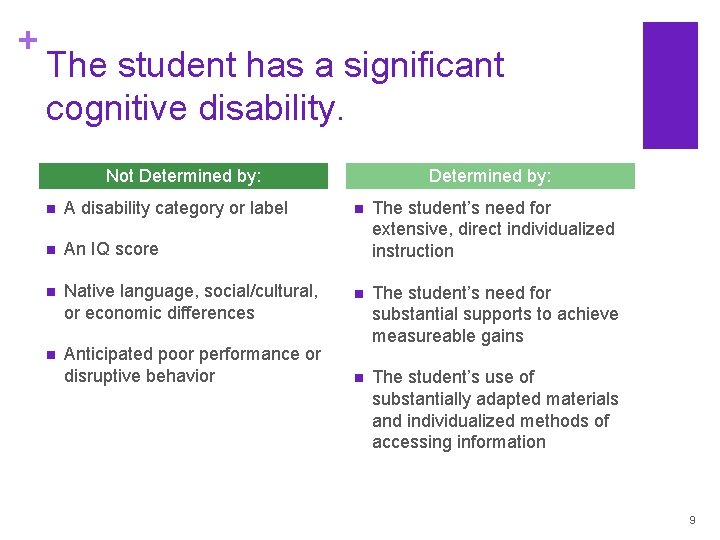
+ The student has a significant cognitive disability. Not Determined by: n A disability category or label n An IQ score n Native language, social/cultural, or economic differences n Anticipated poor performance or disruptive behavior Determined by: n The student’s need for extensive, direct individualized instruction n The student’s need for substantial supports to achieve measureable gains n The student’s use of substantially adapted materials and individualized methods of accessing information 9
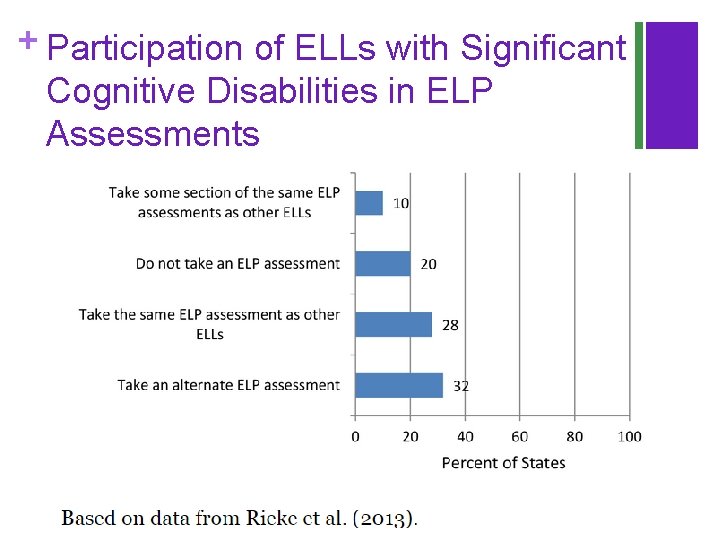
+ Participation of ELLs with Significant Cognitive Disabilities in ELP Assessments
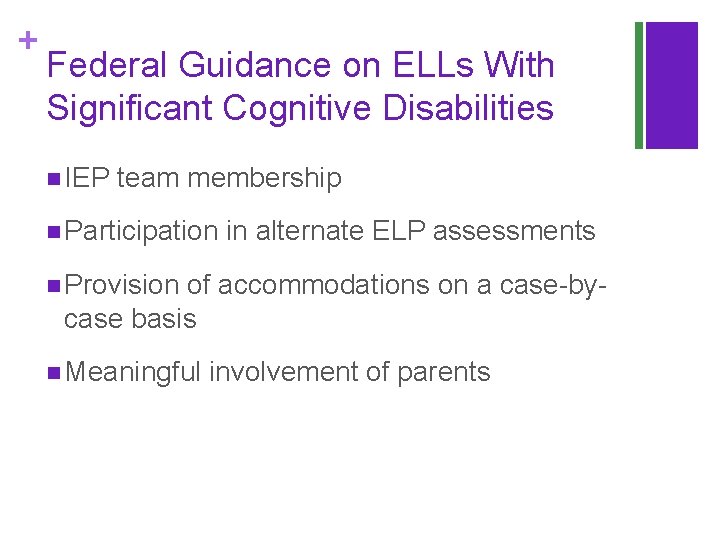
+ Federal Guidance on ELLs With Significant Cognitive Disabilities n IEP team membership n Participation in alternate ELP assessments n Provision of accommodations on a case-bycase basis n Meaningful involvement of parents
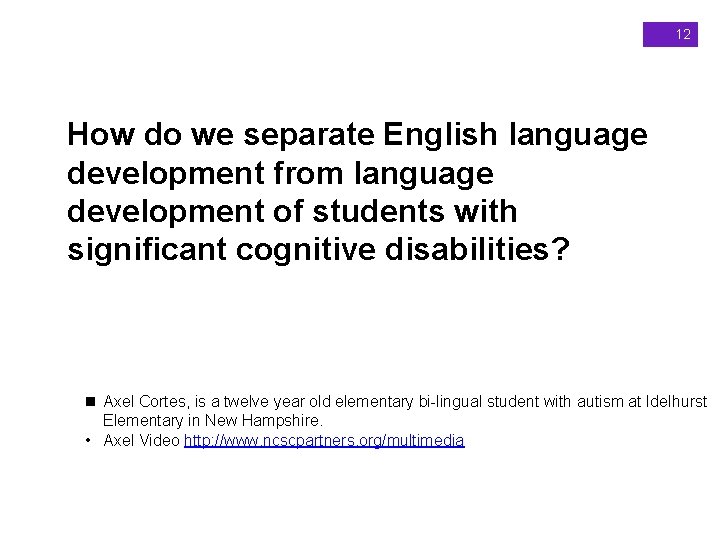
12 How do we separate English language development from language development of students with significant cognitive disabilities? n Axel Cortes, is a twelve year old elementary bi-lingual student with autism at Idelhurst Elementary in New Hampshire. • Axel Video http: //www. ncscpartners. org/multimedia
+ Language n Language is a specific form of communication where letters, figures, numbers, characters, gestures, or combination thereof (spoken, visual, or both) is universally accepted by a culture or sub culture to facilitate common ideas, expressions, and thoughts. n Students do not move lockstep in language development. n Language is learned by using language in all four domains: listening, speaking, reading, and writing.
+ Communication n Communication is a social event which requires sending or receiving messages with an agreed upon sets of symbols, gestures, objects, pictures, words, sounds, movements. n Communication can be words-based, but often is not for students with cognitive delays who may not use words or more words due to the nature of their disabilities. n Because of their cognitive, social, and communicative delays, these children may have a different form of language to fulfill the function of language (to communicate) based on the individual student needs and abilities. n If the student has a language system (any type of AAC), then the student has access to the language needed to access contents and more because he/she can communicate with set of symbols, gestures, objects, pictures, words, etc. , which the student uses as language.
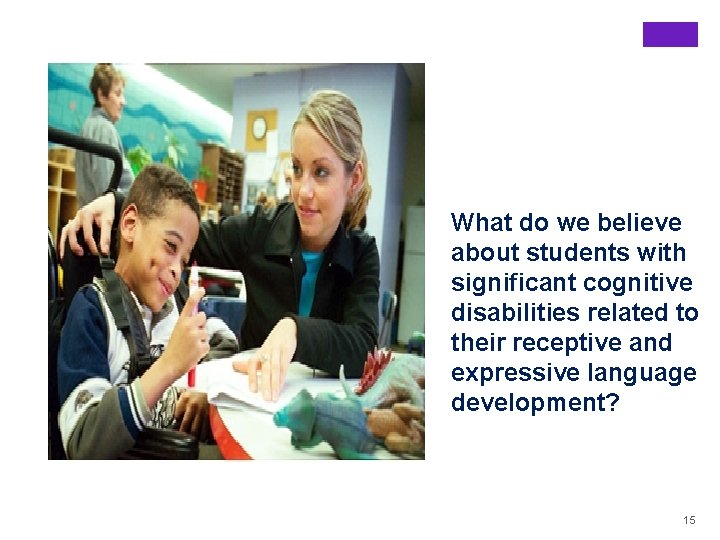
+ What do we believe about students with significant cognitive disabilities related to their receptive and expressive language development? 15
+ Communication Beliefs n All individuals and all behaviors (including gestures, cries, noises) communicate. n Communication is possible and identifiable for all students. n Every step toward improved communication, attention, and interaction leads to increased independence n No more fundamental outcome of education exists than the right and the ability to communicate. 16
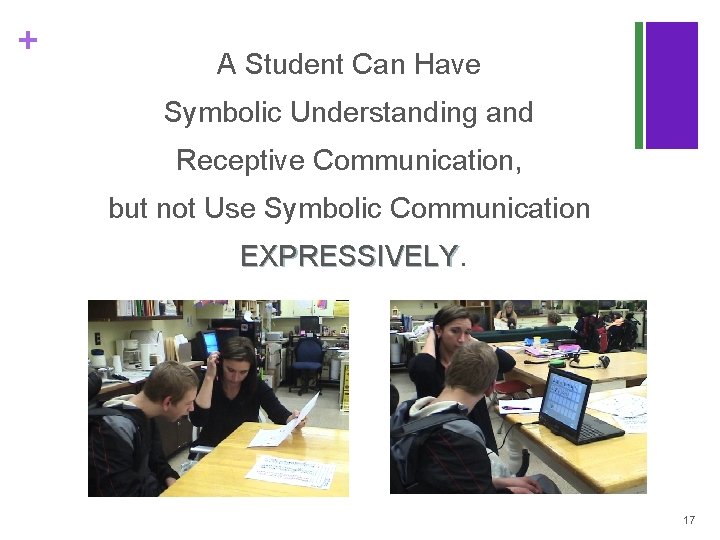
+ A Student Can Have Symbolic Understanding and Receptive Communication, but not Use Symbolic Communication EXPRESSIVELY 17
18 What if the student does not have a dedicated communication system? n The “absence of evidence is not evidence of absence” (Donnellan, 2000).
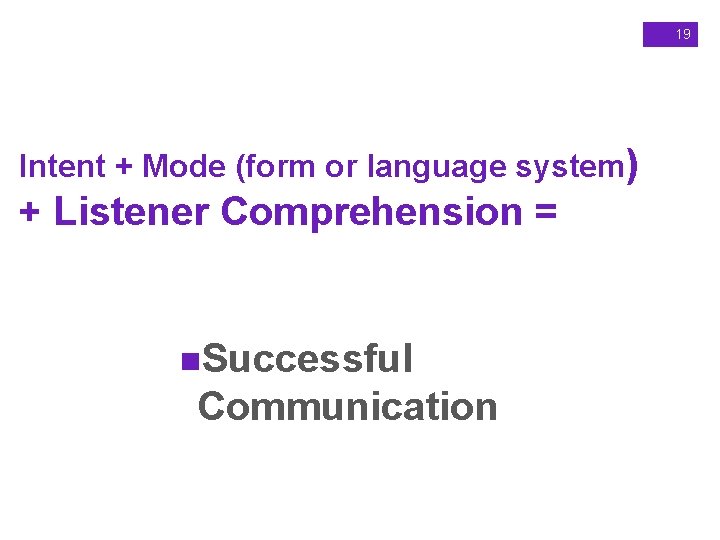
19 Intent + Mode (form or language system) + Listener Comprehension = n. Successful Communication
+ All Students Communication n Teachers observe to identify communication intent and mode/form n Communications targets (intents) are selected n Student strengths are used to establish the best form or mode of communication n Family members describe what the students like and dislike the most n The team records observations of student preferences (likes/dislikes)
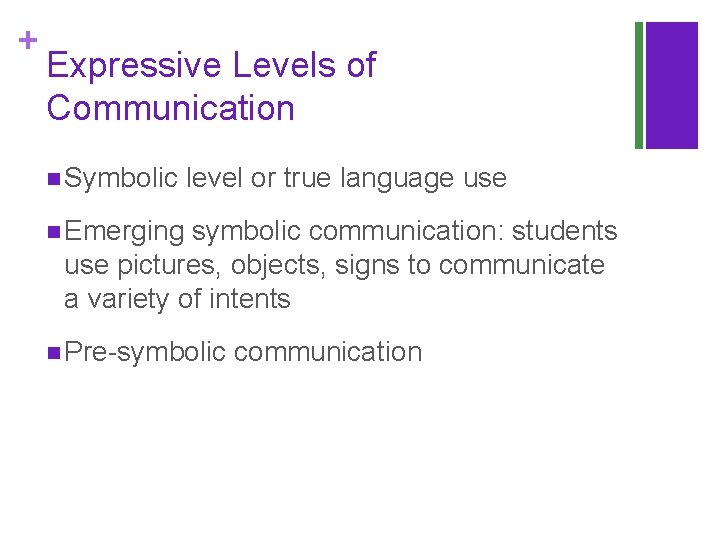
+ Expressive Levels of Communication n Symbolic level or true language use n Emerging symbolic communication: students use pictures, objects, signs to communicate a variety of intents n Pre-symbolic communication
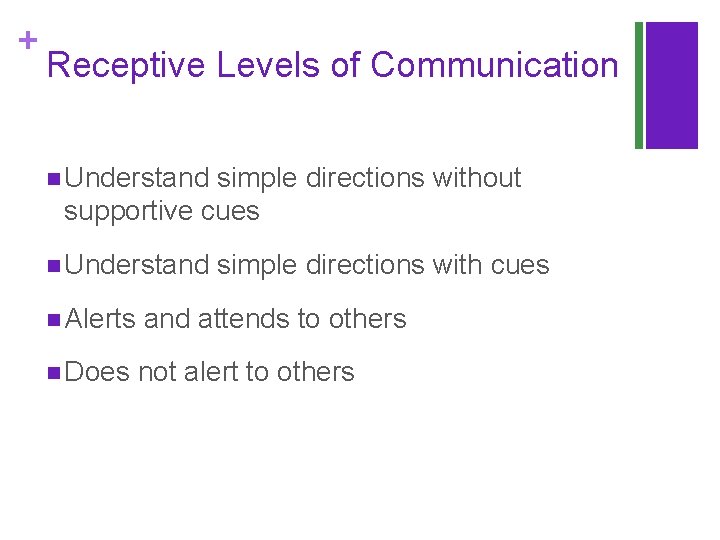
+ Receptive Levels of Communication n Understand simple directions without supportive cues n Understand simple directions with cues n Alerts and attends to others n Does not alert to others
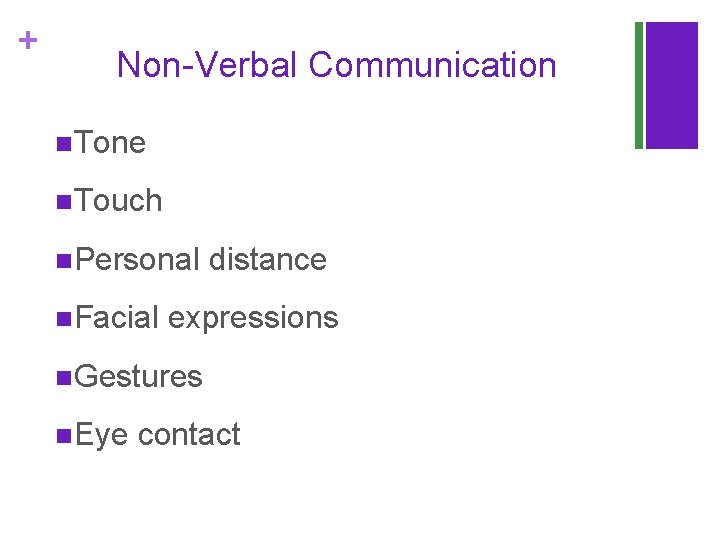
+ Non-Verbal Communication n. Tone n. Touch n. Personal n. Facial distance expressions n. Gestures n. Eye contact
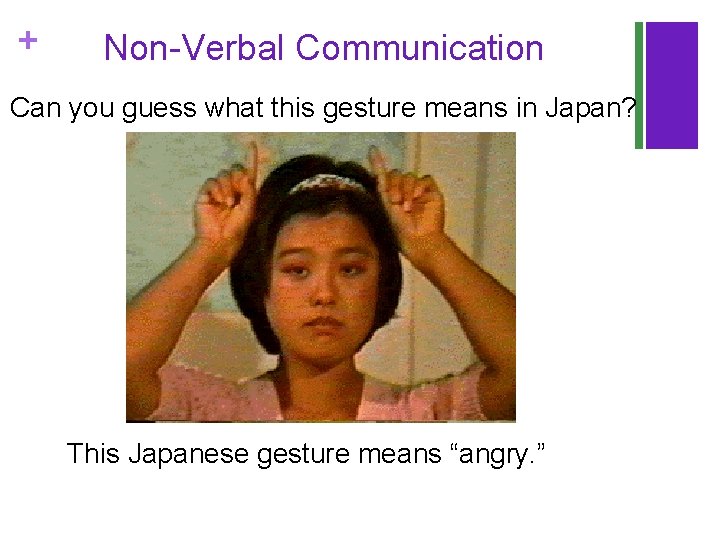
+ Non-Verbal Communication Can you guess what this gesture means in Japan? This Japanese gesture means “angry. ”
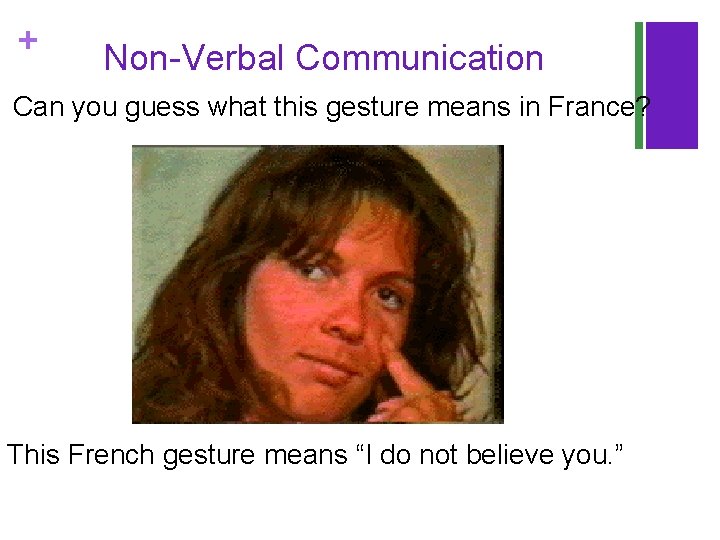
+ Non-Verbal Communication Can you guess what this gesture means in France? This French gesture means “I do not believe you. ”
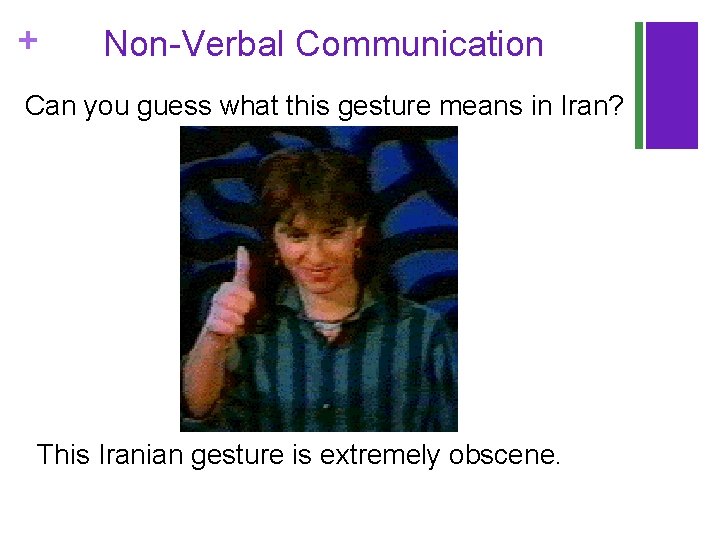
+ Non-Verbal Communication Can you guess what this gesture means in Iran? This Iranian gesture is extremely obscene.
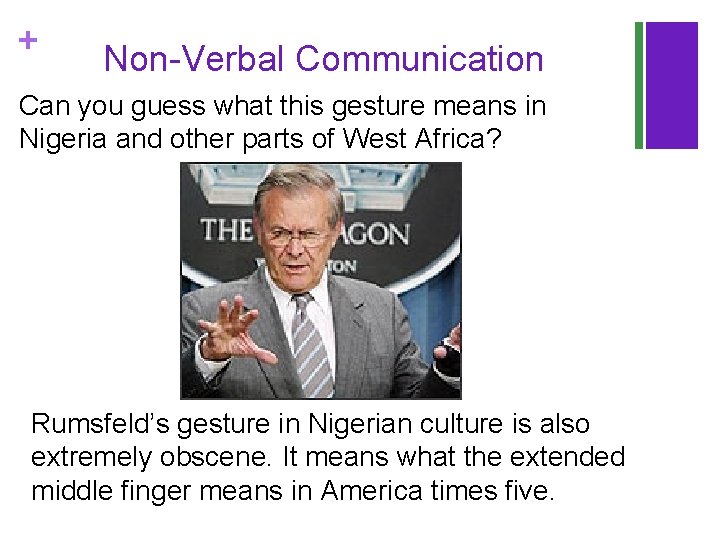
+ Non-Verbal Communication Can you guess what this gesture means in Nigeria and other parts of West Africa? Rumsfeld’s gesture in Nigerian culture is also extremely obscene. It means what the extended middle finger means in America times five.
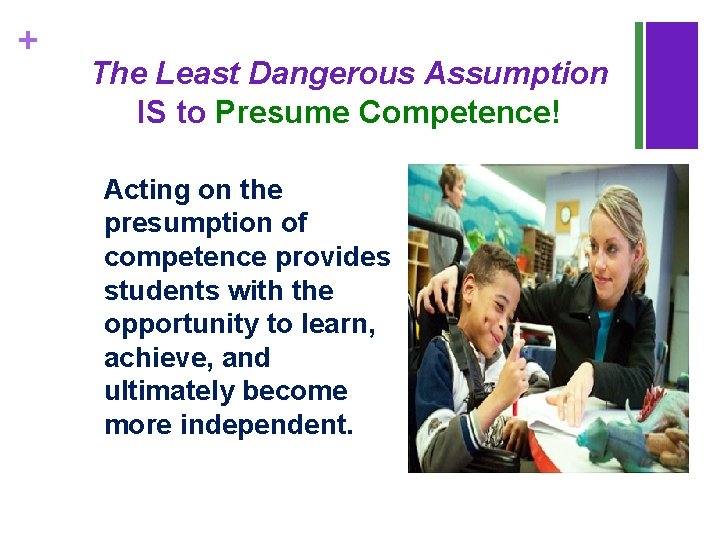
+ The Least Dangerous Assumption IS to Presume Competence! Acting on the presumption of competence provides students with the opportunity to learn, achieve, and ultimately become more independent.
+ Thank you! laurene@umn. edu shyya 001@umn. edu