
English Language Arts Course of Study Overview K5
- Slides: 36
English Language Arts Course of Study Overview K-5 Session One of Two
Outcomes for the Session Participants will gain an awareness of: � Content Organization � Content Movement � Vertical Alignment
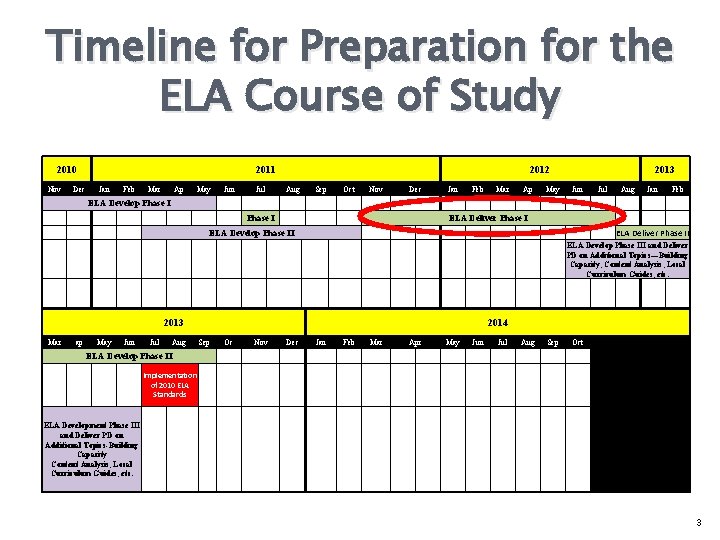
Timeline for Preparation for the ELA Course of Study 2010 2011 Nov Dec Jan Feb Mar Ap May ELA Develop Phase I 2012 2013 Jun Jul Aug Sep Oct Nov Dec Jan Feb Mar Ap May Jun Jul Aug Jan Feb Phase I ELA Develop Phase II ELA Deliver Phase I ELA Deliver Phase II ELA Develop Phase III and Deliver PD on Additional Topics—Building Capacity, Content Analysis, Local Curriculum Guides, etc. 2013 Mar ap May Jun Jul Aug 2014 Sep Oc Nov Dec Jan Feb Mar ELA Develop Phase II ELA Development Phase III and Deliver PD on Additional Topics-Building Capacity Content Analysis, Local Curriculum Guides, etc. Implementation of 2010 ELA Standards Apr May Jun Jul Aug Sep Oct 3
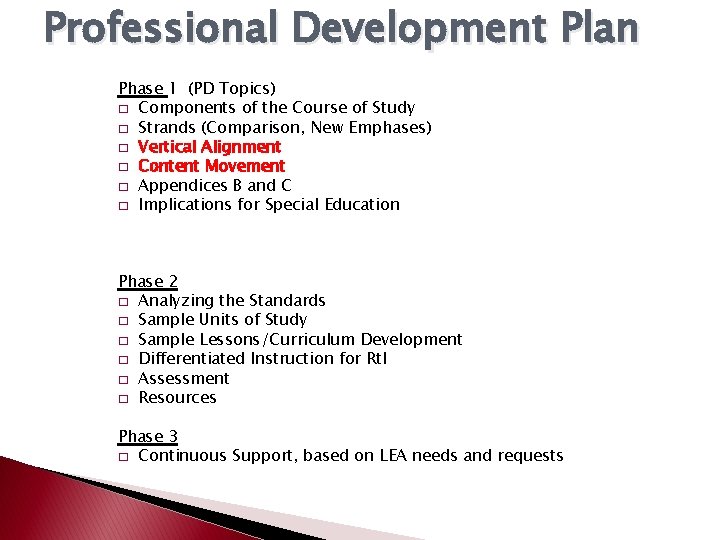
Professional Development Plan Phase 1 (PD Topics) � Components of the Course of Study � Strands (Comparison, New Emphases) � Vertical Alignment � Content Movement � Appendices B and C � Implications for Special Education Phase 2 � Analyzing the Standards � Sample Units of Study � Sample Lessons/Curriculum Development � Differentiated Instruction for Rt. I � Assessment � Resources Phase 3 � Continuous Support, based on LEA needs and requests
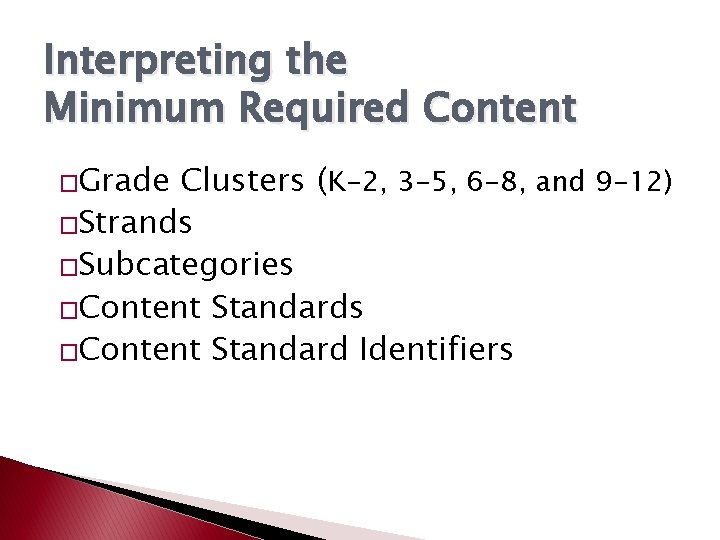
Interpreting the Minimum Required Content �Grade Clusters (K-2, 3 -5, 6 -8, and 9 -12) �Strands �Subcategories �Content Standard Identifiers
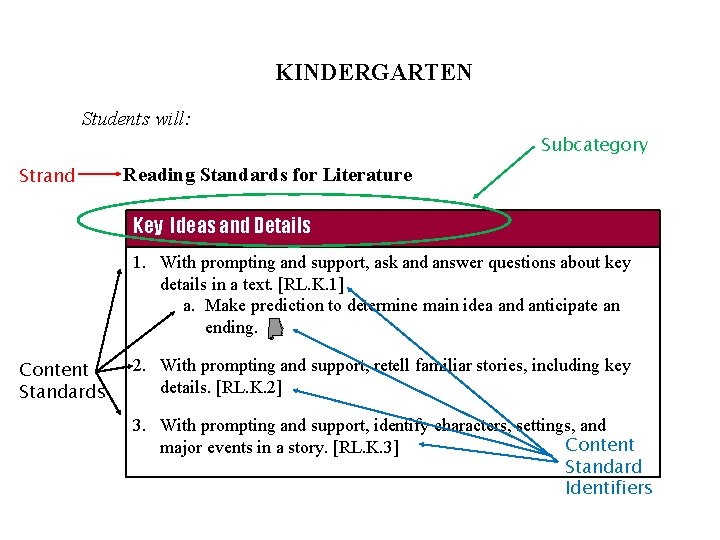
KINDERGARTEN Students will: Subcategory Strand Reading Standards for Literature Key Ideas and Details 1. With prompting and support, ask and answer questions about key details in a text. [RL. K. 1] a. Make prediction to determine main idea and anticipate an ending. Content Standards 2. With prompting and support, retell familiar stories, including key details. [RL. K. 2] 3. With prompting and support, identify characters, settings, and Content major events in a story. [RL. K. 3] Standard Identifiers
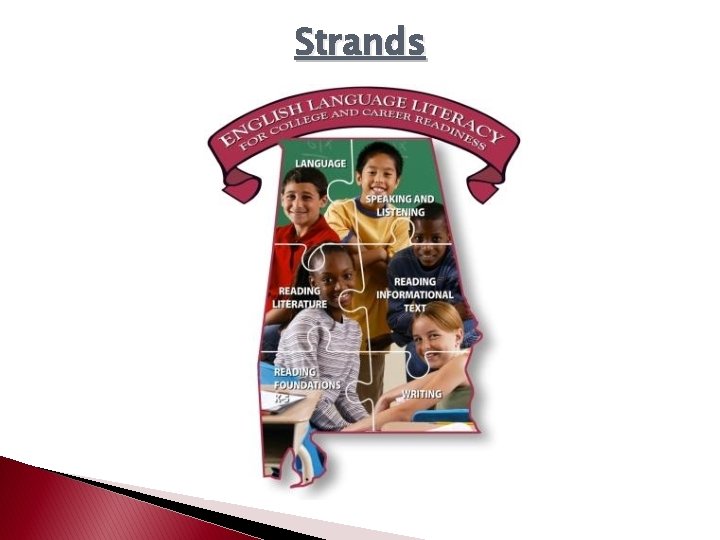
Strands
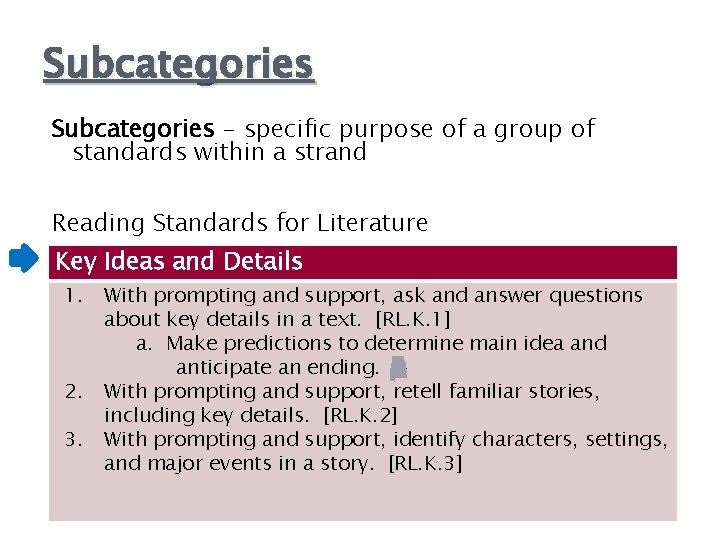
Subcategories - specific purpose of a group of standards within a strand Reading Standards for Literature Key Ideas and Details 1. 2. 3. With prompting and support, ask and answer questions about key details in a text. [RL. K. 1] a. Make predictions to determine main idea and anticipate an ending. With prompting and support, retell familiar stories, including key details. [RL. K. 2] With prompting and support, identify characters, settings, and major events in a story. [RL. K. 3]
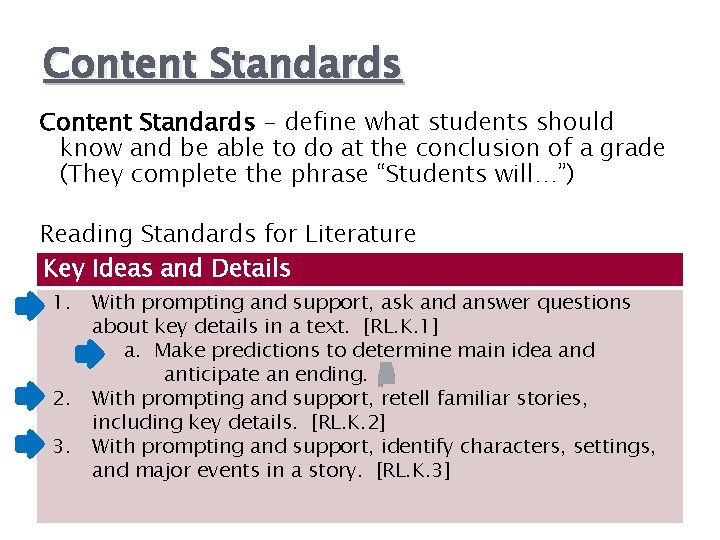
Content Standards - define what students should know and be able to do at the conclusion of a grade (They complete the phrase “Students will…”) Reading Standards for Literature Key Ideas and Details 1. 2. 3. With prompting and support, ask and answer questions about key details in a text. [RL. K. 1] a. Make predictions to determine main idea and anticipate an ending. With prompting and support, retell familiar stories, including key details. [RL. K. 2] With prompting and support, identify characters, settings, and major events in a story. [RL. K. 3]
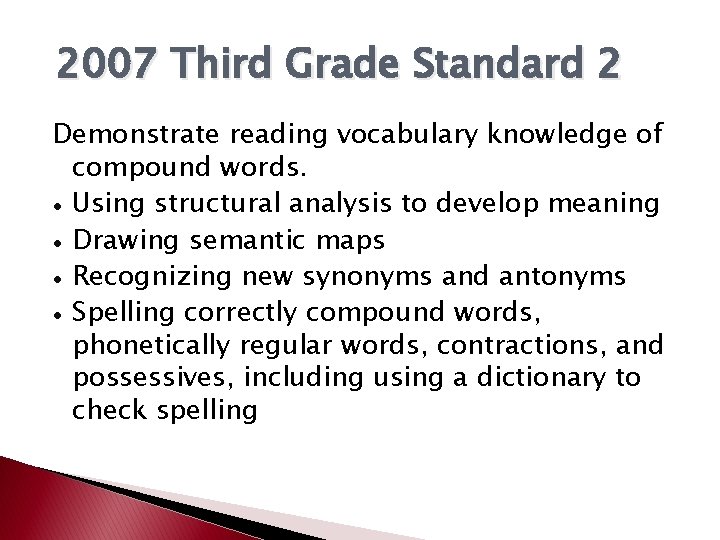
2007 Third Grade Standard 2 Demonstrate reading vocabulary knowledge of compound words. ∙ Using structural analysis to develop meaning ∙ Drawing semantic maps ∙ Recognizing new synonyms and antonyms ∙ Spelling correctly compound words, phonetically regular words, contractions, and possessives, including using a dictionary to check spelling
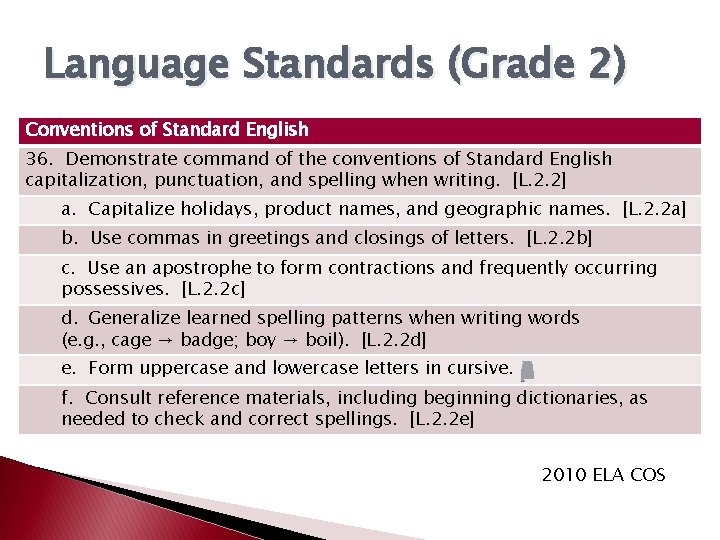
Language Standards (Grade 2) Conventions of Standard English 36. Demonstrate command of the conventions of Standard English capitalization, punctuation, and spelling when writing. [L. 2. 2] a. Capitalize holidays, product names, and geographic names. [L. 2. 2 a] b. Use commas in greetings and closings of letters. [L. 2. 2 b] c. Use an apostrophe to form contractions and frequently occurring possessives. [L. 2. 2 c] d. Generalize learned spelling patterns when writing words (e. g. , cage → badge; boy → boil). [L. 2. 2 d] e. Form uppercase and lowercase letters in cursive. f. Consult reference materials, including beginning dictionaries, as needed to check and correct spellings. [L. 2. 2 e] 2010 ELA COS
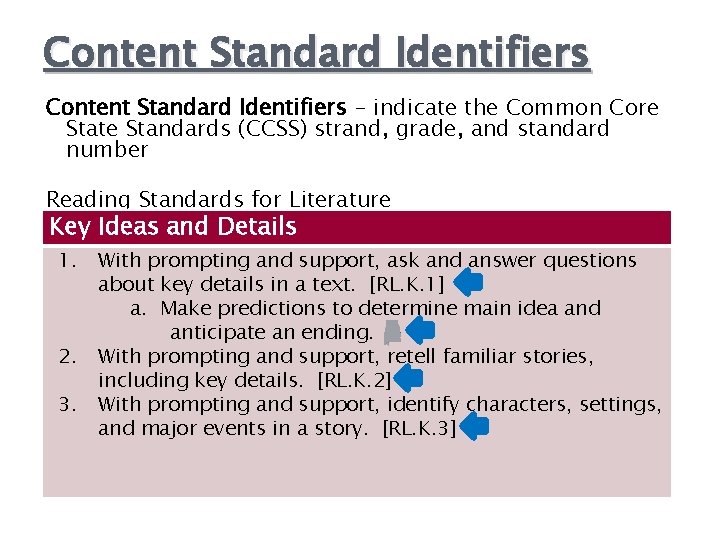
Content Standard Identifiers - indicate the Common Core State Standards (CCSS) strand, grade, and standard number Reading Standards for Literature Key Ideas and Details 1. 2. 3. With prompting and support, ask and answer questions about key details in a text. [RL. K. 1] a. Make predictions to determine main idea and anticipate an ending. With prompting and support, retell familiar stories, including key details. [RL. K. 2] With prompting and support, identify characters, settings, and major events in a story. [RL. K. 3]
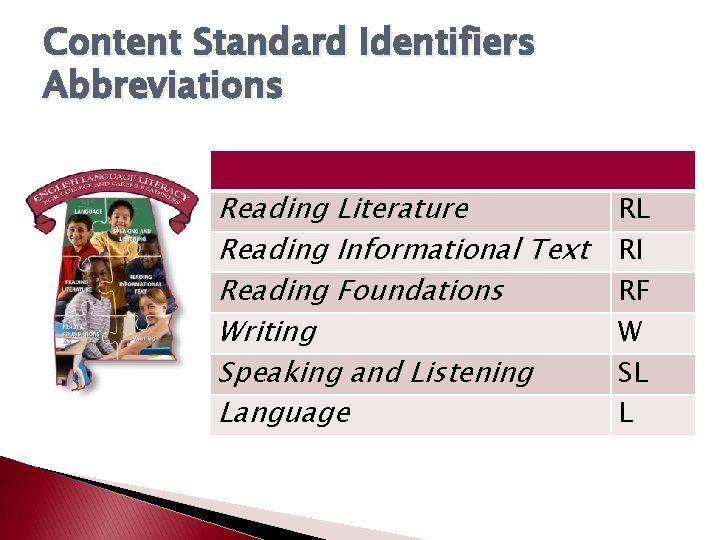
Content Standard Identifiers Abbreviations Reading Literature Reading Informational Text Reading Foundations Writing Speaking and Listening Language RL RI RF W SL L
Alignment There are two alignment considerations: 1. Alignment between the 2007 COS standards and the Common Core State Standards (CCSS) 2. Vertical Alignment/Learning Trajectories
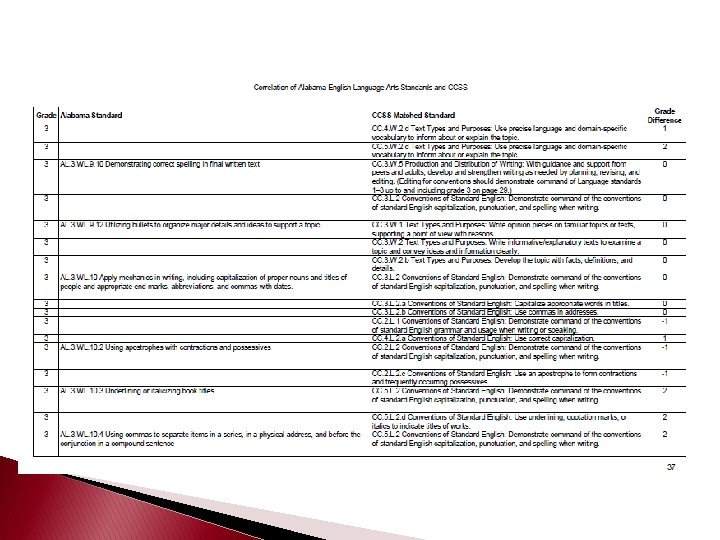
Alignment Between 2007 COS Standards and the CCSS �A comparison of the 2007 Alabama COS standards and the CCS standards shows some movement of content from one grade level to another. www. alsde. edu/Special Links/Courses of Study/Drafts and Period for Public Review/Correlation of Alabama English Language Arts Standards and CCSS
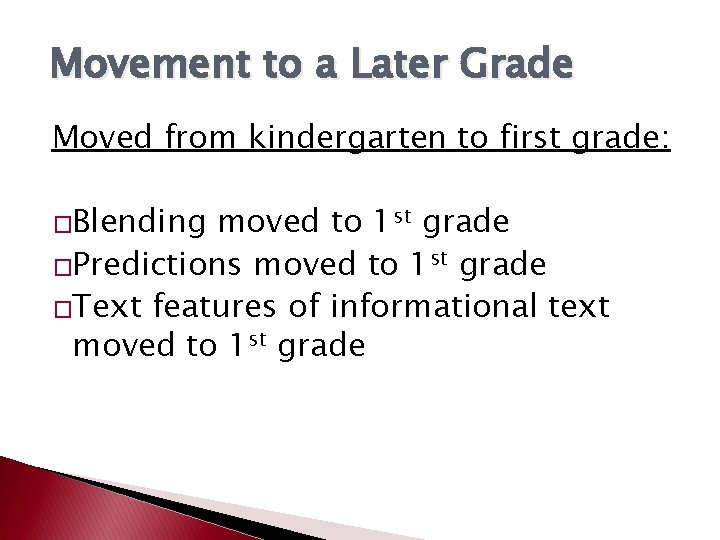
Movement to a Later Grade Moved from kindergarten to first grade: �Blending moved to 1 st grade �Predictions moved to 1 st grade �Text features of informational text moved to 1 st grade
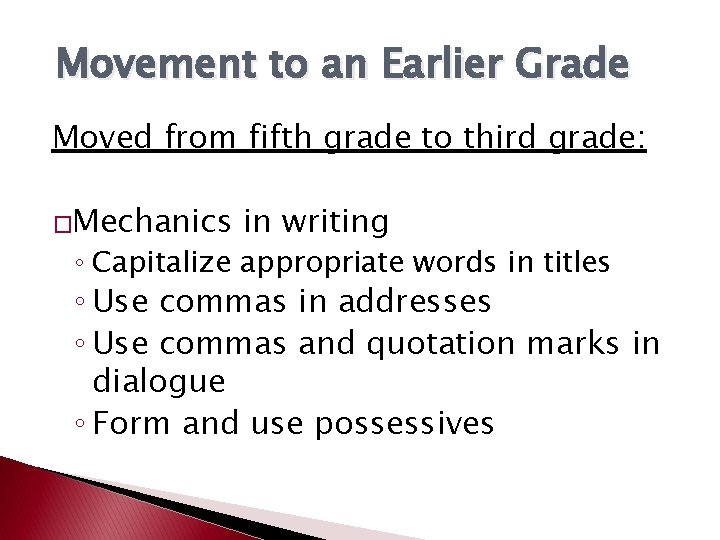
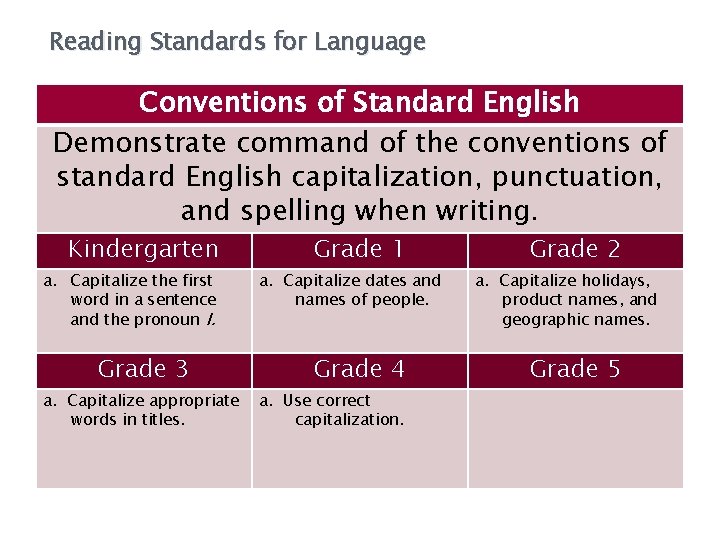
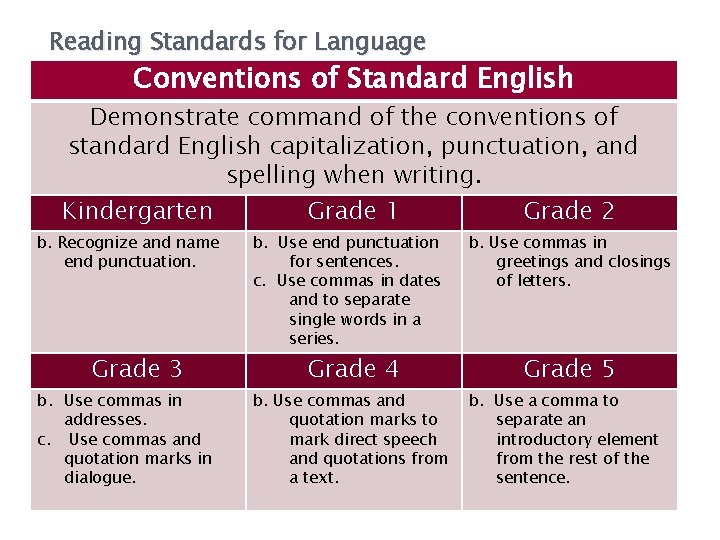
Movement to an Earlier Grade Moved from fifth grade to third grade: �Mechanics in writing ◦ Capitalize appropriate words in titles ◦ Use commas in addresses ◦ Use commas and quotation marks in dialogue ◦ Form and use possessives
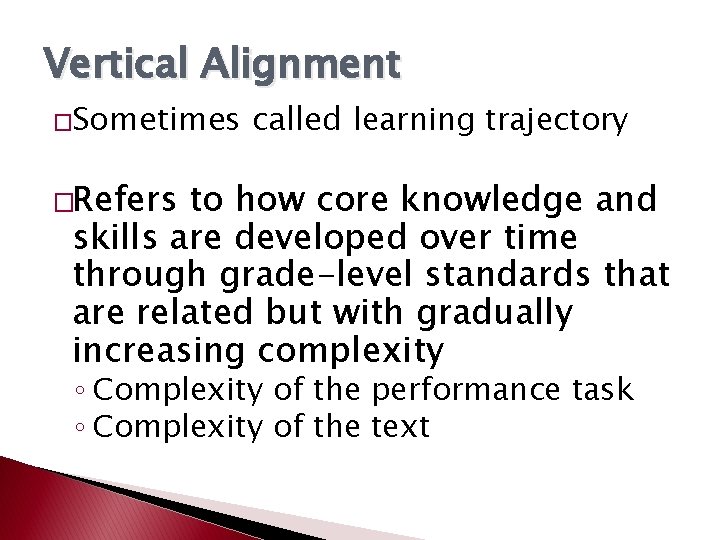
Vertical Alignment �Sometimes called learning trajectory �Refers to how core knowledge and skills are developed over time through grade-level standards that are related but with gradually increasing complexity ◦ Complexity of the performance task ◦ Complexity of the text
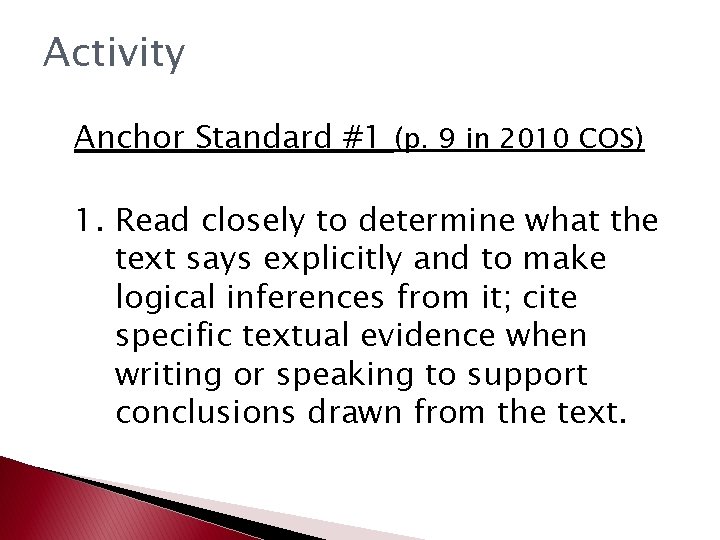
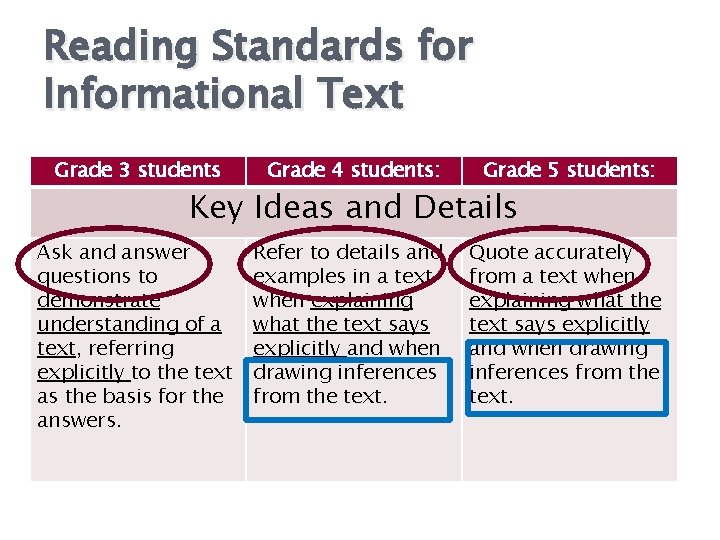
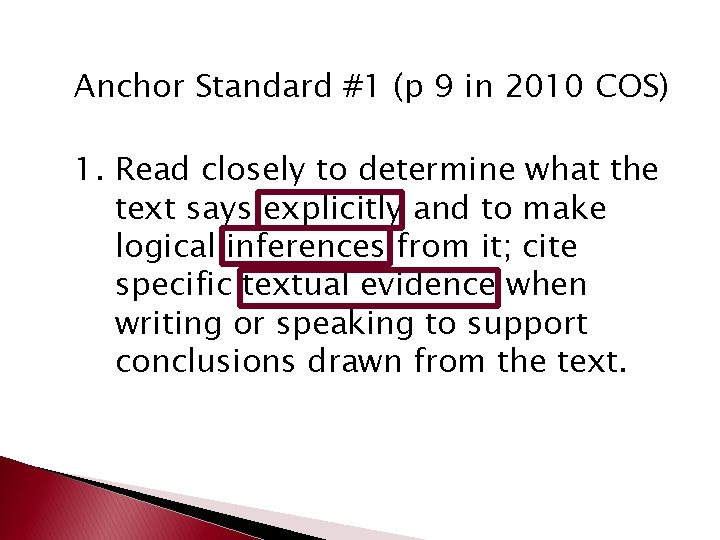
Activity Anchor Standard #1 (p. 9 in 2010 COS) 1. Read closely to determine what the text says explicitly and to make logical inferences from it; cite specific textual evidence when writing or speaking to support conclusions drawn from the text.
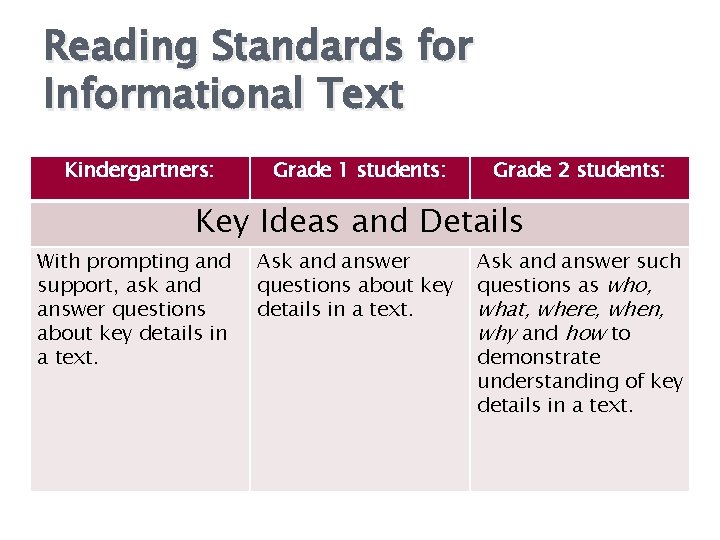
Reading Standards for Informational Text Kindergartners: Grade 1 students: Grade 2 students: Key Ideas and Details With prompting and support, ask and answer questions about key details in a text. Ask and answer such questions as who, what, where, when, why and how to demonstrate understanding of key details in a text.
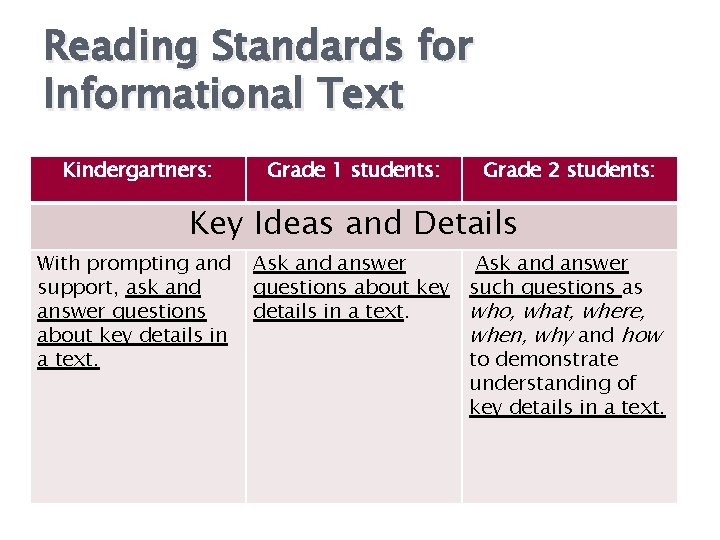
Reading Standards for Informational Text Kindergartners: Grade 1 students: Grade 2 students: Key Ideas and Details With prompting and support, ask and answer questions about key details in a text. Ask and answer questions about key such questions as details in a text. who, what, where, when, why and how to demonstrate understanding of key details in a text.
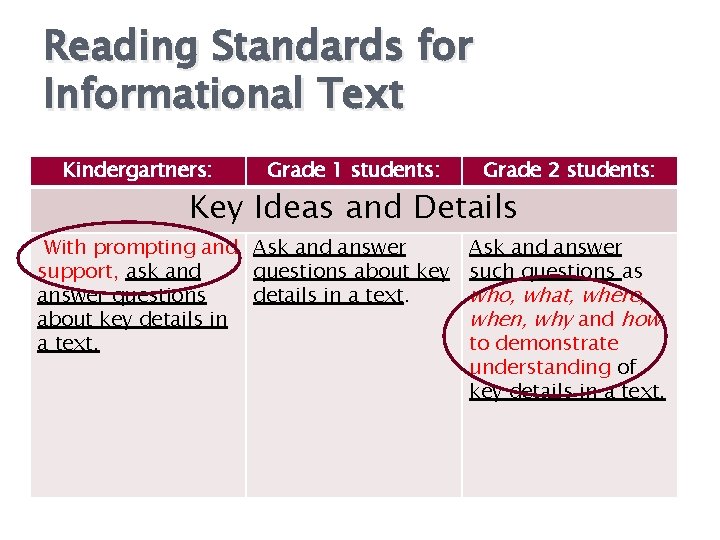
Reading Standards for Informational Text Kindergartners: Grade 1 students: Grade 2 students: Key Ideas and Details With prompting and Ask and answer support, ask and questions about key answer questions details in a text. about key details in a text. Ask and answer such questions as who, what, where, when, why and how to demonstrate understanding of key details in a text.
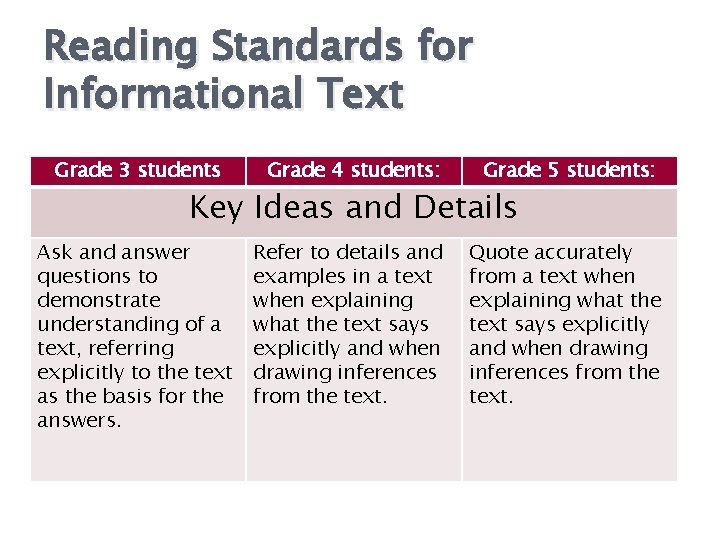
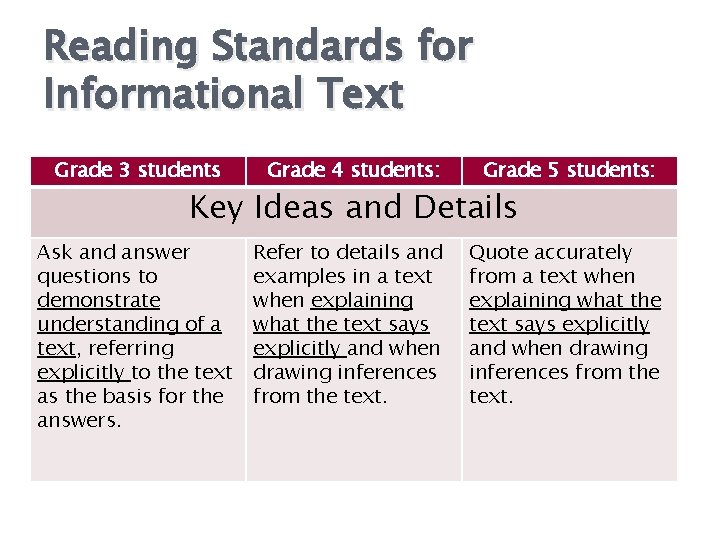
Reading Standards for Informational Text Grade 3 students Grade 4 students: Grade 5 students: Refer to details and examples in a text when explaining what the text says explicitly and when drawing inferences from the text. Quote accurately from a text when explaining what the text says explicitly and when drawing inferences from the text. Key Ideas and Details Ask and answer questions to demonstrate understanding of a text, referring explicitly to the text as the basis for the answers.
Reading Standards for Informational Text Grade 3 students Grade 4 students: Grade 5 students: Refer to details and examples in a text when explaining what the text says explicitly and when drawing inferences from the text. Quote accurately from a text when explaining what the text says explicitly and when drawing inferences from the text. Key Ideas and Details Ask and answer questions to demonstrate understanding of a text, referring explicitly to the text as the basis for the answers.
Reading Standards for Informational Text Grade 3 students Grade 4 students: Grade 5 students: Refer to details and examples in a text when explaining what the text says explicitly and when drawing inferences from the text. Quote accurately from a text when explaining what the text says explicitly and when drawing inferences from the text. Key Ideas and Details Ask and answer questions to demonstrate understanding of a text, referring explicitly to the text as the basis for the answers.
Anchor Standard #1 (p 9 in 2010 COS) 1. Read closely to determine what the text says explicitly and to make logical inferences from it; cite specific textual evidence when writing or speaking to support conclusions drawn from the text.
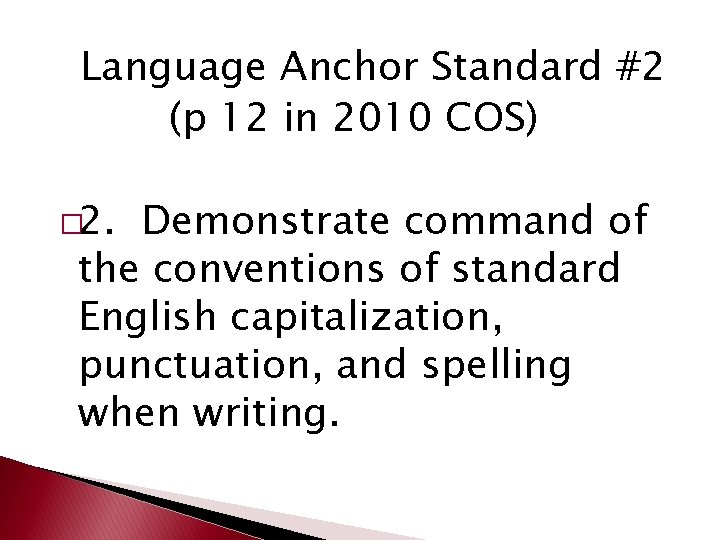
Language Anchor Standard #2 (p 12 in 2010 COS) � 2. Demonstrate command of the conventions of standard English capitalization, punctuation, and spelling when writing.
Reading Standards for Language Conventions of Standard English Demonstrate command of the conventions of standard English capitalization, punctuation, and spelling when writing. Kindergarten a. Capitalize the first word in a sentence and the pronoun I. Grade 3 a. Capitalize appropriate words in titles. Grade 1 a. Capitalize dates and names of people. Grade 4 a. Use correct capitalization. Grade 2 a. Capitalize holidays, product names, and geographic names. Grade 5
Reading Standards for Language Conventions of Standard English Demonstrate command of the conventions of standard English capitalization, punctuation, and spelling when writing. Kindergarten b. Recognize and name end punctuation. Grade 3 b. Use commas in addresses. c. Use commas and quotation marks in dialogue. Grade 1 Grade 2 b. Use end punctuation for sentences. c. Use commas in dates and to separate single words in a series. b. Use commas in greetings and closings of letters. b. Use commas and quotation marks to mark direct speech and quotations from a text. b. Use a comma to separate an introductory element from the rest of the sentence. Grade 4 Grade 5
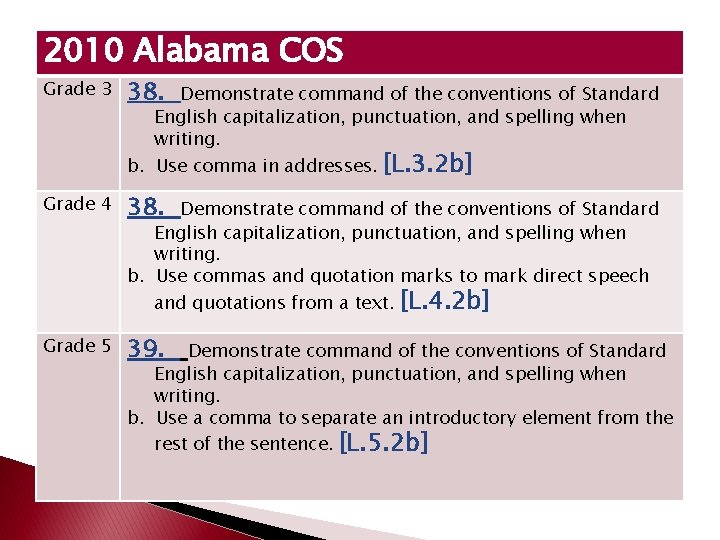
2010 Alabama COS Grade 3 38. Grade 4 38. Grade 5 39. Demonstrate command of the conventions of Standard English capitalization, punctuation, and spelling when writing. b. Use comma in addresses. [L. 3. 2 b] Demonstrate command of the conventions of Standard English capitalization, punctuation, and spelling when writing. b. Use commas and quotation marks to mark direct speech and quotations from a text. [L. 4. 2 b] Demonstrate command of the conventions of Standard English capitalization, punctuation, and spelling when writing. b. Use a comma to separate an introductory element from the rest of the sentence. [L. 5. 2 b]
Think about… �How this vertical alignment serves as a learning trajectory
In our next Webinar, we will consider: �The importance of text selection in building literacy proficiency. �The importance of writing in building literacy proficiency.
Preparation for second K-5 Webinar Become familiar with the documents that are referenced in � Appendix B (p. 100) Text Exemplars and Sample Performance Tasks � Appendix C (p. 101) Samples of Student Writing Links to both documents are included on pages 100 and 101. � Graphic Organizer from website
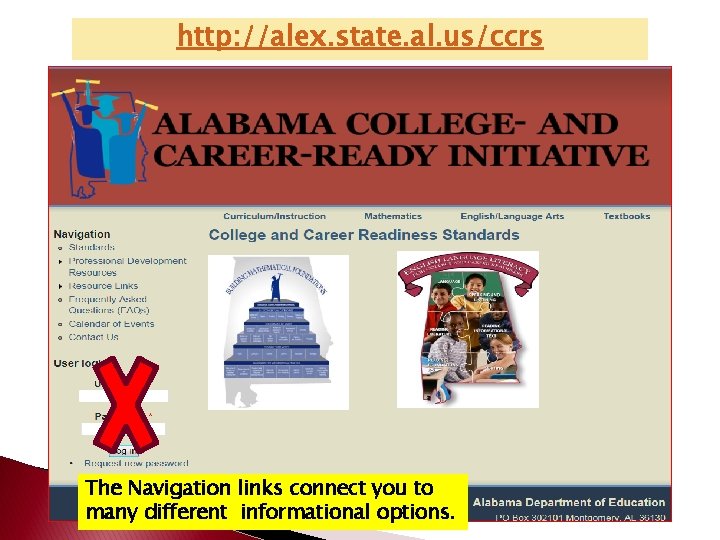
http: //alex. state. al. us/ccrs The Navigation links connect you to many different informational options.
Send questions to: Pam Higgins at phiggins@alsde. edu or Steve Mc. Aliley at stevemc@alsde. edu Questions and answers will be posted to the website www. alex. state. al. us/ccrs.