
English Language Acquisition Program ELAP Beyond the Bell
English Language Acquisition Program (ELAP) Beyond the Bell Language Acquisition Branch 2009 -2010
What is ELAP? • Provides English Learners (Els), including recently reclassified students in grades 4 -5/6, with English language support • Supports Tier I instruction • On-track intervention • Can be provided during the school day, before or after school or Saturdays -Memo-4856. 0
Target Audience for ELAP Materials • ELs proficient (4 & 5) on CELDT and scoring at Basic or below on CST- ELA • Reclassified students at Basic or below on CST-ELA -Memo-4856. 0
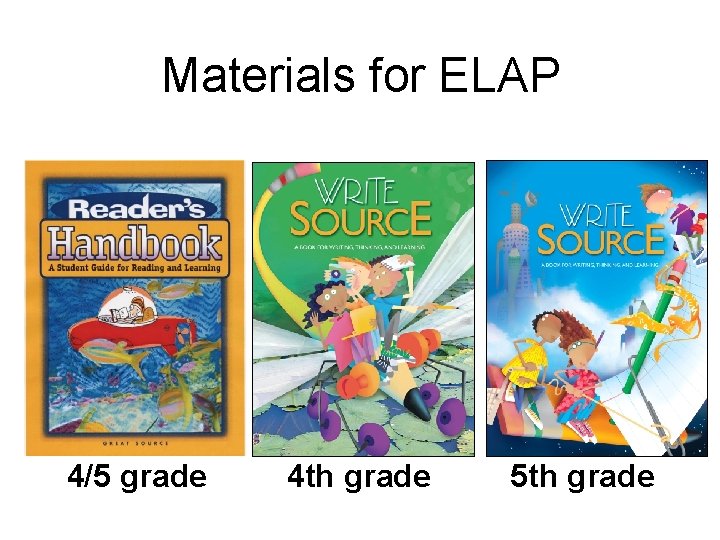
Materials for ELAP 4/5 grade 4 th grade 5 th grade
Goals for Today • Gain the knowledge needed to implement this new Intervention Program. • Become familiar with Reader’s Handbook and Write Source (the resources available for this intervention class). • Practice with the Implementation Guides created for these intervention classes.
What is difficult about reading and writing for our students?
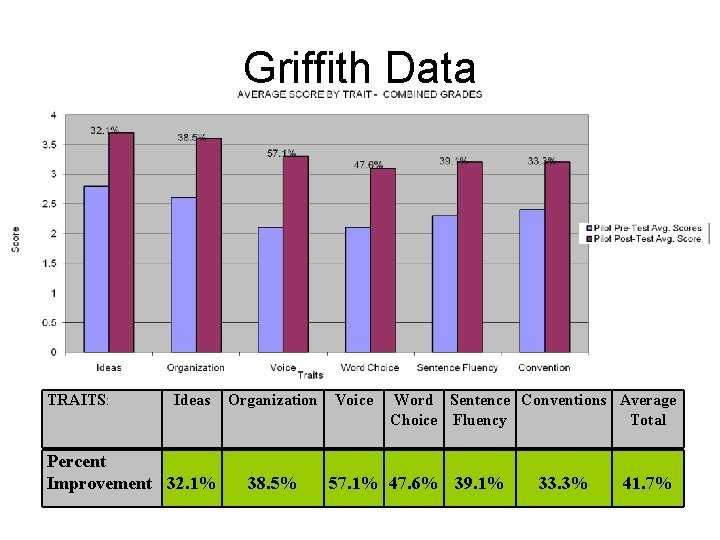
Griffith Data TRAITS: Ideas Percent Improvement 32. 1% Organization 38. 5% Voice Word Sentence Conventions Average Choice Fluency Total 57. 1% 47. 6% 39. 1% 33. 3% 41. 7%
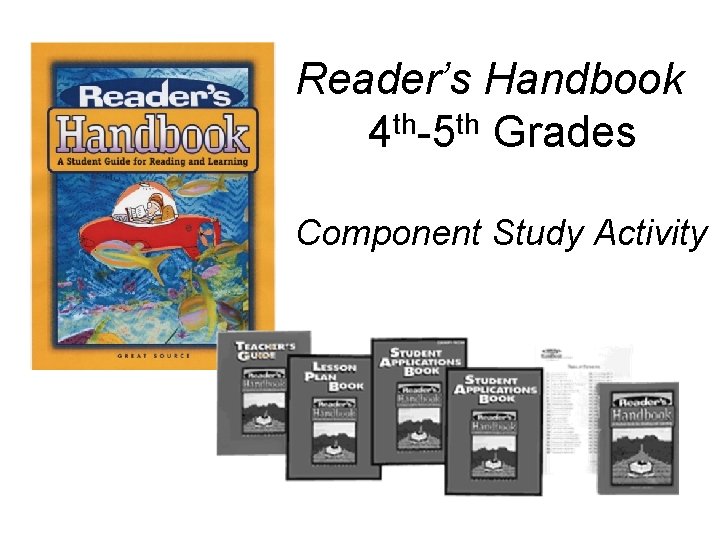
Reader’s Handbook 4 th-5 th Grades Component Study Activity
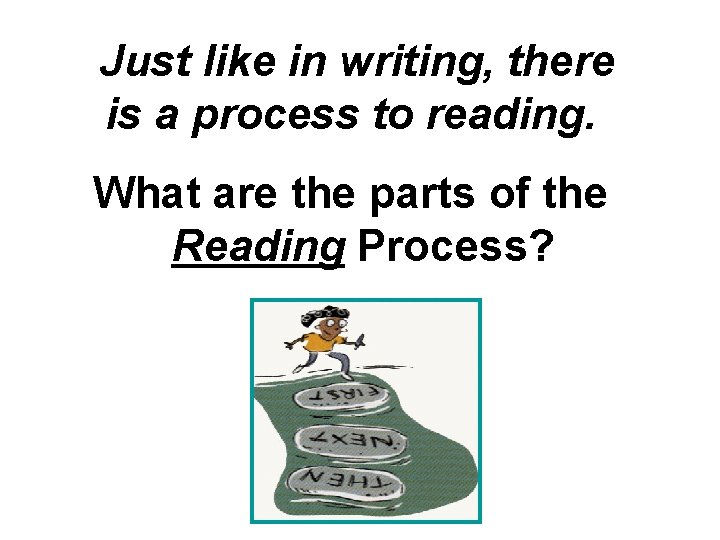
Just like in writing, there is a process to reading. What are the parts of the Reading Process?
Reading Process • Easy, 3 -step process • Before Reading • During Reading • After Reading • Idea familiar, but not steps • Idea of process well understood • Idea of what to do at each stage has not been clearly described before
Before Reading • Set Purpose Establish reason for reading. • Preview Determine what to look for as you preview. • Plan Decide on a strategy that works with what you now know about the reading.
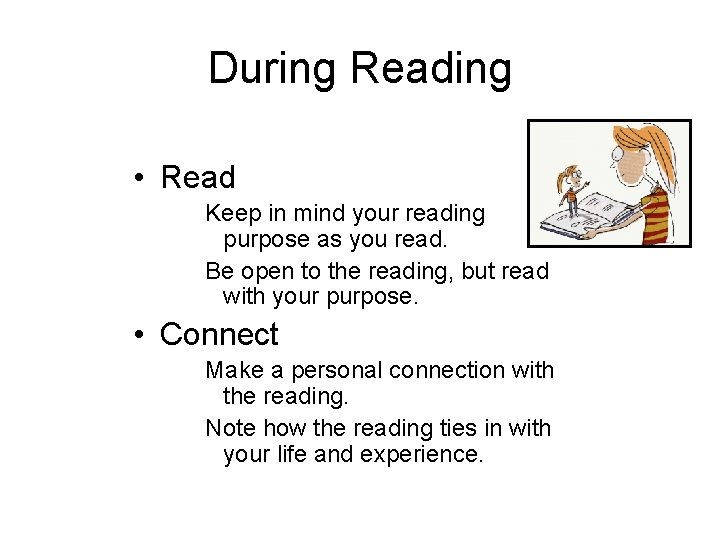
During Reading • Read Keep in mind your reading purpose as you read. Be open to the reading, but read with your purpose. • Connect Make a personal connection with the reading. Note how the reading ties in with your life and experience.
After Reading • Pause and Reflect Take time to look back and monitor how well you comprehend the reading. • Reread Go back into reading to improve comprehension by using a new strategy. • Remember Make the reading your own by “doing” or “creating” something with it.
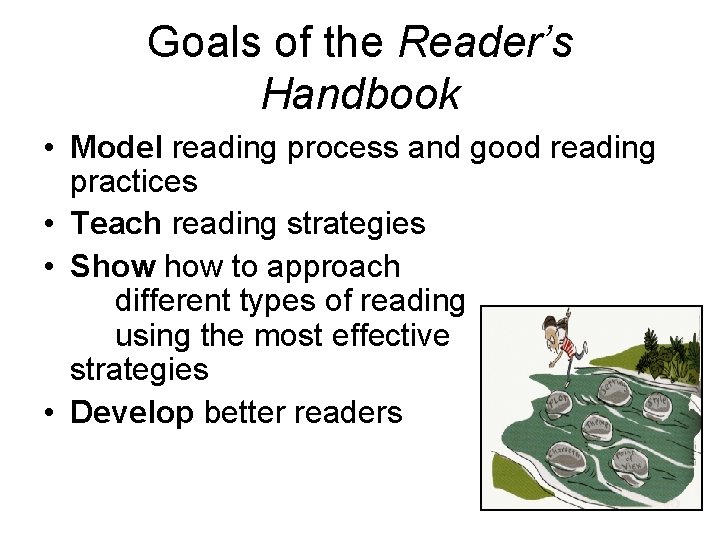
Goals of the Reader’s Handbook • Model reading process and good reading practices • Teach reading strategies • Show to approach different types of reading using the most effective strategies • Develop better readers
Reading Expository Texts What are the characteristics of an Expository Text? • Nonfiction (articles, newspapers, biographies, speeches) • Intent is to inform or explain to reading audience • Function is to make topic explicitly clear to the reader • Variety of formats (How-to, definition, description, persuasion, analysis, classification, comparisoncontrast, cause-effect, problem-solution)
Reading Expository Texts What are examples of an Expository Text? • • Directions Textbooks Encyclopedias Scientific Books/Journals Atlases Guides Biographies Newspapers
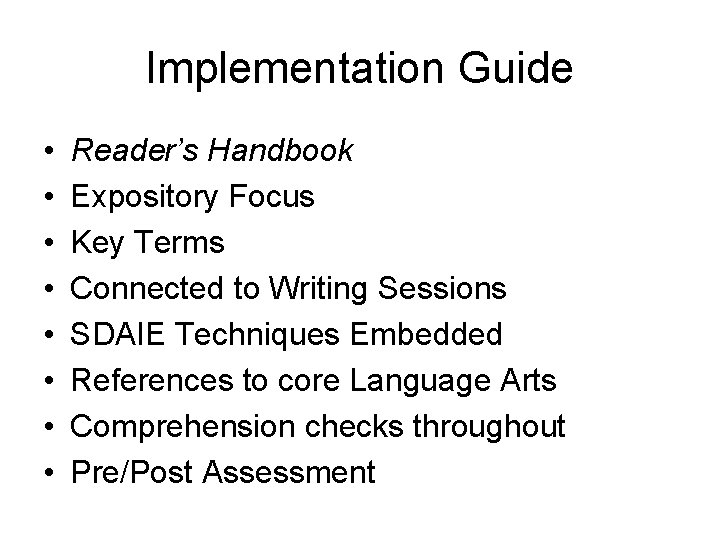
Implementation Guide • • Reader’s Handbook Expository Focus Key Terms Connected to Writing Sessions SDAIE Techniques Embedded References to core Language Arts Comprehension checks throughout Pre/Post Assessment
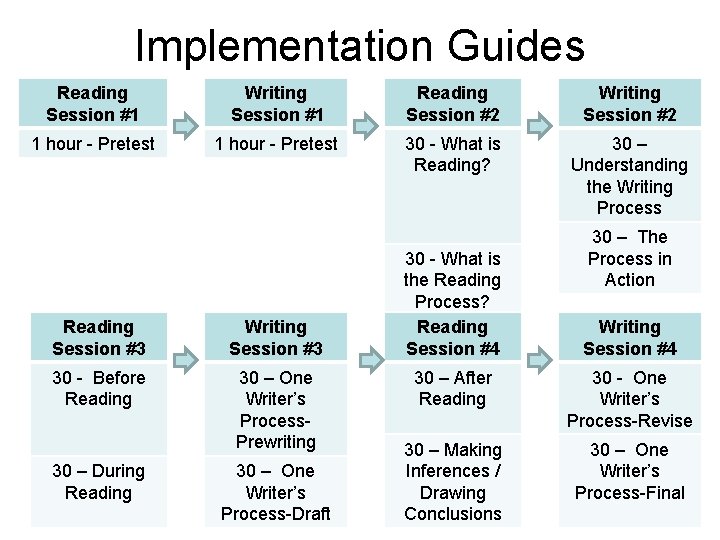
Implementation Guides Reading Session #1 Writing Session #1 Reading Session #2 Writing Session #2 1 hour - Pretest 30 - What is Reading? 30 – Understanding the Writing Process Reading Session #3 Writing Session #3 30 - Before Reading 30 – One Writer’s Process. Prewriting 30 – During Reading 30 – One Writer’s Process-Draft 30 - What is the Reading Process? Reading Session #4 30 – The Process in Action Writing Session #4 30 – After Reading 30 - One Writer’s Process-Revise 30 – Making Inferences / Drawing Conclusions 30 – One Writer’s Process-Final
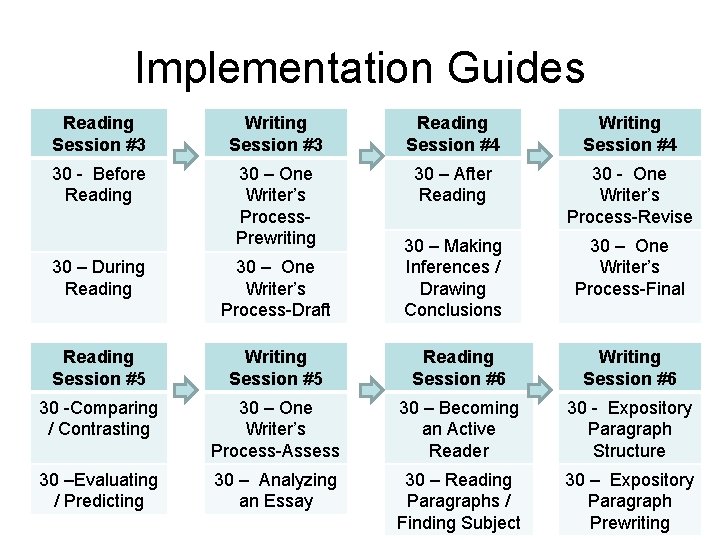
Implementation Guides Reading Session #3 Writing Session #3 Reading Session #4 Writing Session #4 30 - Before Reading 30 – One Writer’s Process. Prewriting 30 – After Reading 30 - One Writer’s Process-Revise 30 – Making Inferences / Drawing Conclusions 30 – One Writer’s Process-Final 30 – During Reading 30 – One Writer’s Process-Draft Reading Session #5 Writing Session #5 Reading Session #6 Writing Session #6 30 -Comparing / Contrasting 30 – One Writer’s Process-Assess 30 – Becoming an Active Reader 30 - Expository Paragraph Structure 30 –Evaluating / Predicting 30 – Analyzing an Essay 30 – Reading Paragraphs / Finding Subject 30 – Expository Paragraph Prewriting
- Slides: 19