
English Hub School networks GCSE English specs Autumn
English Hub School networks GCSE English specs Autumn 2016 Slide 1 Copyright © AQA and its licensors. All rights reserved.
Notes for advocates • You can amend these slides to make them applicable to your meeting. • You will need to – Rearrange the agenda and add your timings. – Put the slides in the sequence for your meeting. • You may want to hyperlink the articles to slide 14 so that you can click and open them on screen. Copyright © AQA and its licensors. All rights reserved.
Agenda Welcome and introductions Independent Learning Sharing student responses A preview of the new GCSE English Literature Mark Scheme Engagement materials Updates Slide 3 Copyright © AQA and its licensors. All rights reserved.
GCSE Independent Learning Slide 4 Copyright © AQA and its licensors. All rights reserved.
Outcomes By the end of the session you will: • have discussed and shared approaches for encouraging students independence • be familiar with the independent study resource and have shared ideas about how it might be used. Copyright © AQA and its licensors. All rights reserved.
Using the resource • This is a model for teachers to use to create independent learning sessions for their students. • Teachers can amend the presentation to include a theme of their own choosing, their own texts and web links. • This example can be uploaded to the school intranet so pupils can access it and respond either as homework or in small groups in the classroom. Slide 6 Copyright © AQA and its licensors. All rights reserved.
Independent learning unit GCSE English Language Paper 2 Slide 7 Copyright © AQA and its licensors. All rights reserved.
What will you gain? useful? Why is this Wider understanding of selected current issues. • Paper 2 requires reading of varied nonfiction sources. • Confidence in identifying and responding to different viewpoints and perspectives. • • Experience of writers writing non-fiction texts. You have to evaluate and compare viewpoints and perspectives by looking at what writers present and how they communicate their attitudes and create impact through language and structure. • You have to produce a piece of non-fiction writing on a linked topic showing your skills in using language and structure to create impact on your readers. • You need to give a presentation to an audience in which you communicate your ideas and answer questions. • • Ideas about how to organise information in non-fiction texts. • Ideas for writing and/or spoken language presentations. Slide 8 Copyright © AQA and its licensors. All rights reserved.
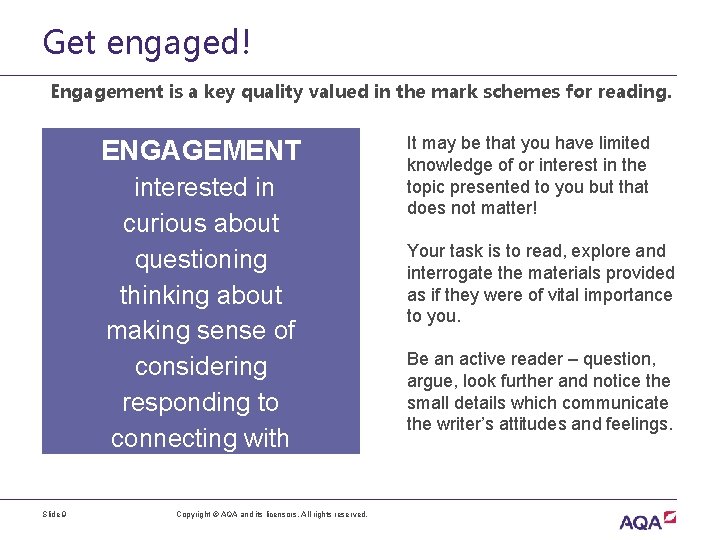
Get engaged! Engagement is a key quality valued in the mark schemes for reading. ENGAGEMENT interested in curious about questioning thinking about making sense of considering responding to connecting with Slide 9 Copyright © AQA and its licensors. All rights reserved. It may be that you have limited knowledge of or interest in the topic presented to you but that does not matter! Your task is to read, explore and interrogate the materials provided as if they were of vital importance to you. Be an active reader – question, argue, look further and notice the small details which communicate the writer’s attitudes and feelings.

How the unit works 1. Start with your own thoughts about an issue or topic. 2. Do some research. Read about and consider what other people think and how they have presented their viewpoints. 3. Reflect on what you have read and learned and try an exam type writing task (Paper 2 Question 5). 4. Practise writing a response to reading a Paper 2 Question 4 type question. 5. Think about your spoken language presentation and consider what the priorities are when speaking to an audience and how this is different from writing for a reader. 6. Practise preparing a short presentation on the topic you have researched. Slide 10 Copyright © AQA and its licensors. All rights reserved.
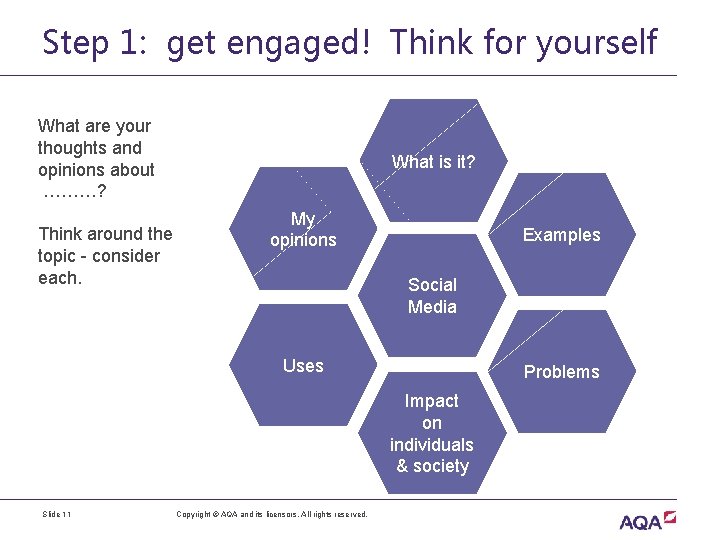
Step 1: get engaged! Think for yourself What are your thoughts and opinions about ………? Think around the topic - consider each. What is it? My opinions Examples Social Media Uses Problems Impact on individuals & society Slide 11 Copyright © AQA and its licensors. All rights reserved.
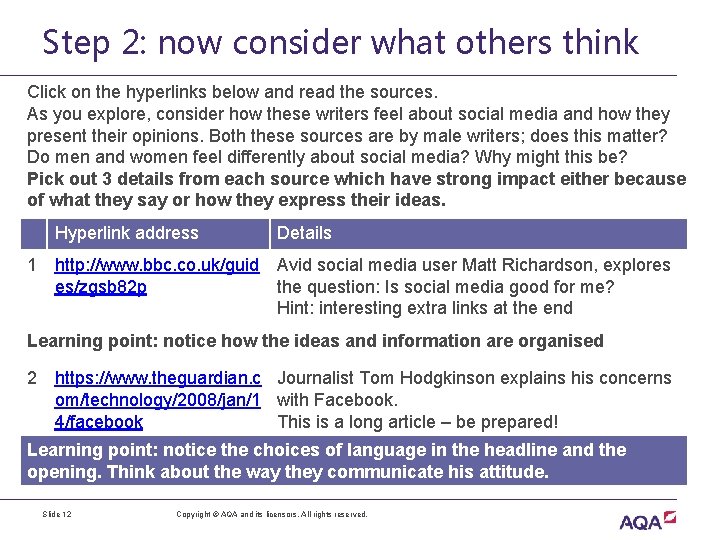
Step 2: now consider what others think Click on the hyperlinks below and read the sources. As you explore, consider how these writers feel about social media and how they present their opinions. Both these sources are by male writers; does this matter? Do men and women feel differently about social media? Why might this be? Pick out 3 details from each source which have strong impact either because of what they say or how they express their ideas. Hyperlink address Details 1 http: //www. bbc. co. uk/guid Avid social media user Matt Richardson, explores es/zgsb 82 p the question: Is social media good for me? Hint: interesting extra links at the end Learning point: notice how the ideas and information are organised 2 https: //www. theguardian. c Journalist Tom Hodgkinson explains his concerns om/technology/2008/jan/1 with Facebook. 4/facebook This is a long article – be prepared! Learning point: notice the choices of language in the headline and the opening. Think about the way they communicate his attitude. Slide 12 Copyright © AQA and its licensors. All rights reserved.
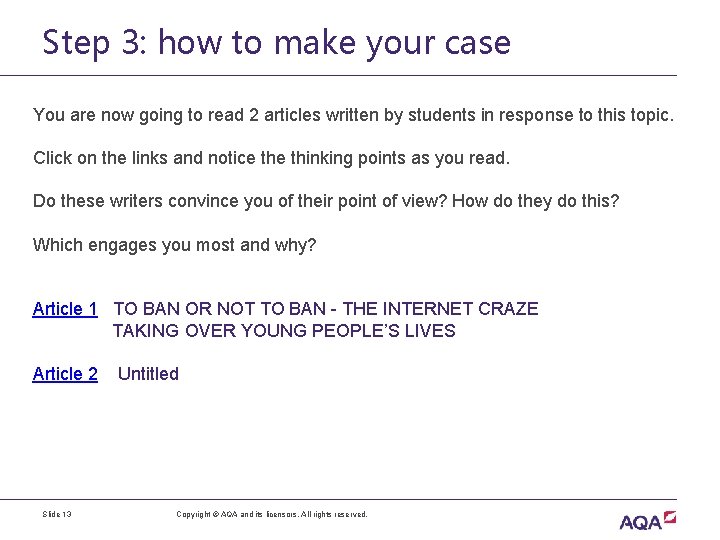
Step 3: how to make your case You are now going to read 2 articles written by students in response to this topic. Click on the links and notice thinking points as you read. Do these writers convince you of their point of view? How do they do this? Which engages you most and why? Article 1 TO BAN OR NOT TO BAN - THE INTERNET CRAZE TAKING OVER YOUNG PEOPLE’S LIVES Article 2 Slide 13 Untitled Copyright © AQA and its licensors. All rights reserved.
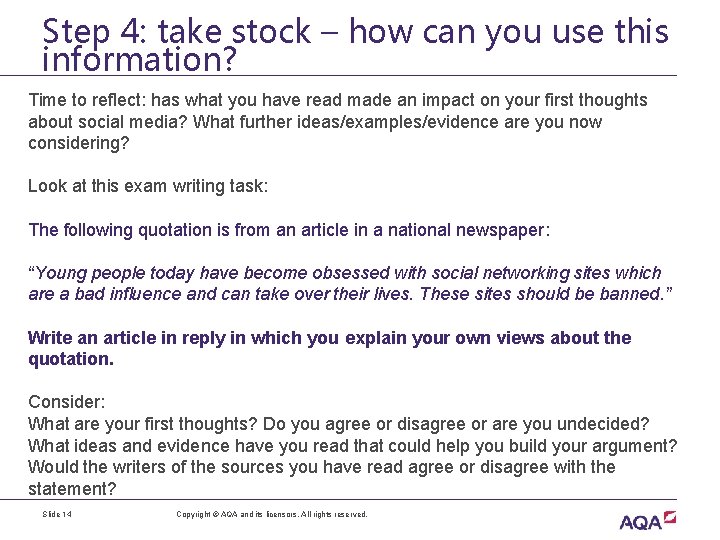
Step 4: take stock – how can you use this information? Time to reflect: has what you have read made an impact on your first thoughts about social media? : What further ideas/examples/evidence are you now considering? Look at this exam writing task: The following quotation is from an article in a national newspaper: “Young people today have become obsessed with social networking sites which are a bad influence and can take over their lives. These sites should be banned. ” Write an article in reply in which you explain your own views about the quotation. Consider: What are your first thoughts? Do you agree or disagree or are you undecided? What ideas and evidence have you read that could help you build your argument? Would the writers of the sources you have read agree or disagree with the statement? Slide 14 Copyright © AQA and its licensors. All rights reserved.

Step 5: exam practice - paper 2, Q 4, AO 3 (comparison) Look back across the 4 sources you have read. Compare how the writers convey their different ideas and perspectives on social media. In your answer, you could: • compare their different ideas and perspectives • compare the methods they use to convey their ideas and perspectives • support your response with references to both texts. What to consider…… - the details they focus on and the examples they include - choices and effects of language - order, emphasis - tone – how they sound - bias – do they give a balanced view. You should allow yourself 20 minutes to write a response to this question. Slide 15 Copyright © AQA and its licensors. All rights reserved.
Step 6: spoken language presentation • During your course you will be asked to give a presentation and answer questions about your ideas from an audience. • You can practise for this at the same time as developing your reading and writing skills. But first - think about: • How is speaking to an audience different from writing for them? Slide 16 Copyright © AQA and its licensors. All rights reserved.
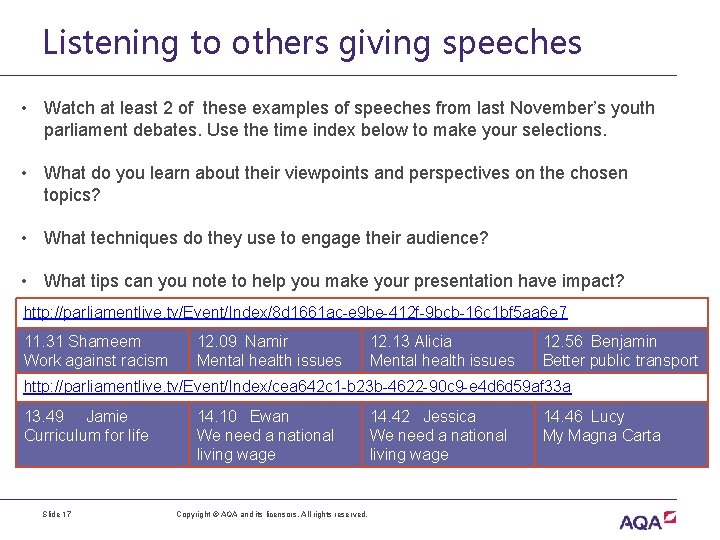
Listening to others giving speeches • Watch at least 2 of these examples of speeches from last November’s youth parliament debates. Use the time index below to make your selections. • What do you learn about their viewpoints and perspectives on the chosen topics? • What techniques do they use to engage their audience? • What tips can you note to help you make your presentation have impact? http: //parliamentlive. tv/Event/Index/8 d 1661 ac-e 9 be-412 f-9 bcb-16 c 1 bf 5 aa 6 e 7 11. 31 Shameem Work against racism 12. 09 Namir Mental health issues 12. 13 Alicia Mental health issues 12. 56 Benjamin Better public transport http: //parliamentlive. tv/Event/Index/cea 642 c 1 -b 23 b-4622 -90 c 9 -e 4 d 6 d 59 af 33 a 13. 49 Jamie Curriculum for life Slide 17 14. 10 Ewan We need a national living wage Copyright © AQA and its licensors. All rights reserved. 14. 42 Jessica We need a national living wage 14. 46 Lucy My Magna Carta
Extra help You can find extra help on doing presentations at these links: • Make a presentation fun • Five-best-presentations Slide 18 Copyright © AQA and its licensors. All rights reserved.
Over to you - delivering your own presentation • Think of your topic. • What are your thoughts and opinions about it? • Do some research by finding out what other people think. • Think about how to structure your presentation to engage and interest your audience. • Practise delivering your presentation maybe to a friend or family member and invite them to ask you questions. Slide 19 Copyright © AQA and its licensors. All rights reserved.
Keep up the good work… The activities you have completed are intended to help you meet the challenge of your GCSE English Language examinations. Your skills will improve faster if you keep up your reading on topical issues via online sites or newspapers. These last few slides offer tips to support you in this. Here are some ideas to consider: 1. Devise your own research trail using the model from this unit on a topic which interests you. Practise comparing viewpoints and perspectives. • When you search for other sources, it is advisable to be specific so that you can get the most useful material to review. • For example: ask a question “What do people think of social media? ” • Specify a genre: “research/blogs/essays/debates /reports/editorials/news about social media. • Be prepared to ignore advertising sites when they appear in the search results and to skip past adverts on the sites you click. Slide 20 Copyright © AQA and its licensors. All rights reserved.

Keep up the good work… 1. Share your trail with other students and ask for their feedback and opinions. 2. Take the plunge and add your own comments under news reports on sites to practise expressing your opinions for a public audience. 3. Practise writing and responding to essay style questions based on what you have read. 4. Use this model to research your own topic and practise writing responses to reading and writing exam questions and thinking about your presentation. 5. Stretch and challenge: the exam will include sources from the 19 th century alongside a source from either the 20 th or 21 st century so why not look back in time on your chosen topic? Slide 21 Copyright © AQA and its licensors. All rights reserved.
Keep up the good work: tips for your research • Be selective with your search results; don’t assume the first ones will be the most useful – they are often advertisements or sponsored sites • Don’t just rely on factual sources like Wikipedia. You need to consider a range of opinions, experiences, viewpoints and perspectives so look at editorials, news articles and pay attention to the dates to see if attitudes have changed over time • Blogs are a fabulous source of good, personal and opinion focused writing. Wordpress hosts thousands of these but they will come up on search engines if you specify the form. • For all the above, remember the emphasis in the exam will be British English and any talk you give will be to British people so don’t rely on American web sources – watch out for the. com as opposed to the. co. uk or. org Slide 22 Copyright © AQA and its licensors. All rights reserved.
End of Independent Study Unit Copyright © AQA and its licensors. All rights reserved.
Additional content (for teachers) • Mr Hanson’s blog https: //mrhansonsenglish. wordpress. com/category/for-pupils/ • A recently recorded screen share tutorial on using the English e-Library to develop student autonomy. It's for A-level Lit specs but the mechanics are the same regardless of level. Link here • To use, please right-click the link and open. The link may not work if you copy and paste in to browser. • You can also find this link on aqa. org. uk/english; simply scroll to ‘English news’. Slide 24 Copyright © AQA and its licensors. All rights reserved.
GCSE English Literature Slide 25 Copyright © AQA and its licensors. All rights reserved.
Sharing student’s responses to Literature Copyright © AQA and its licensors. All rights reserved.
Please note… This session is intended as an opportunity for you to look at students’ work in terms of: – – identifying the good aspects of the response discussing areas for improvement thinking about a mark or which level of the mark scheme applies sharing approaches to teaching the particular text. Your advocate can not verify any marks. Slide 27 Copyright © AQA and its licensors. All rights reserved.
GCSE English Literature mark scheme session Aims: • To introduce you to selected, key aspects of a new resource so that you are familiar with the type of support it offers. • To provide you with the opportunity to work together on one strand of it in detail. • To stimulate discussion of implications and opportunities for improvements in teaching and learning. • To provide scenarios for how the full resource can be used in schools. Slide 28 Copyright © AQA and its licensors. All rights reserved.
Updates from AQA Slide 29 Copyright © AQA and its licensors. All rights reserved.
GCSE For Language: • • • Release of new SAMs 4: Mock assessment papers Oct 2016. Annotated and colour coded student responses for every question at every level. Option to enter data through Doublestruck platform. Key messages about database and windows of entry. Series of events with key stakeholder groups and Academy Trusts. For Literature: • • Full mark scheme resource available Autumn term 2016. Series of events with key stakeholder groups and Academy Trusts. Slide 30 Copyright © AQA and its licensors. All rights reserved.
- Slides: 30