
English for Hospitality and Hotel industry Unit 4
- Slides: 35
餐飲旅館英語 English for Hospitality and Hotel industry Unit 4 In the Restaurant Dr. Leo T. A. Lin Feb. 19, 2013
Unit 4 In the Restaurant
1. Taking a restaurant reservation by phone • (Emma answered the phone. ) -- Good afternoon. The Grill Room Restaurant. How may I help you? (The caller asked for a reservation later in the day…) -- Yes. Hello. My name is Mike Gordon. I’d like to make a reservation for the evening.
1. Taking a restaurant reservation by phone • (The caller gave some details about the time and the size of the party. ) -- There are four of us, and we’d like a table at about 7: 00. (Emma checked the reservation log(登記表冊) on her computer. She told the caller that a table for four was available then. ) -- Yes, Mr. Gordon. We have some very nice window tables for four at 7: 00.
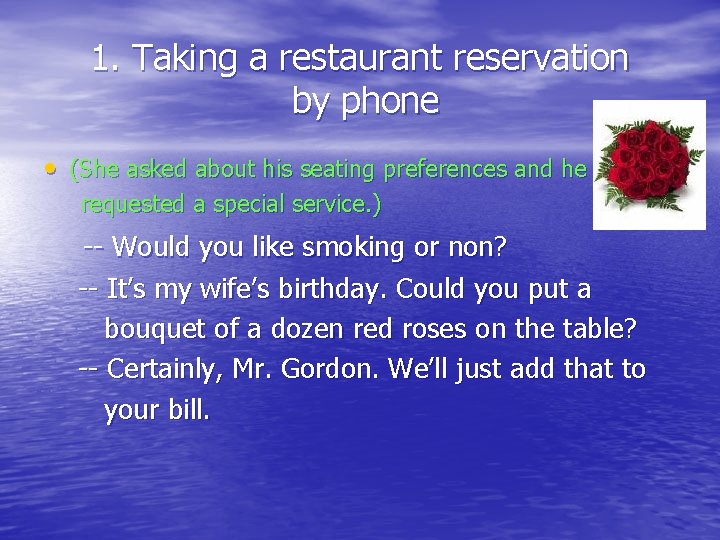
1. Taking a restaurant reservation by phone • (She asked about his seating preferences and he requested a special service. ) -- Would you like smoking or non? -- It’s my wife’s birthday. Could you put a bouquet of a dozen red roses on the table? -- Certainly, Mr. Gordon. We’ll just add that to your bill.
1. Taking a restaurant reservation by phone • (Emma noted the request and confirmed the details of the reservation. ) -- So we’ll see you at 7: 00 this evening, Mr. Gordon. The roses will be on the table before you’re seated. -- Thank you very much. Bye.
2. Accommodating guests who have no reservation • (Ms. Lopez walked up to the hostess station. Emma, the hostess, asked her if she had a reservation. ) -- Do you have a reservation? -- No, I don’t. (Emma asked for the number of people in Ms. Lopez’s party. ) -- How many are in your party?
2. Accommodating guests who have no reservation • (Ms. Lopez needed a table for six. ) -- There will be six of us. (Emma checked the waiting list and estimated the wait for a table. ) -- It will be about ten minutes. -- That will be fine.
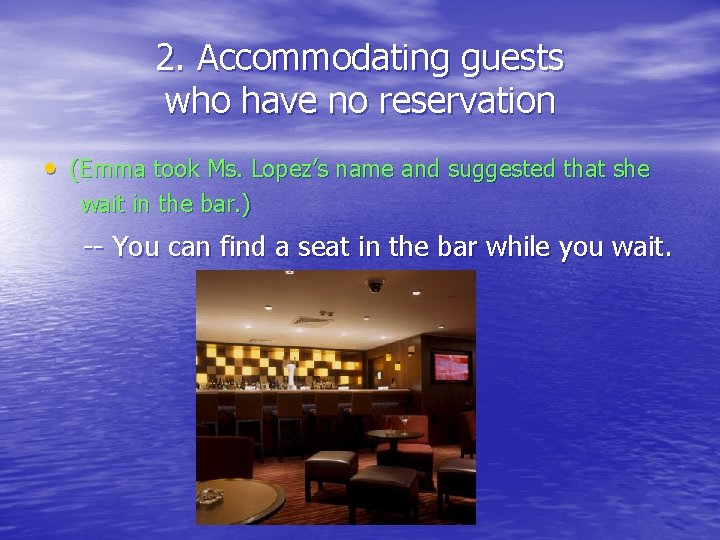
2. Accommodating guests who have no reservation • (Emma took Ms. Lopez’s name and suggested that she wait in the bar. ) -- You can find a seat in the bar while you wait.
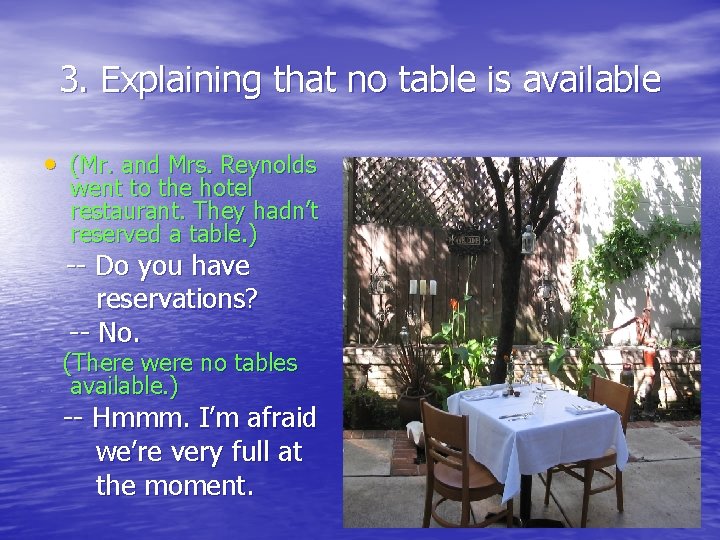
3. Explaining that no table is available • (Mr. and Mrs. Reynolds went to the hotel restaurant. They hadn’t reserved a table. ) -- Do you have reservations? -- No. (There were no tables available. ) -- Hmmm. I’m afraid we’re very full at the moment.
3. Explaining that no table is available • (The waiting list was very long. ) -- I’m sorry. There will be at least an hour’s wait. (Mrs. Reynolds could not wait. ) -- Jeff, we need to eat sooner than that. (The hostess showed them a list of other local restaurants. ) -- Maybe I can help you find another restaurant.
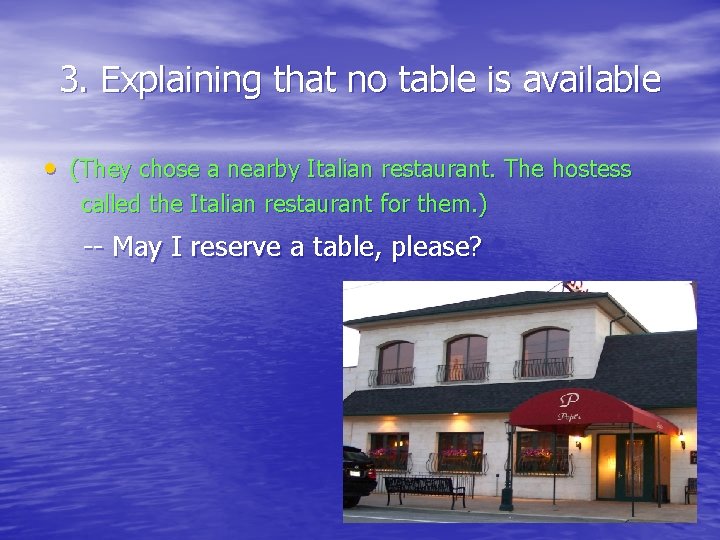
3. Explaining that no table is available • (They chose a nearby Italian restaurant. The hostess called the Italian restaurant for them. ) -- May I reserve a table, please?
4. Seating guests • (Emma, the hostess, checked the Porters’ name on her reservation list. She found their table on the seating chart. ) -- Right. Here we are. (She picked up two menus and led the Porters to their table. She held the chair for Mrs. Porter. Emma gave them menus and offered Mr. Porter the wine list. She wished them a pleasant meal. ) -- Enjoy your meal.
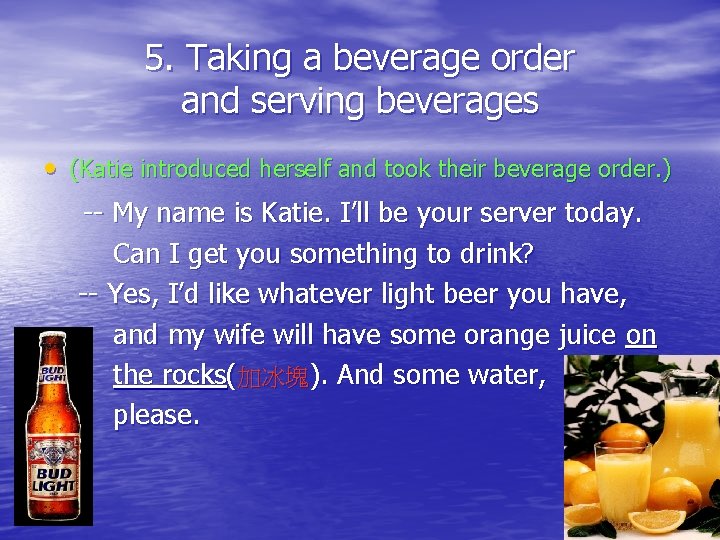
5. Taking a beverage order and serving beverages • (Katie introduced herself and took their beverage order. ) -- My name is Katie. I’ll be your server today. Can I get you something to drink? -- Yes, I’d like whatever light beer you have, and my wife will have some orange juice on the rocks(加冰塊). And some water, please.
5. Taking a beverage order and serving beverages • (She poured two glasses of water and walked the beverage order up to the bar. ) -- I have the water right here. I’ll just go and place your order while you look at the menu. (The bartender filled Katie’s beverage order for her and she returned to the table with a tray of drinks. She placed Mr. Porter’s bottle of beer on the table and set a beer glass next to it. )
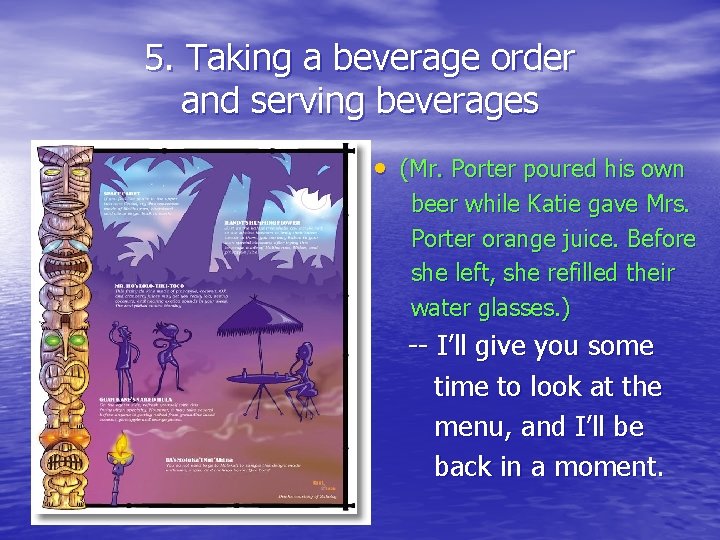
5. Taking a beverage order and serving beverages • (Mr. Porter poured his own beer while Katie gave Mrs. Porter orange juice. Before she left, she refilled their water glasses. ) -- I’ll give you some time to look at the menu, and I’ll be back in a moment.
6. Taking a meal order • (Katie checked that the Porters were ready to order. ) -- Are you ready to order? (She wrote the table number, the number of guests, and her server number on the check. First, she took Mrs. Porter’s order. ) -- For you, madam? (Then Mr. Porter ordered his entrée(主菜). ) -- I’ll have the steak.
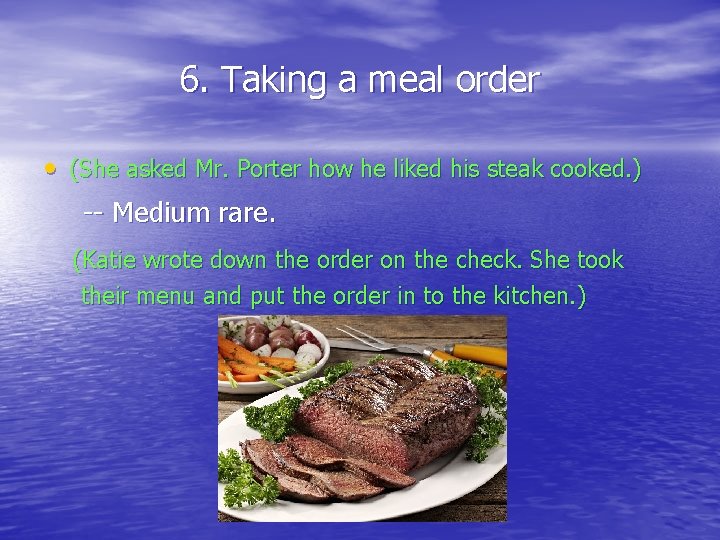
6. Taking a meal order • (She asked Mr. Porter how he liked his steak cooked. ) -- Medium rare. (Katie wrote down the order on the check. She took their menu and put the order in to the kitchen. )
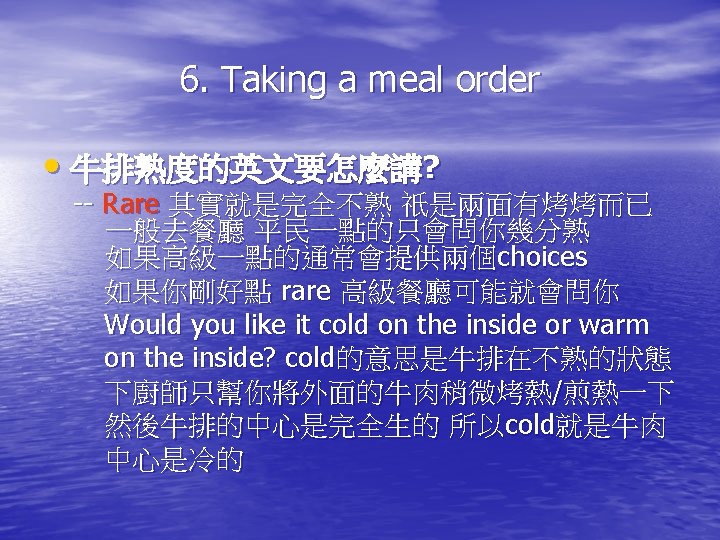
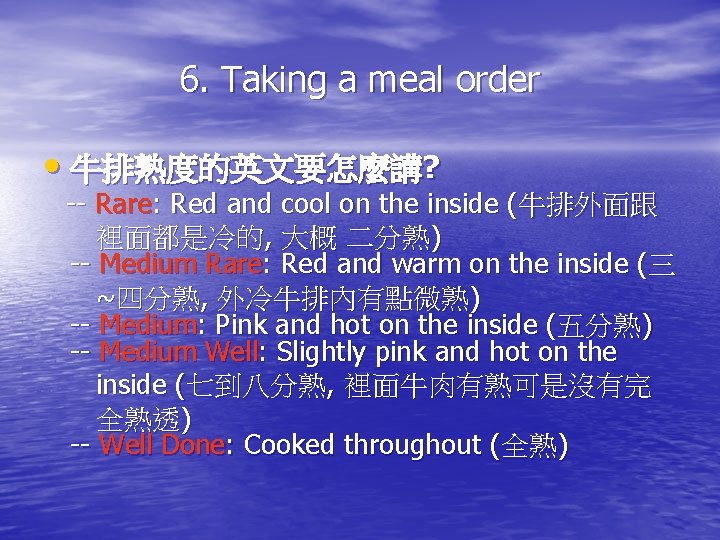
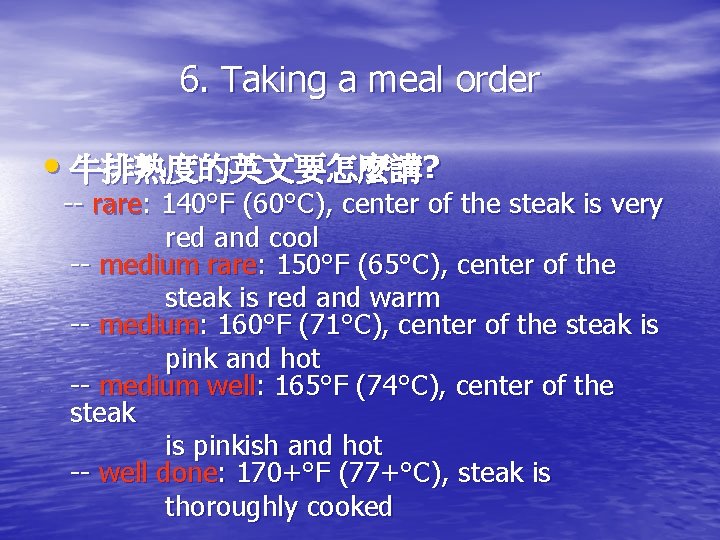
6. Taking a meal order • 牛排熟度的英文要怎麼講? -- Rare: Red and cool on the inside (牛排外面跟 裡面都是冷的, 大概 二分熟) -- Medium Rare: Red and warm on the inside (三 ~四分熟, 外冷牛排內有點微熟) -- Medium: Pink and hot on the inside (五分熟) -- Medium Well: Slightly pink and hot on the inside (七到八分熟, 裡面牛肉有熟可是沒有完 全熟透) -- Well Done: Cooked throughout (全熟)
6. Taking a meal order • 牛排熟度的英文要怎麼講? -- rare: 140°F (60°C), center of the steak is very red and cool -- medium rare: 150°F (65°C), center of the steak is red and warm -- medium: 160°F (71°C), center of the steak is pink and hot -- medium well: 165°F (74°C), center of the steak is pinkish and hot -- well done: 170+°F (77+°C), steak is thoroughly cooked
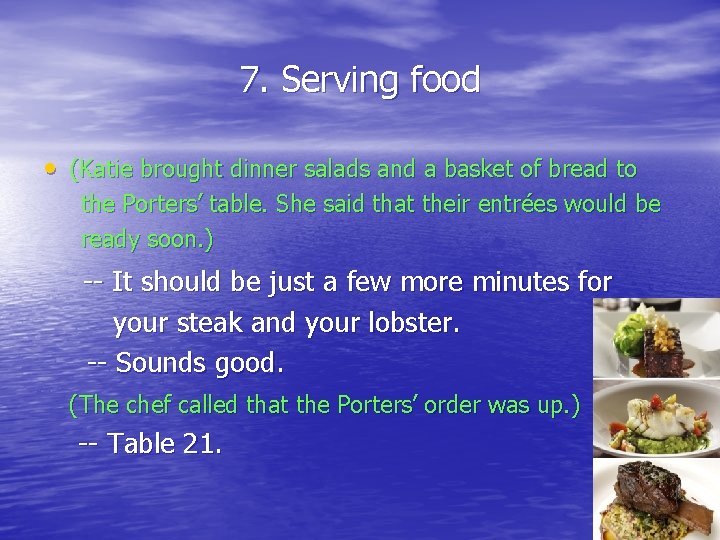
7. Serving food • (Katie brought dinner salads and a basket of bread to the Porters’ table. She said that their entrées would be ready soon. ) -- It should be just a few more minutes for your steak and your lobster. -- Sounds good. (The chef called that the Porters’ order was up. ) -- Table 21.
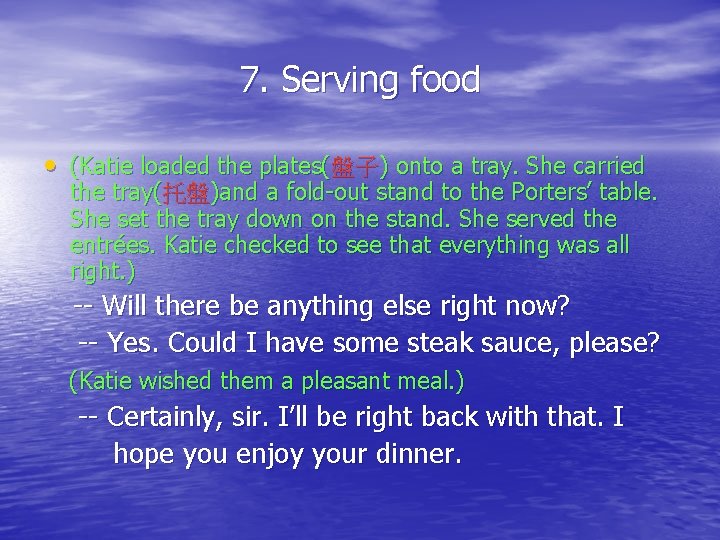
7. Serving food • (Katie loaded the plates(盤子) onto a tray. She carried the tray(托盤)and a fold-out stand to the Porters’ table. She set the tray down on the stand. She served the entrées. Katie checked to see that everything was all right. ) -- Will there be anything else right now? -- Yes. Could I have some steak sauce, please? (Katie wished them a pleasant meal. ) -- Certainly, sir. I’ll be right back with that. I hope you enjoy your dinner.
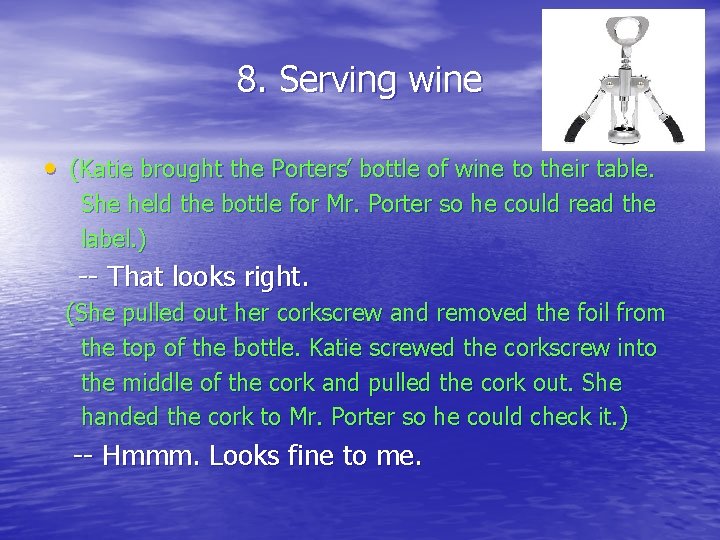
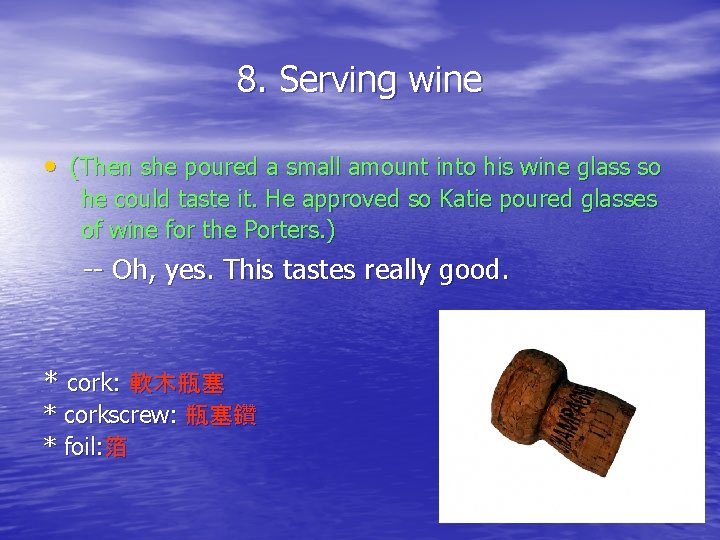
8. Serving wine • (Katie brought the Porters’ bottle of wine to their table. She held the bottle for Mr. Porter so he could read the label. ) -- That looks right. (She pulled out her corkscrew and removed the foil from the top of the bottle. Katie screwed the corkscrew into the middle of the cork and pulled the cork out. She handed the cork to Mr. Porter so he could check it. ) -- Hmmm. Looks fine to me.
8. Serving wine • (Then she poured a small amount into his wine glass so he could taste it. He approved so Katie poured glasses of wine for the Porters. ) -- Oh, yes. This tastes really good. * cork: 軟木瓶塞 * corkscrew: 瓶塞鑽 * foil: 箔
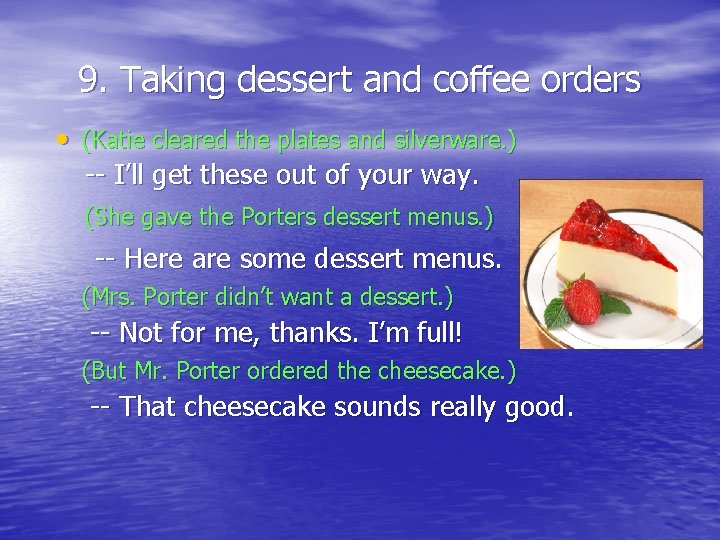
9. Taking dessert and coffee orders • (Katie cleared the plates and silverware. ) -- I’ll get these out of your way. (She gave the Porters dessert menus. ) -- Here are some dessert menus. (Mrs. Porter didn’t want a dessert. ) -- Not for me, thanks. I’m full! (But Mr. Porter ordered the cheesecake. ) -- That cheesecake sounds really good.
9. Taking dessert and coffee orders • (Katie offered them coffee and poured a cup of decaffeinated coffee(脫除咖啡因的咖啡) for Mrs. Porter. ) -- Would you like some coffee? -- No, thanks. -- Sure. Decaf, please. (She collected a fork from the server station and brought Mr. Porter’s cheesecake. )
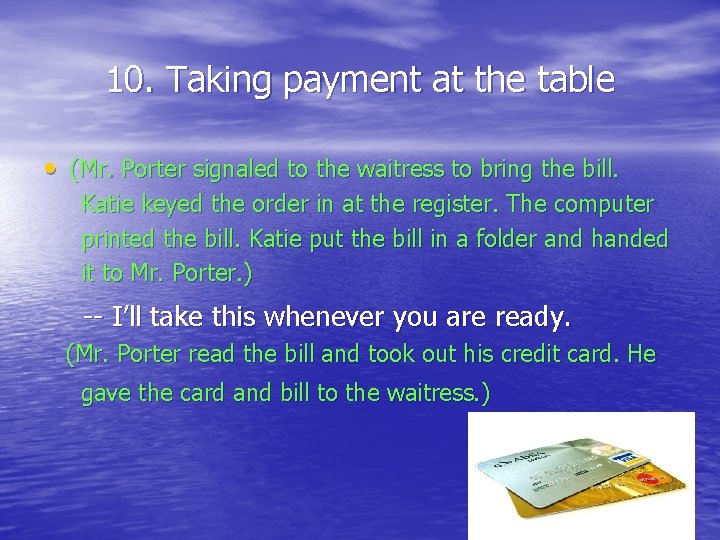
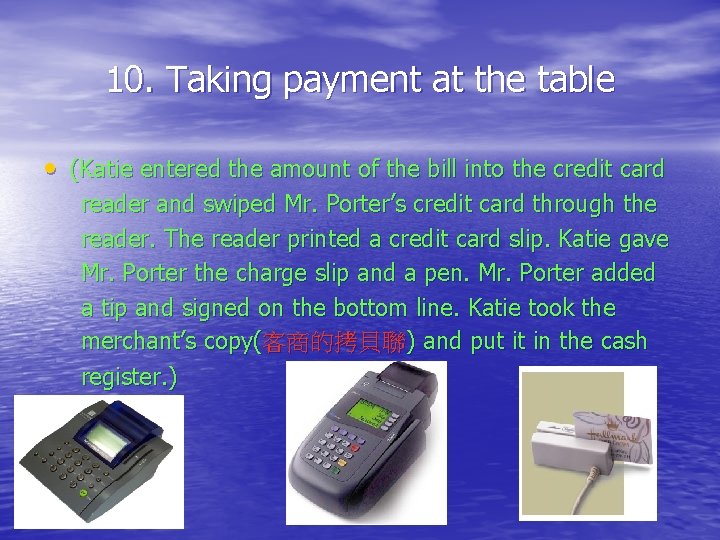
10. Taking payment at the table • (Mr. Porter signaled to the waitress to bring the bill. Katie keyed the order in at the register. The computer printed the bill. Katie put the bill in a folder and handed it to Mr. Porter. ) -- I’ll take this whenever you are ready. (Mr. Porter read the bill and took out his credit card. He gave the card and bill to the waitress. )
10. Taking payment at the table • (Katie entered the amount of the bill into the credit card reader and swiped Mr. Porter’s credit card through the reader. The reader printed a credit card slip. Katie gave Mr. Porter the charge slip and a pen. Mr. Porter added a tip and signed on the bottom line. Katie took the merchant’s copy(客商的拷貝聯) and put it in the cash register. )
11. Taking payment at a register 1: A satisfied customer • (Mr. Reynolds took his bill to the cashier. He handed the bill to Emma, who entered the amount in the cash register. She asked Mr. Reynolds which form of payment he was using. ) -- Cash, check, or credit card? (Mr. Reynolds chose to pay in cash. ) -- I’ll pay cash. (Emma gave him his change. ) -- Okay. Out of 30. Here’s 18, 19, 20, and 30.
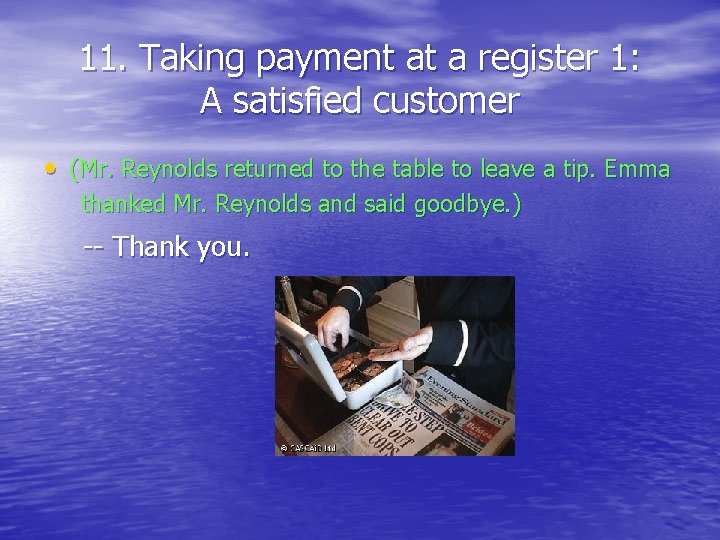
11. Taking payment at a register 1: A satisfied customer • (Mr. Reynolds returned to the table to leave a tip. Emma thanked Mr. Reynolds and said goodbye. ) -- Thank you.
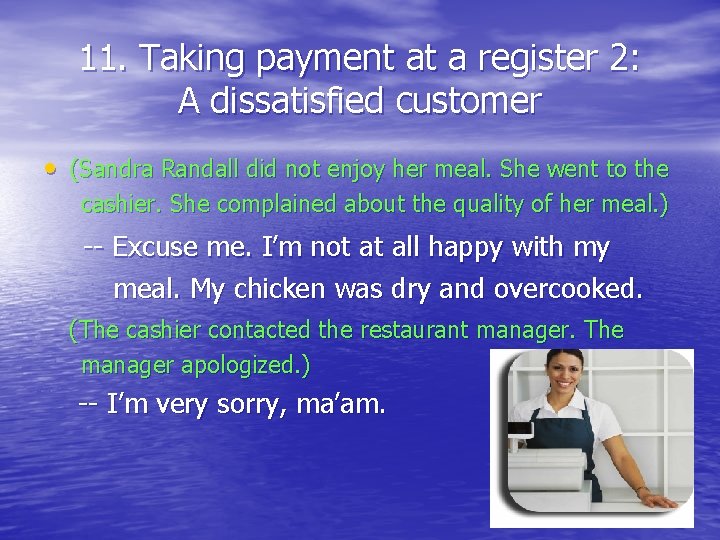
11. Taking payment at a register 2: A dissatisfied customer • (Sandra Randall did not enjoy her meal. She went to the cashier. She complained about the quality of her meal. ) -- Excuse me. I’m not at all happy with my meal. My chicken was dry and overcooked. (The cashier contacted the restaurant manager. The manager apologized. ) -- I’m very sorry, ma’am.
11. Taking payment at a register 2: A dissatisfied customer • (The manager didn’t charge Sandra for her entrée. ) -- Let me remove that charge from your bill. (Sandra wrote a check for the new total. ) -- Thank you for your understanding. (The manager informed the chef about the problem. ) -- Edward, we had a very unhappy customer.
12. Taking payment at a register 3: A credit card problem • (Emma, the cashier, swiped Sam Monroe’s credit card through the card reader. However, the machine rejected the card. Emma retried the card, but the transaction failed again. Emma handed the card back to Sam. ) -- I’m sorry, sir. This card is not working for some reason.
12. Taking payment at a register 3: A credit card problem • (Sam realized that his card had expired. ) -- Oh. My mistake. This one has expired. (Sam took out a different card. ) -- Let’s try another one. (The machine accepted the new card. )