
ENGLISH CONSORTIUM INSET Spring 2010 Restructuring ENGLISH ENGLISH
![Why change and what do we need to know [1]? • Cycle of examination](https://slidetodoc.com/presentation_image_h2/90212e6b22a64acbd00aab389a66ec4c/image-5.jpg "Why change and what do we need to know [1]? • Cycle of examination")
![Why change and what do we need to know [2]? • Agreement between N](https://slidetodoc.com/presentation_image_h2/90212e6b22a64acbd00aab389a66ec4c/image-6.jpg "Why change and what do we need to know [2]? • Agreement between N")
![Key Points [1]: • New course for first teaching from 2010, first accreditation Summer](https://slidetodoc.com/presentation_image_h2/90212e6b22a64acbd00aab389a66ec4c/image-7.jpg "Key Points [1]: • New course for first teaching from 2010, first accreditation Summer")
![Key Points [2] • In order to fulfil the KS 4 English Po. S](https://slidetodoc.com/presentation_image_h2/90212e6b22a64acbd00aab389a66ec4c/image-8.jpg "Key Points [2] • In order to fulfil the KS 4 English Po. S")
![Key Points [3]: • Some changes such as controlled assessment restrictions are cross-curricular changes,](https://slidetodoc.com/presentation_image_h2/90212e6b22a64acbd00aab389a66ec4c/image-9.jpg "Key Points [3]: • Some changes such as controlled assessment restrictions are cross-curricular changes,")
![You will need. . . Language Specification Language SAMs [Units 1 and 2] Controlled](https://slidetodoc.com/presentation_image_h2/90212e6b22a64acbd00aab389a66ec4c/image-12.jpg "You will need. . . Language Specification Language SAMs [Units 1 and 2] Controlled")




![Controlled Assessment: English Literature [1] • For GCSE English Literature, any Shakespeare play may](https://slidetodoc.com/presentation_image_h2/90212e6b22a64acbd00aab389a66ec4c/image-27.jpg "Controlled Assessment: English Literature [1] • For GCSE English Literature, any Shakespeare play may")
![Controlled Assessment: English Literature [2] • Themes – Love, Family and parent/child relationships, youth/age,](https://slidetodoc.com/presentation_image_h2/90212e6b22a64acbd00aab389a66ec4c/image-28.jpg "Controlled Assessment: English Literature [2] • Themes – Love, Family and parent/child relationships, youth/age,")
- Slides: 38
ENGLISH CONSORTIUM INSET Spring 2010 Restructuring ENGLISH: ENGLISH GCSEs 2012
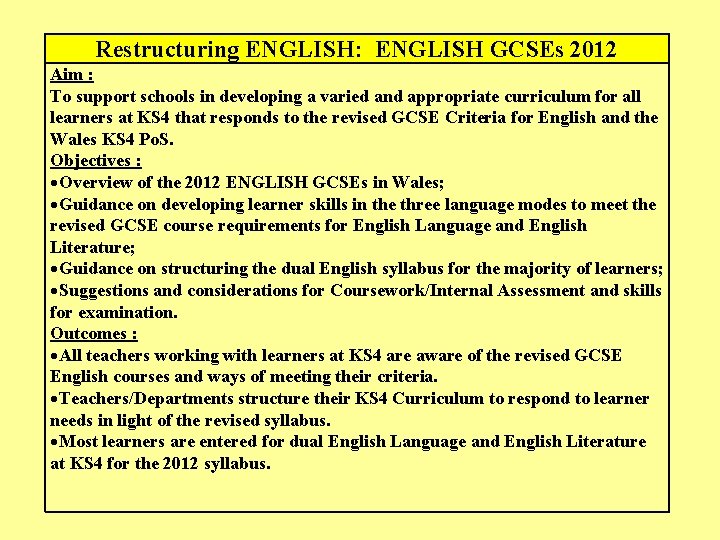
Restructuring ENGLISH: ENGLISH GCSEs 2012 Aim : To support schools in developing a varied and appropriate curriculum for all learners at KS 4 that responds to the revised GCSE Criteria for English and the Wales KS 4 Po. S. Objectives : Overview of the 2012 ENGLISH GCSEs in Wales; Guidance on developing learner skills in the three language modes to meet the revised GCSE course requirements for English Language and English Literature; Guidance on structuring the dual English syllabus for the majority of learners; Suggestions and considerations for Coursework/Internal Assessment and skills for examination. Outcomes : All teachers working with learners at KS 4 are aware of the revised GCSE English courses and ways of meeting their criteria. Teachers/Departments structure their KS 4 Curriculum to respond to learner needs in light of the revised syllabus. Most learners are entered for dual English Language and English Literature at KS 4 for the 2012 syllabus.
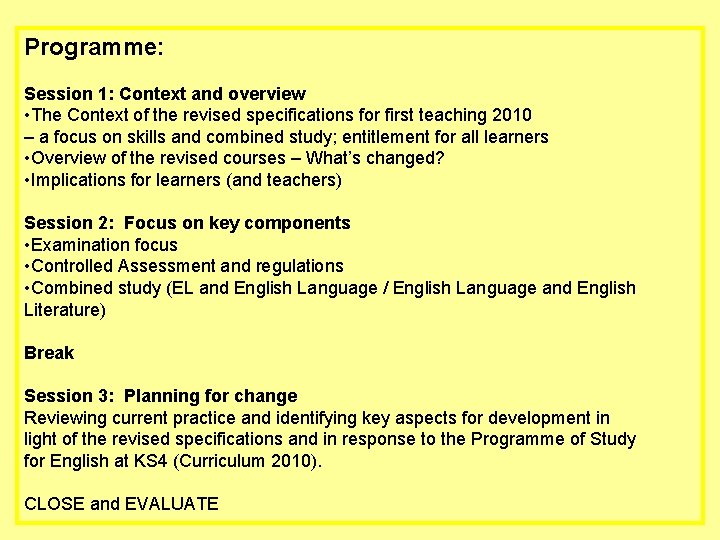
Programme: Session 1: Context and overview • The Context of the revised specifications for first teaching 2010 – a focus on skills and combined study; entitlement for all learners • Overview of the revised courses – What’s changed? • Implications for learners (and teachers) Session 2: Focus on key components • Examination focus • Controlled Assessment and regulations • Combined study (EL and English Language / English Language and English Literature) Break Session 3: Planning for change Reviewing current practice and identifying key aspects for development in light of the revised specifications and in response to the Programme of Study for English at KS 4 (Curriculum 2010). CLOSE and EVALUATE
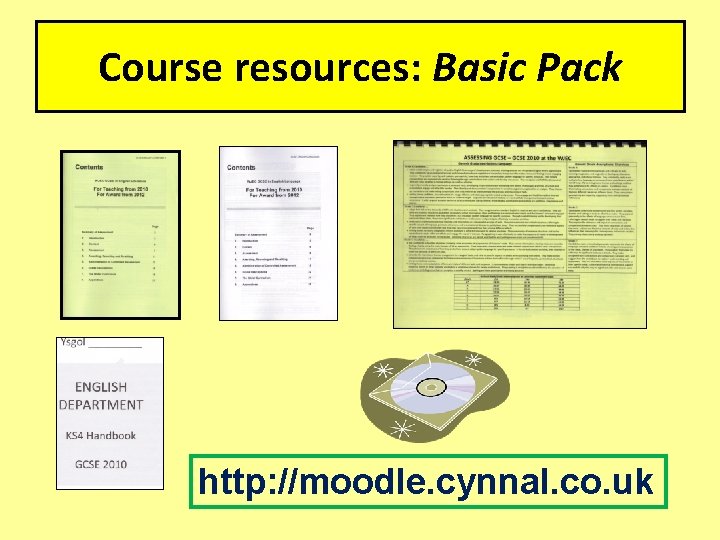
Course resources: Basic Pack http: //moodle. cynnal. co. uk
Why change and what do we need to know [1]? • Cycle of examination review (all subjects except English, Welsh, Maths, ICT and Science began new courses Sept. 09) • New courses were originally due for implementation Sept. 08 (same time as NC 2008 and new A Level !!!) • Integration of key/essential/functional skills • 3 ‘Courses’ – English Language, English Literature and a combined English course (only available in England) • Clearer links to the A Level English courses and distinction between English Language and English Literature
Why change and what do we need to know [2]? • Agreement between N Ireland, England Wales ‘English, Irish and Welsh Literary Heritage’ – no ‘country routes’ (except lack of ‘English’ accreditation in Wales/N Ireland. • No ‘dual entry’ tasks – unlike current coursework • Functional aspects (although fewer than originally planned). . . • Controlled Assessment (more on this later. . . )
Key Points [1]: • New course for first teaching from 2010, first accreditation Summer 2012. • GCSE English in Wales: “GCSE English is not available in Wales. Centres can meet the statutory requirements fully through entering pre-16 candidates for both GCSE English Language and GCSE English Literature. For the minority of candidates entered only for GCSE English Language, centres should ensure their taught curriculum fulfils statutory requirements”. [WJEC on behalf of DCELLS – Dec 09 final spec]
Key Points [2] • In order to fulfil the KS 4 English Po. S for Wales it is expected that the vast majority of learners be dual entered for English Language and English Literature from 2010 (first teaching). • A notional 80% national aim was suggested. Gwynedd = 75% currently / Mon 65% currently. Some of you already dual enter 100% annually. • Boys’ entry varies from 12 -100% across centres locally.
Key Points [3]: • Some changes such as controlled assessment restrictions are cross-curricular changes, not just English specific (more on this later. . . ). • Much of the examination assessment looks very similar to what learners have to do currently (phew!). • Main challenge – planning a teaching and learning route/routes through the course. • 40% of the course assessment must be undertaken in year 11 – both specs.
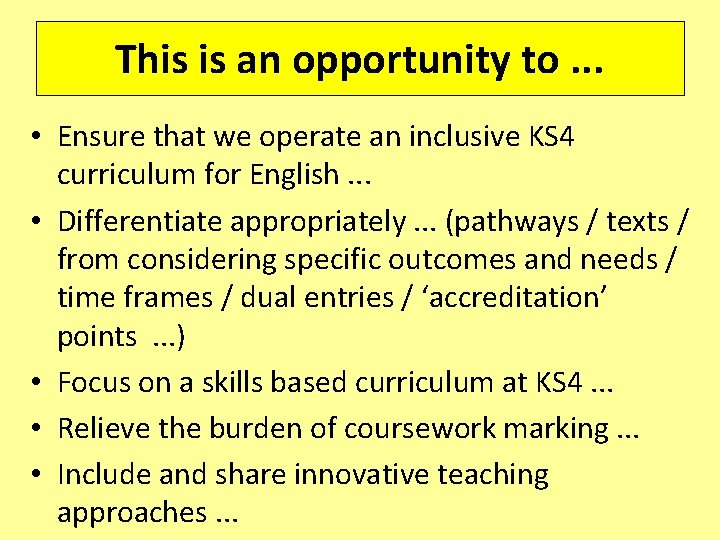
This is an opportunity to. . . • Ensure that we operate an inclusive KS 4 curriculum for English. . . • Differentiate appropriately. . . (pathways / texts / from considering specific outcomes and needs / time frames / dual entries / ‘accreditation’ points. . . ) • Focus on a skills based curriculum at KS 4. . . • Relieve the burden of coursework marking. . . • Include and share innovative teaching approaches. . .
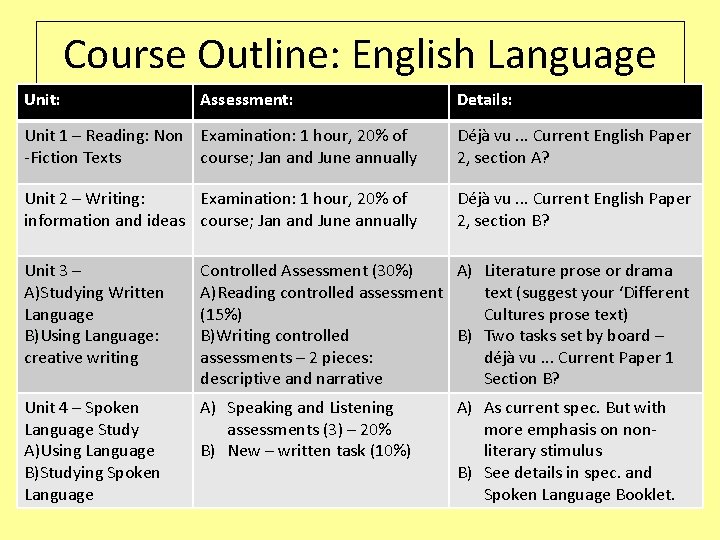
Course Outline: English Language Unit: Assessment: Details: Unit 1 – Reading: Non Examination: 1 hour, 20% of -Fiction Texts course; Jan and June annually Déjà vu. . . Current English Paper 2, section A? Unit 2 – Writing: Examination: 1 hour, 20% of information and ideas course; Jan and June annually Déjà vu. . . Current English Paper 2, section B? Unit 3 – A)Studying Written Language B)Using Language: creative writing Controlled Assessment (30%) A) Literature prose or drama A)Reading controlled assessment text (suggest your ‘Different (15%) Cultures prose text) B)Writing controlled B) Two tasks set by board – assessments – 2 pieces: déjà vu. . . Current Paper 1 descriptive and narrative Section B? Unit 4 – Spoken Language Study A)Using Language B)Studying Spoken Language A) Speaking and Listening assessments (3) – 20% B) New – written task (10%) A) As current spec. But with more emphasis on nonliterary stimulus B) See details in spec. and Spoken Language Booklet.
You will need. . . Language Specification Language SAMs [Units 1 and 2] Controlled Assessment Guidance [Unit 3] Speaking and Listening Guidance sheet [Unit 4] • Spoken Language Booklet [Unit 4] • •
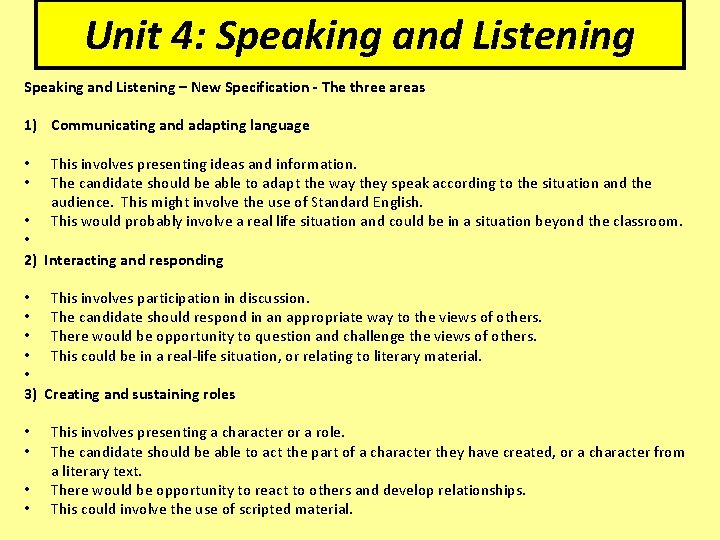
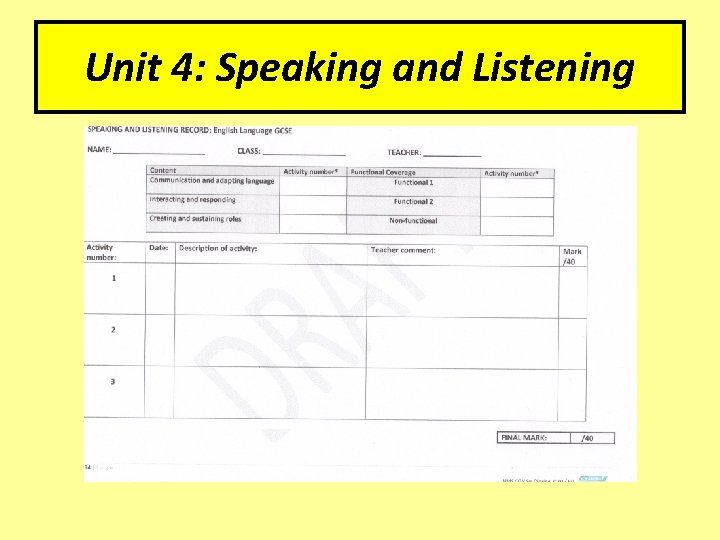
Unit 4: Speaking and Listening – New Specification - The three areas 1) Communicating and adapting language • • This involves presenting ideas and information. The candidate should be able to adapt the way they speak according to the situation and the audience. This might involve the use of Standard English. This would probably involve a real life situation and could be in a situation beyond the classroom. • • 2) Interacting and responding • • • 3) • • This involves participation in discussion. The candidate should respond in an appropriate way to the views of others. There would be opportunity to question and challenge the views of others. This could be in a real-life situation, or relating to literary material. Creating and sustaining roles This involves presenting a character or a role. The candidate should be able to act the part of a character they have created, or a character from a literary text. There would be opportunity to react to others and develop relationships. This could involve the use of scripted material.
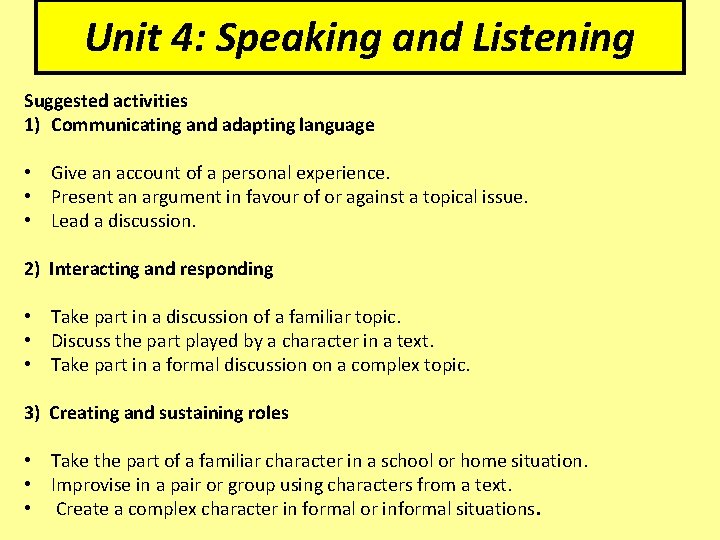
Unit 4: Speaking and Listening Suggested activities 1) Communicating and adapting language • Give an account of a personal experience. • Present an argument in favour of or against a topical issue. • Lead a discussion. 2) Interacting and responding • Take part in a discussion of a familiar topic. • Discuss the part played by a character in a text. • Take part in a formal discussion on a complex topic. 3) Creating and sustaining roles • Take the part of a familiar character in a school or home situation. • Improvise in a pair or group using characters from a text. • Create a complex character in formal or informal situations.
Unit 4: Speaking and Listening
Controlled Assessment: English Language Spoken Language Study – Unit 4: Worth 10% Not an exercise in terminology (speak-speak!) Not ‘AS/A 2 Language-Lite! Look at WJEC examples in booklet provided. Can take in research notes and a transcript. Need to teach how to transcribe. Can have one task or allow learners to research their own spoken language and transcribe. • Needs to be based on ‘spontaneous’ spoken language – not scripted. • •
Spoken Language Study: TASK • Use the last side of your assessment resource. • Work with a partner/in a small group to decide which BAND you would place three sample responses in. • Where in that band would you pitch them? What mark?
Any Questions? § Please keep these on post its for now.
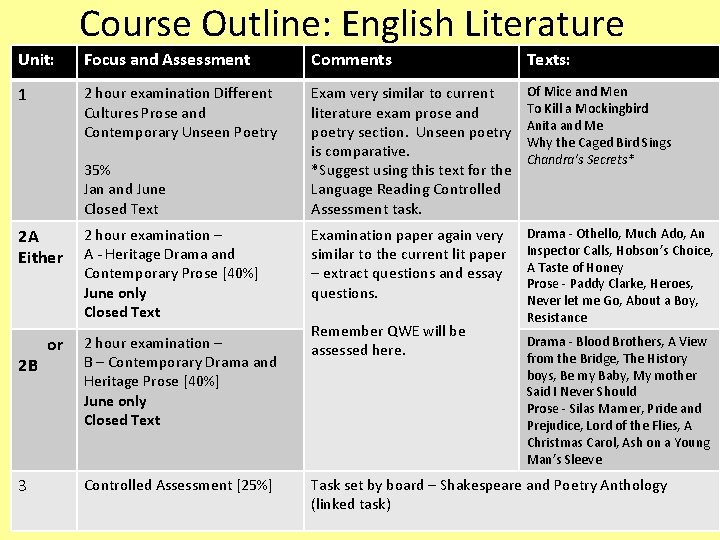
Course Outline: English Literature Unit: Focus and Assessment Comments Texts: 1 2 hour examination Different Cultures Prose and Contemporary Unseen Poetry Exam very similar to current literature exam prose and poetry section. Unseen poetry is comparative. *Suggest using this text for the Language Reading Controlled Assessment task. Of Mice and Men To Kill a Mockingbird Anita and Me Why the Caged Bird Sings Chandra’s Secrets* Examination paper again very similar to the current lit paper – extract questions and essay questions. Drama - Othello, Much Ado, An Inspector Calls, Hobson’s Choice, A Taste of Honey Prose - Paddy Clarke, Heroes, Never let me Go, About a Boy, Resistance 35% Jan and June Closed Text 2 A Either 2 B 3 or 2 hour examination – A - Heritage Drama and Contemporary Prose [40%] June only Closed Text 2 hour examination – B – Contemporary Drama and Heritage Prose [40%] June only Closed Text Controlled Assessment [25%] Remember QWE will be assessed here. Drama - Blood Brothers, A View from the Bridge, The History boys, Be my Baby, My mother Said I Never Should Prose - Silas Marner, Pride and Prejudice, Lord of the Flies, A Christmas Carol, Ash on a Young Man’s Sleeve Task set by board – Shakespeare and Poetry Anthology (linked task)
GCSE ENGLISH LITERATURE: • Look at the Pink Exemplar Papers and guidance booklet. [Literature Examinations] • Consider what is different between the requirements of the current course and the new course? • What implications are there for teaching and learning?
CD Support - Texts
CD Support - Texts
Any Questions? § Please keep these on post its for now.
Controlled Assessment: General • Please make sure you are familiar with the controlled assessment requirements as noted in the WJEC specifications – check if you are unsure! • Please follow these instructions, particularly in relation to time and support for learners. • Make sure work is collected in at the end of any writing time and kept securely once the piece is completed. LEARNERS are not allowed to take work home with them once the writing period for controlled assessment has begun. • Please use the relevant assessment grid when assessing each piece. • Redrafting, unless it happens as part of the writing process within the allocated time, is not permitted. • Please keep an accurate record and report any absences during controlled assessment writing periods to the HOE. • Please make sure all learners sign their controlled assessment coversheets and keep these securely. • Use the course check lists (class and pupil) to keep track of completed work.
Controlled Assessment: English Language WRITING: • Two pieces – one descriptive, one narrative • Generic tasks are set by the exam board each April. Refer to the specification and WJEC Controlled Assessment guidance for examples. • Planning and preparation time must not exceed 15 hours. • During this time pupils can have access to resources and stimulus material relevant to the task. This needs to be noted on the coversheet. • Writing time – maximum 2 hours (one hour per piece). During this time no access to dictionary, thesauri, spell check or grammar programmes. No notes or plans to be taken in to the writing period!
Controlled Assessment: English Language READING: • Analysis of an extended text (Prose or Drama) • Texts can by any Shakespeare play or any of the Drama/Prose texts on the Literature spec. • Poetry is not valid for this assessment. • Departmental recommendations are noted in the KS 4 Overview and planning documents. • Generic tasks are set by the exam board each April. Make sure the generic task is valid when you set the task. Use the guidance materials and specifications (WJEC’s) to help you set a specific question on your chosen text. Ask if you are uncertain. • Planning and preparation time must not exceed 15 hours. • One A 4 side of notes may be taken into the writing period. This must be submitted with the final piece. • Writing time – maximum of 2 hours.
Controlled Assessment: English Literature [1] • For GCSE English Literature, any Shakespeare play may be chosen except for Othello and Much Ado About Nothing since these two texts are on the English Literature set text list. • Two themes and selection of nominated poetry per ‘generic task’ – these will be changed annually from 2012. Generic tasks are set by the exam board each April. Refer to the specification and WJEC Controlled Assessment guidance for examples. • Around 10 poems will be nominated for reading alongside the Shakespeare play. The generic questions and examples show the close reading focus and wider reading of the whole text/anthology + links.
Controlled Assessment: English Literature [2] • Themes – Love, Family and parent/child relationships, youth/age, power and ambition, Conflict (War), Male/female relationships, hypocrisy/prejudice, grief. • Planning and preparation – • Writing time – 4 hours maximum as this counts as two texts. • Active teaching and learning approaches e. g. through drama approaches would be effective in helping learners to engage with the texts, make connections and remember key scenes and quotes as notes are limited (one side A 4 as with the reading task). • Resources - The board advises a closed book exercise. Another possibility would be to just have clean copies of the key scene(s) and poem(s) in the ‘writing’ session. • Copies of the anthology are available through the WJEC. There will also be an audio CD available to support teaching the poetry anthology.
Any Questions? § Place your question post its on one part of the placemat. § Share each other’s questions. § Can you answer each other’s questions? § Place any remaining questions in the centre of the placemat.
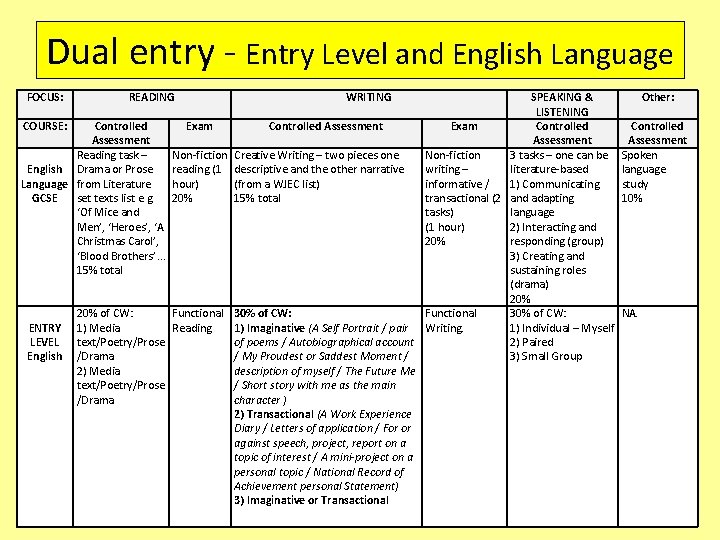
Dual entry - Entry Level and English Language FOCUS: READING WRITING SPEAKING & LISTENING COURSE: Controlled Exam Controlled Assessment Reading task – Non-fiction Creative Writing – two pieces one Non-fiction 3 tasks – one can be English Drama or Prose reading (1 descriptive and the other narrative writing – literature-based Language from Literature hour) (from a WJEC list) informative / 1) Communicating GCSE set texts list e. g. 20% 15% total transactional (2 and adapting ‘Of Mice and tasks) language Men’, ‘Heroes’, ‘A (1 hour) 2) Interacting and Christmas Carol’, 20% responding (group) ‘Blood Brothers’. . . 3) Creating and 15% total sustaining roles (drama) 20% of CW: Functional 30% of CW: ENTRY 1) Media Reading. 1) Imaginative (A Self Portrait / pair Writing. 1) Individual – Myself LEVEL text/Poetry/Prose of poems / Autobiographical account 2) Paired English /Drama / My Proudest or Saddest Moment / 3) Small Group 2) Media description of myself / The Future Me text/Poetry/Prose / Short story with me as the main /Drama character ) 2) Transactional (A Work Experience Diary / Letters of application / For or against speech, project, report on a topic of interest / A mini-project on a personal topic / National Record of Achievement personal Statement) 3) Imaginative or Transactional Other: Controlled Assessment Spoken language study 10% NA.
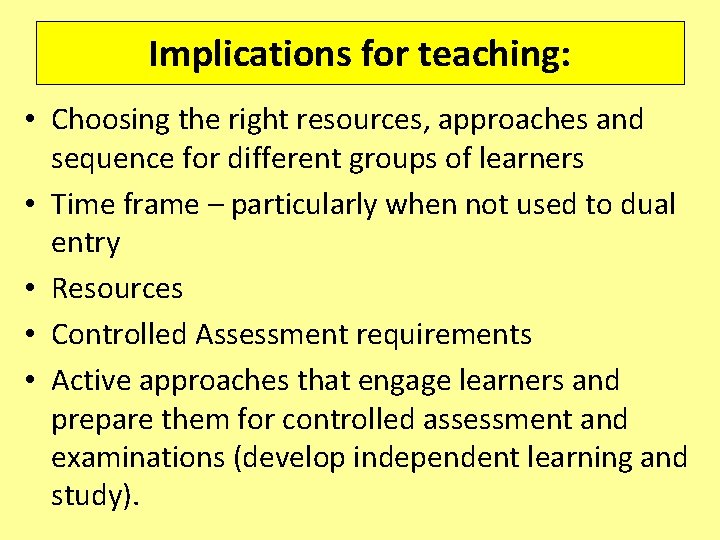
Implications for teaching: • Choosing the right resources, approaches and sequence for different groups of learners • Time frame – particularly when not used to dual entry • Resources • Controlled Assessment requirements • Active approaches that engage learners and prepare them for controlled assessment and examinations (develop independent learning and study).
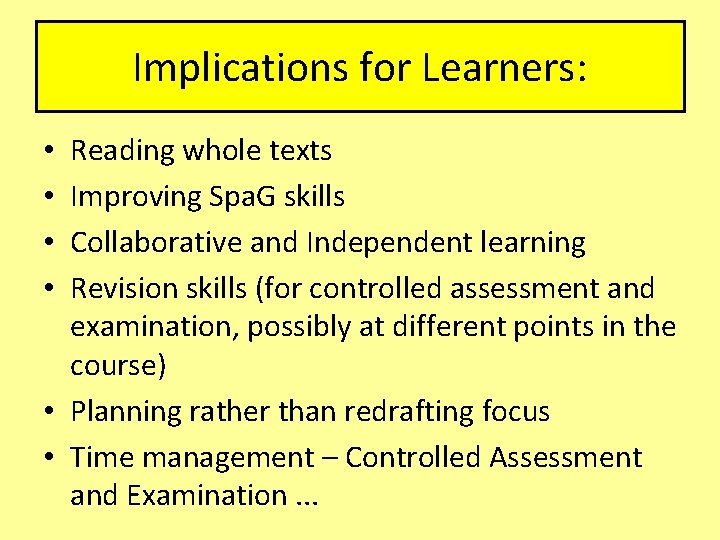
Implications for Learners: Reading whole texts Improving Spa. G skills Collaborative and Independent learning Revision skills (for controlled assessment and examination, possibly at different points in the course) • Planning rather than redrafting focus • Time management – Controlled Assessment and Examination. . . • •
So what does the course look like for a year 10/11 student? • You have a sample of the examinations/ Controlled Assessment (CA) that a pupil sitting GCSE English Language and English Literature would have to undertake. • Use the assessment grids and the handout provided to summarise what skills a pupil working towards an E, C or A* grade would need to demonstrate across these components. • What kind of teaching and learning implications are there?
The GCSE Course Planning Game: You will need. . . • To work as a department / groups within the department. . . • A board game and course cards. . . • A problem-solving mind. . . • Post its, paper, pens. . . • Assessment grids and course information – in your packs. . .
The GCSE Course Planning Game: The Aim. . . • To consider possible routes for different groups of learners in your school across the two year course. To map these out on your ‘game’ board. Remember to: Consider dual entry, examination preparation, controlled assessment, timeframes (lessons, weeks, deadlines (mocks, CA, examinations), annoying things that cut into lesson time. . . , ‘catch up time’. . .
Departmental Evaluation and Planning: • Use the remaining time to consider what you need to do back in your departments. • It might be useful to think about: q. What doesn’t need changing q. What needs tweaking q. Big jobs that need doing. • Consider: What? When? How? and Who?
Any Questions? • Any further questions? • Can anyone else on your table answer them? Any final questions?
HELP lines. . . ! • Course CD and Pack: Ø Specs and SAMs; Assessment Grids Ø Student and parent course guides* Ø Exemplar literature support materials [Blue File + CD] Ø Adapted past papers Ø KS 4 Handbook, Spoken Language Booklet Ø Cynnal KS 4 Moodle 2010 Ø WJEC website Ø Each other. . .