
English Composition I CoReq Module 2 Reading Strategies



- Slides: 41
English Composition I & Co-Req Module 2: Reading Strategies
Learning Outcomes • • • Analyze and utilize general reading strategies Describe active reading strategies Use previewing as a reading strategy Use questioning as a reading strategy Explain strategies for annotating texts Summarize a passage of reading Paraphrase a passage of reading Use outlining as a reading strategy Describe strategies for effective review
Reading Strategies
Practice Question Why should we analyze academic reading strategies?
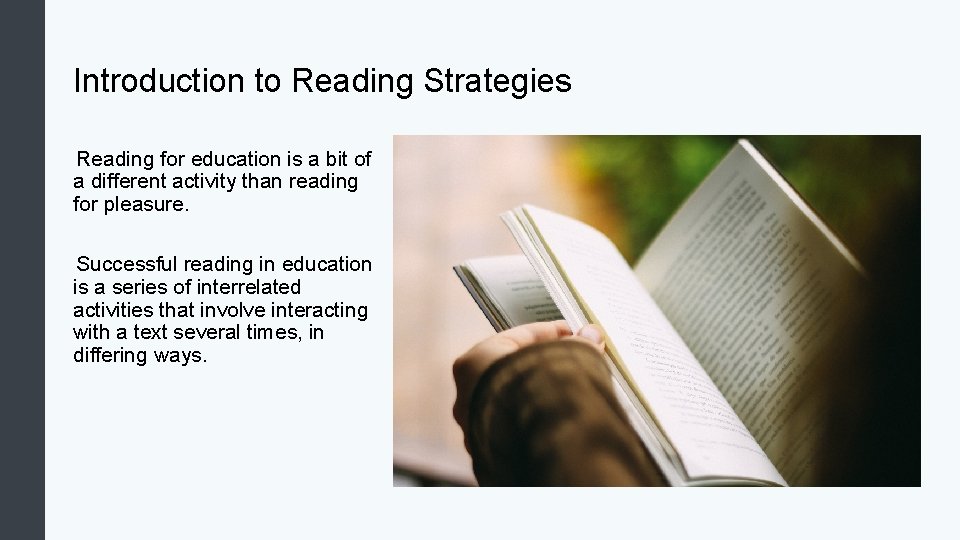
Introduction to Reading Strategies Reading for education is a bit of a different activity than reading for pleasure. Successful reading in education is a series of interrelated activities that involve interacting with a text several times, in differing ways.
Strategies for Active Reading These tips can help make your reading more effective: • Create an optimal setting for reading and a reading environment that helps decrease distraction • Engage in pre-reading strategies before starting to read • Read material efficiently: pick up a piece of material, engage actively with it, and finish. • Annotate written texts—write directly on the texts and/or take notes as you read. By doing this, you can enter into a discussion with the text, interacting with it. • Research or investigate content you don’t fully understand.
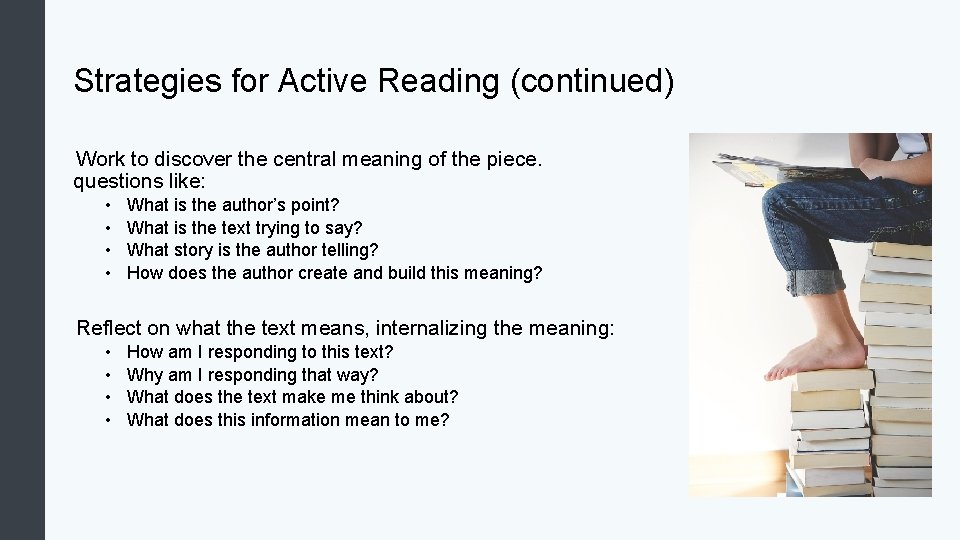
Strategies for Active Reading (continued) Work to discover the central meaning of the piece. questions like: • • What is the author’s point? What is the text trying to say? What story is the author telling? How does the author create and build this meaning? Reflect on what the text means, internalizing the meaning: • • How am I responding to this text? Why am I responding that way? What does the text make me think about? What does this information mean to me? Ask
Reading Strategy: Previewing What It Is • Previewing is a strategy that readers use to recall prior knowledge and set a purpose for reading. It calls for readers to skim a text before reading, looking for various features and information that will help as they return to read it in detail later. Why Use It • According to research, previewing a text can improve comprehension (Graves, Cooke, & La. Berge, 1983, cited in Paris et al. , 1991). It can set a purpose for reading and help you prepare for what’s coming.
Questioning Being an active reader means that you should be actively thinking about and interacting with the text you read, as if it were a conversation. Just like a conversation includes a back and forth dialogue between two speakers, when you read a text, there should be a dialogue between you and the author. Imagine that you were in an argument with a friend. When you read, you similarly want to think of it as a conversation, where you think about what the author is saying while developing your own thoughts and questions about what you read. Asking questions is an excellent way to think critically about a text and to be an engaged reader.
Activity: Questioning What are some questions that you should ask before, during, and reading? With a partner, make a list from the reading of the questions that you find most helpful. Now that you have a list, discuss how you might apply these questions when you’re reading material in your other courses.
Annotating To annotate is to actively engage a text by pausing to reflect, mark up, and add notes as you read. It can increase comprehension, help you remember what you’ve read, and save you time by not requiring you to re-read as often. The simplest ways to include marking up the text by highlighting, underlining, bracketing, or placing symbols in the text or the margins, but simply highlighting is insufficient. Highlighting tells you that you thought something was important in the moment you read it, but when you go back later, you won’t know why you thought it was important. As you annotate, you’ll also want to add keywords, phrases, or questions, and make connections to the content.
Note-taking Strategies SQ 3 R • • • Survey Question Read Recite Review Cornell Notes • • • Record Question Recite Reflect Review
Summarizing, or condensing someone else’s ideas and putting it into your own shortened form, allows you to be sure that you’ve accurately captured the main idea of the text you’re reading. Underline important information and write keywords in the margin. Record ideas using a two-column note-taking system. Record questions you have about the text concepts in the left column and answers you find in the reading in the right column. Identify how concepts relate to what you already know. Add examples and details
Paraphrasing is the act of putting an author’s ideas into your own words. When reading, paraphrasing is helpful for checking your understanding of what you read as well as remembering what you read. When writing, paraphrasing is an important skill to have when constructing a research paper and incorporating the ideas of alongside your own. others
Outline and Mapping An outline will • • present information in an organized and logical manner Focus on main ideas and key details Show information is related Cover a lot of material in a small space To create a concept map: • • • Write down the name of the text (or concept) you want to map. Draw a box for the main idea. Draw boxes for supporting ideas. Draw more boxes for supporting details. Draw arrows connecting the boxes. Organization flows vertically in this example, but concept maps can be organized horizontally, or even with the main idea in the center and supporting ideas and details surrounding it.
Reviewing is the final stage in the academic reading process. All the other steps you've taken while reading—previewing, active reading, and summarizing (which we'll discuss in detail later)—put the content into your head. For example, when you’re ready to study for an exam, you should: • Review your notes • If provided, review the chapter objectives and outline • Review important information, such as theories, facts, names, dates, and terms • Review any vocabulary flashcards you created • Review any study questions you created • Review your answers to study questions and activities
Specialized Reading Strategies
Learning Outcomes: Specialized Reading Strategies • • • Explain tips for reading effectively in various disciplines (sciences, social sciences, and math) Explain how to effectively read scholarly articles Use reading strategies to glean information from visual aids
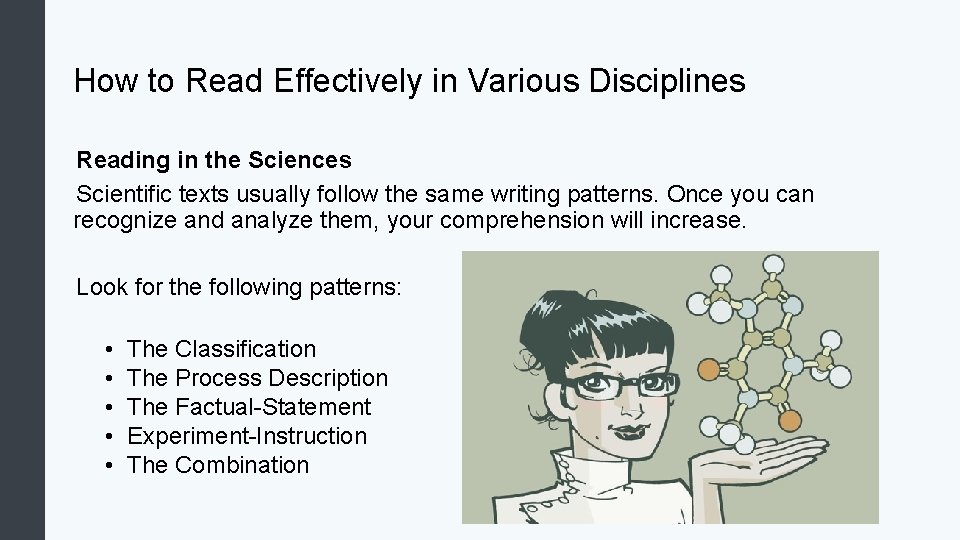
How to Read Effectively in Various Disciplines Reading in the Sciences Scientific texts usually follow the same writing patterns. Once you can recognize and analyze them, your comprehension will increase. Look for the following patterns: • • • The Classification The Process Description The Factual-Statement Experiment-Instruction The Combination
How to Read Effectively in Various Disciplines: Social Sciences Reading in the Social Sciences • Organize reading over the weeks and months • Begin any reading assignment by reading the abstract, preface, introductions, and conclusions • Mechanics of reading and note-taking
How to Read Effectively in Various Disciplines: Math Class Reading for Math Class • Work through the problem one step at a time • Close the book and try to work it again on your own • Repeat until you can reproduce the solution with the book closed • Try not to memorize the solution • Keep track of “what to do” to move from each line to the next • It’s okay if your version has more lines than the author’s (it may take you two or three steps to accomplish what the author does in one). This is a good sign that you’re thinking for yourself! • Be patient. It’s common to spend an hour or two on a single page. It’s worth your time to learn the process.
Practice Question: Reading Scholarly Articles What are some common characteristics of scholarly articles?
Reading Visual Aids A visual aid is an image or graphic used to display information. Visual aids can be found in just about every kind of print and electronic media; they can appear within the body of the text, in boxes or sidebars, or in appendices. • Tables • Graphs • Charts • Diagrams • Pictures
Rhetorical Context
Learning Outcomes: Rhetorical Context • • Explain the concept of rhetorical context Identify the rhetorical context of a passage
Rhetorical Context • All versions are accurate representations of your weekend, but you make strategic choices about which details to include or not include based on the particular rhetorical situation of your discussion. Rhetorical context refers to the circumstances surrounding an act of reading and/or composition. That is, how and what you communicate is shaped by: • The writer, author, creator, also known as the rhetor • The audience, including primary, secondary, and tertiary audiences • The topic of the communication • The purpose, which often can be broken into a primary, secondary, and tertiary purpose
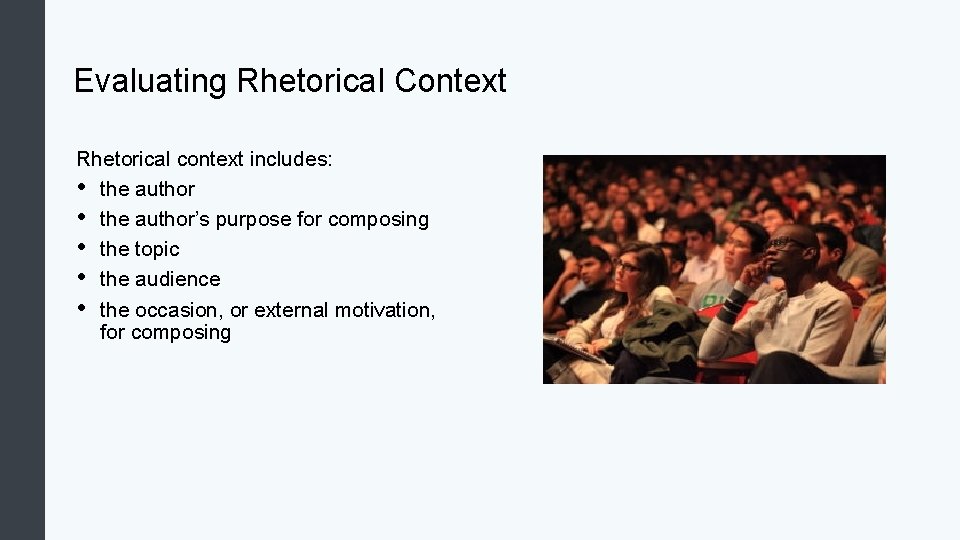
Evaluating Rhetorical Context Rhetorical context includes: • the author’s purpose for composing • the topic • the audience • the occasion, or external motivation, for composing
Practice Question: In order to understand a rhetorical context, what are the questions you should ask when you’re reading or listening? How does knowing the speech’s rhetorical context help you in writing an opposing argument?
Vocabulary-Building Reading Strategies
Using Context Clues A context clue is a word or phrase in the same sentence or a nearby sentence that can help the reader decipher the meaning of an unfamiliar word. Context clues consist of all the words and phrases that are near a word. Often, you can define words based on the other words around them. If you’re reading a lot of material, you don’t have time to look up individual words. Reading words in context helps ensure a high level of focus, whereas breaking your concentration to lookup words is distracting.
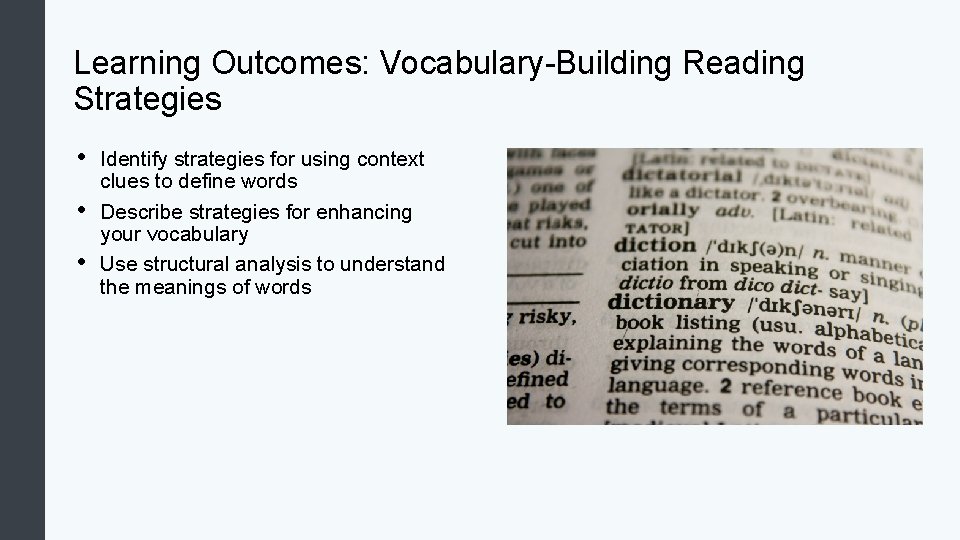
Learning Outcomes: Vocabulary-Building Reading Strategies • • • Identify strategies for using context clues to define words Describe strategies for enhancing your vocabulary Use structural analysis to understand the meanings of words
Six Different Types of Clues • • • Definition: a word or phrase that defines the unfamiliar word. Synonym: has a similar meaning to the unfamiliar word. Contrast/Antonym: has the opposite meaning of the unfamiliar word. Example: provides an example to illustrate the unfamiliar word Experience: draws upon personal experience or background knowledge to help you infer the meaning of the unfamiliar word. • Adjacent: a word or phrase in a nearby sentence that explains the meaning of the unfamiliar word.
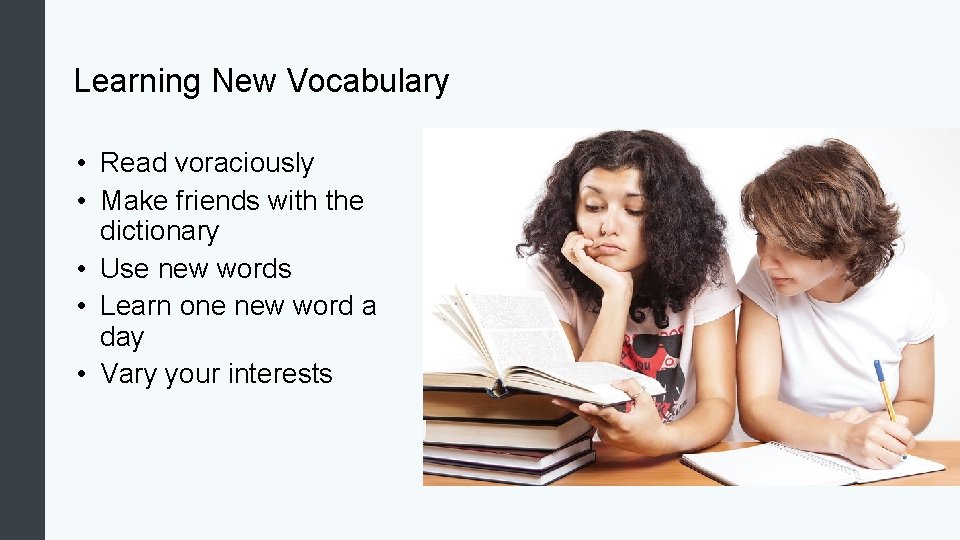
Learning New Vocabulary • Read voraciously • Make friends with the dictionary • Use new words • Learn one new word a day • Vary your interests
Enhancing Your Vocabulary When using structural analysis, the reader breaks words down into their basic parts: • Prefixes – word parts located at the beginning of a word to change meaning • Roots – the basic meaningful part of a word • Suffixes – word parts attached to the end of a word; suffixes often alter the part of speech of the word
Types of Reading Material
Learning Outcomes: Types of Reading Material • • • Differentiate between the goals and purposes of various genres of texts Analyze characteristics from different genres of text Explain differences between the of various genres of texts characteristics
Distinguishing Features of Textbooks • • • Literature: entertain • Poetry, fiction, creative non-fiction, drama Journalism: inform Academic journals: distribute new ideas Textbooks: educate Reference works: find information
1) What type of reading is this? Music education is a field of study associated with the teaching and learning of music. It touches on all learning domains, including the psychomotor domain (the development of skills), the cognitive domain (the acquisition of knowledge), and, in particular and significant ways, the affective domain (the learner’s willingness to receive, internalize, and share what is learned), including music appreciation and sensitivity. Music training from preschool through post-secondary education is common in most nations because involvement with music is considered a fundamental component of human culture and behavior. Music, like language, is an accomplishment that distinguishes humans as a species. During the 20 th century, many distinctive approaches were developed or further refined for the teaching of music, some of which have had widespread impact. The Dalcroze method (eurhythmics) was developed in the early 20 th century by Swiss musician and educator Émile Jaques-Dalcroze. The Kodály Method emphasizes the benefits of physical instruction and response to music. The Orff Schulwerk “approach” to music education leads students to develop their music abilities in a way that parallels the development of western music.
2) What type of reading is this? Sheila split open and the air was filled with gumballs. Yellow gumballs. This was awful for Stan, just awful. He had loved Sheila for a long time, fought for heart, believed in their love until finally she had come around. They were about to kiss for the first time and then this: yellow gumballs. Stan went to a group to try to accept that Sheila was gone. It was a group for people whose unrequited love had ended in some kind of surrealist moment. There is a group for everything in California. After several months of hard work on himself with the group, Stan was ready to open a shop and sell the thousands of yellow gumballs. He did this because he believed in capitalism, he loved capitalism. He loved the dynamic surge and crash of Amazon’s stock price, he loved the great concrete malls spreading across America like blood staining through a handkerchief, he loved how everything could be tracked and mirrored in numbers. When he closed the store each night he would count the gumballs sold, and he would determine his gross revenue, his operating expenses, his operating margin; he would adjust his balance sheet and learn his debt-to-equity ratio; and after this exercise each night, Stan felt he understood himself and was at peace, and he could go home to his apartment and drink tea and sleep, without shooting himself or thinking about Sheila. On the night before the IPO of gumballs. com, Sheila came to Stan in a dream. She was standing in a kiddie pool; Stan and his brothers and sisters were running around splashing and screaming; she had managed to insert herself into a Super 8 home movie of Stan’s family, shot in the late seventies. She looked terribly sad. “Sheila, where are you? ” Stan said. “Why did you leave me, why did you become gumballs? ” “The Ant King has me, ” Sheila said. “You must rescue me. ” Stan woke up, he shaved, he put on his Armani suit, and drove his Lexus to his appointment with his venture capitalists and investment bankers. But the dream would not leave him. .
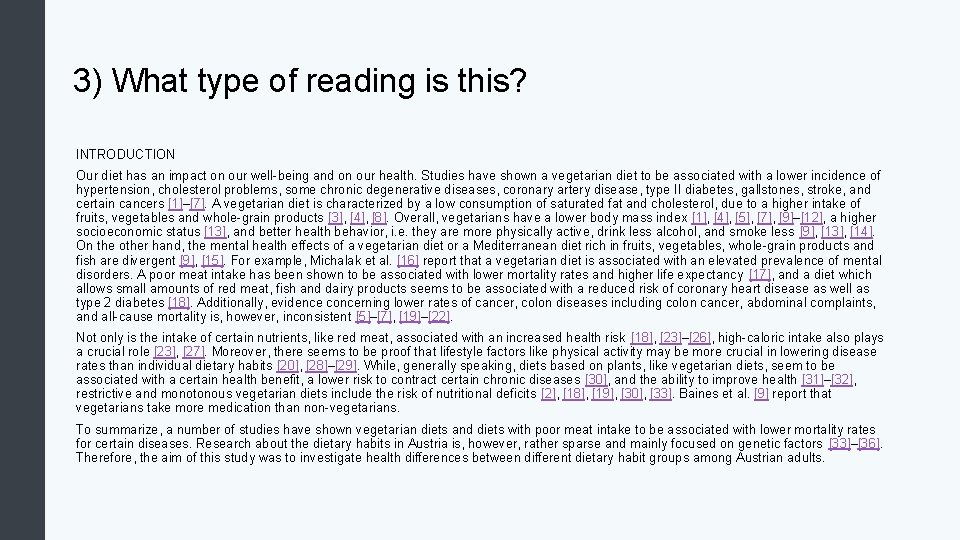
3) What type of reading is this? INTRODUCTION Our diet has an impact on our well-being and on our health. Studies have shown a vegetarian diet to be associated with a lower incidence of hypertension, cholesterol problems, some chronic degenerative diseases, coronary artery disease, type II diabetes, gallstones, stroke, and certain cancers [1]–[7]. A vegetarian diet is characterized by a low consumption of saturated fat and cholesterol, due to a higher intake of fruits, vegetables and whole-grain products [3], [4], [8]. Overall, vegetarians have a lower body mass index [1], [4], [5], [7], [9]–[12], a higher socioeconomic status [13], and better health behavior, i. e. they are more physically active, drink less alcohol, and smoke less [9], [13], [14]. On the other hand, the mental health effects of a vegetarian diet or a Mediterranean diet rich in fruits, vegetables, whole-grain products and fish are divergent [9], [15]. For example, Michalak et al. [16] report that a vegetarian diet is associated with an elevated prevalence of mental disorders. A poor meat intake has been shown to be associated with lower mortality rates and higher life expectancy [17], and a diet which allows small amounts of red meat, fish and dairy products seems to be associated with a reduced risk of coronary heart disease as well as type 2 diabetes [18]. Additionally, evidence concerning lower rates of cancer, colon diseases including colon cancer, abdominal complaints, and all-cause mortality is, however, inconsistent [5]–[7], [19]–[22]. Not only is the intake of certain nutrients, like red meat, associated with an increased health risk [18], [23]–[26], high-caloric intake also plays a crucial role [23], [27]. Moreover, there seems to be proof that lifestyle factors like physical activity may be more crucial in lowering disease rates than individual dietary habits [20], [28]–[29]. While, generally speaking, diets based on plants, like vegetarian diets, seem to be associated with a certain health benefit, a lower risk to contract certain chronic diseases [30], and the ability to improve health [31]–[32], restrictive and monotonous vegetarian diets include the risk of nutritional deficits [2], [18], [19], [30], [33]. Baines et al. [9] report that vegetarians take more medication than non-vegetarians. To summarize, a number of studies have shown vegetarian diets and diets with poor meat intake to be associated with lower mortality rates for certain diseases. Research about the dietary habits in Austria is, however, rather sparse and mainly focused on genetic factors [33]–[36]. Therefore, the aim of this study was to investigate health differences between different dietary habit groups among Austrian adults.
Quick Review: Now that you have learned strategies for active and rhetorical reading, apply them in your own work. As you read, remember to do the following: • Consider the author’s rhetorical context; • Consider your rhetorical context as the reader; • Preview the text, and make predictions; • Read actively, questioning the author’s ideas and annotating the text; • Summarize the text after reading, and discuss it with others; • Use context clues to help you understand the meaning of new words; • Read voraciously and strategically.