
English Composition I CoReq Module 11 The Research




- Slides: 24
English Composition I & Co-Req Module 11: The Research Process—Using and Citing Sources
Integrating Source Material
Bringing Sources into the Conversation When you reference someone else’s ideas, whether you use a direct quotation, a summary, or a paraphrase, it is important to distinguish source material from your own ideas, to explain how the cited source fits into your argument, and to properly cite that material. You’ll want to: • 1) transition into and introduce the source • 2) use a signal phrase to actually move into the material from the source • 3) provide a citation that can be easily connected to the full citation material in your bibliography or works cited list • 4) explain how this material fits into your argument. This method of source integration is sometimes called a “source sandwich”
Quoting • • • Avoid using long quotations merely as space-fillers. While this is an attractive option when faced with a ten-page paper, the overuse of long quotations gives the reader the impression you are not thinking for yourself. Don’t use quotations to make your point for you. Readers should be able to skip the quotations in your paper and still understand all your main points. Use only as much of the quotation as you need. Excerpt from the source material and leave out any unnecessary words. When introducing direct quotations, try to use a variety of verbs in your signal phrases. Don’t always rely on stock verbs such as “states” or “says. ” Think for a little while about the purpose of your quotation and then choose a context-appropriate verb. Finally, don’t use only direct quotations. Try using paraphrases in addition to direct quotations. To the reader, the effective use of paraphrases indicates that you took the time to think about the meaning behind the quotation’s words.
What is Paraphrasing? • • In a paraphrase, you use your own words to explain the specific points another writer has made. If the original text refers to an idea or term discussed earlier in the text, your paraphrase may also need to explain or define that idea. You may also need to interpret specific terms made by the writer in the original text. Be careful not to add information or commentary that isn’t part of the original passage in the midst of your paraphrase. You don’t want to add to or take away from the meaning of the passage you are paraphrasing. Save your comments and analysis until after you have finished your paraphrase. And be careful to remember that your paraphrase still requires a citation. Even when you use someone else’s ideas but put those ideas into your own words, you still need to acknowledge the source of those ideas! What Does Good Paraphrasing Look Like?
Summarizing How to Construct a Summary • Decide what part of the source is most relevant to your argument. • Pick out the most important sentences in that part of the source. In most cases, you’ll focus on the main points. • Paraphrase those sentences. If they include any important or memorable phrases, quote those in your paraphrases. List the paraphrased sentences in the order they occur in the original. • Add any other information that readers might need to understand how your paraphrased sentences connect to one another. • Revise the list so that it reads not like a list but like a paragraph.
Practice Question What is the difference between a summary and a paraphrase? State the similarities and differences in your own words.
Synthesizing Sources Once you have analyzed the texts involved in your research and taken notes, you must turn to the task of writing your essay. The goal here is not simply to summarize your findings. Critical writing requires that you communicate your analysis, synthesis, and evaluation of those findings to your audience. Use the list to help frame your purpose and to ensure that you are adopting the characteristics of a strong academic writer as you synthesize from various sources: • Writers state the value of their work and announce their plan for their papers. • Writers adopt a voice of authority. • Writers respond to what others have said about their topic. • Writers acknowledge that others might disagree with the position they have taken. • Writers use academic and discipline-specific vocabulary. • Writers emphasize evidence, often in tables, graphs, and images.
Writing Ethically
What is Academic Integrity? Academic Integrity is defined as the honest and responsible pursuit of scholarship. Academic integrity is characterized by: • completing exams and other academic assignments in an honest way • presenting truthful and accurate data and research information in academic assignments • avoiding plagiarism by properly incorporating and acknowledging sources
Academic Dishonesty In all academic work, students are expected to submit materials that are their own and are to include attribution for any ideas or language that are not their own. Examples of dishonest conduct include, but are not limited to: • Cheating, including giving and receiving information in examinations. • Falsification of data, results or sources. • Collusion, such as working with another person when independent work is assigned. • Plagiarism. • Submitting the same paper or report for assignments in more than one course without permission (self-plagiarism).
How Can You Avoid Academic Dishonesty? • Start your assignments early and stay on track with due dates. • Ask for help from your professor. • Join a study group. • Take careful notes as you do your research and organize your sources. • Work with a Librarian or the Writing Center to integrate and cite your sources and avoid plagiarism. • Prioritize your integrity! It is your responsibility as the student to avoid plagiarizing. As a scholar you are expected to credit the sources of the ideas that you use in your own work.
Defining Plagiarism What Counts as Plagiarism? • Here are some examples of plagiarism: • Submitting a paper written by someone else. • Using words and phrases from the source text and patching them together in new sentences. • Failing to acknowledge the sources of words or information. • Not providing quotation marks around a direct quotation. This leads to the false assumption that the words are your own. • Borrowing the idea or opinion of someone else without giving the person credit • Restating or paraphrasing a passage without citing the original author • Borrowing facts or statistics that are not common knowledge without proper acknowledgment
Avoiding Plagiarism Citing Your Sources • The most essential way to avoid plagiarism is to properly cite your sources. To write a proper citation we recommend following these steps, which will help you maintain accuracy and clarity in acknowledging sources. • • • Step 1: Choose Your Citation Style Step 2: Create In-Text Citations Step 3: Determine the Kind of Source Step 4: Study Your Style’s Rules for Bibliographic Citations Step 5: Create End Citations for Each of Your Sources
What Needs Citing? The key to avoiding plagiarism is to make sure you give credit where credit is due. This may be credit for something somebody said, wrote, emailed, drew, or implied. You need to give credit to the creator of any of the following: • Any words or ideas presented in a magazine, book, newspaper, song, TV program, movie, web page, computer program, letter, advertisement, or any other medium • Information you gain through interviewing or conversing with another person face-to-face, over the phone, or in writing • Any media, including diagrams, illustrations, images, charts, pictures, audio, or video that you reprint, reuse, or report Ultimately, you must cite any source of information you use in your paper that doesn’t originate with you. You do NOT need to cite: • your own words, ideas, and opinions • common knowledge and facts
MLA Documentation
MLA Style Why Cite? • You will recall from the previous reading that citing is important because: • citations help others find the information you used in your research paper • citing your sources accurately helps establish the credibility of your research • citations connect your work to the work of other scholars • citations are one way that scholars enter into a dialogue with one another • citations are a way to honor and acknowledge the work of others who have made your own research possible MLA Style • MLA style is one of the most common citation and formatting styles you will encounter in your academic career. The MLA, which stands for Modern Language Association, is an organization of language scholars and experts. MLA format is typically used for writing in the humanities and is widely used in many high school and introductory college English classes, as well as scholarly books and professional journals.
Activity: MLA/APA Documentation If you are working on a paper that requires either MLA or APA documentation, where would you find more information at your college? What does the library have for you for resources? What about the Writing Center? What can you find on your college’s website? With a partner, find all of the resources that you can to help you and take notes.
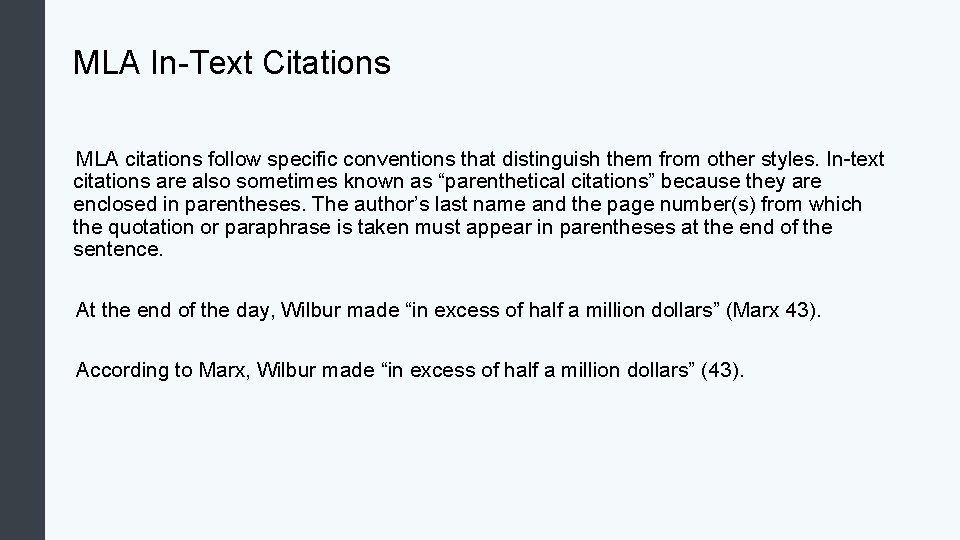
MLA In-Text Citations MLA citations follow specific conventions that distinguish them from other styles. In-text citations are also sometimes known as “parenthetical citations” because they are enclosed in parentheses. The author’s last name and the page number(s) from which the quotation or paraphrase is taken must appear in parentheses at the end of the sentence. At the end of the day, Wilbur made “in excess of half a million dollars” (Marx 43). According to Marx, Wilbur made “in excess of half a million dollars” (43).
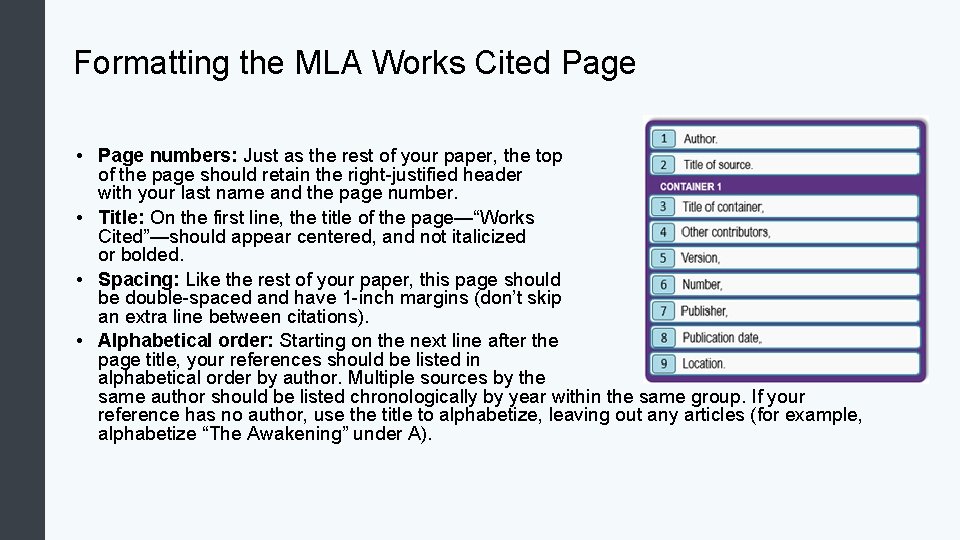
Formatting the MLA Works Cited Page • Page numbers: Just as the rest of your paper, the top of the page should retain the right-justified header with your last name and the page number. • Title: On the first line, the title of the page—“Works Cited”—should appear centered, and not italicized or bolded. • Spacing: Like the rest of your paper, this page should be double-spaced and have 1 -inch margins (don’t skip an extra line between citations). • Alphabetical order: Starting on the next line after the page title, your references should be listed in alphabetical order by author. Multiple sources by the same author should be listed chronologically by year within the same group. If your reference has no author, use the title to alphabetize, leaving out any articles (for example, alphabetize “The Awakening” under A).
APA Documentation
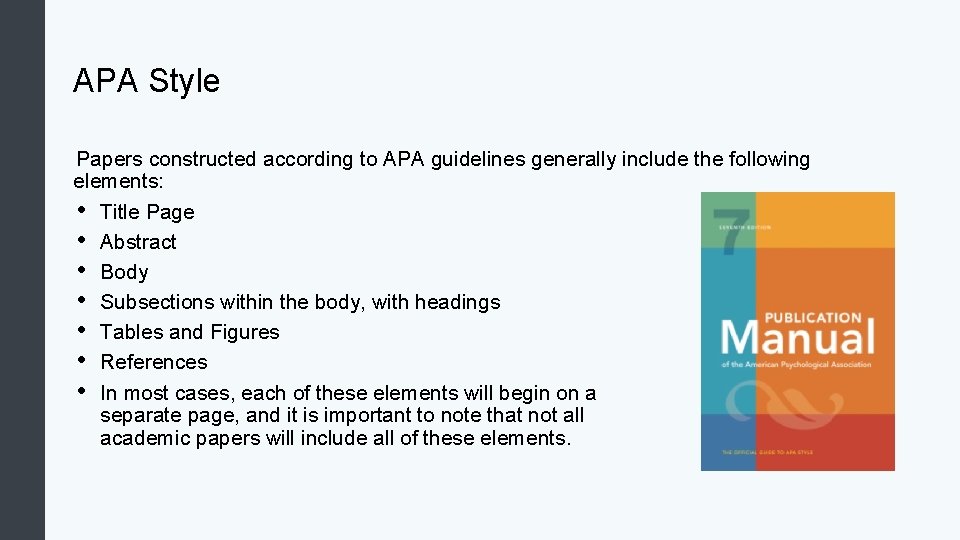
APA Style Papers constructed according to APA guidelines generally include the following elements: • Title Page • Abstract • Body • Subsections within the body, with headings • Tables and Figures • References • In most cases, each of these elements will begin on a separate page, and it is important to note that not all academic papers will include all of these elements.
APA In-Text Citations • APA citations follow specific conventions that distinguish them from other styles. • In most cases, APA citations in your text will follow the guidelines illustrated below. If you have questions or need further instruction, visit the APA Style Guide, the Excelsior Online Writing Lab, the Purdue Online Writing Lab, or the APA Guide from Santa Fe College.
Quick Review As you apply the knowledge learned from this section, be sure to keep the following principles in mind: • Determine whether paraphrase, summary, or direct quotation works best for your purposes. • Use signal phrases to clearly introduce source material. • Make sure source material is integrated smoothly into your work and that your voice remains in control. • Understand the context of your source material, and be confident that it adds value (don’t use a quotation simply to add a source). • Pay attention to detail with in-text citations and works cited or references pages.