
English Composition I CoReq Module 10 The Research
- Slides: 27
English Composition I & Co-Req Module 10: The Research Process—Finding and Evaluating Sources
Finding and Evaluating Sources
Learning Outcomes: Using Sources • • • Examine how the "source sandwich" and signal phrases help to integrate sources into your writing Effectively integrate and introduce quotes into your writing Describe when and how to paraphrase Describe when and how to summarize Evaluate how good source synthesis and integration builds credibility
Why learn to find and evaluate sources? We are surrounded with so much readily available information at our fingertips, that it is sometimes hard to differentiate fact from fiction. Of course, not everything you read on the internet is true, but how do you know what’s a good source to rely on for personal information in your life? How about for an academic essay? In this section, you’ll learn about tools you can use and steps you can follow in order to find credible information. You’ll learn how to find information, evaluate it, integrate it, and document it correctly for your research paper.
What is research? Research is about acquiring new information or new knowledge, which means that it always begins from a gap in your knowledge—that is, something you don’t know. More importantly, research is always goal-directed: that is, it always begins from a specific question you need to answer (a specific gap in your body of information that you need to fill) in order to accomplish some particular goal. This research question is the statement of the thing you don’t know that motivates your research. For the purposes of this course, research is the process of finding the information needed to answer your research question and then deriving or building the answer from the information you found.
The Essential Building Blocks of Research Writing Begin with a question to which you don’t know the answer and that can’t be answered just by going to the appropriate reference source. That is, begin from a research question, not a homework question. This is the research process, and it happens before you begin to write your paper. Without research, you can’t have research writing, so don’t shortchange this part of the process. Create a one-sentence answer to your research question. Share your answer to research questions in a way that makes it believable, understandable, and usable for your readers.
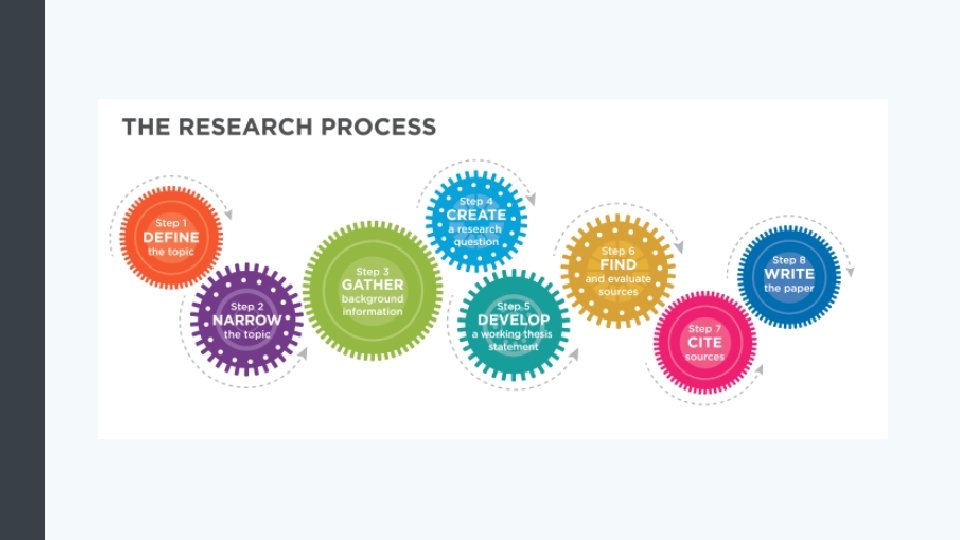
The Research Process The research process is not a linear process in which you must complete step one before moving on to step two or three. • Decide on the topic • Narrow the topic in order to narrow search parameters. • Do background research, or pre-research. • Create a research question. • Next, “answer” the main research question to create a working thesis statement. • Determine what kind of sources are best for your argument. • Create a bibliography as you gather and reference sources. • Write and edit your paper! Finally, you’ll incorporate the research into your own writing and properly cite your sources.
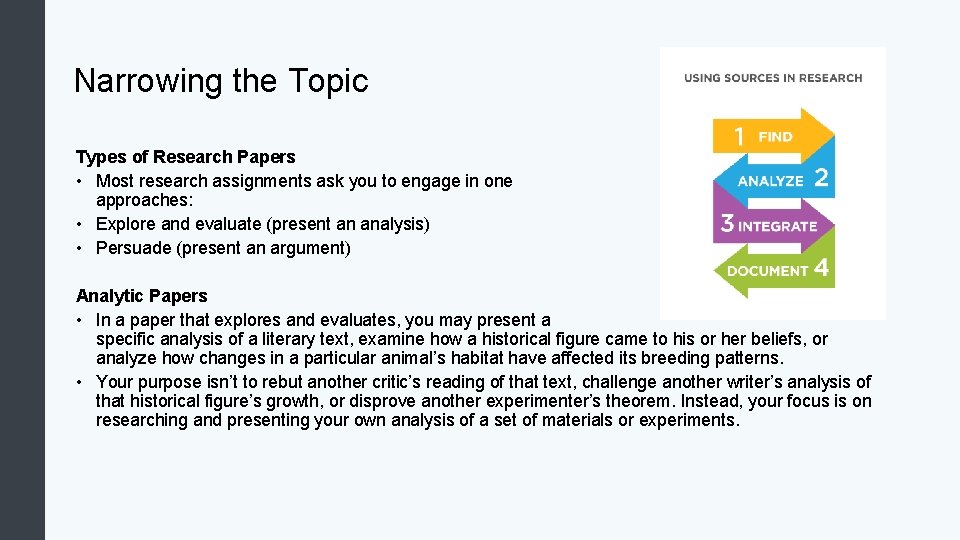
Narrowing the Topic Types of Research Papers • Most research assignments ask you to engage in one approaches: • Explore and evaluate (present an analysis) • Persuade (present an argument) of two Analytic Papers • In a paper that explores and evaluates, you may present a specific analysis of a literary text, examine how a historical figure came to his or her beliefs, or analyze how changes in a particular animal’s habitat have affected its breeding patterns. • Your purpose isn’t to rebut another critic’s reading of that text, challenge another writer’s analysis of that historical figure’s growth, or disprove another experimenter’s theorem. Instead, your focus is on researching and presenting your own analysis of a set of materials or experiments.
Research Questions No matter what your topic is, you can follow the same four-level process in narrowing your topic and developing your research question. Try following these steps once you have settled on a general topic: • How many different aspects of this topic am I able to list? You may want to consult encyclopedias or web pages to get you started here if you are stuck. Write down the list. • Of those aspects listed above, which am I most interested in learning more about? • Of the aspect that most interests me, what elements of it am I able to find information about in an encyclopedia or on a web page? (Notice that you may need to repeat this step more than once to really get down to a workable limited focus. ) Make a list. • What relationships between these elements are suggested by combining them using what, when, where, why, or how words?
Finding Sources
Learning Outcomes • • Evaluate the definition of academic dishonesty Describe and give examples of what constitutes plagiarism Describe proactive strategies to avoid plagiarism Explain best practices for using and citing copyrighted and openly licensed materials
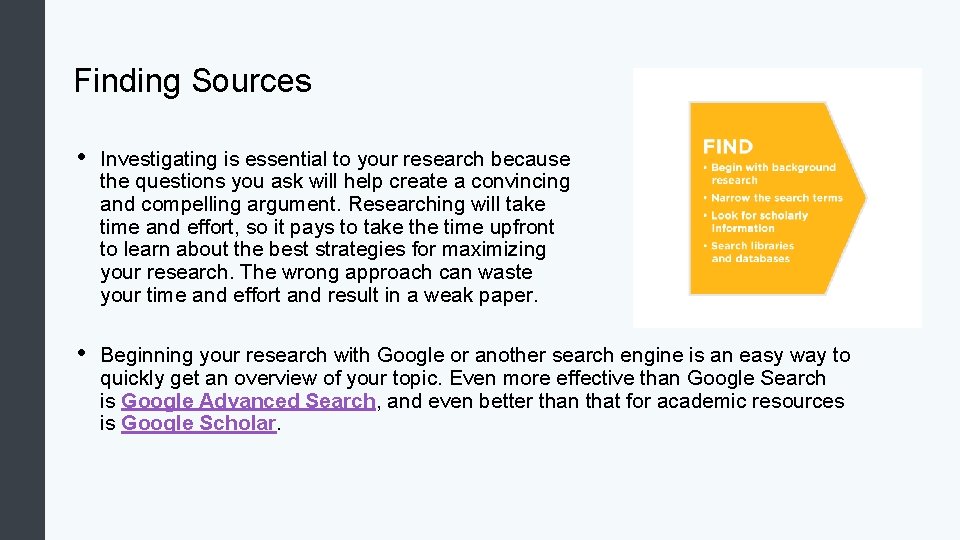
Finding Sources • Investigating is essential to your research because the questions you ask will help create a convincing and compelling argument. Researching will take time and effort, so it pays to take the time upfront to learn about the best strategies for maximizing your research. The wrong approach can waste your time and effort and result in a weak paper. • Beginning your research with Google or another search engine is an easy way to quickly get an overview of your topic. Even more effective than Google Search is Google Advanced Search, and even better than that for academic resources is Google Scholar.
Primary and Secondary Sources While most scholarly sources are secondary sources, you will sometimes be asked to find primary sources in your research. • Primary sources allow researchers to get as close as possible to original ideas, events, and empirical research as possible. Such sources may include creative works, first hand or contemporary accounts of events, and the publication of the results of empirical observations or research. These include diaries, interviews, speeches, photographs, etc. • Secondary sources analyze, review, or summarize information in primary resources or other secondary resources. Even sources presenting facts or descriptions about events are secondary unless they are based on direct participation or observation. These include biographies, journal articles, books, and dissertations. • Tertiary sources provide overviews of topics by synthesizing information gathered from other resources. Tertiary resources often provide data in a convenient form or provide information with context by which to interpret it. These are often grouped together with secondary sources. They include encyclopedias and dictionaries.
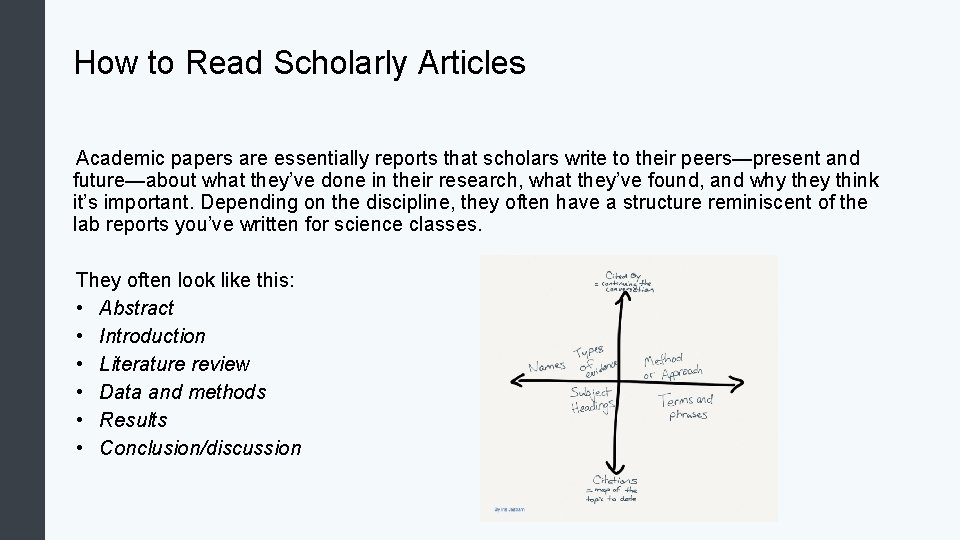
How to Read Scholarly Articles Academic papers are essentially reports that scholars write to their peers—present and future—about what they’ve done in their research, what they’ve found, and why they think it’s important. Depending on the discipline, they often have a structure reminiscent of the lab reports you’ve written for science classes. They often look like this: • Abstract • Introduction • Literature review • Data and methods • Results • Conclusion/discussion
Finding Scholarly Articles What if your project also requires scholarly articles? • To find scholarly articles, you need to look in a database. A research database lets you search across the text of millions of articles published in thousands of academic journals. General databases have a little bit of everything (like a big retail store). Examples of general databases include Google Scholar, the library articles search, or JSTOR. These are good starting points when you’re starting out and shopping around for articles on a wide range of topics, but you may find there are too many search results to sift through. If you’re getting too much irrelevant stuff, try a specialized database. • A specialized database—often called a research or library database—allows targeted searching on one or more specific subject areas (i. e. , engineering, medicine, Latin American history, etc. ), for a specific format (i. e. , books, articles, conference proceedings, video, images), or for a specific date range during which the information was published. Most of what specialized databases contain can not be found by Google or Bing.
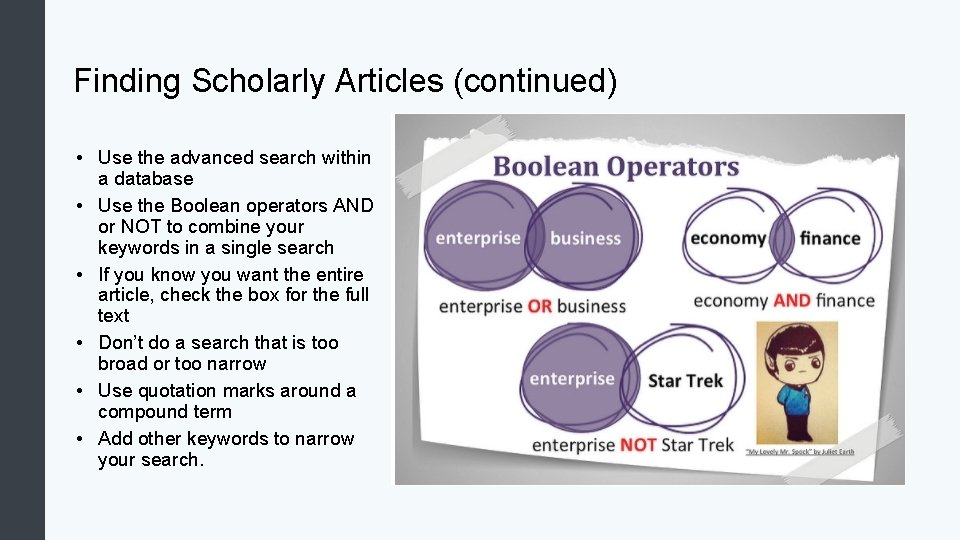
Finding Scholarly Articles (continued) • Use the advanced search within a database • Use the Boolean operators AND or NOT to combine your keywords in a single search • If you know you want the entire article, check the box for the full text • Don’t do a search that is too broad or too narrow • Use quotation marks around a compound term • Add other keywords to narrow your search.
Source Analysis
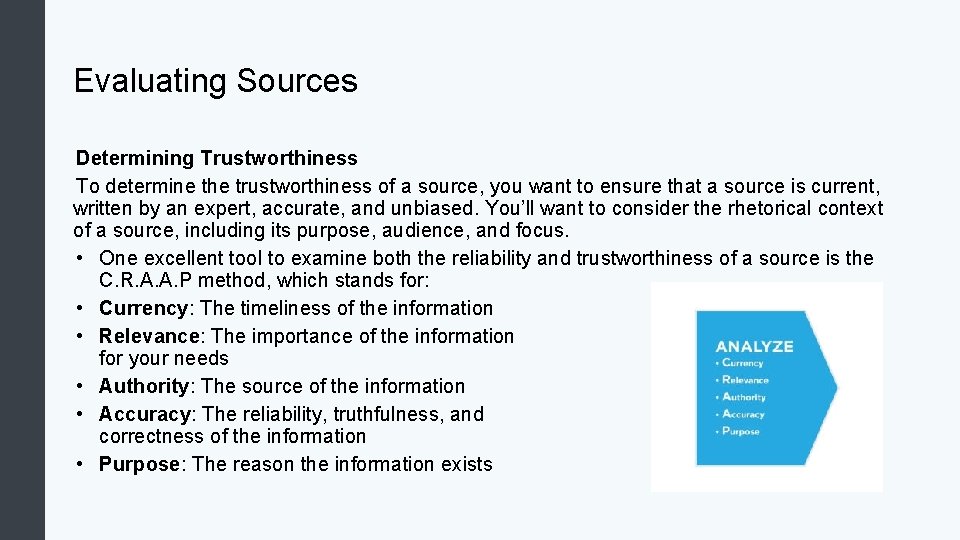
Evaluating Sources Determining Trustworthiness To determine the trustworthiness of a source, you want to ensure that a source is current, written by an expert, accurate, and unbiased. You’ll want to consider the rhetorical context of a source, including its purpose, audience, and focus. • One excellent tool to examine both the reliability and trustworthiness of a source is the C. R. A. A. P method, which stands for: • Currency: The timeliness of the information • Relevance: The importance of the information for your needs • Authority: The source of the information • Accuracy: The reliability, truthfulness, and correctness of the information • Purpose: The reason the information exists
Learning Outcomes: Source Analysis • • Describe general APA document formatting and guidelines Successfully identify the components of APA in-text citations Successfully create and identify appropriate entries for an APA References page Describe APA document formatting guidelines for the title page and headers
Learning Outcomes: Source Analysis (continued) • • • Evaluate reasons for the use of MLA formatting and documentation Describe overall MLA document formatting, including page layout Successfully identify the components of MLA in-text citations Successfully create and identify appropriate MLA Works Cited entries Evaluate the components of a properly formatted MLA Works Cited page
Practice Question: CRAAP Method • What are the key question for each part of the CRAAP method? List out the questions in a summary of your own words.
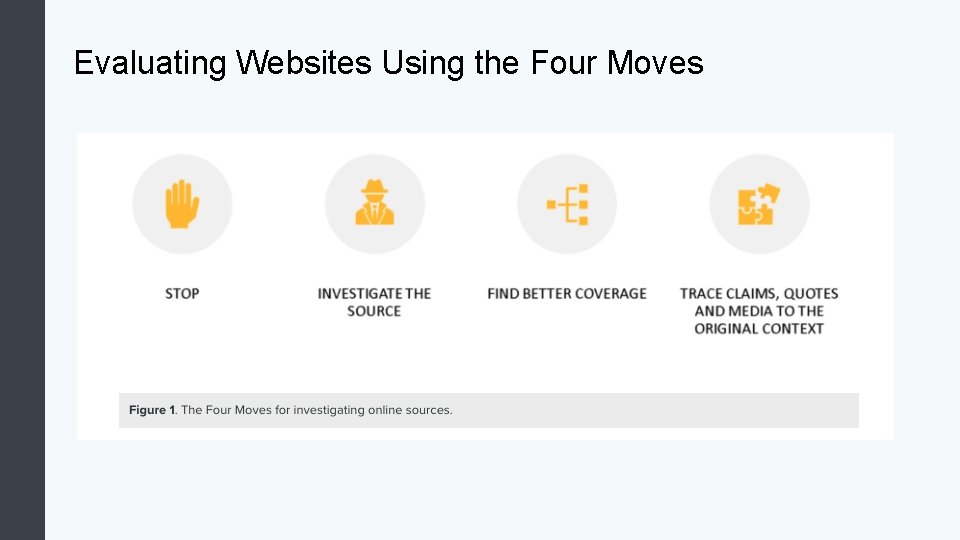
Evaluating Websites Using the Four Moves
The Four Moves When you read something online and you aren’t sure whether or not it’s true, then you can employ the four moves to help you uncover the truth of a claim. Here are the moves: • STOP. Think critically. Avoid being too emotionally charged or looking for information that confirms your own biases. Have an open mind to consider new or controversial topics, and seek to understand. • INVESTIGATE. Find out who the author is, why they wrote it, etc. • FIND BETTER COVERAGE. Read laterally. Once you get to the source of a claim, read what other people say about the source. • TRACE CLAIMS. Trace claims, quotes, and media to the original source.
Activity • Go to a social media platform of your choice, such as Twitter or Social Media. Find a post that you can perform the SIFT process. Take notes as you go through each step. • Discuss what your findings in a small group.
Annotated Bibliographies Keep these suggestions in mind as you construct an annotated bibliography: • You need a relatively narrow focus • As you research, select the sources that seem most related to your narrow focus. Skim the sources first; then more carefully read those that seem useful to your research focus. • In your annotation for each entry in your annotated bibliography, summarize the source. Reproduce the author’s main ideas in your own words. Be careful to change the wording and the structure as you put the information from the source into your own words. • After you summarize, analyze the source. • Finally, evaluate the source’s usefulness to the narrow focus of your research. Make connections between the source and your focus for your project. • Be sure to use the assigned bibliographic style (usually MLA or APA style) to create the bibliography entry that begins each annotated source on your list.
Quick Review Analyze what is research Write a research question Narrow your topic Find credible sources using the CRAAP method • Perform The Four Moves on web sources • Evaluate sources • Annotate bibliographies • • Questions to consider: • What have you discovered during your research? Have you learned new theories, opinions, or aspects of your subject? Did anything surprise you, intrigue you, or make you look further?