
ENGLISH APPENDIX 1 SPELLING Years 5 and 6

- Slides: 17
ENGLISH APPENDIX 1 SPELLING Years 5 and 6
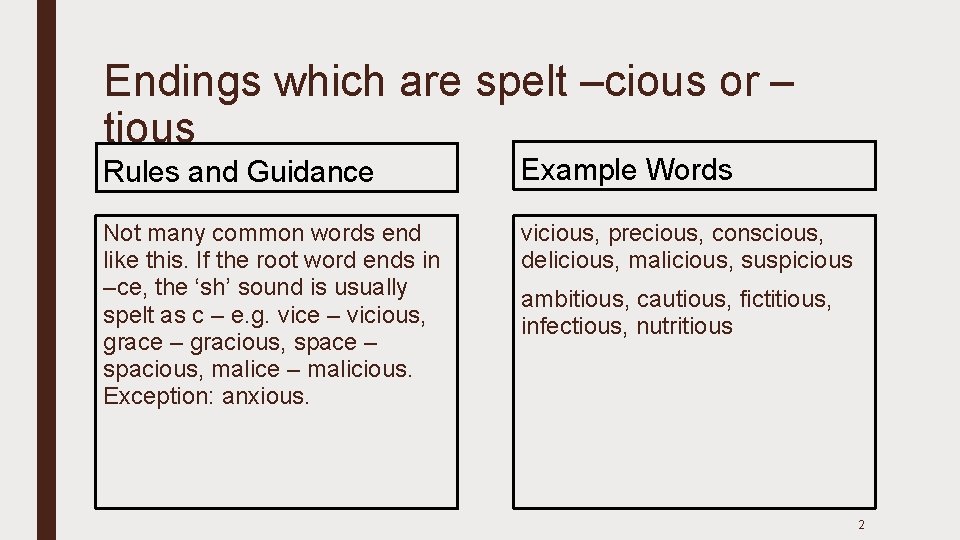
Endings which are spelt –cious or – tious Rules and Guidance Example Words Not many common words end like this. If the root word ends in –ce, the ‘sh’ sound is usually spelt as c – e. g. vice – vicious, grace – gracious, space – spacious, malice – malicious. Exception: anxious. vicious, precious, conscious, delicious, malicious, suspicious ambitious, cautious, fictitious, infectious, nutritious 2
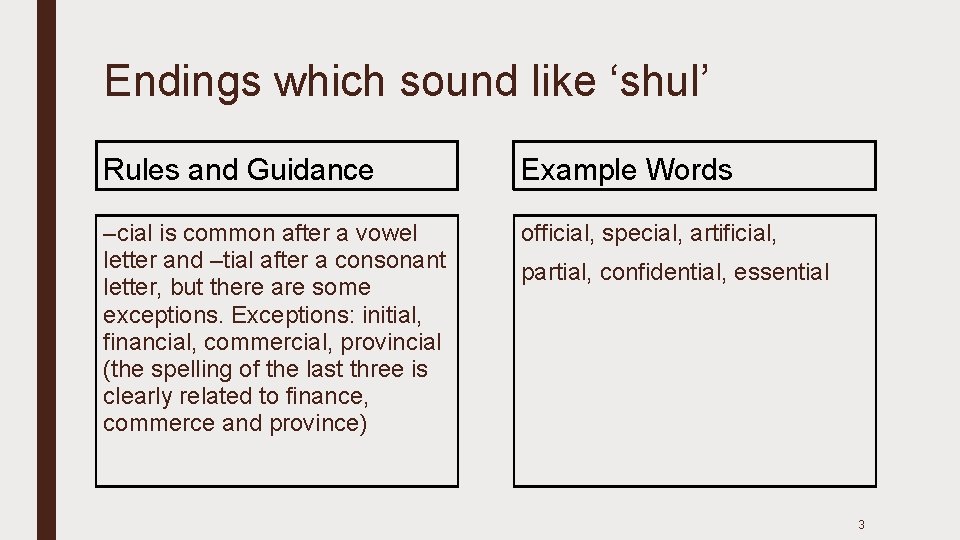
Endings which sound like ‘shul’ Rules and Guidance Example Words –cial is common after a vowel letter and –tial after a consonant letter, but there are some exceptions. Exceptions: initial, financial, commercial, provincial (the spelling of the last three is clearly related to finance, commerce and province) official, special, artificial, partial, confidential, essential 3
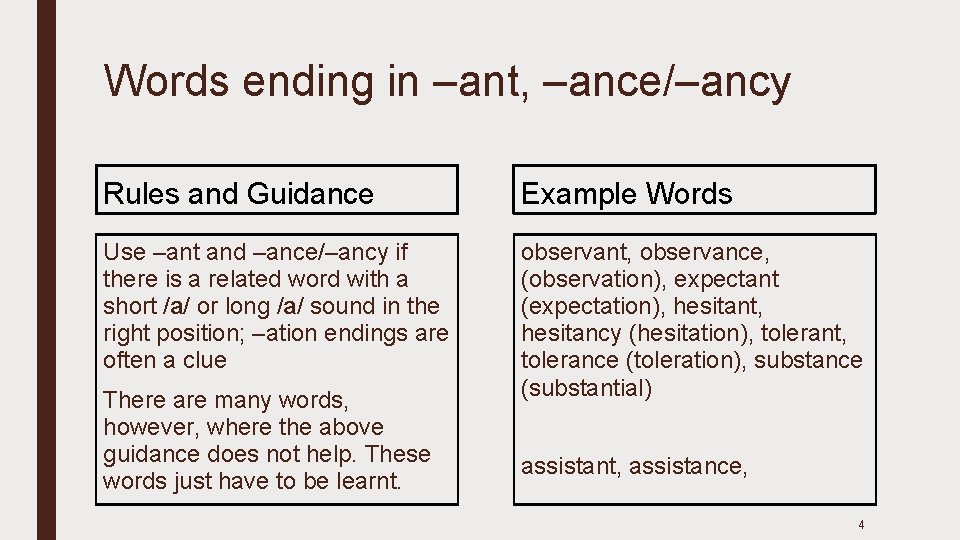
Words ending in –ant, –ance/–ancy Rules and Guidance Example Words Use –ant and –ance/–ancy if there is a related word with a short /a/ or long /a/ sound in the right position; –ation endings are often a clue observant, observance, (observation), expectant (expectation), hesitant, hesitancy (hesitation), tolerant, tolerance (toleration), substance (substantial) There are many words, however, where the above guidance does not help. These words just have to be learnt. assistant, assistance, 4
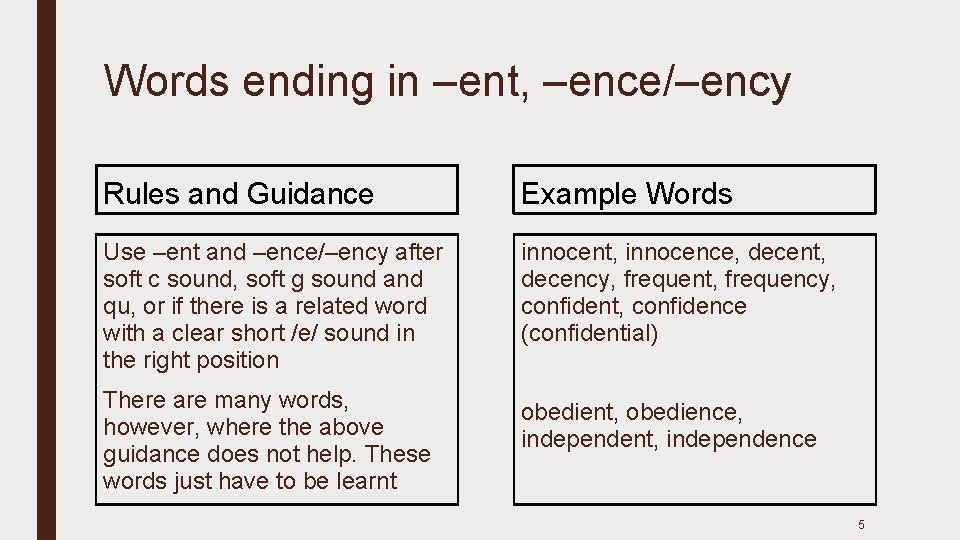
Words ending in –ent, –ence/–ency Rules and Guidance Example Words Use –ent and –ence/–ency after soft c sound, soft g sound and qu, or if there is a related word with a clear short /e/ sound in the right position innocent, innocence, decent, decency, frequent, frequency, confident, confidence (confidential) There are many words, however, where the above guidance does not help. These words just have to be learnt obedient, obedience, independent, independence 5
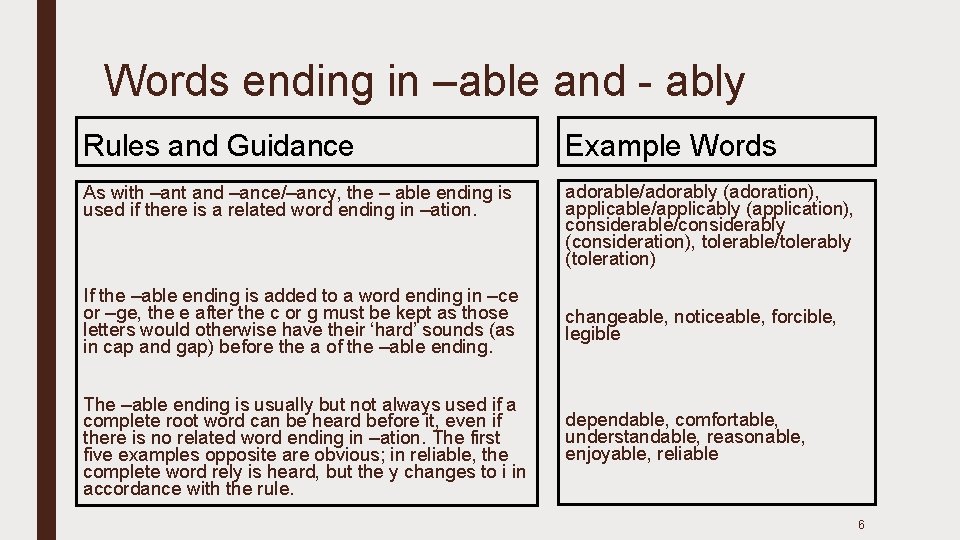
Words ending in –able and - ably Rules and Guidance Example Words As with –ant and –ance/–ancy, the – able ending is used if there is a related word ending in –ation. adorable/adorably (adoration), applicable/applicably (application), considerable/considerably (consideration), tolerable/tolerably (toleration) If the –able ending is added to a word ending in –ce or –ge, the e after the c or g must be kept as those letters would otherwise have their ‘hard’ sounds (as in cap and gap) before the a of the –able ending. changeable, noticeable, forcible, legible The –able ending is usually but not always used if a complete root word can be heard before it, even if there is no related word ending in –ation. The first five examples opposite are obvious; in reliable, the complete word rely is heard, but the y changes to i in accordance with the rule. dependable, comfortable, understandable, reasonable, enjoyable, reliable 6
Words ending in ible and –ibly Rules and Guidance Example Words The –ible ending is common if a complete root word can’t be heard before it but it also sometimes occurs when a complete word can be heard (e. g. sensible). possible/possibly, horrible/horribly, terrible/terribly, visible/visibly, incredible/incredibly, sensible/sensibly 7
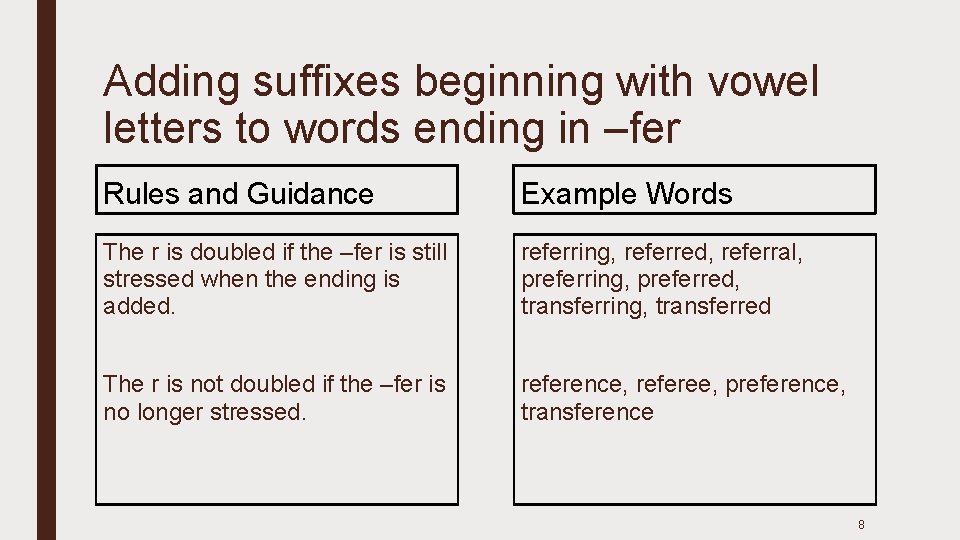
Adding suffixes beginning with vowel letters to words ending in –fer Rules and Guidance Example Words The r is doubled if the –fer is still stressed when the ending is added. referring, referred, referral, preferring, preferred, transferring, transferred The r is not doubled if the –fer is no longer stressed. reference, referee, preference, transference 8
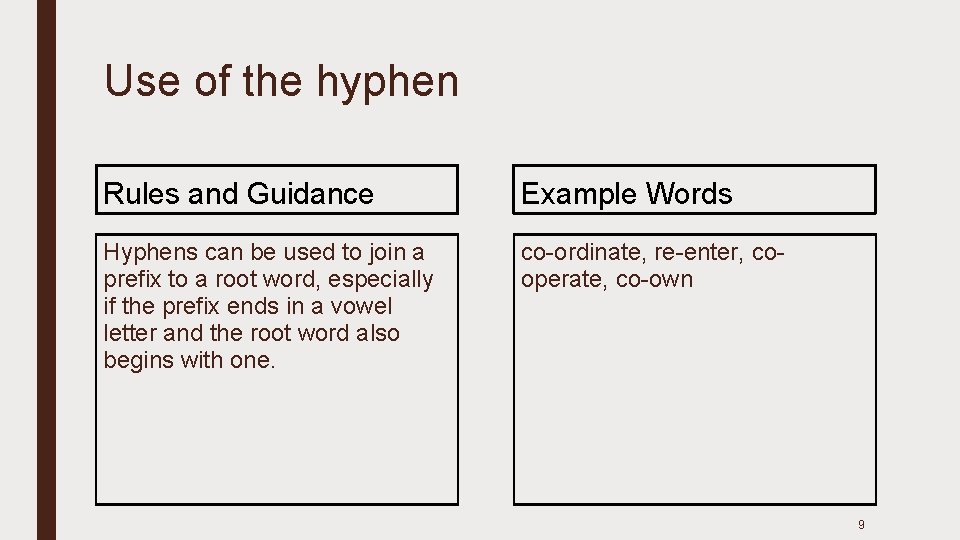
Use of the hyphen Rules and Guidance Example Words Hyphens can be used to join a prefix to a root word, especially if the prefix ends in a vowel letter and the root word also begins with one. co-ordinate, re-enter, cooperate, co-own 9
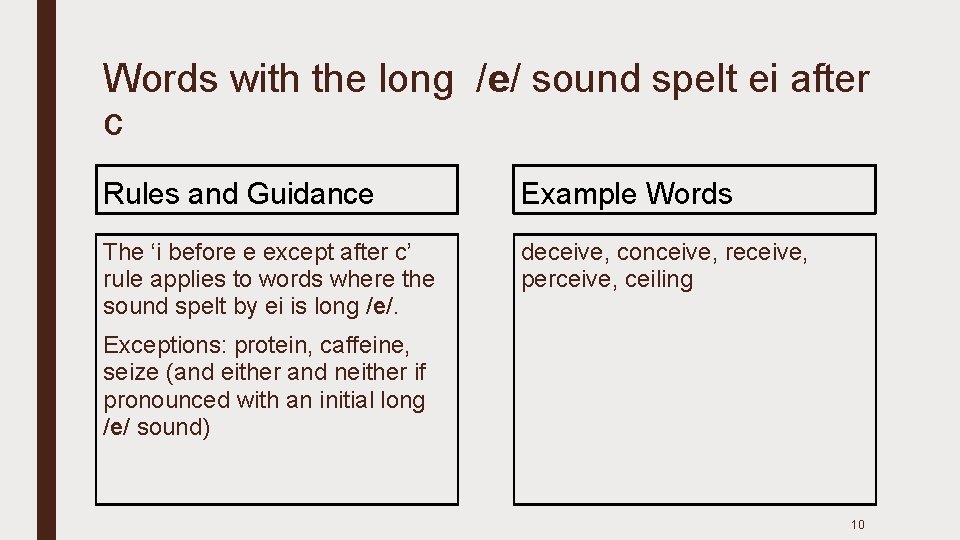
Words with the long /e/ sound spelt ei after c Rules and Guidance Example Words The ‘i before e except after c’ rule applies to words where the sound spelt by ei is long /e/. deceive, conceive, receive, perceive, ceiling Exceptions: protein, caffeine, seize (and either and neither if pronounced with an initial long /e/ sound) 10
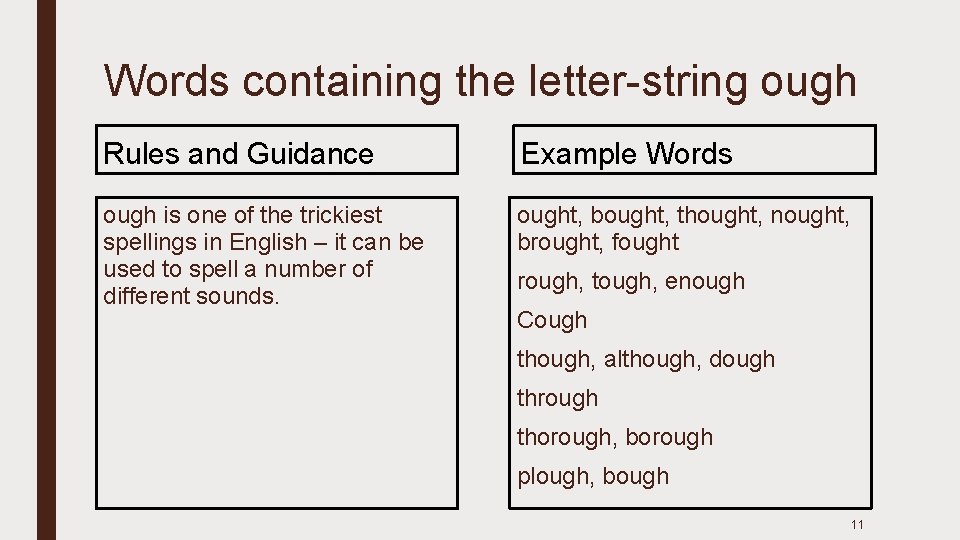
Words containing the letter-string ough Rules and Guidance Example Words ough is one of the trickiest spellings in English – it can be used to spell a number of different sounds. ought, bought, thought, nought, brought, fought rough, tough, enough Cough though, although, dough through thorough, borough plough, bough 11
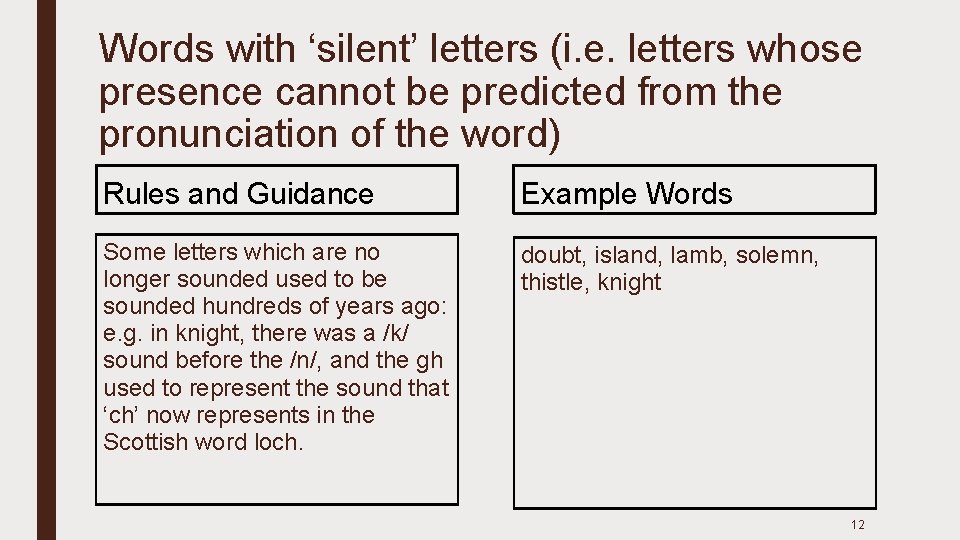
Words with ‘silent’ letters (i. e. letters whose presence cannot be predicted from the pronunciation of the word) Rules and Guidance Example Words Some letters which are no longer sounded used to be sounded hundreds of years ago: e. g. in knight, there was a /k/ sound before the /n/, and the gh used to represent the sound that ‘ch’ now represents in the Scottish word loch. doubt, island, lamb, solemn, thistle, knight 12
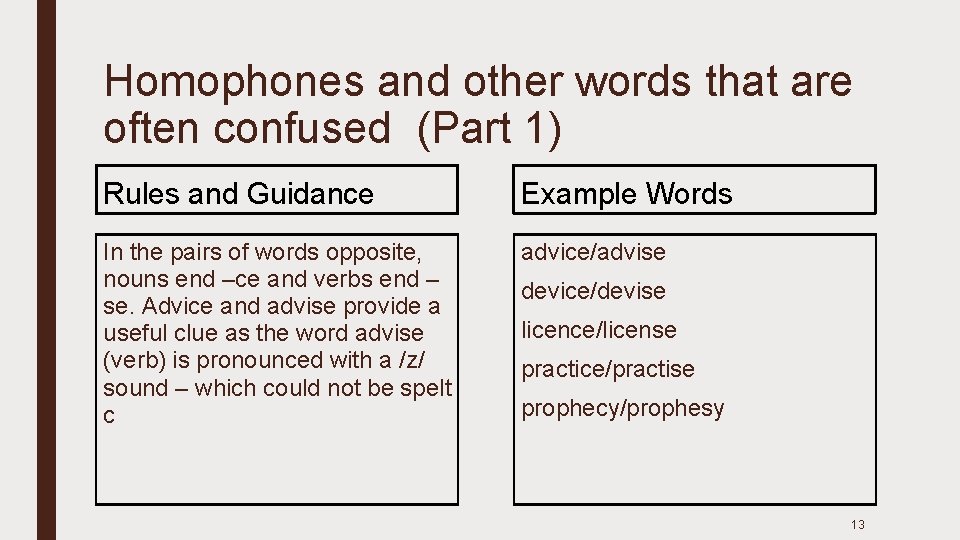
Homophones and other words that are often confused (Part 1) Rules and Guidance Example Words In the pairs of words opposite, nouns end –ce and verbs end – se. Advice and advise provide a useful clue as the word advise (verb) is pronounced with a /z/ sound – which could not be spelt c advice/advise device/devise licence/license practice/practise prophecy/prophesy 13
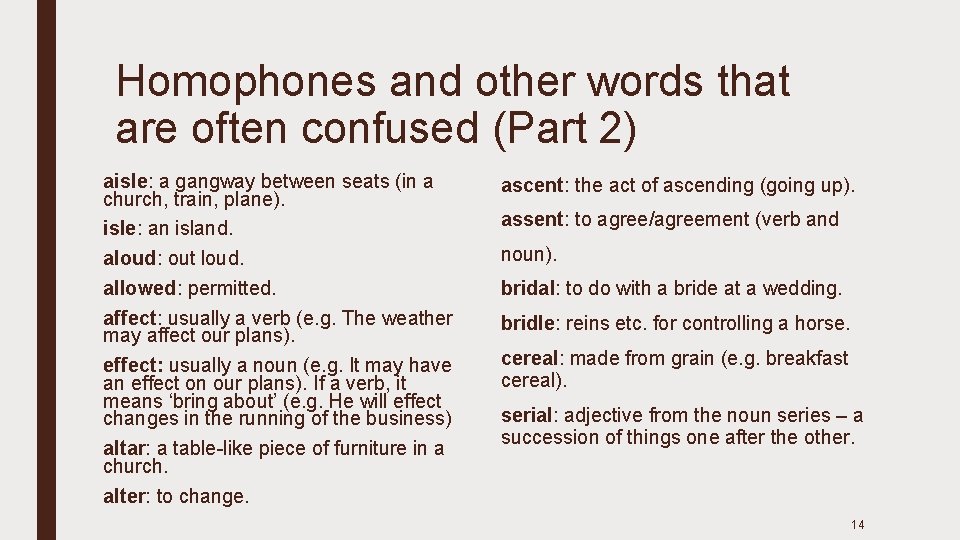
Homophones and other words that are often confused (Part 2) aisle: a gangway between seats (in a church, train, plane). isle: an island. aloud: out loud. allowed: permitted. affect: usually a verb (e. g. The weather may affect our plans). effect: usually a noun (e. g. It may have an effect on our plans). If a verb, it means ‘bring about’ (e. g. He will effect changes in the running of the business) altar: a table-like piece of furniture in a church. alter: to change. ascent: the act of ascending (going up). assent: to agree/agreement (verb and noun). bridal: to do with a bride at a wedding. bridle: reins etc. for controlling a horse. cereal: made from grain (e. g. breakfast cereal). serial: adjective from the noun series – a succession of things one after the other. 14
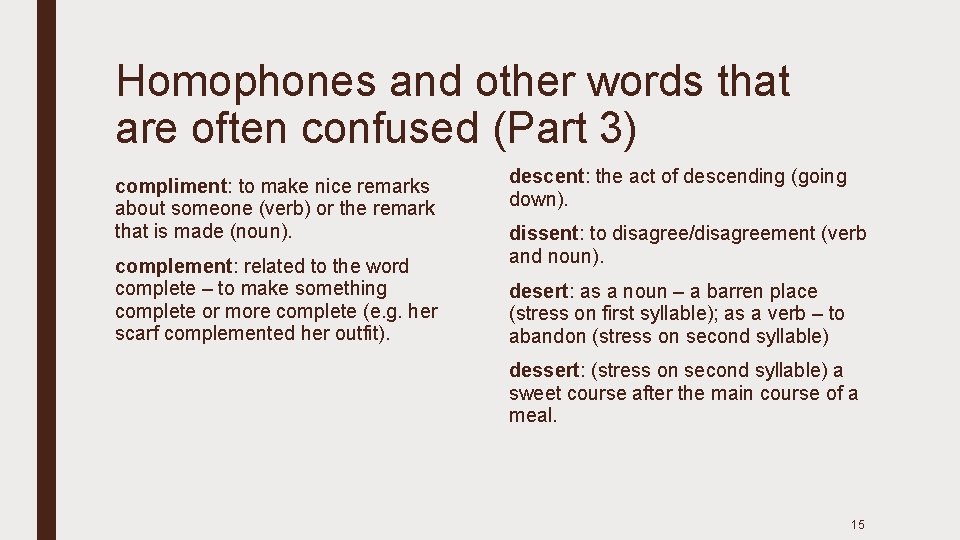
Homophones and other words that are often confused (Part 3) compliment: to make nice remarks about someone (verb) or the remark that is made (noun). complement: related to the word complete – to make something complete or more complete (e. g. her scarf complemented her outfit). descent: the act of descending (going down). dissent: to disagree/disagreement (verb and noun). desert: as a noun – a barren place (stress on first syllable); as a verb – to abandon (stress on second syllable) dessert: (stress on second syllable) a sweet course after the main course of a meal. 15
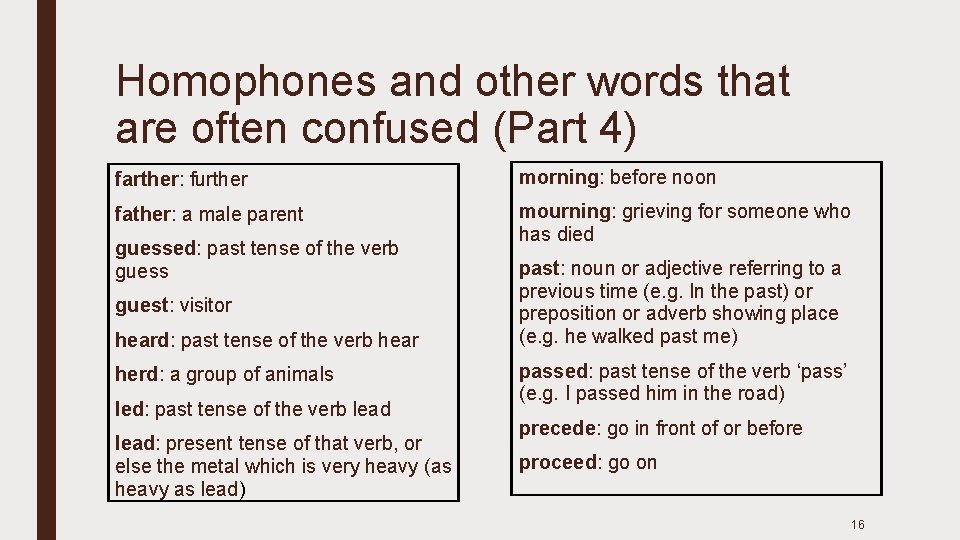
Homophones and other words that are often confused (Part 4) farther: further morning: before noon father: a male parent mourning: grieving for someone who has died guessed: past tense of the verb guess guest: visitor heard: past tense of the verb hear herd: a group of animals led: past tense of the verb lead: present tense of that verb, or else the metal which is very heavy (as heavy as lead) past: noun or adjective referring to a previous time (e. g. In the past) or preposition or adverb showing place (e. g. he walked past me) passed: past tense of the verb ‘pass’ (e. g. I passed him in the road) precede: go in front of or before proceed: go on 16
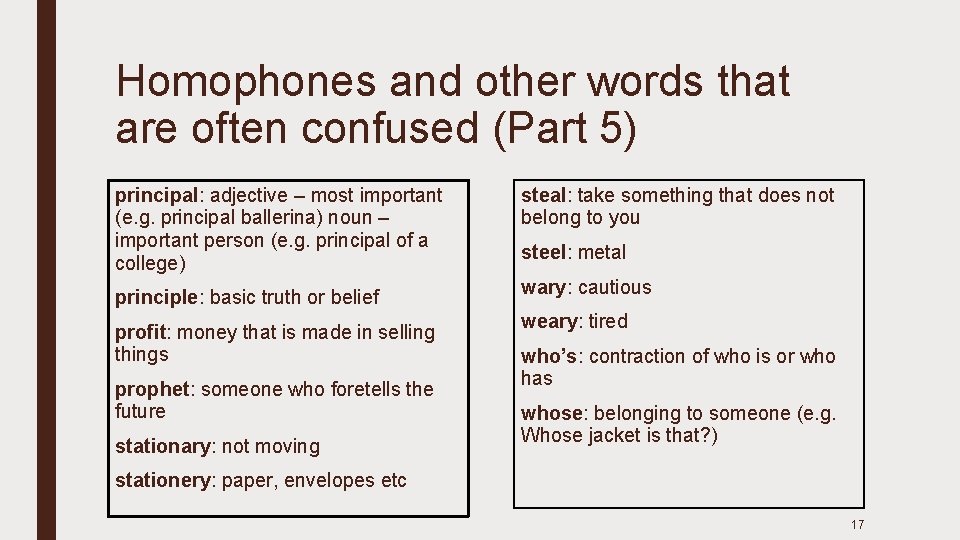
Homophones and other words that are often confused (Part 5) principal: adjective – most important (e. g. principal ballerina) noun – important person (e. g. principal of a college) principle: basic truth or belief profit: money that is made in selling things prophet: someone who foretells the future stationary: not moving steal: take something that does not belong to you steel: metal wary: cautious weary: tired who’s: contraction of who is or who has whose: belonging to someone (e. g. Whose jacket is that? ) stationery: paper, envelopes etc 17