
English and Ukrainian Proverbs and Sayings Done by

English and Ukrainian Proverbs and Sayings Done by: Veronika Kulichenko Group 11 - 1 Financial-economical lyceum Dnipropetrovsk Teacher: Klachkova Mariya Antonivna, specialist of higher category, teacher-methodologist

It is well-known that wisdom and spirit of people are expressed in its proverbs and sayings, and the knowledge of proverbs and sayings of this or that nation promotes not only a better knowledge of the language, but also helps understand views and characters of its people.
Our work is devoted to English and Ukrainian proverbs and sayings. The folklore of the Ukrainian and English languages is the object of the work THE EARLY WORM GOES FORTH WITH ZEAL
Objectives of the work are: • to learn to distinguish proverbs from sayings and idioms; • to prove the relevance of proverbs; • to consider the opportunity of using proverbs for training the language; • to compare English and Ukrainian proverbs.
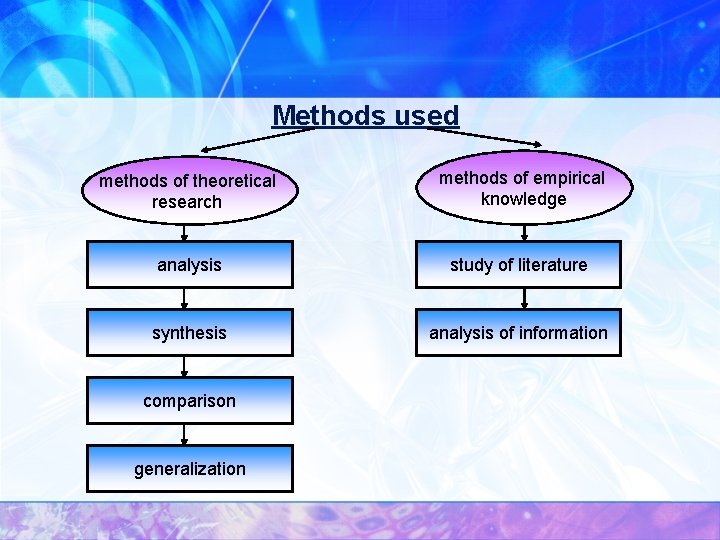
Methods used methods of theoretical research methods of empirical knowledge analysis study of literature synthesis analysis of information comparison generalization
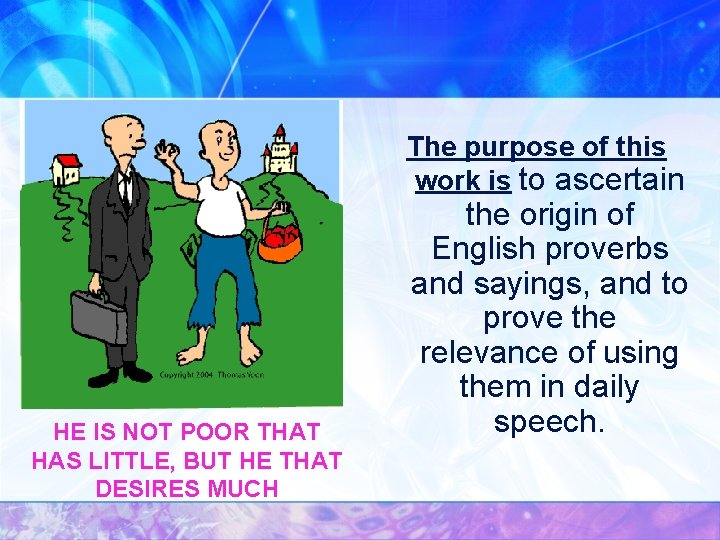
The purpose of this work is to ascertain НЕ IS NOT POOR THAT HAS LITTLE, BUT HE THAT DESIRES MUCH the origin of English proverbs and sayings, and to prove the relevance of using them in daily speech.
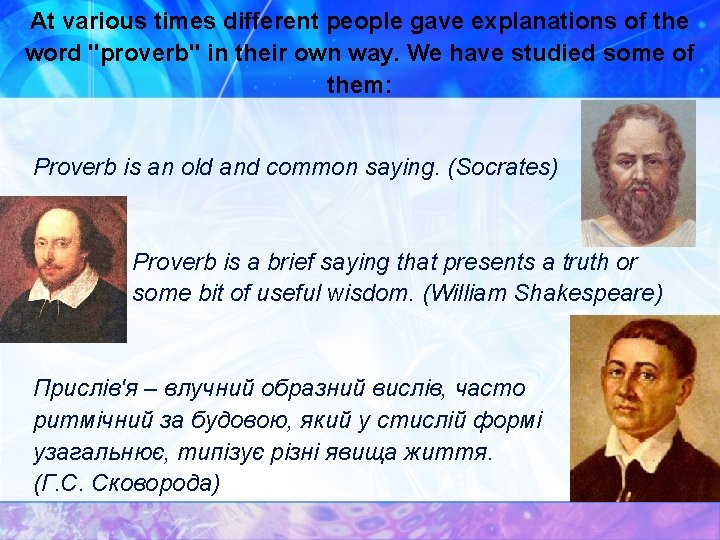
At various times different people gave explanations of the word "proverb" in their own way. We have studied some of them: Proverb is an old and common saying. (Socrates) Proverb is a brief saying that presents a truth or some bit of useful wisdom. (William Shakespeare) Прислів'я – влучний образний вислів, часто ритмічний за будовою, який у стислій формі узагальнює, типізує різні явища життя. (Г. С. Сковорода)
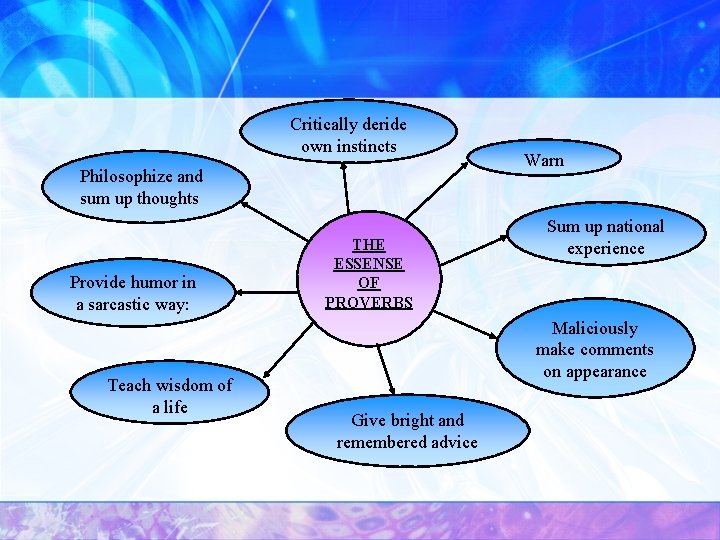
Critically deride own instincts Philosophize and sum up thoughts Provide humor in a sarcastic way: Teach wisdom of a life THE ESSENSE OF PROVERBS Warn Sum up national experience Maliciously make comments on appearance Give bright and remembered advice
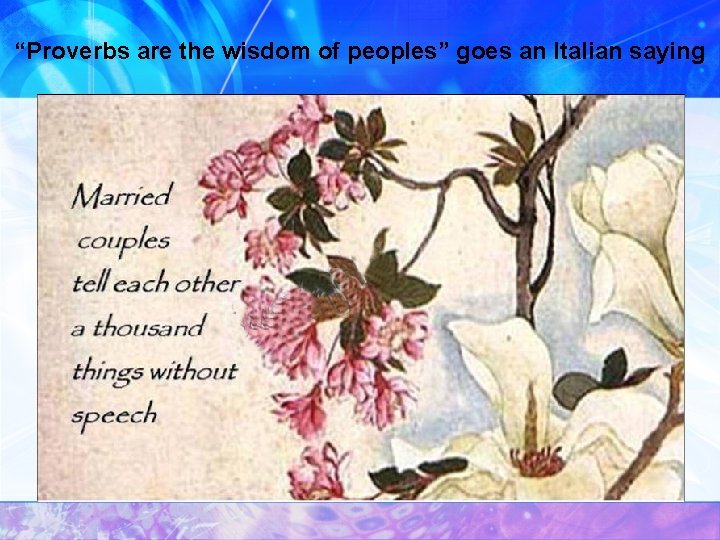
“Proverbs are the wisdom of peoples” goes an Italian saying
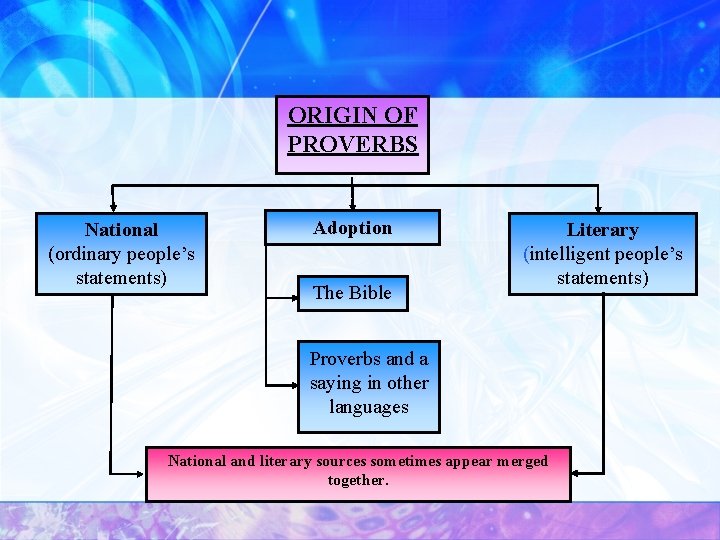
ORIGIN OF PROVERBS National (ordinary people’s statements) Adoption The Bible Literary (intelligent people’s statements) Proverbs and a saying in other languages National and literary sources sometimes appear merged together.
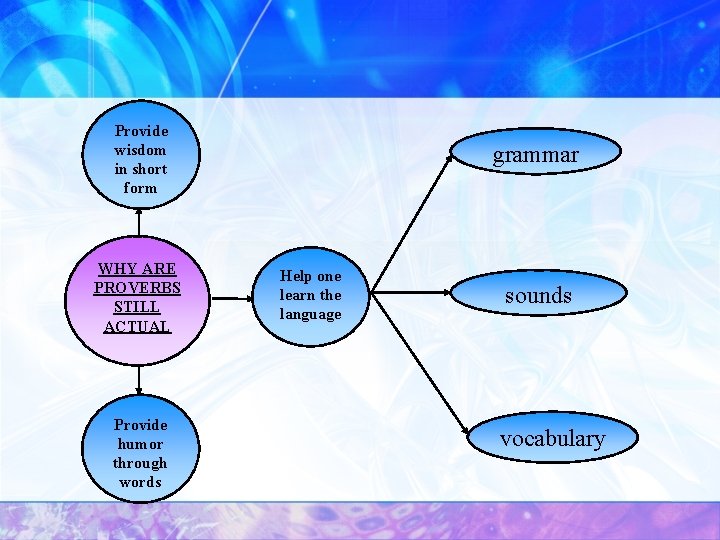
Provide wisdom in short form WHY ARE PROVERBS STILL ACTUAL Provide humor through words grammar Help one learn the language sounds vocabulary
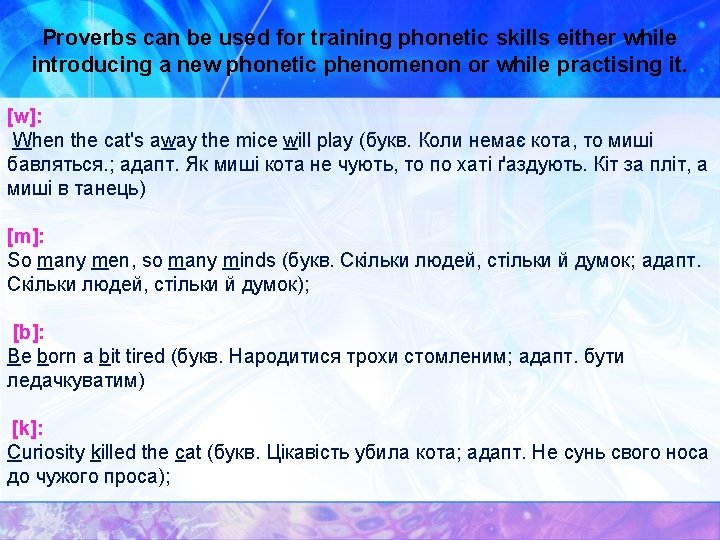
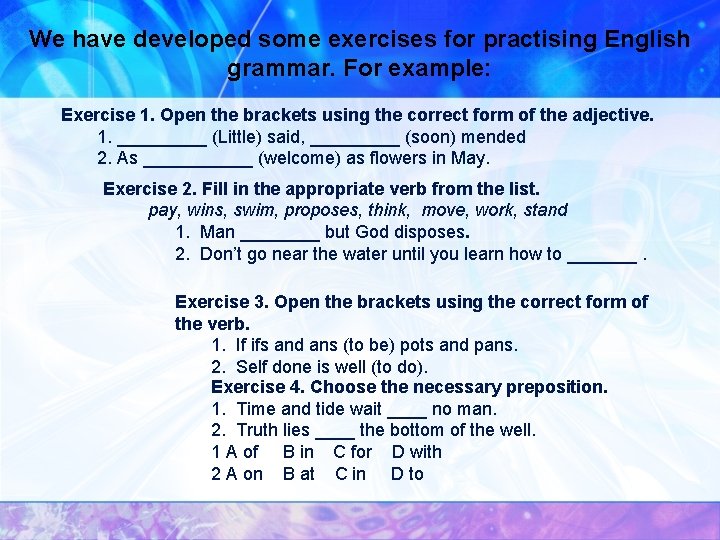
We have developed some exercises for practising English grammar. For example: Exercise 1. Open the brackets using the correct form of the adjective. 1. _____ (Little) said, _____ (soon) mended 2. As ______ (welcome) as flowers in May. Exercise 2. Fill in the appropriate verb from the list. pay, wins, swim, proposes, think, move, work, stand 1. Man ____ but God disposes. 2. Don’t go near the water until you learn how to _______. Exercise 3. Open the brackets using the correct form of the verb. 1. If ifs and ans (to be) pots and pans. 2. Self done is well (to do). Exercise 4. Choose the necessary preposition. 1. Time and tide wait ____ no man. 2. Truth lies ____ the bottom of the well. 1 A of B in C for D with 2 A on B at C in D to
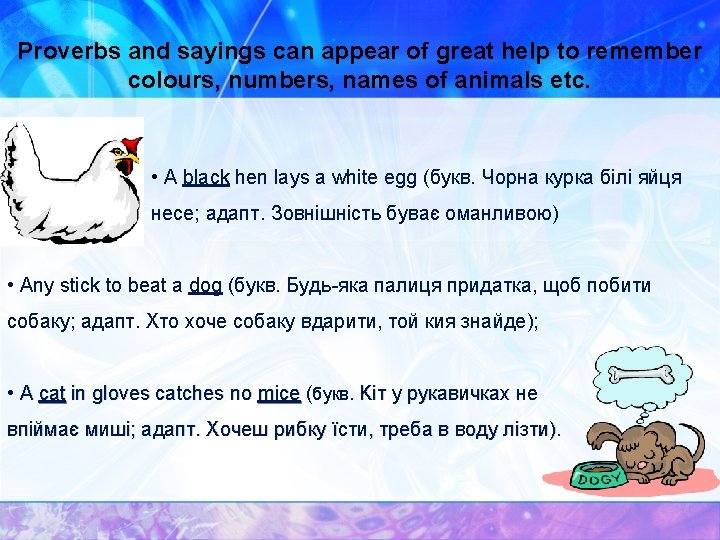

НЕ IS HAPPY WHO THINKS HIMSELF SO Functioning as incentive motivation proverbs and sayings may be used for developing communicative skills, especially speaking and writing.
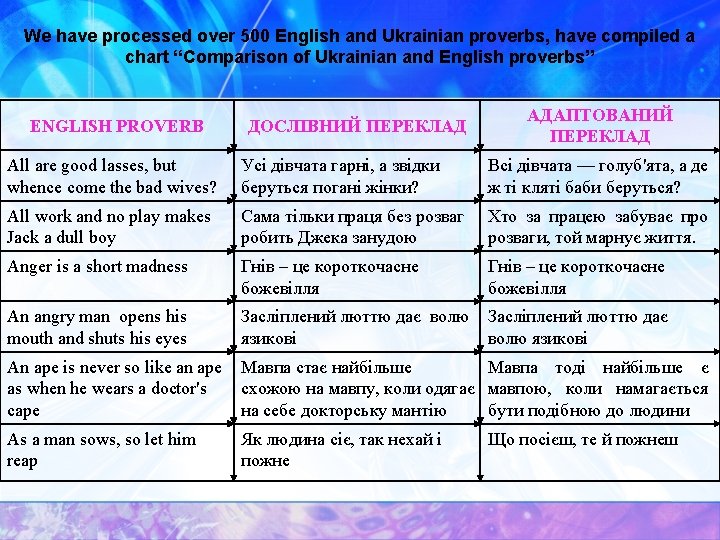
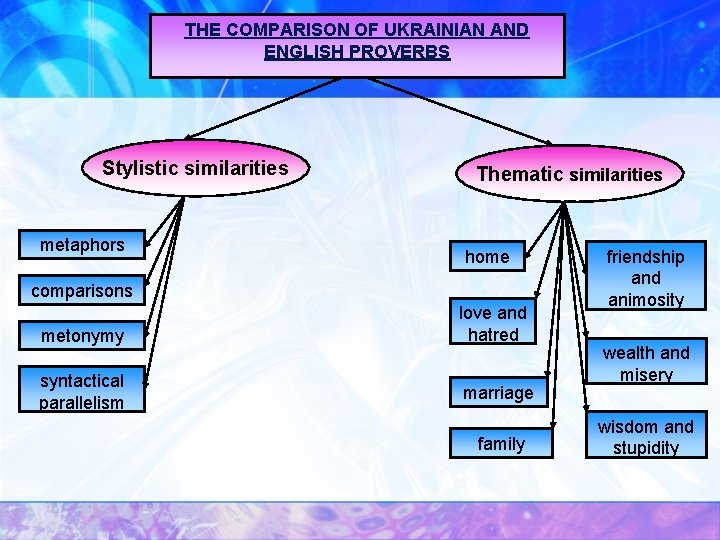
THE COMPARISON OF UKRAINIAN AND ENGLISH PROVERBS Stylistic similarities metaphors Thematic similarities home comparisons metonymy syntactical parallelism love and hatred marriage family friendship and animosity wealth and misery wisdom and stupidity
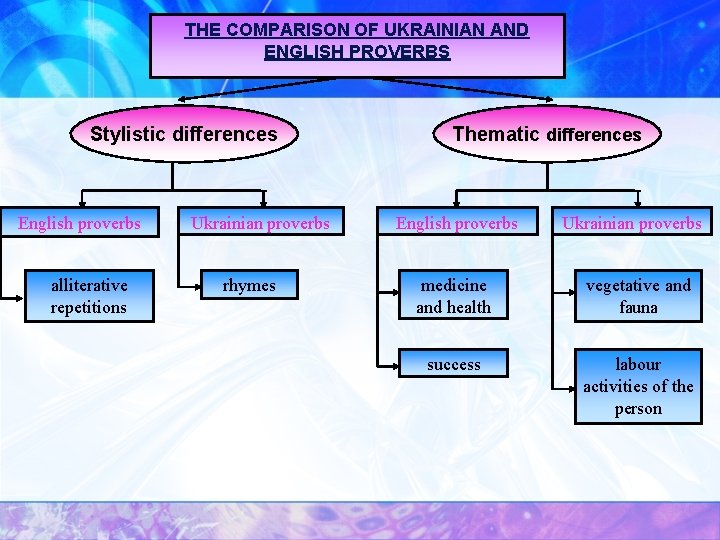
THE COMPARISON OF UKRAINIAN AND ENGLISH PROVERBS Stylistic differences English proverbs alliterative repetitions Ukrainian proverbs rhymes Thematic differences English proverbs Ukrainian proverbs medicine and health vegetative and fauna success labour activities of the person
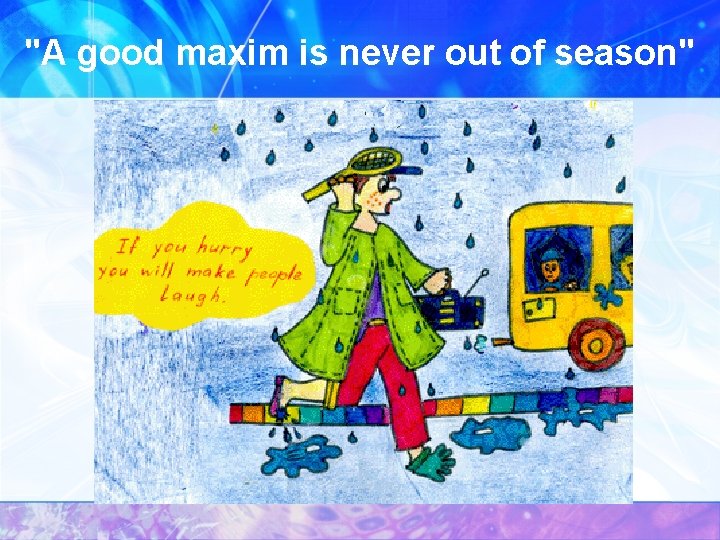
"A good maxim is never out of season"

- Slides: 20