
English Across the Curriculum Introduction Orientation session held



- Slides: 14
English Across the Curriculum: Introduction Orientation session held at the Protea Hotel OR Tambo Date: 26 to 29 May 2014
Strategy for teaching English Across the Curriculum
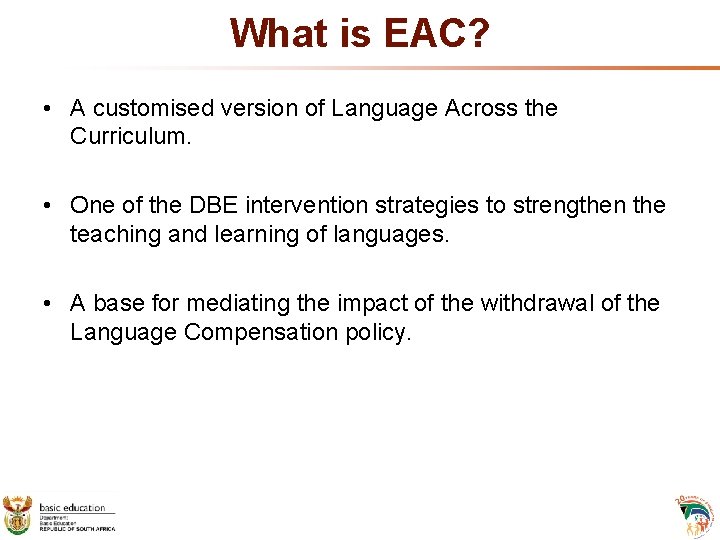
What is EAC? • A customised version of Language Across the Curriculum. • One of the DBE intervention strategies to strengthen the teaching and learning of languages. • A base for mediating the impact of the withdrawal of the Language Compensation policy.
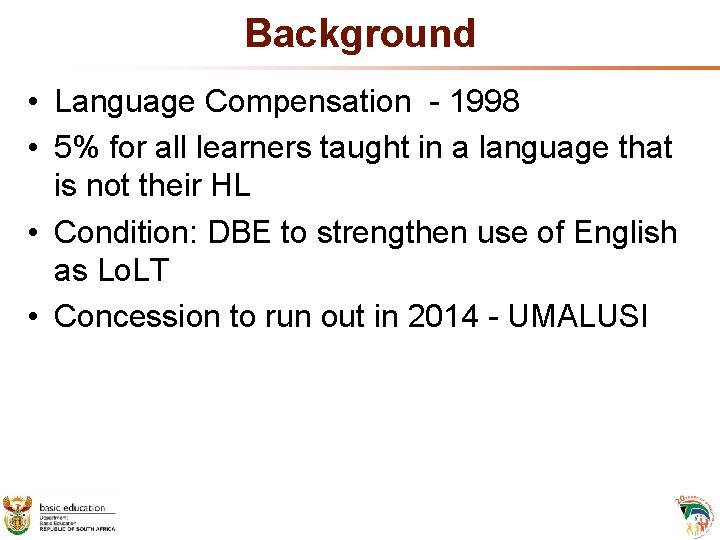
Background • Language Compensation - 1998 • 5% for all learners taught in a language that is not their HL • Condition: DBE to strengthen use of English as Lo. LT • Concession to run out in 2014 - UMALUSI
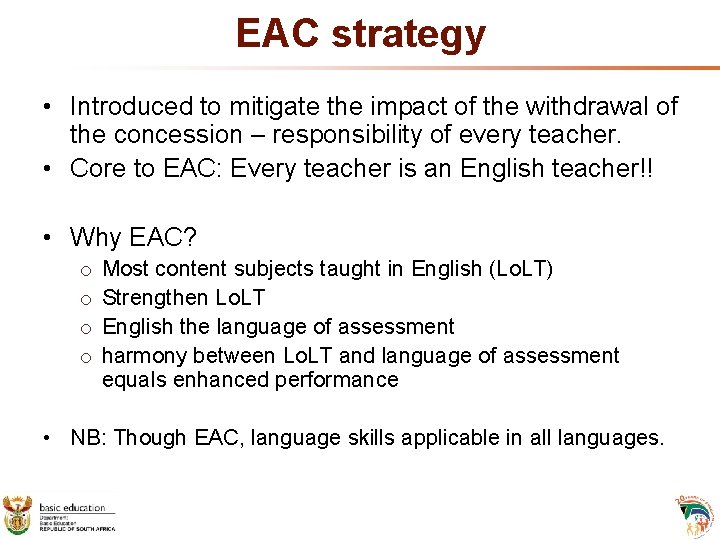
EAC strategy • Introduced to mitigate the impact of the withdrawal of the concession – responsibility of every teacher. • Core to EAC: Every teacher is an English teacher!! • Why EAC? o o Most content subjects taught in English (Lo. LT) Strengthen Lo. LT English the language of assessment harmony between Lo. LT and language of assessment equals enhanced performance • NB: Though EAC, language skills applicable in all languages.
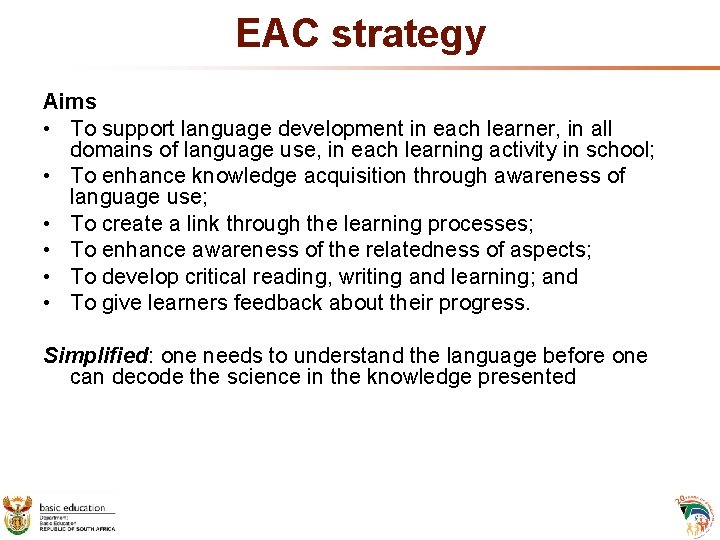
EAC strategy Aims • To support language development in each learner, in all domains of language use, in each learning activity in school; • To enhance knowledge acquisition through awareness of language use; • To create a link through the learning processes; • To enhance awareness of the relatedness of aspects; • To develop critical reading, writing and learning; and • To give learners feedback about their progress. Simplified: one needs to understand the language before one can decode the science in the knowledge presented
EAC strategy Focuses on: • Skills of language, viz. Reading, Writing, Listening and Speaking; and • all non-verbal means of representation and expression that we use when communicating. It enhances: • knowledge acquisition • interrogation of knowledge • expression and presentation of knowledge – in writing or spoken form • critical thinking, reading and writing
EAC strategy • Implications for the content subject teacher (Mr Nematangari) o Remain rooted in the science of the subject – NOT taking over from the English teacher. o Engages learners in Lo. LT - the language in which the child is being assessed. o While developing the Lo. LT, does not necessarily assess it as English teacher would • Implications for the English (language teacher) o Subject expert o Facilitate Lo. LT development • Anticipated gains for the teaching corpse: o Joint planning o Expanded learning horizon o A more visible learning thread.
Activity 1 1. Discuss the language issues in your subject and how they impact learner attainment. 2. Discuss words/concepts used in your subject which may mean something else in ordinary English language use? 3. Discuss how the EAC strategy would enhance the spirit of co-operation among members of staff. 4. Discuss how an enhanced team teaching approach will enhance learner attainment. 5. Feedback and discussion. 9
In response 1. Most reports conducted inside and outside DBE cite Lo. LT as a barrier to learning. • EAC addresses Linguistic Knowledge which should enhance conceptual and procedural knowledge acquisition. Mathematics is not limited to performing computations in isolation; it is dependent on the English language. Academic standards in mathematics require students to apply computational skills in a variety of real- life problemsolving situations, read and solve word problems, communicate their mathematical thinking, and collaborate with their peers to complete a task.
In response 2. Does the word ‘positive’ mean the same – the deaf learner scenario cited at the 10 th International Languages Conference. 3. Joint planning; expanded learning fields; practical approach to teaching and learning. 4. The golden thread.
Manual for teaching English Across the Curriculum
What is the manual for teaching EAC? • Practical application of the strategy. • Working document on how language is addressed in subjects. • A source from which the activities of the commissions can be modelled or improved. • Second edition of the manual to result from the activities of the commissions
Thank you. Website: www. education. gov. za Call Centre: 0800 202 933 | callcentre@dbe. gov. za Twitter: @DBE_SA | Facebook: DBE SA