
English 9 Reading Writing workshop Grammar Scope and










- Slides: 45
English 9: Reading & Writing workshop Grammar
Scope and Sequence for the year Subject verb agreement Verbs: action, linking, & verb phrases Capitalization: title, place, & direction Direct & Indirect Objects Punctuation: Comma, Quotations, & apostrophes
agreement When a word refers to one person or thing it is singular. When the word refers to more than one it is plural.
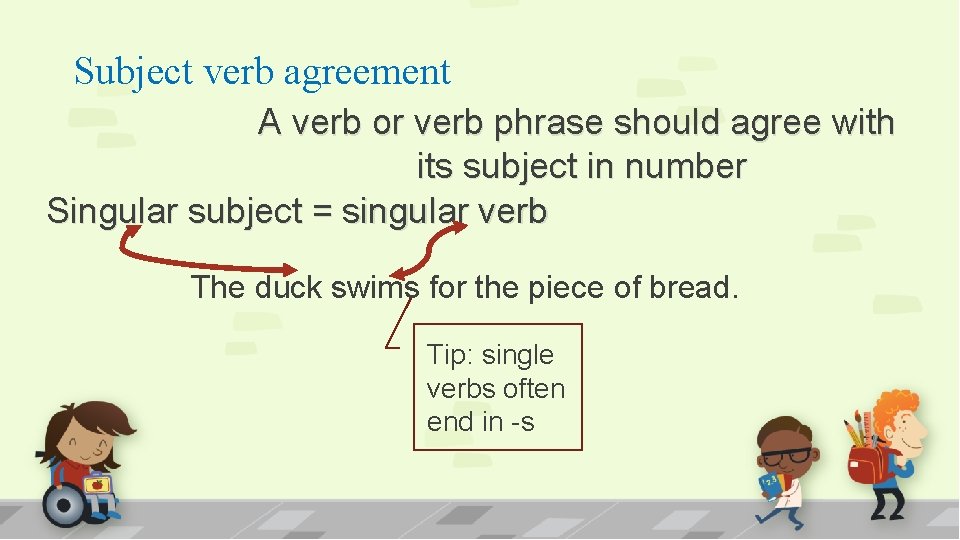
Subject verb agreement A verb or verb phrase should agree with its subject in number Singular subject = singular verb The duck swims for the piece of bread. Tip: single verbs often end in -s
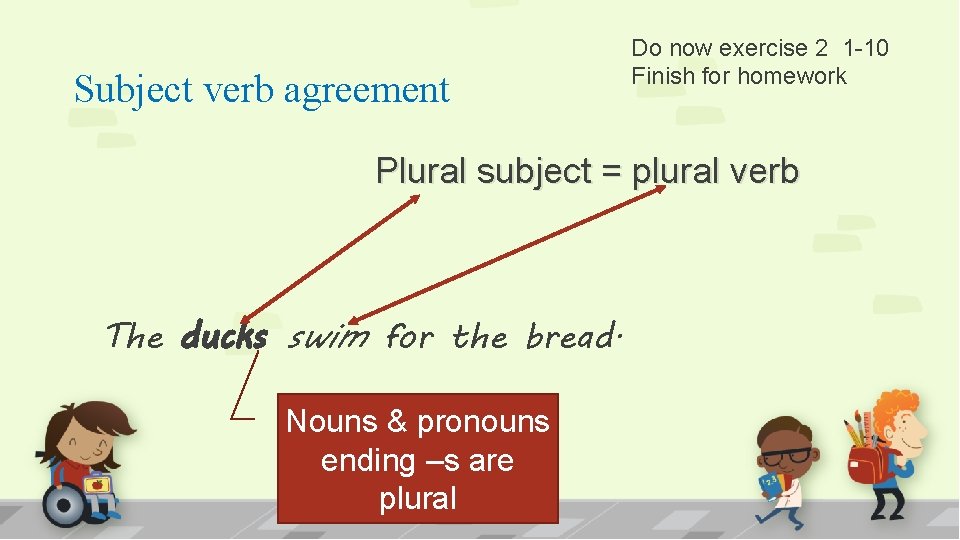
Subject verb agreement Do now exercise 2 1 -10 Finish for homework Plural subject = plural verb The ducks swim for the bread. Nouns & pronouns ending –s are plural
Warriner’s 4 th 109
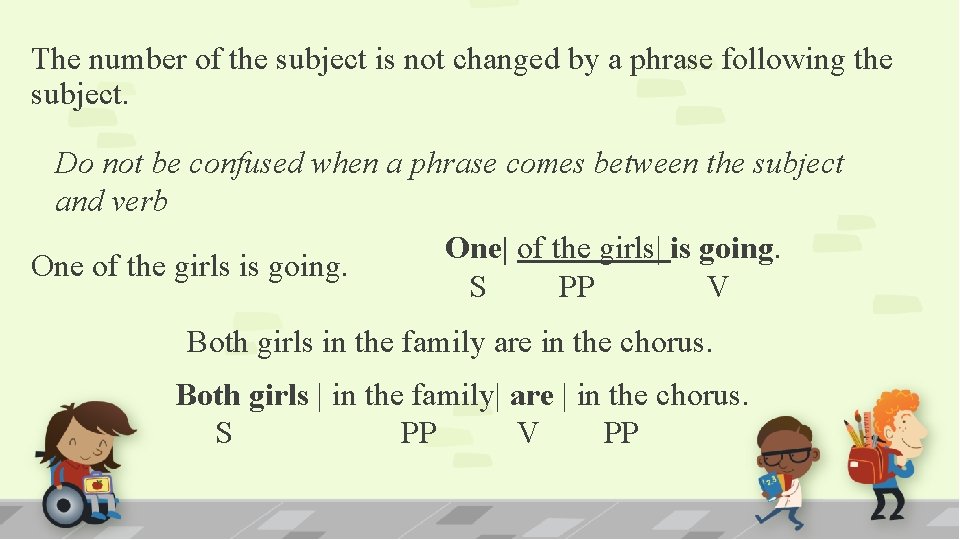
The number of the subject is not changed by a phrase following the subject. Do not be confused when a phrase comes between the subject and verb One| of the girls| is going. One of the girls is going. S PP V Both girls in the family are in the chorus. Both girls | in the family| are | in the chorus. S PP V PP
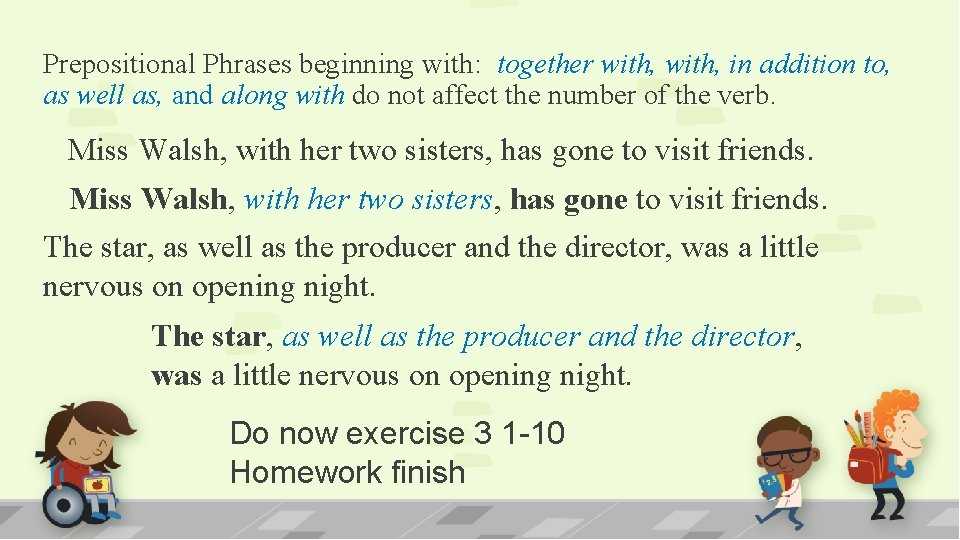
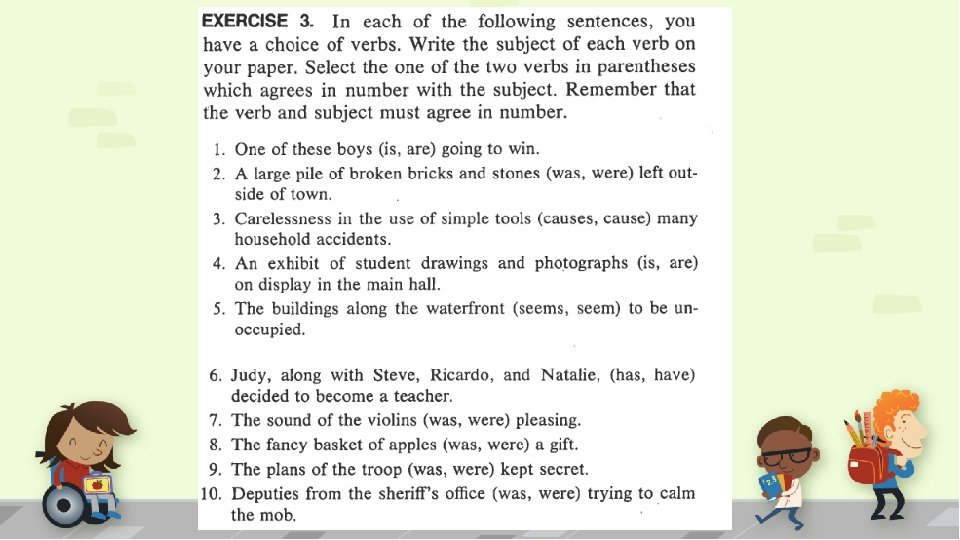
Prepositional Phrases beginning with: together with, in addition to, as well as, and along with do not affect the number of the verb. Miss Walsh, with her two sisters, has gone to visit friends. The star, as well as the producer and the director, was a little nervous on opening night. Do now exercise 3 1 -10 Homework finish
These are singular pronouns: each, either, neither, one, everybody, no one, nobody, anyone, somebody They are indefinite pronouns because they are general or vague. One of the uniforms is blue. Each was working on a project. One| of the uniforms| is blue. Each | was working on a project. Everybody takes English. Everybody in both classes takes English.
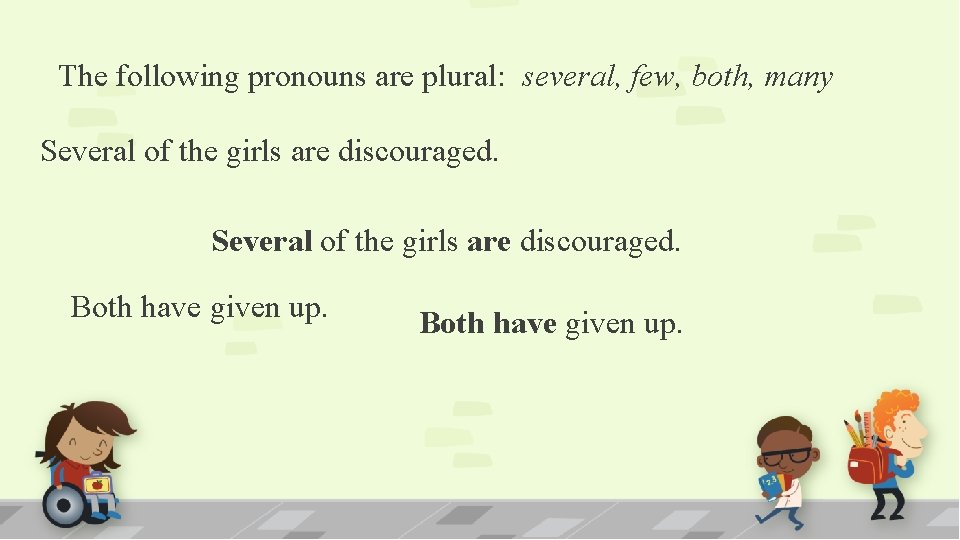
The following pronouns are plural: several, few, both, many Several of the girls are discouraged. Both have given up.
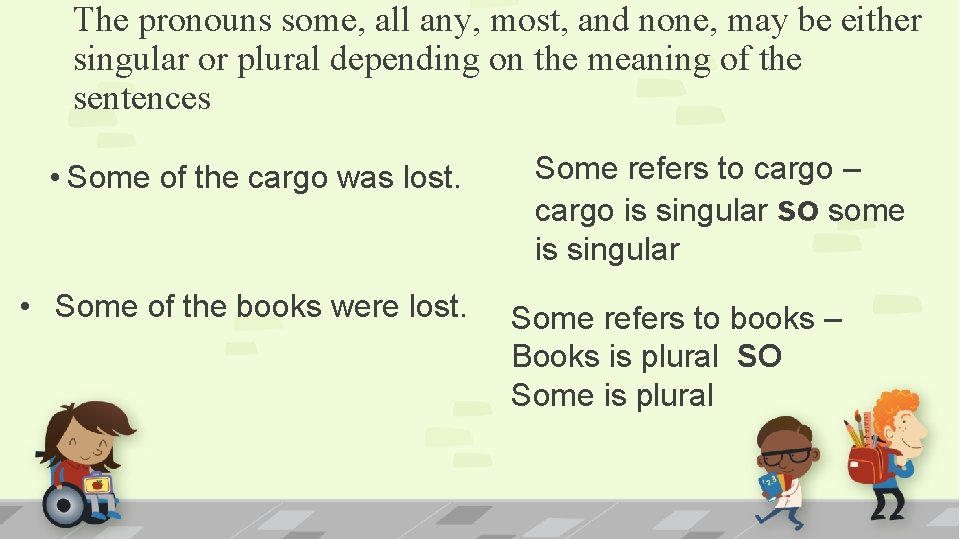
The pronouns some, all any, most, and none, may be either singular or plural depending on the meaning of the sentences • Some of the cargo was lost. • Some of the books were lost. Some refers to cargo – cargo is singular so some is singular Some refers to books – Books is plural SO Some is plural
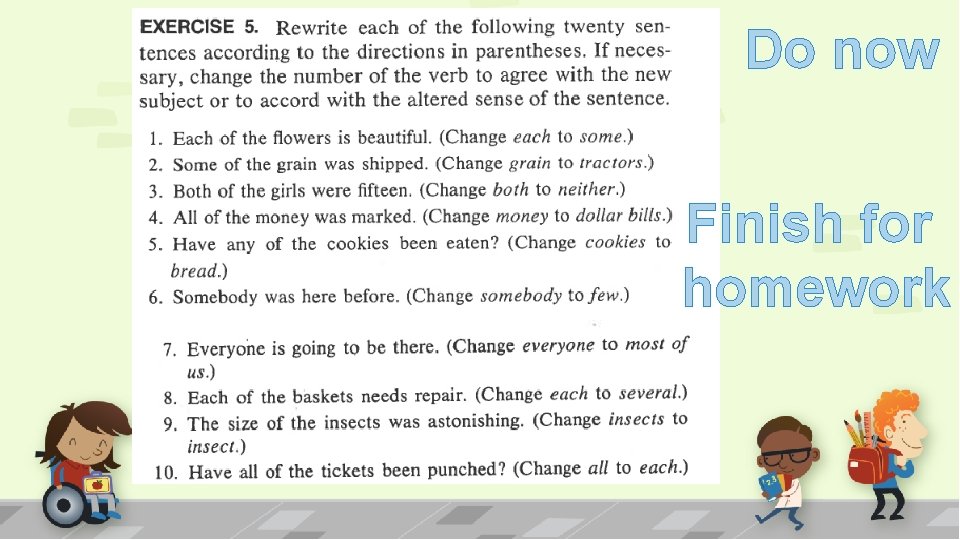
Do now Finish for homework
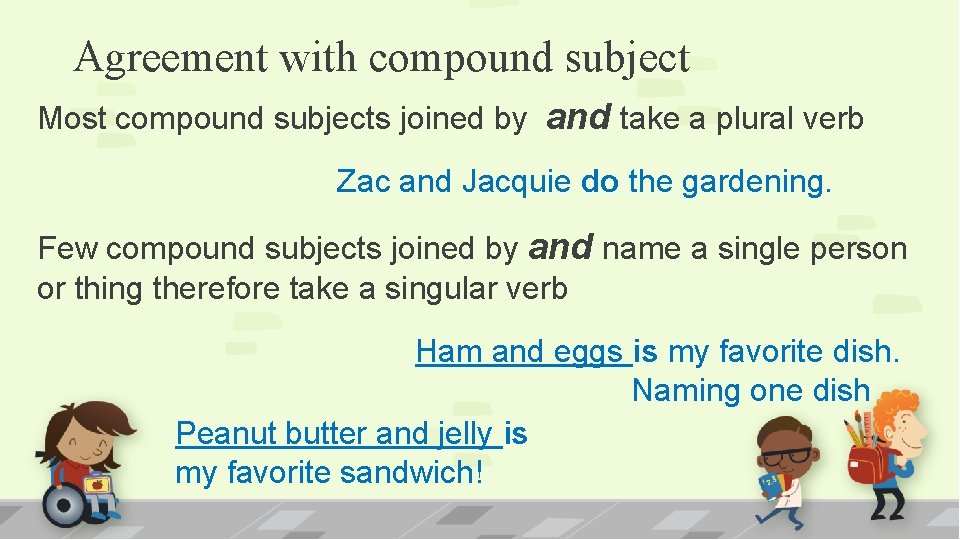
Agreement with compound subject Most compound subjects joined by and take a plural verb Zac and Jacquie do the gardening. Few compound subjects joined by and name a single person or thing therefore take a singular verb Ham and eggs is my favorite dish. Naming one dish Peanut butter and jelly is my favorite sandwich!
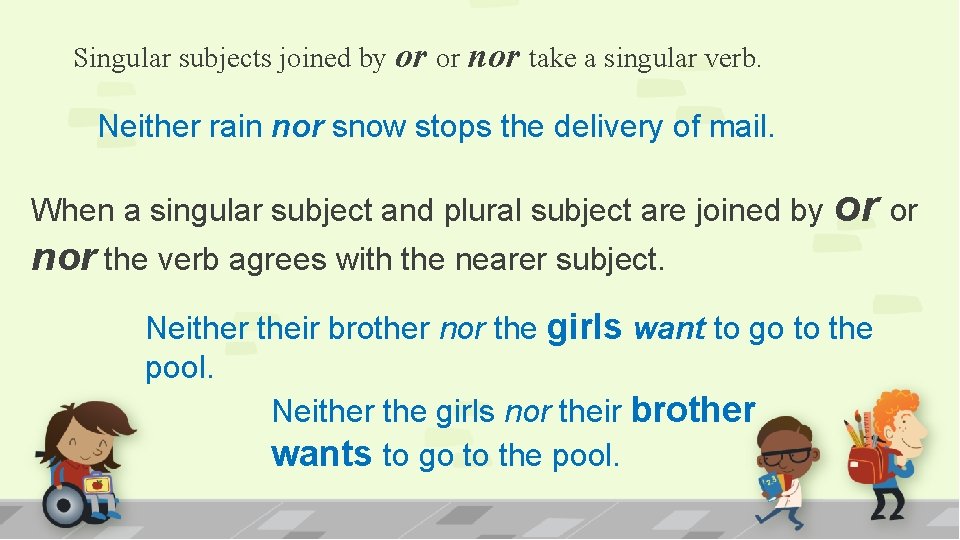
Singular subjects joined by or or nor take a singular verb. Neither rain nor snow stops the delivery of mail. When a singular subject and plural subject are joined by or or nor the verb agrees with the nearer subject. Neither their brother nor the girls want to go to the pool. Neither the girls nor their brother wants to go to the pool.
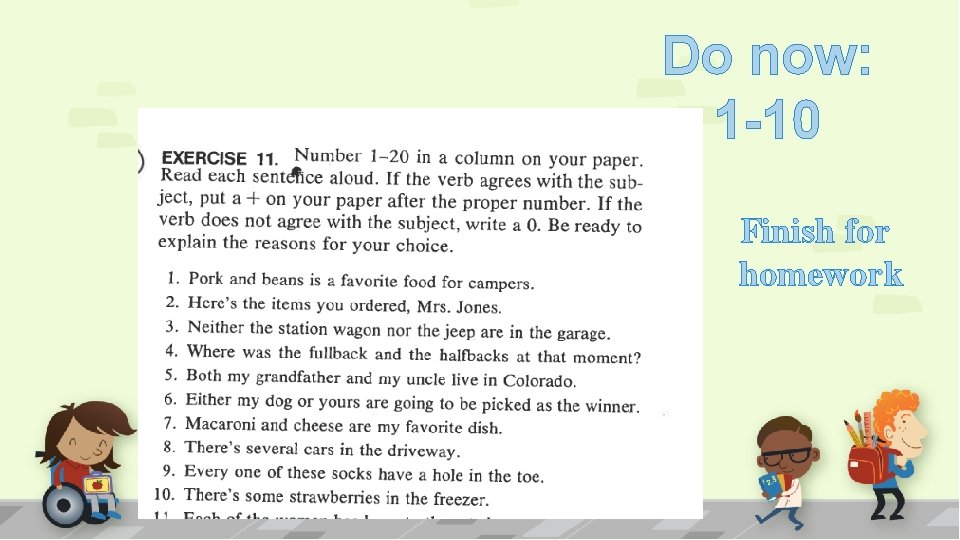
Do now: 1 -10 Finish for homework
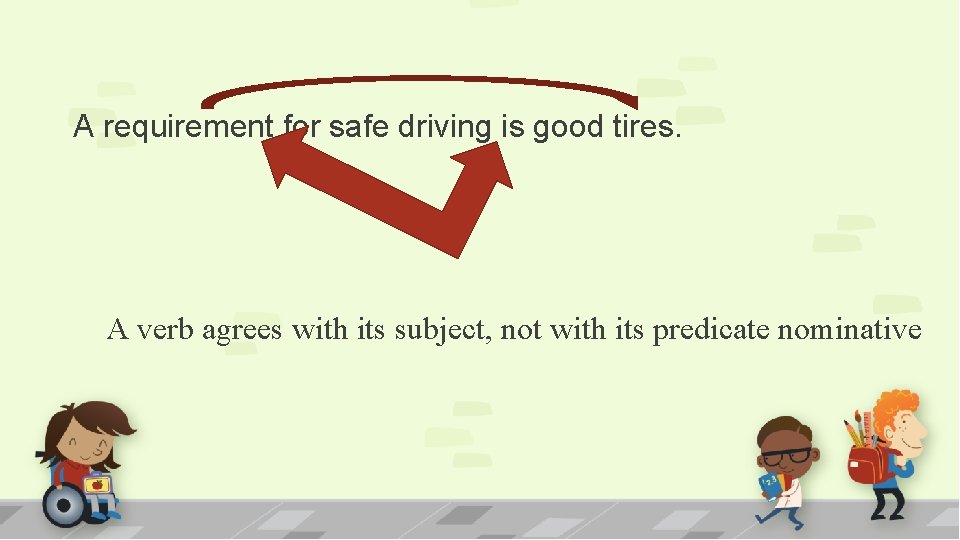
A requirement for safe driving is good tires. A verb agrees with its subject, not with its predicate nominative
When the subject follows the verb – as with sentences beginning with there and here – anticipate the subject and make sure the verb agrees. There are fourteen thousand people in my town.
Do now: 1 -10 Finish for homework
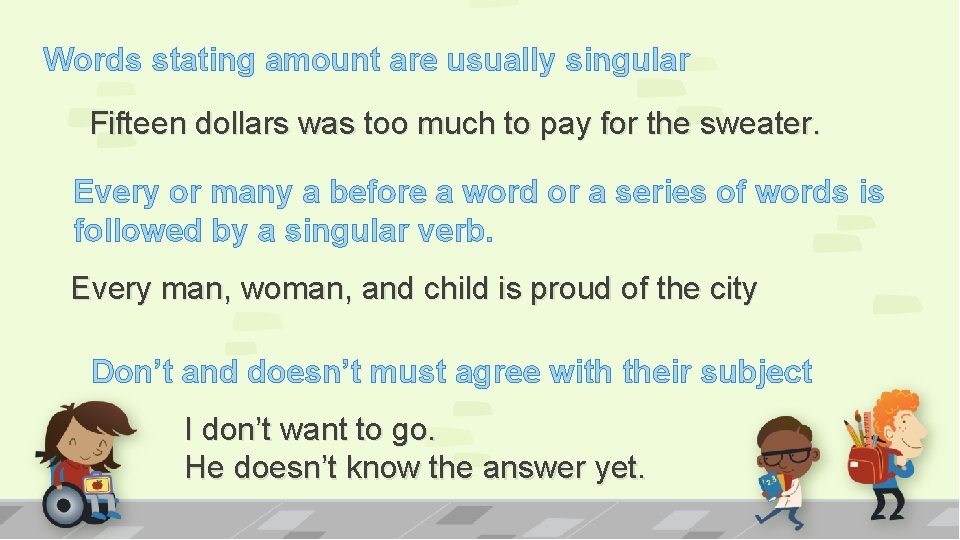
Words stating amount are usually singular Fifteen dollars was too much to pay for the sweater. Every or many a before a word or a series of words is followed by a singular verb. Every man, woman, and child is proud of the city Don’t and doesn’t must agree with their subject I don’t want to go. He doesn’t know the answer yet.
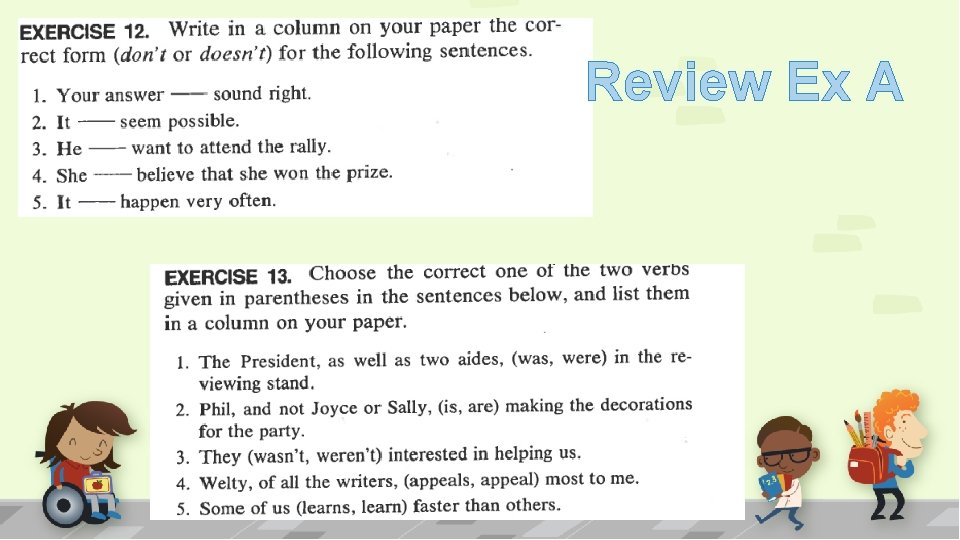
Review Ex A
Pronoun Antecedent Agreement
A pronoun agrees with its antecedent in gender and number. Boy, bull, rooster masculine Russ left his phone in the car. Ali washed her car this weekend. Feminine Girl, cow, her Room, Gender Neutral book, When you find the book bring it with you. house The soldiers want their pay.
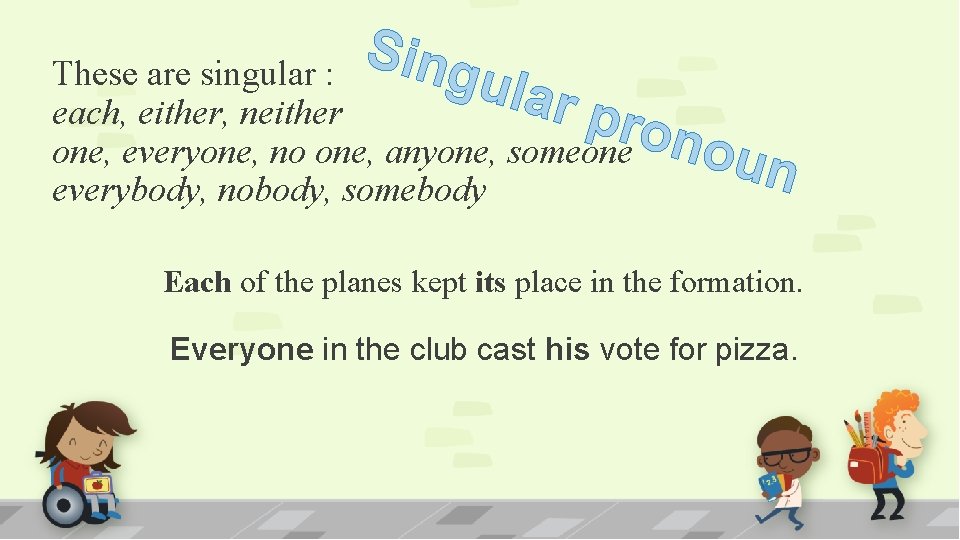
Sing These are singular : u l ar p each, either, neither r o one, everyone, no one, anyone, someone nou n everybody, nobody, somebody Each of the planes kept its place in the formation. Everyone in the club cast his vote for pizza.
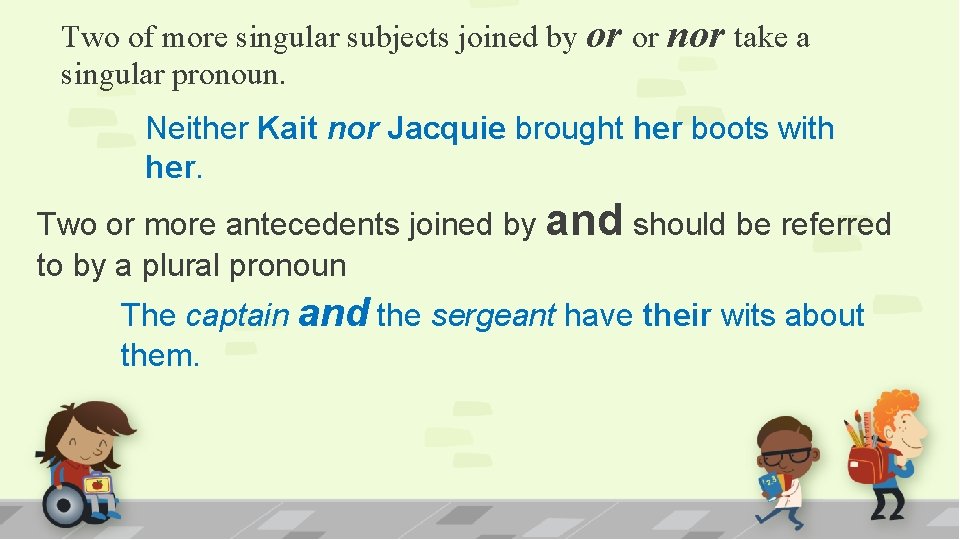
Two of more singular subjects joined by or or nor take a singular pronoun. Neither Kait nor Jacquie brought her boots with her. Two or more antecedents joined by and should be referred to by a plural pronoun The captain and the sergeant have their wits about them.
Do now exercise 14 & 15 Homework exercise B & C
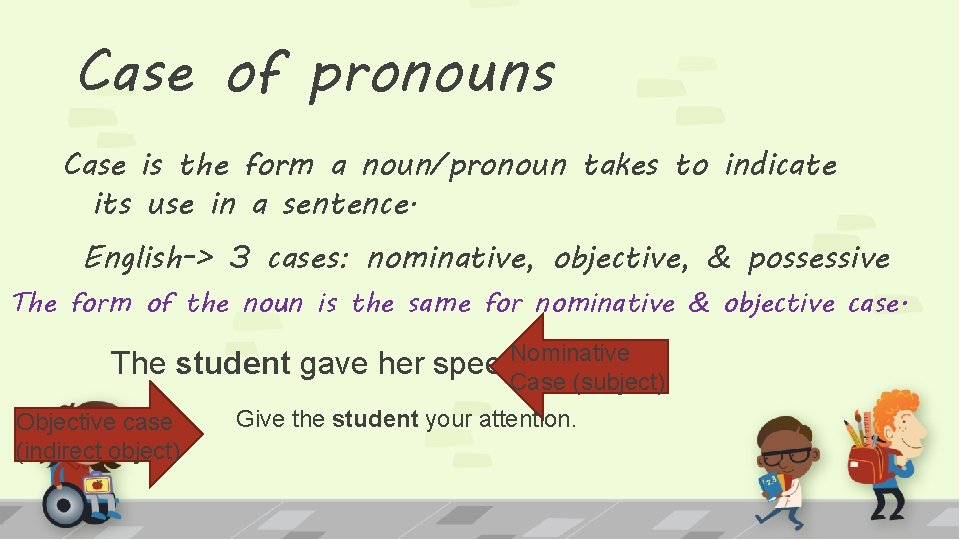
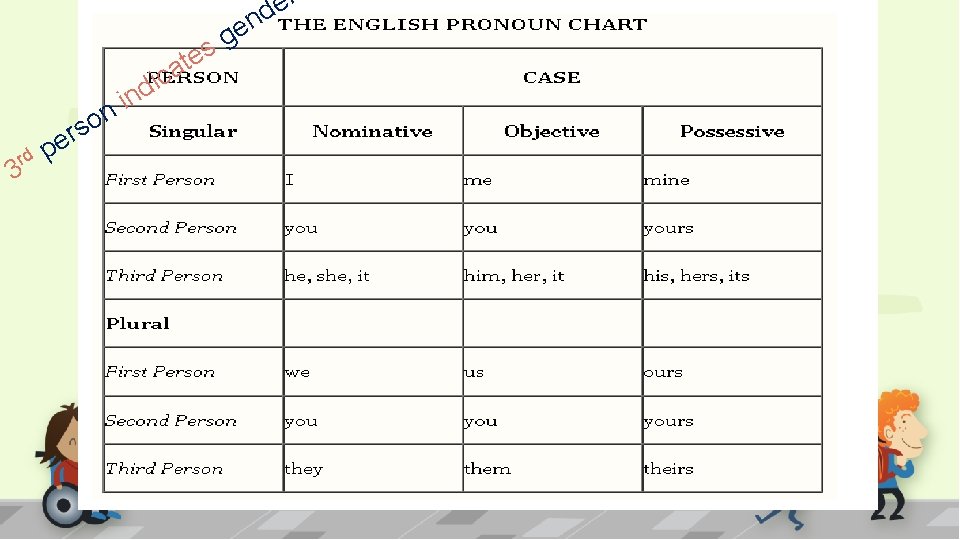
Case of pronouns Case is the form a noun/pronoun takes to indicate its use in a sentence. English-> 3 cases: nominative, objective, & possessive The form of the noun is the same for nominative & objective case. Nominative The student gave her speech Case (subject) Objective case (indirect object) Give the student your attention.
r e d n e g s te n i n rd 3 p o s r e a c i d
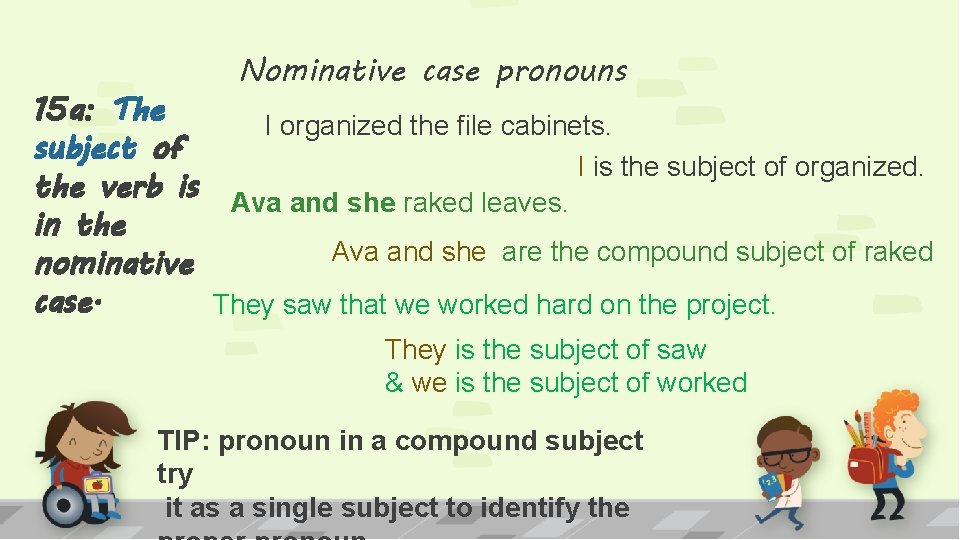
Nominative case pronouns 15 a: The I organized the file cabinets. subject of I is the subject of organized. the verb is Ava and she raked leaves. in the Ava and she are the compound subject of raked nominative case. They saw that we worked hard on the project. They is the subject of saw & we is the subject of worked TIP: pronoun in a compound subject try it as a single subject to identify the
Do now ex. 6 1 -10 A 1 -10 Finish for homework
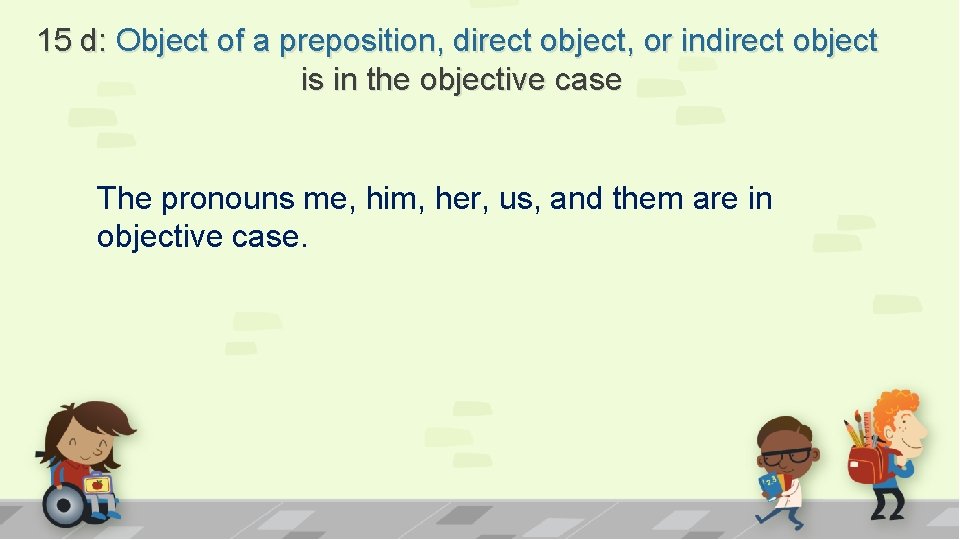
15 d: Object of a preposition, direct object, or indirect object is in the objective case The pronouns me, him, her, us, and them are in objective case.
Direct and Indirect objects 43 -46 Warrnier’s
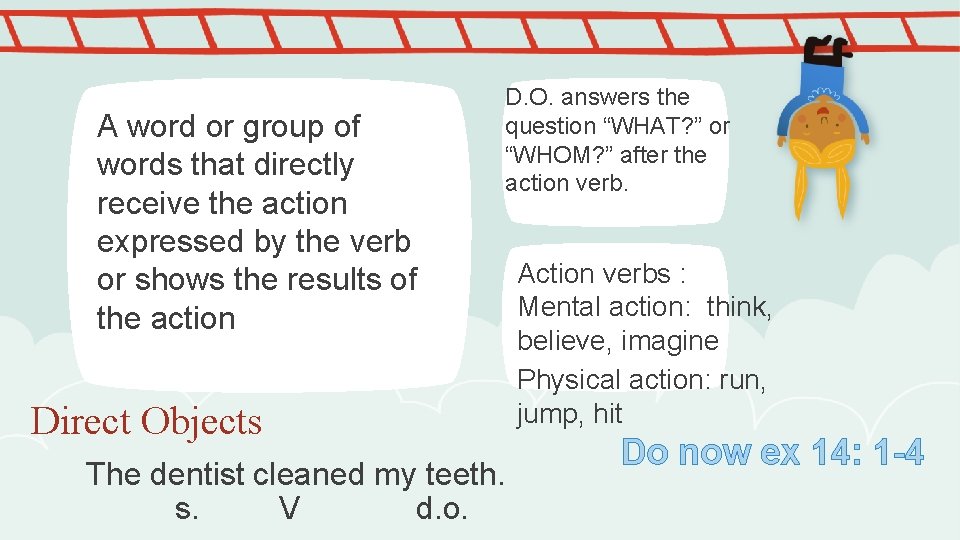
A word or group of words that directly receive the action expressed by the verb or shows the results of the action D. O. answers the question “WHAT? ” or “WHOM? ” after the action verb. Direct Objects The dentist cleaned my teeth. s. V d. o. Action verbs : Mental action: think, believe, imagine Physical action: run, jump, hit Do now ex 14: 1 -4
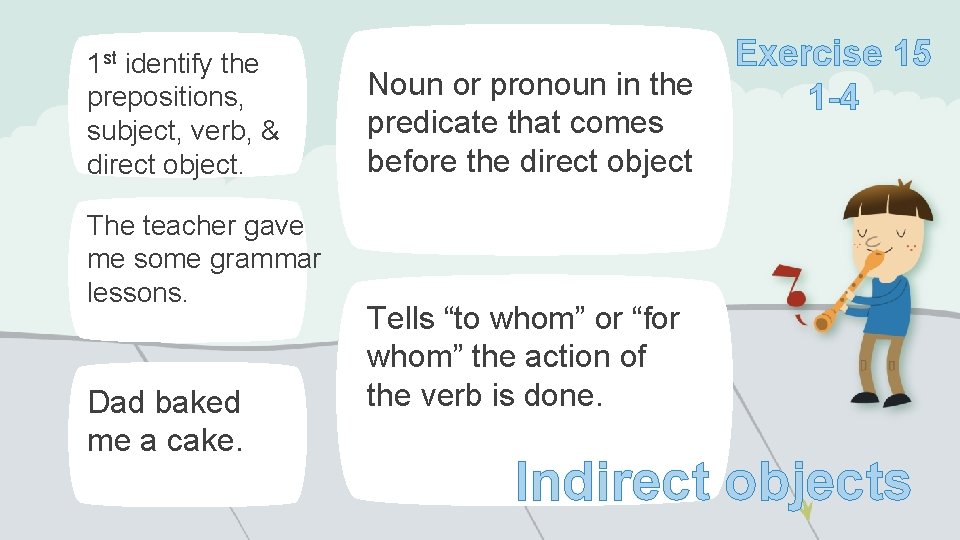
1 st identify the prepositions, subject, verb, & direct object. The teacher gave me some grammar lessons. Dad baked me a cake. Noun or pronoun in the predicate that comes before the direct object Exercise 15 1 -4 Tells “to whom” or “for whom” the action of the verb is done. Indirect objects
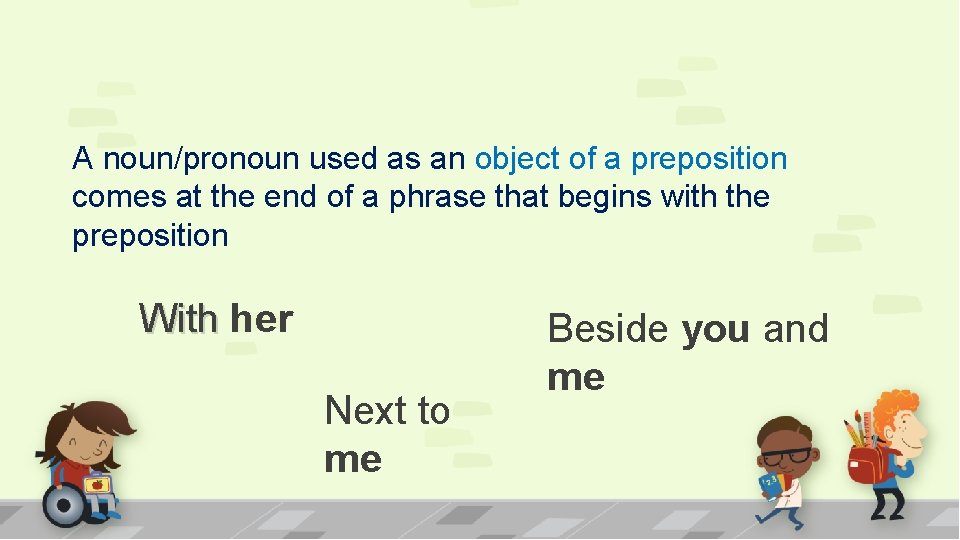
A noun/pronoun used as an object of a preposition comes at the end of a phrase that begins with the preposition With her Next to me Beside you and me
Verb Tense Warriner’s 159 -165
Verb Tense Verbs change form to show the time of the action or the idea they express Time indicated by the form of the verb is called tense There are 6 tenses formed from the principal parts of the verb (conjugating of the verb)
Action Verbs Warriner’s 11 -12
Linking Verbs Warriner’s 13 -14, 153
Verb Phrase Warriner’s 14 -15
Capitalization Warriner’s 357 -74, 410 -411
Punctuation comma, quotation marks, & apostrophes Warriner’s Comma 379 -89, 392 -93, 411 -12 quotation marks 410 -15 Apostrophes 416 -19, 421 -24