
English 10 Global Fictions Manuel del Alto mdelaltouci
+ English 10 – Global Fictions Manuel del Alto mdelalto@uci. edu Office: M 5 -6 & W 2 -3 HH 365
+ Objectives for today n Warm up / Intro n General n Weekly re-cap of syllabus section goals / “What do we do in section? ” n Discussion
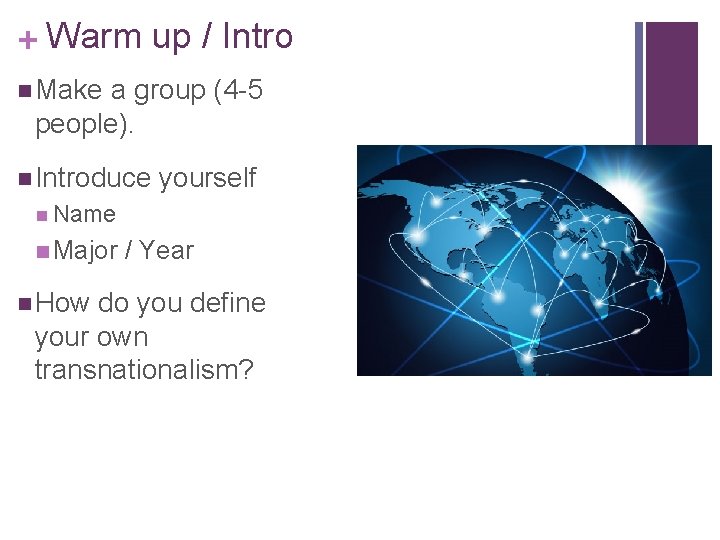
+ Warm up / Intro n Make a group (4 -5 people). n Introduce yourself n Name n Major n How / Year do you define your own transnationalism?

+ Syllabus Review n Reading Quizzes – (10%) n Informal / Spot check for reading n At random n 5 -10 per quarter n Cannot be made up – Must attend lecture n No electronic devices allowed, but you can use handwritten notes
+ Syllabus Review n Mid-Term Exam (35%) n In-class exam – You should bring a blue book n At-home essay – You will complete at home (about 1, 000 words) n Turn 1 copy in to turnitin. com n Bring 1 printed copy to class (for comments) n Final Exam (40%) n In-class exam – Bring blue book n At-home essay – Complete at home before class n Turn 1 copy in to turnitin. com n Bring 1 printed copy to class
+ Syllabus Review n Section n n grade (15%) Attendance Policy n Late arrivals: n Inform TA if you arrive late to update roll n If you arrive within 10 minutes of section state = late n If you arrive after 10 mins of section state = absent n 3 late arrivals = 2. 5% deduction of section grade n Absence policy: n 1 free absence n 2 nd absence and thereafter = 2. 5% deduction per absence For example: n 2 absences + 3 late = 5% deduction of grade
+ Syllabus Review n Submission of work n Submit mid-term and final take home essays on turnitin. com before class starts on due date n Class name = course code n Password is zotzot n Remember to bring a printed copy of take home essay to class n Late work policy: n Deduction of 5% of grade per day late – Late work not accepted after 7 days late
+ Syllabus Review n Participation policy n Preparation: n Read the text before you come to class n Participate at least 1 time per discussion n Post a question / topic / observation to “message board” on EEE by Tuesday noon n Your comment must be at least 5 sentences n Computer policy: n Computers are not necessary to articulate your thoughts about the text – No computers or cell phones during discussion n Disclosure about participation n I reserve the right to adjust your section grade in line with your participation in this section. If you are disruptive, not prepared, or engaged online or via cell phone, your grade will be reduced.
+ Syllabus Review
+ “What do we do in section? ” n Discuss the reading: n What happened in the text? n What interested you? n What did you observe? n What confused you? n Identify themes / topics shared between text and lecture: n What is your “take away” from what you read? n Do you agree with the professor’s ideas? Why / Why not? n Synthesize - How is this relevant in your life? n What does this text “say” about your world?
+ Lecture review n The repetitive devolution of history n Marx – Tragedy/Farce n Uncanny n What examples of doubling or repetition have you noticed in the novel?
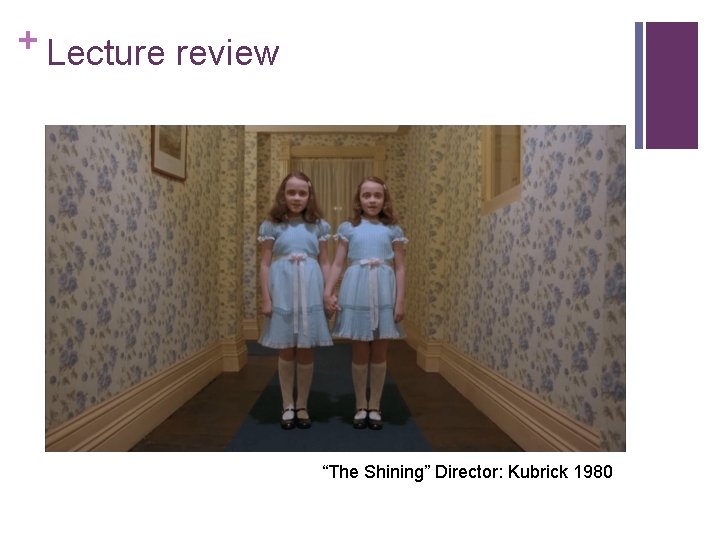
+ Lecture review “The Shining” Director: Kubrick 1980
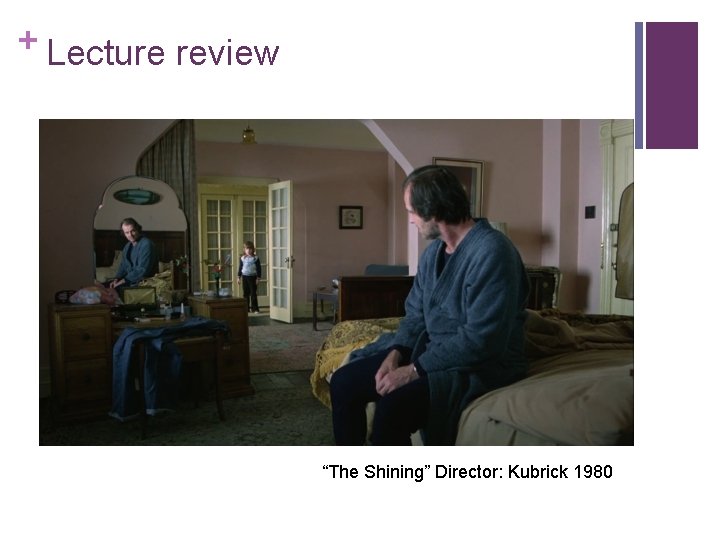
+ Lecture review “The Shining” Director: Kubrick 1980
+ Lecture review Hypothesis on Cloud Atlas The novel tracks the repetitive devolution of history from tragedy to face; however, this is paradoxically preserved by the very mechanisms that function to erase it
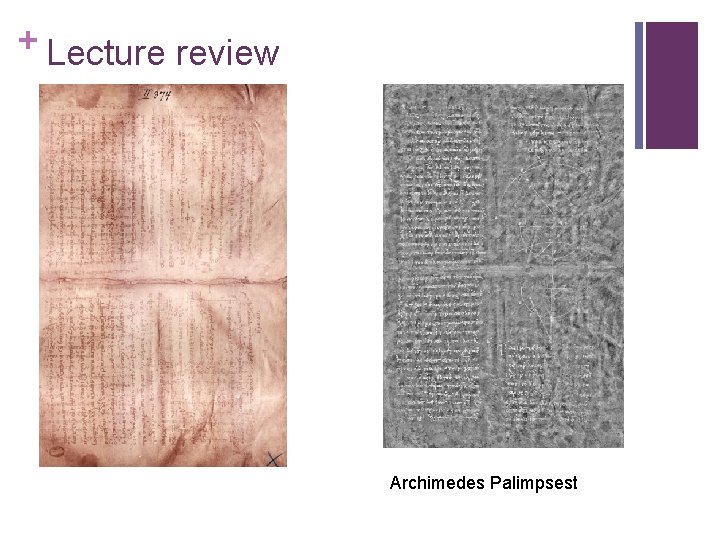
+ Lecture review Archimedes Palimpsest
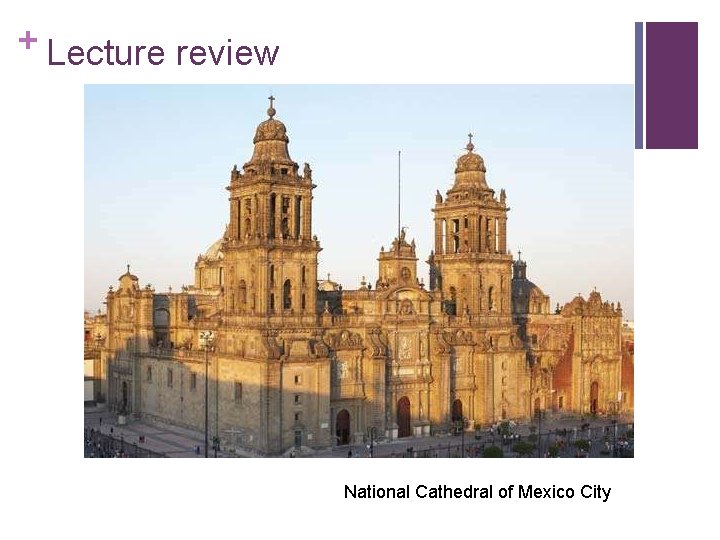
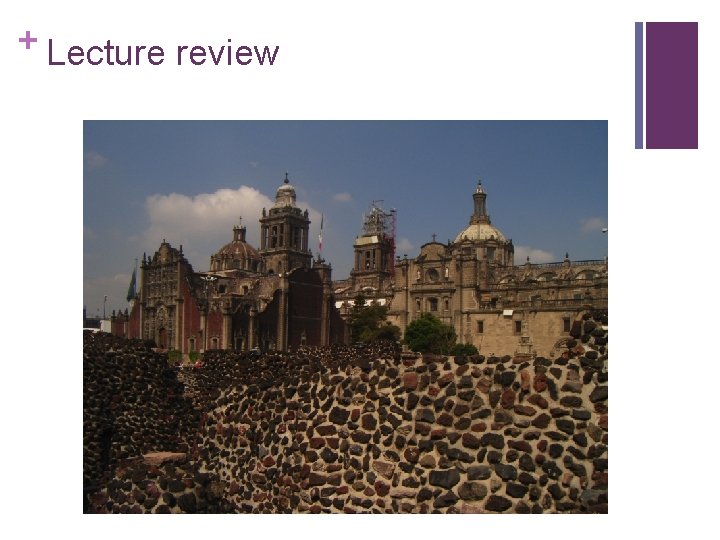
+ Lecture review National Cathedral of Mexico City
+ Lecture review
+ Lecture Review n Minor characters – Alex Woloch The One Vs. the Many (2003) n Vanishing – Absorbed in someone else’s story – Disappear – The actualization of a human being is denied n 2 kinds of minor character n Engulfing of an interior personality by the delimited signs that express it (Agent Smith) n Explosion of a suffocated interior being into an unrepresentable, fragmented form (Teddy) n Questions on this theory? n Does this work for the novel? Why/Why not? n What problems are there w Woloch’s theory?
+ Close reading technique n What is “close reading”? Wiki n What is it good for? n How do I do it? n Let’s practice – n Cinematic n Literary – “The Shining” – Cloud Atlas Pg 112 Chapter 18
+ n Discussion – Microhistory n “History as seen from below and not from above” – Lucien Febvre n “The history of any country, presented as the history of a family, conceals fierce conflicts of interest between conquerors and the conquered, masters and slaves, capitalists and workers, dominators and dominated in race and sex. And in such a world of conflict, a world of victims and executioners, it is the job of thinking people not to be on the side of the executioners. ” Howard Zinn
+ n Discussion – “Only a generation ago, history was mainly about great events (…) 1776, the Declaration of Independence, Washington and Jefferson; 1815 Waterloo, Napoleon and Wellington; 1917 the Bolshevik Revolution, Lenin and Trotsky. If we could recite the dates, describe the cataclysms, memorize the names, we could confidently assume to have mastered the outlines we had of the past. n But in recent years, growing numbers of historians have shifted their inquiries to the mass of humanity who existed outside of the political and social mainstream. What did peasants and artisans think about centuries ago? How were their beliefs disseminated, and how did they differ from notions that prevailed in more affluent, literate society?
+ Discussion – n “The historian’s task is just the opposite of what most of us were taught to believe. He must destroy our false sense of proximity to people of the past because they came from socities very different from our own. The more we discover about these people’s “mental universe, ” the more we should be shocked by the cultural distance that separates us from them. ” – Carlo Ginzburg interview in NYT 11/17/91
- Slides: 23