
ENGLISH 10 ASSERTION JOURNAL 2019 2020 ASSIGNMENT OVERVIEWREQUIREMENTS


- Slides: 11
ENGLISH 10 ASSERTION JOURNAL 2019 -2020
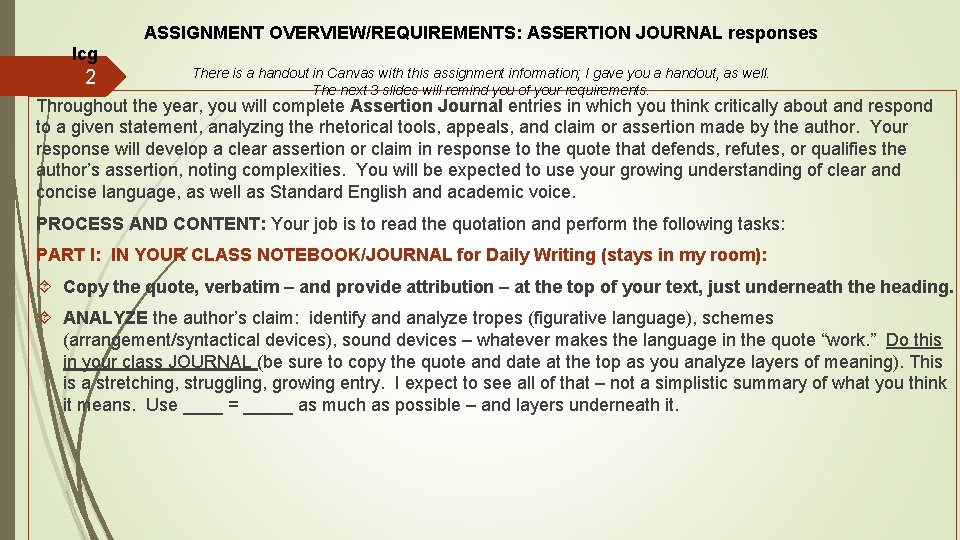
ASSIGNMENT OVERVIEW/REQUIREMENTS: ASSERTION JOURNAL responses lcg 2 There is a handout in Canvas with this assignment information; I gave you a handout, as well. The next 3 slides will remind you of your requirements. Throughout the year, you will complete Assertion Journal entries in which you think critically about and respond to a given statement, analyzing the rhetorical tools, appeals, and claim or assertion made by the author. Your response will develop a clear assertion or claim in response to the quote that defends, refutes, or qualifies the author’s assertion, noting complexities. You will be expected to use your growing understanding of clear and concise language, as well as Standard English and academic voice. PROCESS AND CONTENT: Your job is to read the quotation and perform the following tasks: PART I: IN YOUR CLASS NOTEBOOK/JOURNAL for Daily Writing (stays in my room): Copy the quote, verbatim – and provide attribution – at the top of your text, just underneath the heading. ANALYZE the author’s claim: identify and analyze tropes (figurative language), schemes (arrangement/syntactical devices), sound devices – whatever makes the language in the quote “work. ” Do this in your class JOURNAL (be sure to copy the quote and date at the top as you analyze layers of meaning). This is a stretching, struggling, growing entry. I expect to see all of that – not a simplistic summary of what you think it means. Use ____ = _____ as much as possible – and layers underneath it.
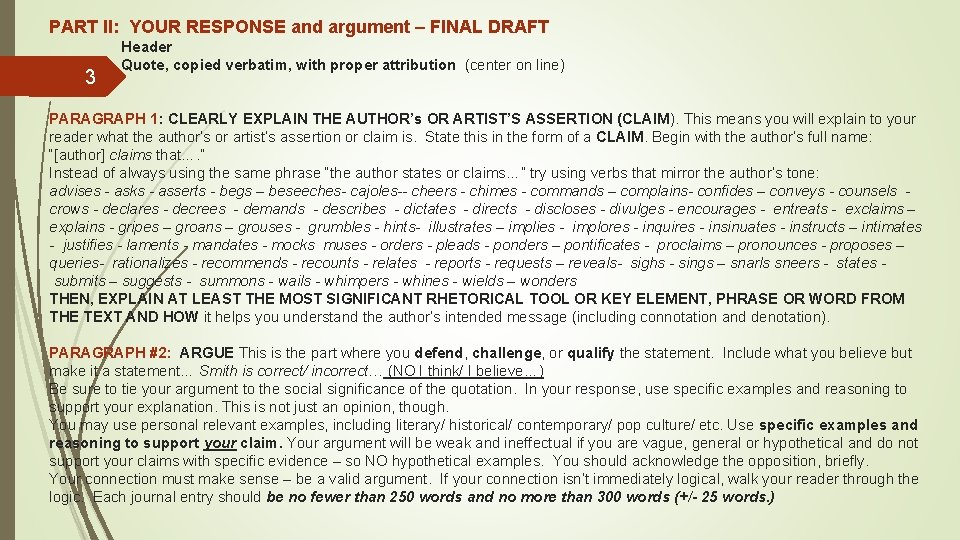
PART II: YOUR RESPONSE and argument – FINAL DRAFT 3 Header Quote, copied verbatim, with proper attribution (center on line) PARAGRAPH 1: CLEARLY EXPLAIN THE AUTHOR’s OR ARTIST’S ASSERTION (CLAIM). This means you will explain to your reader what the author’s or artist’s assertion or claim is. State this in the form of a CLAIM. Begin with the author’s full name: “[author] claims that…. ” Instead of always using the same phrase “the author states or claims…” try using verbs that mirror the author’s tone: advises - asks - asserts - begs – beseeches- cajoles-- cheers - chimes - commands – complains- confides – conveys - counsels crows - declares - decrees - demands - describes - dictates - directs - discloses - divulges - encourages - entreats - exclaims – explains - gripes – groans – grouses - grumbles - hints- illustrates – implies - implores - inquires - insinuates - instructs – intimates - justifies - laments - mandates - mocks muses - orders - pleads - ponders – pontificates - proclaims – pronounces - proposes – queries- rationalizes - recommends - recounts - relates - reports - requests – reveals- sighs - sings – snarls sneers - states submits – suggests - summons - wails - whimpers - whines - wields – wonders THEN, EXPLAIN AT LEAST THE MOST SIGNIFICANT RHETORICAL TOOL OR KEY ELEMENT, PHRASE OR WORD FROM THE TEXT AND HOW it helps you understand the author’s intended message (including connotation and denotation). PARAGRAPH #2: ARGUE This is the part where you defend, challenge, or qualify the statement. Include what you believe but make it a statement… Smith is correct/ incorrect… (NO I think/ I believe…) Be sure to tie your argument to the social significance of the quotation. In your response, use specific examples and reasoning to support your explanation. This is not just an opinion, though. You may use personal relevant examples, including literary/ historical/ contemporary/ pop culture/ etc. Use specific examples and reasoning to support your claim. Your argument will be weak and ineffectual if you are vague, general or hypothetical and do not support your claims with specific evidence – so NO hypothetical examples. You should acknowledge the opposition, briefly. Your connection must make sense – be a valid argument. If your connection isn’t immediately logical, walk your reader through the logic. Each journal entry should be no fewer than 250 words and no more than 300 words (+/- 25 words. )
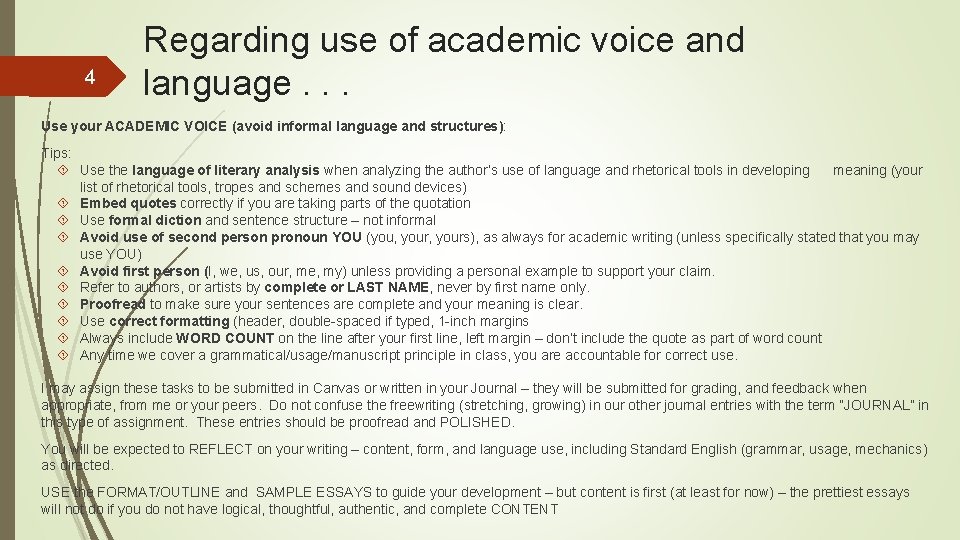
4 Regarding use of academic voice and language. . . Use your ACADEMIC VOICE (avoid informal language and structures): Tips: Use the language of literary analysis when analyzing the author’s use of language and rhetorical tools in developing meaning (your list of rhetorical tools, tropes and schemes and sound devices) Embed quotes correctly if you are taking parts of the quotation Use formal diction and sentence structure – not informal Avoid use of second person pronoun YOU (you, yours), as always for academic writing (unless specifically stated that you may use YOU) Avoid first person (I, we, us, our, me, my) unless providing a personal example to support your claim. Refer to authors, or artists by complete or LAST NAME, never by first name only. Proofread to make sure your sentences are complete and your meaning is clear. Use correct formatting (header, double-spaced if typed, 1 -inch margins Always include WORD COUNT on the line after your first line, left margin – don’t include the quote as part of word count Any time we cover a grammatical/usage/manuscript principle in class, you are accountable for correct use. I may assign these tasks to be submitted in Canvas or written in your Journal – they will be submitted for grading, and feedback when appropriate, from me or your peers. Do not confuse the freewriting (stretching, growing) in our other journal entries with the term “JOURNAL” in this type of assignment. These entries should be proofread and POLISHED. You will be expected to REFLECT on your writing – content, form, and language use, including Standard English (grammar, usage, mechanics) as directed. USE the FORMAT/OUTLINE and SAMPLE ESSAYS to guide your development – but content is first (at least for now) – the prettiest essays will not do if you do not have logical, thoughtful, authentic, and complete CONTENT
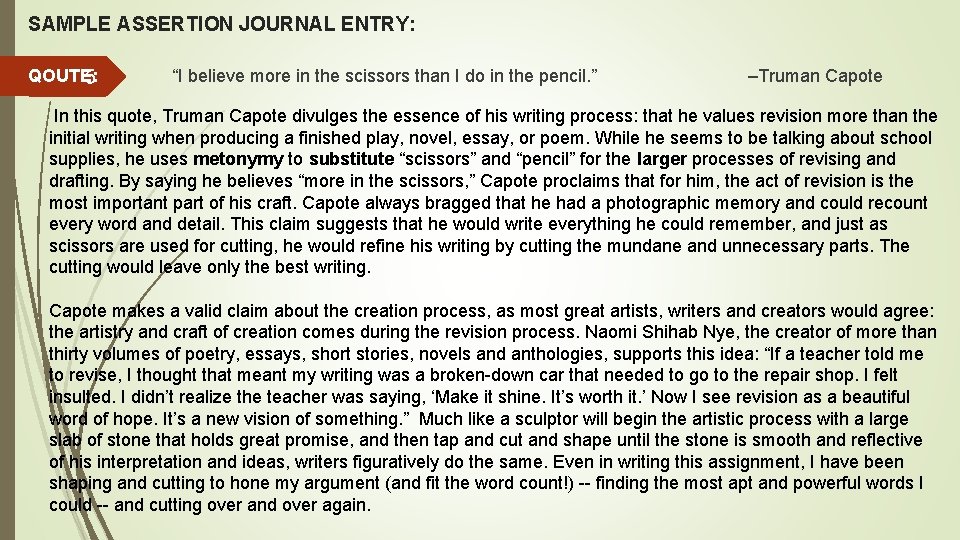
SAMPLE ASSERTION JOURNAL ENTRY: QOUTE: 5 “I believe more in the scissors than I do in the pencil. ” –Truman Capote In this quote, Truman Capote divulges the essence of his writing process: that he values revision more than the initial writing when producing a finished play, novel, essay, or poem. While he seems to be talking about school supplies, he uses metonymy to substitute “scissors” and “pencil” for the larger processes of revising and drafting. By saying he believes “more in the scissors, ” Capote proclaims that for him, the act of revision is the most important part of his craft. Capote always bragged that he had a photographic memory and could recount every word and detail. This claim suggests that he would write everything he could remember, and just as scissors are used for cutting, he would refine his writing by cutting the mundane and unnecessary parts. The cutting would leave only the best writing. Capote makes a valid claim about the creation process, as most great artists, writers and creators would agree: the artistry and craft of creation comes during the revision process. Naomi Shihab Nye, the creator of more than thirty volumes of poetry, essays, short stories, novels and anthologies, supports this idea: “If a teacher told me to revise, I thought that meant my writing was a broken-down car that needed to go to the repair shop. I felt insulted. I didn’t realize the teacher was saying, ‘Make it shine. It’s worth it. ’ Now I see revision as a beautiful word of hope. It’s a new vision of something. ” Much like a sculptor will begin the artistic process with a large slab of stone that holds great promise, and then tap and cut and shape until the stone is smooth and reflective of his interpretation and ideas, writers figuratively do the same. Even in writing this assignment, I have been shaping and cutting to hone my argument (and fit the word count!) -- finding the most apt and powerful words I could -- and cutting over and over again.
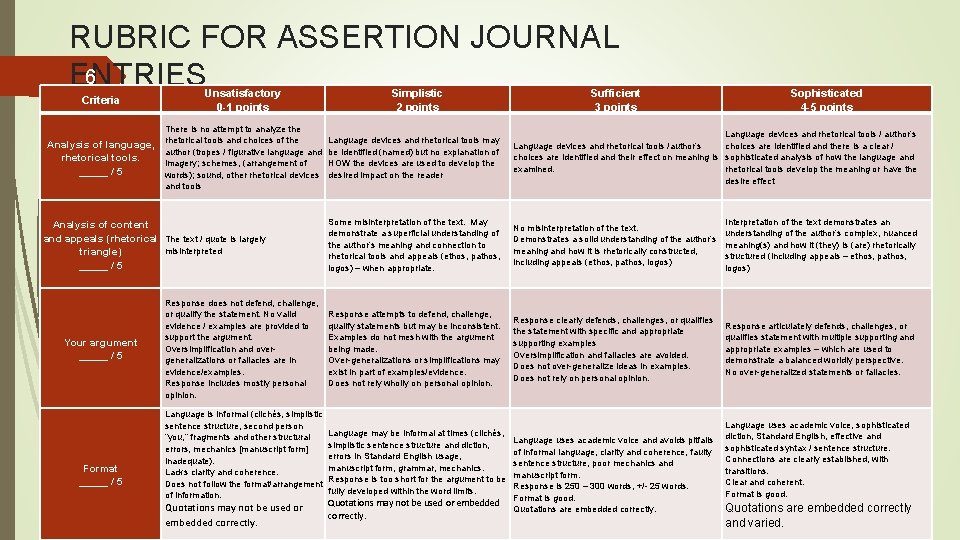
RUBRIC FOR ASSERTION JOURNAL 6 ENTRIES Criteria Unsatisfactory 0 -1 points Analysis of language, rhetorical tools. _____ / 5 There is no attempt to analyze the rhetorical tools and choices of the author (tropes / figurative language and imagery; schemes, (arrangement of words); sound, other rhetorical devices and tools Analysis of content and appeals (rhetorical The text / quote is largely misinterpreted triangle) _____ / 5 Your argument _____ / 5 Format _____ / 5 Response does not defend, challenge, or qualify the statement. No valid evidence / examples are provided to support the argument. Oversimplification and overgeneralizations or fallacies are in evidence/examples. Response includes mostly personal opinion. Language is informal (clichés, simplistic sentence structure, second person “you, ” fragments and other structural errors, mechanics [manuscript form] inadequate). Lacks clarity and coherence. Does not follow the format/arrangement of information. Quotations may not be used or embedded correctly. Simplistic 2 points Sufficient 3 points Sophisticated 4 -5 points Language devices and rhetorical tools may be identified (named) but no explanation of HOW the devices are used to develop the desired impact on the reader Language devices and rhetorical tools / author’s choices are identified and there is a clear / Language devices and rhetorical tools /author’s choices are identified and their effect on meaning is sophisticated analysis of how the language and examined. rhetorical tools develop the meaning or have the desire effect Some misinterpretation of the text. May demonstrate a superficial understanding of the author’s meaning and connection to rhetorical tools and appeals (ethos, pathos, logos) – when appropriate. Interpretation of the text demonstrates an No misinterpretation of the text. understanding of the author’s complex, nuanced Demonstrates a solid understanding of the author’s meaning(s) and how it (they) is (are) rhetorically meaning and how it is rhetorically constructed, structured (including appeals – ethos, pathos, including appeals (ethos, pathos, logos) Response attempts to defend, challenge, qualify statements but may be inconsistent. Examples do not mesh with the argument being made. Over-generalizations or simplifications may exist in part of examples/evidence. Does not rely wholly on personal opinion. Response clearly defends, challenges, or qualifies the statement with specific and appropriate supporting examples Oversimplification and fallacies are avoided. Does not over-generalize ideas in examples. Does not rely on personal opinion. Language may be informal at times (clichés, simplistic sentence structure and diction, errors in Standard English usage, manuscript form, grammar, mechanics. Response is too short for the argument to be fully developed within the word limits. Quotations may not be used or embedded correctly. Language uses academic voice and avoids pitfalls of informal language, clarity and coherence, faulty sentence structure, poor mechanics and manuscript form. Response is 250 – 300 words, +/- 25 words. Format is good. Quotations are embedded correctly. Response articulately defends, challenges, or qualifies statement with multiple supporting and appropriate examples – which are used to demonstrate a balanced worldly perspective. No over-generalized statements or fallacies. Language uses academic voice, sophisticated diction, Standard English, effective and sophisticated syntax / sentence structure. Connections are clearly established, with transitions. Clear and coherent. Format is good. Quotations are embedded correctly and varied.
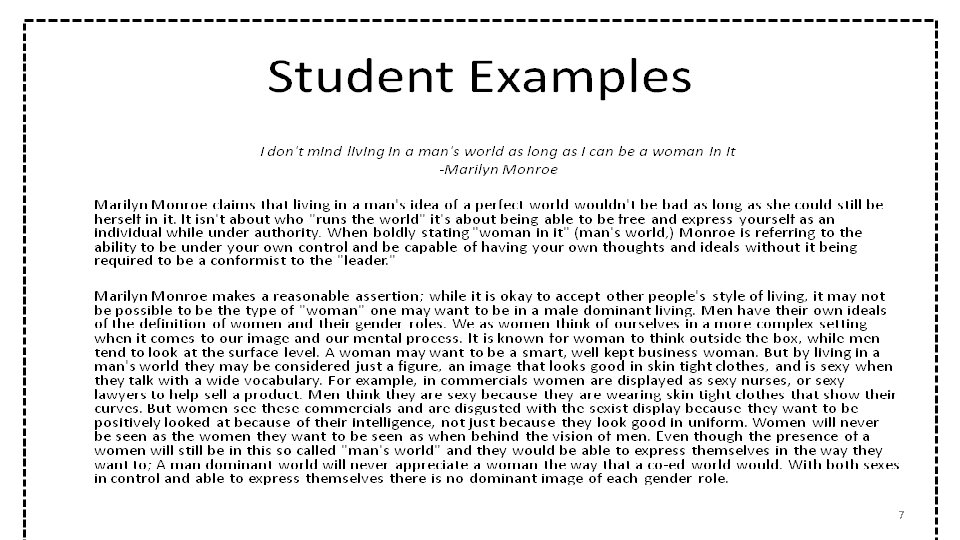
7
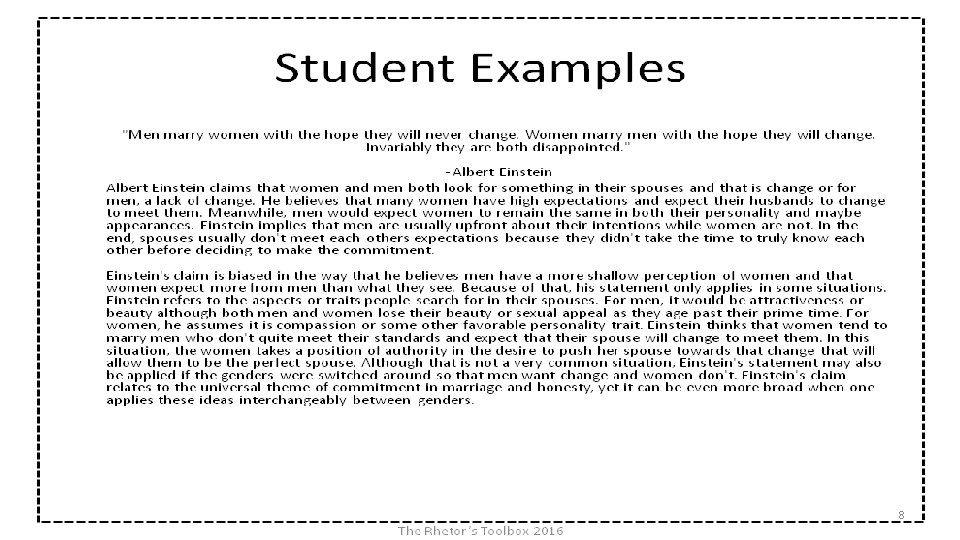
8
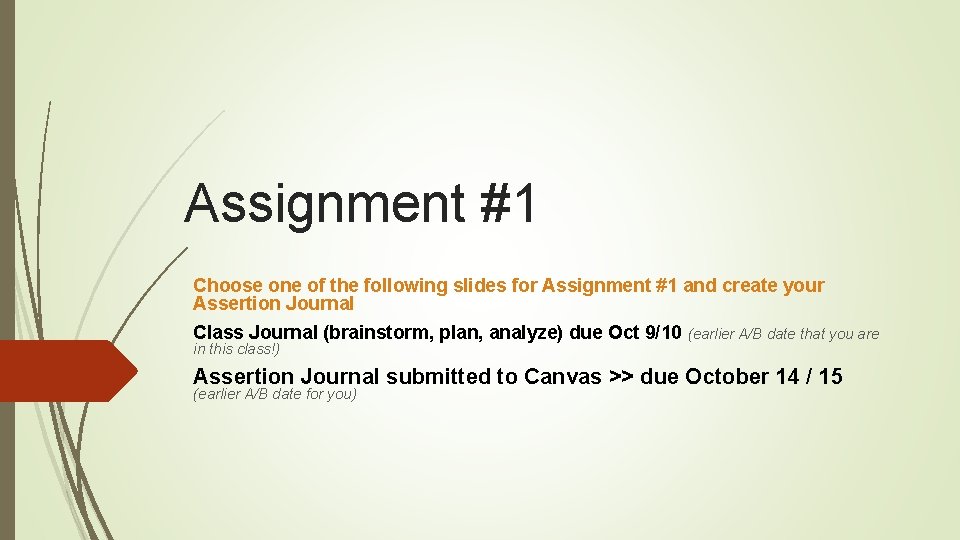
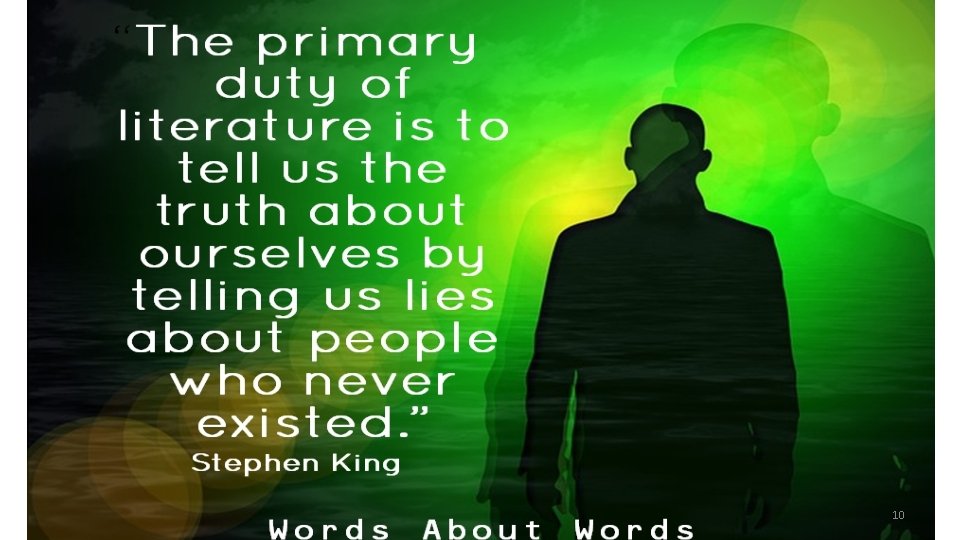
Assignment #1 Choose one of the following slides for Assignment #1 and create your Assertion Journal Class Journal (brainstorm, plan, analyze) due Oct 9/10 (earlier A/B date that you are in this class!) Assertion Journal submitted to Canvas >> due October 14 / 15 (earlier A/B date for you)
10
“The roots of education are bitter, but the fruit is sweet. ” -- Aristotle 11